
Khi bạn chọn các tùy chọn Cardano stake pool, bạn không chỉ chọn một validator - bạn đang đưa ra quyết định ảnh hưởng trực tiếp đến phần thưởng stake, sự phân quyền của mạng lưới và sức khỏe dài hạn của blockchain. Với hàng trăm pool hoạt động đang cạnh tranh để nhận ủy quyền của bạn, việc lựa chọn có thể khiến bạn cảm thấy quá sức. Hướng dẫn này sẽ phân tích chính xác những gì cần được đánh giá để bạn có thể ủy quyền với sự tự tin.
Stake Pool là gì và tại sao lựa chọn của bạn quan trọng?
Pool stake là một node validator được vận hành bởi một nhà điều hành pool stake (SPO) và tạo ra các khối trên mạng Cardano. Khi ủy quyền ADA của bạn cho một pool, bạn thực sự đang nói "Tôi tin tưởng nhà điều hành này có thể vận hành một cơ sở hạ tầng đáng tin cậy và hành động một cách trung thực". Về phần thưởng, bạn sẽ nhận được một phần thưởng của pool tương ứng với số lượng stake của bạn.
Chọn phái đoàn của bạn có ba hậu quả thực tế:
- Điểm thưởng của bạn – Kết quả hoạt động của các bể, phí và độ chật chội đều ảnh hưởng đến lợi nhuận của bạn
Khác với các pool khai thác trong Proof of Work, Proof of Stake của Cardano không yêu cầu bạn khóa tài sản hoặc chạy phần cứng. Bạn vẫn giữ quyền sở hữu hoàn toàn cho ADA của mình – ủy quyền chỉ là một chỉ số trên chuỗi nói rằng "hãy tính số lượng cổ phần của tôi vào quyền sản xuất khối của pool này".
Các chỉ số chính: điều gì thực sự quyết định lợi nhuận của bạn
Trước khi so sánh các quỹ, hãy hiểu bốn số liệu ảnh hưởng đến lợi suất thực tế của bạn.
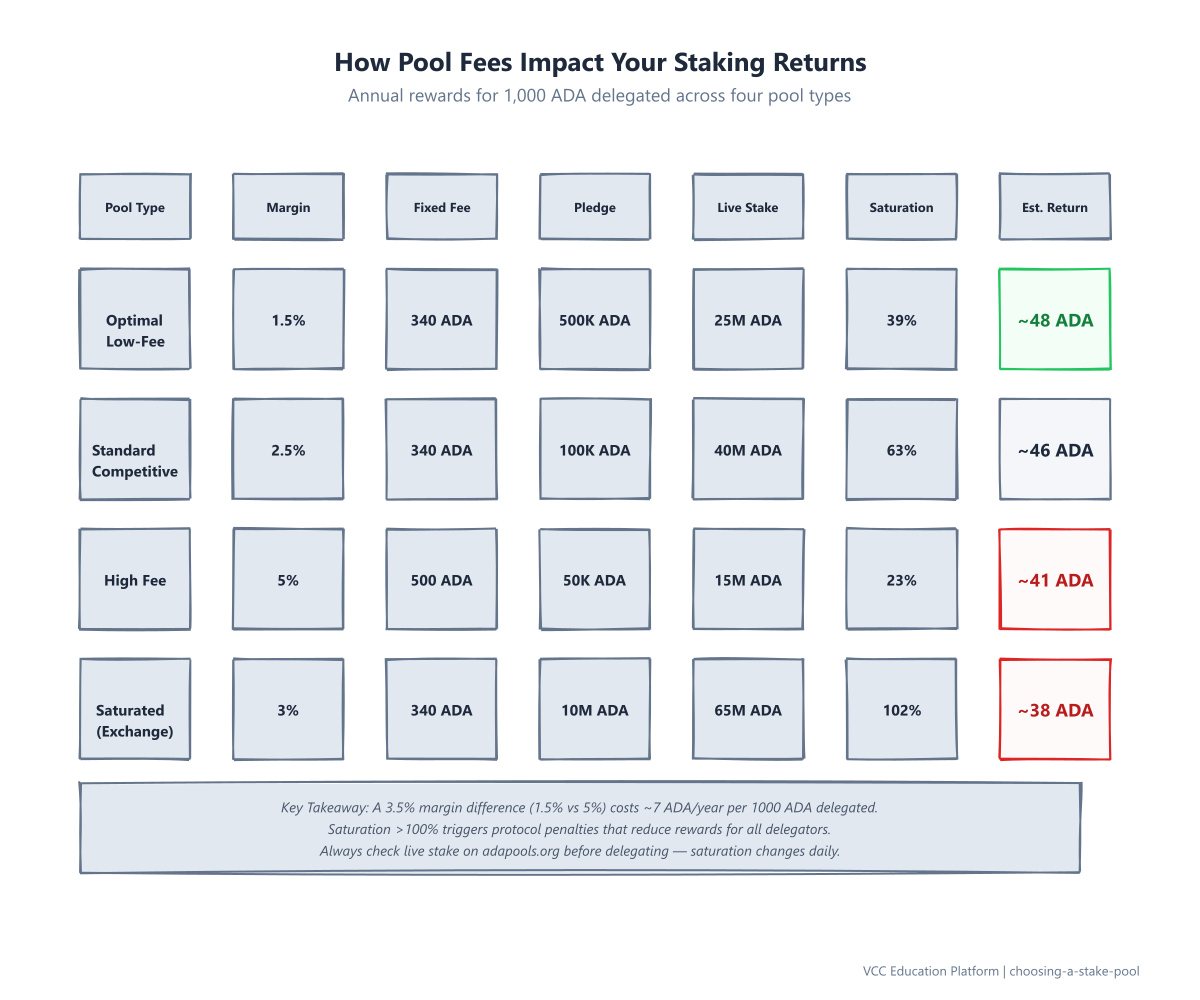
Phần trăm khoản tiền dự trữ (tiền phí thay đổi)
The margin is the percentage of rewards the operator takes after the fixed fee. A 2% margin means the operator keeps 2% of the pool's total rewards, and delegators split the remaining 98%.
| Margin | Công nhân nhận (một phần thưởng 1000 ADA) | Cộng đồng người ủy quyền |
|---|---|---|
| 0% | 0 ADA | 1000 ADA |
| 2% | 20 ADA | 980 ADA |
| 5% | 50 ADA | 950 ADA |
Điều cần xem xét: 1-3% là mức tiêu chuẩn. Dưới 1% có thể chỉ ra hoạt động không bền vững; trên 5% sẽ làm giảm đáng kể lợi nhuận.
Phí cố định (chi phí theo kỳ)
Every pool charges a fixed fee per epoch (5 days), paid from the pool's total rewards before the margin split. The protocol minimum is 340 ADA per epoch.
What to look for: Most competitive pools charge the minimum 340 ADA. Some charge 340–500 ADA. Avoid pools charging significantly more unless they offer clear value (enterprise infrastructure, insurance, etc.).
Sự bão hòa và chức năng mong muốn
Cardano uses a desirability function to discourage over-delegation. Each pool has a saturation point (currently ~64M ADA). As a pool approaches saturation:
- Rewards per ADA delegated decrease linearly
- At 100% saturation, rewards are capped — additional delegators dilute everyone's share
- Over-saturated pools are mathematically suboptimal for delegators
What to look for: Target pools between 10M–50M ADA live stake. Below 1M ADA carries higher variance risk; above 55M ADA approaches saturation penalties.
Return on ADA (ROA) — The Bottom Line
ROA combines all factors into an annualized percentage. A pool advertising "5% ROA" means 1000 ADA delegated earns ~50 ADA/year if the pool performs perfectly.
Reality check: Actual ROA varies epoch-to-epoch due to:
- Block production luck (small pools have higher variance)
- Missed blocks (downtime, configuration errors)
- Fee changes mid-year
KPI: Ngoài những con số được tuyên truyền
Lifetime Blocks Produced vs. Expected
Every pool has an "expected blocks" number based on its active stake. Compare actual blocks produced to expected blocks:
- >95%: Excellent reliability
- 90–95%: Good, minor issues
- <90%: Investigate — could be downtime, relay issues, or operator neglect
Uptime and Infrastructure Quality
A pool that misses slots loses rewards for all delegators. Look for:
- Multiple geographically distributed relays (minimum 2, ideally 3+ across regions)
- Cloud provider diversity (not all on AWS us-east-1)
- Monitoring and alerting (operators who publish uptime stats)
- Disaster recovery (cold standby block producer, tested failover)
Lời hứa: Da trong trò chơi
Pledge is the operator's own ADA committed to the pool. Higher pledge:
- Increases the pool's reward potential slightly (via the
a0parameter) - Signals operator confidence and long-term commitment
- Reduces "rug pull" risk (operators with low pledge can abandon the pool cheaply)
What to look for: Pledge relative to pool size. A 1M ADA pool with 500K pledge (50%) shows stronger commitment than a 50M ADA pool with 100K pledge (0.2%).
The Delegation Decision Framework
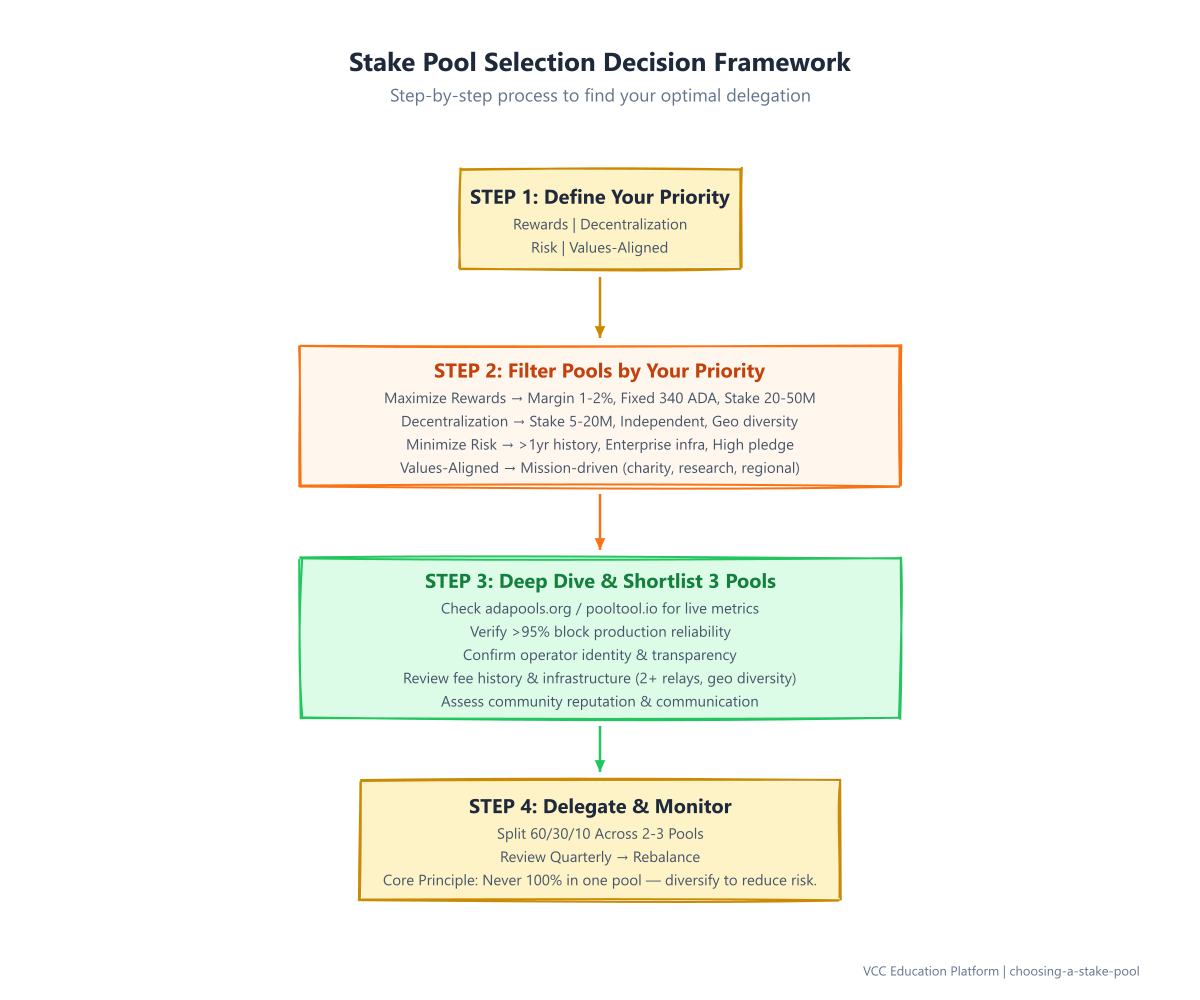
Use this step-by-step filter to narrow hundreds of pools to a shortlist.
Step 1: Eliminate the Obvious Non-Starters
Filter out pools that fail basic hygiene:
- ❌ Margin > 5% or fixed fee > 500 ADA
- ❌ Saturation > 90% (check live stake on adapools.org or pooltool.io)
- ❌ Lifetime performance < 90% (unless very new pool with <6 months history)
- ❌ Single relay or undisclosed infrastructure
- ❌ Anonymous operator with no verifiable identity, website, or community presence
Bước 2: Định nghĩa hồ sơ ưu tiên của bạn
| Priority | Target Pool Characteristics |
|---|---|
| Maximize rewards | Low margin (1–2%), minimum fixed fee, 20M–50M ADA stake, high pledge |
| Support decentralization | Hồ nhỏ/medium (5M–20M ADA), nhà điều hành độc lập, đa dạng về địa lý |
| Minimize risk | Established pool (>1 year), enterprise infrastructure, high pledge, transparent ops |
| Values-aligned | Các cộng đồng được điều hành bởi mục tiêu (phi chính phủ, nghiên cứu, nguồn mở, cộng đồng địa phương) |
Bước 3: Tìm hiểu sâu hơn về 3-5 ứng viên
Đối với mỗi hồ sơ được lựa chọn, kiểm tra:
- Operator identity — Real name, LinkedIn/GitHub, track record in Cardano
- Infrastructure transparency — Relay locations, cloud providers, hardware specs published
- Communication — Active updates on Twitter/Discord/website during outages or upgrades
- Community reputation — Search pool ticker on Cardano Forum, Reddit, Twitter for feedback
- Fee history — Has the operator changed fees frequently? (Check pooltool.io history)
Step 4: Make the Delegation
Delegate via your wallet (Daedalus, Yoroi, Eternl, Lace, etc.). The transaction costs ~0.17 ADA. Your delegation takes effect at the next epoch boundary.
Pro tip: Split delegation across 2–3 pools. This reduces variance, supports decentralization, and protects against single-pool issues.
Tools for Pool Research
| Công cụ | Best For | Key Features |
|---|---|---|
| adapools.org | Overview & comparison | Rankings, saturation alerts, fee history, pledge tracking |
| pooltool.io | Technical deep-dive | Kết quả theo khối, cấu trúc relay, phân tích trận chiến slot |
| cardanoscan.io | On-chain verification | Pool metadata, delegation history, reward accounting |
| Koios API | Programmatic access | REST/GraphQL cho bảng điều khiển tùy chỉnh |
| Daedalus/Yoroi built-in | Quick delegation | Filtered lists, basic metrics, one-click delegate |
Common Mistakes to Avoid
Chasing the Highest Advertised ROA
Pools advertising 6–7%+ ROA often use unsustainable fee structures (0% margin + 340 ADA fixed fee on tiny stake) that collapse once the pool grows. Sustainable ROA is 3.5–5% for most delegators.
Phân quyền cho các nhóm chứa đầy
Large exchanges and famous pools often run saturated. You're subsidizing their brand, not earning optimal rewards. Check live stake before delegating.
Ignoring the Operator
A pool is only as good as its operator. Anonymous operators with no track record can disappear, misconfigure upgrades, or worse — run malicious infrastructure.
Set-and-Forget Forever
Pools change. Operators adjust fees, infrastructure degrades, saturation shifts. Review your delegation every 3–6 months or when you notice reward drops.
Advanced Considerations
Stratégie phân quyền nhiều hồ
Instead of 100% to one pool, consider:
- Primary (60–70%): Established, reliable, low-fee pool
- Secondary (20–30%): Smaller pool supporting decentralization or aligned values
- Tertiary (5–10%): New/emerging pool you want to support (higher risk, higher community impact)
This mirrors institutional portfolio diversification — you're diversifying operator risk, not market risk.
Monitoring Your Delegation
Track these monthly:
- Actual vs. expected rewards (use pooltool.io's delegator view)
- Pool performance alerts (subscribe to operator's announcement channel)
- Saturation changes (set alerts on adapools.org)
Tax Implications
Trong nhiều khu vực pháp lý, phần thưởng staking được coi là thu nhập phải nộp thuế khi nhận được. Hãy lưu trữ các thông tin sau:
Consult a tax professional — this guide doesn't constitute tax advice.
FAQ
How often should I re-evaluate my stake pool?
Mỗi 3-6 tháng hoặc ngay lập tức nếu bạn phát hiện: tỷ lệ thưởng giảm >20%, độ bão hòa của kho bạc thay đổi, người điều hành im lặng hoặc có những thay đổi lớn trong cơ sở hạ tầng.Tôi có thể ủy quyền cho nhiều kho chứa từ một ví tiền điện tử không?
Yes. Most wallets (Daedalus, Yoroi, Eternl, Lace) support multiple delegation addresses or multi-delegation via multiple wallets. Each delegation is a separate on-chain transaction.What happens if my pool gets saturated?
Your rewards per ADA decrease. You can redelegate anytime — the change takes effect at the next epoch boundary. No penalty for switching.Is a higher pledge always better?
Không nhất thiết. Một bể ADA 50M với 100K cam kết (0,2%) ít đáng lo ngại hơn một bể ADA 1M với 10K cam kết (1%). Hãy đánh giá cam kết so với kích thước bể và định danh người điều hành.Tôi có bị mất phần thưởng khi chuyển đổi kho?
No. Rewards are calculated per epoch based on your delegation at the epoch boundary. Switching mid-epoch means you earn from the old pool for that epoch, new pool for subsequent epochs.What's the minimum ADA to delegate?
Technically 1 ADA, but practically 10+ ADA to make transaction fees worthwhile. The 2 ADA deposit for the delegation certificate is refunded when you deregister.Có thể một nhóm khai thác đánh cắp ADA của tôi không?
No. Delegation never transfers custody. Your ADA stays in your wallet. A malicious pool can only affect your rewards (by missing blocks or charging high fees), not your principal.Summary Checklist
- [ ] Primary keyword "choose stake pool cardano" appears in H1, first 100 words, and meta title
- [ ] Pool margin 1–3%, fixed fee at protocol minimum (340 ADA)
- [ ] Live stake between 10M–50M ADA (avoiding saturation)
- [ ] Lifetime block production >95% of expected
- [ ] Operator is identified, transparent, communicative
- [ ] Infrastructure includes 2+ relays in diverse regions
- [ ] Pledge shows meaningful operator commitment
- [ ] Delegation split across 2–3 pools for diversification
- [ ] Review calendar set for 3–6 month check-ins
Choosing a stake pool isn't a one-time decision — it's an ongoing relationship with a network validator. The 30 minutes you spend researching today compounds into better rewards and a healthier Cardano network for years.
Disclaimer: This article is for educational purposes only and does not constitute financial advice. Staking involves risk. Always do your own research and consider consulting a financial advisor.