
Thích hợp của kho chứa cổ phần là một cơ chế chính trong thiết kế proof-of-stake của Cardano, giúp bảo vệ sự phân quyền của mạng bằng cách hạn chế phần thưởng mà một kho chứa có thể nhận được. Khi kho chứa vượt qua điểm thích hợp, quy trình sẽ giảm phần thưởng cho tất cả các người ủy quyền trong kho chứa đó – tạo ra một động lực tự nhiên để phân bổ cổ phần cho nhiều nhà cung cấp độc lập thay vì tập trung vào một số nhà lớn.
Bài viết này sẽ giải thích cách điểm ngập mực hoạt động, tại sao nó quan trọng đối với phần thưởng ADA của bạn và cách chọn các kho chứa giúp bạn duy trì trong khu vực thưởng tối ưu.
Stake Pool Saturation là gì?
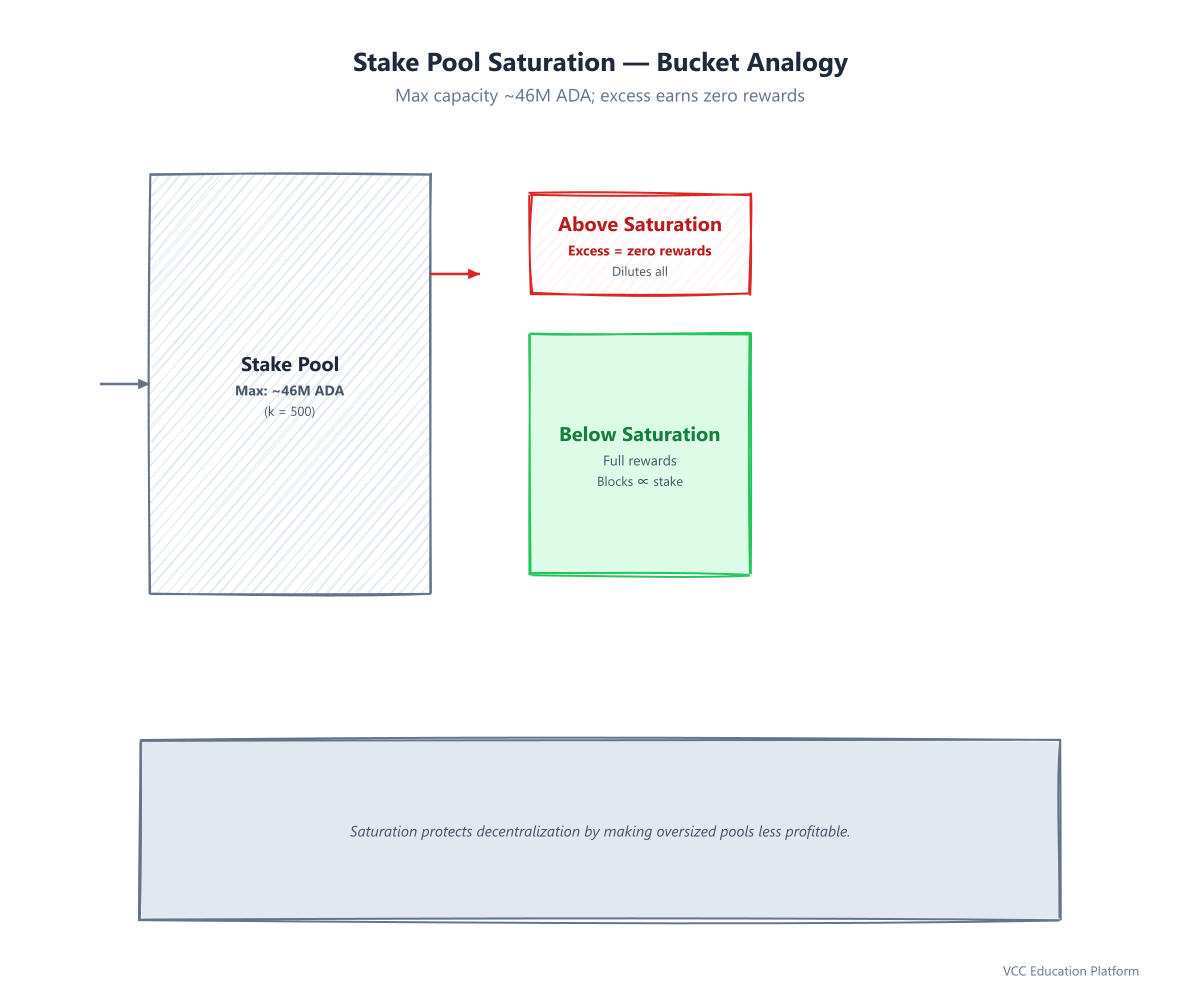
Trong giao thức Ouroboros của Cardano, mỗi nhóm stake có một số stake tối đa hiệu quả được gọi là điểm ngập đầy. Hãy nghĩ về nó như một cái thùng có dung tích cố định – một khi thùng đã đầy, thêm nhiều nước hơn không làm tăng số lượng bạn có thể mang; nó chỉ tràn ra ngoài.
Nguyên tắc ngập tràn được xác định bởi tham số của giao thức được gọi là k (số lượng các kho chứa vốn mong muốn). Công thức đơn giản như sau:
Nguyên tố bão hòa = Tổng ADA được đặt cọc / k
Tính đến năm 2024, với k = 500 và khoảng 23 tỷ ADA được đặt cọc, điểm ngập tràn là 46 triệu ADA cho mỗi nhóm. Số này sẽ tự động điều chỉnh theo sự thay đổi tổng số cọc – nếu có nhiều ADA được ủy quyền, điểm ngập tràn sẽ tăng theo tỷ lệ tương ứng.
Tại sao độ bão hòa tồn tại?
Sự bão hòa không phải là một giới hạn tùy ý – đó là một biện pháp bảo vệ phân quyền. Nếu không có nó, chiến lược hợp lý cho mỗi người sở hữu ADA sẽ là ủy quyền cho nhóm lớn nhất, đáng tin cậy nhất (có thể được điều hành bởi một sàn giao dịch hoặc nhà cung cấp hạ tầng lớn). Kết quả là một số tổ chức sẽ kiểm soát phần lớn sản xuất khối, làm suy yếu an ninh và khả năng chống lại kiểm duyệt mà proof-of-stake mong muốn cung cấp.
By penalizing oversaturated pools, the protocol creates a negative feedback loop:
- A pool grows popular and approaches saturation
- Delegators notice diminishing returns
- Rational delegators move to smaller, unsaturated pools
- Stake redistributes toward the target of
kactive pools
This mechanism is what keeps Cardano's validator set distributed across hundreds of independent operators worldwide rather than concentrated in a few data centers.
The Math Behind Rewards and Saturation
Dưới mức độ bão hòa: Được thưởng đầy đủ
When a pool's total stake is at or below the saturation point, every ADA delegated earns the full protocol reward rate. The pool's performance (block production, uptime) determines the actual yield, but there's no protocol-level penalty.
At Saturation: The Knee of the Curve
Right at the saturation point, the pool is maximally efficient. Adding one more ADA doesn't reduce rewards yet — but the next ADA will.
Above Saturation: Diminishing Returns
Once a pool exceeds the saturation point, the protocol calculates rewards as if the pool were exactly at saturation. The excess stake effectively earns zero additional rewards for the pool operator, but those excess delegators still dilute the reward pool for everyone.
Phương trình thưởng hiệu quả trở thành:
Thu nhập của bạn = (Thu nhập của bạn / min(Thu nhập của cộng đồng, điểm ngập tràn)) × Thu nhập của cộng đồng
Ví dụ: Một pool có 60M ADA được đặt cọc (độ ổn định = 46M ADA). Bạn ủy quyền 100K ADA.
- Không có phạt độ bão hòa: Bạn sẽ nhận được phần thưởng tương ứng với 0,167% phần thưởng của kho.
Wait — that looks better? No. The total pool reward is also capped at what a 46M ADA pool would earn. The 14M ADA of excess stake produces zero blocks but still shares in the fixed reward pie. Everyone's slice shrinks.
Real example: If a saturated 46M ADA pool earns 5% ROA annually, a 60M ADA oversaturated pool might only deliver ~3.8% ROA to all delegators — a 24% reduction in effective yield.
Tính mong muốn: Bảng hướng dẫn của người ủy quyền
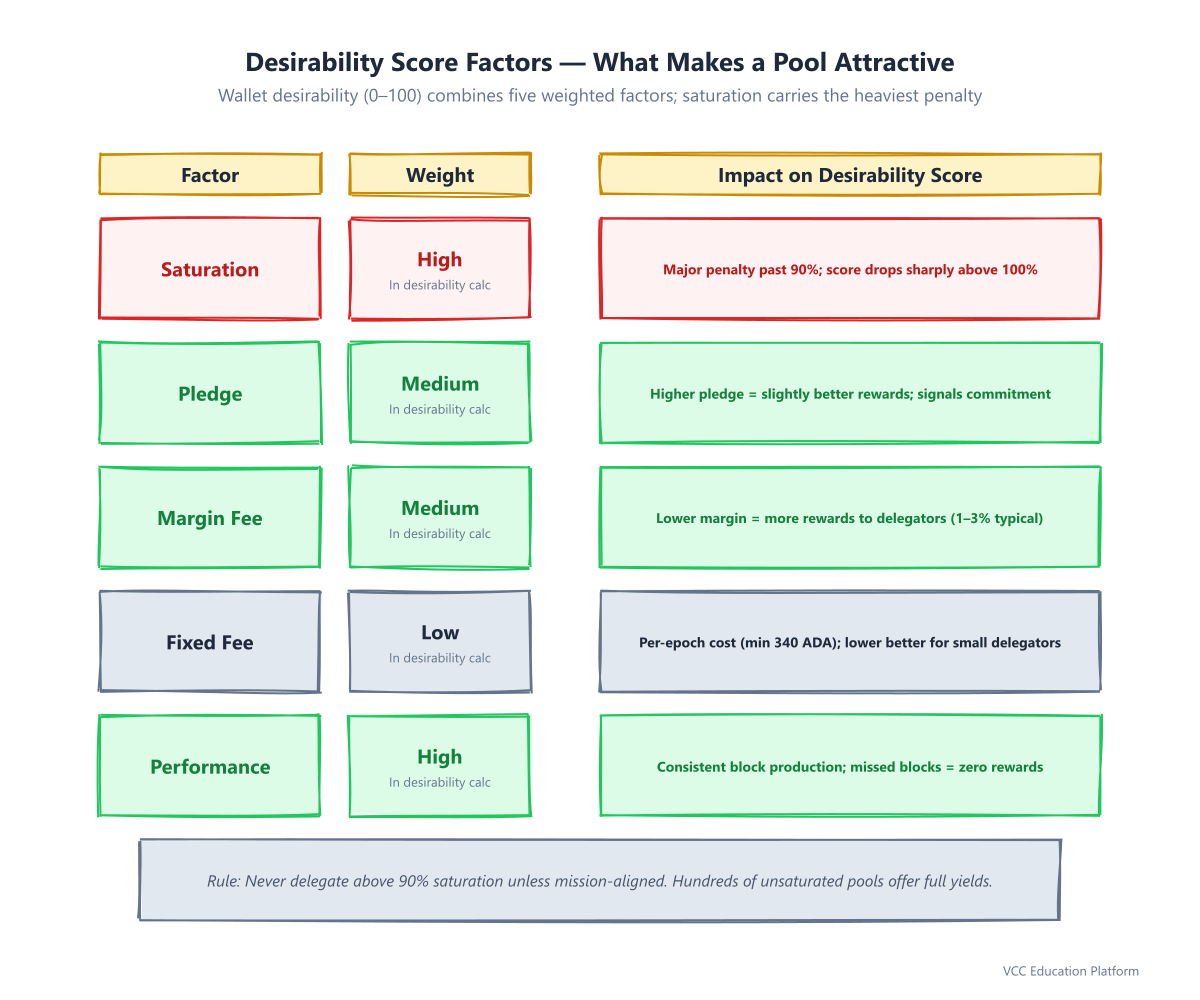
Cardano wallets (Daedalus, Yoroi, Eternl, Lace) display a desirability score for each pool — a 0–100 metric that combines saturation with other factors:
- Saturation (heavily weighted): How close the pool is to its cap
- Pledge: Operator's own skin in the game
- Margin & Fixed Fee: How much the pool takes before delegators
- Performance: Historical block production reliability
- Cost parameters: Fixed cost per epoch (340 ADA minimum)
Desirability drops sharply once a pool passes ~90% saturation. A pool at 95% saturation might show 85 desirability; at 110% it could plummet to 40 or lower.
> Rule of thumb: Never delegate to a pool above 90% saturation unless you have a specific reason (e.g., supporting a mission-aligned operator). The marginal reward loss isn't worth it when hundreds of unsaturated pools offer full yields.
How to Check Pool Saturation
In Your Wallet
Mỗi ví Cardano lớn đều cho thấy độ bão hòa về mặt thị giác:
| Wallet | How to Find It |
|---|---|
| Daedalus | Staking center → Pool list → "Saturation" column (percentage bar) |
| Yoroi | Danh sách đại diện → thẻ nhóm → thước đo "độ bão hòa" |
| Eternl | Stake pools tab → Filter/sort by "Saturation" |
| Lace | Staking → Choose pool → Saturation meter on pool detail |
Look for the percentage — anything above 90% warrants caution; above 100% means you're losing rewards.
Trên Pool Explorers
Các trang web như [adapools.org](https://adapools.org), [pooltool.io](https://pooltool.io) và [cardanoscan.io](https://cardanoscan.io) hiển thị mức độ bão hòa trong thời gian thực với các biểu đồ lịch sử. Những điều này hữu ích cho việc:
- Theo dõi xu hướng bão hòa của một kho chứa trong các thời kỳ
- Xem mức độ gần với giới hạn trước khi phân bổ
- So sánh mức độ bão hòa giữa các kho chứa bạn đang cân nhắc
Tác động thực tiễn đối với các nhà ủy thác
1. Don't Chase the Biggest Pool
The largest pools by stake are often the most saturated. A pool with 100M ADA might have massive brand recognition, but its delegators earn significantly less per ADA than those in a well-run 30M ADA pool.
2. Monitor Your Pool Each Epoch
Saturation changes every epoch (5 days) as:
- Total network stake shifts
- Delegators move in/out
- The
kparameter may change via governance
Kiểm tra độ bão hòa của pool không ít nhất một lần trong mỗi chu kỳ. Pool có độ bão hòa 85% hôm nay có thể đạt 105% trong chu kỳ tiếp theo nếu có một whale ủy quyền.
3. Sử dụng phương pháp phân quyền nhiều hồ (Multi-Pool Delegation)
Cardano allows splitting your stake across multiple pools (via multiple wallets or certain wallet features). This lets you:
- Stay under saturation limits across all positions
- Diversify operator risk (hardware failure, key compromise)
- Support multiple independent SPOs
4. New Pools Need Time
A brand-new pool at 0% saturation offers maximum potential rewards, but it also has:
- No track record of block production
- Risk of missing blocks (lower actual yield)
- Potential for the operator to quit
Balance saturation with performance history — a 6-month-old pool at 40% saturation with 98% block rate often beats a 2-week-old pool at 5% saturation with 70% block rate.
Saturation and the k Parameter: Governance Connection
Kích thước tham số k không được đặt một cách cố định. Nó là một thông số quản trị có thể được điều chỉnh thông qua quản trị chuỗi của Cardano (CIP-1694 / thời kỳ Voltaire).
- Tăng
k→ Nơi ngập lụt thấp hơn → Có nhiều bể nhỏ hơn được khuyến khích
This connects pool saturation directly to ADA holder voting power. When you vote on parameter change proposals, you're indirectly shaping the saturation landscape for years to come.
Common Misconceptions
"Saturated pools don't produce blocks"
Sai. Các pool chật chội chỉ tạo ra các khối, chúng không nhận được các phần thưởng dư cho số stake vượt quá mức chật chội. Thông qua, quy trình vẫn chọn chúng làm các nhà lãnh đạo slot theo tỷ lệ tương ứng với số stake có giới hạn của chúng."Tôi sẽ mất ADA của mình nếu một bể bị ngập"
False. Your principal ADA never leaves your wallet. You only lose potential rewards — the opportunity cost of not delegating to an unsaturated pool."Saturation is the only metric that matters"
False. A pool at 50% saturation with 5% margin, high fixed fees, and 80% block rate will underperform a pool at 85% saturation with 1% margin, low fees, and 99% block rate. Desirability > saturation alone.Hướng dẫn nhanh: cây quyết định độ bão hòa
FAQ
What happens if my pool becomes saturated after I delegate?
Your rewards will decrease starting the next epoch. You don't need to take immediate action, but you should plan to redelegate to an unsaturated pool before the following epoch to avoid continued reduced yields.Can a pool be too small?
Yes. Pools with very low stake (under ~1M ADA) may not be selected as slot leaders every epoch, leading to zero rewards for entire epochs. This creates high variance. Aim for pools with at least 5-10M ADA for consistent block production.Does saturation affect my ability to undelegate?
Không. Bạn có thể hủy ủy quyền hoặc thay đổi nhóm bất kỳ lúc nào. Thay đổi sẽ có hiệu lực tại ranh giới epoch tiếp theo (2 epoch chậm để chuyển hướng phần thưởng).How often does the saturation point change?
Mỗi thời kỳ, lượng ADA được đặt cọc toàn bộ sẽ biến động. Các thay đổi lớn xảy ra khik thay đổi thông qua quản trị hoặc khi số lượng lớn ADA vào/ra khỏi đặt cọc.
What's the difference between saturation and pledge?
Độ bão hòa là giới hạn của quy trình đối với số lượng tổng stake của nhóm (delegators + operator). Đảm bảo là số lượng ADA của operator đã cam kết cho nhóm. Đảm bảo cao hơn có thể làm tăng phần thưởng một chút nhưng không ảnh hưởng đến giới hạn bão hòa.Những điều cần lưu ý
- Stake pool saturation caps effective rewards at ~46M ADA per pool (current
k=500) - Exceeding saturation reduces ROA for all delegators in that pool
- Target pools under 90% saturation for optimal rewards
- Desirability score combines saturation with fees, pledge, and performance
- Check saturation every epoch — it changes as stake flows
- Saturation exists to protect decentralization — it's a feature, not a bug
Understanding saturation puts you ahead of 90% of delegators who simply pick the biggest pool. By choosing unsaturated, well-run pools, you earn better rewards and help keep Cardano decentralized — a rare win-win in crypto.
Next: Learn about [stake pool costs and fee structures](/articles/stake-pool-costs) to complete your pool selection toolkit.