
When the European Investment Bank (EIB) priced a €100 million two-year digital bond on April 27, 2021, it did not just add another line item to its €600 billion balance sheet. It fired a starting gun for the tokenization of sovereign-grade debt. Goldman Sachs, Santander, and Société Générale served as joint lead managers. The bond lived on a private permissioned Ethereum network. Settlement occurred in minutes, not days. Legal finality arrived at block confirmation, not at the end of a T+2 cycle.
Ba năm và ba lần phát hành sau đó, chương trình trái phiếu kỹ thuật số của EIB vẫn là nghiên cứu trường hợp được đề cập nhiều nhất – và được hiểu sai nhất – về việc chuyển đổi thị trường vốn. Bài viết này phân tích những gì thực sự đã xảy ra, tại sao các nhà tổ chức đã xây dựng một khu vườn tường thay vì sử dụng Ethereum công khai, và những gì thí nghiệm này tiết lộ về khoảng cách giữa lời hứa của blockchain và thực tế của thị trường vốn.
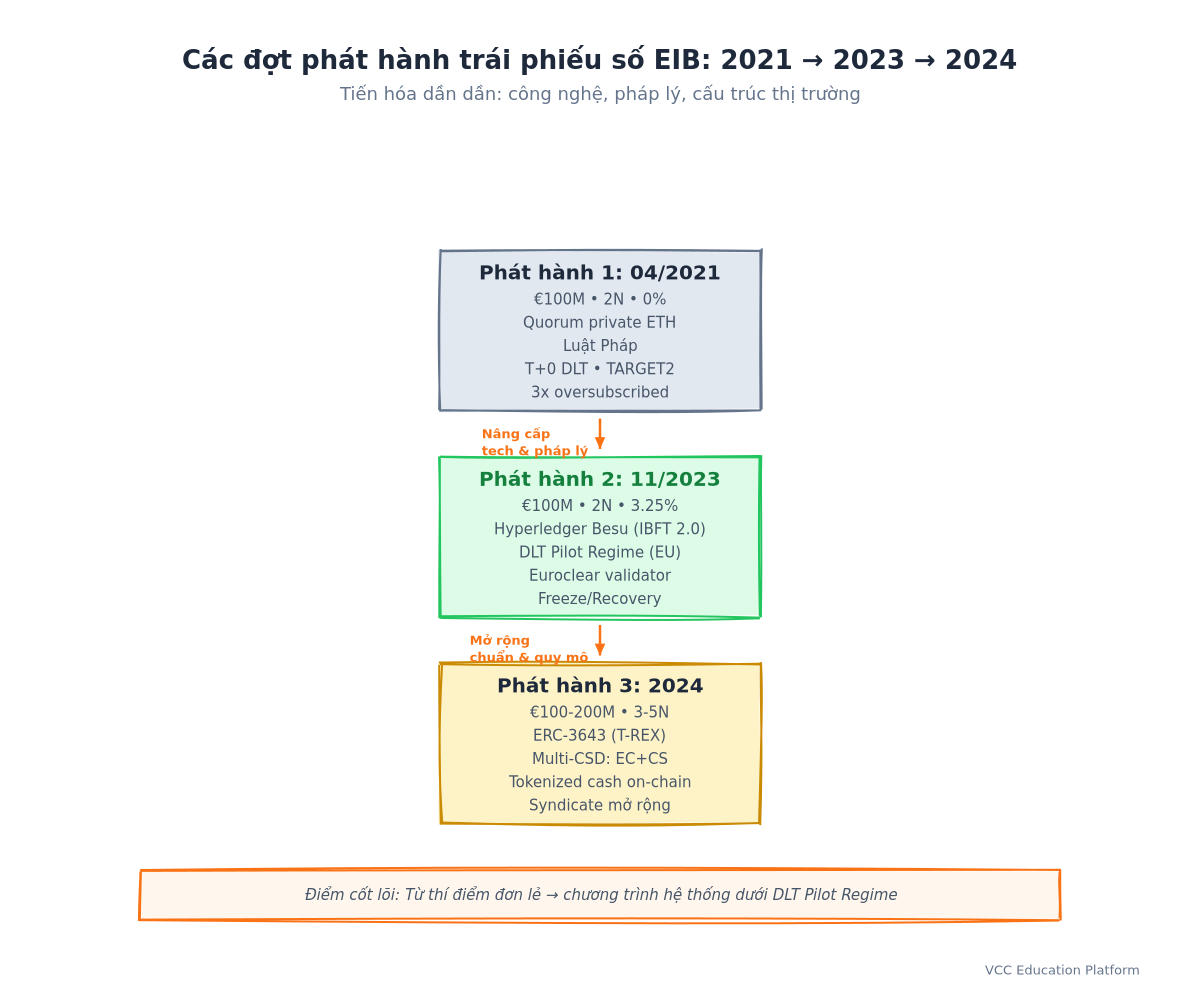
Ba đợt phát hành: Từ thí điểm đến chương trình
Tiền phát hành lần 1: tháng 4 năm 2021 – Đầu tiên trên thế giới
The inaugural €100 million, two-year, zero-coupon digital bond settled on April 28, 2021. EIB chose French law — specifically the 2017 Ordonnance on minibons — which recognizes shared electronic recording systems (DLT) as equivalent to central securities depositories (CSDs). No CSD was required for issuance. Legal finality occurred the moment the bond was recorded on the ledger.
Key parameters:
- Issuer: European Investment Bank (AAA/Aaa/AAA)
- Amount: €100 million
- Tenor: 2 years (maturity April 2023)
- Coupon: 0% (discount issuance)
- Arrangers: Goldman Sachs, Santander, Société Générale
- Technology: Private permissioned Ethereum (Quorum-based, IBFT consensus)
- Settlement: T+0 via DLT, cash leg off-chain via TARGET2
- Investor base: Central banks, sovereign wealth funds, insurers — €300M+ orders for €100M supply
The bond was oversubscribed three times. But the novelty premium masked a structural reality: every investor was a known counterparty, pre-whitelisted, holding through custodians already connected to the permissioned network.
Issuance Two: November 2023 — Under the DLT Pilot Regime
The second €100 million, two-year bond (coupon ~3.25%) launched November 15, 2023 — the first issuance under the EU's DLT Pilot Regime (Regulation 2022/858), which took effect March 2023. The regime grants DLT-based settlement systems CSDR-equivalent legal finality across the EU.
What changed:
- Network: Migrated from Quorum to Hyperledger Besu (IBFT 2.0 consensus)
- CSD integration: Euroclear participated as a validator node, enabling direct DLT-to-DLT settlement
- Regulatory status: Explicit DLT Pilot Regime compliance, not just French law equivalence
- Smart contracts: Enhanced with freeze/recovery functions for regulatory compliance
The DLT Pilot Regime is temporary — it expires in 2028 unless extended. EIB's second issuance effectively stress-tested the regime's legal architecture in production.
Xuất bản lần thứ ba: 2024 – Tăng hạn và nâng cao tiêu chuẩn
The third issuance (size not publicly disclosed, estimated €100–200 million range) extended tenor to 3–5 years and incorporated ERC-3643 (T-REX) compliance features — the emerging standard for permissioned security tokens with on-chain identity, compliance modules, and partition support for multi-jurisdiction distribution.
Evolution markers:
- Multi-CSD connectivity testing (Euroclear + Clearstream)
- Tokenized cash leg exploration (commercial bank money on-chain)
- Broader syndicate beyond the original trio
The Technology Stack: Private Ethereum by Design
Why Not Public Ethereum?
Three words: identity, confidentiality, finality.
Capital markets regulation requires known participants (KYC/AML), trade confidentiality (no front-running), and instant, irreversible finality. Public Ethereum offers none of these natively. Validators are anonymous. State is public. Finality is probabilistic (~15 minutes for high-value transactions).
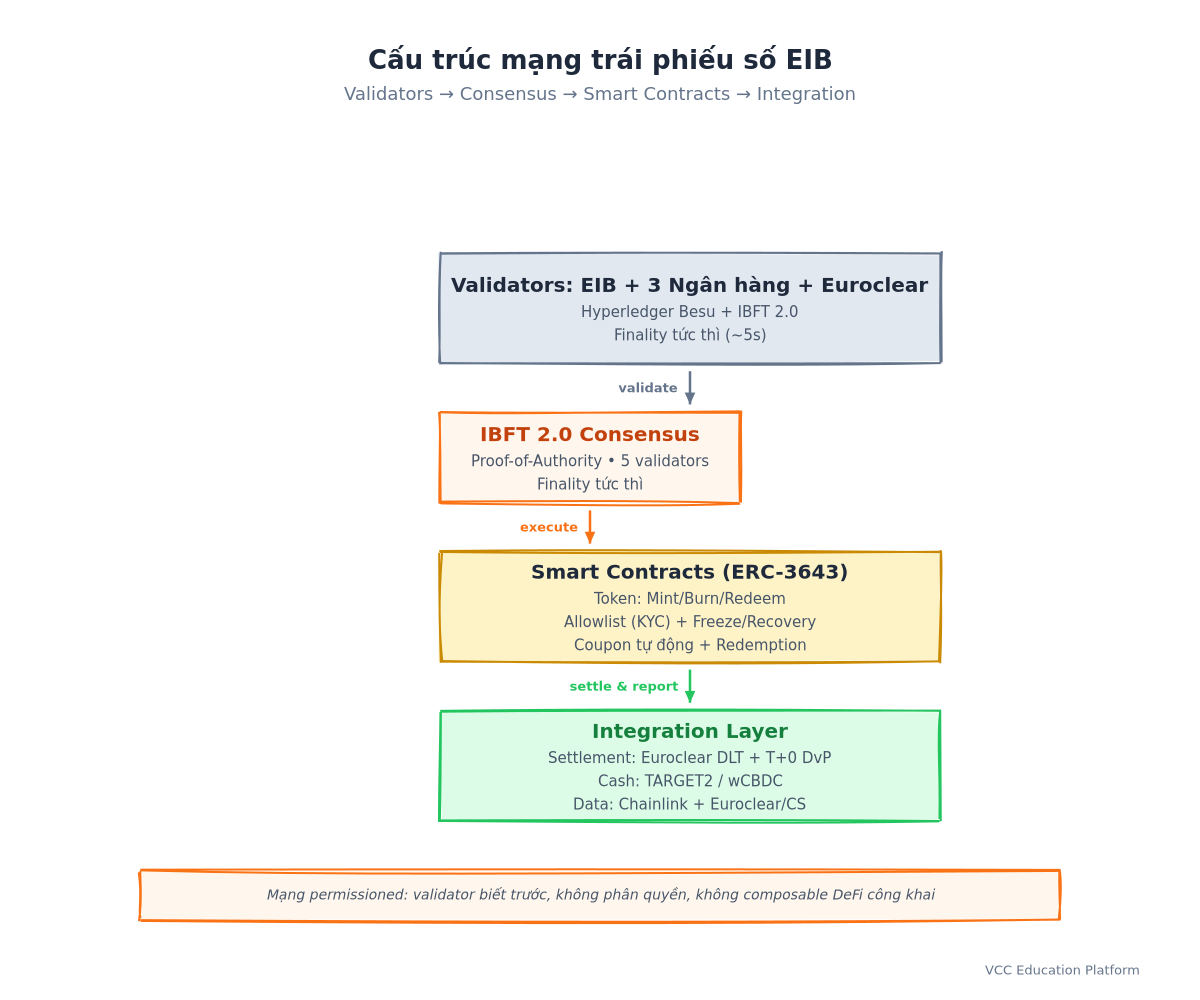
EIB's solution: a permissioned Ethereum network where validators are known, vetted entities — the issuer, the arrangers, and the CSDs.
Kiến trúc mạng
| Bộ phận | Choice | Rationale |
|---|---|---|
| Client | Hyperledger Besu | Enterprise-grade, open-source, Ethereum mainnet compatible |
| Consensus | IBFT 2.0 (PoA) | Kết quả ngay lập tức, không có fork, bộ xác nhận được biết đến |
| Validator | EIB + 3 arrangers + Euroclear | Governance aligned with legal responsibility |
| Block time | ~5 seconds | Sufficient for bond lifecycle events |
| Thông số tiêu chuẩn của token | ERC-20 (custom) → ERC-3643 | Pre-standard; migrating to T-REX for compliance |
Smart Contract Layer
The bond token implements:
- Allowlist: On-chain mapping of verified investor addresses (linked to off-chain KYC)
- Coupon logic: Automated calculation and distribution (though first issuance was zero-coupon)
- Redemption: Automatic principal return at maturity
- Freeze/Recovery: Regulatory compliance — ability to freeze tokens for sanctions, recover lost keys via governance
- Partitions (ERC-3643): Separate compliance rules per jurisdiction
This is not DeFi. There are no liquidity pools, no AMMs, no composability with public protocols. The smart contract is a digital corporate action processor — efficient, auditable, but closed.
Legal Framework: The French-EU Hybrid
French Law: The Enabler
France moved early. The 2017 Ordonnance (Article L.211-3 Code Monétaire et Financier) defines "shared electronic recording systems" and grants them legal equivalence to CSDs. Key provisions:
- Securities can be issued directly on DLT — no CSD intermediary required
- Legal finality at point of DLT entry
- French courts recognize DLT entries as probative evidence of ownership
EIB, as a supranational, can choose its governing law. French law provided the clearest pathway in 2021.
Bộ lớp EU: Hệ thống thử nghiệm DLT
Hệ thống thử nghiệm DLT (Quy định 2022/858) tạo ra một môi trường thử nghiệm trên toàn EU cho các cơ sở hạ tầng thị trường DLT. Nó bao gồm các điều khoản sau:
- Chỉ định tính kết thúc của quá trình thanh toán theo Điều 5/6 của CSDR đối với các hệ thống thanh toán DLT được cấp phép
- Cho phép các CSD vận hành các hệ thống thanh toán DLT (thử nghiệm của Euroclear)
- Cho phép miễn trừ tạm thời một số yêu cầu của MiFID II/CSDR
- Hết hiệu lực vào tháng 3 năm 2028 – một điều khoản "hết hạn" gây ra sự không chắc chắn về quy định
Cuộc phát hành thứ hai của EIB là thử nghiệm lớn đầu tiên của chế độ này. Sự kết thúc pháp lý của trái phiếu hiện dựa trên cả luật pháp Pháp và chế độ của EU – một điểm cố định kép.
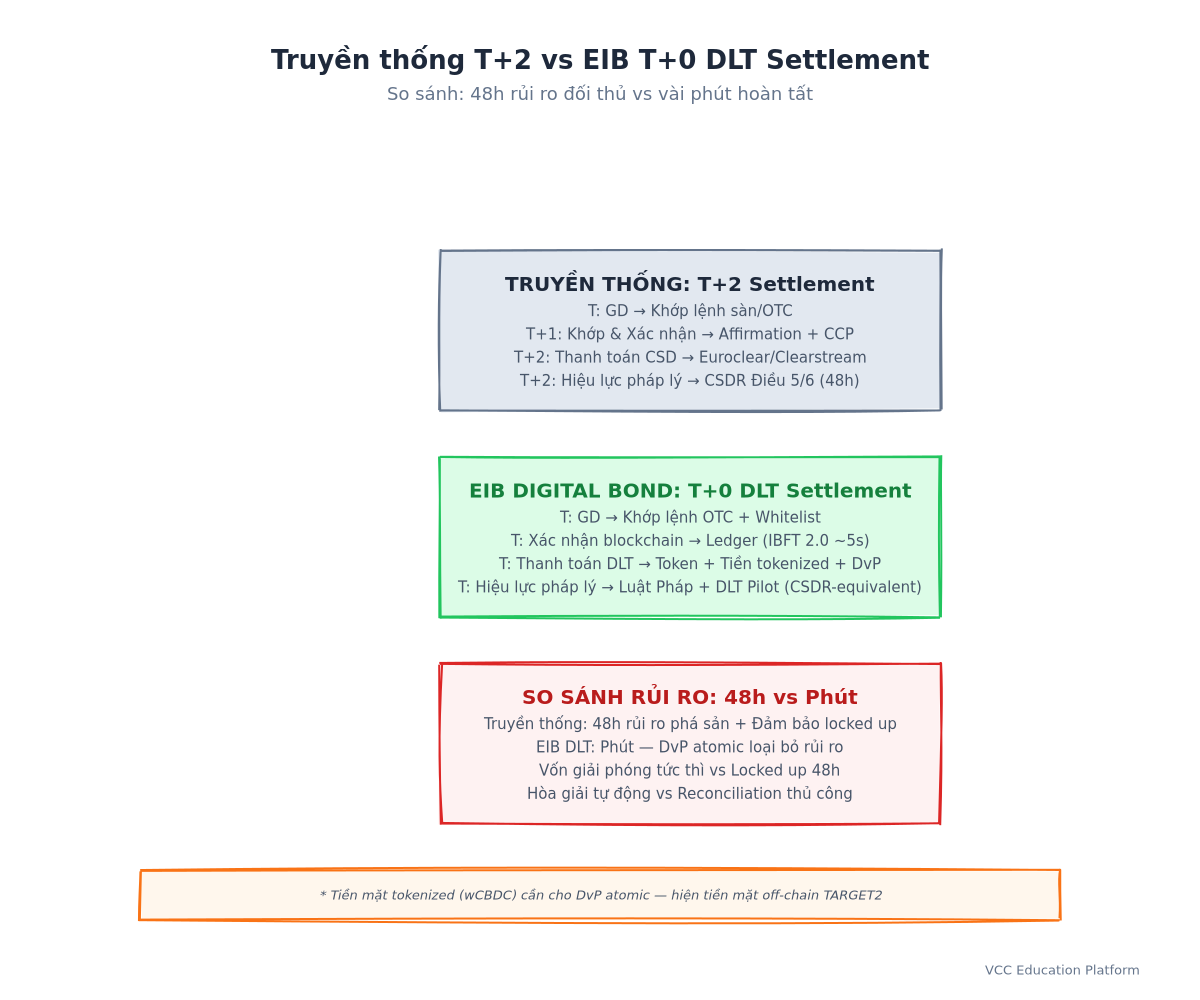
Settlement Finality: T+0 vs T+2
Thanh toán trái phiếu truyền thống: Ngày giao dịch (T) → phù hợp → thanh toán → thanh toán tại CSD (T+2). Hai ngày rủi ro đối tác, khóa tài sản thế chấp, sự khác biệt trong việc xác nhận.
Tài sản số của EIB: Thương mại → xác nhận khối → hoàn tất. Chỉ trong vài phút, không phải vài ngày.
Nhưng: phần tiền mặt vẫn chủ yếu nằm ngoài chuỗi (TARGET2 hoặc chuyển khoản ngân hàng thương mại). Để thực hiện giao dịch thanh toán thực tế (DvP) trên chuỗi, cần có tiền mặt được mã hóa – đồng tiền điện tử của ngân hàng trung ương (CBDC) hoặc các khoản gửi tiết kiệm của ngân hàng thương mại được mã hóa. Các thí nghiệm CBDC bán lẻ của Eurosystem và các thử nghiệm thanh toán DLT của ECB là phần còn thiếu.
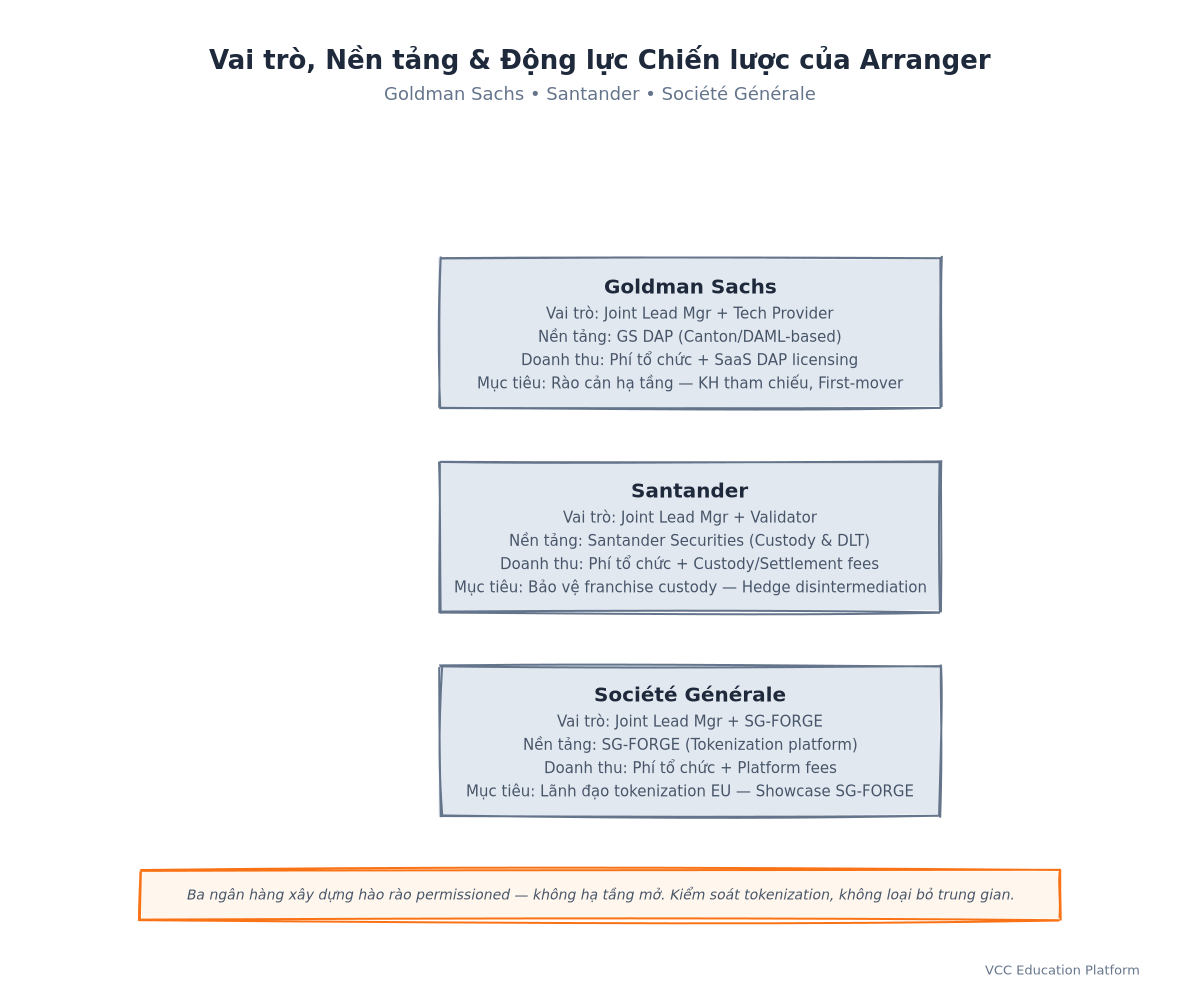
Sách hướng dẫn của các nhà tổ chức: Tại sao là Goldman, Santander, SocGen?
Goldman Sachs: Platform hơn sản phẩm
Goldman's Digital Asset Platform (DAP) — built on Canton (formerly DAML) but interoperable with Ethereum — powered the issuance workflow. For Goldman, the €100M bond was a reference client for DAP. The revenue isn't the arrangement fee (basis points on €100M). It's the platform licensing fees from future issuers who want "the EIB infrastructure."
Santander: Quyền ủy thác và thanh toán
Santander Securities Services vận hành một dịch vụ lưu trữ và thanh toán trên toàn châu Âu. Việc điều hành một nút xác thực cho phép họ hoạt động linh hoạt với thanh toán bằng DLT – điều rất quan trọng khi Euroclear và Clearstream xây dựng các đường ray DLT riêng của họ. Santander đang phòng tránh sự mất trung gian bằng cách trở thành một phần của cơ sở hạ tầng mới.
Société Générale: Trang giới thiệu SG-FORGE
Token hóa tài sản cho khách hàng của SocGen bằng nền tảng SG-FORGE (tiêu chuẩn xanh, quỹ, tín chỉ carbon). Chứng khoán của EIB đã xác nhận khả năng của SG-FORGE trong việc phát hành các loại chứng khoán trên quy mô quốc tế. Trong tài liệu giới thiệu, mỗi khách hàng tiếp theo của SG-FORGE đều được "sử dụng công nghệ tương tự như EIB".
Hiệu ứng tập thể: đổi mới được kiểm soát
Không một trong ba nhà tổ chức nào muốn một thị trường vốn không cần giấy phép, không có trung gian. Họ muốn một quá trình token hóa có giấy phép – nơi họ vẫn là những người giữ chìa khóa, người xác nhận và nhà cung cấp nền tảng. Chứng khoán trái phiếu EIB là một dự án liên minh mạo danh là một phát hành.
Thực tế của nhà đầu tư: Được đăng ký quá số nhưng không có tính thanh khoản
Ai đã mua?
- Central banks: Reserve managers testing DLT operations
- Soverealth wealth funds: Long-term holders, no trading intent
- Insurers: Matching long-duration liabilities, regulatory capital benefits
- Notable absence: Hedge funds, high-frequency traders, retail platforms
The Liquidity Mirage
Three issuances. Zero secondary market trades reported publicly.
Why? Three barriers:
- Custody fragmentation: Only Euroclear (and recently Clearstream) support DLT securities. Most custodians cannot hold them.
- Whitelisting friction: Every transfer requires KYC re-verification. No standardised investor passport.
- No venue: No multilateral trading facility (MTF) for DLT bonds. Trades are bilateral, OTC, wide spreads.
Người đầu tư mua để giữ. Tiện ích "thanh toán T+0" chỉ là lý thuyết đối với các danh mục đầu tư mua và giữ – nó quan trọng cho thị trường giao dịch, chứ không phải đầu tư.
Các chủ đề phản hồi của nhà đầu tư (từ các khảo sát ngành)
| Pain Point | Frequency |
|---|---|
| Custody limitations | 85% |
| Tax/accounting uncertainty | 72% |
| Secondary market access | 68% |
| Hướng dẫn sử dụng theo mạng | 61% |
| Regulatory horizon (2028 cliff) | 54% |
Positive notes: Settlement certainty, operational transparency, straight-through processing. But these are operational improvements, not portfolio improvements.
The Permissioned Paradox
EIB proved you can issue a bond on blockchain. It also proved that doing so requires removing everything that makes blockchain distinctive.
| Hứa hẹn của Blockchain | Xây dựng EIB |
|---|---|
| Truy cập không cần sự cho phép | Whitelisted investors only |
| Khả năng kiểm chứng công khai | Danh sách validator riêng, payload được mã hóa |
| Censorship resistance | Freeze/recovery at validator discretion |
| Composability | Closed network, no external contracts |
| Trust minimization | Yêu cầu tin cậy từ các nhà xác nhận đã được biết đến (EIB + các ngân hàng) |
Kết quả là một bảng dữ liệu phân tán có tính pháp lý cuối cùng – có giá trị, nhưng không mang tính thay đổi. Nó giảm rủi ro thanh toán và chi phí hoạt động. Nó không tạo ra các loại tài sản mới, cơ sở nhà đầu tư mới hoặc các nguyên tắc tài chính mới.
The Interoperability Trap
Each permissioned network (EIB, SG-FORGE, DAP, Canton, Polygon permissioned) is an island. Moving assets between them requires bridging — reintroducing the counterparty risk and operational friction the networks were built to eliminate. The industry is building "walled gardens with drawbridges."
Vietnam Context: Leapfrog or Lag?
Vietnam's Bond Market Today
- Government bonds: ~$80B outstanding, primary dealer system, VSD (Vietnam Securities Depository) as sole CSD
- Corporate bonds: ~$40B, retail-dominated, limited secondary liquidity
- New Securities Law (2019, amended 2024): Provisions for digital securities, electronic registration
- State Securities Commission (SSC): Actively consulting on digital asset framework
Could Vietnam Adopt the EIB Model?
Có – với những thay đổi:
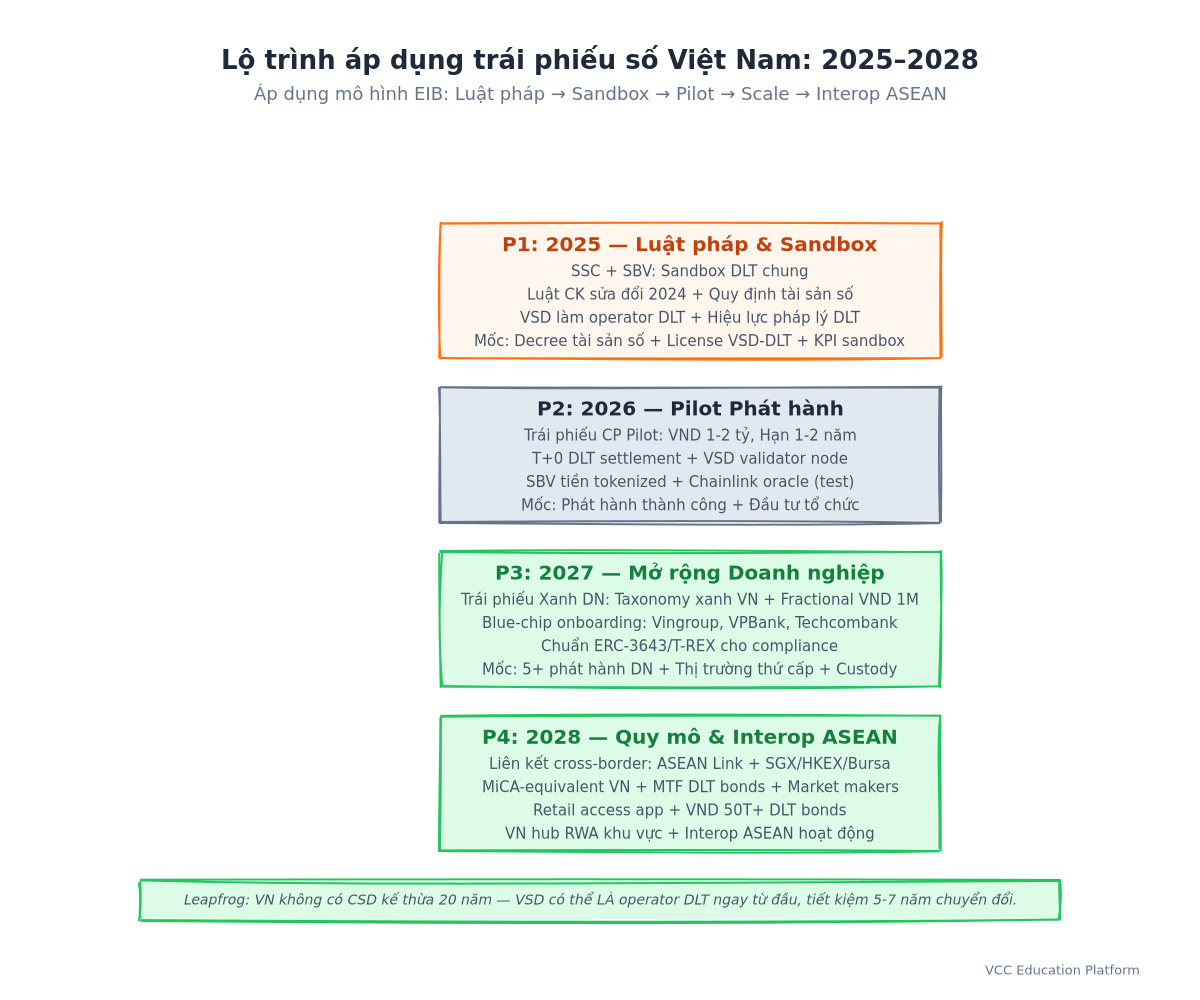
- Chương trình thử nghiệm của chính phủ: Bộ Tài chính có thể phát hành chứng khoán T số trên một chuỗi được phép với VSD làm validator, SBV (Ngân hàng Nhà nước) làm đại lý thanh toán bằng tiền mặt. Cơ sở pháp lý: Luật Chứng khoán được sửa đổi + Quyết định về tài sản số.
- Tài sản xanh của các công ty: Taxonomy xanh của Việt Nam + tokenization = các trái phiếu xanh phân chia cho thị trường tiêu dùng. Cấu trúc trái phiếu về nhận thức về bền vững của EIB được chuyển đổi trực tiếp.
- Sandbox quy định: Sandbox chung của SSC và SBV dành cho chứng khoán DLT (giống như mô hình thử nghiệm DLT của EU). Điều này tránh được nguy cơ "chờ đợi quy định hoàn hảo".
Ưu điểm so với EIB:
- Không có CSD cũ để loại bỏ trung gian – VSD có thể là nhà điều hành DLT
Risks:
- Legal framework untested in Vietnamese courts
- Custody infrastructure: VSD is sole CSD; no Euroclear equivalent
- Investor education: Retail investors need protection frameworks
What Comes Next: The 2028 Cliff and Beyond
Thời hạn kết thúc của chương trình DLT Pilot
Tháng 3 năm 2028: Hệ thống của EU sẽ hết hiệu lực trừ khi được kéo dài hoặc làm cho nó trở thành vĩnh viễn. Ba kịch bản:
- Tiếp tục mở rộng: Tình trạng hiện tại tiếp tục, thêm nhiều dự án thử nghiệm, sự chuẩn hóa chậm chạp
EIB's third issuance (ERC-3643, multi-CSD) is a bet on Scenario 2.
The Real Catalyst: Tokenized Cash
T+0 settlement for securities requires T+0 settlement for cash. Wholesale CBDC (ECB digital euro for institutions) or tokenized commercial bank deposits (JPM Coin, Fnality, Partior) are the enablers. When cash moves at block speed, DvP becomes atomic — the true promise of DLT settlement.
Standardization War: ERC-3643 vs Canton vs Proprietary
- ERC-3643 (T-REX): Ethereum-native, open standard, growing ecosystem (Tokeny, Archax, etc.)
- Canton (DAML): Multi-ledger, privacy-first, backed by Goldman, Deutsche Börse, SIX
- Proprietary: SG-FORGE, DAP, others — vendor lock-in by design
Thị trường sẽ bị phân mảnh cho đến khi các cơ quan quản lý yêu cầu khả năng tương tác (như họ đã làm với SEPA trong lĩnh vực thanh toán).
Key Takeaways for Capital Markets Professionals
- Tokenization works technically — EIB proved T+0 DLT settlement at supranational scale
- Legal finality is solvable — French law + DLT Pilot = dual anchor; other jurisdictions can replicate
- Banks are building moats, not bridges — Permissioned networks entrench incumbents
- Liquidity requires infrastructure — Custody, venues, tax harmonization matter more than smart contracts
- The 2028 deadline is the forcing function — EU regulators must decide: extend, codify, or abandon
For Vietnam: The window is open. The EIB model — supranational issuer, permissioned Ethereum, French law anchor, DLT Pilot regime — is a template. Adapt the law, empower VSD as DLT operator, pilot with government paper. Don't wait for the EU to finish.
FAQ
Câu hỏi: Vốn trái phiếu kỹ thuật số của EIB là một tài sản "công nghệ" không? A: Không. Đây là một chứng khoán được quản lý (quy định pháp luật Pháp, quy định Prospekt của EU) mà lại sử dụng DLT cho việc đăng ký và thanh toán. Không có blockchain công khai, không có chủ sở hữu bí mật, không có khả năng kết hợp DeFi.
Câu hỏi: Tôi có thể mua trái phiếu số EIB như một nhà đầu tư cá nhân không?
Câu hỏi: Nếu chế độ thử nghiệm DLT hết hạn vào năm 2028 thì sẽ xảy ra điều gì? A: Các trái phiếu được phát hành theo chế độ này vẫn giữ nguyên tính pháp lý cuối cùng (quy chế cha truyền con nối). Các phát hành mới sẽ cần cơ sở pháp lý thay thế - có thể là luật quốc gia (Pháp, Đức) hoặc một chế độ của EU lâu dài.
Q: How does this differ from Project Canton or Fnality? A: Canton/Fnality focus on interbank settlement (cash + securities between institutions). EIB focuses on issuance-to-investor lifecycle. They're complementary — Canton could settle the cash leg of an EIB-style bond.
Q: What is ERC-3643 and why does it matter? A: ERC-3643 (T-REX) is an Ethereum standard for permissioned security tokens with on-chain identity, compliance modules, and jurisdiction partitions. It's becoming the de facto standard for regulated tokenization in Europe.
Q: Could this work for Vietnamese corporate bonds? A: Yes. The legal template exists (VN Securities Law amendments). The technology is proven. The gap is custody infrastructure and investor onboarding standards. A pilot with a VN blue-chip issuer (Vingroup, Masan, VPBank) could demonstrate the model.
Word count: ~2,150
Primary keyword: EIB digital bonds (H1, first 100 words, meta title) Secondary keywords: Goldman Sachs, Santander, Societe Generale, CSDR, private permissioned chain (woven into H2s, body, FAQ)