
Khi hầu hết mọi người nghe "tokenized commodities", họ nghĩ ngay đến vàng. PAXG, XAUt, và hàng chục token backed by gold khác thống trị cuộc trò chuyện. Nhưng vàng chỉ là khởi đầu. Một cuộc cách mạng âm thầm đang diễn ra trên silver, oil, electricity, uranium, và base metals — mỗi loại đều có physics, economics, và regulatory maze riêng.
Bài viết này vẽ bản đồ tokenized commodities ngoài vàng. Chúng ta sẽ hiểu tại sao silver tokenization (KAG) hoạt động khác gold, tại sao oil tokenization vẫn chủ yếu institutional, tại sao "electricity tokenization" thực chất là certificates chứ không phải electrons, và tại sao uranium (U3O8) đối mặt nuclear licensing wall mà commodity nào cũng không gặp. Đây là bức tranh toàn cảnh để bạn hiểu rõ cơ hội và rủi ro. Mỗi commodity có profile riêng, không có one-size-fits-all.
Redemption Gradient: Tại Sao Một Số Commodities Tokenize Tốt Hơn
Trước khi đi sâu từng commodity, cần một framework. Single biggest predictor của tokenization success không phải blockchain technology — là redemption logistics. Concept này đơn giản nhưng powerful: nếu bạn không thể redeem physical, token chỉ là synthetic claim. Gradient này explain tại sao gold/silver lead mà uranium lag. Redemption ease directly correlates với tokenization maturity. This framework predicts adoption timeline across commodities. Gradient analysis applies beyond commodities to any tokenized asset.
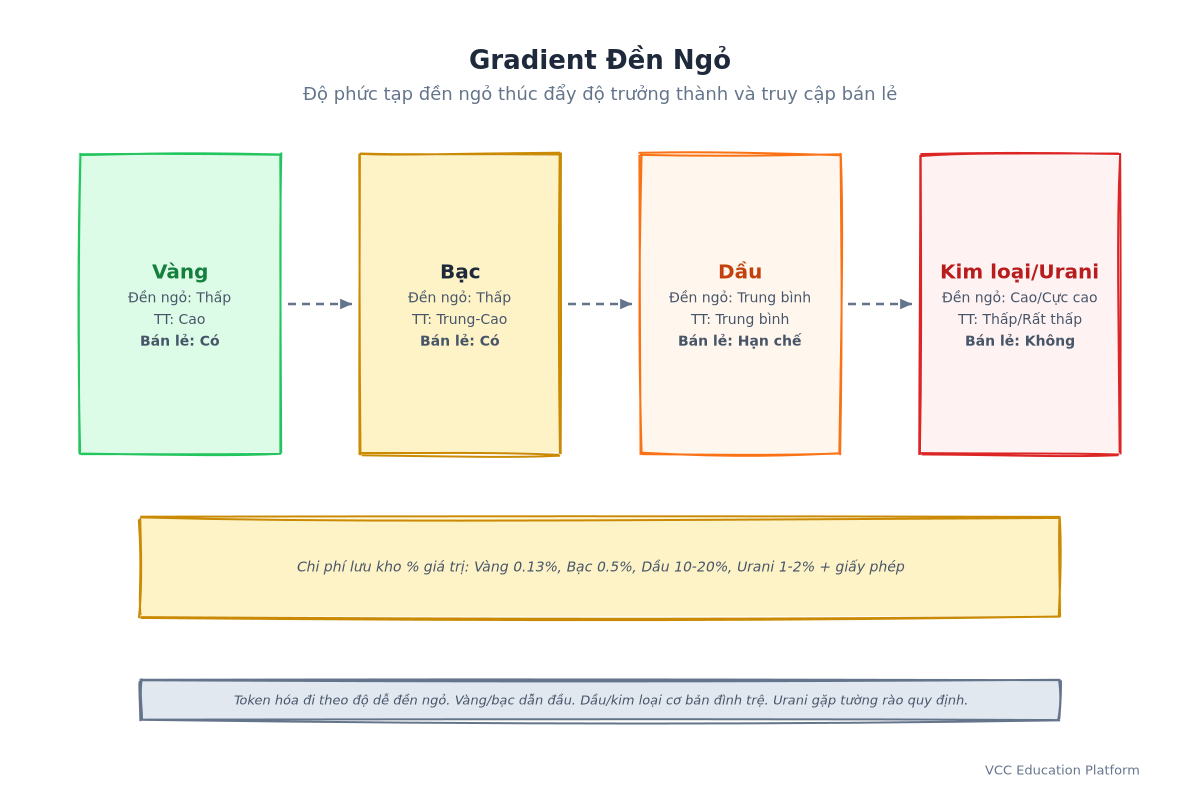
Gold và silver ở đầu dễ dàng. Bạn store bars trong LBMA vault. Khi token holder muốn physical metal, vault ships it. Infrastructure 400 năm tuổi. Oil cần terminal access — không thể deliver barrel đến phòng khách. Base metals cần warehouse networks với quality assays cho từng grade. Uranium đòi hỏi nuclear materials license từ government regulator.
Redemption gradient này giải thích adoption pattern ngày nay:
| Commodity | Redemption Complexity | Tokenization Maturity | Retail Access |
|---|---|---|---|
| Gold | Low (established vault network) | High | Yes |
| Silver | Low (same vaults as gold) | Medium-High | Yes |
| Oil | Medium (terminal infrastructure) | Medium (institutional) | Limited |
| Base Metals | High (grade specs, warehouse network) | Low-Medium | Very Limited |
| Uranium | Extreme (nuclear license) | Very Low | None |
| Electricity | N/A (certificates, not physical) | Medium (RECs/PPAs) | Yes |
Pattern rõ ràng: harder the redemption, slower the tokenization. Nhưng mỗi commodity cũng có unique dynamics. Hiểu gradient này giúp nhà đầu tư định vị đúng kỳ vọng. Redemption ease là gating factor cho adoption.
Silver Tokenization: KAG và Yield Innovation
Silver tokenization trông giống gold tokenization at first glance. Cả hai dùng LBMA vaults. Cả hai issue tokens representing allocated ounces. Nhưng silver có hai twists thay đổi economics hoàn toàn. Density và industrial demand tạo ra dynamics khác biệt so với gold. Silver's dual role as monetary và industrial metal tạo unique tokenization case. Industrial demand provides floor cho token value. Dual-use nature differentiates silver từ pure monetary assets. Industrial consumption provides natural token burn mechanism.
KAG: Kinesis Silver Token
KAG (Kinesis Silver) là established silver token nhất. 1 KAG = 1 troy ounce 999.9 fine silver, stored in Brink's, Loomis, Malca-Amit vaults across London, Zurich, Singapore, New York. Quarterly attestations by Bureau Veritas verify backing.
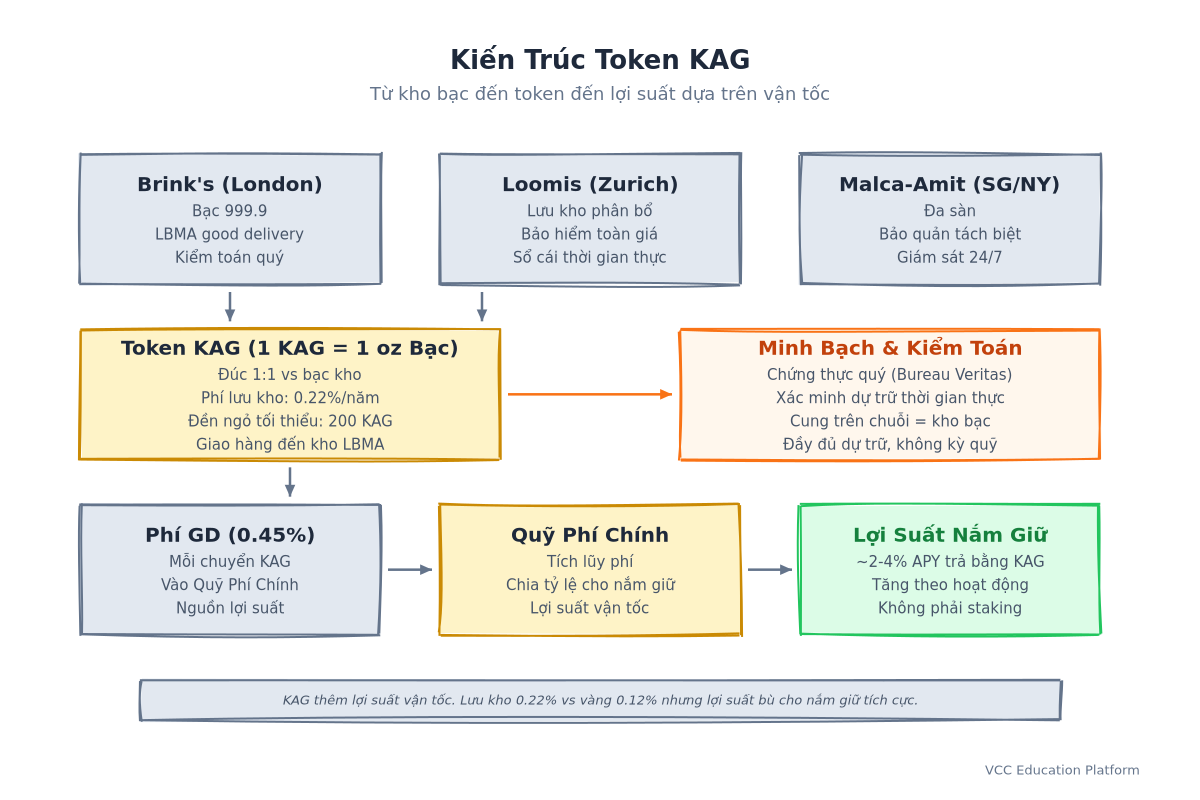
Khác biệt KAG so với gold tokens là yield mechanism. Mọi KAG transaction có 0.45% fee. Phần fee vào "Master Fee Pool" và redistribute cho KAG holders proportionally. 2023-2024: ~2-4% APY tùy transaction volume — genuine yield trên non-interest-bearing asset.
Đây không phải staking hay lending. Là velocity-based yield: token circulates nhiều hơn, holders earn nhiều hơn. Gold tokens như PAXG không có này; chỉ là pure custody plays. Velocity-based yield align incentives giữa holders và platform. Master Fee Pool mechanism tự sustainable, không cần external yield source. Fee redistribution creates organic yield loop. Sustainable yield mechanism không rely on token emissions. Fee-based yield aligns platform success với holder returns.
Storage Cost: Silver's Hidden Drag
Silver density (10.5 g/cm³ vs gold 19.3 g/cm³) → cần ~1.8x vault space per dollar value. Storage fees reflect this:
- Gold: ~0.12-0.15%/year of value
- Silver (KAG): ~0.22%/year of value (Kinesis) to 0.5%+ (other providers)
At silver's lower price/ounce, 0.22% là higher percentage of asset value than gold's 0.12%. Over 10 years, storage eats ~2.2% silver value vs ~1.2% gold. For long-term holders, this matters.
Redemption Thresholds
KAG cho phép physical redemption từ 200 KAG (200 troy ounces ≈ 6.2 kg). Delivery đến LBMA vault hoặc designated location. Smaller holders sell on secondary markets (Kinesis Exchange, Uniswap via Polygon/Ethereum bridges) nhưng không thể take physical delivery.
Key insight: Silver tokenization works vì vault infrastructure đã exist. Innovation là financial (yield), không phải logistical. Điều này làm KAG trở thành case study điển hình cho tokenization layer-2 trên infra có sẵn. Yield từ velocity là innovation độc đáo.
Oil Tokenization: Vakt, Komgo, Institutional Wall
Oil là most traded commodity globally. Mong đợi tokenization massive. Thực tế: almost entirely institutional. Retail participation bị chặn bởi physics của oil storage và delivery. Terminal infrastructure là natural moat cho institutional players. Physical delivery requirement creates high barrier to entry. Terminal access adalah natural moat. Physical infrastructure creates defensible competitive position.
Vakt: Energy Post-Trade Platform
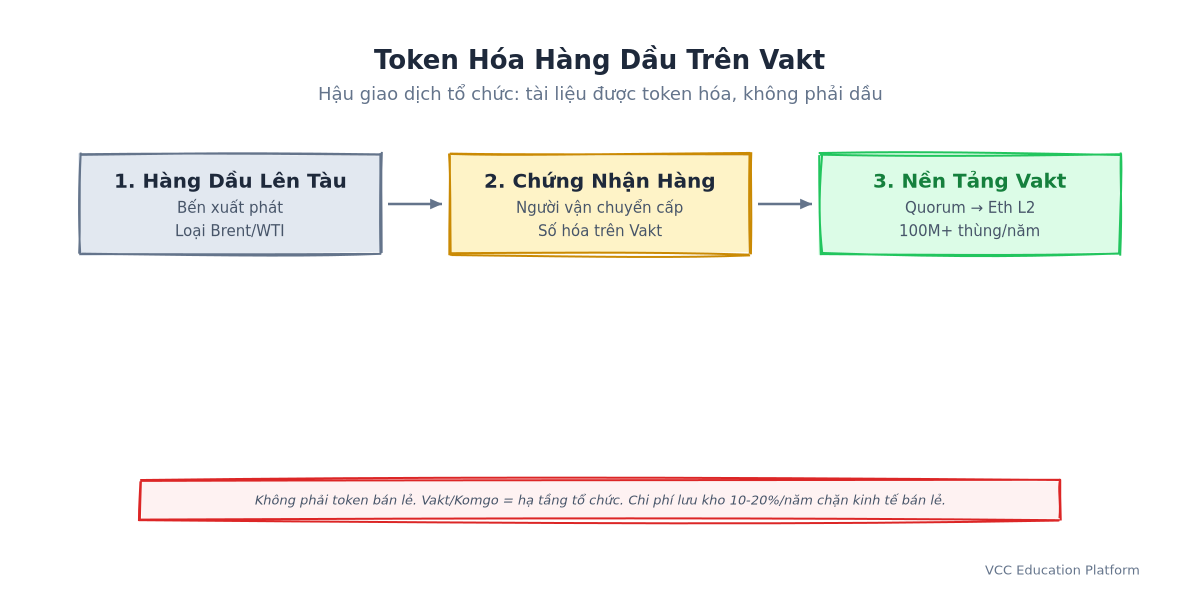
Vakt (backed by BP, Shell, Equinor, Gunvor, Mercuria, Koch) không phải retail token. Là blockchain-based post-trade platform cho energy commodities. Built on Quorum (permissioned Ethereum), processes bills of lading, letters of credit, inspection certificates, title transfer cho crude oil và refined products.
Volume: 100M+ barrels oil equivalent annually (2023).
What gets tokenized: Not oil itself, but documents and rights around oil cargoes. Vakt "token" = digital bill of lading hoặc letter of credit — paperwork proving ownership và enabling financing. Platform này digitize trade flow, không create new financial product.
Komgo: Trade Finance, Not Commodity Tokens
Komgo focus financing layer. Tokenizes KYC credentials, trade finance documents, warehouse receipts. Partners: BNP Paribas, Citibank, ING, Macquarie, MUFG, Société Générale. Volume: $10B+ trade finance facilitated.
Vakt và Komgo đều không issue tokens mua được trên Uniswap. Chúng là infrastructure for institutions, replacing paper/PDFs với shared ledgers.
Why No Retail Oil Tokens?
Ba rào cản:
- Physical Delivery: Oil cần tank storage tại specific terminals (Rotterdam, Houston, Fujairah, Singapore). Retail investors can't take delivery.
- Quality Specs: Brent, WTI, Dubai, Urals — mỗi grade trades differently. "Barrel token" cần grade specification.
- Regulatory: US: oil-backed tokens likely securities (Howey test) hoặc commodities futures (CFTC). Compliance cost kills retail models.
Emerging exception: Projects như PetroDollar concepts, OilCoin attempts tried retail oil tokens backed by royalties/reserves thay vì physical barrels. None achieved meaningful liquidity. Rào cản gốc rễ là physics và economics của oil, không phải technology. Institutional infrastructure đã solve phần lớn liquidity problem.
Electricity Tokenization: RECs, PPAs, Electron Myth
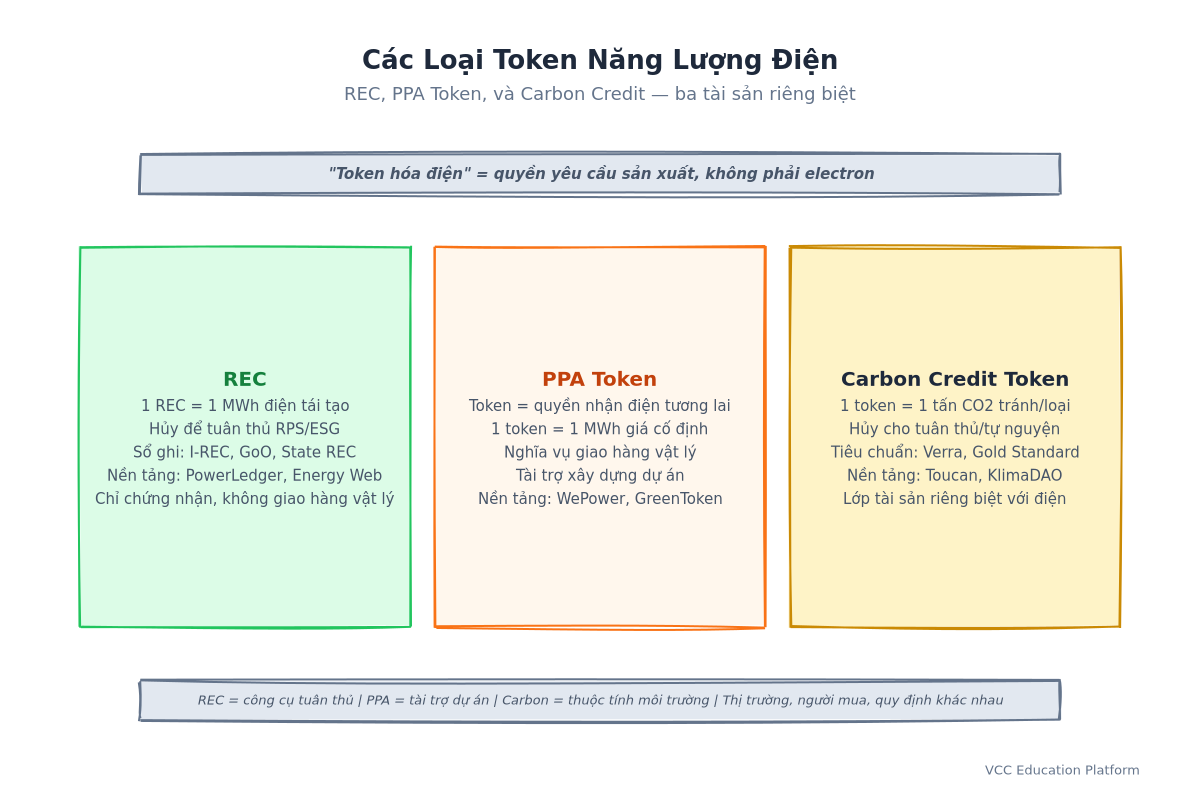
"Electricity tokenization" là misnomer. Không store electrons trong vault. Được tokenize là claims on electricity production hoặc environmental attributes. Electron flow qua grid, certificates flow qua blockchain. Decoupling attribute từ commodity enables global trade. Certificate portability across jurisdictions là key innovation. Cross-border certificate trade unlocks global green markets. Standardized attributes enable frictionless international exchange.
Three Token Types
| Token Type | What It Represents | Redemption | Example Platforms |
|---|---|---|---|
| RECs (Renewable Energy Certificates) | 1 MWh renewable generation | Retired for compliance (RPS, corporate ESG) | PowerLedger, Energy Web, I-REC Standard |
| PPA Tokens | Future energy delivery rights | Physical delivery obligation at agreed price | WePower, GreenToken |
| Carbon Credits | 1 tonne CO₂ avoided/removed | Retired for compliance/voluntary claims | Toucan, KlimaDAO, Verra/Gold Standard on-chain |
PowerLedger: P2P Energy Trading
PowerLedger (POWR token) enables peer-to-peer solar trading in Australia, Thailand, India, US. Households with rooftop solar sell excess to neighbors via blockchain marketplace. "Token" here là settlement layer, không phải commodity claim. P2P energy trading reduce grid congestion và empower prosumers. Local energy markets create resilience against grid failures. Distributed generation reduces transmission losses. Peer-to-peer markets optimize local energy balance. Local trading reduces grid infrastructure requirements.
WePower: Tokenized Power Purchase Agreements
WePower tokenizes future production từ renewable projects. Solar farm issues tokens representing 1 MWh each, sold upfront to finance construction. Buyers get electricity at fixed price hoặc resell tokens. Đây là project finance tokenized, không phải spot electricity.
Regulatory Mosaic
- EU: Guarantees of Origin (GoO) — standardized, mandatory disclosure
- US: State-level REC markets (Texas, California, PJM) — fragmented
- International: I-REC Standard — voluntary, growing in Asia/LATAM
Tokenization here solves fragmentation and trust. REC on Energy Web Chain verifiable across borders. But underlying asset là certificate, không phải electricity. Đây là distinction quan trọng: bạn trade attribute, không trade commodity vật lý. Certificate-based model tránh được physical delivery nightmare. PPA model là bridge giữa project finance và tokenization.
Uranium Tokenization: U3O8 và Nuclear Wall
Uranium là most fascinating — và most constrained — commodity tokenization story.
U3O8: Standard Unit
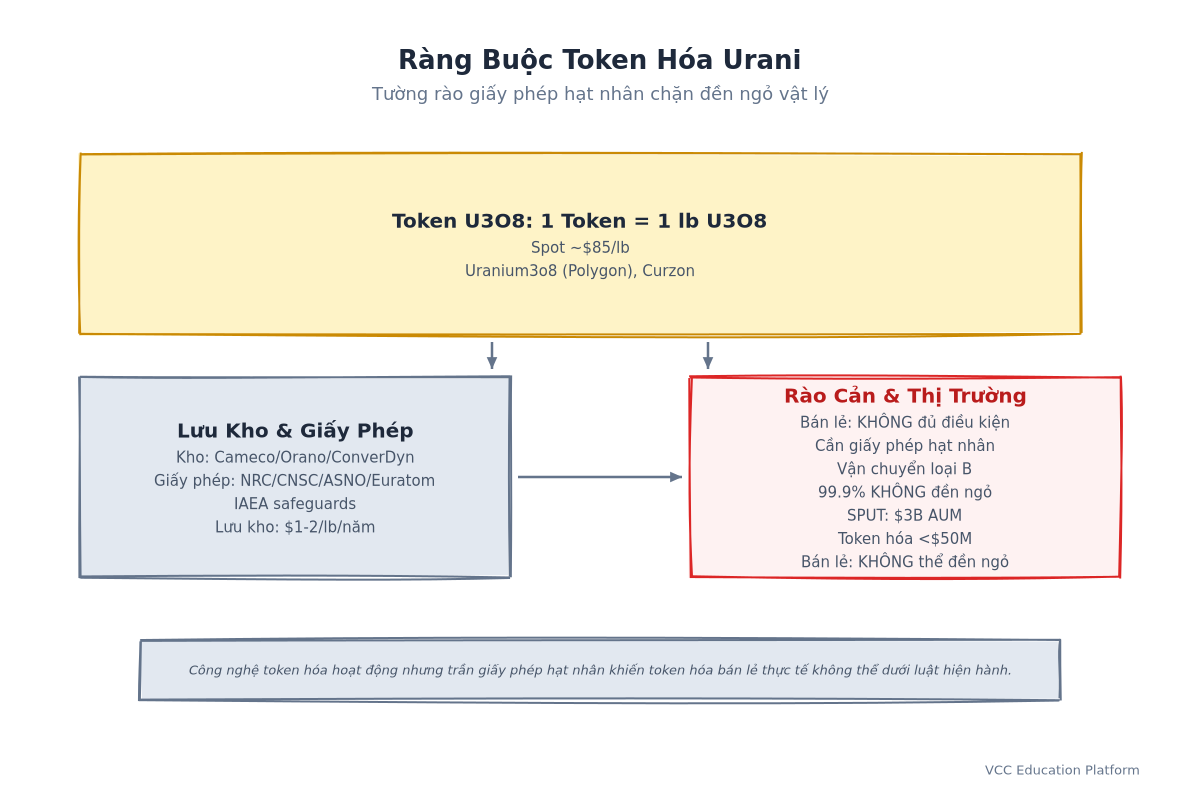
Uranium trades as U3O8 (triuranium octoxide), yellowcake concentrate từ mills. 1 lb U3O8 ≈ 0.848 lb uranium. Spot: ~$80-90/lb (2024-2025). Long-term contracts: $60-70/lb.
Uranium3o8 (Project)
Uranium3o8 tokenizes physical U3O8 on Polygon. 1 token = 1 lb U3O8 stored at licensed conversion facilities (Cameco, Orano, ConverDyn). Targets institutional/accredited investors. Polygon choice reflects need cho low-cost, fast settlement. Low fees critical cho institutional volume. Polygon L2 provides throughput needed cho commodity settlement. Low gas fees essential cho high-volume institutional flows. Cost efficiency critical cho commodity token economics.
Nuclear Licensing Barrier
Đây là nơi uranium khác mọi commodity khác: physical redemption requires nuclear materials license.
- US: NRC (Nuclear Regulatory Commission) license
- Canada: CNSC (Canadian Nuclear Safety Commission)
- Australia: ASNO (Australian Safeguards and Non-Proliferation Office)
- EU: Euratom Treaty provisions
Retail investor cannot take delivery uranium. Even institutions need specialized handling, transport (Type B containers), safeguards reporting. Questo يجعل uranium tokens perpetually synthetic cho 99.9% holders — trade token, physical never moves to you. Synthetic exposure vẫn có value cho price speculation. Price discovery vẫn meaningful even without physical redemption. Synthetic tokens still reflect supply/demand fundamentals. Price discovery function remains intact. Synthetic markets still provide valuable hedging instruments.
Storage Costs
Uranium storage at conversion facilities: ~$1-2/lb/year. At $85/lb, đó là 1.2-2.4%/year — comparable silver's storage drag nhưng thêm regulatory overhead.
Market Context
Primary uranium investment vehicle vẫn là Sprott Physical Uranium Trust (SPUT) — closed-end fund holding physical U3O8, không phải token. SPUT trades premium/discount to NAV. Tokenized uranium (Uranium3o8, Curzon Uranium) tiny by comparison (<$50M AUM combined vs SPUT ~$3B).
Key insight: Uranium tokenization proves concept works technically, nhưng regulatory ceiling caps addressable market to licensed entities. Retail tokenization of uranium effectively impossible under current law. Việc này vẫn là niche cho institutional có license.
Base Metals: Copper, Aluminum, Nickel — Complexity Trap
Base metals (copper, aluminum, zinc, nickel, lead, tin) là backbone of industrial civilization. Tokenization lags for structural reasons. Grade fragmentation là root cause - không có standard unit như gold ounce. Mỗi grade cần separate token contract. Fragmentation makes standardization extremely difficult. Grade-specific tokens increase complexity exponentially. Each grade requires independent oracle và custody setup.
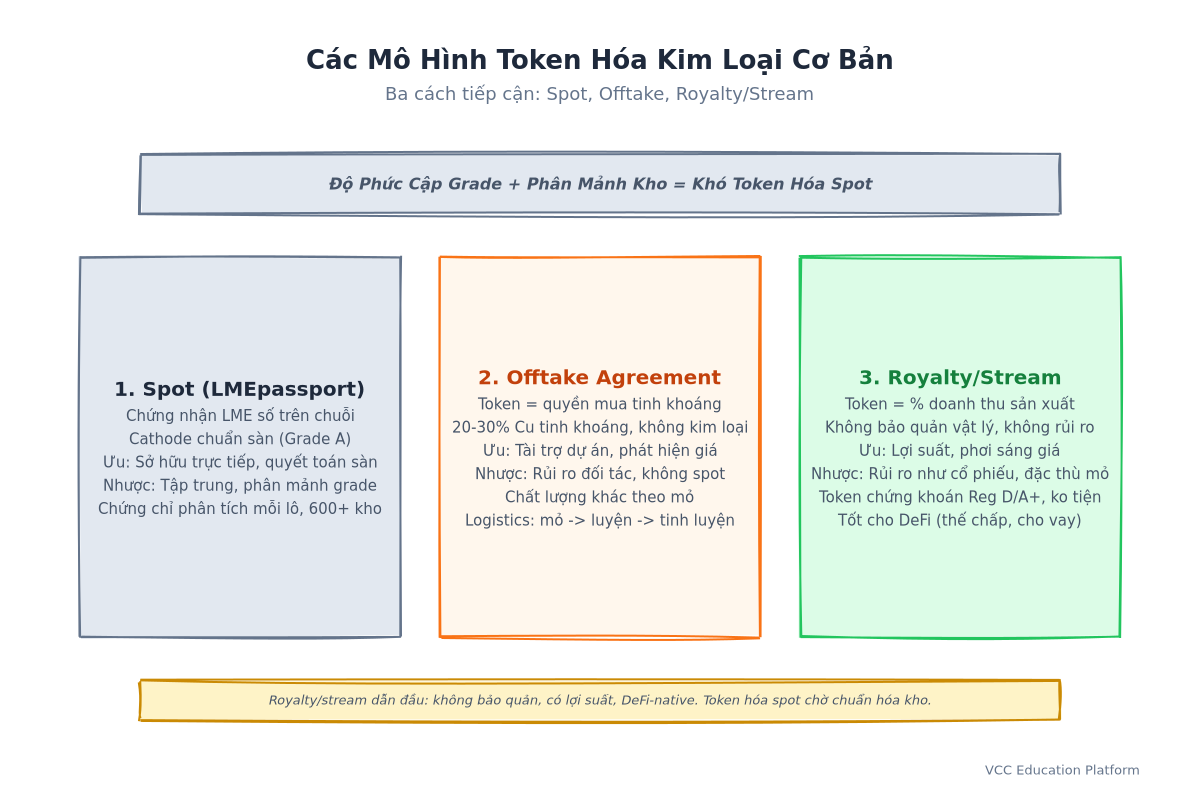
LMEpassport: Digital Warrants, Not Tokens
London Metal Exchange (LME) runs LMEpassport — digital warrant system. LME warrants (title documents cho metal in LME-approved warehouses) digitized. Đây not blockchain tokenization; là centralized digital registry. Nhưng solves same problem: instant title transfer without paper. Centralized registry vẫn capture 90% của value proposition. Blockchain thêm marginal value cho spot trading.
Metalshub & Open Mineral: Marketplaces, Not Tokens
- Metalshub: Digital marketplace cho base metal spot và concentrate trading. No tokens.
- Open Mineral: Tokenizes offtake agreements (rights to buy future concentrate production), not spot metal.
Why Base Metals Resist Tokenization
- Grade Complexity: Copper không chỉ là copper. Grade A cathode, Grade B, anode, blister, concentrate (20-30% Cu). Mỗi grade cần separate tokenization.
- Warehouse Fragmentation: LME có 600+ warehouses globally. Metal moves between them. Tracking specific lots hard.
- Quality Assays: Every delivery requires assay certificates. Tokenizing metal means tokenizing assay data too.
- Logistics Cost: Moving 25 tonnes copper cathode (one LME lot) costs thousands. Redemption expensive.
Royalty/Stream Model
Most successful "base metal tokenization" không phải metal — là royalty and streaming agreements tokenized. Companies như Sandstorm Gold, Franco-Nevada, Wheaton Precious Metals sell future metal production rights. Putting these on-chain (as security tokens) creates yield-bearing assets tied to metal production without physical custody. Model này bypass hoàn toàn logistics vật lý. Royalty/stream tokenization là path of least resistance.
Economics of Tokenized Commodities: Storage, Yield, Liquidity
Across all commodities, three economic forces shape tokenization: storage, liquidity, và composability. Ba pillar này quyết định viability. Cost ratio là filter đầu tiên cho token viability. High cost kills retail token economics. Oil economics fundamentally incompatible với retail tokenization. Negative carry makes long-term holding wealth-destroying.
1. Storage Cost as % of Asset Value
| Commodity | Price (approx) | Storage $/unit/yr | Storage % of Value/yr |
|---|---|---|---|
| Gold | $2,300/oz | $3-4/oz | 0.13-0.17% |
| Silver | $30/oz | $0.15-0.25/oz | 0.5-0.8% |
| Oil (WTI) | $75/bbl | $5-15/bbl | 6.7-20% |
| Copper | $4.00/lb | $0.04-0.12/lb | 1-3% |
| Uranium (U3O8) | $85/lb | $1-2/lb | 1.2-2.4% |
Oil's storage cost is catastrophic for tokenization. At 10-20%/year, tokenized barrel loses value to storage in 5-10 years. This is why oil tokens don't exist for retail — carry cost destroys economics. Negative carry Makes retail oil tokens uneconomic.
Silver's storage drag manageable but real. KAG's 0.22% fee competitive vì Kinesis operates at scale. Ratio này là metric quan trọng nhất khi evaluate tokenized commodity.
2. Liquidity Premium
Tokenized commodities trade at 5-15% premium to physical spot (BCG 2024). Why? Tokens offer:
- 24/7 trading (vs exchange hours)
- Fractional ownership (buy 0.01 oz)
- Instant settlement (T+0 vs T+2)
- DeFi composability (collateral, lending)
Premium này là "convenience yield" of tokenization. Highest for gold/silver, lower for oil/base metals where institutional infrastructure already provides decent liquidity.
3. DeFi Composability: Missing Layer
Today, most tokenized commodities sit in custodial wallets. Few integrate with DeFi:
- Kinesis: Own exchange, own yield — not DeFi-native
- PAXG/XAUt: Collateral on Maker, Aave — but limited
- Uranium3o8: No DeFi integration
- RECs: Some carbon credit DeFi (KlimaDAO, Toucan) but early
Next phase: commodity-backed stablecoins và commodity collateral in lending markets. Imagine borrowing USDC against tokenized copper cathode, or stablecoin backed by basket of tokenized energy commodities. DeFi composability sẽ unlock liquidity cho illiquid commodities. Commodity-backed stablecoins là next major unlock.
Regulatory Landscape: MiCA, SEC, Compliance Maze
Tokenized commodities live in regulatory gray zone varying by jurisdiction.
United States
- SEC: Most commodity-backed tokens = investment contracts (securities) under Howey. Expect registration or exemption (Reg D, Reg A+).
- CFTC: If tokens margined/leveraged or trade as futures, CFTC jurisdiction applies.
- FinCEN: AML/KYC requirements for issuers and exchanges.
European Union (MiCA)
- Asset-Referenced Tokens (ARTs): Commodity-backed tokens fall under ART regime.
- Requirements: 1:1 reserves, custody by authorized custodian, whitepaper approval, governance.
- Timeline: MiCA fully applicable December 2024.
United Kingdom
- FCA: Similar to MiCA. Sandbox for tokenized commodities (e.g., Curzon Uranium in FCA sandbox).
- Post-Brexit divergence: UK may offer more flexible regime for commodity tokens.
Singapore & ADGM (Abu Dhabi)
- MAS (Singapore): Digital Payment Token framework; commodity tokens may be regulated as securities or DPTs.
- ADGM (Abu Dhabi): FSRA framework explicitly covers asset-backed tokens. Several commodity projects incorporated here.
Practical reality: Most projects incorporate in Switzerland, Singapore, or ADGM for regulatory clarity, then serve global users via geo-blocking where needed. Regulatory arbitrage là strategy phổ biến trong space này. Jurisdiction shopping là norm cho commodity token projects.
Vietnamese Context: What This Means for VN Investors
Vietnam has unique relationship with commodities: gold culture, energy transition, và nuclear ambition tạo ra unique demand profile.
Gold Culture
VN households hold ~300-500 tonnes gold (SJC bars, jewelry). Gold tokenization (PAXG, XAUt) conceptually familiar — "digital SJC." But SBV (State Bank of Vietnam) prohibits gold trading outside licensed channels. Tokenized gold exists in legal gray zone. SBV stance trên gold trading tạo ra natural demand cho offshore alternatives. Digital gold access bypass domestic restrictions.
Silver: Emerging Interest
Silver investment growing in VN (industrial demand + monetary hedge). KAG accessible via global exchanges. No VN-specific silver token yet.
Energy Transition
Vietnam's PDP8 (Power Development Plan 8) targets 30%+ renewable by 2030. Tokenization could unlock rooftop solar monetization for VN households — sell RECs to corporate buyers globally via PowerLedger or Energy Web. REC revenue stream improve rooftop solar economics significantly.
Nuclear: Ninh Thuận Context
Vietnam's Ninh Thuận nuclear project canceled (2016) but may revive. If so, uranium tokenization becomes locally relevant — but only for licensed entities. Ninh Thuận revival sẽ drive local uranium demand. Nuclear power renaissance creates new commodity narratives. Uranium demand surge supports tokenization thesis. Nuclear renaissance creates structural tailwind for uranium exposure.
Regulatory Outlook
SBV warned against crypto but hasn't specifically addressed commodity-backed tokens. Distinction between "cryptocurrency" và "tokenized asset" matters. Clear framework would unlock local innovation. Việt Nam có potential lớn nhờ gold culture và energy transition. Tokenization aligns với PDP8 targets.
Future Outlook: Where Tokenized Commodities Go Next
1. Interoperable Standards
ERC-3643 (T-REX) for permissioned tokens, ERC-7208 for data-carrying tokens. Commodity tokens need standards for: grade data, assay certificates, storage proof, redemption rights.
2. DeFi-Native Commodity Primitives
- Commodity-backed stablecoins: Basket of tokenized commodities as collateral
- Commodity lending markets: Borrow against tokenized copper, silver, RECs
- Structured products: Tokenized commodity futures, options, swaps on-chain
3. Physical-Digital Twin Infrastructure
IoT sensors in vaults/warehouses feeding real-time data to tokens (weight, purity, location). Chainlink Proof of Reserve + IoT = trust-minimized custody verification.
4. CBDC + Tokenized Commodities
CBDCs settle cash leg; commodity tokens settle asset leg. Atomic delivery-versus-payment (DvP) for commodity trades. BIS Project mBridge explores this.
5. Emerging Markets Access
Tokenization lets VN solar owner sell RECs to German corporate buyer. Chilean copper miner tokenizes offtake to global investors. Tokenization disintermediates geography. Đây là value proposition cốt lõi: geography không còn barrier. Borderless commodity access reshapes global trade flows. Emerging markets access là largest untapped opportunity.
FAQ
Q: Difference between KAG and PAXG?
A: Both represent allocated metal in LBMA vaults. KAG (silver) adds velocity-based yield from transaction fees (2-4% APY). PAXG (gold) no native yield. KAG min redemption 200 oz; PAXG 430 oz (1 London Good Delivery bar). Yield difference là key differentiator. Yield difference là compelling reason cho silver allocation.
Q: Can I buy tokenized oil as retail investor?
A: Not directly. Vakt and Komgo are institutional platforms. Some projects attempted retail oil tokens (royalty-backed), none achieved liquidity. Storage cost (10-20%/yr) makes retail oil tokens economically unviable. Physics của oil làm retail tokenization fundamentally uneconomic. Terminal access + quality specs + regulation = triple barrier.
Q: Is "electricity tokenization" real?
A: Term misleading. You tokenize certificates (RECs), contracts (PPAs), or carbon credits — not electrons. Valid digital assets with real markets, but represent claims/attributes, not physical electricity. Certificate model solve trust issue without physical custody. Token model unlock green asset class cho retail.
Q: Why uranium tokenization so niche?
A: Physical redemption requires nuclear materials license (NRC in US, CNSC in Canada, etc.). Retail investors cannot qualify. Caps market to licensed entities, making uranium tokens effectively synthetic for almost all holders. Nuclear license là hard barrier no tech can bypass. Regulatory ceiling caps TAM tại institutional only.
Q: Are base metals being tokenized?
A: Spot base metal tokenization minimal. LMEpassport digitizes warrants (centralized). Open Mineral tokenizes offtake agreements. Complexity of grades, assays, warehouse logistics makes spot tokenization hard. Royalty/stream tokenization more promising. Offtake agreements tokenize future production, bypass spot complexity. Royalty tokens capture upside without ops burden.
Q: Storage cost difference gold vs silver tokens?
A: Gold: ~0.12-0.15%/yr of value. Silver: ~0.22-0.5%/yr of value. Silver's lower density means more vault space per dollar, so storage eats higher percentage of value over time. 10-year impact: ~2.2% vs ~1.2% value erosion. Compound effect makes this significant cho long-term holders.
Q: How tokenized commodities taxed in Vietnam?
A: No specific guidance yet. Likely treated as foreign assets or securities under current law. Capital gains tax (20% for individuals) may apply on disposal. Consult VN tax advisor. Tax treatment sẽ clarify khi framework ra mắt. Foreign asset classification most likely under current law.
Q: Can tokenized commodities be used in DeFi?
A: Limited today. PAXG/XAUt work as collateral on Maker/Aave. KAG has own yield system but not DeFi-native. RECs/carbon credits have early DeFi (KlimaDAO, Toucan). This is biggest growth frontier. DeFi integration sẽ transform tokenized commodities từ store-of-value thành productive assets. Collateral usage unlock capital efficiency. Composability unlocks 새로운 financial primitives.
Summary: Commodity Tokenization Spectrum
| Commodity | Token Example | Maturity | Retail Access | Key Constraint |
|---|---|---|---|---|
| Gold | PAXG, XAUt | High | Yes | None major |
| Silver (KAG) | KAG | Medium-High | Yes | Storage cost drag |
| Oil | Vakt (institutional) | Medium | No | Terminal delivery, regulation |
| Electricity | RECs, PPA tokens | Medium | Yes | Certificate-based, not physical |
| Uranium (U3O8) | Uranium3o8 | Very Low | No | Nuclear license for redemption |
| Base Metals | LMEpassport, Open Mineral | Low | No | Grade complexity, warehouse network |
Pattern clear: Tokenization follows redemption ease. Gold/silver lead vì vault networks mature và retail-friendly. Oil/base metals stall at institutional infrastructure. Uranium hits regulatory wall. Electricity tokenizes certificates, not commodity itself.
For investors, opportunity set today: gold/silver tokens for allocation, RECs for green exposure, watch DeFi integration space — that's where next 10x utility comes from. Commodity tokenization mới chỉ ở giai đoạn đầu, upside còn rất lớn. Early adoption trong DeFi integration capture most alpha. Early movers trong DeFi integration sẽ capture most value.
Disclaimer: Educational purposes only. Tokenized commodities carry custody, regulatory, market risks. Consult qualified advisors before investing.