
Debug DeFi protocol không giống debug web app. Khi ứng dụng truyền thống crash, bạn check log, trace stack, fix bug. Khi DeFi protocol fail, hàng triệu đô biến mất trong vài giây, exploit immutable on-chain, và "log" là transaction trace cryptic rải rác across nhiều contract và chain. Guide này cho bạn framework systematic, blockchain-agnostic để debug DeFi smart contract — dù bạn build trên Ethereum, Cardano, Solana, hay bất kỳ EVM-compatible chain.
DeFi Debugging Là Gì và Tại Sao Quan Trọng
DeFi debugging là quá trình systematic identify, isolate, và fix logic error trong decentralized finance smart contract. Khác với general smart contract debugging, DeFi debugging đòi hỏi domain knowledge về automated market maker (AMM), lending protocol, oracle system, và cross-chain bridge — vì bug nằm trong economic logic, không chỉ code syntax. Master DeFi debugging đưa bạn từ reactive fire-fighting sang proactive incident prevention.
Thách Thức Độc Nhất Của Debug DeFi Protocol
Debug truyền thống giả định deterministic execution với input/output rõ ràng. DeFi phá vỡ mọi giả định:
Composability tạo hidden dependency. Lending protocol của bạn gọi oracle, oracle gọi TWAP từ AMM, AMM phụ thuộc liquidity mà flash loan vừa drain. Bug trong Contract A manifest thành revert trong Contract C, cách 3 hop.
Economic invariant thay thế unit test. Trong Web2, assert(user.balance >= 0) catch bug. Trong DeFi, invariant là totalAssets >= totalLiabilities across mọi market đồng thời — và phải hold dưới điều kiện adversarial (flash loan, oracle manipulation, MEV).
Production state irreducible. Bạn không "reproduce locally" được liquidation cascade cần $50M real liquidity, oracle price cụ thể tại block N, và transaction ordering chính xác. Mainnet forking giúp, nhưng state complexity explode.
Thời gian là tiền — theo nghĩa đen. Mỗi phút debug live exploit tốn thêm fund mất. Bạn cần framework jump thẳng đến hypothesis đúng, không phải approach "check log" generic.
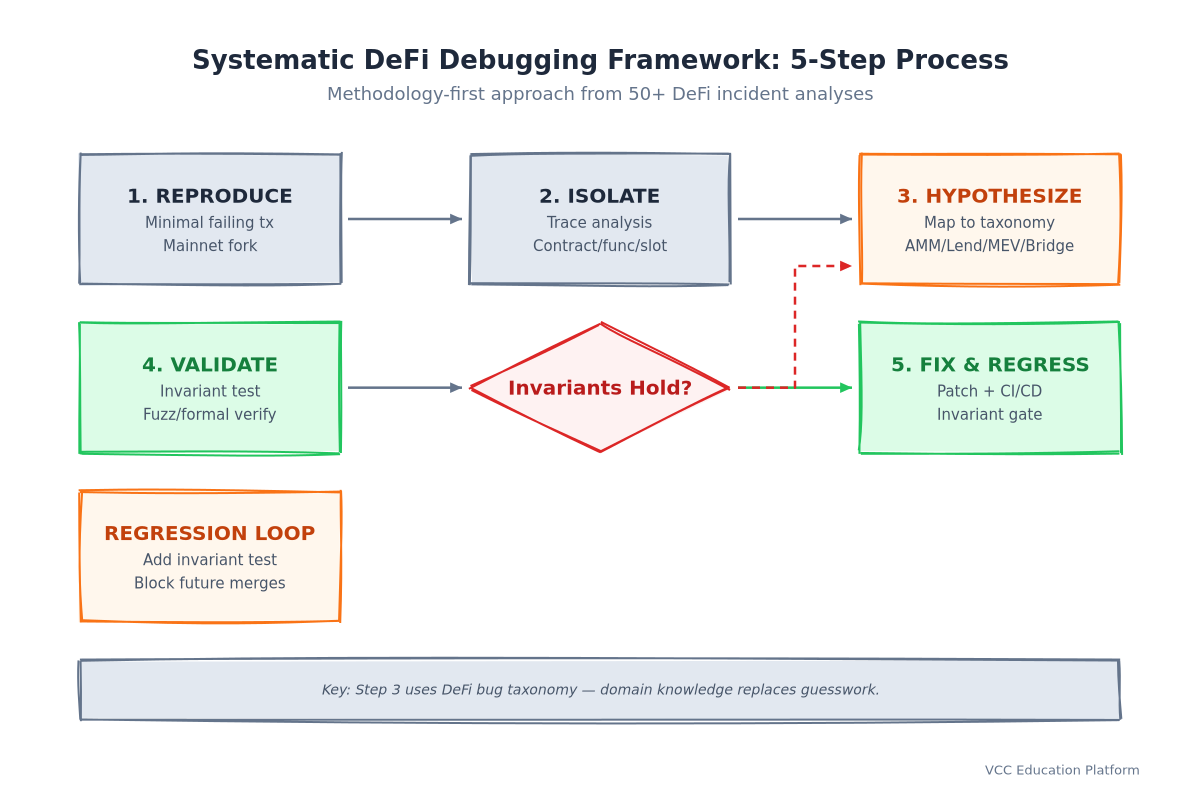
Những challenge này đòi hỏi DeFi-specific methodology. 5-step framework dưới đây được derive từ phân tích 50+ real DeFi incident (Euler, Mango Markets, Nomad Bridge, Curve, và hàng chục khác).
Systematic DeFi Debugging Framework: Quy Trình 5 Bước
1. REPRODUCE: Minimal Failing Transaction
Bắt đầu bằng tạo transaction nhỏ nhất có thể exhibit failure. Dùng mainnet forking (Foundry vm.createFork, Hardhat forking.enabled) để replay exact block state. Strip away unrelated call — nếu exploit dùng flash loan từ Aave, swap trên Uniswap, attack protocol, isolate chỉ attack vector với contract của bạn.
Tool chính: Foundry forge test --fork-url, Hardhat npx hardhat node --fork, Tenderly "Simulate Transaction"
Tip DeFi-specific: Capture toàn bộ call trace, không chỉ revert. Root cause thường trong internal call thành công corrupt state trước revert cuối cùng.
2. ISOLATE: Trace Analysis đến Contract/Function/Storage Slot
Mở transaction trace (Tenderly, Phalcon, hay forge debug). Look for:
- State change trong core contract protocol (vault, pool, controller)
- External call đến oracle, AMM — note return value
- Storage slot modification — map slot đến variable name dùng
forge inspecthay Slither storage layout
Tip DeFi-specific: Focus economic state change: totalSupply, totalBorrow, reserve0/reserve1, price, healthFactor. balanceOf change là noise; totalAssets change mà không có totalShares change tương ứng là signal.
3. HYPOTHESIZE: Map Symptom Đến DeFi Bug Taxonomy
Đây là nơi domain knowledge thay thế guesswork. Match symptom observe với một trong 5 DeFi bug category:
| Category | Symptom Điển Hình | Check Đầu Tiên |
|---|---|---|
| AMM Math Error | Invariant xy=k broken, slippage bất ngờ, zero-output swap | Reserve accounting, fee calculation, precision/rounding |
| Lending/Liquidation Logic | Position undercollateralized không liquidate, bad debt accrual, health factor > 1 nhưng bị liquidate | Oracle price freshness, liquidation threshold math, debt accrual formula |
| Access Control & Reentrancy | Fund drain qua callback, flash loan attack, governance bypass | nonReentrant modifier, callback hook, access control list |
| MEV Vulnerability | Sandwich attack, JIT liquidity remove value, transaction ordering dependence | Commit-reveal scheme, MEV-protected mempool, fair ordering |
| Cross-Chain Bridge Failure | Message không deliver, state root mismatch, validator set stale | Message proof verification, consensus threshold, finality assumption |
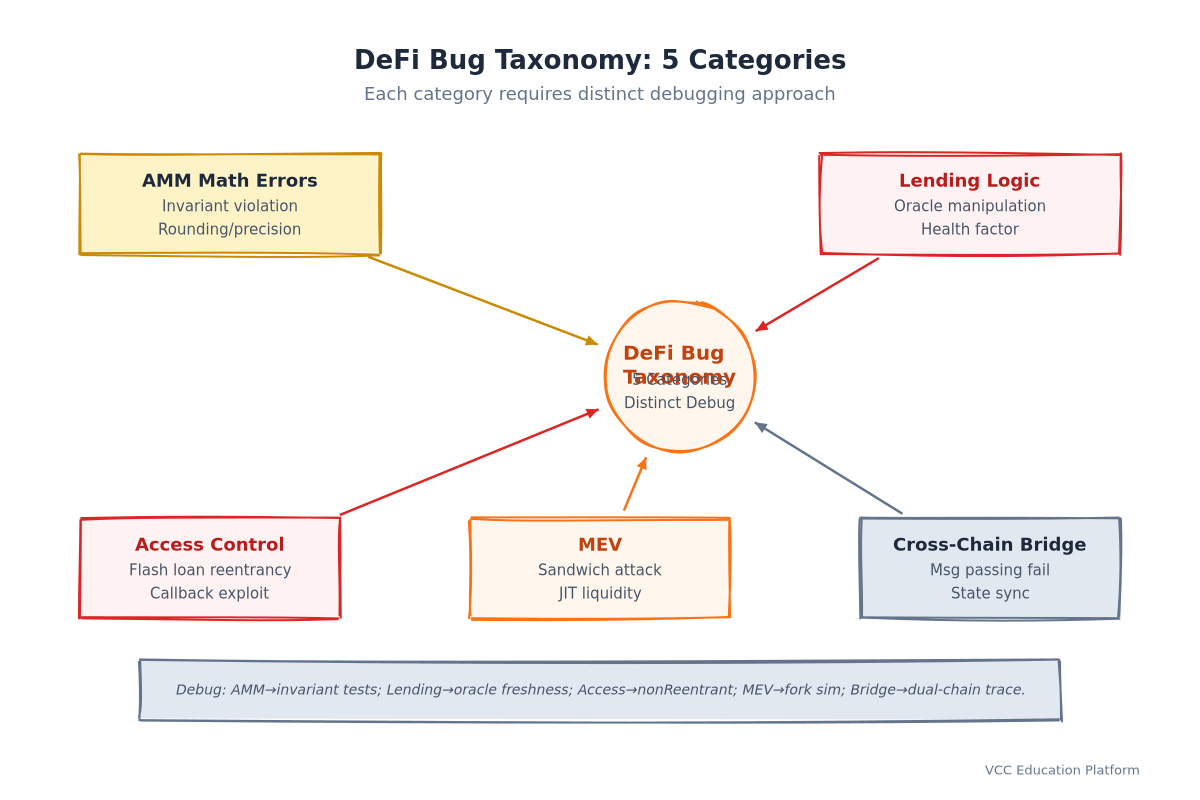
Decision tree: Nếu trace show AMM reserve mismatch → AMM Math. Nếu liquidation execute với stale oracle price → Lending Logic. Nếu fund rời qua onFlashLoan callback → Access Control. Nếu profitable transaction reorder → MEV. Nếu cross-chain message revert → Bridge Failure.
4. VALIDATE: Invariant Testing, Fuzzing, Formal Verification
Đừng chỉ "viết test." Viết property-based test express economic invariant:
// AMM invariant: product của reserve chỉ tăng (trừ fee)
function testInvariant_ReservesProductNeverDecreases() public {
    vm.startPrank(user);
    // ... random swap sequence ...
    vm.stopPrank();
    assertGe(pool.reserve0()  pool.reserve1(), initialProduct);
}
// Lending invariant: totalAssets >= totalBorrows + reserves
function testInvariant_Solvency() public {
    // ... random borrow/repay/liquidate sequence ...
    assertGe(vault.totalAssets(), vault.totalBorrows() + vault.reserves());
}
Tool theo category:
- Invariant testing: Echidna, Foundry
invariant(EVM); Aikencheck(Cardano); Triton (Solana)
- Fuzzing: Foundry
fuzz, Slitherdetectors(static)
- Formal verification: Certora, Halmos (EVM); Plutus formal verification (Cardano)
Tip DeFi-specific: Run invariant test against forked mainnet state để catch bug chỉ manifest với real liquidity distribution.
5. FIX & REGRESS: Patch + CI/CD Invariant Test
Fix chưa hoàn tất cho đến khi invariant test mà sẽ catch nó chạy trên mỗi PR. Add invariant test vào CI pipeline (GitHub Actions, GitLab CI) với blocking gate — merge fail nếu invariant không hold.
Debugging Tool Thiết Yếu Cho DeFi Developer
Không tool đơn lẻ cover tất cả. Bảng dưới map tool category đến blockchain và use case:
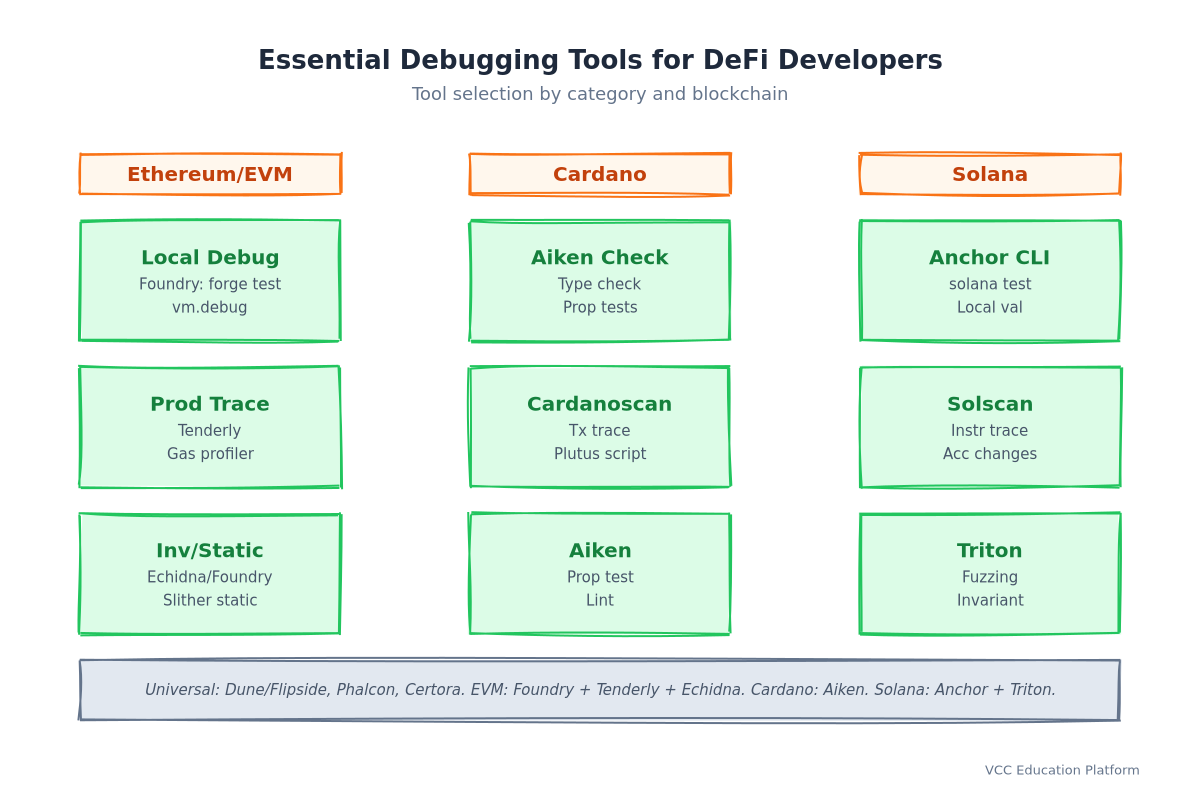
| Category | Ethereum/EVM | Cardano | Solana | Universal |
|---|---|---|---|---|
| Local Debug | Hardhat, Foundry | Aiken Check, Plutip | Solana CLI, Anchor | Dune, Flipside |
| Production Trace | Tenderly, Phalcon, Blockscout | Cardanoscan, Koios | Solscan, SolanaFM | — |
| Static Analysis | Slither, Solhint | Aiken, Plutip | Soteria, Solana CLI | — |
| Invariant Testing | Echidna, Foundry | Aiken check | Triton | — |
| Formal Verification | Certora, Halmos | Plutus FV | — | — |
Hướng dẫn chọn:
- Local development: Foundry (speed) + Hardhat (ecosystem) cho EVM; Aiken cho Cardano; Anchor cho Solana
- Production incident: Tenderly (EVM) cho trace visualization + Phalcon cho attack analysis
- Pre-deployment audit: Slither (static) + Echidna/Foundry invariant (dynamic) + Certora (formal)
- Cross-chain: Dune/Flipside cho analytics; native explorer per chain cho trace
DeFi Bug Category Phổ Biến và Root Cause
AMM Math Error
Invariant violation: Core AMM invariant (reserve0 reserve1 = k cho constant product) break do:
- Rounding down trong Solidity division:
amountOut = (amountIn reserveOut) / (reserveIn + amountIn)mất precision
- Fee calculation order: Fee lấy trước vs sau invariant check thay đổi math
- Multi-hop routing: Intermediate rounding error compound across hop
Ví dụ thực: Uniswap V2 fork round amount0Out down nhưng amount1Out up, tạo arbitrage drain pool qua 10.000 swap.
Cách debug: Add assert(reserve0 reserve1 >= k (1 - fee)) làm invariant test. Check mọi division cho rounding direction.
Lending/Liquidation Logic Flaw
Oracle manipulation: Kẻ tấn công pump oracle price → borrow max → price revert → position underwater nhưng health factor appear healthy do stale price.
Bad debt accounting: Liquidator nhận collateral worth ít hơn debt repaid. Protocol accumulate bad debt silently.
Health factor edge case: Division by zero khi totalDebt = 0; precision loss khi collateralFactor near 100%.
Cách debug:
1. Verify oracle freshness: block.timestamp - oracle.lastUpdate < maxAge
2. Test liquidation với healthFactor = 1.0001 (boundary)
3. Invariant: sum(collateralValue) >= sum(borrowValue) + reserves luôn
Access Control & Reentrancy (DeFi-Specific)
Flash loan reentrancy: Kẻ tấn công borrow flash loan → gọi deposit() → contract gọi onFlashLoan() → kẻ tấn công re-enter withdraw() → drain protocol.
Callback hook exploitation: ERC-3156 flash loan callback, ERC-777 tokensReceived, Uniswap V3 swap callback — bất kỳ external call nào là reentrancy vector.
Governance bypass: Timelock delay không enforce; proposal threshold quá thấp; emergency admin key compromised.
Cách debug:
- Apply
nonReentrantcho mọi external entry point (không chỉ user-facing)
- Dùng
ReentrancyGuardtừ OpenZeppelin (battle-tested)
- Invariant:
totalAssets() == sum(userBalances())sau mỗi external call
MEV & Front-Running Vulnerability
Sandwich attack: Large swap của user bị front-run (buy) và back-run (sell) bởi MEV bot, extract value qua slippage.
JIT liquidity: Liquidity add just before large swap, remove just after — LP capture fee mà không có impermanent risk.
Transaction ordering dependence: Contract behavior thay đổi dựa tx position trong block (vd: Dutch auction, first-come-first-served).
Cách debug:
- Simulate với MEV bot trong forked environment (Tenderly + Flashbots)
- Test với
tx.originvsmsg.senderpattern
- Invariant: User output amount trong
expected (1 - maxSlippage)regardless tx position
Cross-Chain Bridge Failure
Message passing failure: Source chain emit event, relayer fail submit proof, destination contract revert trên verification.
State synchronization: Validator set update không propagate; light client header sync stall.
Finality assumption: Bridge giả định 12-block finality; chain reorg 15 block.
Cách debug:
- Trace message lifecycle: Event → Relayer → Proof → Verification → Execution
- Verify validator set hash match trên cả hai chain
- Test với reorg simulation (Foundry
vm.roll)
Case Study: Debug Production DeFi Incident
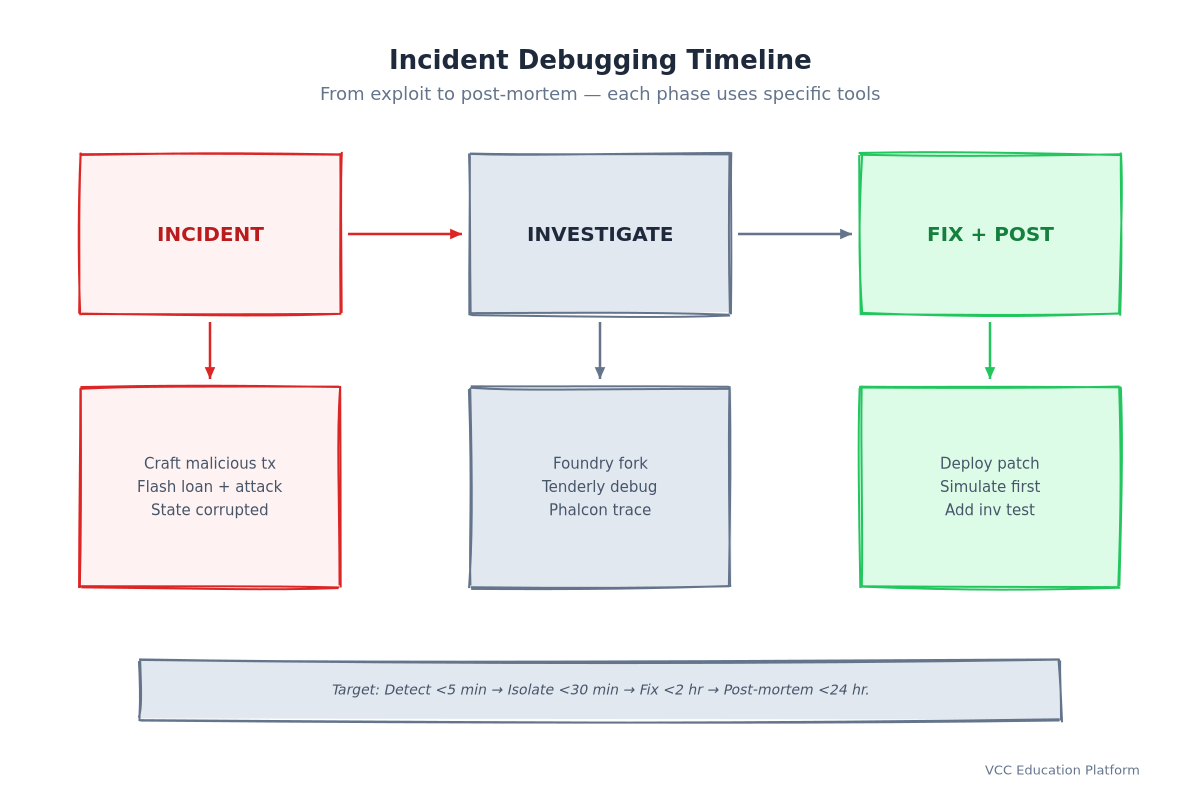
Case Study 1: AMM Invariant Violation Dẫn Đến Drain (Pattern Generic)
Incident: Protocol mất $2.3M trong 3 giờ qua "precision loss" arbitrage.
Detection: Unusual swap volume + reserve ratio drift detect bởi monitoring alert.
Investigation:
1. Fork block tại first anomalous swap
2. Trace show swap() → _update() → reserve update với rounding error
3. Kẻ tấn công repeat: small swap → rounding favor → compounding
Root Cause: amountOut = (amountIn reserveOut) / (reserveIn + amountIn) round down. Kẻ tấn công gửi amountIn = 1 wei lặp lại, mỗi lần amountOut = 0, nhưng reserve update. Sau 10^18 iteration, reserve drained.
Fix: Minimum swap threshold + invariant test reserve0 reserve1 >= k.
Bài học: Rounding error compound. Luôn test với amountIn = 1 boundary.
Case Study 2: Oracle Manipulation Cause Bad Liquidation (Pattern Generic)
Incident: $15M bad debt tạo trong 1 block qua TWAP manipulation.
Detection: Liquidation bot revenue spike + health factor anomaly.
Investigation:
1. Trace show liquidate() → oracle.getPrice() → return manipulated TWAP
2. TWAP window: 30 min. Kẻ tấn công pump price 25 min, rồi trigger liquidation
3. Protocol dùng latestRoundData() thay vì getRoundData() với freshness check
Root Cause: Không oracle freshness validation. stalePrice = oracle.latestAnswer() accept mà không timestamp check.
Fix: Require block.timestamp - oracle.updatedAt < 3600 (1 giờ). Add invariant: healthFactor(user) > 1.1 trước liquidation.
Bài học: Oracle freshness > oracle accuracy. Stale accurate price tệ hơn fresh slightly-inaccurate price.
Case Study 3: Cross-Chain Message Passing Failure (Pattern Generic)
Incident: $8M stuck trong bridge 6 giờ; user không withdraw được trên destination chain.
Detection: Bridge contract MessageSent event ≠ MessageReceived event trên destination.
Investigation:
1. Source chain: dispatchMessage() emit event, relayer pick up
2. Relayer submit proof cho destination → verifyProof() revert
3. Root cause: Destination chain validator set rotate; relayer submit proof against old validator set
Fix:
- Add validator set version vào proof
- Relayer phải fetch latest validator set trước submit
- Invariant:
message.nonce == expectedNoncevàproof.validatorSetHash == currentValidatorSetHash
Bài học: Cross-chain debugging đòi hỏi dual-chain trace analysis. Single-chain tool miss handoff.
Kỹ Thuật Nâng Cao: Fuzzing, Invariant Testing, và Formal Verification
Fuzzing Cho DeFi
Fuzzing generate random valid input để find edge case mà unit test miss.
// Foundry fuzz test - chạy 10.000+ random iteration
function testFuzz_DepositWithdraw(uint256 amount, address user) public {
    vm.assume(amount > 0 && amount < type(uint256).max / 2);
    vm.prank(user);
    vault.deposit(amount, user);
    vault.withdraw(vault.balanceOf(user), user, user);
    assertEq(vault.totalAssets(), 0); // invariant: round-trip preserve asset
}
Fuzzing target DeFi-specific:
- Swap amount: 1 wei đến
type(uint128).max
- Liquidation amount: dust đến full position
- Oracle price: 0.01x đến 100x fair value
- Timestamp: past, present, future (cho time-locked function)
Invariant Testing
Invariant test define property phải luôn hold và run continuous random sequence transaction cố gắng break.
DeFi invariant thiết yếu:
1. Conservation of value: sum(assets) >= sum(liabilities)
2. Monotonic invariant: totalSupply không bao giờ giảm (trừ burn)
3. Proportional invariant: userShare / totalSupply == userAssets / totalAssets
4. Access invariant: onlyOwner function không bao giờ callable bởi non-owner
Tool: Echidna (property-based), Foundry invariant (builtin), Medusa (Go-based cho complex protocol)
Formal Verification
Cho protocol highest-assurance (core AMM math, lending liquidation), formal verification mathematically prove correctness.
Khi nào dùng:
- Core mathematical routine (AMM swap, liquidation calc)
- Upgradeable proxy admin logic
- Cross-chain consensus verification
Tool: Certora Prover (CVL spec), Halmos (bytecode-level), Plutus formal verification (Cardano)
Tích Hợp Debug Vào DeFi Development Workflow
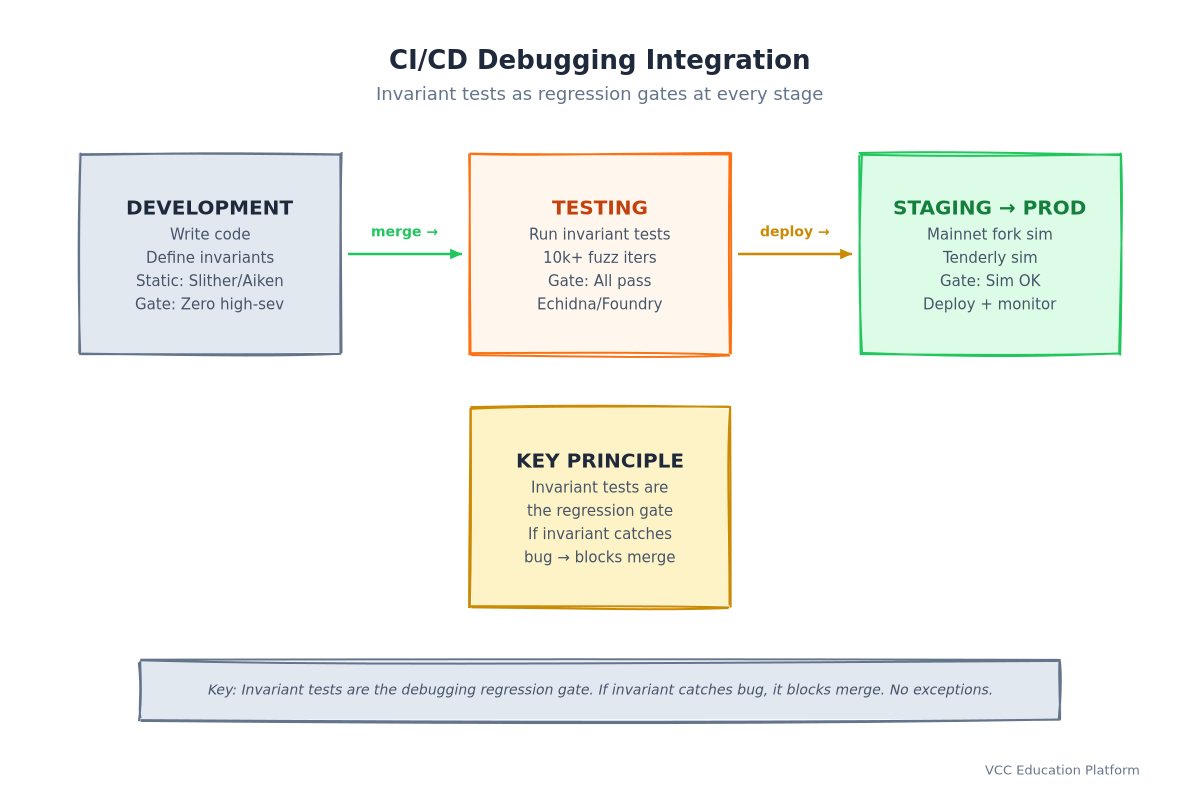
Debug không nên là afterthought. Embed checkpoint ở mỗi pipeline stage:
| Stage | Debugging Checkpoint | Gate Criteria |
|---|---|---|
| Development | Static analysis (Slither/Aiken) | Zero high-severity finding |
| Testing | Unit + Integration + Invariant test | 100% pass; invariant hold 10k fuzz run |
| Staging (Testnet/Mainnet Fork) | Fork simulation + Tenderly simulation | Critical path simulate thành công |
| Production | Monitoring + Alerting | Zero critical alert; invariant monitor green |
CI/CD Pipeline Example (GitHub Actions):
jobs:
  debug-checks:
    runs-on: ubuntu-latest
    steps:
      - uses: actions/checkout@v4
      - name: Static Analysis
        run: slither . --exclude-informational --fail-on high
      - name: Unit & Invariant Tests
        run: forge test --invariant-runs 10000
      - name: Fork Simulation
        run: forge script SimulateMainnet --fork-url $MAINNET_RPC
      - name: Tenderly Simulation
        run: tenderly simulate --fork-id $TENDERLY_FORK
DeFi-specific: Run fork simulation against recent mainnet state (100 block cuối), không genesis. Real liquidity distribution expose bug mà clean state miss.
Lỗi Debug Phổ Biến Lãng Phí Thời Gian
1. Chỉ đọc revert reason — Revert là symptom; cause cách 5-10 call trước trong trace.
2. Test với clean state — DeFi bug cần real liquidity, real oracle price, real user position. Fork mainnet.
3. Ignore event log — Deposit, Borrow, Liquidate event là debugging breadcrumb. Index chúng.
4. Single-chain mindset — Cross-chain bug cần dual-chain trace. Debug handoff, không chỉ mỗi side.
5. Fix mà không invariant test — Nếu không viết được invariant test fail trước fix và pass sau, bạn chưa prove fix work.
6. Tool obsession hơn methodology — Tenderly, Hardhat, Foundry interchangeable. 5-step framework work với bất kỳ.
7. Skip post-mortem — Mỗi incident dạy một invariant mới. Add vào test suite hoặc cùng bug return.
Câu Hỏi Thường Gặp Về DeFi Debugging
Q: DeFi smart contract bug phổ biến nhất là gì?
A: AMM invariant violation (rounding/precision), oracle manipulation (stale/fake price), reentrancy qua flash loan callback, MEV extraction (sandwich/JIT), và cross-chain message failure. 5 category này cover ~80% major DeFi incident.
Q: Làm sao debug failed transaction trên mainnet?
A: 1) Get transaction hash. 2) Load trong Tenderly/Phalcon/Blockscout. 3) Expand full call trace. 4) Find first state change trong contract của bạn deviate từ expected. 5) Map đến DeFi bug taxonomy. 6) Reproduce trong forked environment.
Q: Tool debug nào nên dùng cho DeFi protocol?
A: Dùng Foundry cho local development (nhanh nhất), Tenderly cho production trace (UI tốt nhất), Slither cho static analysis (catch pre-deployment), Echidna/Foundry invariant cho economic logic. Methodology quan trọng hơn tool.
Q: Làm sao set up invariant testing cho AMM?
A: Define 3-5 core invariant (reserve product, fee growth, proportional ownership). Viết làm invariant function trong Foundry hay Echidna property. Run trong CI với 10k+ iteration. Test against forked mainnet state monthly.
Q: Khác biệt giữa debug DeFi vs regular smart contract?
A: Regular contract: logic bug (off-by-one, access control). DeFi contract: economic logic bug (invariant violation, oracle dependence, composability risk). DeFi debugging đòi hỏi financial domain knowledge + on-chain forensics skill.
Bước Tiếp Theo: Nâng Cấp DeFi Debugging Skill
1. Chọn một protocol bạn dùng và viết 3 invariant test cho core math
2. Set up mainnet forking trong local environment (Foundry/Hardhat)
3. Add Tenderly/Blockscout vào incident response runbook
4. Run post-mortem trên bug cuối cùng bạn fix — invariant nào sẽ catch nó?
5. Join debugging community — follow @tenderly, @phalcon_xyz, @foundry_rs cho technique mới nhất
Debug DeFi là craft. Framework và tool evolve, nhưng methodology — reproduce, isolate, hypothesize với domain knowledge, validate với invariant, regress với automation — vẫn là north star. Bắt đầu với một invariant test hôm nay.
Cập nhật: 2026-09-04 | Author: Technical Writer | Nguồn: Chainlink, Alchemy, OpenZeppelin, Tenderly, Slither, Euler/Mango/Nomad/Curve incident report*