
Hãy tưởng tượng bạn đang ở một chợ đông người ở Việt Nam – chẳng hạn như chợ Bến Thành ở Thành phố Hồ Chí Minh – và muốn mua măng cụt tươi. Bạn có thể đến một quầy và chấp nhận giá của họ. Hoặc bạn có thể đi dạo khắp chợ, so sánh giá ở mỗi quầy, thương lượng với mỗi nhà bán và mua những món hàng tốt nhất. Bạn sẽ có được măng cụt tốt hơn với giá rẻ hơn, nhưng bạn sẽ phải mất nhiều giờ đi bộ trong nắng nóng.
DeFi aggregator platforms are the digital equivalent of a personal shopping assistant who instantly checks every stall, negotiates the best combined price, and delivers your mangoes in a single transaction — all while you sip cà phê sữa đá.
In the fragmented world of decentralized finance, where liquidity is scattered across dozens of DEXes, hundreds of pools, and multiple blockchains, DeFi aggregator platforms solve the liquidity fragmentation problem by routing your trades through the optimal path across all available sources. They're the Google Maps of DeFi: you specify the destination (token B), and they find the fastest, cheapest route through a constantly shifting landscape of liquidity.
Tại sao phân mảnh về tính thanh khoản đòi hỏi sự tập hợp
Vấn đề: Thousands of hồ, không có một giá tốt nhất
As of 2024, the DeFi landscape spans:
- 50+ major DEXes across Ethereum, BSC, Polygon, Arbitrum, Optimism, Base, Solana, and more
- 10,000+ active liquidity pools on Ethereum mainnet alone
- $100B+ in combined TVL fragmented across venues
- New pools launching daily — Uniswap V3 concentrated positions, Curve stable pools, Balancer weighted pools, Solidly-style volatile pools
When you want to swap USDC for WETH on Ethereum, the "best price" isn't on a single DEX. It might be:
- 40% on Uniswap V3 (0.05% fee tier)
- 30% on Curve (tricrypto pool)
- 20% on Balancer (weighted pool)
- 10% via an off-chain market maker quote (RFQ)
No single venue has deep enough liquidity for large orders without massive slippage. Aggregation stitches these fragments together.
The Cost of Ignoring Aggregation
A 2023 study by Kaiko Research found that non-aggregated swaps on Ethereum mainnet lost users an average of 0.3-0.8% to slippage and suboptimal routing — on a $10,000 trade, that's $30-80 left on the table per transaction. For active traders or DAOs managing treasuries, this compounds to thousands annually.
How DeFi Aggregation Works Under the Hood
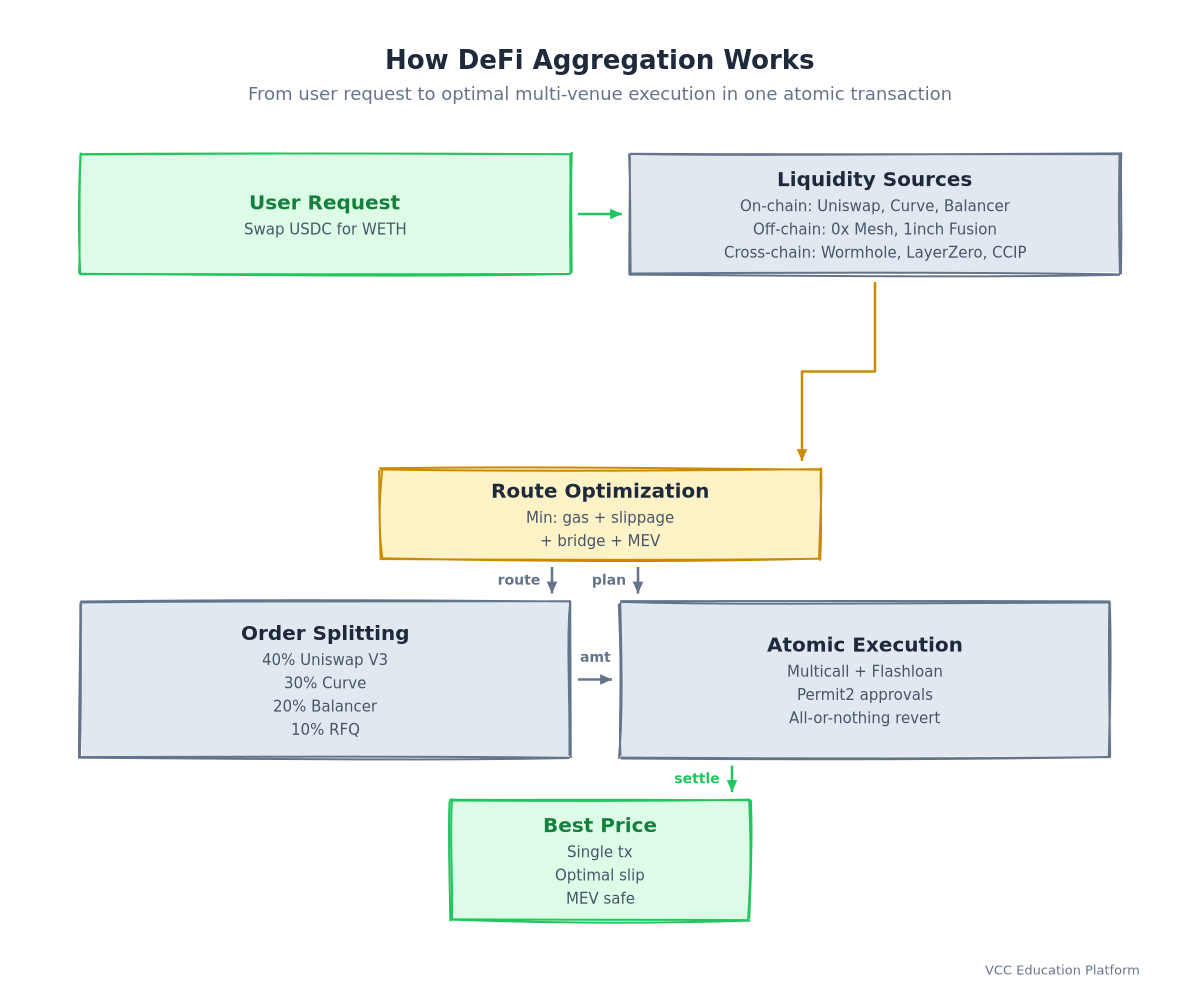
Flowchart - How DeFi Aggregation Works
Step 1: Liquidity Discovery — Querying Every Source Simultaneously
When you initiate a swap on an aggregator, its backend doesn't just check one DEX. It simultaneously queries:
On-chain sources (real-time, trustless):
- Uniswap V2 / V3 / V4 (all fee tiers)
- Curve (stable, crypto, tricrypto, factory pools)
- Balancer (weighted, stable, boosted pools)
- SushiSwap, PancakeSwap, Trader Joe, Camelot, Velodrome
- Chain-specific DEXes: Jupiter (Solana), PancakeSwap (BSC), QuickSwap (Polygon)
Off-chain sources (speed, size):
- RFQ (Request for Quote) networks: 0x Mesh, 1inch Fusion, Paraswap Augustus — professional market makers compete to fill your order
- CEX liquidity via bridges: Some aggregators tap Binance/Coinbase liquidity through institutional bridges
Cross-chain sources:
- Bridge + DEX combinations (Wormhole → Jupiter, LayerZero → PancakeSwap)
- Native cross-chain protocols: Thorchain, Maya Protocol
Intent-based networks (emerging):
- UniswapX fillers, CoW Protocol solvers, 1inch Fusion resolvers — you state what you want, solvers compete on how
Step 2: Route Optimization — The Algorithmic Brain
Each aggregator runs proprietary routing algorithms. Here's how the major ones differ:
| Aggregator | Algorithm | Key Innovation |
|---|---|---|
| 1inch Pathfinder | Graph search (Dijkstra variant) | Multi-hop up to 4 hops, gas-aware edge weights, dynamic pruning |
| 0x / Matcha | RFQ + Mesh + On-chain hybrid | RFQ for >$10k orders, on-chain for small, Mesh for maker diversity |
| Paraswap Augustus v6 | Weighted graph with gas cost | Booster (gas refund via MEV capture), dynamic gas estimation |
| UniswapX | Dutch auction (off-chain) | Giá tăng theo thời gian, các nhà cung cấp cạnh tranh, không có phí chuyển đổi |
| Protokol CoW | Batch auctions (CoW) | Coincidence of wants matching, surplus returned to user |
Core optimization challenge: Find the path minimizing total_cost = gas_cost + slippage_cost + bridge_fees + opportunity_cost
This is NP-hard in the general case (subset sum + shortest path). Production systems use:
- Heuristic pruning: Discard paths >3 hops unless gas is very low
- Gas-aware scoring: Edge weight =
estimated_gas × gas_price + price_impact - Caching: Reuse recent route calculations for similar pairs
- Simulation: Fork mainnet state, simulate execution, measure actual output
Step 3: Order Splitting — Proportional Allocation
Once the optimal route graph is computed, the aggregator splits your order:
` Total USDC → 40% Uniswap V3 (0.05%) → 30% Curve tricrypto → 20% Balancer weighted → 10% RFQ market maker `
Splitting logic considers:
- Liquidity depth: Deeper pools get larger shares
- Price impact: Marginal slippage per additional dollar
- Gas efficiency: Fewer hops when gas > 50 gwei
- MEV risk: Avoid routes known for sandwich attacks
Step 4: Atomic Execution — All or Nothing
The magic: all splits execute in a single transaction. If any leg fails (price moved, pool drained), the entire transaction reverts. You never end up with partial fills at bad prices.
This is achieved through:
- Multicall contracts: Batch multiple DEX interactions
- Flashloan-assisted routing: Borrow intermediate tokens, repay in same tx
- Permit2 / EIP-2612: Gasless approvals for ERC-20 tokens
Major Aggregator Platforms: Head-to-Head Comparison
Comparison - Major Aggregator Platforms
1inch: The Volume Leader
- Chains: 10+ (Ethereum, BSC, Polygon, Arbitrum, Optimism, Base, Avalanche, Gnosis, Fantom, Solana)
- Routing: Pathfinder v5/v6 (on-chain) + Fusion (intent-based)
- Unique features: Limit orders, Fusion mode (gasless, MEV-protected), 1inch Earn (yield aggregation)
- Best for: High-volume traders, multi-chain users, limit order needs
- Trade-off: Complex UI, Fusion requires 1INCH staking for best rates
Matcha / 0x: The RFQ Pioneer
- Chains: 8 EVM chains
- Routing: RFQ (professional makers) + Mesh (decentralized) + On-chain fallback
- Unique features: Gasless trades via meta-transactions, 0x API for developers, Matcha Auto (DCA)
- Best for: Large orders (>$10k), developers building on 0x, gas-sensitive users
- Trade-off: Fewer chains than 1inch, RFQ less effective for small orders
Paraswap: The Gas Optimizer
- Chains: 9 EVM chains
- Routing: Augustus v6 (weighted graph, gas-aware)
- Unique features: Booster (gas refund up to 90% via MEV capture), institutional API, Paraswap Yield
- Best for: Gas optimization, high-frequency traders, institutions
- Trade-off: Smaller market maker network than 0x Mesh
UniswapX: The Intent-Based Challenger
- Chains: Ethereum + L2s (Arbitrum, Optimism, Base, Polygon)
- Routing: Dutch auction (off-chain fillers compete)
- Unique features: Zero swap fees, built-in MEV protection, no token approval needed (Permit2)
- Best for: Ethereum/L2 users prioritizing MEV protection, simple UX
- Trade-off: Limited to Uniswap ecosystem chains, no cross-chain yet
Protokol CoW: Nhà chuyên về đấu giá theo nhóm
- Liên kết: Ethereum + 4 L2s
- Quản lý tuyến đường: đấu giá theo nhóm (Khớp hợp giữa nhu cầu)
- Tính năng độc đáo: Lượng thừa được trả lại cho người dùng, phù hợp nội bộ trước khi quản lý tuyến đường bên ngoài, DAO CoW
Jupiter: Vua của Solana
- Liên kết: Chỉ hỗ trợ Solana
OpenOcean / Li.Fi / Socket: The Cross-Chain Aggregators
- Chains: 20+ (EVM + non-EVM)
- Routing: Bridge + DEX aggregation, hybrid CEX/DEX
- Unique features: Cross-chain in one click, unified API for developers
- Best for: Cross-chain swaps, multi-chain portfolio management
- Trade-off: Bridge risk, longer finality, higher complexity
Cross-Chain Aggregation: The Next Frontier
Architecture - Cross-Chain Aggregation Architecture
Cross-chain aggregation promises "swap any token on any chain to any token on any chain in one click." But it introduces compounded risk layers:
Dạng xếp chồng chéo
Nghĩa của người dùng
Cơ chế rủi ro: những gì bạn thực sự đang ký kết
| Nền tảng rủi ro | Description | Mitigation |
|---|---|---|
| Bridge Smart Contract Risk | Bridge contracts hold billions; hacks = total loss (Wormhole $320M, Nomad $190M) | Use audited bridges (CCIP, LayerZero v2), monitor bridge TVL |
| Finality Risk | Optimistic bridges (7-day challenge) vs ZK bridges (minutes) vs instant (CCIP) | Match urgency to bridge type; don't use optimistic for time-sensitive |
| Destination DEX Risk | Same risks as single-chain: rug pulls, admin keys, oracle manipulation | Stick to battle-tested DEXes on destination chain |
| Slippage Compounding | Slippage on source DEX + bridge fee + slippage on destination DEX | Aggregators should show total all-in cost, not just swap price |
| Atomicity Gap | True atomic cross-chain swaps don't exist yet (except HTLC/HTLC) | Understand: you may receive funds before source chain finalizes |
When Cross-Chain Aggregation Makes Sense
- Moving stablecoins between chains for yield farming
- Rebalancing multi-chain portfolios
- Accessing chain-specific opportunities (Solana memes, Base airdrops)
- Avoid for: Large treasury moves, time-sensitive arbitrage, risk-averse users
The Gas vs. Price Trade-off: Finding the Sweet Spot
Graph - Gas vs Price Trade-off Frontier
One of the most misunderstood aspects of aggregation: more routes ≠ always better.
The Pareto Frontier
` Price Improvement (%) ↑
| ● Cross-chain (gas cao, phạm vi rộng) | |
|---|---|
| ● Tách phân cấp nâng cao (3-4 hop) | |
| ● | |
| ● Basic aggregation (2 hops) | |
| ● Single DEX (baseline) |
+--------------------------------→ Gas Cost Low High `
Quantitative Example: $5,000 USDC → WETH on Ethereum (gas @ 30 gwei)
| Strategy | Hops | Est. Gas | Gas Cost | Price Improvement | Tổng lợi nhuận |
|---|---|---|---|---|---|
| DEX đơn (Uniswap V3) | 1 | 180k | $16.20 | 0% (baseline) | Baseline |
| Basic aggregation | 2 | 280k | $25.20 | 0.15% ($7.50) | -$17.70 |
| Advanced splitting | 3 | 420k | $37.80 | 0.35% ($17.50) | -$20.30 |
| 1inch Pathfinder (optimized) | 2-3 | 310k | $27.90 | 0.28% ($14.00) | -$13.90 |
Insight: On Ethereum mainnet at current gas prices, aggregation often loses money on trades under $10k unless gas is <15 gwei. The "sweet spot" shifts:
- Mainnet: >$10-20k trades, or gas <15 gwei
- L2s (Arbitrum, Optimism, Base): Almost always worth it (gas <$0.10)
- BSC/Polygon: Almost always worth it
- Solana: Always worth it (sub-cent gas)
Practical Rule for Vietnamese Users
Given VN users' high gas sensitivity: Default to L2 aggregators (Arbitrum/Base/Optimism) for trades under $5k. Only use Ethereum mainnet aggregation for >$20k or when L2 liquidity is insufficient.
Risks and Considerations: What Aggregators Don't Advertise
1. Smart Contract Risk
Aggregators route through multiple contracts: the aggregator router + each DEX router + token contracts. A bug in any component can drain funds.
- Mitigation: Use battle-tested aggregators (1inch, 0x, Paraswap audited by Trail of Bits, OpenZeppelin, Spearbit). Check audit reports.
2. Upgrade Risk
Most aggregator routers are upgradeable proxies. The admin (multisig/DAO) can change logic instantly.
- Mitigation: Monitor governance forums. 1inch uses timelock + DAO; 0x uses ZEIP process.
3. MEV Exposure
Even with aggregators, your transaction is visible in the mempool before execution. Sandwich attacks can still occur on the individual DEX legs.
- Mitigation: Use MEV-protected modes (1inch Fusion, UniswapX, CoW Protocol, Paraswap Booster). Private RPC (Flashbots Protect, BloXroute) for advanced users.
4. Price Impact Misestimation
Các máy tổng hợp mô phỏng các tuyến đường đối với trạng thái hiện tại. Tuy nhiên, giữa quá trình mô phỏng và thực thi (12 giây trên Ethereum), các giao dịch lớn của người khác có thể làm thay đổi giá.
5. Các vectơ tập trung
- 1inch: Quản trị token 1INCH, ảnh hưởng của nhóm nhân sự chính
- 0x: Quản trị ZRX, ảnh hưởng đáng kể của 0x Labs
- Paraswap: Quản trị PSP, nhóm nhân sự chính + nhà đầu tư
6. Bảo mật dữ liệu
Các giao diện front-end của máy tổng hợp (web/app) sẽ xem được: địa chỉ ví, kích thước giao dịch, các ưu tiên của token, các mẫu thời gian. - Giảm thiểu: Sử dụng các giao diện tập trung vào bảo mật, xem xét các API của máy tổng hợp thông qua giao diện của riêng bạn cho các giao dịch có giá trị cao.
Cách chọn nhà tổng hợp phù hợp: Khung quyết định
Flowchart - Aggregator Selection Decision Matrix
Mảng quyết định theo hồ sơ người dùng
| Nếu ưu tiên của bạn là ... | Công cụ tổng hợp được khuyến nghị | Why |
|---|---|---|
| Best all-around (EVM) | 1inch | Broadest chain coverage, deepest liquidity, Fusion for MEV protection |
| Large orders (>$10k) | Matcha / 1inch Fusion | RFQ network taps professional makers for size |
| Gas optimization | Paraswap (Booster) / L2 aggregators | Gas refunds, L2-native routing |
| MEV protection | UniswapX / CoW Protocol / 1inch Fusion | Intent-based, batch auctions, private mempool |
| Cross-chain swaps | Li.Fi / Socket / OpenOcean / 1inch Cross-chain | Bridge + DEX aggregation in one flow |
| Solana ecosystem | Jupiter | Purpose-built for Solana, best token coverage |
| Developer integration | 0x API / 1inch API / Li.Fi SDK | Best documentation, SDKs, rate limits |
| Yield + aggregation | 1inch Earn / Paraswap Yield / Yearn | Auto-compounding on top of swap optimization |
Quick-Start Checklist for New Users
- Start on an L2 (Arbitrum/Base/Optimism) — gas is negligible, aggregation always wins
- Use 1inch or Matcha — best UX, broadest support, good defaults
- Enable MEV protection (Fusion/UniswapX) for trades >$1k
- Check slippage settings — default 0.5% for stables, 1-2% for volatile
- Verify the route — most aggregators show "route breakdown" before confirm
- Test with small amount first — $50-100 to confirm flow
The Future: Intent-Based, Solver Networks, and Chain Abstraction
From "User Specifies Path" to "User Specifies Intent"
Mô hình hiện tại: Người dùng → chọn máy tổng hợp → máy tổng hợp tính toán đường đi → thực hiện
Đổi mới này (UniswapX, 1inch Fusion, CoW Protocol, Anoma, SUAVE) chuyển MEV từ những người tìm kiếm lấy từ người dùng sang những người giải quyết cạnh tranh cho dòng lệnh của người dùng. Lượng thừa sẽ đi đến người dùng, không phải những người tìm kiếm.
Tái hiện chuỗi: Kết thúc câu hỏi "Chuỗi nào?"
Các dự án như Particle Network, Near Chain Abstraction, Polygon AggLayer, LayerZero v2 đều hướng đến việc làm cho việc lựa chọn chuỗi trở nên không thể nhận biết. Bạn giữ USDC trên Arbitrum, muốn mua một token trên Base — lớp tổng hợp + trừu tượng sẽ xử lý việc kết nối, thanh toán gas và thực thi một cách mượt mà.
Tác động đối với các nhà tổng hợp: Họ trở thành lớp thực thi cho các giao diện dựa trên ý định và trừu tượng chuỗi. Thương hiệu "nhà tổng hợp" có thể biến mất, được hấp thụ vào các ví (Rabby, Zerion, Coin98) và các lớp dựa trên ý định.
Những điều cần cân nhắc về quy định
- **Các nhà tổng hợp như "nhà môi giới": Một số khu vực pháp lý có thể xem các nhà tổng hợp là nhà môi giới yêu cầu KYC (hướng dẫn của SEC Mỹ đang phát triển)
Người dùng Việt Nam nên theo dõi: chính sách quản lý DeFi của Việt Nam (hiện tại chưa rõ ràng, nhưng SBV đã cảnh báo về thanh toán bằng tiền điện tử). Các nhà tổng hợp không quản lý các khoản tiền, nhưng quyền truy cập giao diện trước có thể bị hạn chế.
FAQ: Các nền tảng tổng hợp DeFi
Điều gì là nền tảng tổng hợp DeFi?
Một nền tảng tổng hợp DeFi là một giao thức lấy nguồn vốn từ nhiều sàn giao dịch phi tập trung (DEX), nhà tạo thị trường và cầu nối đồng thời để cung cấp cho người dùng thực hiện giao dịch thay thế tối ưu – giá tốt nhất, phí gas thấp nhất và bảo vệ MEV – trong một giao dịch duy nhất.
DeFi aggregators kiếm tiền như thế nào?
Hầu hết các nhà tổng hợp thu phí protocoll (thường là 0,05-0,2% của khối lượng trao đổi) trên mức phí của DEX. Một số (UniswapX) không thu phí trao đổi và kiếm tiền thông qua lợi nhuận thừa của cuộc cạnh tranh. Một số khác có mã thông báo quản trị (1INCH, ZRX, PSP) thu lợi nhuận thông qua staking/hiệu suất.
DeFi aggregators có an toàn không?
Các nhà tổng hợp lớn (1inch, 0x, Paraswap, UniswapX) được kiểm toán bởi các công ty hàng đầu và đã xử lý hàng tỷ đô la trong khối lượng mà không có các lỗ hổng lớn. Tuy nhiên, chúng có rủi ro hợp đồng thông minh (hợp đồng router), rủi ro nâng cấp (chìa khóa quản trị) và rủi ro cầu nối (cho chuỗi xuyên suốt). Hãy luôn kiểm tra xem bạn đang ở trên miền chính thức.
Tôi có cần phê duyệt các token cho mỗi DEX không?
Không. Các công cụ tổng hợp hiện đại sử dụng Permit2 (EIP-2612) hoặc multicall để xử lý các phê duyệt theo nhóm. Bạn thường ký một chữ ký giấy phép không sử dụng gas, và công cụ tổng hợp xử lý tất cả các phê duyệt DEX bên trong.
Những khác biệt giữa DEX aggregator và yield aggregator là gì?
- DEX/liquidity aggregator (1inch, Matcha): Tối ưu hóa thực hiện trao đổi - giúp bạn nhận được giá tốt nhất khi giao dịch token A thành token B
Một số nền tảng (1inch Earn, Paraswap Yield) hiện đang kết hợp cả hai.
Tôi có thể sử dụng các công cụ tổng hợp trên thiết bị di động không?
Có. Tất cả các nhà tổng hợp lớn đều có ứng dụng web tương thích với thiết bị di động và một số có ứng dụng bản địa (1inch Wallet, Matcha Mobile, Coin98 tích hợp 1inch/Paraswap). Đối với người dùng Việt Nam sử dụng dữ liệu di động, nhà tổng hợp L2 (Arbitrum/Base) được khuyến nghị mạnh mẽ do phí gas gần như bằng 0.
Làm thế nào để tôi biết mình đang nhận được giá tốt nhất?
Xem báo cáo chi tiết đường đi trước khi xác nhận. Các nhà tổng hợp đáng tin cậy sẽ hiển thị: mỗi DEX được sử dụng, tỷ lệ phân chia, sản lượng dự kiến, ước tính gas và số tiền tối thiểu nhận được (với sự chênh lệch). So sánh 2-3 nhà tổng hợp cho các giao dịch lớn.
Nếu giao dịch thất bại giữa quá trình thực hiện, sẽ xảy ra điều gì?
Các máy tổng hợp sử dụng thực hiện nguyên tử: tất cả các bước đều thành công hoặc toàn bộ giao dịch bị hủy. Bạn sẽ không bao giờ có một giao dịch bị chia đôi. Chi phí duy nhất là phí gas cho giao dịch thất bại.
Có những công cụ tổng hợp cho NFT không?
Có — Blur, OpenSea Pro, Gem.xyz tổng hợp các danh sách trên thị trường NFT. Tuy nhiên, chúng hoạt động theo cách khác nhau (tổng hợp sổ đặt hàng so với tổng hợp lưu lượng thanh khoản của AMM) và là một danh mục riêng biệt.
Những điều cần lưu ý
- Các nền tảng tổng hợp DeFi là cơ sở hạ tầng quan trọng – chúng giải quyết sự phân mảnh về lưu lượng bằng cách chuyển giao giao dịch trên 50+ DEX, các mạng RFQ và các cầu nối
- Không phải tất cả các tổng hợp đều bình đẳng – các thuật toán (Pathfinder, RFQ, đấu giá theo kiểu Hà Lan, đấu giá theo lô) tạo ra các kết quả khác nhau cho các kích thước và chuỗi giao dịch khác nhau
Bắt đầu tích hợp ngay hôm nay
Đối với người dùng Việt Nam mới sử dụng dịch vụ tích hợp:
- Truy cập 1inch.io hoặc matcha.xyz trên trình duyệt di động của bạn
- Kết nối ví của bạn (MetaMask, Coin98, Rabby)
- Thay đổi sang lưới Arbitrum hoặc Base (chọn lưới ở góc trên bên phải)
- Thử giao dịch $50 USDC → WETH – so sánh chi tiết các lựa chọn qua 2-3 dịch vụ tích hợp
- Bật bảo vệ MEV (Fusion trên 1inch, Auto trên Matcha)
- Tăng cường khi bạn có thêm tự tin
Những quả mận đang chờ đợi. Người mua hàng cá nhân của bạn đã sẵn sàng.
Thông báo: Bài viết này chỉ dành cho mục đích giáo dục. DeFi có rủi ro lớn bao gồm thất bại của hợp đồng thông minh, biến động thị trường và mất toàn bộ tiền vốn. Hãy luôn thực hiện nghiên cứu của riêng bạn và không bao giờ đầu tư nhiều hơn số tiền bạn có thể chịu mất.