
Các mẫu hợp đồng thông minh DeFi đã phát triển từ những thử nghiệm lý thuyết thành xương sống của hàng tỷ USD Tổng Giá Trị Khóa (TVL). Khi Uniswap V3 triển khai hơn 4.000 pool sử dụng mẫu factory, và Aave V3 áp dụng kiến trúc diamond để quản lý rủi ro mô-đun, các mẫu này chứng minh chúng không phải là bài tập học thuật — chúng là cơ sở hạ tầng sản xuất. Tuy nhiên, mỗi hợp đồng có thể nâng cấp mang theo một "thuế" ẩn: ~400-800 gas cho mỗi delegatecall, gánh nặng nhận thức cho nhà phát triển, và một giả định niềm tin mới cho người dùng. Hướng dẫn này xuyên qua độ phức tạp để giúp bạn chọn mẫu phù hợp cho giao thức DeFi của mình.
Vấn Đề Nâng Cấp Capability Trong DeFi
Hợp đồng thông minh mặc định là bất biến. Sau khi triển khai, mã của chúng không thể thay đổi — đây là tính năng, không phải lỗi, để tối thiểu hóa niềm tin. Nhưng các giao thức DeFi đối mặt với hai khó: lỗi tồn tại, quy định phát triển, và thị trường đòi hỏi tính năng mới. Sự cố Wormhole năm 2022 ($320M) khai thác lỗi xác thực chữ ký mà một lần nâng cấp kịp thời có thể ngăn chặn. Sự cố Euler Finance năm 2023 ($197M) liên quan đến lỗi logic quyên góp được vá sau khai thác. Các sự cố này không chỉ tốn tiền — chúng định hình lại cách các giao thức suy nghĩ về khả năng nâng cấp.
Đánh Giá Tránh-off: Bất Biến vs Có Thể Nâng Cấp
| Dimensión | Bất Biến | Có Thể Nâng Cấp |
|---|---|---|
| Niềm Tin | Code là pháp luật | Admin có thể thay đổi logic |
| Gas | Gọi trực tiếp | ~400-800 gas/delegatecall |
| Audit | Audit một lần | Audit lại mỗi lần nâng cấp |
| Governance | Không cần | Cần Timelock/multisig/DAO |
| Phản Ứng Lỗi | Triển khai mới, di chuyển | Vá tại chỗ |
"Thuế Proxy" vượt ra ngoài gas. Mỗi proxy thêm gánh nặng nhận thức: nhà phát triển phải hiểu delegatecall, quy tắc layout storage, và mẫu initializer. Debugger và tracer thường gặp khó khăn với call stack proxy. Auditor thu phí cao 30-50% cho codebase proxy. Governance gây độ trễ — timelock trì hoãn sửa lỗi quan trọng 24-72 giờ.
Insight gốc: Xem việc áp dụng proxy như "nợ kỹ thuật có lãi". Chỉ proxy các hợp đồng có >50% khả năng cần nâng cấp trong 2 năm. Token ERC20 đơn giản, vault cơ bản, và hợp đồng triển khai một lần hiếm khi đáng giá thuế này.
Các Sự Cổ Thực Thực Tế Thúc Đẩy Việc Áp Dụng Mẫu
Sự chuyển dịch về các mẫu có thể nâng cấp tương quan với các sự cố DeFi lớn:
- bZx (2020): Thao túng oracle → nâng cấp logic price feed qua proxy
- Harvest Finance (2020): Khai thác arbitrage → nâng cấp khẩn cấp để pause hợp đồng
- Poly Network (2021): Khai thác cross-chain → proxy cho phép khôi phục
- Wormhole (2022): Xác thực chữ ký → guardian set có thể nâng cấp
- Euler (2023): Logic quyên góp → nâng cấp sau hack để ngăn chặn lặp lại
Mỗi sự cố củng cố một mẫu: giao thức có khả năng nâng cấp khôi phục nhanh hơn. Nhưng chúng cũng tiết lộ rủi ro governance — khóa admin trở thành mục tiêu giá trị cao.

Phân Tích Sâu Proxy Pattern
Các mẫu proxy sử dụng delegatecall để tách logic hợp đồng (implementation) khỏi state (proxy storage). Proxy giữ tiền người dùng và state; implementation chứa business logic. Khi implementation cần cập nhật, địa chỉ implementation của proxy thay đổi — state được giữ nguyên.
Standard Proxy (Chuyển Tiếp Delegatecall)
Proxy đơn giản nhất chuyển tiếp tất cả calls đến địa chỉ implementation:
`solidity // Minimal proxy - KHÔNG cho production (không có cơ chế nâng cấp) contract SimpleProxy { address public implementation;
constructor(address _impl) { implementation = _impl; }
fallback() external payable { address impl = implementation; assembly { calldatacopy(0, 0, calldatasize()) let result := delegatecall(gas(), impl, 0, calldatasize(), 0, 0) returndatacopy(0, 0, returndatasize()) if iszero(result) { revert(0, returndatasize()) } return(0, returndatasize()) } } } `
Vấn đề: Không có cơ chế nâng cấp. Sau triển khai, implementation cố định.
Transparent Proxy (OpenZeppelin)
Transparent Proxy (tuân thủ EIP-1967) giải quyết "clash function selector" bằng cách route admin calls khác với user calls:
`solidity // Logic TransparentUpgradeableProxy đơn giản hóa contract TransparentProxy { // Admin functions: upgradeTo, changeAdmin, admin() // User functions: delegated to implementation // Selector check: if msg.sender == admin → admin logic, else delegatecall } `
Storage slots (EIP-1967):
- Implementation:
0x360894a13ba1a3210667c828492db98dca3e2076cc3735a920a3ca505d382bbc - Admin:
0xb53127684a568b3173ae13b9f8a6016e243e63b6e8ee1178d6a717850b5d6103
Đánh giá: Mọi user call trả gas cho check msg.sender == admin (~200 gas). Admin không thể gọi implementation functions trực tiếp.
UUPS (Universal Upgradeable Proxy Standard - EIP-1822)
UUPS di chuyển logic nâng cấp vào implementation, tiết kiệm gas trên user calls:
`solidity // ERC1822Proxiable interface interface IERC1822Proxiable { function proxiableUUID() external view returns (bytes32); }
// Implementation phải implement upgrade logic contract UUPSImplementation is IERC1822Proxiable, Initializable { function proxiableUUID() external view override returns (bytes32) { return type(IERC1822Proxiable).interfaceId; }
function upgradeTo(address newImpl) external { // Access control: onlyAuthorized() // Validate newImpl implements proxiableUUID() // Update implementation slot }
// Storage gap cho nâng cấp tương lai uint256[50] private __gap; } `
Ưu điểm: Không check admin trên user calls. Implementation tự kiểm soát nâng cấp. ~200 gas rẻ hơn mỗi call so với Transparent Proxy.
Rủi ro: Nếu upgradeTo có bug, hợp đồng bị brick vĩnh viễn. Không có admin fallback.
Beacon Proxy (EIP-1967 Beacon)
Dùng cho việc triển khai nhiều proxy trỏ đến cùng implementation:
`solidity contract BeaconProxy { // Trỏ đến Beacon contract // Beacon lưu địa chỉ implementation // Nâng cấp beacon → tất cả proxy cập nhật cùng lúc } `
Được dùng bởi: Lido (stETH), Rocket Pool — hàng chục validator chia sẻ logic.
So Sánh Proxy: Gas, Storage, Governance
| Mẫu | User Call Gas | Upgrade Gas | Rủi Ro Collision Storage | Admin Fallback | Phù hợp Cho |
|---|---|---|---|---|---|
| Transparent | +600-800 | ~50k | Thấp (EIP-1967 slots) | Có | General purpose |
| UUPS | +400-600 | ~40k | Trung bình (impl kiểm soát) | Không | Gas-sensitive |
| Beacon | +400-600 | ~30k (beacon) | Thấp | Có | Nhiều clone |
| Standard | +400-600 | N/A | Cao (không standard) | N/A | Triển khai một lần |

Diamond Pattern (EIP-2535): Kiến Trúc DeFi Mô-đun
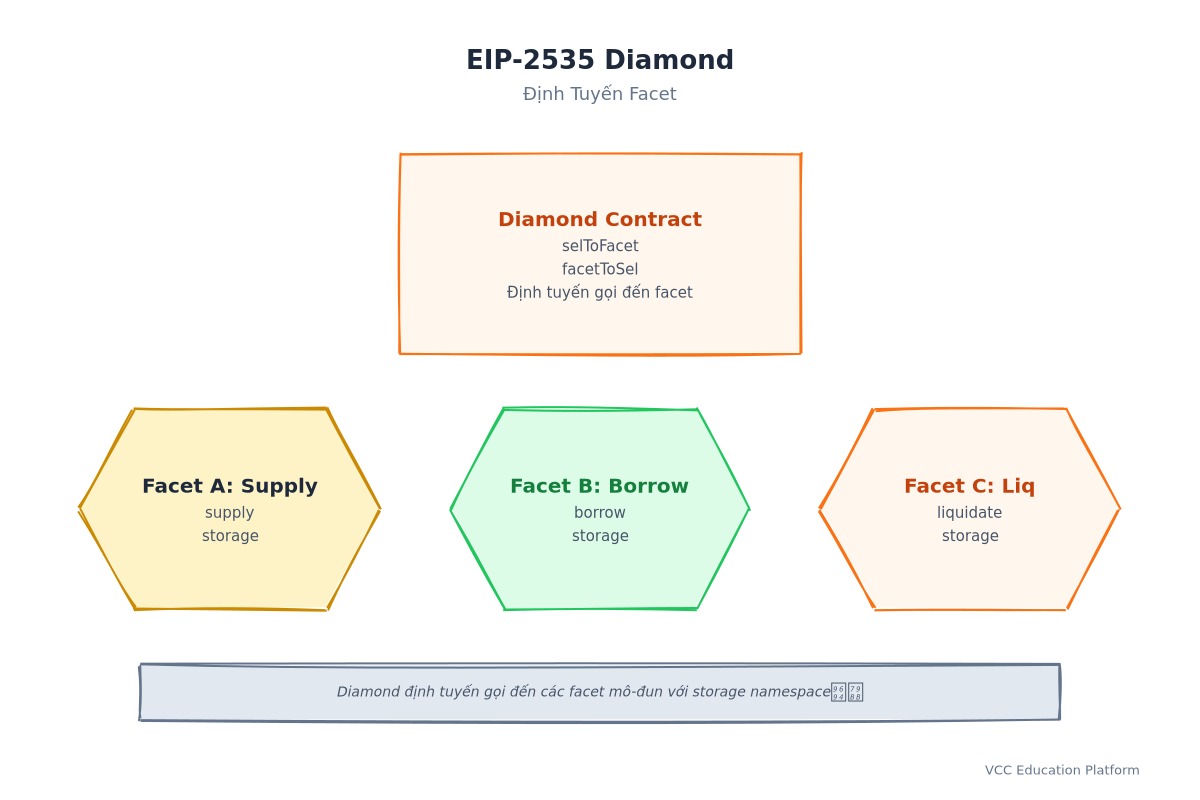
Nếu proxy là "single inheritance", diamond là "composition over inheritance". Diamond Standard (EIP-2535) cho phép một hợp đồng đơn lẻ expose nhiều "facet" — các hợp đồng độc lập chia sẻ cùng địa chỉ và storage. Hãy nghĩ như microservices cho hợp đồng thông minh: facets = services, diamond storage = shared database với namespace isolation, loupe functions = service discovery.
Định Tuyến Facet và Function Selector
Fallback function của diamond route calls đến facet đúng:
`solidity contract Diamond { // mapping(bytes4 => FacetAddress) selectorToFacet // mapping(address => bytes4[]) facetToSelectors
fallback() external payable { bytes4 selector = msg.sig; address facet = selectorToFacet[selector]; require(facet != address(0), "Function not found");
assembly { calldatacopy(0, 0, calldatasize()) let result := delegatecall(gas(), facet, 0, calldatasize(), 0, 0) returndatacopy(0, 0, returndatasize()) if iszero(result) { revert(0, returndatasize()) } return(0, returndatasize()) } } } `
Mỗi facet sở hữu một tập function selector. Không hai facet chia sẻ selector. Thêm/thay thế/xóa facet dùng diamondCut:
`solidity struct FacetCut { address facetAddress; bytes4[] functionSelectors; bool isReplacement; // true = replace, false = add }
function diamondCut(FacetCut[] calldata cuts) external { // Validate: no selector conflicts, facet implements functions // Apply cuts atomic // Emit DiamondCut event } `
Diamond Storage vs AppStorage
Hai cách tiếp cận cho shared state:
AppStorage (Single Struct): `solidity struct AppStorage { uint256 totalSupply; mapping(address => uint256) balances; // Tất cả state trong một struct } AppStorage internal s; // Slot 0 ` Ưu: Đơn giản, quen thuộc. Nhược: Tất cả facet chia sẻ namespace — rủi ro collision.
Diamond Storage (Namespaced): `solidity // Facet A storage bytes32 constant FACET_A_STORAGE = keccak256("diamond.storage.facetA"); struct FacetAStorage { uint256 a; } FacetAStorage storage a = FacetAStorage(FACET_A_STORAGE);
// Facet B storage bytes32 constant FACET_B_STORAGE = keccak256("diamond.storage.facetB"); struct FacetBStorage { uint256 b; } FacetBStorage storage b = FacetBStorage(FACET_B_STORAGE); ` Ưu: Zero collision risk, facet thực sự độc lập. Nhược: Verbose hơn, multiple storage reads.
Aave V3 dùng Diamond Storage cho risk management modules — mỗi market configuration isolated trong namespace riêng.
Loupe Functions Cho Introspection
EIP-2535 yêu cầu bốn "loupe" functions cho introspection on-chain:
`solidity interface IDiamondLoupe { function facets() external view returns (Facet[] memory); function facetFunctionSelectors(address facet) external view returns (bytes4[] memory); function facetAddresses() external view returns (address[] memory); function facetAddress(bytes4 selector) external view returns (address); } `
Chúng cho phép:
- Frontend khám phá các function có sẵn
- Auditor verify facet deployment
- Governance audit proposed cuts
Thêm/Thay Thế/Xóa Facet
Function diamondCut xử lý tất cả modifications atomic:
`solidity // Thêm facet mới với 3 functions FacetCut({ facetAddress: address(newFacet), functionSelectors: [selector1, selector2, selector3], isReplacement: false })
// Thay thế facet (migrate logic) FacetCut({ facetAddress: address(newFacetV2), functionSelectors: [selector1, selector2], // Same selectors isReplacement: true })
// Xóa facet FacetCut({ facetAddress: address(0), functionSelectors: [selector1, selector2], isReplacement: false }) `
Quan trọng: diamondCut phải access-controlled (timelock + multisig). Một cut độc hại có thể drain tất cả diamond storage.
Factory Pattern (EIP-1167): Mở Rộng Triển Khai DeFi
Factory pattern triển khai nhiều clone của một template contract. EIP-1167 (Minimal Proxy) giảm deployment gas từ ~500k xuống ~45k — tiết kiệm 10x. Factory của Uniswap V3 tạo ~4.000 pools. Ở 20 gwei: 4.000 × 500k gas = 2B gas ($500k) vs 4.000 × 45k = 180M gas ($45k). Factory pattern làm cho triển khai permissionless trở nên khả thi về kinh tế.
Minimal Proxy (Clone Factory)
`solidity // EIP-1167 Minimal Proxy bytecode (45 bytes) contract CloneFactory { bytes20 internal constant MINIMAL_PROXY_BYTECODE = 0x363d3d373d3d3d363d730000000000000000000000005af43d82803e903d91602b57fd5bf3;
function createClone(address template) external returns (address clone) { bytes memory bytecode = bytes(MINIMAL_PROXY_BYTECODE); // Insert template address at offset 10 bytecode[10:30] = abi.encodePacked(template);
assembly { clone := create(0, add(bytecode, 32), mload(bytecode)) if iszero(extcodesize(clone)) { revert(0, 0) } } // Initialize clone IInitializable(clone).initialize(msg.sender); return clone; } } `
Cách hoạt động: Runtime code của clone chỉ là delegatecall đến template. State sống trong clone; logic trong template. Template phải là Initializable (không có constructor).
CREATE2 Địa Chỉ Xác Định
CREATE2 cho phép tính toán địa chỉ clone trước khi triển khai:
`solidity function createCloneCREATE2(address template, bytes32 salt) external returns (address clone) { bytes memory bytecode = bytes(MINIMAL_PROXY_BYTECODE); bytecode[10:30] = abi.encodePacked(template);
assembly { clone := create2(0, add(bytecode, 32), mload(bytecode), salt) if iszero(extcodesize(clone)) { revert(0, 0) } } IInitializable(clone).initialize(msg.sender); return clone; }
// Dự đoán địa chỉ (off-chain hoặc on-chain) function predictAddress(address template, bytes32 salt) public view returns (address) { return address(uint160(uint256(keccak256(abi.encodePacked( bytes1(0xff), address(this), salt, keccak256(bytecode) ))))); } `
Uniswap V3 dùng CREATE2 cho pool addresses: salt = keccak256(abi.encodePacked(tokenA, tokenB, fee)). Bất kỳ ai có thể tính toán pool address trước khi nó tồn tại.
Factory Với Initialization Parameters
Clone thường cần cấu hình per-instance:
`solidity interface IInitializable { function initialize(address owner, uint256 param1, string calldata param2) external; }
contract ConfigurableCloneFactory { function createClone( address template, address owner, uint256 param1, string calldata param2 ) external returns (address clone) { clone = createClone(template); IInitializable(clone).initialize(owner, param1, param2); return clone; } } `
Rủi ro front-running: Giữa create và initialize, clone chưa initialized. Mitigation: atomic create+initialize via create2 với initialization data trong bytecode, hoặc dùng ERC1167 với initialize trong constructor (không thể với minimal proxy).
Khung So Sánh & Lựa Chọn Mẫu
Việc chọn mẫu phù hợp phụ thuộc vào ràng buộc của giao thức. Đây là khung quyết định:
Bảng So Sánh Chi Phí Gas
| Operation | Direct Call | Transparent Proxy | UUPS | Diamond | Minimal Proxy Deploy |
|---|---|---|---|---|---|
| Function call | Baseline | +600-800 | +400-600 | +600-1000 | N/A |
| Deploy new logic | ~500k+ | ~50k (proxy) | ~40k (impl) | ~60k (facet) | ~45k (clone) |
| Upgrade | Redeploy | ~50k | ~40k | ~50k (cut) | Redeploy template |
| Storage read | Baseline | Baseline | Baseline | +100 (namespace) | Baseline |
Ma Trận Complexity vs Flexibility
| Mẫu | Complexity | Flexibility | Upgrade Granularity | Audit Burden |
|---|---|---|---|---|
| Transparent Proxy | Thấp | Trung bình | Whole contract | Trung bình |
| UUPS | Trung bình | Trung bình | Whole contract | Trung bình |
| Beacon | Trung bình | Thấp | All clones at once | Trung bình |
| Diamond | Cao | Cao | Per facet | Cao |
| Factory | Thấp | Thấp | Template only | Thấp |
Flowchart Quyết Định: Chọn Mẫu Nào?
` START: Cần nâng cấp capability? │ ├─ KHÔNG → Triển khai immutable contract (gas thấp nhất, niềm tin cao nhất) │ └─ CÓ → Nhiều module độc lập cần nâng cấp riêng biệt? │ ├─ CÓ → Diamond Pattern (EIP-2535) │ ├─ Cần introspection on-chain? → Loupe functions │ └─ Team có diamond expertise? → Nếu không, suy nghĩ lại │ └─ KHÔNG → Nhiều hợp đồng tương tự (pools, vaults, positions)? │ ├─ CÓ → Factory + Minimal Proxy (EIP-1167) │ ├─ Cần địa chỉ xác định? → CREATE2 │ └─ Template hiếm khi thay đổi? → Good fit │ └─ KHÔNG → Single contract, nâng cấp đôi khi? │ ├─ Gas quan trọng? → UUPS (EIP-1822) ├─ Cần admin fallback? → Transparent Proxy └─ Nhiều proxy cùng logic? → Beacon Proxy `
Case Study Giao Thức DeFi Thực Tế
Uniswap V3: Factory + Pool Deployment
Kiến trúc Uniswap V3 chứng minh sự thành thạo factory pattern:
`solidity // UniswapV3Factory.sol (đơn giản hóa) contract UniswapV3Factory { address public poolTemplate; // Minimal proxy template
function createPool(address tokenA, address tokenB, uint24 fee) external returns (address pool) { (tokenA, tokenB) = sortTokens(tokenA, tokenB); bytes32 salt = keccak256(abi.encodePacked(tokenA, tokenB, fee)); pool = createPoolByCREATE2(tokenA, tokenB, fee, salt); }
function createPoolByCREATE2(...) internal returns (address pool) { // CREATE2 deployment với fee-specific initialization } } `
Quyết định chính:
- CREATE2 cho deterministic pool addresses (cho phép off-chain routing)
- Fee tiers (0.01%, 0.05%, 0.3%, 1%) làm separate pools
- Pool template immutable — nâng cấp qua factory version mới
- ~45k gas mỗi pool vs ~500k+ cho full deployment
Aave V3: Proxy + Diamond Module System
Aave V3 kết hợp các mẫu: Transparent Proxy cho core protocol, Diamond cho risk modules:
` AaveV3Pool (Transparent Proxy) └── PoolLogic (Implementation) └── Diamond (Risk Management) ├── Facet: SupplyLogic ├── Facet: BorrowLogic ├── Facet: LiquidationLogic ├── Facet: EmissionLogic └── Facet: ConfigurationLogic `
Tại sao composition này?
- Pool logic nâng cấp hiếm (Transparent Proxy đủ)
- Risk parameters thay đổi thường xuyên (Diamond cho phép per-facet upgrades)
- Loupe functions cho phép frontend khám phá active risk modules
- Isolation: bug liquidation logic không ảnh hưởng supply logic
OpenZeppelin Contracts Wizard: Pattern Composition
OpenZeppelin Wizard tạo starter code kết hợp các mẫu:
`solidity // Wizard output: UUPS + Ownable + ERC20 + AccessControl contract MyToken is ERC20Upgradeable, ERC20PermitUpgradeable, OwnableUpgradeable, AccessControlUpgradeable, UUPSUpgradeable { function initialize(...) public initializer { ... }
function _authorizeUpgrade(address newImpl) internal override onlyRole(UPGRADER_ROLE) { } } `
Bài học: Giao thức thực kết hợp các mẫu. Aave dùng Proxy + Diamond. Uniswap dùng Factory + Immutable Pools. Compound dùng Transparent Proxy + Timelock.
Anti-Patterns & Sai Lầm Thường Gặp
Storage Collision Vulnerabilities
Vulnerability nâng cấp #1: implementation mới ghi vào sai storage slot.
`solidity // V1: Single variable contract V1 { uint256 public value; }
// V2: Thêm variable TRƯỚC variable hiện có - COLLISION! contract V2 { uint256 public newValue; // Slot 0 - GHI ĐÈ value! uint256 public value; // Slot 1 } `
Fix: Storage gaps (OpenZeppelin pattern):
`solidity contract V1 { uint256 public value; uint256[50] private __gap; // Reserve 50 slots }
contract V2 { uint256 public value; uint256 public newValue; // Dùng gap slot uint256[49] private __gap; // 49 còn lại } `
Diamond storage loại bỏ điều này qua namespaced keccak256 keys.
Initializer vs Constructor Pitfalls
Constructors không chạy trong proxy context. Dùng initializer modifier:
`solidity // SAI: Constructor chạy ở deploy, không phải trong proxy contract BadImplementation { constructor() { owner = msg.sender; } // Chạy khi deploy implementation! }
// ĐÚNG: Initializer chạy khi proxy gọi initialize() contract GoodImplementation is Initializable, OwnableUpgradeable { function initialize(address _owner) public initializer { __Ownable_init(_owner); } } `
Bug phổ biến: Quên initializer modifier → tấn công reinitialization.
Governance Attack Vectors
| Vector | Impact | Mitigation |
|---|---|---|
| Single admin key | Full control theft | Multisig (Gnosis Safe) |
| No timelock | Instant malicious upgrade | 48-72h timelock |
| Upgrade to malicious impl | Drain all funds | DAO approval + audit |
| Beacon upgrade | All clones compromised | Separate beacons per risk tier |
| Diamond cut | Selective facet replacement | Loupe verification pre-execution |
Chiến Lược Testing & Deployment
Unit Testing Proxy Upgrades
`javascript // Hardhat test cho UUPS upgrade const { upgrades, ethers } = require("hardhat");
describe("UUPS Upgrade", function() { let proxy, v1, v2;
beforeEach(async () => { const V1 = await ethers.getContractFactory("MyContractV1"); proxy = await upgrades.deployProxy(V1, [initArgs], { kind: "uups" }); v1 = await ethers.getContractAt("MyContractV1", proxy.address); });
it("should upgrade to V2 preserving state", async () => { await v1.setValue(42); expect(await v1.value()).to.equal(42);
const V2 = await ethers.getContractFactory("MyContractV2"); const upgraded = await upgrades.upgradeProxy(proxy.address, V2);
// State preserved expect(await upgraded.value()).to.equal(42); // New function works await upgraded.newFunction(); }); }); `
Integration Testing Diamond Facets
`javascript // Test diamond facet interactions describe("Diamond Facet Integration", function() { it("should route calls to correct facet", async () => { const diamond = await deployDiamond();
// Add facet A await diamond.diamondCut([{ facetAddress: facetA.address, functionSelectors: [facetA.interface.getFunction("funcA").selector], isReplacement: false }]);
// Call via diamond await expect(diamond.funcA()).to.emit(facetA, "FuncACalled");
// Replace facet A with V2 await diamond.diamondCut([{ facetAddress: facetAV2.address, functionSelectors: [facetA.interface.getFunction("funcA").selector], isReplacement: true }]);
// New logic executes await expect(diamond.funcA()).to.emit(facetAV2, "FuncACalledV2"); }); }); `
Mainnet Deployment Checklist
- [ ] Tất cả contracts compiled với cùng Solidity version
- [ ] Storage layout verified:
forge inspectstorage - [ ] Initializer gọi đúng một lần (reinitializer cho upgrades)
- [ ] Timelock configured (min 48h, max 7d)
- [ ] Multisig signers verified (3/5 hoặc 4/7 threshold)
- [ ] Diamond loupe functions trả về expected facets
- [ ] Factory clone initialization atomic (hoặc front-run protected)
- [ ] Emergency pause mechanism tested
- [ ] Upgrade simulation trên forked mainnet
- [ ] Audit report cho implementation/facet mới
- [ ] Monitoring: implementation address changes, diamond cuts, factory creates
FAQ
Q: Khác biệt giữa Transparent Proxy và UUPS là gì? A: Transparent Proxy route admin/user calls trong proxy (~200 gas overhead). UUPS di chuyển upgrade logic vào implementation, tiết kiệm gas trên user calls nhưng loại bỏ admin fallback. UUPS ưu tiên cho protocol nhạy cảm gas.
Q: Khi nào nên dùng Diamond pattern vs Proxy pattern? A: Dùng Diamond khi bạn có nhiều module độc lập cần nâng cấp riêng biệt (ví dụ: risk modules của Aave). Dùng Proxy cho single-contract upgradeability. Diamond thêm complexity đáng kể — chỉ áp dụng nếu bạn cần per-module upgrades.
Q: EIP-1167 minimal proxy tiết kiệm gas như thế nào? A: Runtime bytecode của clone chỉ 45 bytes (một delegatecall stub). Deployment cost ~45k gas vs ~500k+ cho full contract. State sống trong clone; logic trong template chia sẻ.
Q: Tôi có thể nâng cấp diamond facet mà không ảnh hưởng facet khác không? A: Có. diamondCut với isReplacement: true chỉ thay thế function selectors của facet được chỉ định. Các facet khác không đổi. Đây là lợi thế chính của Diamond.
Q: Rủi ro storage collision trong upgradeable contracts là gì? A: Nếu V2 khai báo state variable mới TRƯỚC variable của V1, nó ghi đè storage slot của V1. Luôn append variable mới và dùng storage gaps (uint256[50] private __gap). Diamond storage tránh điều này via namespaced keys.
Q: Làm sao test proxy upgrades local trước mainnet? A: Dùng Hardhat/Foundry với OpenZeppelin Upgrades plugin. Deploy proxy, verify state, upgrade, verify state preserved + new functions work. Fork mainnet cho integration testing.
Q: Giao thức DeFi nào dùng diamond pattern trong production? A: Aave V3 (risk management modules), Uniswap V4 (hooks architecture), Morpho Blue (modular lending). Ít khác — diamond vẫn niche do complexity.
Q: Chi phí gas của proxy call vs direct call là bao nhiêu? A: Transparent Proxy: +600-800 gas. UUPS: +400-600 gas. Diamond: +600-1000 gas (additional selector lookup). Direct call: baseline.
Q: CREATE2 cho phép deterministic factory deployment như thế nào? A: CREATE2 address = keccak256(0xff + deployer + salt + keccak256(bytecode)). Salt có thể encode parameters (token pair, fee). Bất kỳ ai có thể tính address off-chain trước deploy.
Q: Cơ chế governance nào bảo vệ upgradeable contracts? A: Tối thiểu: Timelock (48h+) + Multisig (3/5). Tốt hơn: DAO voting + timelock + emergency council. Tốt nhất: DAO + timelock + audit requirement + bug bounty + pause mechanism.
Kết Luận & Next Steps
Các mẫu hợp đồng thông minh DeFi không phải one-size-fits-all. "Proxy Tax" là thực tế — mỗi delegatecall tốn gas, mỗi proxy thêm giả định niềm tin, mỗi upgrade mechanism mở rộng attack surface. Nhưng cho protocol quản lý hàng tỷ, upgradeability không phải optional — nó là sự sống còn.
Heuristic lựa chọn:
- Protocol đơn giản, nâng cấp hiếm → Transparent Proxy hoặc UUPS
- Nhiều hợp đồng tương tự (pools, vaults) → Factory + Minimal Proxy (EIP-1167)
- Kiến trúc mô-đun, cập nhật module thường xuyên → Diamond (EIP-2535)
- Cần cả ba → Compose patterns (Aave: Proxy + Diamond)
Next steps của bạn:
- Audit contracts hiện tại: Nào upgradeable? Nào nên là?
- Chọn một mẫu cho deployment tiếp theo — đừng over-engineer
- Implement storage gaps trong TẤT CẢ upgradeable contracts ngay hôm nay
- Setup timelock + multisig TRƯỚC KHI deploy bất kỳ proxy nào
- Test upgrades trên forked mainnet TRƯỚC MỖI production upgrade
Các mẫu là công cụ. Kỷ luật — storage discipline, governance discipline, testing discipline — mới là thứ giữ an toàn quỹ.
Bài viết này chỉ cung cấp nội dung giáo dục, không phải lời khuyên tài chính hoặc kỹ thuật. Luôn audit contracts của bạn và tham khảo chuyên gia bảo mật trước khi deploy mainnet.