
Thu is the compliance lead at a Hanoi fintech that wants to tokenize customer rewards on blockchain. Her developers love the idea. Her lawyer does not. Under Nghị định 13/2023, every salary record, KYC file and transaction history her company touches counts as personal data, and public blockchains publish everything forever — to anyone who asks. "Midnight network là gì?" she asks the team. "Can it give us blockchain's benefits without putting customer data on a public ledger?" The answer is yes, and this article explains why.
Why business data cannot live on a public ledger
A public blockchain is a glass house. Every transaction — the sender, the receiver, the amount, the date — is written permanently and shown to everyone. That transparency is what makes blockchain trustworthy for money: nobody can quietly double-spend, inflate a balance, or erase a payment. But the same glass walls become a liability the moment the data is a contract, a salary, a medical record, or a customer's identity.
Businesses deal with data that is sensitive by nature. Payroll reveals who earns what. Health records reveal diagnoses. KYC files reveal national IDs and addresses. Even a "simple" token transfer can leak a company's revenue, its client relationships, and its strategy. Public by default, a standard ledger exposes all of it. Regulators in Vietnam and abroad increasingly demand the opposite: data minimization, consent, and controlled access.
Midnight is built to solve exactly this mismatch. It is what its developers call a data protection blockchain — a platform where a distributed ledger keeps its security, transparency for the parts that need it, and verifiability, while sensitive data stays shielded and under the user's control.
Four generations of blockchain — from money to data protection
To understand Midnight's position, it helps to see the arc of blockchain history. In Charles Hoskinson's framing, each generation removed one barrier:
- First generation — Bitcoin. Decentralized digital money. It solved double-spending and proved that trustless value transfer was possible, but its scripting was too limited for complex applications.
- Second generation — Ethereum. Programmable money. Smart contracts let anyone build decentralized applications and financial primitives — but every contract, balance, and interaction was fully public, leaving a gap for anything sensitive.
- Third generation — Cardano. Scalability, interoperability, and governance built on a research-first approach. It made blockchain sustainable and enterprise-grade, but still offered no protocol-level solution for selective data privacy.
- Fourth generation — Midnight. Data protection. As Hoskinson put it: "Satoshi gave us good money; Ethereum gave us programmability; Cardano brought the third generation of interoperability, scale and good governance. Midnight gives us our identity and privacy back."
Midnight is therefore not a competitor to Cardano. It is the missing layer — a blockchain bảo vệ dữ liệu that makes blockchain usable for businesses that could never publish their data on a public ledger.
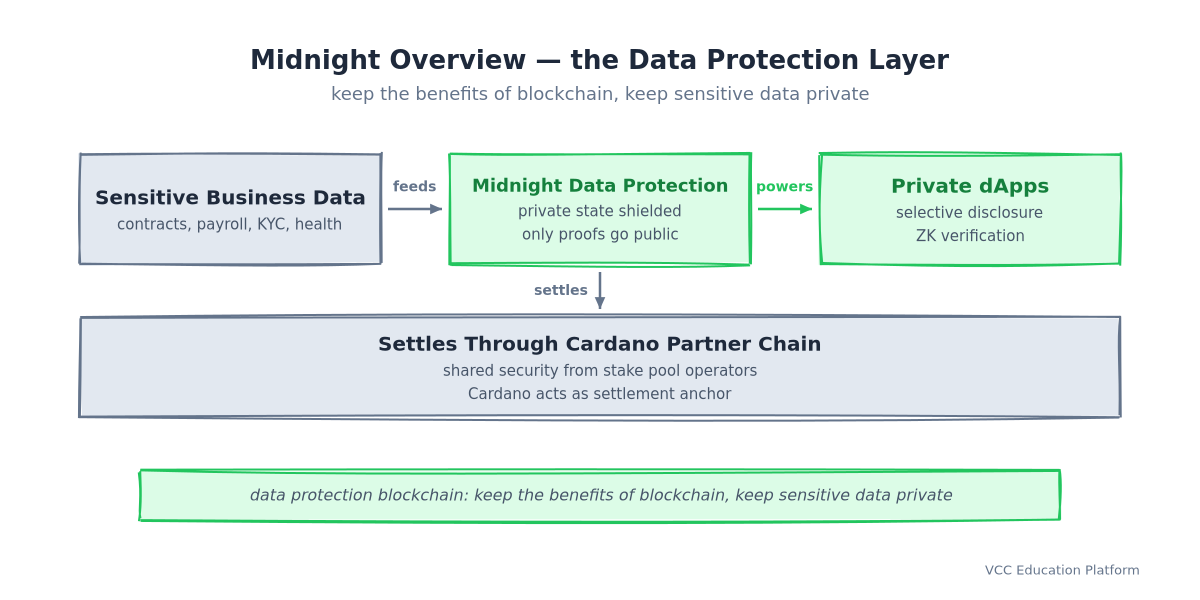
Figure 1: Midnight is the data protection layer — keep the benefits of blockchain, keep sensitive data private
A partner chain, not a sidechain
The midnight blockchain cardano relationship is often misread. One of the most common mistakes is to call Midnight a sidechain. The difference matters. A sidechain is a separate network linked to the main chain by a bridge; it runs under its own rules and, usually, its own weaker security. A layer-2, meanwhile, posts data or proofs back to its host and effectively rents the host's security.
Midnight is a partner chain — a category IOG developed precisely for this relationship. A partner chain is an independent blockchain with its own architecture, its own token, and its own rules, that cooperates with Cardano instead of renting from it. In practice that means:
- Shared security. Cardano's thousands of stake pool operators can opt in to validate the partner chain and earn its rewards, so Midnight inherits a battle-tested security community rather than bootstrapping a new one.
- Settlement anchor. Cardano acts as a public settlement layer for the ecosystem, while Midnight handles the private computation. Assets and value can flow between the two networks.
- Independence. Midnight makes its own design decisions — a different consensus participation model, a different fee model, its own privacy architecture — without waiting for Cardano's roadmap.
The two networks are partners, not parent and child. Cardano keeps its transparency; Midnight adds the data-protection layer the ecosystem was missing.
A dual ledger: shielded and transparent
Midnight's signature design is the dual ledger. The network maintains two parallel states that work together:
- The transparent (public) ledger holds visible state: balances that need to be verifiable, governance signals, and the shared ordering of events. Anyone can inspect it.
- The shielded (private) ledger holds confidential state: salary data, health records, identity attributes, contract terms. It exists locally with each user and is never published to the network.
The bridge between the two is a zero-knowledge proof (ZKP). A ZKP lets one party convince another that a statement is true — "this user qualifies for the loan," "this salary payment is within budget," "this patient is insured" — without revealing the underlying data. In Midnight's terms, a proof shows that a private state change justifies a public state change. The proof crosses the bridge; the raw data never does.
This is what selective disclosure means: an application decides precisely which facts are public, which are shielded, and what can be proven without revealing the data underneath. A healthcare dApp can prove a patient qualifies for treatment without exposing the medical history. A payroll platform can prove total wages match tax filings without publishing individual salaries.
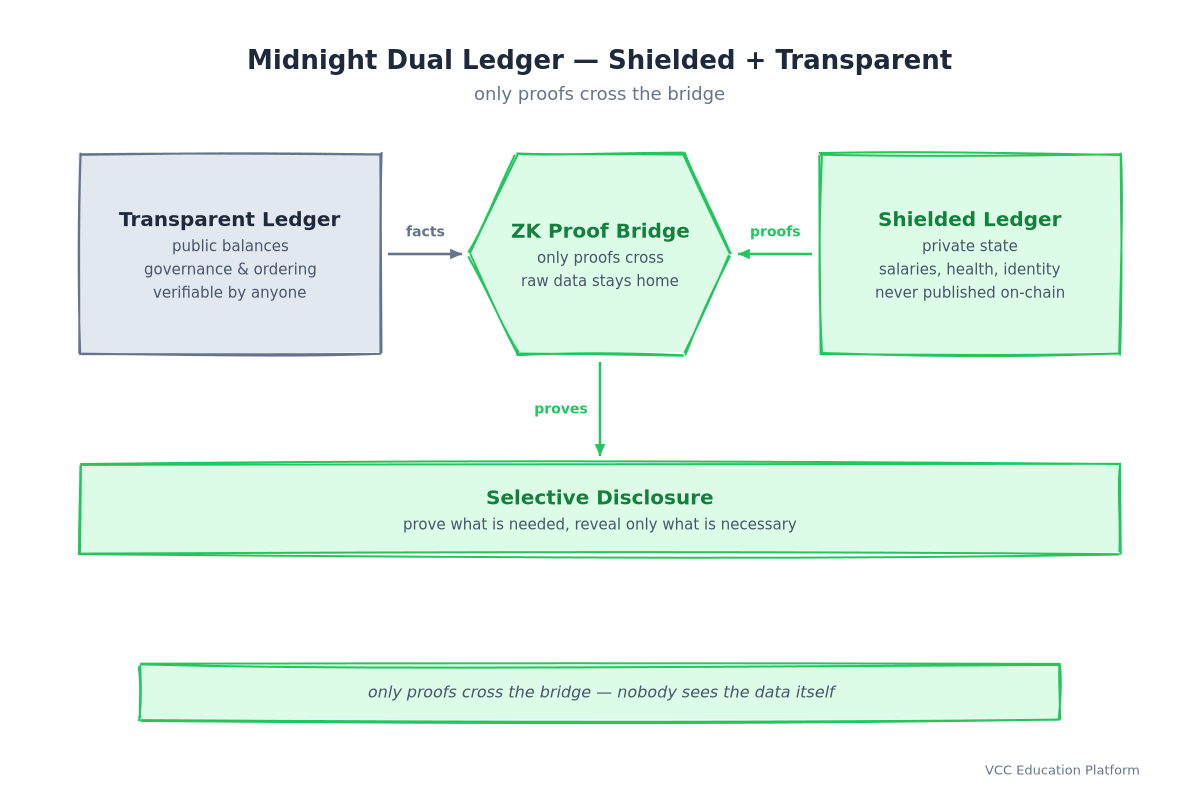
Figure 2: Midnight dual ledger — only proofs cross the bridge, nobody sees the data itself
The tools under the hood: Compact, Kachina, NIGHT and DUST
Three components make the dual ledger usable in practice. (A quick overview here; deeper dives are separate articles in this series.)
Compact is Midnight's smart-contract language. It is based on TypeScript, so mainstream web developers can write privacy-preserving contracts with familiar code; the compiler automatically turns that code into zero-knowledge circuits. You do not need a PhD in cryptography to build a private dApp — you need to know TypeScript.
Kachina is the underlying smart-contract protocol. It formalizes how public state on the blockchain and private state on the user's machine interact. In Kachina's model, contracts are reactive state machines, private data never goes on-chain, and authorization is always based on zero-knowledge proofs that verify a transaction complies with the contract's rules.
NIGHT and DUST form the token model. NIGHT is the network's capital and governance token — a transparent asset, not a privacy token itself. Holding NIGHT continuously generates DUST, a shielded, non-transferable resource that pays for private transactions. This separation keeps transaction costs predictable and detached from market volatility. One practical consequence: DUST can never be bought, so any "buy DUST" offer you see is a scam.
What you can build on Midnight
Midnight's promise is a set of categories, not a single product. The same programmable privacy serves several industries:
- Regulated DeFi. Lend, borrow, and trade without exposing your portfolio size, your positions, or your wallet history to every observer.
- Tokenization of real-world assets. Tokenize property, invoices, or securities while keeping buyer identity, contract terms, and valuation details shielded.
- Digital identity and KYC. Prove that you completed verification, your age, or your accreditation without handing over the full identity file — again and again, to every new service.
- Health records. Prove coverage, test status, or eligibility for treatment without uploading diagnoses or medical history to a public ledger.
- Enterprise data management. Share business intelligence, payroll, and supply-chain details with the confidence that only necessary data becomes visible.
For Vietnam, the angle is especially concrete. Nghị định 13/2023 classifies financial, health, and biometric data as sensitive personal data, and the Law on Personal Data Protection in force from 2026 explicitly names blockchain among the high-tech domains it regulates. Midnight's data-minimization-by-design is the cryptographic equivalent of what Vietnamese law asks companies to do operationally. A fintech can prove to a partner that it holds a valid customer base without exposing the customers; a hospital can prove it processed a claim without exposing the patient. VNeID-based flows are a natural fit: prove residence or KYC status from a shielded identity without copying the underlying documents to yet another database.
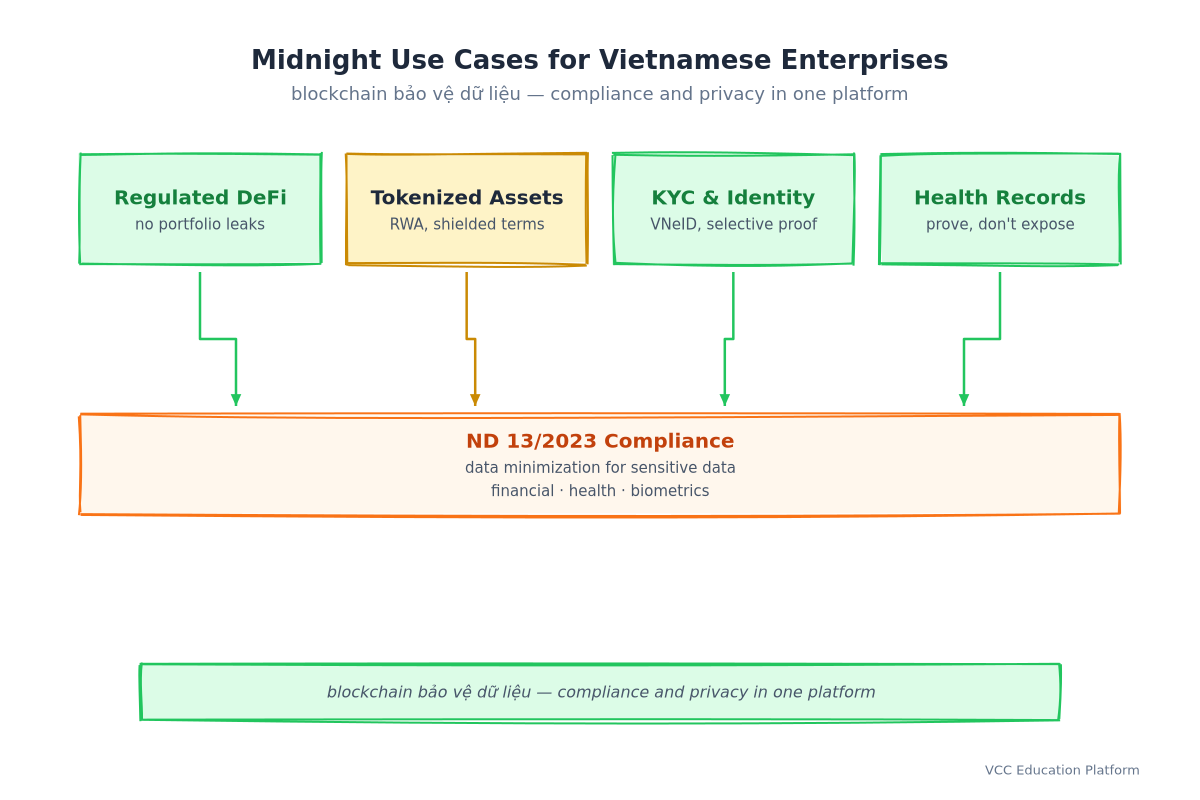
Figure 3: Vietnamese enterprise use cases — compliance and privacy in one platform
Where Midnight stands today
As of mid-2026, Midnight is a live production network, but with an honest caveat about maturity. NIGHT launched on Cardano as a native asset in December 2025, followed by the Kūkolu mainnet going live on March 31, 2026. The network is permanent — contracts deployed and transactions made will not be reset — yet the current validator set is federated: a permissioned group of institutional operators including Google Cloud, Vodafone, and Blockdaemon. Decentralization is on the roadmap: the next phase, Mōhalu, opens validation to Cardano stake pool operators and activates the DUST capacity exchange.
The token and distribution have real footprint. NIGHT has a fixed supply of 24 billion, with roughly 16.6 billion circulating after the Glacier Drop and Scavenger Mine airdrops reached more than 170,000 addresses. The token trades on major exchanges including Binance, Bybit, Kraken, OKX, and Gate; Binance listed it in March 2026 with a seed tag, a warning label for volatility. NIGHT is a transparent token — it is not a privacy asset, and its role is governance and utility, not stealth.
Frequently asked questions
Midnight network là gì — in one sentence?
Midnight is Cardano's first partner chain and a data protection blockchain: a network where sensitive data stays shielded on a private ledger while zero-knowledge proofs make the parts that matter publicly verifiable.How does the midnight blockchain cardano relationship work?
Midnight is an independent partner chain, not a sidechain or layer-2. Cardano's stake pool operators can validate it and earn rewards, Cardano acts as a settlement anchor, and assets move between the two networks — while Midnight keeps its own consensus, economy, and privacy architecture.Is Midnight the same as Cardano?
No. Midnight is an independent partner chain that cooperates with Cardano, inherits part of its security through shared stake pool operators, and uses Cardano as a settlement anchor. NIGHT also exists on both chains without duplicating value.Is Midnight anonymous like Monero?
No. Monero hides everything. Midnight is built on programmable privacy: applications and users choose what to shield and what to reveal. This selective disclosure is what makes it usable in regulated industries — and why it is called a data protection chain, not an anonymity chain.What is the difference between NIGHT and DUST?
NIGHT is a transferable governance and utility token (fixed supply of 24 billion). Holding NIGHT generates DUST, a shielded, non-transferable resource spent on private transaction fees. DUST cannot be bought or transferred; if someone tries to sell you DUST, treat it as a scam.Do I need to understand zero-knowledge proofs to build on Midnight?
No. Compact is TypeScript-based and compiles to ZK circuits automatically. Developers write familiar code; the proving machinery is handled by the compiler and the network.Is Midnight production-ready for my business?
The mainnet is live and permanent, but the validator set is still federated and the ecosystem is young. Privacy dApps are being deployed now, with SPO-operated validation and the DUST capacity exchange scheduled for the next phase. For a Vietnamese enterprise, the right move today is a pilot on sensitive, non-critical data.Conclusion
Thu's question — midnight network là gì — has a practical answer: it is the fourth-generation data protection blockchain that gives businesses blockchain's security and verifiability without forcing their sensitive data into a glass house. As a blockchain bảo vệ dữ liệu, it turns "keep it private" from a legal burden into a protocol property. By pairing a transparent ledger with a shielded ledger, connecting them with zero-knowledge proofs, and settling through Cardano's partner-chain framework, Midnight turns compliance from an obstacle into an advantage. The network is young, but the direction is clear: the fourth generation is about protecting data, and Vietnam's data-sensitive industries are exactly where it matters most.
Quick Reference
| Question | Answer |
|---|---|
| What is Midnight? | Cardano's first partner chain; a data protection blockchain with a dual (shielded + transparent) ledger |
| Why data protection? | Public ledgers publish everything forever; sensitive data (contracts, health, payroll, KYC) cannot live there |
| Which generation? | Fourth — after Bitcoin (money), Ethereum (smart contracts), Cardano (scale/governance) |
| How is it secured? | Shared security with Cardano via the partner chain framework (SPOs) |
| How does privacy work? | Shielded ledger holds private state; ZK proofs prove facts without revealing data |
| Token model | NIGHT (governance/utility, 24B supply) generates DUST (non-transferable fee resource) |
| Status (2026) | Kūkolu mainnet live March 31, 2026; federated validators; Mōhalu (SPOs) next |
| Vietnam fit | Selective disclosure aligns with ND 13/2023 data minimization and VNeID-based identity flows |