
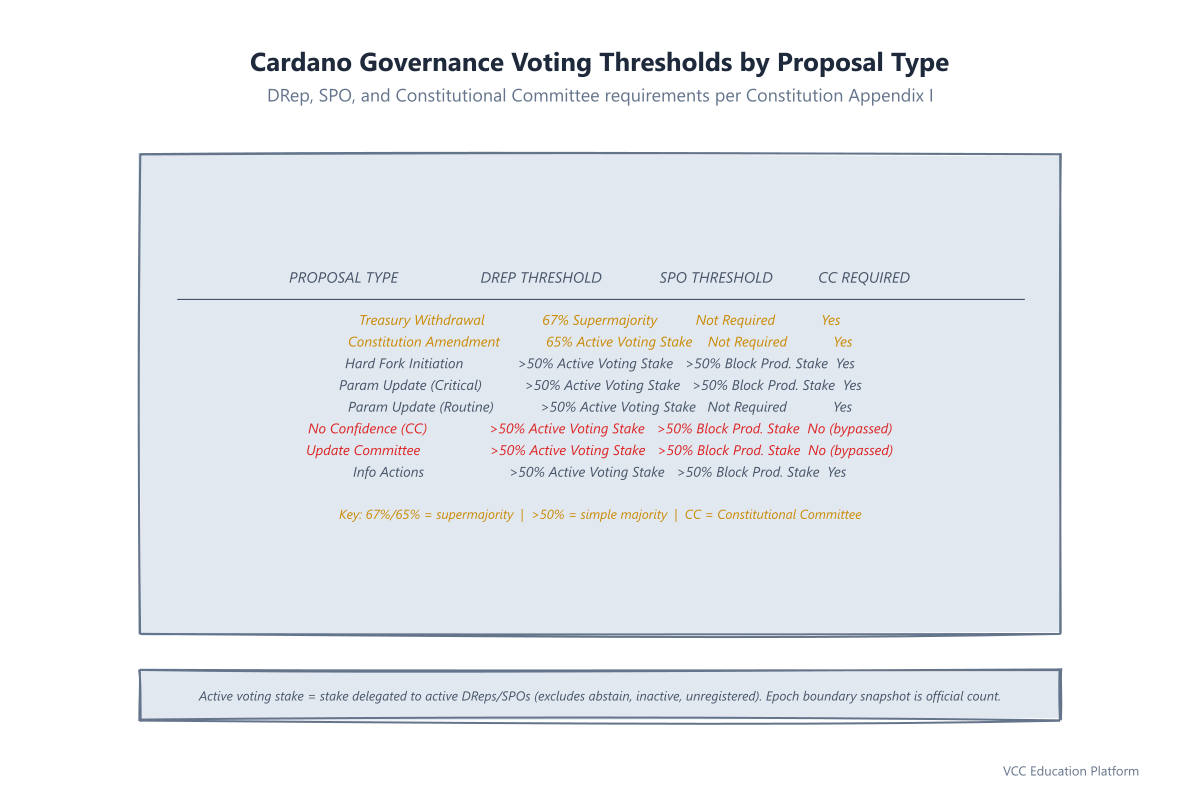
 | Proposal Type | DRep Threshold | SPO Threshold | CC Vote Required? |
|---------------|----------------|---------------|-------------------|
| Treasury Withdrawal | **67% supermajority** | No | **Yes** |
| Constitution Amendment | **65% active voting stake** | No | **Yes** |
| Hard Fork Initiation | >50% | >50% active block production stake | **Yes** |
| Parameter Update (security-critical) | >50% | >50% active block production stake | **Yes** |
| Parameter Update (routine) | >50% | No | **Yes** |
| No Confidence (CC) | >50% | >50% | No (triggers CC state change) |
| Update Committee | >50% | >50% | No |
| Info Actions | >50% | >50% | **Yes** |
**Key insight:** The 67% treasury threshold is deliberately high — the Constitution treats spending ada more cautiously than parameter changes. The 65% constitution amendment threshold ensures broad consensus for rule changes.
---
## The Governance Action Lifecycle
Every on-chain governance action follows this flow:
| Proposal Type | DRep Threshold | SPO Threshold | CC Vote Required? |
|---------------|----------------|---------------|-------------------|
| Treasury Withdrawal | **67% supermajority** | No | **Yes** |
| Constitution Amendment | **65% active voting stake** | No | **Yes** |
| Hard Fork Initiation | >50% | >50% active block production stake | **Yes** |
| Parameter Update (security-critical) | >50% | >50% active block production stake | **Yes** |
| Parameter Update (routine) | >50% | No | **Yes** |
| No Confidence (CC) | >50% | >50% | No (triggers CC state change) |
| Update Committee | >50% | >50% | No |
| Info Actions | >50% | >50% | **Yes** |
**Key insight:** The 67% treasury threshold is deliberately high — the Constitution treats spending ada more cautiously than parameter changes. The 65% constitution amendment threshold ensures broad consensus for rule changes.
---
## The Governance Action Lifecycle
Every on-chain governance action follows this flow:
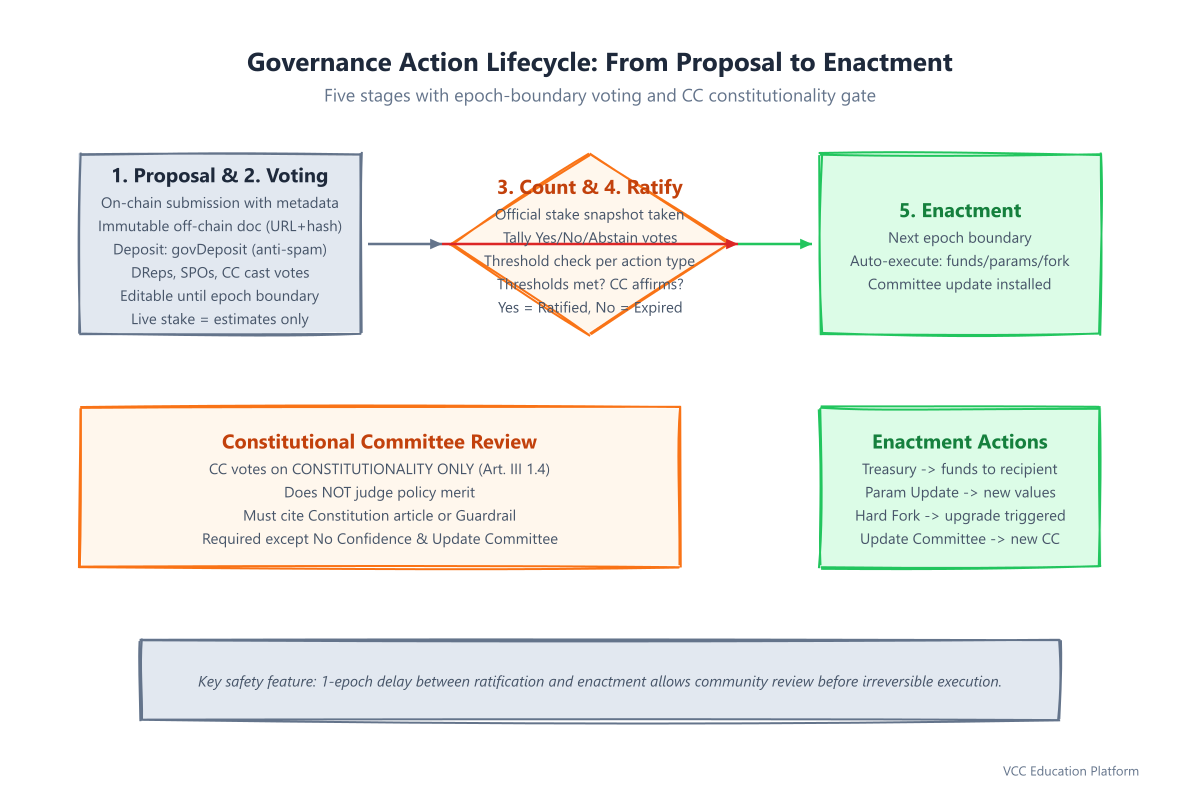 1. **Proposal Submission** — Proposer submits on-chain with metadata: title, abstract, justification, and an immutable off-chain document (URL + hash). A deposit (govDeposit) is required to deter spam.
2. **Voting Period** — DReps, SPOs, and CC members cast votes. **Crucial:** Votes are *not* final until the epoch boundary. You can change your vote anytime before the boundary.
3. **Epoch Boundary Count** — At each epoch boundary, the ledger snapshots stake (epoch boundary stake — the official count) and tallies votes. Live stake shown by explorers mid-epoch may differ ~5%.
4. **Ratification** — If thresholds are met *and* the CC affirms constitutionality (for applicable actions), the action becomes "Ratified." Voting stops.
5. **Enactment** — At the *next* epoch boundary, the action executes: funds transfer, parameter change, hard fork trigger, or committee update.
**Why the one-epoch delay?** It provides a final safety window. If a ratified action has an unforeseen issue, the community can raise alarms before enactment.
---
## The Constitutional Committee: Guardrails, Not Policy
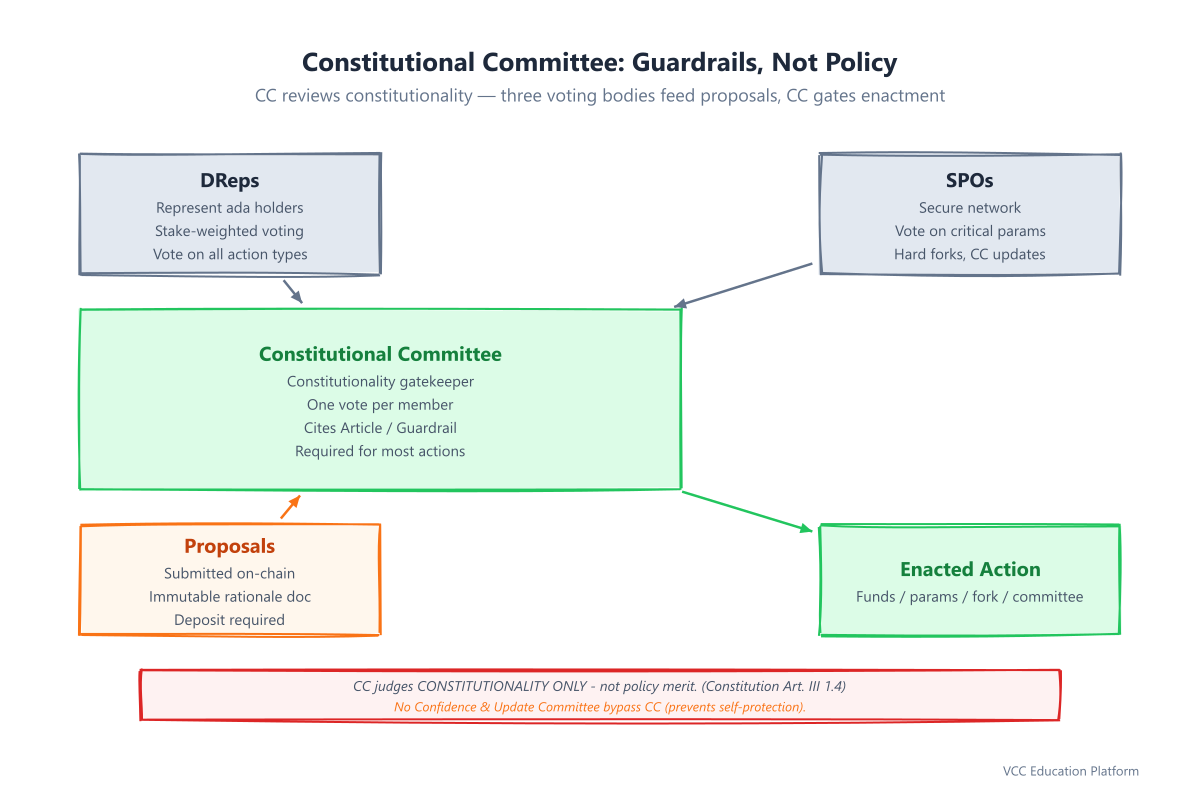
The CC is often misunderstood. Per Constitution Article III Section 1(4): *"The CC shall be limited to voting on the constitutionality of governance actions."* They do **not** decide if a proposal is good policy — only whether it violates the Constitution's tenets (Article I) or Guardrails (Appendix I).
- Each CC member has one vote (not stake-weighted)
- CC affirmation required for most action types
- CC decisions must cite specific Constitution articles or Guardrails
- No-confidence motions and committee updates bypass CC (to prevent self-protection)
1. **Proposal Submission** — Proposer submits on-chain with metadata: title, abstract, justification, and an immutable off-chain document (URL + hash). A deposit (govDeposit) is required to deter spam.
2. **Voting Period** — DReps, SPOs, and CC members cast votes. **Crucial:** Votes are *not* final until the epoch boundary. You can change your vote anytime before the boundary.
3. **Epoch Boundary Count** — At each epoch boundary, the ledger snapshots stake (epoch boundary stake — the official count) and tallies votes. Live stake shown by explorers mid-epoch may differ ~5%.
4. **Ratification** — If thresholds are met *and* the CC affirms constitutionality (for applicable actions), the action becomes "Ratified." Voting stops.
5. **Enactment** — At the *next* epoch boundary, the action executes: funds transfer, parameter change, hard fork trigger, or committee update.
**Why the one-epoch delay?** It provides a final safety window. If a ratified action has an unforeseen issue, the community can raise alarms before enactment.
---
## The Constitutional Committee: Guardrails, Not Policy
The CC is often misunderstood. Per Constitution Article III Section 1(4): *"The CC shall be limited to voting on the constitutionality of governance actions."* They do **not** decide if a proposal is good policy — only whether it violates the Constitution's tenets (Article I) or Guardrails (Appendix I).
- Each CC member has one vote (not stake-weighted)
- CC affirmation required for most action types
- CC decisions must cite specific Constitution articles or Guardrails
- No-confidence motions and committee updates bypass CC (to prevent self-protection)
 ---
## Step-by-Step: Voting Directly on GovTool
---
## Step-by-Step: Voting Directly on GovTool
 ### Prerequisites
- A Cardano wallet with ada (any amount — voting power = your delegated stake)
- Wallet browser extension or mobile app with dApp connector support
### Walkthrough
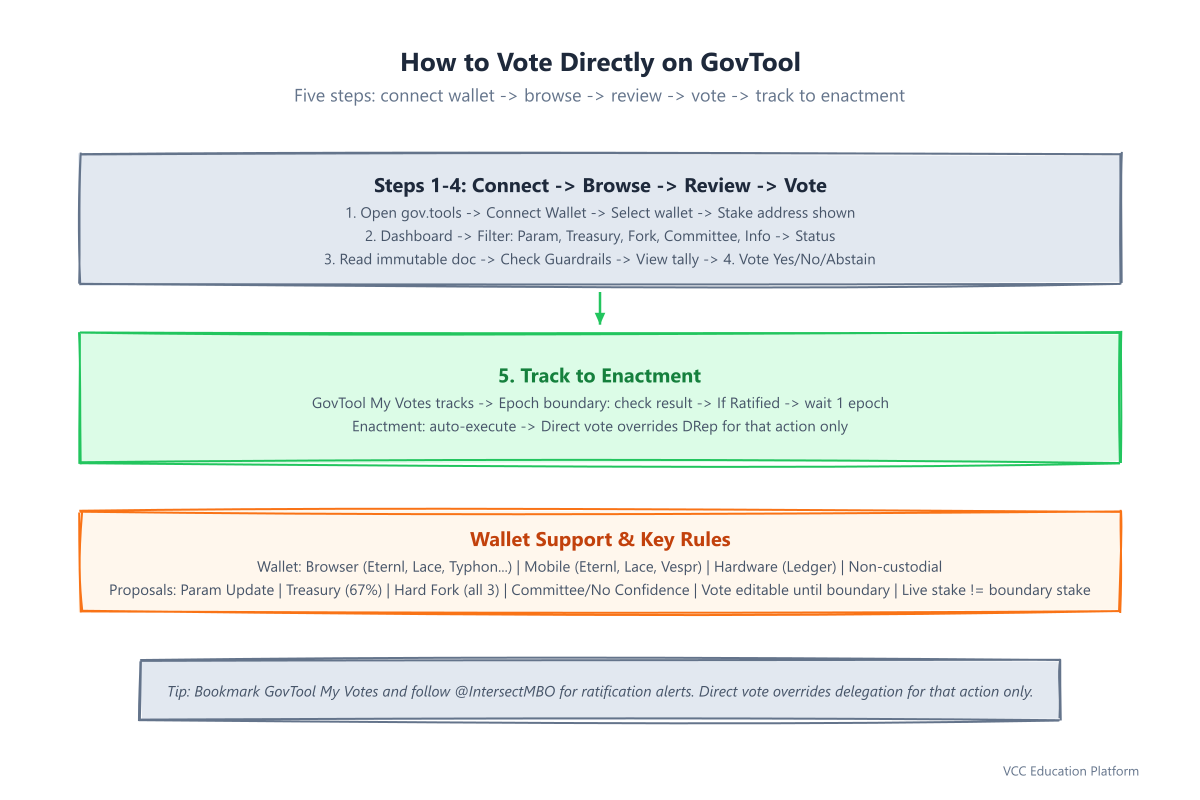
**Step 1: Open GovTool and Connect Wallet**
- Go to https://gov.tools
- Click "Connect Wallet" → select your wallet → approve connection
- Your stake address and voting power display
**Step 2: Browse Proposals**
- Dashboard shows active governance actions with status: *Voting*, *Ratified*, *Enacted*, *Expired*
- Filter by category: Parameter Changes, Treasury Withdrawals, Hard Forks, Committee Updates, etc.
- Click a proposal to view details
**Step 3: Review the Proposal**
- **Title & Type** — e.g., "Parameter Update: Increase maxBlockBodySize"
- **Rationale Document** — Link to immutable off-chain doc (IPFS/GitHub). Read this.
- **Guardrails Check** — GovTool shows which Guardrails apply and whether the proposal passes automated checks
- **Current Vote Tally** — Live DRep/SPO/CC percentages (remember: mid-epoch = estimates)
**Step 4: Cast Your Vote**
- Choose: **Yes** / **No** / **Abstain**
- Click "Vote" → wallet prompts for signature → confirm
- Transaction submits; vote recorded on-chain
**Step 5: Track to Enactment**
- GovTool shows proposal status updates each epoch
- At epoch boundary: check if thresholds met
- If ratified: wait one more epoch for enactment
- Funds transfer / parameter change occurs automatically at enactment boundary
---
## Common Questions (FAQ)
### Do I lose my ada when I delegate or vote?
**No.** Delegation and voting are non-custodial. Your ada stays in your wallet. You only pay standard transaction fees (~0.17 ada typical).
### Can I delegate to a DRep *and* a stake pool at the same time?
**Yes.** Stake pool delegation earns staking rewards. DRep delegation assigns voting power. Same ada, two independent signals. They don't interfere.
### What happens if I don't delegate and don't vote directly?
Your stake goes to the **"abstain" predefined option** — it counts toward quorum but not toward any Yes/No threshold. You're effectively sitting out.
### How long does delegation take to become active?
Delegation takes effect at the **next epoch boundary** after you sign the transaction. Same for delegation changes or removal.
### Can I change my vote after submitting?
**Yes, until the epoch boundary.** Votes are only finalized at the boundary snapshot. You can overwrite your vote anytime before then.
### Why do different explorers show different vote percentages?
Tools use either **live stake** (dynamic, updates as delegations change) or **epoch boundary stake** (official snapshot). They converge at the boundary. Trust epoch-boundary numbers for final outcomes.
### What is "active voting stake"?
The total lovelace delegated to *active* DReps or SPOs. Excludes: stake delegated to inactive DReps, the abstain option, unregistered stake, and registered-but-undelegated stake. This is the denominator for threshold calculations.
### How do I find a good DRep?
Check **GovTool**, **DRepTalk**, **Chang Watch**, or **CGOV** for:
- Voting history (did they vote on recent actions?)
- Published rationales (do they explain *why*?)
- Compensation disclosure (required by Constitution)
- Stated positions on key issues (treasury, parameters, hard forks)
### What if my DRep stops voting or acts against my interests?
**Remove or change delegation anytime.** Sign a new delegation transaction to a different DRep (or "remove delegation" to vote directly). No penalty, no waiting period beyond the epoch boundary.
### Are there risks to voting directly?
Main risk: **missing votes**. If you don't monitor proposals, you don't participate. Delegation solves this by having a representative watch full-time. Direct voting gives control but requires attention.
---
## Pro Tips for Effective Participation
1. **Set calendar reminders for epoch boundaries** (every 5 days / 432,000 slots) — that's when votes finalize
2. **Bookmark the GovTool "My Votes" page** — tracks your direct votes and delegation status
3. **Follow @IntersectMBO and @Cardano** on X for proposal announcements and ratification alerts
3. **Read the rationale document** — don't vote on title alone. The off-chain doc has the technical details and trade-offs
4. **Understand the Guardrails** — they're the automated safety rails. If a proposal violates a (y)-marked Guardrail, it *cannot* be submitted on-chain
5. **Participate in the Constitutional Committee election** — CC members serve staggered terms; elections are themselves governance actions you vote on
---
## Vietnamese Context: Bầu Cử vs Ủy Quyền
Vietnamese readers will recognize the parallel:
- **Bỏ phiếu trực tiếp** (direct voting) = bầu cử — you research each candidate/proposal and cast your own ballot
- **Ủy quyền cho DRep** (delegation) = ủy quyền đại biểu — you choose a trusted representative to vote on your behalf
Both are valid. In Vietnam's National Assembly, deputies (đại biểu) are elected to represent constituents. Cardano's DReps function similarly — but you can *change* your representative instantly, without waiting for an election cycle.
---
## Summary Checklist
- [ ] **Choose your path:** Delegate (low effort, continuous) or Direct Vote (high control, high effort)
- [ ] **Get a compatible wallet** with ada
- [ ] **If delegating:** Research DReps on GovTool/DRepTalk → delegate → confirm at epoch boundary
- [ ] **If voting directly:** Connect to GovTool → review proposals → cast votes → track to enactment
- [ ] **Understand thresholds:** 67% for treasury, 65% for constitution, 50%+ for most others
- [ ] **Know the lifecycle:** Proposal → Voting → Epoch Boundary Count → Ratification → Enactment (next epoch)
- [ ] **Monitor participation:** Your voice matters more when others stay silent
---
*Cardano governance is still young. Every vote — delegated or direct — shapes the precedent for how a billion-dollar decentralized treasury and protocol evolve. The tools exist. The Constitution is live. The only missing piece is you.*
### Prerequisites
- A Cardano wallet with ada (any amount — voting power = your delegated stake)
- Wallet browser extension or mobile app with dApp connector support
### Walkthrough
**Step 1: Open GovTool and Connect Wallet**
- Go to https://gov.tools
- Click "Connect Wallet" → select your wallet → approve connection
- Your stake address and voting power display
**Step 2: Browse Proposals**
- Dashboard shows active governance actions with status: *Voting*, *Ratified*, *Enacted*, *Expired*
- Filter by category: Parameter Changes, Treasury Withdrawals, Hard Forks, Committee Updates, etc.
- Click a proposal to view details
**Step 3: Review the Proposal**
- **Title & Type** — e.g., "Parameter Update: Increase maxBlockBodySize"
- **Rationale Document** — Link to immutable off-chain doc (IPFS/GitHub). Read this.
- **Guardrails Check** — GovTool shows which Guardrails apply and whether the proposal passes automated checks
- **Current Vote Tally** — Live DRep/SPO/CC percentages (remember: mid-epoch = estimates)
**Step 4: Cast Your Vote**
- Choose: **Yes** / **No** / **Abstain**
- Click "Vote" → wallet prompts for signature → confirm
- Transaction submits; vote recorded on-chain
**Step 5: Track to Enactment**
- GovTool shows proposal status updates each epoch
- At epoch boundary: check if thresholds met
- If ratified: wait one more epoch for enactment
- Funds transfer / parameter change occurs automatically at enactment boundary
---
## Common Questions (FAQ)
### Do I lose my ada when I delegate or vote?
**No.** Delegation and voting are non-custodial. Your ada stays in your wallet. You only pay standard transaction fees (~0.17 ada typical).
### Can I delegate to a DRep *and* a stake pool at the same time?
**Yes.** Stake pool delegation earns staking rewards. DRep delegation assigns voting power. Same ada, two independent signals. They don't interfere.
### What happens if I don't delegate and don't vote directly?
Your stake goes to the **"abstain" predefined option** — it counts toward quorum but not toward any Yes/No threshold. You're effectively sitting out.
### How long does delegation take to become active?
Delegation takes effect at the **next epoch boundary** after you sign the transaction. Same for delegation changes or removal.
### Can I change my vote after submitting?
**Yes, until the epoch boundary.** Votes are only finalized at the boundary snapshot. You can overwrite your vote anytime before then.
### Why do different explorers show different vote percentages?
Tools use either **live stake** (dynamic, updates as delegations change) or **epoch boundary stake** (official snapshot). They converge at the boundary. Trust epoch-boundary numbers for final outcomes.
### What is "active voting stake"?
The total lovelace delegated to *active* DReps or SPOs. Excludes: stake delegated to inactive DReps, the abstain option, unregistered stake, and registered-but-undelegated stake. This is the denominator for threshold calculations.
### How do I find a good DRep?
Check **GovTool**, **DRepTalk**, **Chang Watch**, or **CGOV** for:
- Voting history (did they vote on recent actions?)
- Published rationales (do they explain *why*?)
- Compensation disclosure (required by Constitution)
- Stated positions on key issues (treasury, parameters, hard forks)
### What if my DRep stops voting or acts against my interests?
**Remove or change delegation anytime.** Sign a new delegation transaction to a different DRep (or "remove delegation" to vote directly). No penalty, no waiting period beyond the epoch boundary.
### Are there risks to voting directly?
Main risk: **missing votes**. If you don't monitor proposals, you don't participate. Delegation solves this by having a representative watch full-time. Direct voting gives control but requires attention.
---
## Pro Tips for Effective Participation
1. **Set calendar reminders for epoch boundaries** (every 5 days / 432,000 slots) — that's when votes finalize
2. **Bookmark the GovTool "My Votes" page** — tracks your direct votes and delegation status
3. **Follow @IntersectMBO and @Cardano** on X for proposal announcements and ratification alerts
3. **Read the rationale document** — don't vote on title alone. The off-chain doc has the technical details and trade-offs
4. **Understand the Guardrails** — they're the automated safety rails. If a proposal violates a (y)-marked Guardrail, it *cannot* be submitted on-chain
5. **Participate in the Constitutional Committee election** — CC members serve staggered terms; elections are themselves governance actions you vote on
---
## Vietnamese Context: Bầu Cử vs Ủy Quyền
Vietnamese readers will recognize the parallel:
- **Bỏ phiếu trực tiếp** (direct voting) = bầu cử — you research each candidate/proposal and cast your own ballot
- **Ủy quyền cho DRep** (delegation) = ủy quyền đại biểu — you choose a trusted representative to vote on your behalf
Both are valid. In Vietnam's National Assembly, deputies (đại biểu) are elected to represent constituents. Cardano's DReps function similarly — but you can *change* your representative instantly, without waiting for an election cycle.
---
## Summary Checklist
- [ ] **Choose your path:** Delegate (low effort, continuous) or Direct Vote (high control, high effort)
- [ ] **Get a compatible wallet** with ada
- [ ] **If delegating:** Research DReps on GovTool/DRepTalk → delegate → confirm at epoch boundary
- [ ] **If voting directly:** Connect to GovTool → review proposals → cast votes → track to enactment
- [ ] **Understand thresholds:** 67% for treasury, 65% for constitution, 50%+ for most others
- [ ] **Know the lifecycle:** Proposal → Voting → Epoch Boundary Count → Ratification → Enactment (next epoch)
- [ ] **Monitor participation:** Your voice matters more when others stay silent
---
*Cardano governance is still young. Every vote — delegated or direct — shapes the precedent for how a billion-dollar decentralized treasury and protocol evolve. The tools exist. The Constitution is live. The only missing piece is you.*