
Primary keyword: what is an epoch in cardano
Secondary keywords: cardano epochs explained, cardano slots explained, how cardano epochs work, cardano epoch vs slot
Introduction (≈120 words)
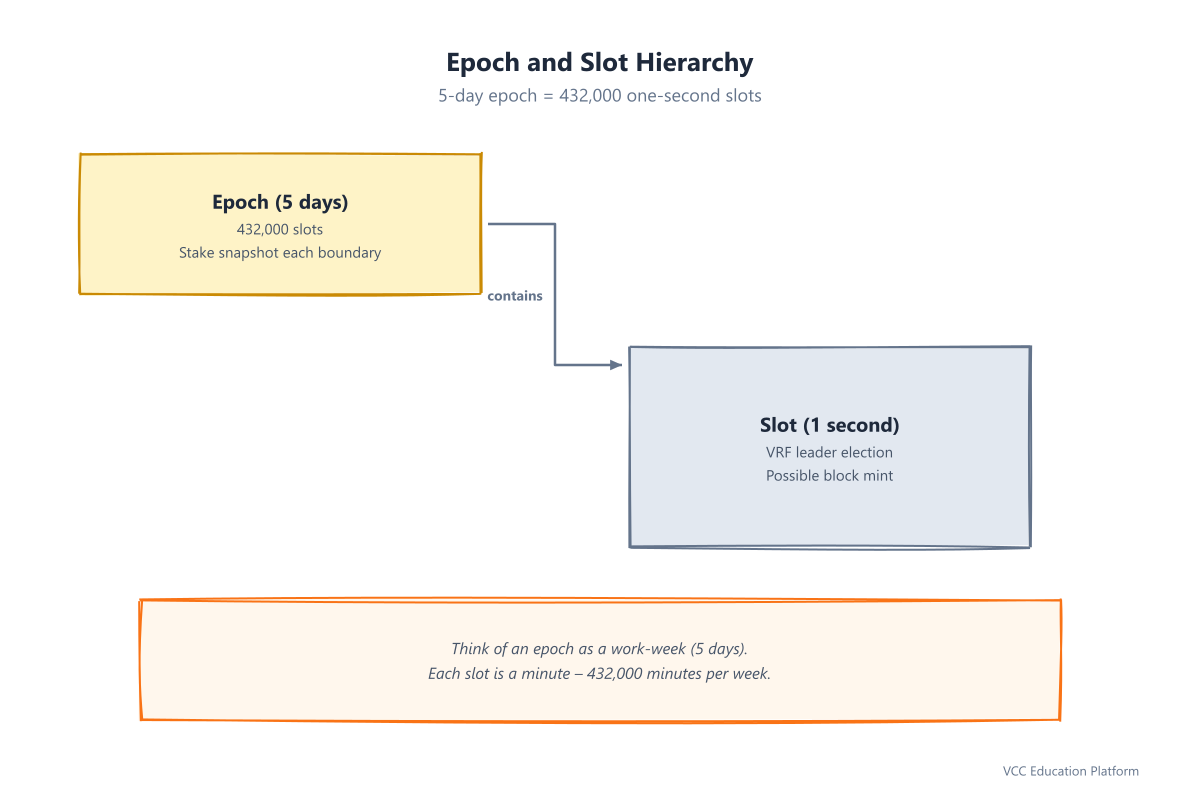
Cardano measures time differently from traditional blockchains. Instead of a single “block height” clock, it splits time into epochs and slots. An epoch is a five‑day period; a slot is a one‑second window inside that epoch. Understanding this two‑layer clock is essential for anyone who stakes ADA, runs a stake pool, or simply wants to know when rewards appear.
Key takeaway: Epoch = work‑week, Slot = minute. This analogy makes the mechanics intuitive for Vietnamese readers who track salary cycles weekly.
Cardano Epochs Explained (≈300 words)
Definition & Length
An epoch on Cardano lasts exactly 5 days (432,000 seconds). The network uses epochs to:
- Schedule stake‑snapshot for delegation rewards
- Rotate slot‑leader election
- Delimit protocol‑parameter updates
Epoch Boundaries & Snapshots
At the last block of epoch N‑1 the ledger takes a snapshot of all active delegations. That snapshot determines the stake distribution for epoch N. Rewards for epoch N are calculated and distributed at the start of epoch N+1.
Vietnam tip: Many local pools post “snapshot taken” notices on Zalo groups right after the epoch boundary – follow your pool’s channel to avoid missing delegation changes.
[Visual: Flowchart - Epoch boundary snapshot & reward cycle]
Epoch Numbering
Genesis began with epoch 0 (September 2017). As of August 2026 the network is in epoch 450+. You can view the current epoch on any block explorer (e.g., Cardanoscan, Adapools).
Cardano Slots Explained (≈300 words)
What Is a Slot?
A slot = 1 second. Each epoch contains 432,000 slots (5 days × 86,400 seconds). Slots are the granular ticks that drive block production.
Slot Leader Election
For every slot the protocol runs a Verifiable Random Function (VRF) using the stake‑snapshot from the previous epoch. The VRF output decides whether a given stake pool becomes the slot leader for that second.
- Probability ∝ active stake of the pool
- Outcome is unpredictable until the slot arrives
- A pool may be elected multiple times or not at all in an epoch
Block Production in a Slot
If a pool is elected, it may mint one block during its slot. Missed slots produce empty slots – the chain simply moves to the next second. This design yields:
- Fast finality (≈20 seconds for 20‑block confirmation)
- Resistance to selfish‑mining (leaders cannot be predicted)
[Visual: Sequence - Slot leader election & block production]
How Cardano Epochs Work – End‑to‑End (≈350 words)
- Epoch N‑1 ends → snapshot taken
- Epoch N starts → VRF seeds derived from snapshot
- Each of 432,000 slots → VRF determines leader
- Leaders mint blocks → chain grows
- Epoch N ends → rewards for N calculated
- Epoch N+1 begins → rewards distributed to delegators
Reward Timeline Example
| Epoch | Action |
|---|---|
| 100 | Delegation snapshot (end of 99) |
| 101 | Blocks produced, rewards accrued |
| 102 | Rewards paid out to delegators |
Practical note: If you delegate in epoch 100, you first earn rewards in epoch 102 – a two‑epoch lag.
Epoch vs Slot – Quick Comparison (≈150 words)
| Aspect | Epoch | Slot |
|---|---|---|
| Duration | 5 days (432,000 s) | 1 second |
| Purpose | Stake snapshot, reward period, protocol upgrades | Leader election, block minting |
| Visibility | Human‑readable (epoch 450) | Machine‑level (slot 123,456) |
| Impact on Delegators | Determines when rewards appear | Determines how often a pool can mint |
[Visual: Comparison table - Epoch vs Slot]
Frequently Asked Questions
When does an epoch end?
Exactly every 5 days at the same wall‑clock time (UTC). The network does not use leap seconds.
How many slots per epoch?
432,000 (5 days × 86,400 seconds).
Can I change delegation mid‑epoch?
Yes, but the new delegation only takes effect after the next snapshot (i.e., two epochs later).
What happens if a slot leader is offline?
The slot becomes empty; the next slot proceeds normally. No penalty beyond missed block rewards.
Summary
- Epoch = 5‑day reward cycle, snapshot‑driven.
- Slot = 1‑second leader‑election window.
- Two‑epoch reward lag is by design.
- Understanding both layers helps you time delegations, evaluate pool performance, and anticipate protocol upgrades.
Next read: Cardano Epoch Schedule – learn exact calendar dates for upcoming epoch boundaries.