
 ## The Inflow Mechanism: `treasuryCut` and the ~20% Slice
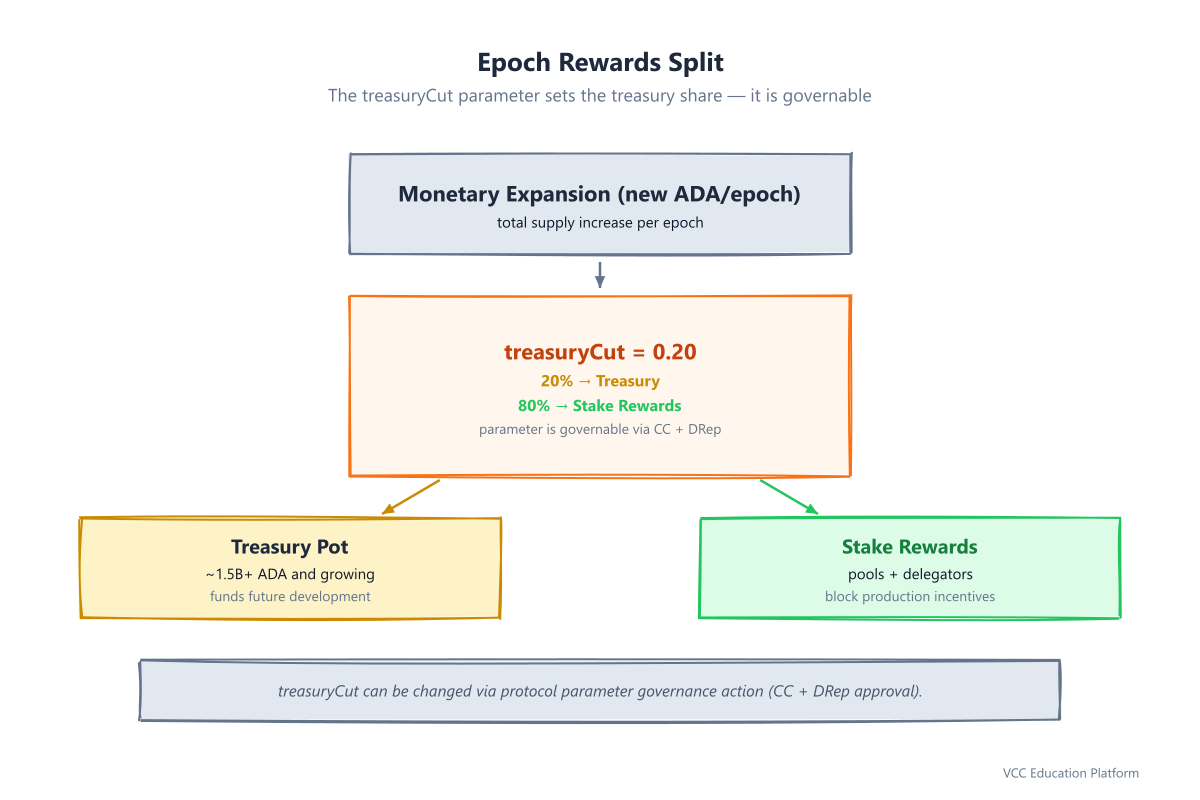
The Cardano ledger does not hard-code the treasury's share. Instead, a protocol parameter called **`treasuryCut`** (in the economic parameter group) determines what fraction of each epoch's monetary expansion flows to the treasury versus the stake reward pot.
```
Treasury Inflow = Monetary Expansion × treasuryCut
Stake Rewards = Monetary Expansion × (1 − treasuryCut)
```
At current settings, `treasuryCut = 0.2` — meaning **20% of newly minted ADA per epoch goes to the treasury**, and 80% funds block production rewards. This is not a fixed tax; it is a **governable parameter**. If the community decides the treasury is growing too fast (or too slow), a protocol parameter change governance action can adjust `treasuryCut` — subject to the same Constitutional Committee + DRep ratification as any economic parameter change.
Transaction fees provide a second, smaller inflow. Every transaction pays a fee; roughly 20% of that fee is redirected to the treasury (the rest goes to the block-producing pool). Combined, these inflows have built a treasury holding **over 1.5 billion ADA** and growing.
> **Key distinction from Article 12**: The earlier article described the treasury's *sources* in broad strokes. Here we name the exact protocol parameter (`treasuryCut`), show the epoch-level math, and emphasize that the "tax rate" is itself a governance decision.
## The Outflow Mechanism: Treasury Withdrawal Governance Actions
Under the Shelley-era design, treasury movements used **MIR certificates** (Move Instantaneous Rewards) authorized by a fixed set of governance keys. CIP-1694 replaced that with a **governance action** framework. Treasury withdrawal is now **governance action type 6** — one of seven action types, each with its own ratification rules.
### What a Treasury Withdrawal Action Contains
Per CIP-1694 specification, a treasury withdrawal action carries:
- A **map from stake credentials to Lovelace amounts** — i.e., a list of recipients and how much each receives
- A **deposit** (`govActionDeposit`) — refunded whether the action passes or expires
- An **anchor** — a URL + hash pointing to off-chain metadata (the budget rationale, project details, audit reports)
- The **governance action ID** of the most recently enacted withdrawal (to prevent accidental clashes)
This design means every withdrawal is **self-describing** on-chain: you can see exactly who gets what, and trace the justification via the anchor.
### The Ratification Gauntlet: CC + DRep (No SPO Vote)
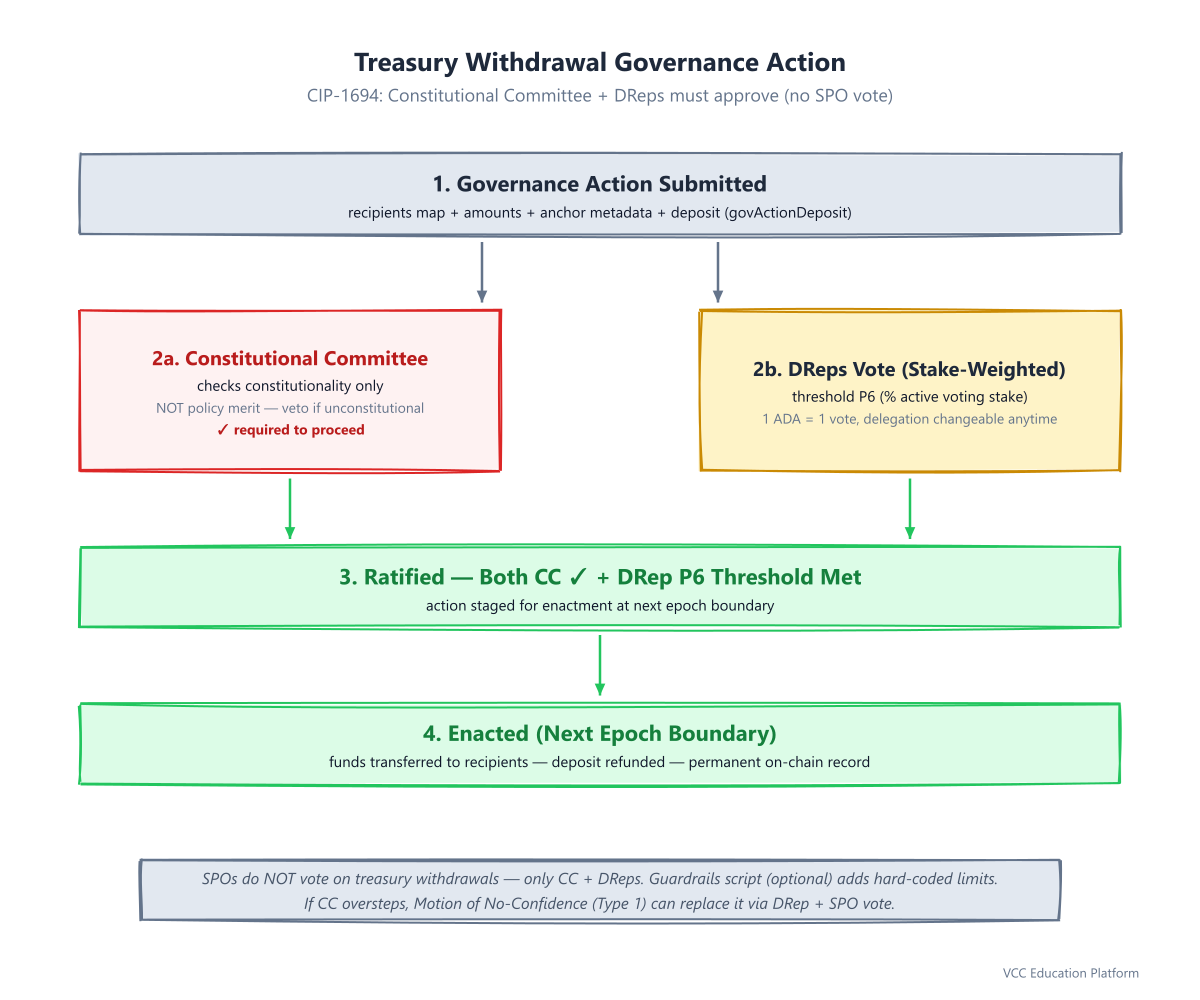
CIP-1694's ratification table is explicit: **treasury withdrawals require approval from exactly two bodies** — the Constitutional Committee and DReps. Stake Pool Operators do **not** vote on treasury withdrawals.
| Governance Action | Constitutional Committee | DReps | SPOs |
|-------------------|--------------------------|-------|------|
| Treasury Withdrawal | ✓ Must approve | P6 threshold (% active voting stake) | — Not required |
**Constitutional Committee (CC)**: Votes **only on constitutionality**. If a withdrawal violates the Cardano Constitution (e.g., funds a project that undermines network decentralization), the CC votes `No`. The CC does *not* judge whether a project is "good value" — that is the DReps' domain.
**DReps**: Vote with **stake-weighted power** (1 Lovelace = 1 vote). The threshold `P6` is a governance parameter (percentage of active voting stake that must vote `Yes`). If `P6 = 51%`, then DReps controlling >51% of actively delegated stake must approve.
**Why no SPO vote?** Treasury spending is a fiscal decision, not a network-security decision. SPOs vote on hard forks and security-relevant protocol parameters (via `Q5`), but fiscal policy is delegated to the stake-weighted electorate (DReps) plus the constitutional backstop (CC).
## The Inflow Mechanism: `treasuryCut` and the ~20% Slice
The Cardano ledger does not hard-code the treasury's share. Instead, a protocol parameter called **`treasuryCut`** (in the economic parameter group) determines what fraction of each epoch's monetary expansion flows to the treasury versus the stake reward pot.
```
Treasury Inflow = Monetary Expansion × treasuryCut
Stake Rewards = Monetary Expansion × (1 − treasuryCut)
```
At current settings, `treasuryCut = 0.2` — meaning **20% of newly minted ADA per epoch goes to the treasury**, and 80% funds block production rewards. This is not a fixed tax; it is a **governable parameter**. If the community decides the treasury is growing too fast (or too slow), a protocol parameter change governance action can adjust `treasuryCut` — subject to the same Constitutional Committee + DRep ratification as any economic parameter change.
Transaction fees provide a second, smaller inflow. Every transaction pays a fee; roughly 20% of that fee is redirected to the treasury (the rest goes to the block-producing pool). Combined, these inflows have built a treasury holding **over 1.5 billion ADA** and growing.
> **Key distinction from Article 12**: The earlier article described the treasury's *sources* in broad strokes. Here we name the exact protocol parameter (`treasuryCut`), show the epoch-level math, and emphasize that the "tax rate" is itself a governance decision.
## The Outflow Mechanism: Treasury Withdrawal Governance Actions
Under the Shelley-era design, treasury movements used **MIR certificates** (Move Instantaneous Rewards) authorized by a fixed set of governance keys. CIP-1694 replaced that with a **governance action** framework. Treasury withdrawal is now **governance action type 6** — one of seven action types, each with its own ratification rules.
### What a Treasury Withdrawal Action Contains
Per CIP-1694 specification, a treasury withdrawal action carries:
- A **map from stake credentials to Lovelace amounts** — i.e., a list of recipients and how much each receives
- A **deposit** (`govActionDeposit`) — refunded whether the action passes or expires
- An **anchor** — a URL + hash pointing to off-chain metadata (the budget rationale, project details, audit reports)
- The **governance action ID** of the most recently enacted withdrawal (to prevent accidental clashes)
This design means every withdrawal is **self-describing** on-chain: you can see exactly who gets what, and trace the justification via the anchor.
### The Ratification Gauntlet: CC + DRep (No SPO Vote)
CIP-1694's ratification table is explicit: **treasury withdrawals require approval from exactly two bodies** — the Constitutional Committee and DReps. Stake Pool Operators do **not** vote on treasury withdrawals.
| Governance Action | Constitutional Committee | DReps | SPOs |
|-------------------|--------------------------|-------|------|
| Treasury Withdrawal | ✓ Must approve | P6 threshold (% active voting stake) | — Not required |
**Constitutional Committee (CC)**: Votes **only on constitutionality**. If a withdrawal violates the Cardano Constitution (e.g., funds a project that undermines network decentralization), the CC votes `No`. The CC does *not* judge whether a project is "good value" — that is the DReps' domain.
**DReps**: Vote with **stake-weighted power** (1 Lovelace = 1 vote). The threshold `P6` is a governance parameter (percentage of active voting stake that must vote `Yes`). If `P6 = 51%`, then DReps controlling >51% of actively delegated stake must approve.
**Why no SPO vote?** Treasury spending is a fiscal decision, not a network-security decision. SPOs vote on hard forks and security-relevant protocol parameters (via `Q5`), but fiscal policy is delegated to the stake-weighted electorate (DReps) plus the constitutional backstop (CC).
 ## The Budget Process: Intersect and the Annual Cycle
Governance actions do not appear spontaneously. They are the output of a **structured budget process** administered by **Intersect MBO** — the member-based organization tasked with "administering and championing Cardano's community-led governance implemented by CIP-1694" (Intersect GitHub profile, Pillar 2).
### Intersect's Budget Cycle (Annual)
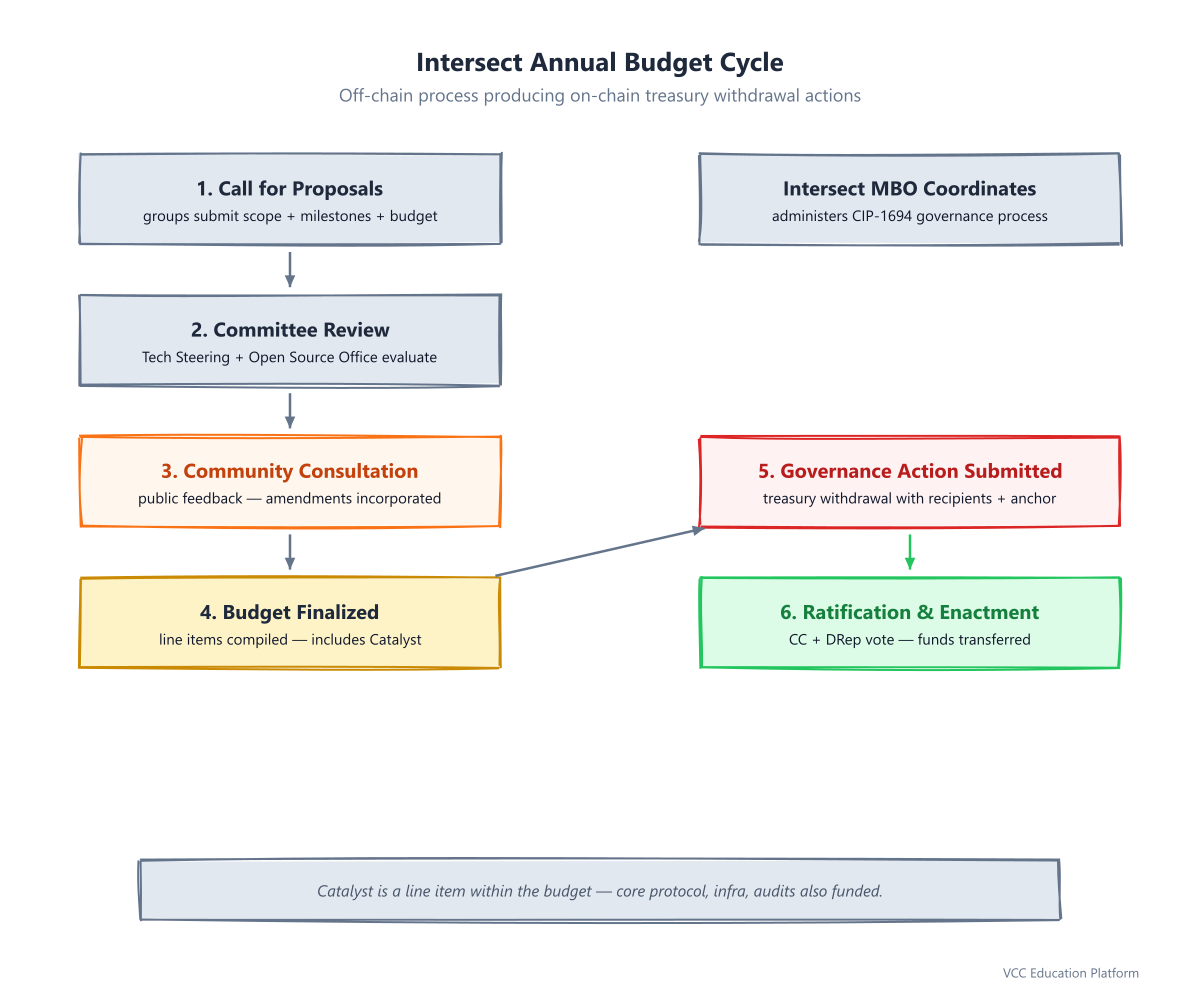
1. **Call for proposals** — Working groups (Technical Steering Committee, Open Source Office, Catalyst, etc.) and community members submit funding requests with scope, milestones, and budget.
2. **Review & prioritization** — Intersect committees evaluate technical merit, strategic alignment, and cost-effectiveness.
3. **Community consultation** — Draft budget published for open feedback; amendments incorporated.
4. **Budget finalization** — Approved line items compiled into one or more **treasury withdrawal governance actions**.
5. **On-chain submission** — Intersect (or designated submitter) posts the governance action(s) with `govActionDeposit`.
6. **Ratification voting** — CC reviews constitutionality; DReps vote on merit. Voting period spans multiple epochs.
7. **Enactment** — If ratified, funds transfer at the next epoch boundary.
8. **Execution & reporting** — Recipients receive funds; progress reported publicly; feeds into next cycle's review.
### How This Differs from Project Catalyst
| Aspect | Project Catalyst | Intersect Budget |
|--------|------------------|------------------|
| **Purpose** | Innovation fund — experiments, new ideas | Core protocol, infrastructure, strategic ops |
| **Cycle** | Rolling funds (every 6–12 weeks) | Annual, synchronized with roadmap |
| **Voters** | Registered stake (Catalyst app) | DReps + CC (CIP-1694 on-chain) |
| **Output** | Catalyst-funded projects | Treasury withdrawal governance actions |
| **Oversight** | Community advisors + Catalyst team | Intersect committees + on-chain ratification |
Both ultimately move ADA from the treasury via governance actions, but **Catalyst is a program *within* the budget**, while the Intersect budget covers the *entire* operational envelope — node development, formal specification, security audits, governance tooling, and Catalyst itself.
## The Budget Process: Intersect and the Annual Cycle
Governance actions do not appear spontaneously. They are the output of a **structured budget process** administered by **Intersect MBO** — the member-based organization tasked with "administering and championing Cardano's community-led governance implemented by CIP-1694" (Intersect GitHub profile, Pillar 2).
### Intersect's Budget Cycle (Annual)
1. **Call for proposals** — Working groups (Technical Steering Committee, Open Source Office, Catalyst, etc.) and community members submit funding requests with scope, milestones, and budget.
2. **Review & prioritization** — Intersect committees evaluate technical merit, strategic alignment, and cost-effectiveness.
3. **Community consultation** — Draft budget published for open feedback; amendments incorporated.
4. **Budget finalization** — Approved line items compiled into one or more **treasury withdrawal governance actions**.
5. **On-chain submission** — Intersect (or designated submitter) posts the governance action(s) with `govActionDeposit`.
6. **Ratification voting** — CC reviews constitutionality; DReps vote on merit. Voting period spans multiple epochs.
7. **Enactment** — If ratified, funds transfer at the next epoch boundary.
8. **Execution & reporting** — Recipients receive funds; progress reported publicly; feeds into next cycle's review.
### How This Differs from Project Catalyst
| Aspect | Project Catalyst | Intersect Budget |
|--------|------------------|------------------|
| **Purpose** | Innovation fund — experiments, new ideas | Core protocol, infrastructure, strategic ops |
| **Cycle** | Rolling funds (every 6–12 weeks) | Annual, synchronized with roadmap |
| **Voters** | Registered stake (Catalyst app) | DReps + CC (CIP-1694 on-chain) |
| **Output** | Catalyst-funded projects | Treasury withdrawal governance actions |
| **Oversight** | Community advisors + Catalyst team | Intersect committees + on-chain ratification |
Both ultimately move ADA from the treasury via governance actions, but **Catalyst is a program *within* the budget**, while the Intersect budget covers the *entire* operational envelope — node development, formal specification, security audits, governance tooling, and Catalyst itself.
 ## Constitutional Safeguards: Two Layers of Protection
### Layer 1: Constitutional Committee (Human Judgment)
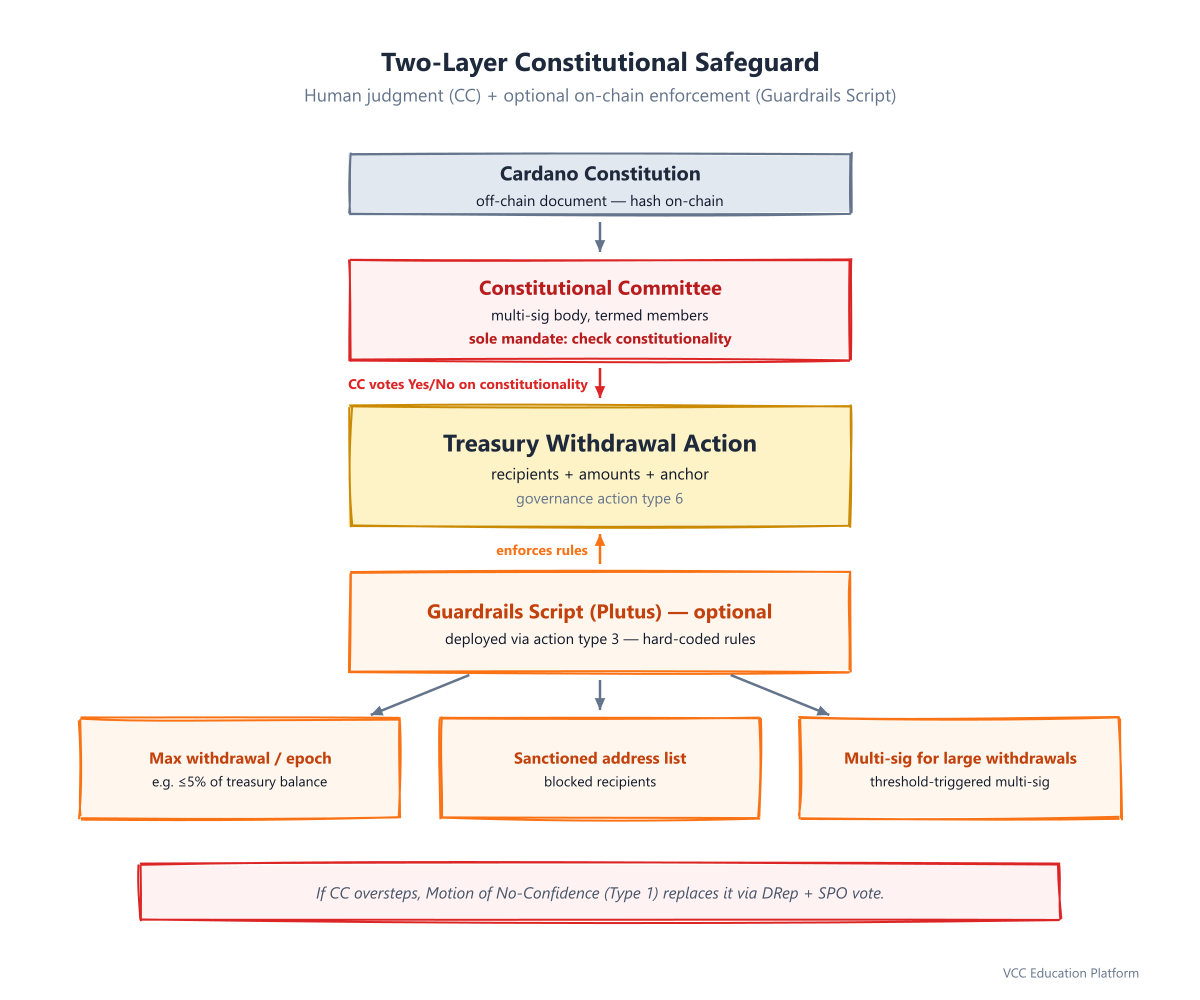
The CC is a **multi-signature body** (hot/cold key setup, variable size, per-member terms) whose sole mandate is: *"ensure the Constitution is respected."* It cannot enforce its judgment on-chain — it is a social contract — but a `No` vote from the CC blocks the withdrawal.
The Constitution is an **off-chain document** (hash recorded on-chain). Example constitutional principles:
- "The Cardano network must always be able to produce new blocks"
- "No single entity shall control protocol upgrades"
- "Treasury funds shall not be used to enrich insiders at the expense of the community"
If a withdrawal proposes funding a centralized exchange integration that creates a single point of failure, the CC may deem it unconstitutional.
### Layer 2: Guardrails Script (Optional On-Chain Enforcement)
CIP-1694 provides for an optional **Guardrails Script** — a Plutus script that can enforce hard rules on treasury withdrawals and protocol parameter changes. Examples of guardrails:
- Maximum withdrawal per epoch (e.g., ≤5% of treasury balance)
- No withdrawals to addresses on a sanctions list
- Mandatory multi-sig for withdrawals > threshold
If deployed, the guardrails script **must be satisfied** for the transaction to be valid — it is a *technical* constraint, not a social one. As of writing, no guardrails script has been ratified; the CC provides the sole constitutional check.
### No-Confidence: The Ultimate Override
If the CC oversteps (e.g., routinely blocking legitimate withdrawals), Ada holders can trigger a **Motion of No-Confidence** (governance action type 1). This requires DRep threshold `P1` and SPO threshold `Q1`. Once passed, the CC enters a **state of no-confidence** — it cannot vote on any governance action until replaced via an "Update Committee" action (type 2a/2b). This is the electorate's nuclear option.
## Constitutional Safeguards: Two Layers of Protection
### Layer 1: Constitutional Committee (Human Judgment)
The CC is a **multi-signature body** (hot/cold key setup, variable size, per-member terms) whose sole mandate is: *"ensure the Constitution is respected."* It cannot enforce its judgment on-chain — it is a social contract — but a `No` vote from the CC blocks the withdrawal.
The Constitution is an **off-chain document** (hash recorded on-chain). Example constitutional principles:
- "The Cardano network must always be able to produce new blocks"
- "No single entity shall control protocol upgrades"
- "Treasury funds shall not be used to enrich insiders at the expense of the community"
If a withdrawal proposes funding a centralized exchange integration that creates a single point of failure, the CC may deem it unconstitutional.
### Layer 2: Guardrails Script (Optional On-Chain Enforcement)
CIP-1694 provides for an optional **Guardrails Script** — a Plutus script that can enforce hard rules on treasury withdrawals and protocol parameter changes. Examples of guardrails:
- Maximum withdrawal per epoch (e.g., ≤5% of treasury balance)
- No withdrawals to addresses on a sanctions list
- Mandatory multi-sig for withdrawals > threshold
If deployed, the guardrails script **must be satisfied** for the transaction to be valid — it is a *technical* constraint, not a social one. As of writing, no guardrails script has been ratified; the CC provides the sole constitutional check.
### No-Confidence: The Ultimate Override
If the CC oversteps (e.g., routinely blocking legitimate withdrawals), Ada holders can trigger a **Motion of No-Confidence** (governance action type 1). This requires DRep threshold `P1` and SPO threshold `Q1`. Once passed, the CC enters a **state of no-confidence** — it cannot vote on any governance action until replaced via an "Update Committee" action (type 2a/2b). This is the electorate's nuclear option.
 ## Vietnamese Context: Ngân Sách Nhà Nước with Continuous Accountability
For a Vietnamese reader, the Cardano treasury allocation process mirrors the **state budget (ngân sách nhà nước)** — but with three radical upgrades:
| State Budget (Vietnam) | Cardano Treasury Allocation |
|------------------------|------------------------------|
| **Revenue**: Taxes, fees, SOE dividends | **Inflow**: `treasuryCut` (~20% epoch rewards) + transaction fees |
| **Budget drafting**: Ministry of Finance → Government → National Assembly | **Budget drafting**: Intersect committees → Community consultation → On-chain governance action |
| **Oversight**: State Audit + National Assembly (annual sessions) | **Oversight**: Constitutional Committee (constitutionality) + DReps (stake-weighted vote) — **continuous, on-chain** |
| **Expenditure**: Ministries, localities, programs | **Expenditure**: Treasury withdrawal governance actions (recipients + amounts on-chain) |
| **Transparency**: Reports published periodically | **Transparency**: Every withdrawal permanently auditable on ledger by anyone |
| **Recall**: Elections every 5 years | **Recall**: DRep delegation changeable **instantly**; CC replaceable via no-confidence |
The critical difference: **continuity**. In Vietnam's system, you wait for the next National Assembly session to question a budget line. In Cardano, every withdrawal is a governance action with a public anchor, a CC vote record, and a DRep vote tally — all visible in real time. A DRep who votes for a wasteful withdrawal can be **undelegated instantly** by stakeholders. There is no election cycle; accountability is *continuous*.
## Step-by-Step: From Idea to Funded Project
1. **Need identified** — e.g., "Cardano node needs a new P2P layer for scalability"
2. **Proposal drafted** — Technical Steering Committee scopes work, estimates 2M ADA over 6 months
3. **Budget inclusion** — Proposal enters Intersect annual budget; community consultation
4. **Governance action created** — Intersect submits treasury withdrawal action: `{ stakeCredential: IntersectTreasuryMultisig, amount: 2_000_000_000_000 }` (2M ADA in Lovelace)
5. **CC review** — Committee checks: Does this violate Constitution? (No — core protocol development aligns with sustainability principle)
6. **DRep voting** — DReps review anchor (technical spec, milestones, team). Stake-weighted vote; threshold `P6` must be met
7. **Ratification** — Both CC and DRep thresholds met → action **ratified**
8. **Enactment** — Next epoch boundary: 2M ADA moves from treasury to Intersect multisig
9. **Delivery & reporting** — Intersect pays developers; monthly progress reports published; feeds into next budget cycle
## Common Questions About Treasury Fund Allocation
### What is the `treasuryCut` parameter and can it change?
`treasuryCut` is a protocol parameter (economic group) that sets the fraction of epoch monetary expansion going to the treasury. Current value ~0.2 (20%). It **can be changed** via a protocol parameter change governance action (type 5b), requiring CC + DRep ratification.
### Who decides the DRep threshold `P6` for treasury withdrawals?
`P6` is a **governance parameter** set by the community (via governance action type 5d — governance group). It can be adaptive: CIP-1694 notes "the treasury threshold could also be adaptive, depending on the total Lovelace being withdrawn."
### Can the Constitutional Committee block a withdrawal for policy reasons?
**No.** The CC's mandate is strictly **constitutionality**. It should only vote `No` if the withdrawal violates the Cardano Constitution. Policy merit (is this project worth the money?) is the DReps' decision.
### What happens if a treasury withdrawal action expires?
If ratification thresholds aren't met before `govActionLifetime` epochs, the action **expires**. The deposit is returned to the submitter. No funds move. A new action can be submitted with adjustments.
### How does Intersect's budget relate to Project Catalyst?
Catalyst is a **line item within the Intersect budget**. The annual budget process allocates a tranche to Catalyst; Catalyst then runs its own funding rounds. Both use treasury withdrawal governance actions to move funds.
### Can I audit every treasury withdrawal myself?
**Yes.** Every withdrawal is a governance action on-chain. You can query any Cardano explorer or node for: the action ID, recipients + amounts, CC votes, DRep vote tally, anchor metadata. The ledger is the receipt.
### What prevents a "runaway" treasury drain?
Three safeguards: (1) CC constitutional veto, (2) DRep stake-weighted threshold `P6`, (3) optional Guardrails script (hard-coded limits). The deposit (`govActionDeposit`) also disincentivizes spam.
### How often does the budget cycle run?
**Annual**, aligned with the Cardano Technical Roadmap. Emergency withdrawals are possible via ad-hoc governance actions but face the same ratification gauntlet.
---
## Quick Reference
| Property | Value |
|----------|-------|
| **Inflow parameter** | `treasuryCut` (~0.2 = 20% of epoch monetary expansion) |
| **Secondary inflow** | ~20% of transaction fees |
| **Current balance** | ~1.5B+ ADA (growing) |
| **Withdrawal action type** | Governance action type 6 (CIP-1694) |
| **Ratification: CC** | ✓ Must approve (constitutionality only) |
| **Ratification: DReps** | P6 threshold (% active voting stake) |
| **Ratification: SPOs** | Not required |
| **Enactment priority** | 6th (after protocol parameter changes) |
| **Budget administrator** | Intersect MBO (annual cycle) |
| **Constitutional backstop** | CC + optional Guardrails script |
| **Ultimate override** | Motion of No-Confidence (type 1) |
| **Auditability** | 100% on-chain, permanent, public |
---
*The Cardano treasury turns "community-owned network" from a slogan into an operational reality: every ADA spent is proposed, debated, voted, and recorded on a public ledger you can audit right now. The allocation mechanism — `treasuryCut` for inflow, CIP-1694 governance actions for outflow, Intersect for budget process, CC + DReps for oversight — is a complete, governable, transparent fiscal pipeline. No ministry, no boardroom, no black box. Just code, constitution, and continuous consent.*
## Vietnamese Context: Ngân Sách Nhà Nước with Continuous Accountability
For a Vietnamese reader, the Cardano treasury allocation process mirrors the **state budget (ngân sách nhà nước)** — but with three radical upgrades:
| State Budget (Vietnam) | Cardano Treasury Allocation |
|------------------------|------------------------------|
| **Revenue**: Taxes, fees, SOE dividends | **Inflow**: `treasuryCut` (~20% epoch rewards) + transaction fees |
| **Budget drafting**: Ministry of Finance → Government → National Assembly | **Budget drafting**: Intersect committees → Community consultation → On-chain governance action |
| **Oversight**: State Audit + National Assembly (annual sessions) | **Oversight**: Constitutional Committee (constitutionality) + DReps (stake-weighted vote) — **continuous, on-chain** |
| **Expenditure**: Ministries, localities, programs | **Expenditure**: Treasury withdrawal governance actions (recipients + amounts on-chain) |
| **Transparency**: Reports published periodically | **Transparency**: Every withdrawal permanently auditable on ledger by anyone |
| **Recall**: Elections every 5 years | **Recall**: DRep delegation changeable **instantly**; CC replaceable via no-confidence |
The critical difference: **continuity**. In Vietnam's system, you wait for the next National Assembly session to question a budget line. In Cardano, every withdrawal is a governance action with a public anchor, a CC vote record, and a DRep vote tally — all visible in real time. A DRep who votes for a wasteful withdrawal can be **undelegated instantly** by stakeholders. There is no election cycle; accountability is *continuous*.
## Step-by-Step: From Idea to Funded Project
1. **Need identified** — e.g., "Cardano node needs a new P2P layer for scalability"
2. **Proposal drafted** — Technical Steering Committee scopes work, estimates 2M ADA over 6 months
3. **Budget inclusion** — Proposal enters Intersect annual budget; community consultation
4. **Governance action created** — Intersect submits treasury withdrawal action: `{ stakeCredential: IntersectTreasuryMultisig, amount: 2_000_000_000_000 }` (2M ADA in Lovelace)
5. **CC review** — Committee checks: Does this violate Constitution? (No — core protocol development aligns with sustainability principle)
6. **DRep voting** — DReps review anchor (technical spec, milestones, team). Stake-weighted vote; threshold `P6` must be met
7. **Ratification** — Both CC and DRep thresholds met → action **ratified**
8. **Enactment** — Next epoch boundary: 2M ADA moves from treasury to Intersect multisig
9. **Delivery & reporting** — Intersect pays developers; monthly progress reports published; feeds into next budget cycle
## Common Questions About Treasury Fund Allocation
### What is the `treasuryCut` parameter and can it change?
`treasuryCut` is a protocol parameter (economic group) that sets the fraction of epoch monetary expansion going to the treasury. Current value ~0.2 (20%). It **can be changed** via a protocol parameter change governance action (type 5b), requiring CC + DRep ratification.
### Who decides the DRep threshold `P6` for treasury withdrawals?
`P6` is a **governance parameter** set by the community (via governance action type 5d — governance group). It can be adaptive: CIP-1694 notes "the treasury threshold could also be adaptive, depending on the total Lovelace being withdrawn."
### Can the Constitutional Committee block a withdrawal for policy reasons?
**No.** The CC's mandate is strictly **constitutionality**. It should only vote `No` if the withdrawal violates the Cardano Constitution. Policy merit (is this project worth the money?) is the DReps' decision.
### What happens if a treasury withdrawal action expires?
If ratification thresholds aren't met before `govActionLifetime` epochs, the action **expires**. The deposit is returned to the submitter. No funds move. A new action can be submitted with adjustments.
### How does Intersect's budget relate to Project Catalyst?
Catalyst is a **line item within the Intersect budget**. The annual budget process allocates a tranche to Catalyst; Catalyst then runs its own funding rounds. Both use treasury withdrawal governance actions to move funds.
### Can I audit every treasury withdrawal myself?
**Yes.** Every withdrawal is a governance action on-chain. You can query any Cardano explorer or node for: the action ID, recipients + amounts, CC votes, DRep vote tally, anchor metadata. The ledger is the receipt.
### What prevents a "runaway" treasury drain?
Three safeguards: (1) CC constitutional veto, (2) DRep stake-weighted threshold `P6`, (3) optional Guardrails script (hard-coded limits). The deposit (`govActionDeposit`) also disincentivizes spam.
### How often does the budget cycle run?
**Annual**, aligned with the Cardano Technical Roadmap. Emergency withdrawals are possible via ad-hoc governance actions but face the same ratification gauntlet.
---
## Quick Reference
| Property | Value |
|----------|-------|
| **Inflow parameter** | `treasuryCut` (~0.2 = 20% of epoch monetary expansion) |
| **Secondary inflow** | ~20% of transaction fees |
| **Current balance** | ~1.5B+ ADA (growing) |
| **Withdrawal action type** | Governance action type 6 (CIP-1694) |
| **Ratification: CC** | ✓ Must approve (constitutionality only) |
| **Ratification: DReps** | P6 threshold (% active voting stake) |
| **Ratification: SPOs** | Not required |
| **Enactment priority** | 6th (after protocol parameter changes) |
| **Budget administrator** | Intersect MBO (annual cycle) |
| **Constitutional backstop** | CC + optional Guardrails script |
| **Ultimate override** | Motion of No-Confidence (type 1) |
| **Auditability** | 100% on-chain, permanent, public |
---
*The Cardano treasury turns "community-owned network" from a slogan into an operational reality: every ADA spent is proposed, debated, voted, and recorded on a public ledger you can audit right now. The allocation mechanism — `treasuryCut` for inflow, CIP-1694 governance actions for outflow, Intersect for budget process, CC + DReps for oversight — is a complete, governable, transparent fiscal pipeline. No ministry, no boardroom, no black box. Just code, constitution, and continuous consent.*