
Cardano stake delegation lets ADA holders earn rewards by participating in network security without running infrastructure. This guide covers everything from choosing a stake pool to understanding rewards, risks, and the step-by-step delegation process.
---
What Is Cardano Stake Delegation?
Cardano uses a Proof-of-Stake (PoS) consensus mechanism called Ouroboros. Instead of miners competing with hardware, the network selects stake pools to produce blocks based on the amount of ADA delegated to them.
When you delegate ADA to a stake pool, you're essentially voting for that pool to validate transactions and produce blocks. In return, you receive a share of the rewards the pool earns — typically 3-5% APY — without ever losing custody of your funds.
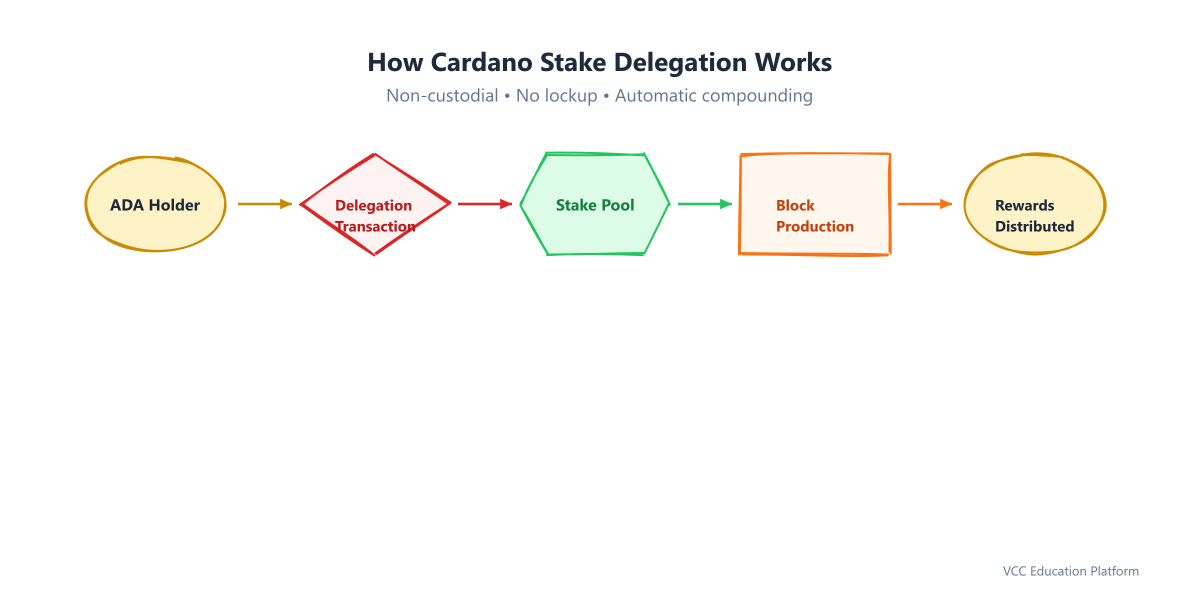
Key Properties of Delegation
| Property | Details | |----------|---------| | Non-custodial | ADA never leaves your wallet | | No lockup period | Undelegate anytime (takes 1-2 epochs) | | Per-wallet delegation | Each wallet delegates to one pool at a time | | Rewards compound automatically | Staked ADA earns on rewards too |
---
How Stake Pool Delegation Works
The Delegation Cycle
Cardano operates in epochs — 5-day periods (432,000 slots, 1 slot = 1 second). Understanding the epoch timeline is crucial for setting expectations.
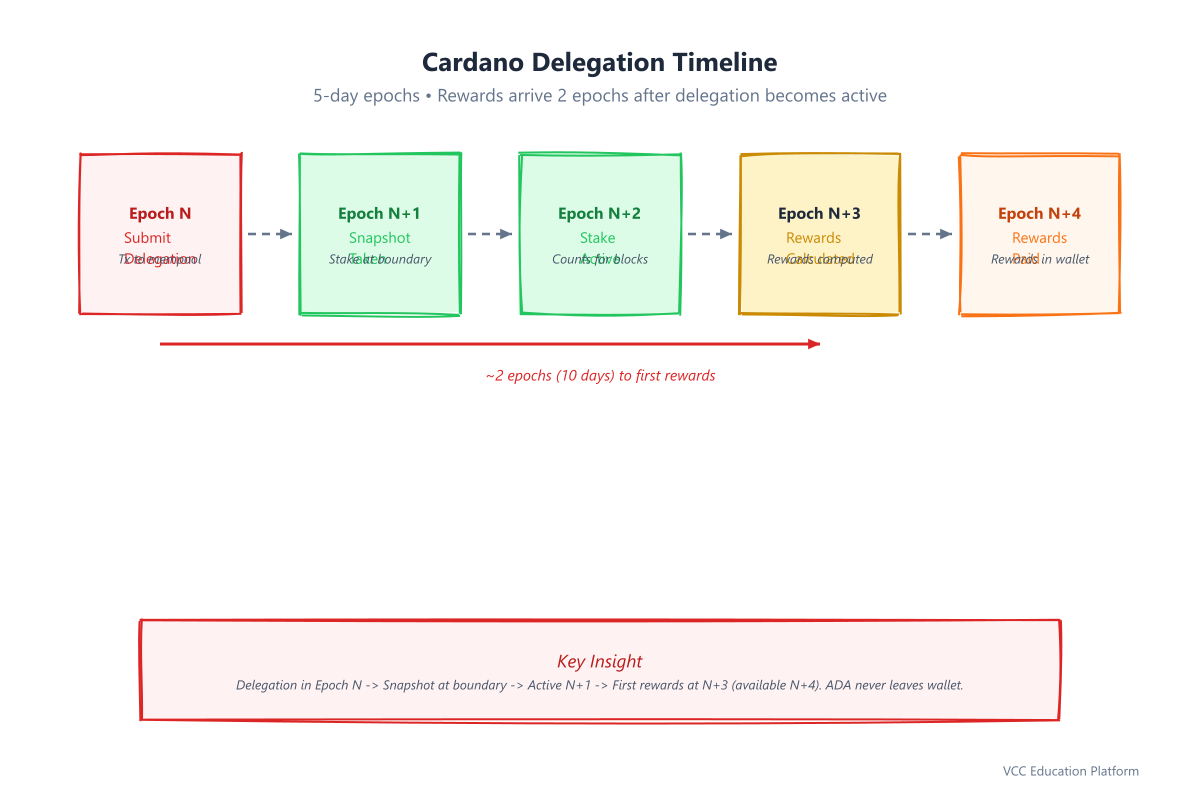
1. Submit delegation — Transaction goes to mempool 2. Snapshot taken — At epoch boundary, stake is recorded 3. Becomes active — Next epoch, your stake counts toward pool's block production 4. Rewards calculated — After epoch ends, rewards computed 5. Rewards paid — Two epochs after delegation, rewards appear in wallet
The Reward Formula
Your rewards depend on three factors:
Your Reward = Pool Rewards × (Your Stake / Pool Total Stake) - Pool Fees
Where:
- Pool Rewards = Fixed block rewards + transaction fees for blocks produced
- Your Stake = Your delegated ADA + accumulated rewards
- Pool Total Stake = Sum of all delegators' stake + pool operator's pledge
- Pool Fees = Fixed fee (min 340 ADA/epoch) + margin percentage
- Increases pool rewards slightly (via the
a0parameter) - Signals long-term commitment
- Reduces Sybil attack risk
- Higher margin, minimum fixed fee — Better for small delegators
- Eternl/Lace/Yoroi: Click "Staking" or "Delegate" in sidebar
- Daedalus: Click "Delegation Center" tab
- Browse or search for pools by ticker
- Filter by saturation, pledge, margin
- Pro tip: Use pooltool.io or adapools.org for deeper analysis
- Review pool details and fees
- Click "Delegate" and confirm with spend password
- Wait for transaction confirmation (~30 seconds)
- Epoch 3: Earn ~15 ADA (at 4% APY)
- Epoch 4: Stake = 10,015 ADA (earns on 10,015)
- Over 5 years: ~22% more than simple interest
- Server downtime
- Missed slots
- Network connectivity issues
- Change margin/fees without notice
- Run multiple pools (Sybil attack)
- Abandon the pool
- Split ADA across multiple wallets
- Delegate each to different pools
- Diversify operator risk and support decentralization
- Lower margins (0-1%)
- Higher pledge commitment
- Direct communication channels
- Community-focused mission
- PoolTool.io — Real-time block production, luck, saturation
- AdaPools.org — Historical performance, rankings
- CardanoScan.io — On-chain delegation verification
- Wallet built-in dashboards — Quick overview
- [ ] Verify operator transparency (website, contact, track record)
- [ ] Compare margin + fixed fee for your stake size
- [ ] Delegate via your wallet's delegation center
- [ ] Verify "Active" status after 1-2 epochs
- [ ] Monitor pool performance monthly
- [ ] Re-evaluate if saturation approaches 90%+
---
Choosing the Right Stake Pool
Not all stake pools are equal. The pool you choose directly impacts your returns and network decentralization.
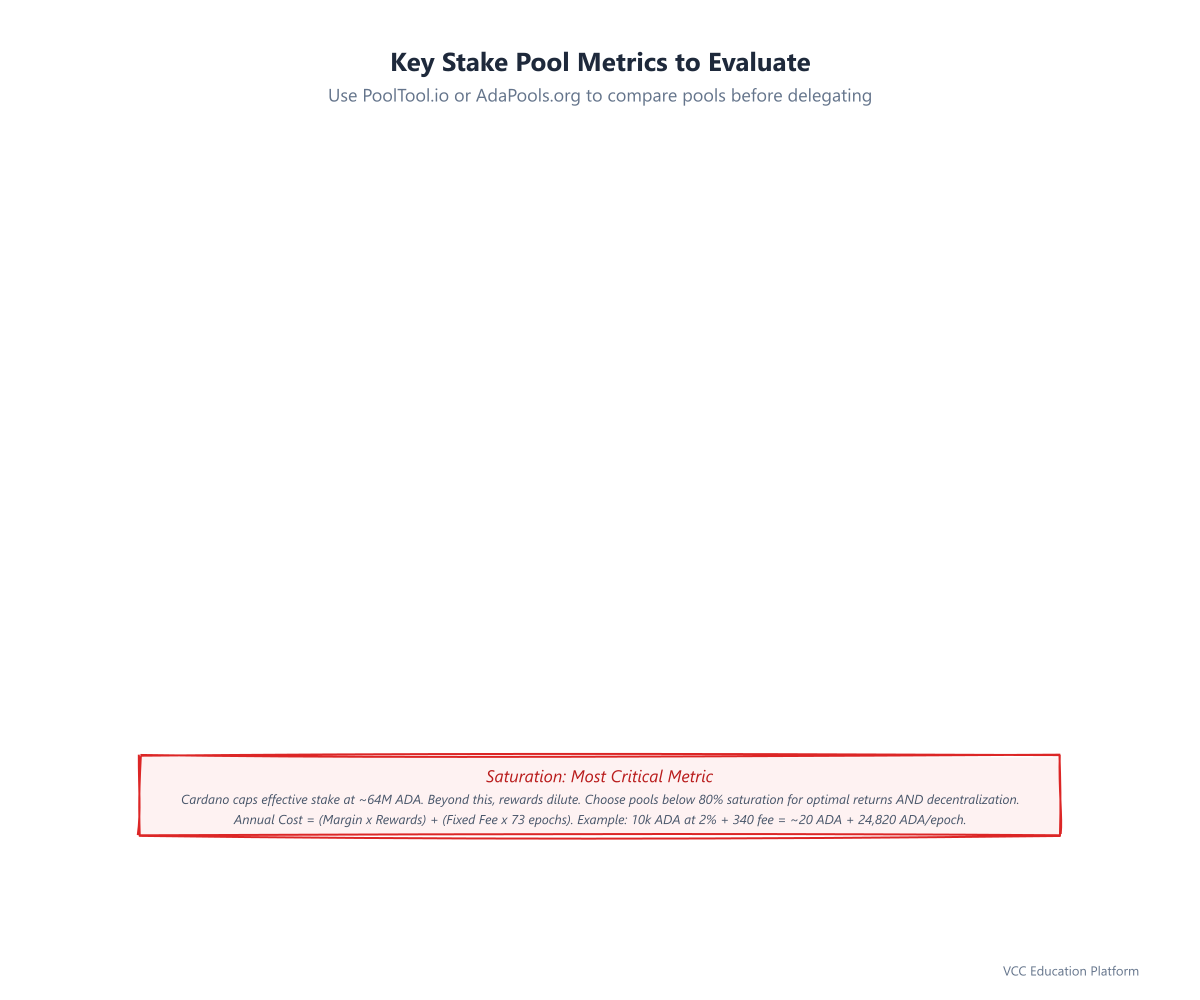
Critical Metrics to Evaluate
| Metric | Target | Why It Matters | |--------|--------|----------------| | Saturation | < 90% | Saturated pools earn diminishing returns | | Pledge | Higher is better | Shows operator skin in the game | | Margin | 0-3% | Lower margin = more rewards to you | | Fixed Fee | 340 ADA (min) | Covers operator costs; high fees hurt small delegators | | Blocks/Epoch | Consistent | Indicates reliability and performance | | Lifetime Luck | ~100% | Measures actual vs expected blocks |
Saturation: The Most Important Metric
Cardano caps effective stake at the saturation point (currently ~64M ADA). Beyond this, rewards don't increase — they're diluted among more delegators.
Rule of thumb: Choose pools below 80% saturation for optimal returns and to support decentralization.
Pledge and Operator Commitment
Pledge is the pool operator's own ADA committed to the pool. Higher pledge:
Margin vs Fixed Fee Trade-off
- Low margin, higher fixed fee — Better for large delegators
Calculate your effective cost: Annual Cost = (Margin × Your Rewards) + (Fixed Fee × 73 epochs)
---
Step-by-Step: How to Delegate Cardano
Prerequisites
1. Cardano wallet with ADA (Daedalus, Yoroi, Eternl, Lace, Typhon, etc.) 2. Minimum ~5-10 ADA for transaction fees + 2 ADA deposit (returned on undelegation) 3. Internet connection and wallet password/spend password
Delegation Process (Eternl Wallet Example)
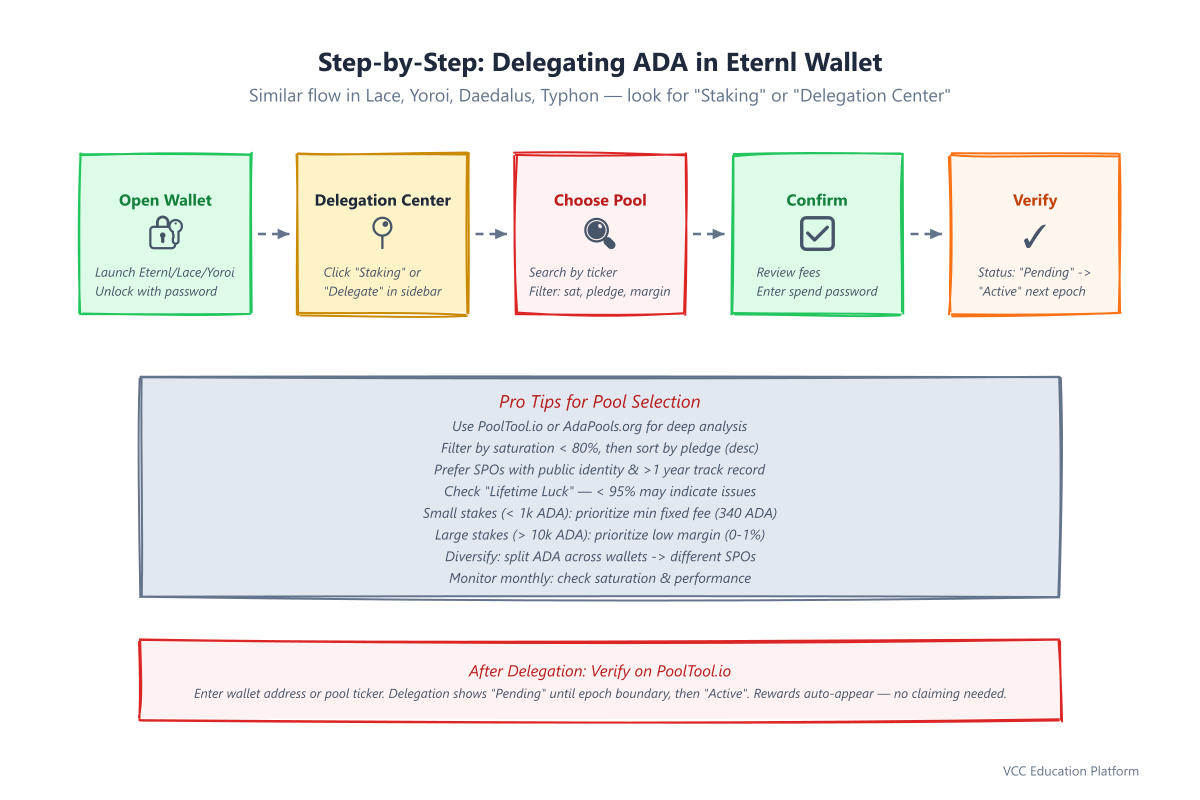
#### Step 1: Open Your Wallet Launch your wallet and unlock it with your password.
#### Step 2: Navigate to Delegation Center
#### Step 3: Choose a Stake Pool
#### Step 4: Confirm Delegation
#### Step 5: Verify Status Your delegation shows as "Pending" until the next epoch boundary, then "Active."
---
Understanding Rewards and Compounding
Reward Schedule
| Event | Timing | |-------|--------| | Delegation submitted | Anytime | | Snapshot taken | End of current epoch | | Stake becomes active | Next epoch | | Rewards calculated | End of active epoch | | Rewards available | 2 epochs after delegation |
Compounding Effect
Rewards are automatically added to your stake — no manual claiming needed. This means:
- Epoch 1: Delegate 10,000 ADA
Real-World Returns (2024 Data)
| Pool Size | Typical APY | Notes | |-----------|-------------|-------| | Small (<10M ADA) | 3.5-4.5% | Higher variance, supports decentralization | | Medium (10-40M ADA) | 4-5% | Balanced returns and stability | | Large (>40M ADA) | 3.5-4.5% | Lower variance but saturation risk | | Saturated (>64M ADA) | <3% | Diminishing returns |
---
Risks and Considerations
No Loss of Principal
Your ADA never leaves your wallet. Delegation is a blockchain-recorded preference, not a transfer. You can't lose ADA through delegation itself.Pool Performance Risk
Poorly performing pools produce fewer blocks → lower rewards. Causes:Saturation Risk
If your pool becomes saturated, your effective rewards drop. Monitor saturation weekly.Operator Risk
Malicious operators could:Mitigation: Choose pools with transparent operators, published contact info, and track record >1 year.
Tax Implications
In many jurisdictions, staking rewards are taxable income at receipt. Consult a tax professional.---
Advanced Delegation Strategies
Multi-Wallet Delegation
Since each wallet delegates to one pool, power users often:
Delegating to Single Pool Operators (SPOs)
Independent SPOs often offer:
Monitoring Your Delegation
Use these tools to track performance:
---
Frequently Asked Questions
Can I delegate to multiple pools from one wallet?
No. Each wallet delegates to exactly one pool. Use multiple wallets for multi-pool delegation.What happens if my pool mints zero blocks?
You earn zero rewards for that epoch. Your principal ADA is unaffected.Can I change pools anytime?
Yes. Submit a new delegation transaction. The switch takes effect at the next epoch boundary (1-2 epochs).Do I need to claim rewards manually?
No. Rewards are automatically added to your delegated stake and compound.What's the minimum ADA to delegate?
Technically 1 ADA, but practically 10+ ADA to cover transaction fees (0.17 ADA) and make rewards meaningful.Is my ADA locked while delegated?
No. You can send/spend ADA anytime. Only the delegated portion earns rewards.How are rewards taxed?
Varies by country. Many treat staking rewards as ordinary income at fair market value when received.What if my pool retires?
Your delegation becomes inactive. You must re-delegate to a new pool to resume earning.---
Summary Checklist
- [ ] Choose a pool with <80% saturation
---
Next Steps
1. Research pools at adapools.org or pooltool.io 2. Open a Cardano wallet if you haven't (Eternl, Lace, Yoroi recommended) 3. Delegate a test amount first to verify the process 4. Scale up once comfortable 5. Monitor quarterly and adjust as needed
Cardano stake delegation is one of the safest ways to earn yield on crypto. By choosing quality pools and staying informed, you support network security while growing your ADA holdings.