
Choosing the right stake pool feels like picking a restaurant in a foreign city — everyone claims to be the best, menus look similar, and you only discover the truth after you've committed. Stake pool tools solve this by making every pool's performance, fees, and operator behavior transparent. This tutorial walks you through the four main Cardano pool explorers — AdaPools, PoolTool, CardanoScan, and CExplorer — so you can read their screens like a pro and pick a pool that matches your priorities.
Why Tools Matter More Than Rankings
Most delegators start by sorting a leaderboard by ROA (Return on ADA). That's like choosing a car by top speed alone — you miss reliability, fuel economy, and whether the dealer honors warranties. Pool rankings capture a snapshot; tools reveal the movie.
Cardano's protocol makes all pool data public: blocks minted, saturation, pledge, margin, fixed fee, reward history. But raw data is noisy. A pool with 99% lifetime luck might have missed three blocks last epoch. A 2% margin pool might hike to 5% next month without notice. The right stake pool tools surface these patterns before you delegate.
Key insight: The protocol makes all pool data public. The edge goes to delegators who know how to read it.
The Four Main Tools at a Glance
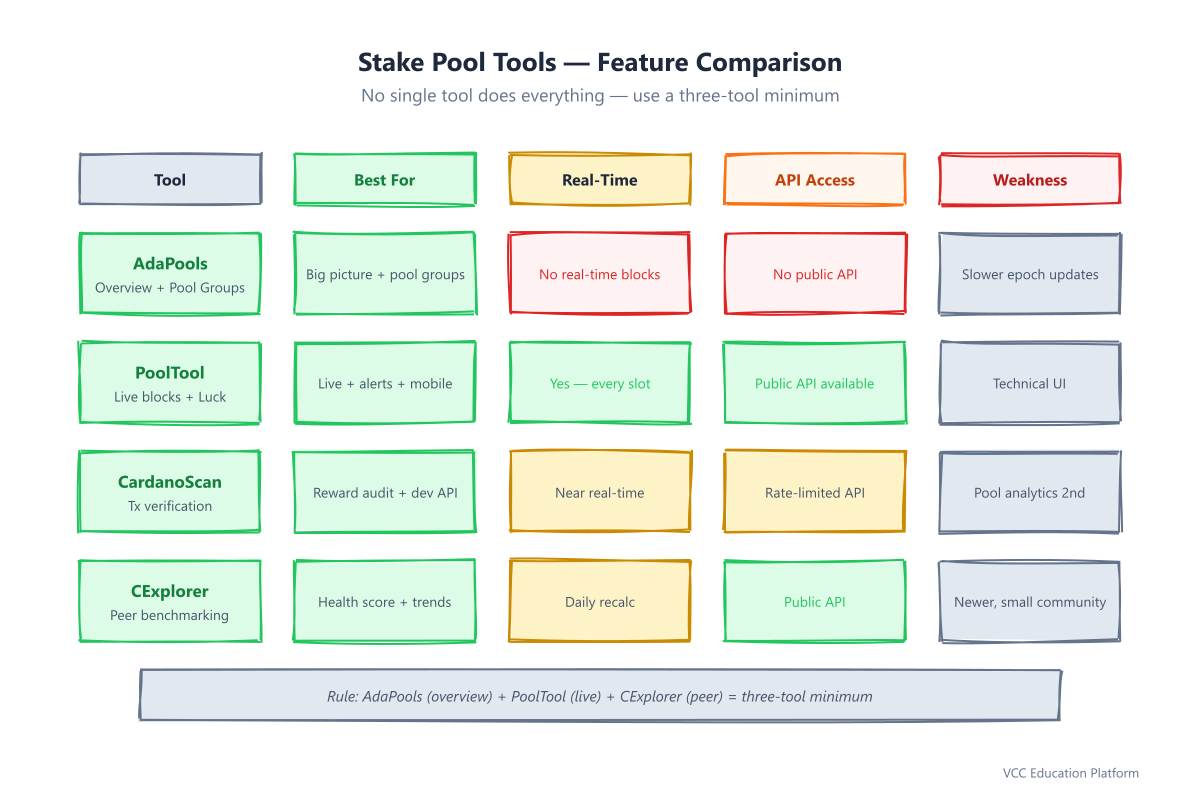
Each tool started with a different DNA, and it shows in what they emphasize:
| Tool | Origin | Best For | Weakness |
|---|---|---|---|
| AdaPools | Community-focused explorer | Overview, pool groups, beginner-friendly UI | No API, no real-time blocks, slower epoch updates |
| PoolTool | Operator toolkit turned public | Real-time block tracking, luck analysis, alerts, mobile apps | Technical UI can overwhelm beginners |
| CardanoScan | Block explorer first | Transaction verification, reward payment audit, developer API | Pool analytics secondary, dense interface |
| CExplorer | Analytics platform | Peer benchmarking, health scores, comparative trends | Newer, smaller community knowledge base |
You don't pick one. You use a three-tool minimum: AdaPools for the big picture, PoolTool for live block production, CExplorer for peer comparison. CardanoScan stays in your back pocket for "show me the transaction" moments.
Step 1: Define Your Criteria Before You Open Any Tool
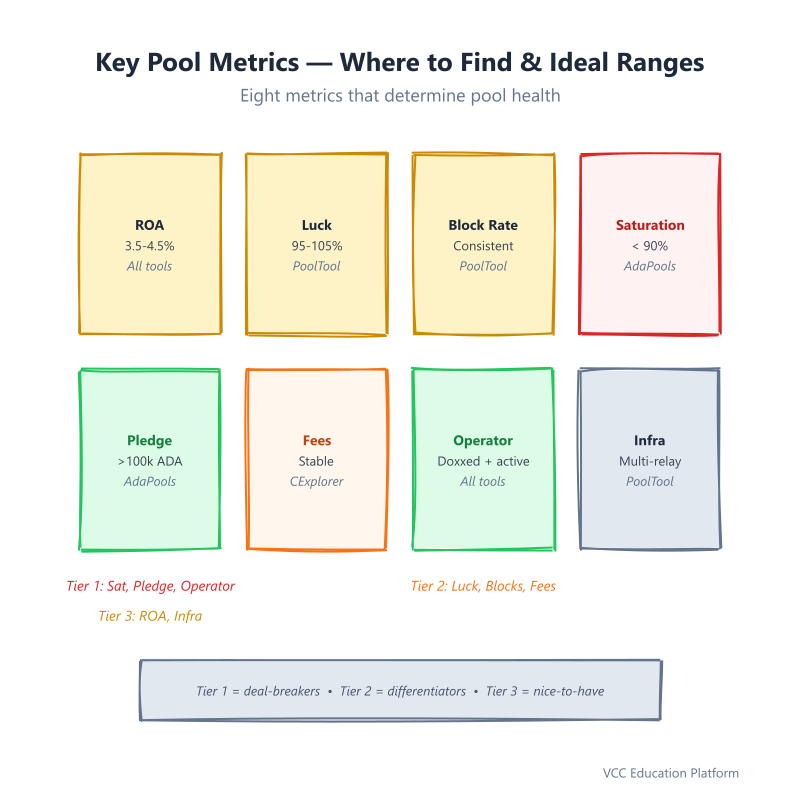
Before comparing pools, decide what matters to you. A retiree seeking steady income weights reliability over yield. A crypto-native user might tolerate higher variance for lower fees. Write down your non-negotiables:
- Saturation ceiling: Most delegators avoid pools >90% saturated (rewards diminish). Some set 80% for buffer.
- Pledge floor: Higher pledge = more skin in the game. 100k ADA is a common minimum; Vietnamese operators often run 200k-1M.
- Fee tolerance: Margin 0-5%, fixed fee 340 ADA minimum. Decide your max for each.
- Operator transparency: Doxxed (real identity known) vs anonymous. Doxxed operators tend to communicate better.
- Communication channels: Telegram, Discord, Twitter, email updates. Vietnamese SPOs often run Zalo/Facebook groups.
- Infrastructure: Multiple relays, geographic distribution, monitoring alerts.
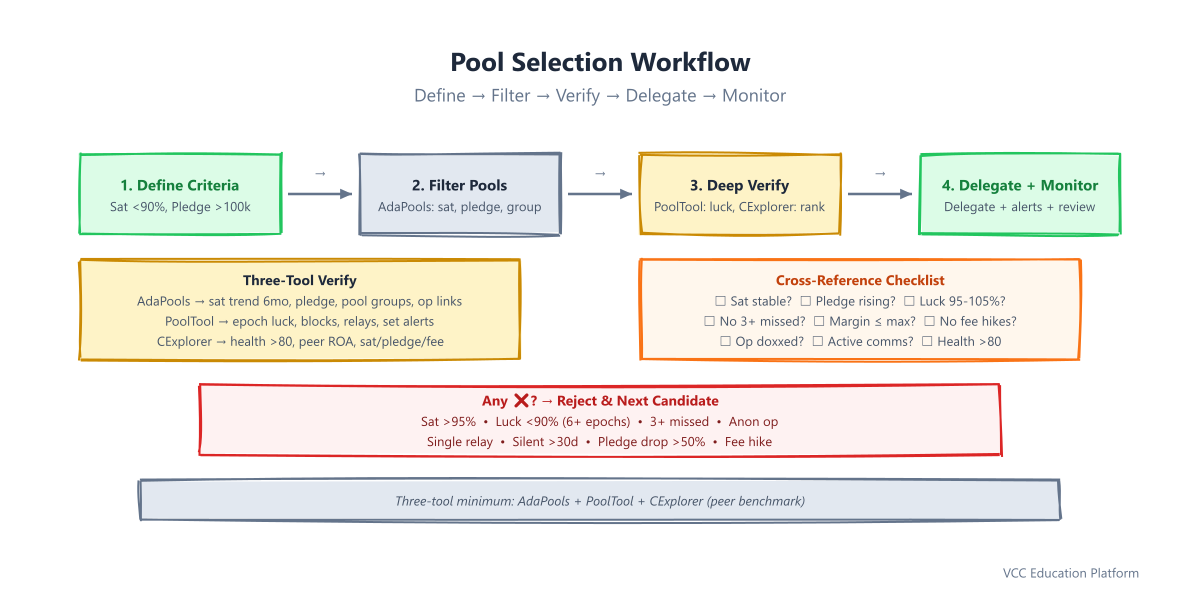
Step 2: AdaPools — The Big Picture Start
Open adapools.org. The homepage shows a searchable, sortable table. Here's how to read the key columns:
Rankings Page
- ROA %: Annualized return based on recent epochs. Hover for epoch-by-epoch breakdown.
- Saturation %: Current live stake vs k-parameter cap. Green <90%, yellow 90-95%, red >95%.
- Pledge: Operator's own ADA in the pool. Click to see pledge history — drops are red flags.
- Margin / Fixed Fee: Variable + fixed cut. Margin compounds on rewards; fixed fee is 340 ADA minimum per epoch.
- Lifetime Luck: Actual blocks / expected blocks. 100% = exactly as predicted. 95-105% is healthy range.
Pool Detail Page (Click any pool)
Tabs to check:- Performance: Epoch-by-epoch blocks, luck, ROA. Look for consistency — not just average.
- Delegators: Stake distribution. Whale-heavy pools (>50% from top 5) risk sudden outflow.
- Blocks: Every block minted with timestamp, slot, height. Cross-reference with PoolTool.
- Operator: Pool group membership (multi-pool operators), contact links, metadata JSON.
AdaPools superpower: Pool Groups. Operators running multiple pools appear grouped. If one pool saturates, they often open a sister pool. Track the operator, not just the pool.
Vietnamese context: Most VN SPOs list on AdaPools. Check the "Operator" tab for Zalo/Telegram links — local operators post epoch reports in Vietnamese there.
Step 3: PoolTool — Real-Time Block Production
Open pooltool.io. Paste a pool ID (bech32 format: pool1...) or ticker. The dashboard shows:
Live Block Monitor (Top Section)
- Current Epoch: Blocks minted vs expected so far this epoch. Updates every slot.
- Luck %: Running ratio. Don't panic at 50% halfway through an epoch — variance is normal.
- Next Slot Leader: Countdown to next assigned block. Great for verifying your pool is online.
Historical Analysis (Scroll Down)
- Luck Chart: Epoch-by-epoch bars. Green >100%, red <100%. Consistent green = reliable infrastructure.
- Block Timeline: Visual strip of every epoch. Gaps = missed slots. Three+ consecutive missed epochs = investigation needed.
- Relay Health: PoolTool pings relays. Red relays = potential propagation delays.
Alerts (Free Account Required)
Set alerts for:- Margin changes
- Pledge changes
- Saturation crossing thresholds
- Missed blocks
- Relay downtime
Pro tip: PoolTool's "Luck" is the most misunderstood metric. A pool at 120% luck isn't "skilled" — it's statistically due for regression. A pool at 80% isn't "unlucky" — it's due for mean reversion. Look for consistency (95-105% over 12+ epochs), not outliers.
Step 4: CExplorer — Peer Benchmarking
Open cexplorer.io. Search by pool ID or ticker. The "Pool Analytics" dashboard adds comparative context:
Health Score (Top Right)
Composite 0-100 combining: performance, saturation stability, pledge stability, fee consistency, operator responsiveness. >80 = healthy. <60 = investigate.Peer Group Comparison (Unique Feature)
CExplorer groups pools by similar live stake (±20%). Your pool ranks within its weight class:- ROA vs Peers: Top quartile? Median? Bottom?
- Luck vs Peers: Is underperformance systemic or pool-specific?
- Fee Competitiveness: Are you overpaying for similar performance?
Trends (6-Month View)
- Saturation Trend: Creeping up? Sudden spike? Stable?
- Pledge Trend: Rising (operator confidence) or falling (extracting value)?
- Margin History: Any hikes? Frequency?
Step 5: CardanoScan — Verify the Money Trail
Open cardanoscan.io. This isn't for pool selection — it's for verification.
When to Use CardanoScan
- Reward not showing in wallet: Paste your stake address → "Rewards" tab → verify payment tx hash.
- Pool claims "we minted X blocks": Search pool ID → "Blocks" tab → verify every block height/hash.
- Tax records: Export reward transaction history with timestamps and amounts.
- Metadata audit: Check pool's registered metadata (name, ticker, homepage, description) matches what they advertise.
Reading Reward Transactions
Each reward withdrawal shows:- Epoch: Which epoch rewards cover
- Amount: Lovelace (divide by 1,000,000 for ADA)
- Tx Hash: Immutable proof on-chain
- Time: When withdrawal was submitted
Warning: CardanoScan shows withdrawals, not earnings. Rewards accumulate automatically; you only see a tx when you (or your wallet) withdraw. Don't confuse "no withdrawal tx" with "no rewards earned."
Step 6: Cross-Reference — The Three-Tool Check
Never delegate based on one tool. Run this 5-minute checklist:
| Check | AdaPools | PoolTool | CExplorer | Pass? |
|---|---|---|---|---|
| Saturation < 90% now | ✓ | ✓ | ||
| Saturation stable 6mo | ✓ | ✓ | ||
| Pledge > 100k ADA | ✓ | ✓ | ||
| Pledge stable/rising | ✓ | ✓ | ||
| Lifetime luck 95-105% | ✓ | ✓ | ✓ | |
| Current epoch luck OK | ✓ | |||
| No 3+ missed epochs | ✓ | ✓ | ||
| Margin ≤ your max | ✓ | ✓ | ||
| No surprise fee hikes | ✓ | ✓ | ||
| Operator doxxed/contact | ✓ | ✓ | ||
| Active communication | (links) | (alerts) | ✓ | |
| Peer ROA top 50% | ✓ | |||
| Health score > 80 | ✓ |
If any "Pass?" column has a ❌, dig deeper or move to next candidate.
Red Flags: What Tools Reveal That Rankings Hide
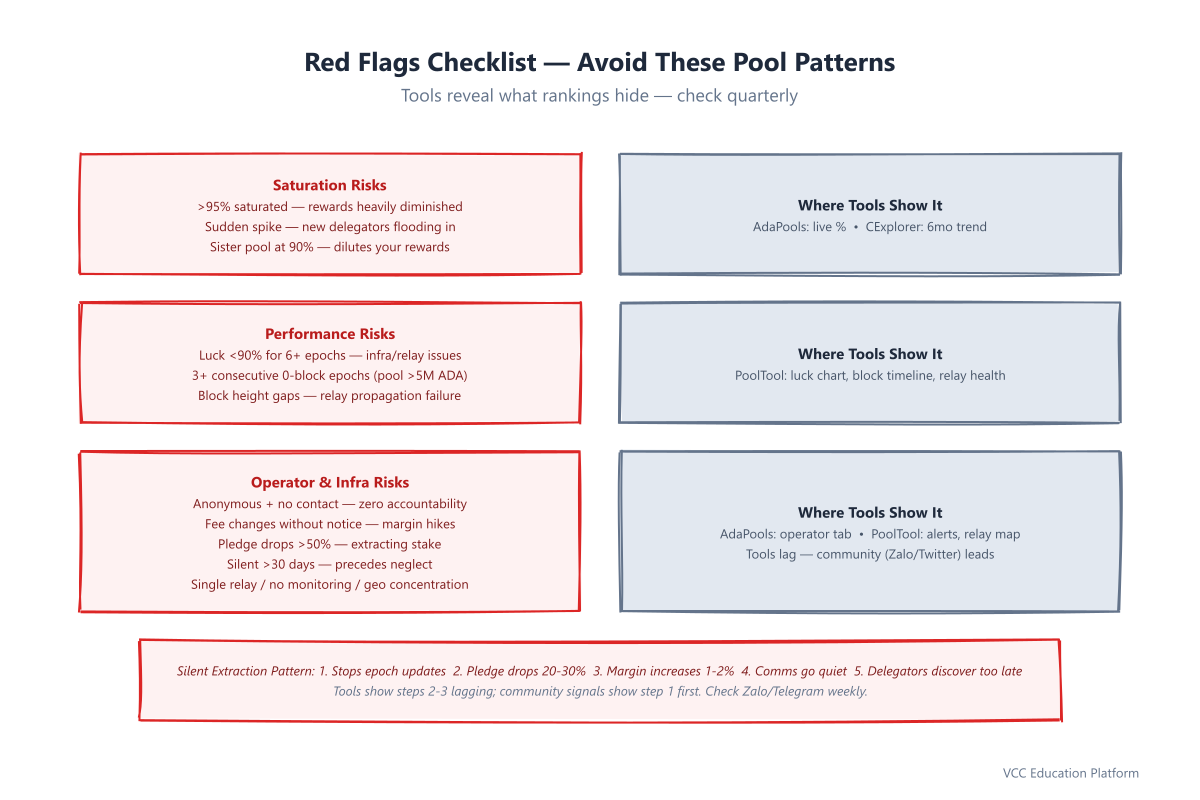
Saturation Red Flags
- >95% saturated: Rewards heavily diminished. Delegators still join — don't be one.
- Sudden saturation spike: New delegators flooding in. Often precedes saturation cap hit.
- Operator opening sister pool at 90%: Smart for them, dilutes your rewards if you stay.
Performance Red Flags
- Luck <90% for 6+ epochs: Not variance — infrastructure or relay issues.
- 3+ consecutive epochs with 0 blocks: For pools >5M ADA, statistically near-impossible without problems.
- Block height gaps: Missing slots in PoolTool timeline = relay propagation failure.
Operator Red Flags
- Anonymous + no contact info: No accountability. If they hike margin or drop pledge, you can't reach them.
- Fee changes without notice: Margin hike from 2% → 5% mid-epoch. Check history on AdaPools/CExplorer.
- Pledge drops >50%: Operator extracting stake. Often precedes margin increase.
- Silent periods: No epoch updates, social media dead >30 days. Precedes neglect.
Infrastructure Red Flags
- Single relay: Single point of failure. PoolTool shows relay count.
- No monitoring alerts: PoolTool/cexplorer alerts not configured = operator not watching.
- Geographic concentration: All relays in one data center/region. Check PoolTool relay map.
Behavioral Red Flags (The "Silent Extraction" Pattern)
- Operator stops posting epoch updates
- Pledge drops 20-30%
- Margin increases 1-2%
- Communication channels go quiet
- Delegators discover too late
Tools show steps 2-3 lagging; community signals (Telegram, Twitter, Zalo) show step 1 first.
Vietnamese Delegator Workflow: Adapting the Process
Vietnamese Cardano community has distinct patterns worth incorporating:
1. Community Verification First
Before tools, check:- Zalo/Facebook groups: "Cardano Staking Việt Nam", "ADA Việt Nam" — ask about pool reputation
- SPO Telegram channels: Most VN operators run Vietnamese-language announcement channels
- Local exchange staking: Some VN exchanges (Remitano, Bvnex) offer staking — compare their pool vs self-custody
2. Language-Aware Tool Usage
- AdaPools/PoolTool/CExplorer: English only. Use browser translate for key pages.
- CExplorer's health score and peer groups transcend language — numbers are universal.
- CardanoScan transaction hashes need no translation.
3. Tax Tracking
Vietnam tax guidance on staking rewards is evolving. Use CardanoScan export + local spreadsheet:- Column A: Epoch
- Column B: Reward (ADA)
- Column C: VND value at receipt (use CoinGecko/VCBS historical rate)
- Column D: Pool ID (for audit trail)
FAQ
How often should I check my pool?
Quarterly deep dive (run the three-tool check), monthly glance (AdaPools saturation + PoolTool current epoch luck). Set PoolTool alerts for instant notification of changes.What's a "good" ROA?
Network average ~3-4% annually after fees. Pools advertising 6%+ usually have: unsustainable low fees (will rise), high saturation (diminishing returns), or high variance (small stake). Target 3.5-4.5% consistent over 12+ epochs.Can I delegate to multiple pools?
Yes. Split delegation across 2-3 pools reduces single-pool risk. Wallets like Eternl, Lace, Yoroi support multi-delegation. Track each in AdaPools "My Delegations" dashboard.Do tools show future performance?
No. All metrics are historical. A pool's past blocks don't guarantee future slots — slot leadership is random per epoch. Tools help you avoid known problems, not predict future luck.What if my pool saturates?
Rewards diminish proportionally. You don't lose principal. Redelegate to a sister pool (same operator) or new pool. No epoch lock — redelegate anytime, effective next epoch.How do I verify an operator is "doxxed"?
Check AdaPools Operator tab → links to Twitter, GitHub, website. Real name + photo + verifiable history = doxxed. Anonymous = only pseudonym. Both can be honest; doxxed adds accountability.Are mobile apps reliable?
PoolTool iOS/Android apps use same backend as web — data identical. AdaPools/CExplorer are mobile-responsive web. CardanoScan works on mobile but dense. For daily glances, PoolTool app + AdaPools web is a solid combo.What about hardware wallet staking?
Ledger/Trezor + AdaPools/PoolTool web = maximum security. You sign delegation tx on device; tools are read-only. Never enter seed phrase into any tool.Summary: Your Tool Stack
| Task | Primary Tool | Backup | Frequency |
|---|---|---|---|
| Initial pool discovery | AdaPools | CExplorer | Quarterly |
| Live block monitoring | PoolTool | CardanoScan | Weekly/Alerts |
| Peer benchmarking | CExplorer | AdaPools | Quarterly |
| Reward verification | CardanoScan | Wallet UI | Monthly/Tax time |
| Operator communication | PoolTool alerts + SPO channels | AdaPools links | Ongoing |
The best delegators don't chase the highest ROA — they avoid the preventable mistakes. Four tools, five minutes a quarter, and you'll sidestep 90% of delegation regrets.
Final thought: Staking is a relationship with an operator, not a transaction with a pool. Tools show you the operator's track record. Your job is to decide if that track record earns your trust — and your ADA.