
Cardano staking ROI is the metric every ADA holder wants to understand before delegating. This guide walks you through the exact formulas, real-world variables, and practical tools to calculate your staking returns accurately — with Vietnamese context for local investors.
---
Why ROI Calculation Matters for Cardano Stakers
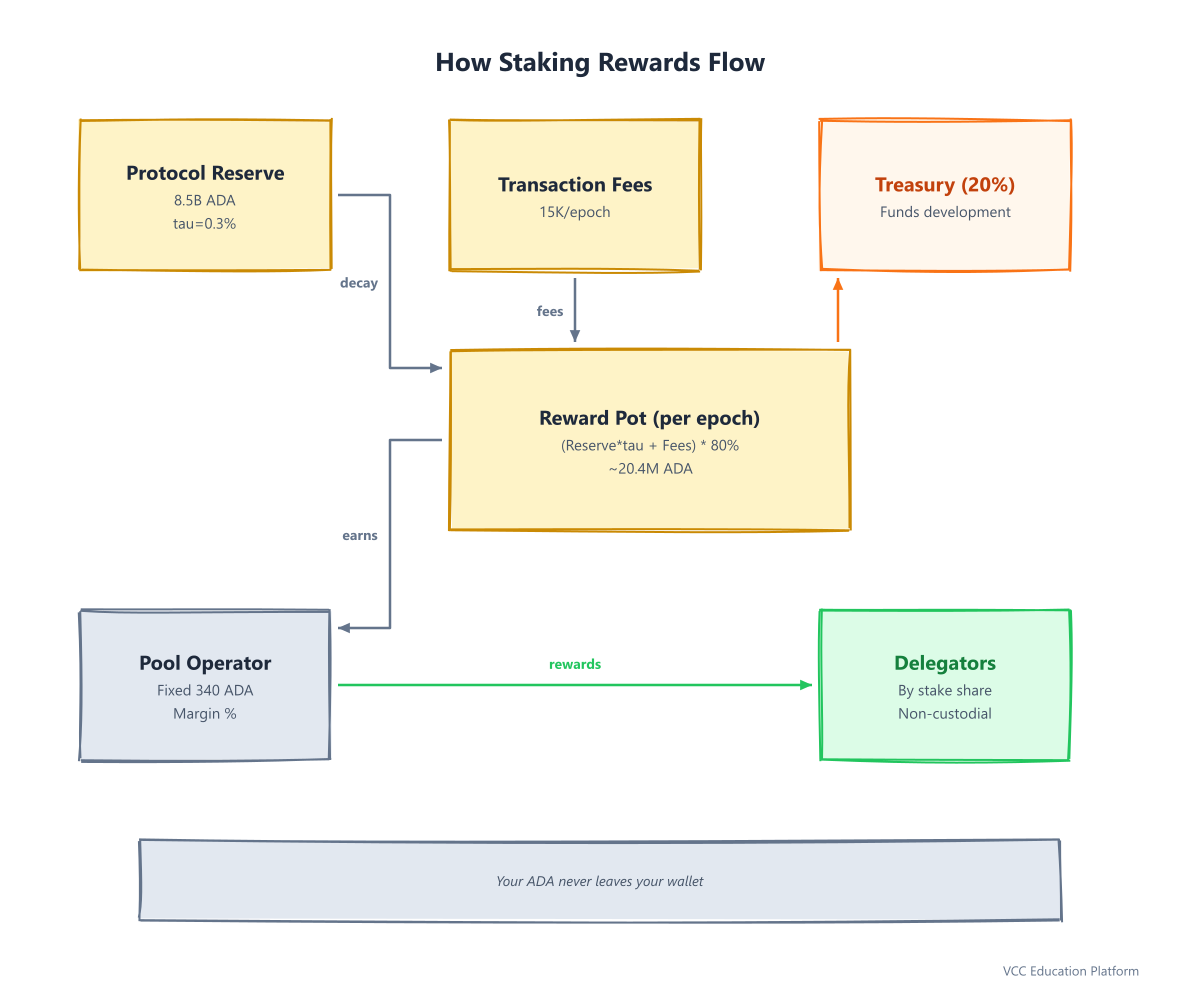
When you delegate ADA to a stake pool, you're not "locking up" coins or sending them anywhere. Your ADA stays in your wallet. The pool uses your stake weight to produce blocks, and the protocol rewards you from a reward pot that resets every epoch (5 days).
But the percentage you see on pool ranking sites — "5.2% ROA" or "4.8% APY" — is a simplified projection. Your actual return depends on:
- Pool performance (missed blocks, uptime)
- Pool fees (fixed cost + margin)
- Saturation level (over-saturated pools earn less per ADA)
- Network parameters (reserve decay, treasury cut, a₀)
- ADA price movement (ROI in ADA ≠ ROI in VND/USD)
---
The Core Formula: How Cardano Staking Returns Work
Epoch-Level Reward Calculation
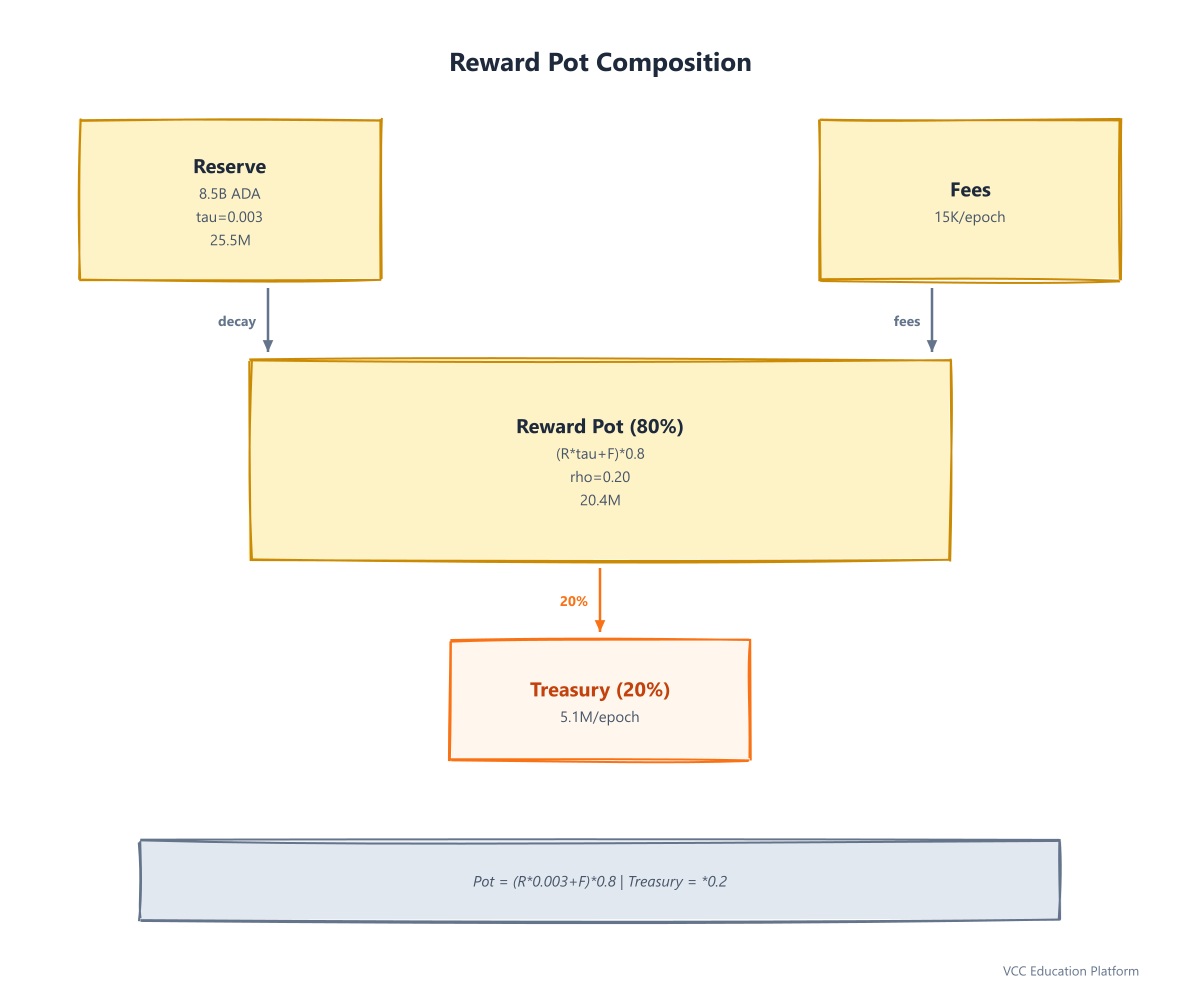
Every epoch, the protocol calculates the total reward pot:
Reward Pot = Reserve Contribution + Transaction Fees - Treasury Cut
Where:
Your Share = Your Stake / Total Active Stake
If you delegate 10,000 ADA to a pool with 50M ADA total stake, and total network stake is 24B ADA:
Your Epoch Reward = Reward Pot × (Pool Stake / Total Stake) × (Your Stake / Pool Stake)
                  = Reward Pot × (Your Stake / Total Stake)
Key insight: Your reward depends on YOUR stake relative to TOTAL network stake, not the pool's size. A 10,000 ADA delegation earns the same ADA amount whether the pool has 10M or 60M — until saturation kicks in.
Saturation Penalty
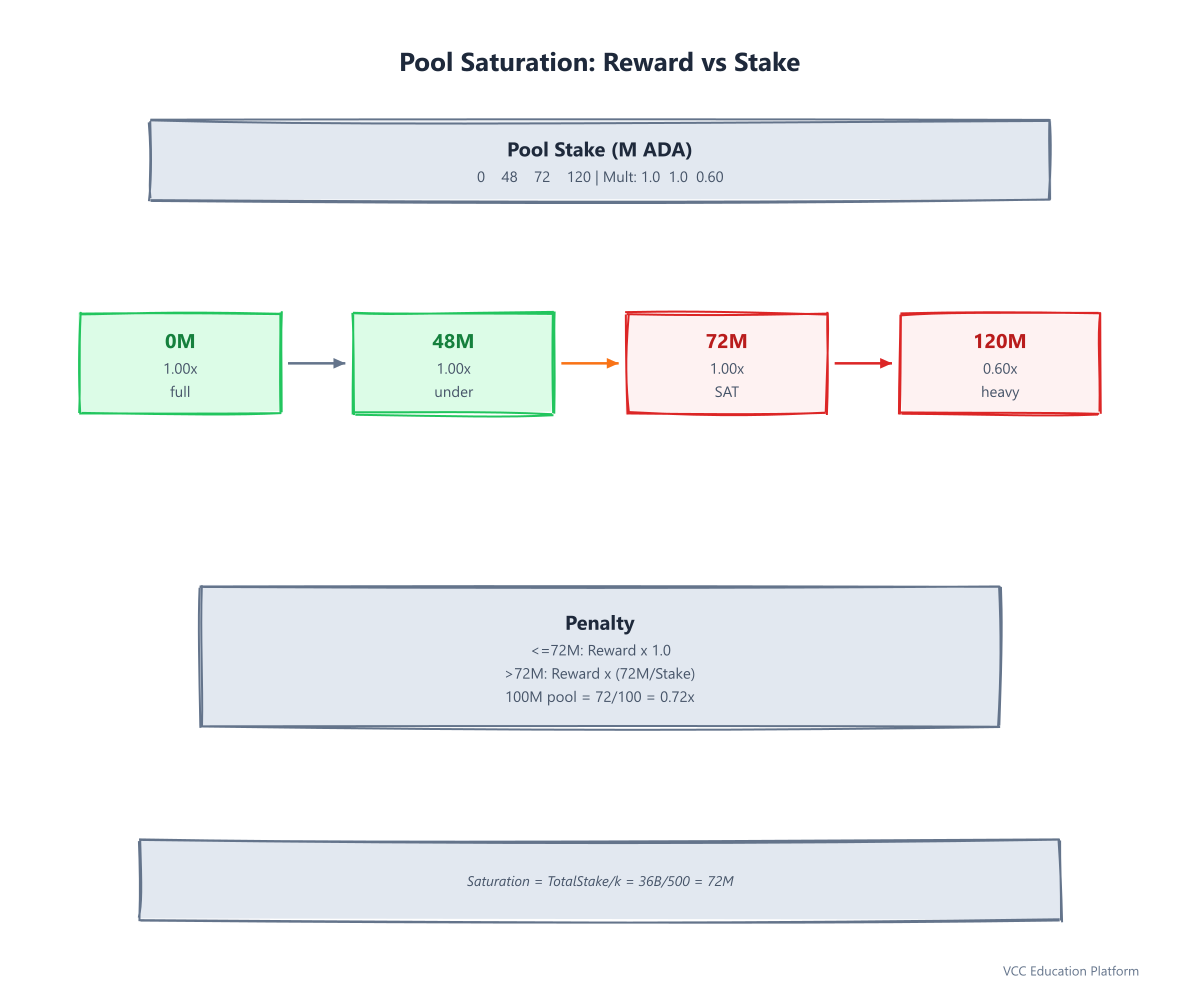
Cardano caps pool rewards at the saturation point (k parameter). Current k = 500, saturation ≈ 72M ADA (36B / 500).
If Pool Stake ≤ Saturation:  Reward = Full Formula Above
If Pool Stake > Saturation:  Reward = Full Formula × (Saturation / Pool Stake)
An over-saturated pool (100M ADA) pays each delegator only 72% of what a right-sized pool would.
---
Pool Fees: The Two Components That Eat Your Returns
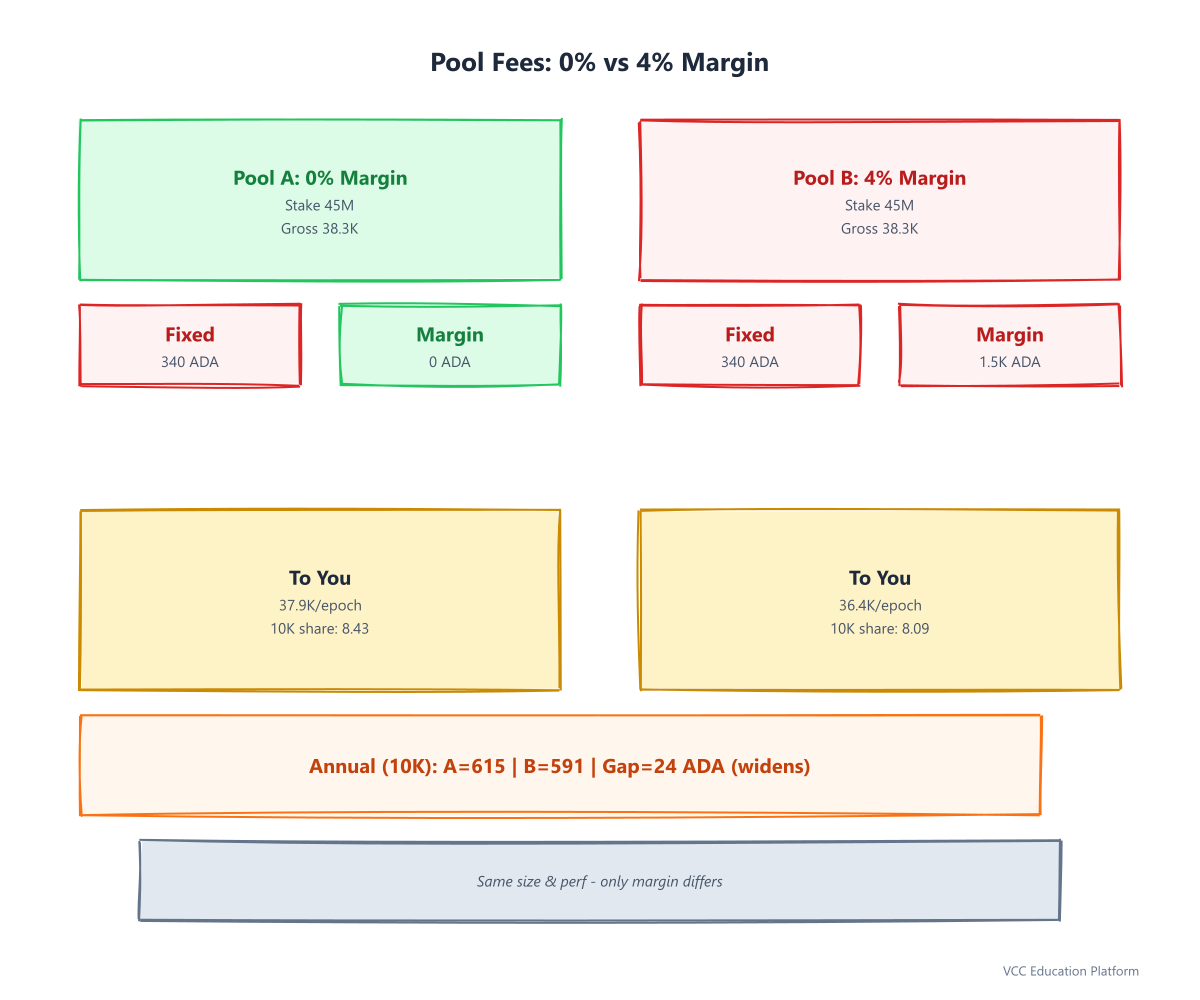
Every pool charges two fees before distributing rewards to delegators:
1. Fixed Cost (min 340 ADA/epoch)
The protocol enforces a minimum 340 ADA per epoch to cover operator infrastructure. This comes off the top of the pool's earnings.Pool Gross Reward = Pool Stake Share × Reward Pot
Pool Net Reward = Pool Gross Reward - 340 ADA
2. Margin (operator's cut, typically 0-5%)
After the fixed cost, the operator takes a percentage:Delegator Pool Reward = Pool Net Reward × (1 - Margin)
Your Reward = Delegator Pool Reward × (Your Stake / Pool Stake)
Example: Pool earns 10,000 ADA gross. Fixed cost 340 ADA. Margin 2%.
---
From Epoch Rewards to Annual ROA/APY
ROA (Return on ADA) — Stake-Weighted
Epoch ROA = (Your Epoch Reward / Your Stake) × 100%
Annual ROA = Epoch ROA × 73  (73 epochs per year = 365/5)
APY (Annual Percentage Yield) — With Compounding
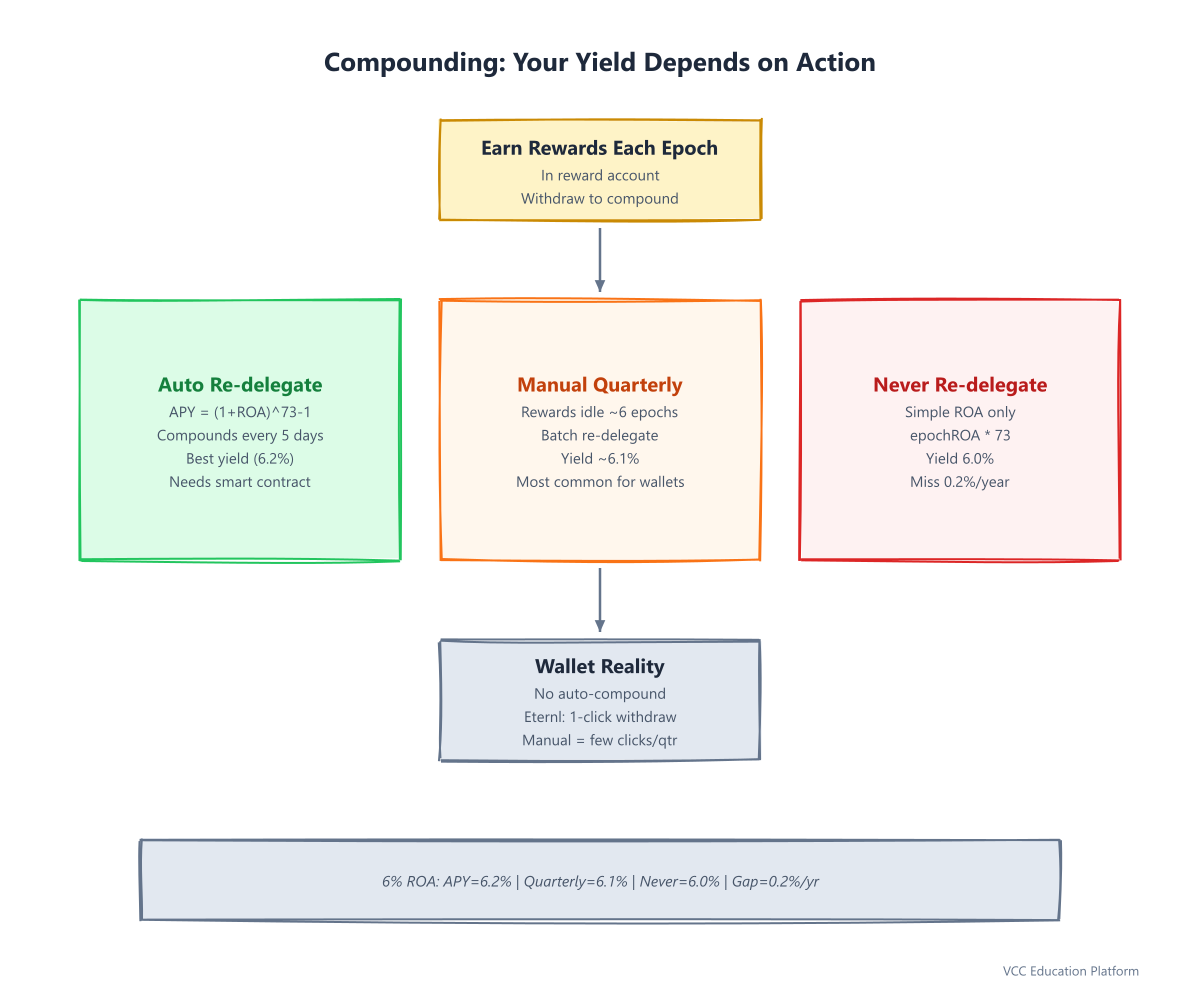
If you re-delegate rewards automatically (most wallets don't auto-compound; you must manually re-delegate or use a service):
APY = (1 + Epoch ROA)^73 - 1
Reality check: Most delegators don't compound every epoch. Manual re-delegation every few months makes your effective yield closer to simple ROA.
---
Real-World Calculation: Step-by-Step Example
Let's calculate for a Vietnamese investor delegating 50,000 ADA to a pool with:
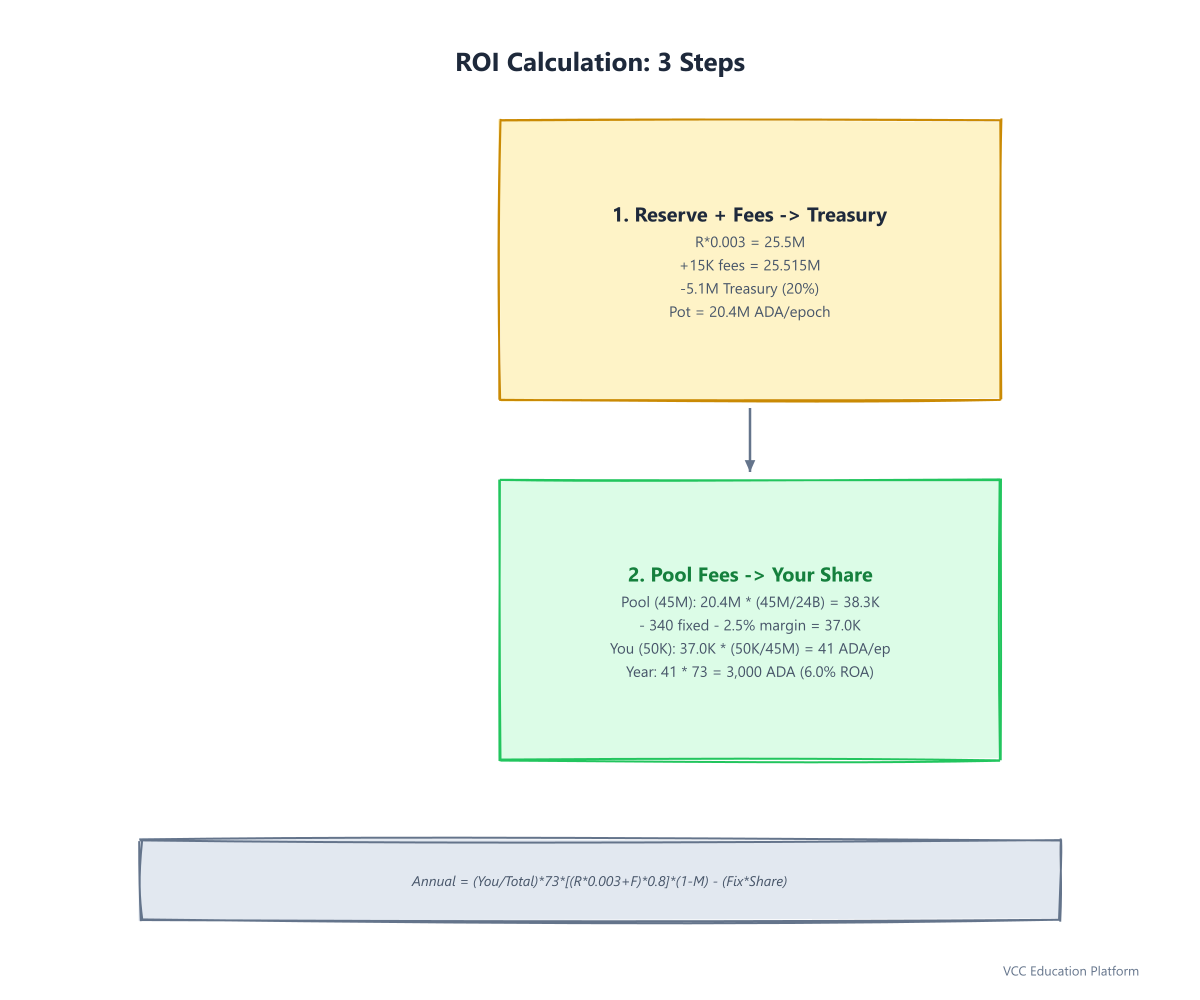
Step 1: Calculate Reward Pot
Reserve Contribution = 8,500,000,000 × 0.003 = 25,500,000 ADA
Total Before Treasury = 25,500,000 + 15,000 = 25,515,000 ADA
Treasury Cut (20%)    = 5,103,000 ADA
Reward Pot            = 20,412,000 ADA
Step 2: Pool's Share of Pot
Pool Stake Fraction = 45,000,000 / 24,000,000,000 = 0.001875
Pool Gross Reward   = 20,412,000 × 0.001875 = 38,272.5 ADA
Step 3: Apply Fees
After Fixed Cost = 38,272.5 - 340 = 37,932.5 ADA
After 2.5% Margin = 37,932.5 × 0.975 = 36,984.2 ADA to delegators
Step 4: Your Share
Your Fraction = 50,000 / 45,000,000 = 0.001111...
Your Reward   = 36,984.2 × 0.001111... = 41.1 ADA/epoch
Step 5: Annualize
Epoch ROA  = 41.1 / 50,000 = 0.0822% per epoch
Annual ROA = 0.0822% × 73 = 6.0% ROA
APY (compounded) = (1.000822)^73 - 1 = 6.2% APY
In VND terms (at 1 ADA = 8,500 VND): 41.1 ADA × 73 × 8,500 = ~25.5M VND/year on a 425M VND stake.
---
Tools That Do the Math for You
| Tool | What It Shows | Best For | |------|---------------|----------| | Adapools.org | Live ROA, saturation, blocks, fees, pledge | Pool comparison, historical performance | | PoolTool.io | Real-time luck, VRF, slot assignments | Technical verification | | Cardanoscan.io | Pool metadata, delegator count, rewards history | Transparency check | | Daedalus/Yoroi/Eternl wallets | Built-in pool ranking with ROA estimates | Quick delegation decisions |
Pro tip: Don't trust a single site's "ROA %". Cross-reference Adapools (long-term average) with PoolTool (recent luck). A pool showing 5.5% on Adapools but 4.2% on PoolTool last month may be having bad luck.
---
Common Mistakes That Skew Your ROI Expectations
1. Confusing ROA with APY
Sites often label simple ROA as "APY". If you don't compound, you earn ROA, not APY.2. Ignoring the Fixed Cost on Small Stakes
If you delegate 1,000 ADA to a 50M pool, the 340 ADA fixed cost is spread across all delegators — but your share of the pool is tiny. The fixed cost hurts small delegators proportionally more.3. Chasing the Highest ROA % Without Checking Saturation
A pool showing 6% ROA but at 90M stake (over-saturated) will drop to ~4.3% once saturation penalty applies.4. Forgetting ADA Price Volatility
6% ROA in ADA ≠ 6% in VND. If ADA drops 30%, your VND return is negative. If ADA rises 50%, your VND return is 50%+.5. Not Accounting for Epoch Boundaries
Rewards are paid 2 epochs after the epoch they're earned in. Delegate at epoch 400 → first rewards at epoch 402.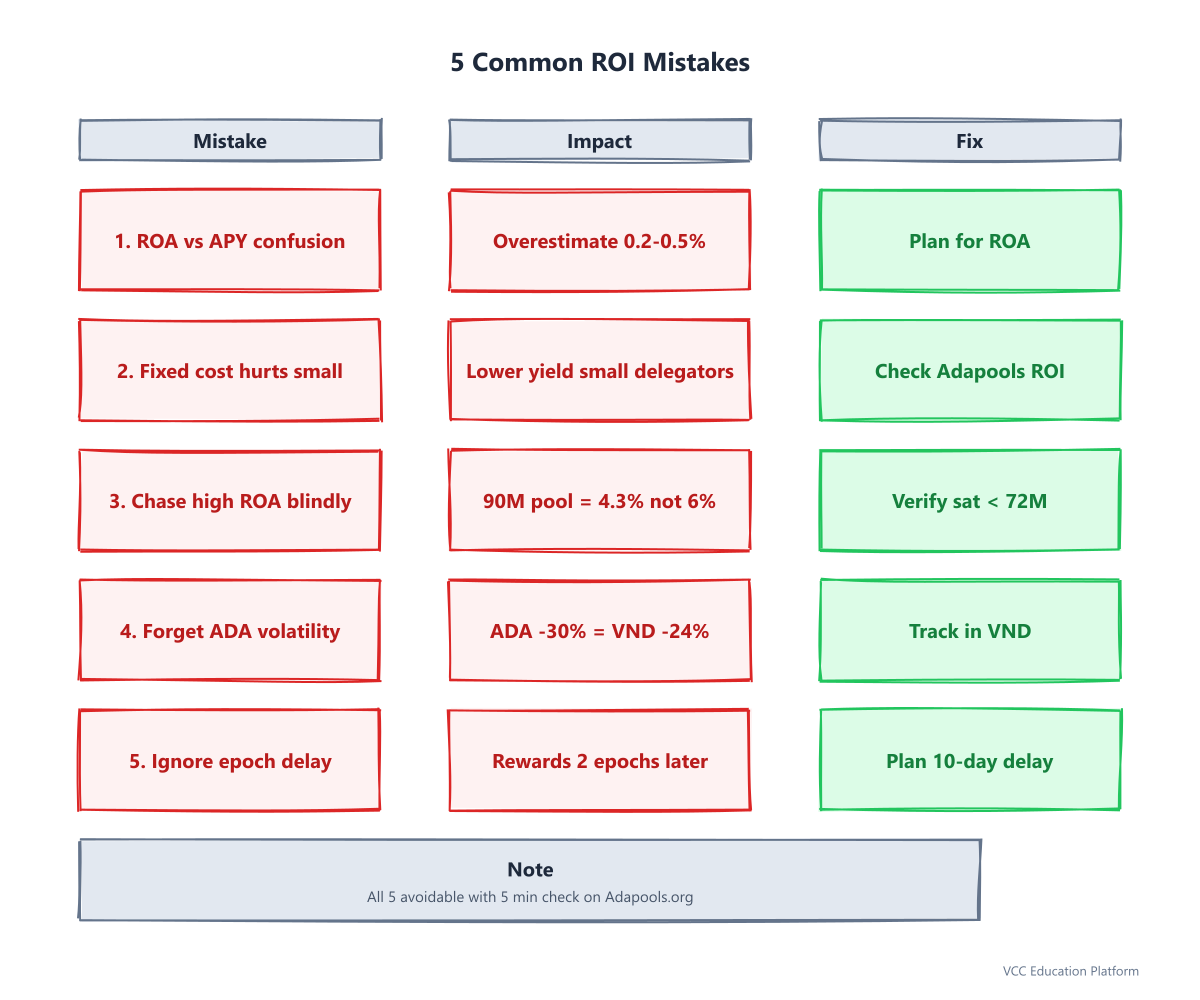
---
Vietnamese Context: Tax, Regulations, and Practical Tips
Tax Implications (Vietnam, 2024)
Choosing Pools from Vietnam
VND Denomination Thinking
Instead of "5% ROA", think: "50,000 ADA → ~2,500 ADA/year → ~21M VND/year at current price". This makes opportunity cost clearer vs. savings accounts (4-5% VND) or government bonds (2-3%).---
Advanced: Factors That Move the Needle
Network Parameter Changes (Governance)
These change via hard forks or governance actions (CIP-1694). Monitor Cardano Foundation announcements.
Pool Pledge Influence
Higher operator pledge → slightly higher rewards (when a₀ > 0). Current a₀ = 0.3 means pledge has modest effect. A pool with 1M pledge earns ~0.3% more per epoch than one with 0 pledge — if both produce all assigned blocks.Luck Variance (Short-Term)
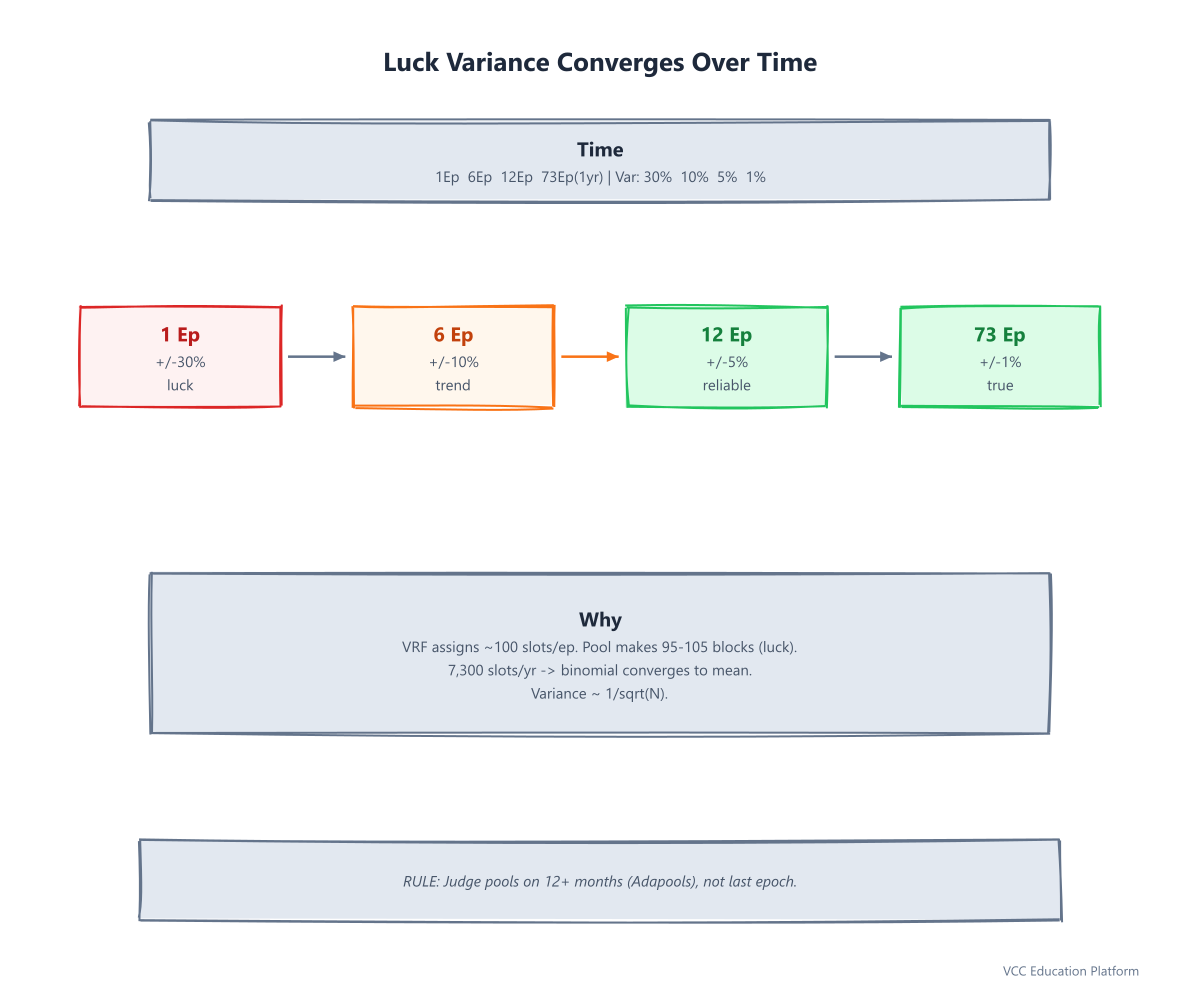
Cardano uses VRF (Verifiable Random Function) for slot leadership. A pool assigned 100 slots/epoch might produce 95 blocks (bad luck) or 105 (good luck). Over 1 year (7,300 slots), luck evens out. Over 1 epoch, it doesn't.Rule: Judge pools on 12+ month history, not last epoch.
---
FAQ: Cardano Staking ROI Questions
Q: What's the difference between ROA and APY?
A: ROA = simple annual return (epoch reward × 73). APY = compounded return assuming you re-delegate every epoch. Most wallets don't auto-compound, so your real yield is closer to ROA.Q: Does my ADA leave my wallet when I stake?
A: No. Delegation is a on-chain certificate saying "this stake key authorizes that pool key". Your ADA never moves. You can spend it anytime — the delegation just becomes inactive for the spent amount.Q: Why did my rewards drop this epoch?
A: Common causes: pool missed blocks, pool became over-saturated, network fees were low, or reserve decay changed. Check Adapools for the pool's "luck" and "saturation" status.Q: Should I split my stake across multiple pools?
A: For decentralization, yes — it helps network security. For ROI, splitting 50K ADA into 5 pools of 10K each earns the same total ADA as one 50K delegation (assuming equal pool performance). The only difference is fixed cost: 5 pools = 5 × 340 ADA fixed cost taken from pool earnings, slightly reducing your share.Q: How do I calculate ROI in VND/USD?
A: Track ADA rewards per epoch. Multiply by historical VND price at receipt. Annualize. Or use: Annual ADA Reward × Current ADA/VND Price = Estimated VND Return (but remember price changes).Q: What happens if my pool gets saturated after I delegate?
A: Your rewards per ADA drop proportionally. You can re-delegate anytime (takes effect next epoch). No penalty for switching.Q: Are staking rewards taxable in Vietnam?
A: No clear guidance yet. Treat as "other income" conservatively. Keep detailed records: date, epoch, ADA amount, VND value. Consult a professional.---
Summary: Your ROI Checklist
Before delegating, verify:
- [ ] Pool stake < 72M ADA (under saturation)
Final formula to remember:
Your Annual ADA ≈ (Your ADA / Total Network Stake) × Annual Reward Pot × (1 - Pool Margin) - (Fixed Cost × Your Share)
Where Annual Reward Pot ≈ 73 × [(Reserve × 0.003 + Avg Fees) × 0.8]
For 50K ADA at current network stats: ~3,000 ADA/year (6% ROA).
---
This guide is educational, not financial advice. Staking rewards vary. Always verify live data before making decisions. Consult a tax professional for Vietnam-specific obligations.