
When Minh delegated 50,000 ADA to a stake pool last year, he thought his work was done. Cardano had no slashing, his coins never left his wallet — so what could go wrong? Eighteen months later he checked his rewards history and discovered the truth: three of his pools' recent epochs had produced zero blocks, and his annual yield had quietly slid from 3.1% down to 2.4%. Nobody stole anything. He simply never practiced staking risk management, and it cost him real income.
That gap — between your ADA is safe and your returns are guaranteed — is where every cardano staking risk actually lives. This guide maps that territory honestly. You will learn which risks are baked into the protocol and unavoidable, which ones you eliminate with a good pool choice, and which ones you create yourself through habits. By the end, you'll have a checklist, a monitoring cadence, and a clear rule for when switching pools is worth it.
---
Why "No Slashing" Is Only Half the Story
Cardano's design genuinely removes the scariest staking failure modes. Delegation is non-custodial: you sign a certificate that points your wallet's stake at a pool, and the ADA itself never moves. There is no slashing mechanism like Ethereum's, no lockup period, and the only protocol-side costs are transaction fees plus a refundable 2 ADA deposit. If your pool vanishes tomorrow morning, your principal balance is untouched.
But notice what that guarantee covers: your principal. It says nothing about your rewards. A pool can miss blocks, charge heavy fees, or drift past its saturation point, and each of those quietly shrinks your yield while your balance looks perfectly healthy. measured in percentage points of APY rather than missing coins. That is exactly why risk management here means learning to protect staking rewards, not guarding treasure.
---
The Three Tiers of Cardano Staking Risk
Most articles list risks as a flat bullet dump. A more useful mental model sorts them by controllability — because your response should differ for each tier.
Tier 1: Protocol risks you accept
These exist no matter which pool you pick:
- Market volatility. Rewards arrive in ADA, not dollars or VND. A 40% price drop
- Network-level incidents. In November 2025 a malformed delegation transaction
- Governance changes. Parameters like
k(the target number of saturated pools) and
You cannot diversify these away within Cardano. You manage them by position sizing: never delegate money whose fiat value you cannot tolerate fluctuating.
One protocol quirk belongs in this tier too: the reward clock. Cardano moves in epochs of roughly five days. After you delegate, a snapshot must be taken, your stake must influence the pool's next assignments, and rewards calculate one epoch behind — so the first payment typically lands 15–20 days after delegating, then arrives every epoch afterward. New stakers regularly misread this delay as a failure and panic-switch pools, resetting the clock and losing more days. Knowing the rhythm is itself a form of risk management.
Tier 2: Pool-selection risks you control
This tier is where your decisions move the needle most.
- Saturation. Each pool has a saturation point equal to total staked ADA divided by
- Performance. A pool assigned ten blocks in an epoch but minting only six delivers
- Fee structure. Every pool deducts a fixed cost per epoch (protocol minimum 340 ADA)
- Operator commitment. A pledge — the operator's own ADA locked into their pool —
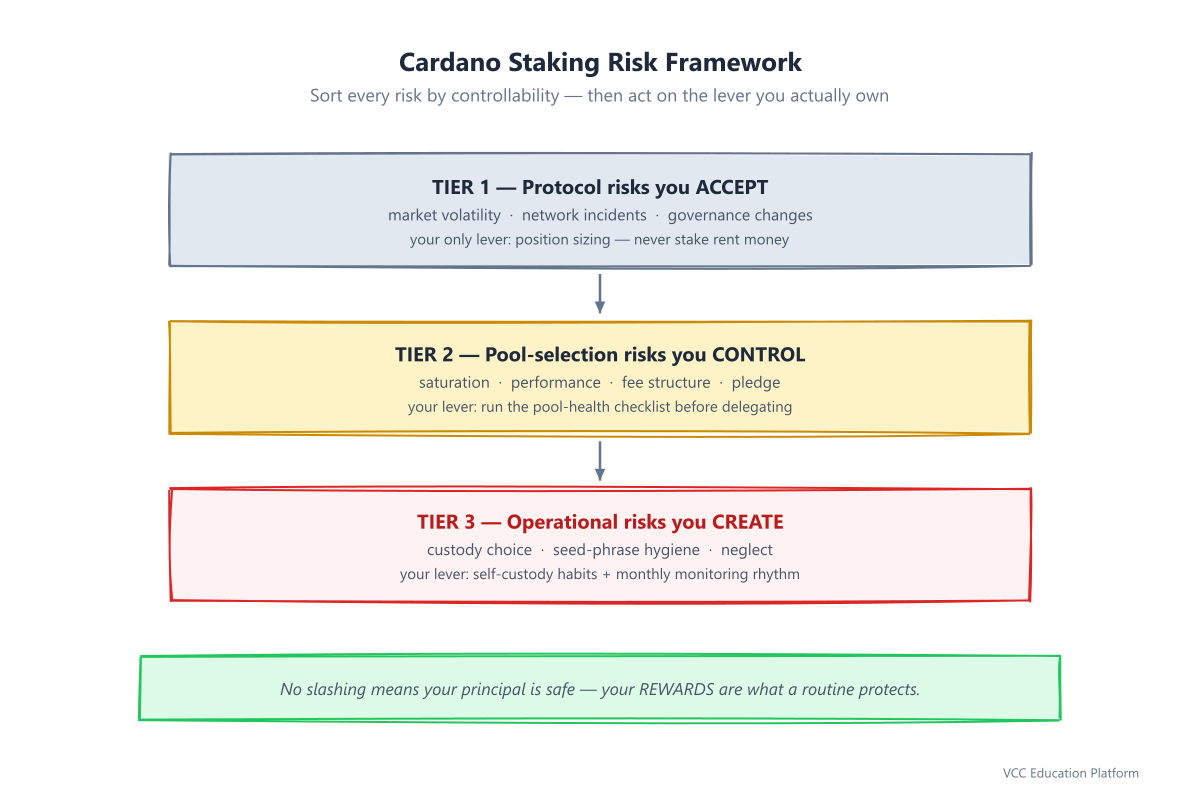
Tier 3: Operational risks you create
- Custody choice. Native delegation keeps keys with you. Exchange staking hands the
- Seed phrase hygiene. Self-custody trades counterparty risk for personal
- Neglect. Minh's actual mistake wasn't choosing badly — it was never looking again.
---
What Cannot Happen vs What Can Happen
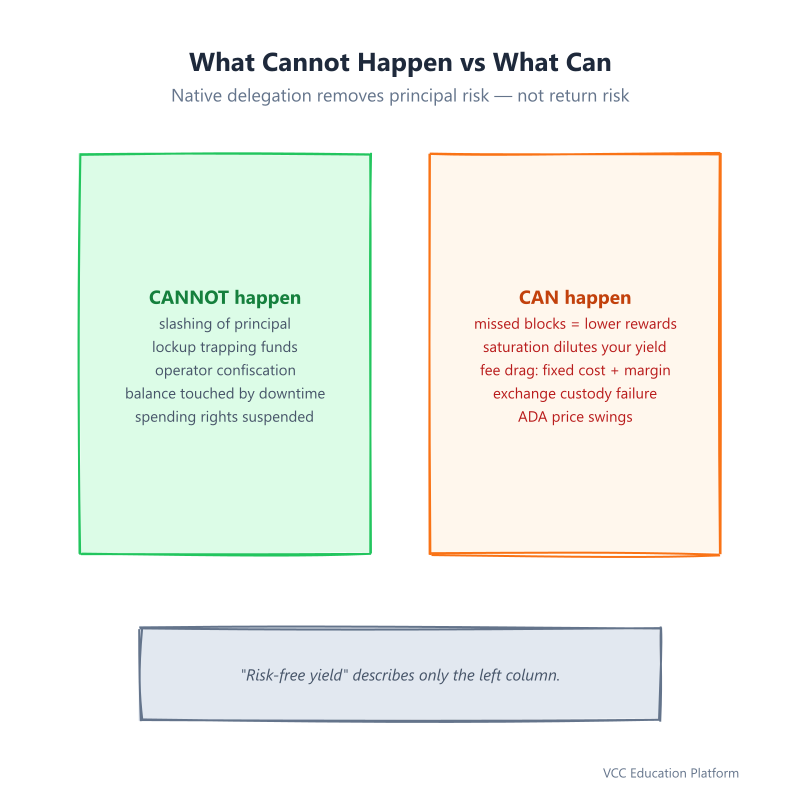
Let's separate the two lists explicitly, because marketing copy often blurs them.
Cannot happen with native delegation: slashing of principal, confiscation by a pool operator, lockup trapping your funds, loss from pool downtime touching your balance. Your spending rights stay intact every second you are delegated — send, swap, or spend ADA normally while earning.
Can happen: reduced rewards from poor pool performance, diluted rewards above the saturation point, fee drag from high margins or oversized fixed costs, total reward loss during epochs when your pool mints nothing, counterparty loss if you chose a custodial exchange instead, and fiat-value swings from ADA's market price.
The honest summary: Cardano removed principal risk from the protocol, not return risk from reality. Anyone promising "risk-free yield" is describing only the left column.
---
Staking Safety Tips: Your Pool Health Checklist
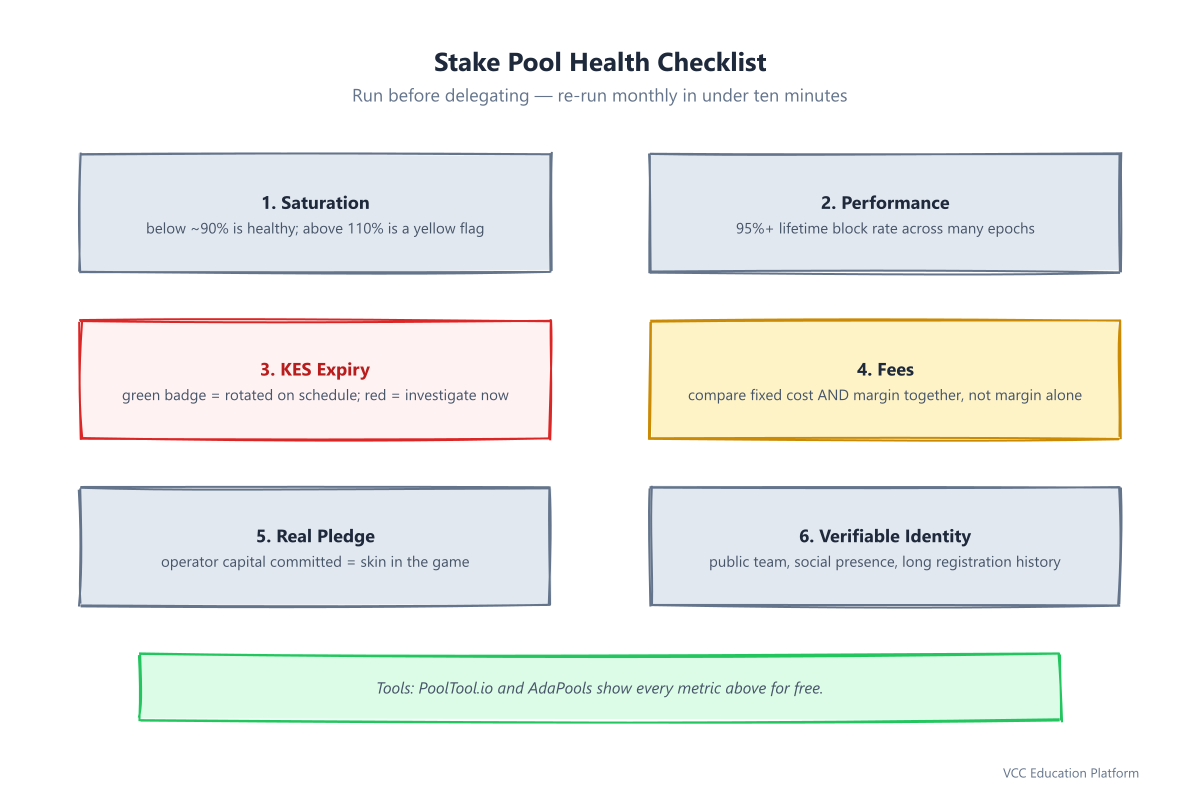
Run this checklist before delegating, then re-run it periodically. It takes under ten minutes with tools like PoolTool.io or AdaPools.
- Saturation under control. Prefer pools below ~90% saturation; treat >110% as a
- Lifetime performance. Look for pools producing close to their assigned blocks
- KES expiry discipline. Operators must rotate key-evolving-signature keys roughly
- Fee sanity. Compare fixed cost AND margin together. A 0% margin with a huge fixed
- Real pledge. Some operator capital committed beats a shiny website.
- Verifiable identity. Pools with public operators, social presence, and long
A Vietnamese Investor's Lens
It helps to translate these ideas into familiar instruments. Gửi tiết kiệm protects principal through institutions — banks plus deposit insurance up to 125 million VND. Cardano's no-slashing design protects principal architecturally: there is no insurance fund, the guarantee is the code. That's stronger in some ways (no insurer can go broke) and weaker in others (nobody reimburses you if you leak your own seed phrase).
Staking rewards resemble dividends from a stock that pays them in its own shares: the yield is real, but it arrives denominated in a volatile asset. And custody deserves its own warning — staking through an exchange is like handing your gold bar to a neighbor for safekeeping. Convenient, yes. But keeping the bar at home, in your own safe, is the entire point of self-custody.
---
When Switching Pools Actually Makes Sense
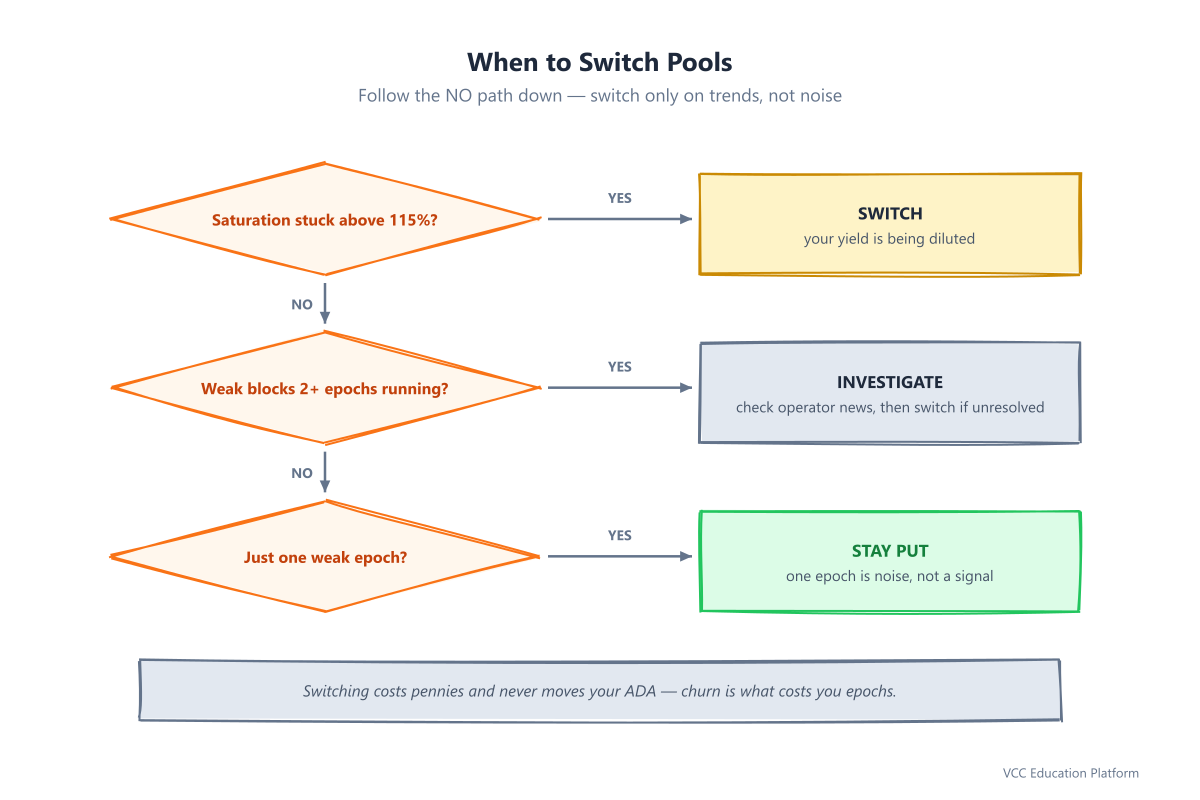
Switching is cheap — a redelegation transaction takes effect from a future epoch snapshot, costs pennies in fees, and never moves your coins. Cheap options still deserve rules, or you'll churn monthly over noise.
Switch when: your pool stays above ~115% saturation for several consecutive epochs; performance stays degraded for two-plus epochs without a documented network-wide incident; fees rise without added value; or the operator goes silent and KES badges turn red. Don't switch because of: a single missed epoch, one bad month against a backdrop of years of solid performance, or a margin difference of half a percent on a small stake — where the switch fee and your time outweigh the gain.
Cardano Risk Mitigation: A Simple Operating Rhythm
Put it all together into habits that take minutes per month:
- At delegation time: run the full six-point checklist above.
- Monthly glance: check saturation trend, recent epochs produced, and any operator
- Quarterly: re-check fees against comparable pools and confirm your custody setup
- After major news (hard forks, governance votes affecting parameters): skim official
Risk management done right feels boring. Boring means nothing surprised you.
The deeper point: none of these staking safety tips require technical skill. They require a calendar reminder and the discipline to look. Protecting staking rewards is a habit, not a one-time setup — the ten minutes you spend each month reviewing saturation trends and epoch results is the entire price of cardano risk mitigation, and it compounds exactly like the rewards it protects.
---
Common Mistakes That Turn Small Risks Into Real Losses
Before closing, four patterns show up again and again in delegator post-mortems:
- Chasing zero fees. A 0% margin pool run by an anonymous operator with no pledge
- Panic-switching on noise. One weak epoch triggers a redelegation, which resets
- Mixing custody with convenience. Keeping a trading balance on an exchange is a
- Treating the seed phrase as done-and-dusted. Backups degrade, move houses, and
Each mistake converts a controllable Tier-2 or Tier-3 risk into actual lost income — which is exactly what a staking risk management routine exists to prevent.
---
Frequently Asked Questions
Can I lose my ADA by staking on Cardano? Not through native delegation. There is no slashing and your coins stay spendable in your wallet. You can lose value through ADA price moves, and you can lose funds through exchange custody or leaked seed phrases — those are choices, not protocol behavior.
Does Cardano have slashing penalties? No. Ouroboros deliberately omits slashing. A misbehaving or offline pool simply earns less; it cannot reduce delegators' balances.
When do staking rewards actually arrive? After your first delegation, expect roughly 15–20 days before the first payment while the epoch snapshot-and-calculation cycle completes. After that, rewards arrive once per epoch (about every five days) whenever your pool produces blocks.
Is staking ADA on an exchange safe? Safer than nothing, riskier than native wallets. You accept platform-level counterparty risk — hacks, insolvency, withdrawal freezes — and usually give up your governance voting power too. For meaningful amounts, self-custody wallets are the better cardano risk mitigation.
How much reward drop should trigger me to switch pools? Watch trends, not single epochs. Two or more consecutive weak epochs without a network incident, or persistent saturation above ~115%, justify moving. One bad epoch is noise.
Do I need to unstake before spending my ADA? Never. Delegation doesn't lock anything. Spend from your wallet anytime; new balances join the next epoch snapshot automatically.