
If you already delegate ADA to a stake pool, you are earning rewards every five days. The uncomfortable question is whether you are earning as much as you could. Most delegators lose meaningful return not because they failed at some advanced trick, but because they picked a pool by instinct — biggest name, lowest fee, highest number on a dashboard. Learning to maximize cardano rewards is less about secret techniques and more about understanding three levers the protocol actually gives you: pool quality, saturation math, and time. This guide walks through each lever the way you would walk through it with a friend comparing options over cà phê sữa — including the honest math on what compounding does and does not do for you.
Why "set and forget" is only half right
Cardano staking is genuinely low-maintenance: delegation is non-custodial, your ADA never leaves your wallet, and the protocol pays rewards automatically at the start of each epoch — one epoch lasting five days, or 73 per year. You can switch pools whenever you like without withdrawing anything first, because rewards accumulate in your own reward account, not on the pool.
But low-maintenance is not the same as no-maintenance. A pool's performance — how many blocks it actually produces versus how many randomness says it should — directly scales your return. A pool that misses blocks due to poor connectivity or an overloaded node quietly taxes your yield every single epoch. So the first method of cardano reward optimization is simply: check performance history before you delegate, and re-check it occasionally.
It helps to know what the protocol is doing under the hood. Every epoch, the network snapshots active stake; rewards earned from that snapshot are paid at the start of an epoch two snapshots later, which is why a fresh delegation takes a few epochs before the first payout lands. The same delay applies when you switch pools — nothing is lost, it just hasn't arrived yet. Understanding this rhythm prevents the most common beginner mistake: panicking after five quiet days and churning to another pool right before rewards are due.
Lever 1 — Pick pools on performance, not popularity
Every pool on explorers like adapools.org publishes its luck or performance metric, its fee structure, and its saturation level. When you want to increase staking returns, rank candidate pools in this order of importance:
- Consistent block production. Look at several recent epochs, not just last epoch. Pools producing several blocks per epoch give smoother, more predictable rewards; tiny pools that mint one block occasionally look fine on averages but pay out in lumps.
- Saturation status. Anything flagged near or above saturation is diluting its delegators — explained below.
- Pledge. Operators who lock their own ADA into the pool have skin in the game, and the protocol gives pledge a small bonus weight.
- Fees. Last, deliberately. See why below.
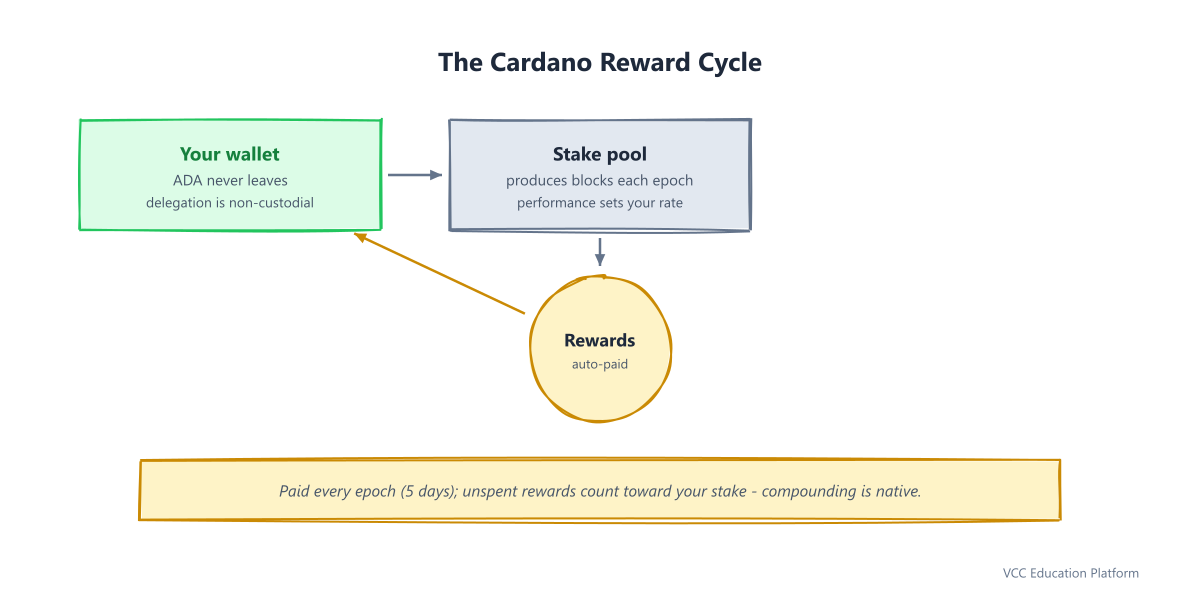
A note on splitting your stake across several pools: spreading delegation can diversify operational risk — if one pool's server dies mid-epoch, only part of your stake is affected. It does not, however, raise your average rate beyond what the best pool offers, and it multiplies the number of pools you should monitor. For most holders, one well-chosen pool beats a scattered portfolio; split only across pools you actually keep an eye on.
Lever 2 — Respect the saturation knee
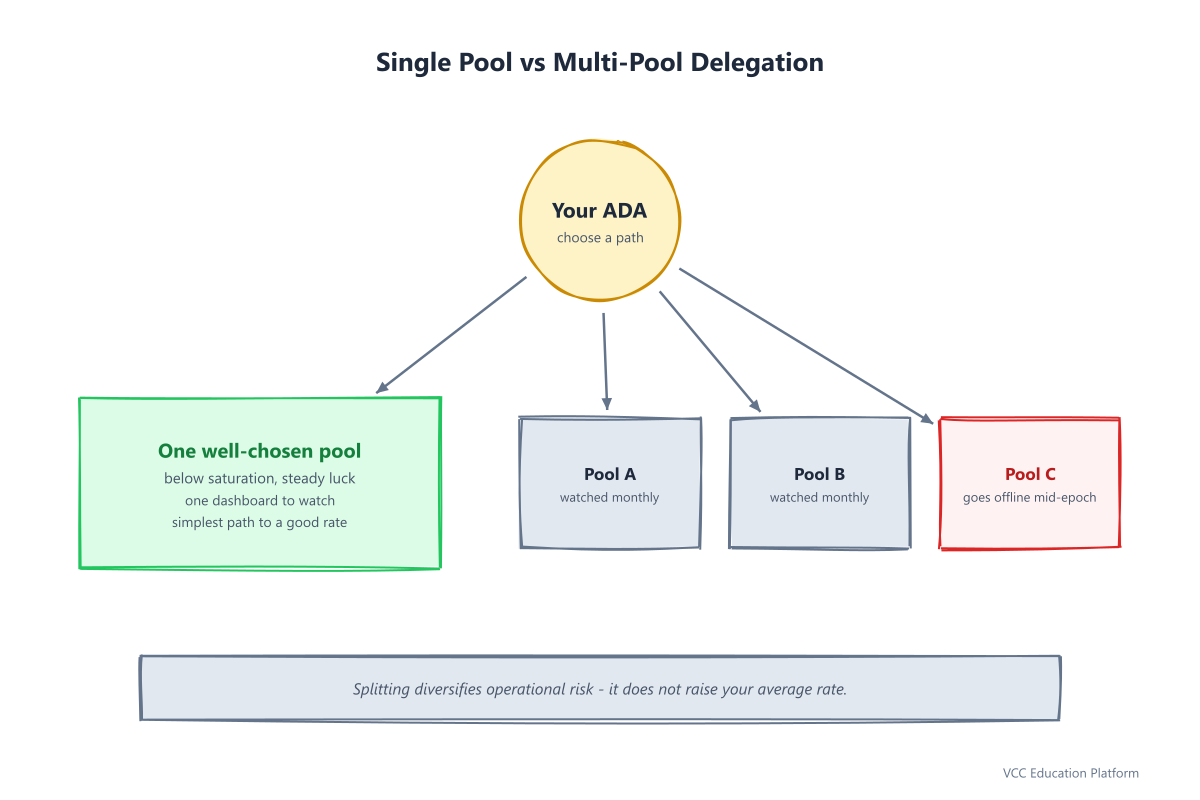
This is where most yield is silently lost. To keep the network decentralized, Cardano caps how much stake a single pool is rewarded for. With the target pool number k set to 500, the saturation point sits around 65–75 million ADA of total stake in 2026. Past that line, extra delegation earns nothing additional for the pool — so the same gross reward pot gets divided among more and more ADA, and everyone's rate falls.
Here is the worked example competitors rarely show. Imagine two pools:
- Pool A holds 65 million ADA — right at the knee.
- Pool B holds 130 million ADA — twice saturated.
Pool B produces no more gross reward than a pool at the knee; the protocol refuses to pay for excess. Per ADA delegated, Pool B therefore returns roughly half of Pool A's rate. If you hold one percent of either pool, choosing B over A costs you about half your staking income for zero benefit to anyone except the operator's ego.
The counterintuitive conclusion: the "biggest pool wins most often" logic from other blockchains is exactly backwards here. Frequent block production is a property of size, but past the knee, size stops paying. Aim for pools comfortably below saturation — the region just under the knee where efficiency peaks.
One forward-looking caveat: governance discussions in 2026 propose raising k toward 1,000, which would halve the saturation point and push delegators toward smaller pools. If that lands, today's "comfortably below saturation" numbers will need recalculating — another reason to revisit your delegation a few times a year rather than never.
Lever 3 — Put time on your side
Rewards arrive every epoch and sit in your reward account. Under current protocol behavior, the balance there counts toward your delegated stake, so unspent rewards keep working — Cardano compounds natively, per epoch, without you lifting a finger. You only need to withdraw rewards when you actually want to spend them. (You may still find older articles insisting you must manually restake; that advice predates current behavior.)
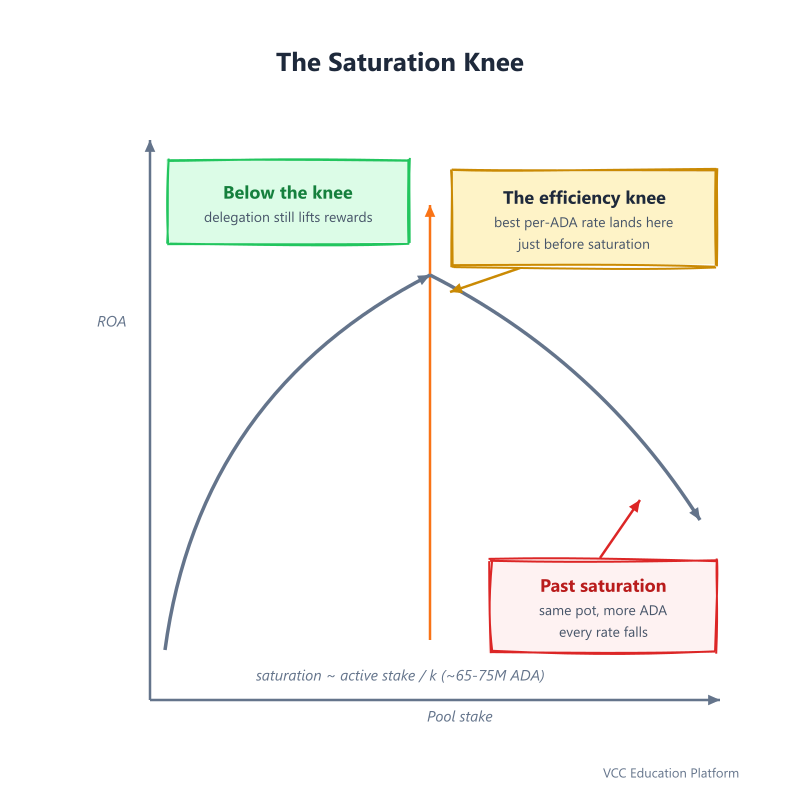
How much does cadence matter? Less than people assume. Take 10,000 ADA at roughly 3% annually. Whether rewards compound per epoch or you manually redelegate once a year, the difference after twelve months amounts to well under 1 ADA. The real function of time is letting a well-chosen pool do its job while you resist the urge to churn — compounding staking rewards is the default, not an achievement.
For Vietnamese readers, this feels familiar. Gửi tiết kiệm ngân hàng works the same way: lãi kép only becomes dramatic when you tái tục gốc cùng lãi year after year. The difference is that a bank deposit pays in đồng at a fixed quoted rate — around 4.5–6% a year at large banks — while Cardano pays in ADA at a variable rate with price exposure attached. Staking rewards are also far more liquid than a term deposit: your funds stay spendable, and moving them away takes two epochs instead of forfeiting interest for breaking early. And where Vietnamese deposits carry state deposit insurance up to 125 million VND per bank, self-custodied ADA carries no such backstop — the trade-off for control is that security hygiene is yours alone.
What fees actually cost you (less than you think)
Delegators obsess over fees, so let's do the arithmetic. Each epoch, the pool deducts a fixed cost first — the protocol minimum is 170 ADA, though most operators still charge 340 — and then takes its margin percentage from what remains. At a near-saturated pool earning tens of thousands of ADA per epoch, that 340 ADA fixed fee is barely one percent of gross. The difference between a 0% and 5% margin moves your annual return by roughly 0.15 percentage points.
Compare that to the damage from picking a pool performing ten points below its luck potential, or double-saturated. Fee shopping is the cheapest lever on the board — useful at the margins, worthless as a primary strategy. A reliable operator charging 2% margin beats an anonymous zero-fee pool with patchy uptime every time.
The contrarian view — when chasing yield loses money
Every optimization guide should include the ways optimization goes wrong, because cardano reward strategies attract exactly the scammers who know you're searching for them.
- Guaranteed high ROA. Protocol math puts realistic full-time returns in the low single digits. Anyone promising 10%+ reliably is describing something other than plain staking — usually a lending scheme wearing a staking costume.
- Backward-looking dashboards. The ROA column reflects past epochs. A pool that got lucky for six weeks can top the charts right before mean reversion. Judge months of history, not highlights.
- Multi-pool empires. Some operators run many sibling pools. Delegating to their flagship helps saturate it; they then market the next sibling. Your rate quietly degrades with each generation.
- Pledge illusions. The protocol's pledge bonus only meaningfully benefits delegators under specific parameter conditions. A huge advertised pledge is a trust signal, not a yield multiplier — treat marketing that conflates the two as noise.
The discipline that protects you: verify everything against live data yourself, and be suspicious of anyone who shortcuts that verification for you.
A practical routine
Turn the levers into habits:
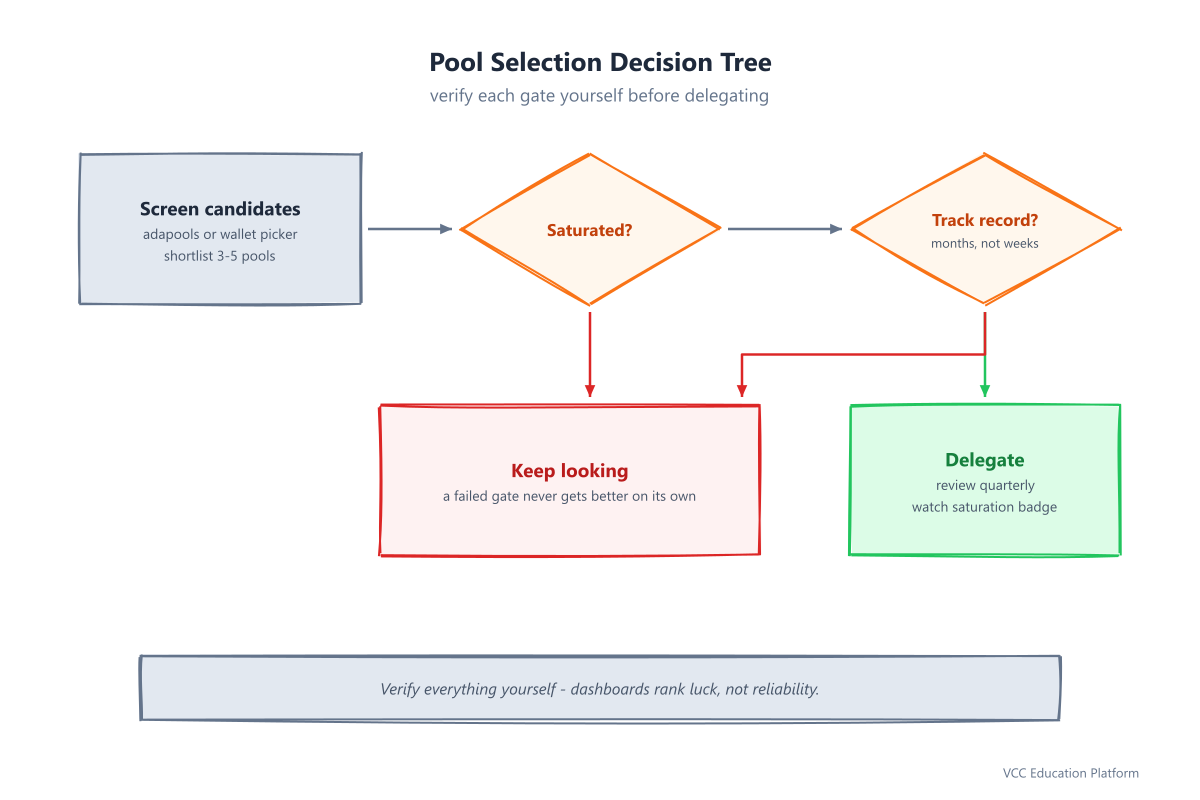
- Before delegating: screen candidates on adapools or your wallet's picker — consistent luck, below saturation, real pledge, sane fees, operator you can identify.
- Monthly, five minutes: glance at your pool's performance and saturation badge.
- Quarterly: check whether governance changes (like a future k increase) have shifted the saturation landscape.
- Never: chase the top ROA number of the week.
FAQ
Is staking ADA worth it compared to a bank deposit? They answer different needs. Bank deposits in Vietnam offer fixed đồng returns with insurance; Cardano staking offers variable ADA-denominated rewards plus whatever ADA price does. Many holders treat staking as a yield layer on an asset they'd hold anyway, not as a substitute for savings.
How much can I realistically earn? Low single digits annually in ADA terms for well-run, non-saturated pools — around 3% is a fair planning number, drifting slowly downward as the protocol reserve depletes.
Does compounding make a big difference? Less than marketing suggests. Cardano compounds natively per epoch since rewards in your reward account count toward stake; but at 3% rates, the cadence difference over a year is fractions of a percent. Pool quality dominates.
Can I lose ADA by staking? Not through delegation itself — it's non-custodial, there's no slashing of delegator funds, and you can't get locked out of your wallet. Real risks live elsewhere: sending funds to fake "staking" sites, signing malicious transactions, or trusting custody you shouldn't.
How often should I switch pools? Rarely. Switch when your pool persistently underperforms or crosses saturation — not because another pool had one good month. Every move costs two epochs of transition time before rewards flow again.
Do I need to withdraw rewards for them to earn? No, under current behavior the reward account balance counts toward your delegated stake. Withdraw only when you want to spend.