
In 2021, a wine producer in the country of Georgia started sticking QR-code labels on bottles of white wine. When a shopper in Tbilisi scans one with a phone camera, the phone quietly checks a record anchored to the Cardano blockchain and confirms: this bottle is real, this is where the grapes were pressed, this certificate is genuine. No cryptocurrency wallet, no jargon, no visible crypto at all — just a counterfeit problem being solved.
That little bottle label is a better starting point for understanding cardano use cases than any roadmap slide, because it already passed the test most projects fail: it shipped. In this article we'll walk through the Cardano real world applications that are genuinely running today, the famous partnerships that stalled, and a simple method for telling the difference yourself — including what all of this could mean for Vietnamese coffee, seafood, and export businesses.
First, a honesty rule: three stages of "real"
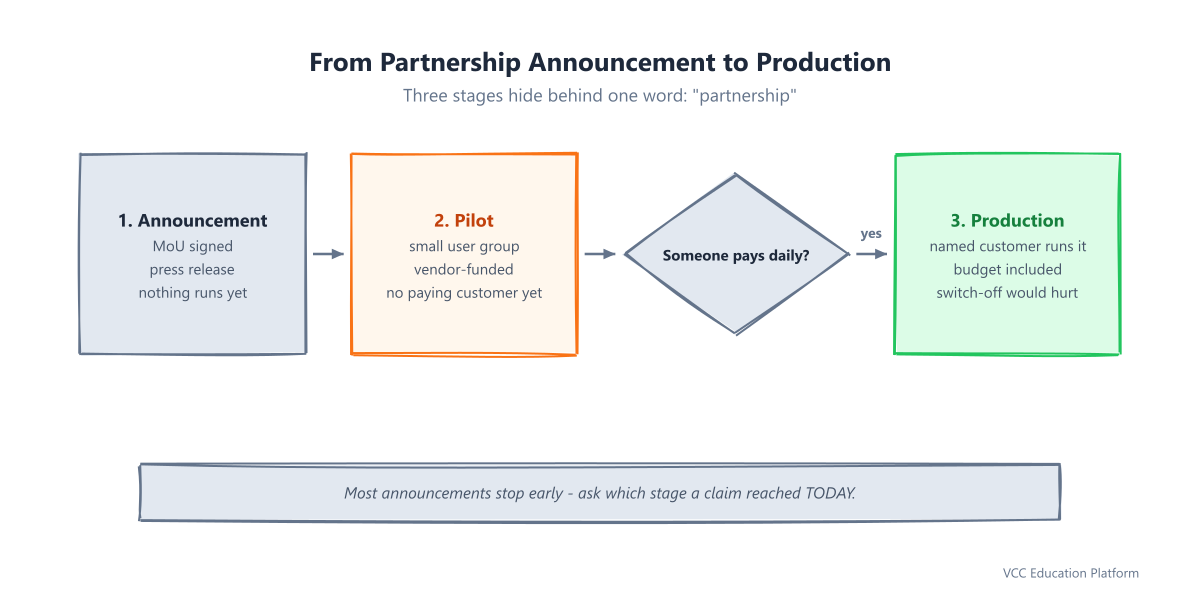
Before listing examples, we need a filter, because blockchain marketing blurs three very different situations into one word: "partnership."
- Stage 1 — Announcement: two organisations sign an MoU or appear on stage
together. Nothing runs yet. Many announcements never leave this stage.
- Stage 2 — Pilot or proof-of-concept: a limited version runs with a small user
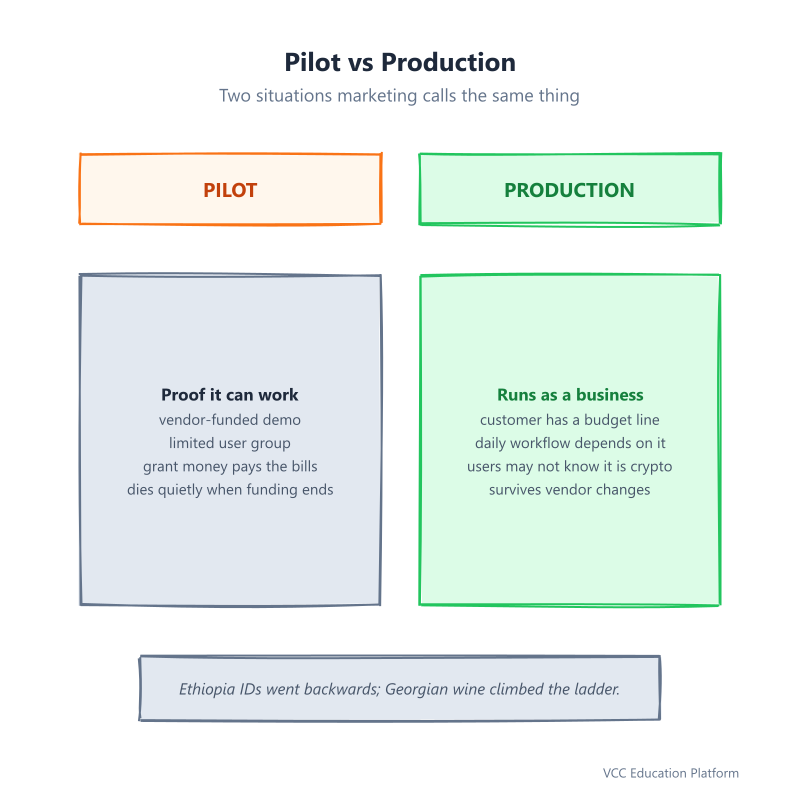
group, often funded by the vendor itself. It proves the technology works; it does not prove anyone will pay to keep it running.
- Stage 3 — Production: a named customer operates it in daily business, budget
included. If you switched it off tomorrow, somebody's workflow would break.
Almost every listicle you'll find ranks Cardano partnerships without asking which stage they reached. We'll apply the ladder explicitly to each case below.
Traceability: Georgian wine, the flagship that really runs
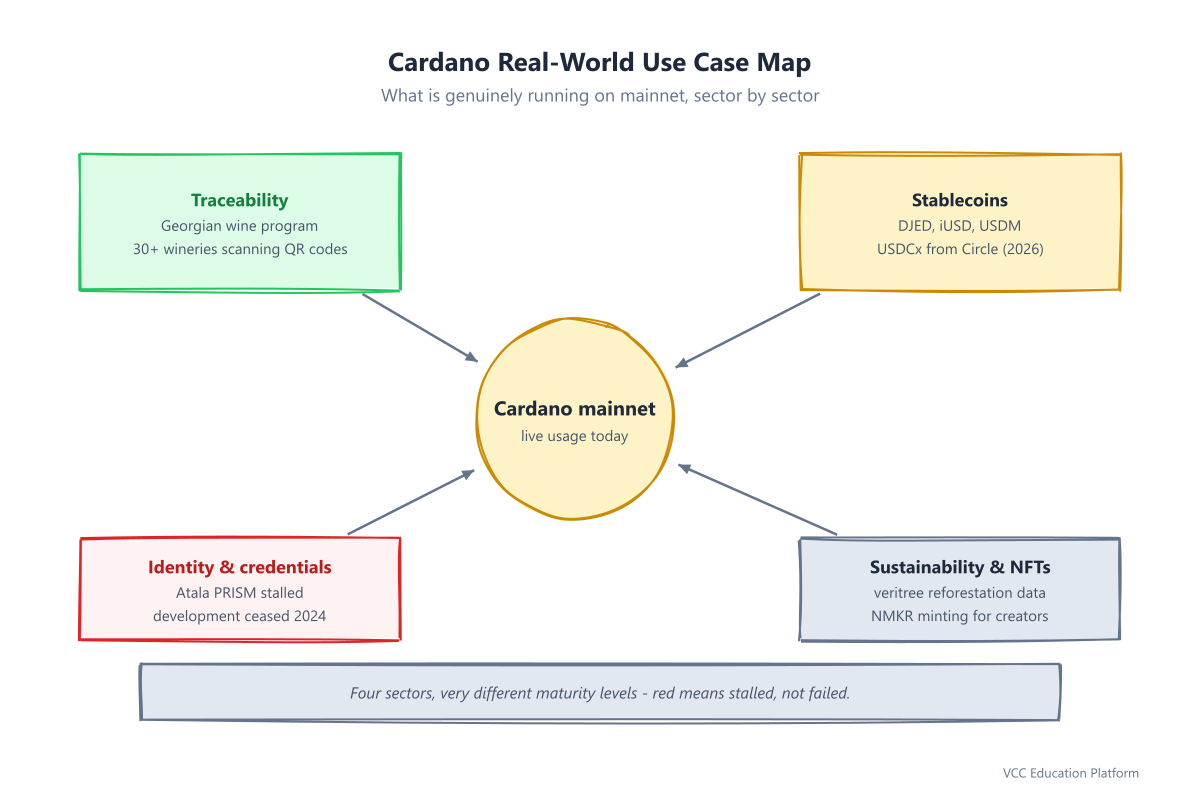
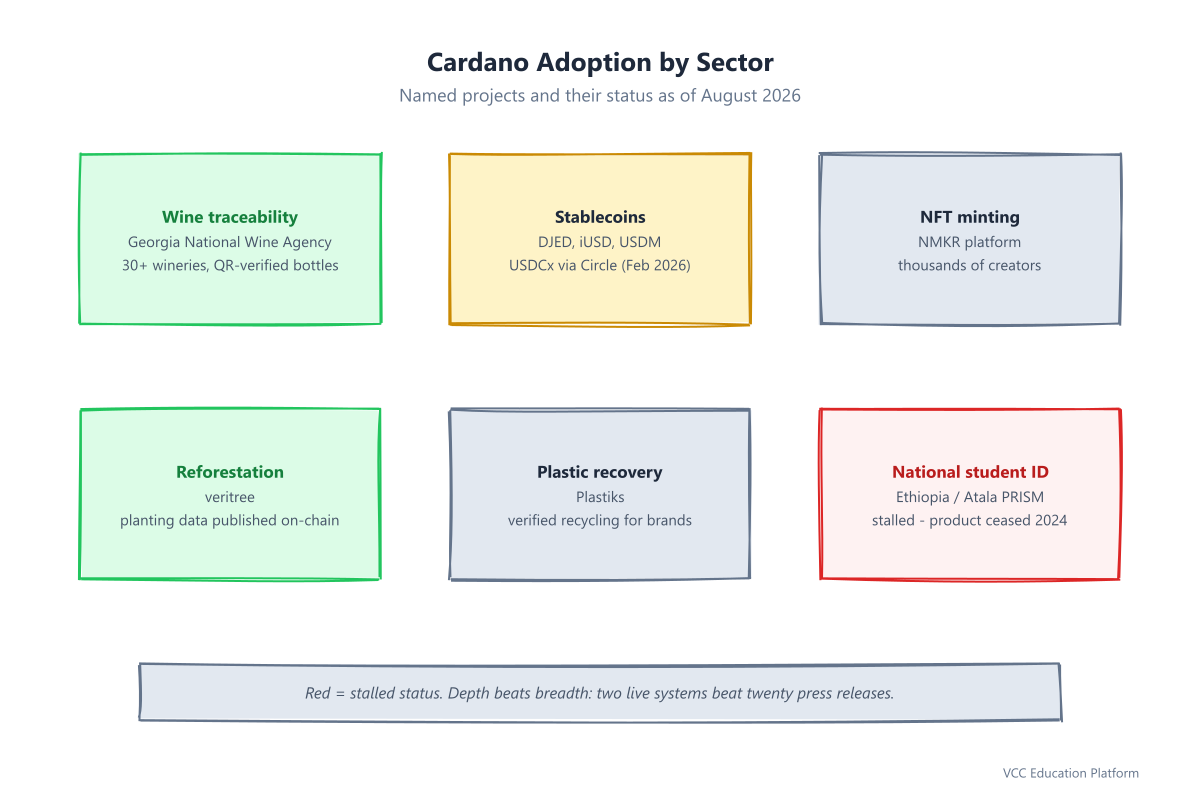
The strongest supply-chain example is the Georgian Wine Traceability Program. The Cardano Foundation partnered with Georgia's National Wine Agency — an official state body under the Ministry of Environmental Protection and Agriculture — together with the Bolnisi Winemakers Association and the traceability company Scantrust. Every production step, from grape intake to certification, is registered as transaction metadata on Cardano, so certificates of conformity become tamper-evident records instead of paper that can be forged.
Why does this matter? Counterfeit wine has damaged Georgia's reputation as the birthplace of winemaking, and buyers abroad had no way to verify authenticity. With the program, more than 30 wineries got digital inventory tools, and consumers scan a QR code to see the full history of the bottle. The agency's chairman, Levan Mekhuzla, describes it as helping certify that wines comply with their labels and reach new markets. Note the honest framing: this began as a smaller proof-of-concept with Baia's Wine back in 2020, then graduated to a state-backed program. That's exactly how a healthy pilot should evolve.
Why enterprises choose this chain at all
A fair question: with many blockchains available, why did a national wine agency end up on Cardano? Four properties keep recurring across enterprise adoption stories:
- Predictable, low fees. Anchoring thousands of QR-scan records costs fractions
of a cent each, and fees don't spike unpredictably — finance departments like budgets they can forecast.
- Transaction metadata. Compliance documents can ride along with a transaction
without exposing raw business data publicly.
- Deterministic settlement. Cardano's eUTXO model means a transaction either
succeeds predictably or doesn't execute — no half-finished states.
- Energy-light security. Ouroboros proof-of-stake lets sustainability-minded
organisations answer ESG questions about their supplier stack.
None of these is unique to Cardano alone, but the combination explains its niche in traceability and credentialing rather than, say, high-frequency trading.
Identity and education: Ethiopia's big promise — and its lesson
The most famous announcement in Cardano's history was Ethiopia. In April 2021, Input Output (IOHK, now IOG) signed with Ethiopia's Ministry of Education to put blockchain IDs and academic records on Atala PRISM for five million students, 750,000 teachers, and 3,500 schools. Headlines called it the largest blockchain deployment ever attempted.
Here's the part most articles won't tell you: it never became that. Builders on the ground reported delays through 2022, and in October 2024 IOG stopped developing Atala PRISM as a product, open-sourcing the codebase into Hyperledger Identus instead. The company framed it as normal open-source strategy; the practical outcome is that the flagship national identity rollout quietly ended without a successor commitment.
We include this not to mock the project but because it's the single best case study in stage-thinking. An announcement is not a deployment. Government MoUs take years, and infrastructure deals can stall on politics and procurement long after the blockchain part works. When someone quotes you a huge partnership number — users, students, farmers — ask which stage it's in today, not on announcement day.
Finance: stablecoins are the quietest success
If any category of Cardano use is closest to genuine production, it's dollar-pegged stablecoins. The ecosystem now hosts several live options: DJED, an overcollateralized stablecoin issued by COTI since early 2023; iUSD from the Indigo protocol; USDM, a fiat-backed token; and notably USDCx, brought to Cardano by Circle in February 2026 — the same issuer behind one of the world's largest stablecoins.
What makes this "real"? Ordinary holders move value across borders daily without thinking about which chain settles it. There's also governance substance behind it: in 2025, ADA holders voted on-chain to allocate 70 million ADA from the treasury to accelerate stablecoin adoption — a decision made transparently by the community, not a boardroom. For remittance corridors relevant to Southeast Asia, cheap stablecoin rails are the use case with the clearest everyday benefit, even if most users will never know they're touching Cardano.
A concrete way to feel the difference between an announcement and production is the remittance test. Vietnam is one of the world's largest recipients of money sent home by overseas workers — tens of billions of US dollars flow in every year — and each traditional transfer eats fees and waiting time. This is why dollar stablecoins on low-cost rails matter more here than any headline partnership: the technology is judged not by its roadmap but by whether a worker abroad can send value to a family in Da Nang faster and cheaper than a bank wire. Stablecoins are the first Cardano use case where ordinary, non-crypto people complete the final action without ever knowing which chain settled it.
The wider map: sectors where things run today
Beyond wine and dollars, the current landscape includes veritree (reforestation projects publishing planting data on-chain), Plastiks (verifying plastic recovery for circular-economy partners), Palmyra (a trade-compliance trace platform), Epoch Sports (memorabilia authenticity), NMKR (NFT minting used by thousands of creators), and Project Catalyst, which has funded thousands of community experiments with real treasury money. Some are modest; none is a household name. But breadth matters less than depth: two systems with paying operators beat twenty press releases.
A Vietnamese lens: where could this fit here?
Vietnam isn't home to a national Cardano deployment, and honest writing shouldn't pretend otherwise. But look at the demand side. Vietnam exported over eight billion US dollars of coffee in 2025, and the EU Deforestation Regulation now demands plot-level traceability for every bag entering Europe. The Ministry of Agriculture targets digitizing most agricultural processes, and in 2026 Vietnam finished piloting a national agricultural traceability platform using blockchain-style records and GS1 QR codes.
That is precisely the problem shape the Georgian program solved: an exporting industry, a counterfeiting or compliance pain, and buyers abroad who want verifiable proof. A Vietnamese pepper, coffee, or seafood exporter doesn't need to wait for a government deal — the Georgia model shows an industry association plus a traceability vendor plus an anchoring layer can start with one cooperative. Land registry, by contrast, remains politically sensitive everywhere and has stayed at pilot stage even in friendlier jurisdictions; treat any such claim with extra skepticism.
How to evaluate any use-case claim yourself
Next time a headline announces a blockchain breakthrough, run four checks:
- Named operator: Can you find the actual organisation running it today, not
just the vendor's press release?
- User evidence: Do ordinary people touch it? Check app-store reviews, scan
rates, or government portals.
- Budget line: Is someone paying for it in 2026? Free pilots die when grant
money ends.
- Consequence test: Would switching it off break a real workflow?
Apply these and you'll notice most crypto articles collapse into two sentences: "it was announced" and "we don't know what happened next." You now know how to ask.
Frequently asked questions
Does Cardano have real-world use cases?
Yes — most convincingly in supply-chain traceability (Georgia's state-backed wine program with 30+ wineries), stablecoins (DJED, iUSD, USDM, and Circle's USDCx since February 2026), NFT minting via NMKR, and sustainability tracking via veritree. All are small relative to global finance, but they are operating systems, not concepts.
Is Cardano actually used in Africa?
Partially. Ethiopia's famous five-million-student ID project was announced in 2021 but development of the underlying Atala PRISM product was discontinued by IOG in October 2024 before nationwide rollout completed. Other African activity, such as connectivity and verification pilots, remains mostly in pilot stage. Africa is Cardano's biggest announced opportunity and its clearest cautionary tale.
What companies partner with Cardano?
Known collaborators include Scantrust and Georgia's National Wine Agency (traceability), COTI (DJED stablecoin), Circle (USDCx), Mehen (USDM), veritree, Plastiks, and NMKR. Historically IOG held government relationships, including Ethiopia's Ministry of Education.
Is Ethiopia's Cardano project still running?
Not in its original form. After repeated delays, IOG ceased Atala PRISM product development in late 2024 and open-sourced the code as Hyperledger Identus. No official successor plan for the national student-ID rollout has been published.
Can Cardano be used for payments?
Yes. Stablecoins like DJED and USDCx let users send dollar-equivalent value for fractions of a cent, and merchants can accept them through wallets and payment processors. Native ADA also works for direct payments, though volatility makes stablecoins preferable for pricing goods.
Could Vietnamese exporters use Cardano-style traceability?
Technically yes, and the economics fit: anchoring batch records costs cents per scan. Realistically, adoption would follow the Georgia pattern — an industry association or exporter adopting a vendor platform that anchors to Cardano behind the scenes — driven by EU compliance pressure rather than enthusiasm for crypto itself.