
 ## Inside Catalyst Funding Rounds: The Life Story of One Idea
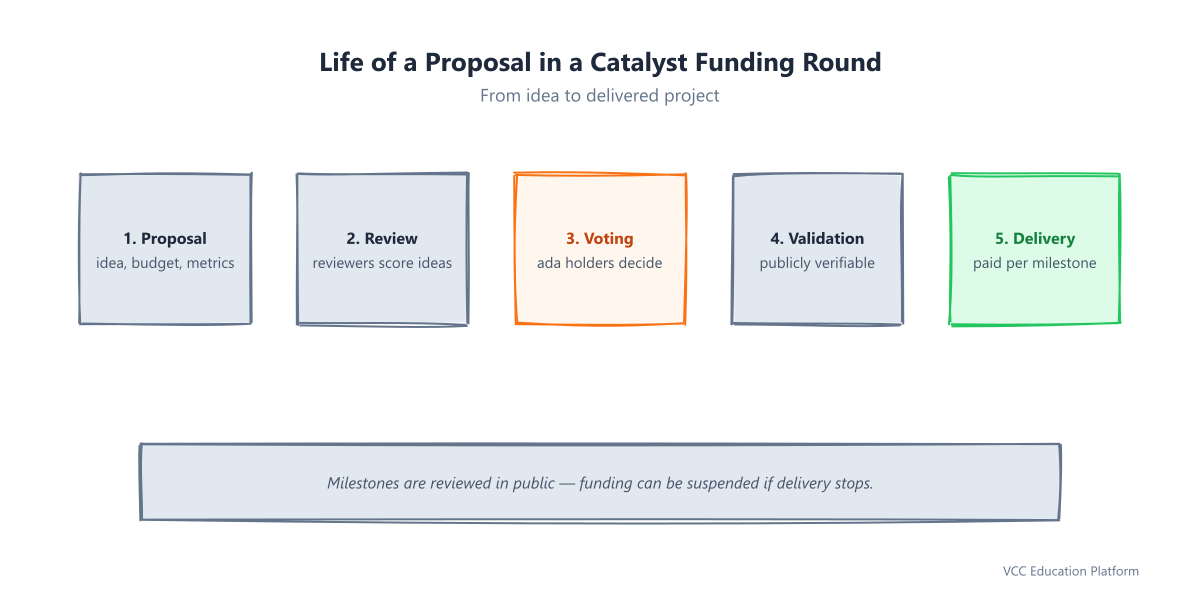
The best way to understand **catalyst funding rounds** is not to memorize stage names but to follow a single idea through the machine. Meet Lan, a university student from Da Nang with an idea: a mobile course that teaches remittance families how to compare transfer fees safely. Here is her journey.
### Stage 1 — Proposal submission
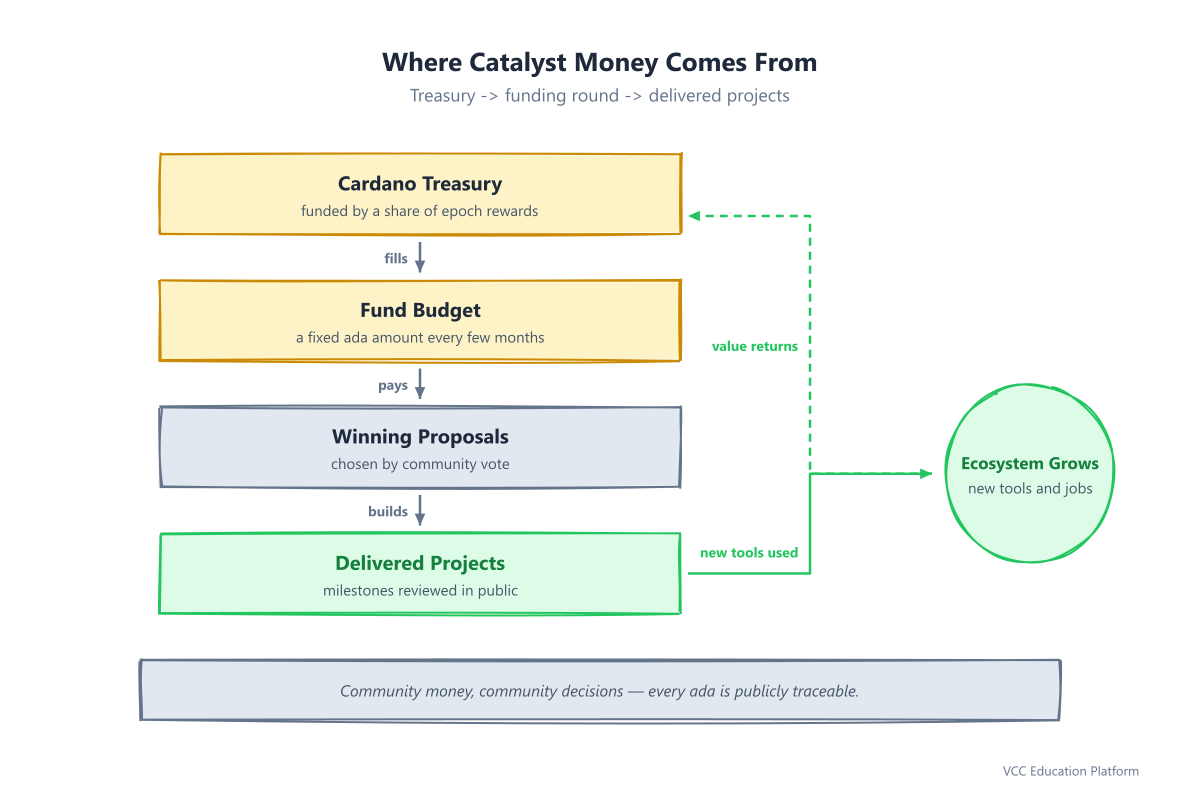
Every few months a new Fund opens with a published ada budget. Recent budgets ranged widely: Fund13 carried 46.5 million ada, while Fund14 worked with 18.6 million ada across categories such as Cardano Open (ecosystem and developers) and Cardano Use Cases (concept vs product maturity). Lan has about three weeks to turn her idea into a structured proposal on the Catalyst platform: the problem, the solution, a budget breakdown, team details, success metrics, and a realistic timeline.
Writing quality here matters enormously. Winning project catalyst proposals tend to share three traits reviewers reward: a sharply defined problem, a measurable definition of success, and a budget a stranger can audit line by line.
### Stage 2 — Community review
Before anyone votes, paid community reviewers score each proposal on impact, feasibility, and value for money, writing short public assessments with their scores. This is quality control by crowd — and Catalyst actively polices it. Automated scripts flag reviews that are too short, suspiciously similar to other reviews, or AI-generated, and flagged reviews go to human moderators. Reviewers are rewarded in ada, which keeps participation high but also creates gaming incentives the flagging system exists to counter.
Lan reads her reviews and rewrites the weak spots in her proposal before voting begins. Good proposers treat review feedback as free consulting.
### Stage 3 — Voting
ADA holders register to vote from supported wallets (a minimum of roughly 500 ada is required), then vote in the Catalyst mobile voting app. Votes are anonymous and weighted by how much ada each voter holds. There are no transaction fees for voting and no coins leave your wallet — registration just proves you exist at a snapshot moment.
This is where the neighborhood-council analogy bends: a wallet with two million ada carries vastly more weight than a wallet with six hundred. Defenders call this stake-aligned skin in the game; critics call it plutocracy with extra steps. Both are partly right, which is why voter *education* programs keep growing every fund.
### Stage 4 — On-chain validation
After voting closes, results are published alongside cryptographic data that anyone can verify against the chain — without ever learning who voted for what. Anonymity and verifiability usually pull in opposite directions; Catalyst's voting design is one of the cleaner demonstrations that you can have both.
### Stage 5 — Funding, milestones, and accountability
Winners do not receive a lump sum and disappear. Modern rounds use milestone-based disbursement: projects check in at proof-of-life meetings, hit agreed milestones reviewed by the community, and publish reports. Miss them, and funding can be suspended or cancelled — a formal enforcement process added as Catalyst matured.
## Inside Catalyst Funding Rounds: The Life Story of One Idea
The best way to understand **catalyst funding rounds** is not to memorize stage names but to follow a single idea through the machine. Meet Lan, a university student from Da Nang with an idea: a mobile course that teaches remittance families how to compare transfer fees safely. Here is her journey.
### Stage 1 — Proposal submission
Every few months a new Fund opens with a published ada budget. Recent budgets ranged widely: Fund13 carried 46.5 million ada, while Fund14 worked with 18.6 million ada across categories such as Cardano Open (ecosystem and developers) and Cardano Use Cases (concept vs product maturity). Lan has about three weeks to turn her idea into a structured proposal on the Catalyst platform: the problem, the solution, a budget breakdown, team details, success metrics, and a realistic timeline.
Writing quality here matters enormously. Winning project catalyst proposals tend to share three traits reviewers reward: a sharply defined problem, a measurable definition of success, and a budget a stranger can audit line by line.
### Stage 2 — Community review
Before anyone votes, paid community reviewers score each proposal on impact, feasibility, and value for money, writing short public assessments with their scores. This is quality control by crowd — and Catalyst actively polices it. Automated scripts flag reviews that are too short, suspiciously similar to other reviews, or AI-generated, and flagged reviews go to human moderators. Reviewers are rewarded in ada, which keeps participation high but also creates gaming incentives the flagging system exists to counter.
Lan reads her reviews and rewrites the weak spots in her proposal before voting begins. Good proposers treat review feedback as free consulting.
### Stage 3 — Voting
ADA holders register to vote from supported wallets (a minimum of roughly 500 ada is required), then vote in the Catalyst mobile voting app. Votes are anonymous and weighted by how much ada each voter holds. There are no transaction fees for voting and no coins leave your wallet — registration just proves you exist at a snapshot moment.
This is where the neighborhood-council analogy bends: a wallet with two million ada carries vastly more weight than a wallet with six hundred. Defenders call this stake-aligned skin in the game; critics call it plutocracy with extra steps. Both are partly right, which is why voter *education* programs keep growing every fund.
### Stage 4 — On-chain validation
After voting closes, results are published alongside cryptographic data that anyone can verify against the chain — without ever learning who voted for what. Anonymity and verifiability usually pull in opposite directions; Catalyst's voting design is one of the cleaner demonstrations that you can have both.
### Stage 5 — Funding, milestones, and accountability
Winners do not receive a lump sum and disappear. Modern rounds use milestone-based disbursement: projects check in at proof-of-life meetings, hit agreed milestones reviewed by the community, and publish reports. Miss them, and funding can be suspended or cancelled — a formal enforcement process added as Catalyst matured.
 ## Who Participates — And What They Get
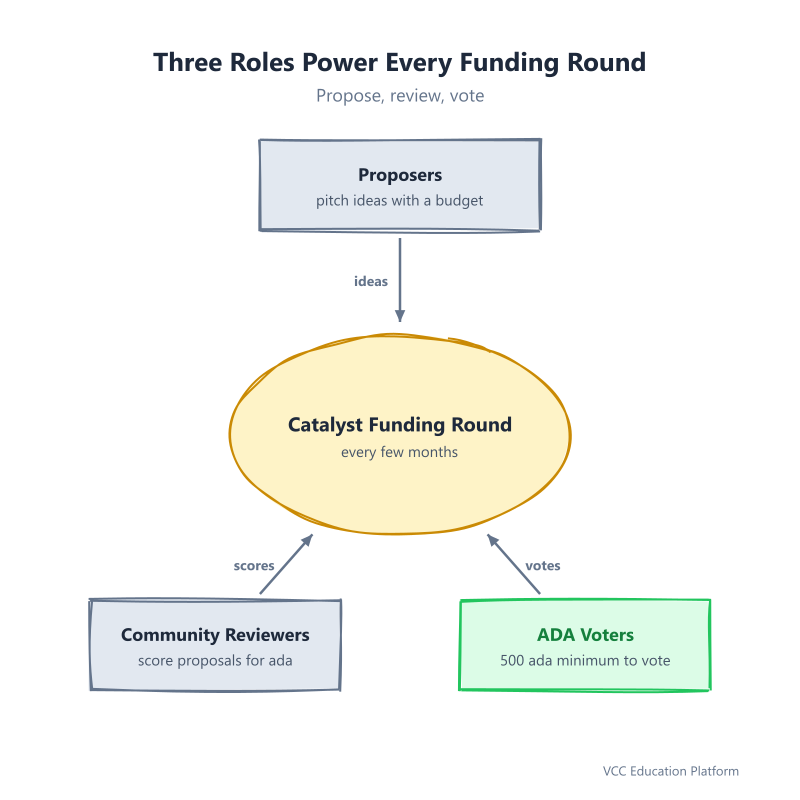
Cardano community funding works because three roles feed each other:
- **Proposers** get access to non-dilutive funding with no equity taken and no repayment. Intellectual property stays with the proposer.
- **Community reviewers** earn ada for honest scoring, building a reputation layer the whole ecosystem leans on.
- **Voters** directly steer where hundreds of millions of dollars of ecosystem resources go. It is the lowest-effort, highest-leverage role: reading ten proposals thoughtfully arguably does more for Cardano's future than most marketing campaigns.
Compare this with traditional venture capital: founders pitch analysts and partners behind closed doors, and capital concentrates wherever relationships already exist. Catalyst replaces the closed room with a public scoreboard. The trade-off is real — thousands of amateur voters instead of a few professionals — but the entry barrier collapses from "know someone" to "own 500 ada."
## Who Participates — And What They Get
Cardano community funding works because three roles feed each other:
- **Proposers** get access to non-dilutive funding with no equity taken and no repayment. Intellectual property stays with the proposer.
- **Community reviewers** earn ada for honest scoring, building a reputation layer the whole ecosystem leans on.
- **Voters** directly steer where hundreds of millions of dollars of ecosystem resources go. It is the lowest-effort, highest-leverage role: reading ten proposals thoughtfully arguably does more for Cardano's future than most marketing campaigns.
Compare this with traditional venture capital: founders pitch analysts and partners behind closed doors, and capital concentrates wherever relationships already exist. Catalyst replaces the closed room with a public scoreboard. The trade-off is real — thousands of amateur voters instead of a few professionals — but the entry barrier collapses from "know someone" to "own 500 ada."
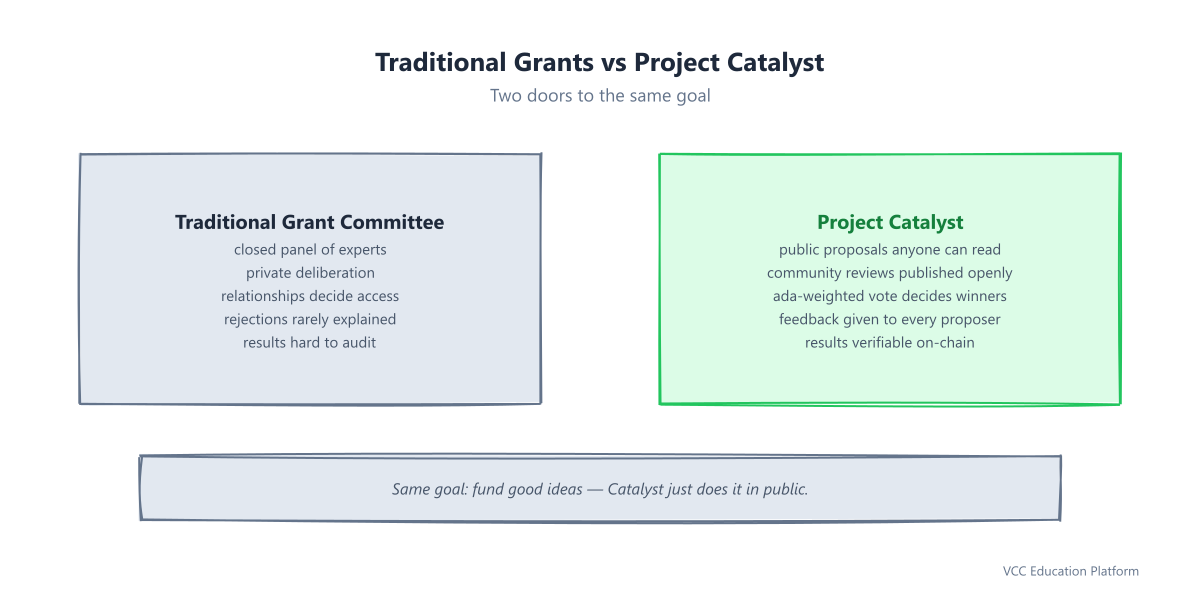 For Vietnamese readers, the contrast with familiar grant culture is striking. University and state research funding in Vietnam typically moves through committees whose deliberations are invisible to applicants. Catalyst flips that: every score, every review, every vote total ends up publicly auditable. A student in Hue can read exactly why a similar proposal from Ho Chi Minh City won — or lost — last fund.
## How Big Has Project Catalyst Grown?
By mid-2026 the official numbers stand at over $150 million in total funding commitments and more than 2,200 funded proposals, spanning developer tools, education, regional communities, DeFi experiments, and real-world pilots. Individual funds have fluctuated between roughly 5 and 46 million ada depending on category design and treasury strategy. Participation is genuinely global: dedicated hubs exist across Africa, Latin America, East Asia, and Southeast Asia, with Vietnam consistently among the most active Cardano communities.
Funded output ranges from modest to notable. Some grants produced abandoned repos; others matured into wallets, explorers, education platforms, and integrations still used today. That spread is not a bug of decentralized funding — it is the expected variance of a portfolio approach applied to early-stage ideas, run in public.
## Honest Risks and Criticisms
No serious overview should skip the failure modes, because Project Catalyst has visible ones:
- **Uneven completion.** Official dashboards openly tag some funded projects as "did not finish." Money committed is not money delivered.
- **Misuse cases.** Community investigations — such as a 2025 forum report questioning how a Brazil community-hub proposal spent its 68,000 ada grant — show accountability depends heavily on volunteers doing forensic work.
- **Low-information voting.** Stake-weighted votes mean large holders can sway outcomes without deep engagement, and proposal quality varies far more than the average voter can verify.
- **Transition turbulence.** In early 2026 stewardship moved from IOG to the Cardano Foundation, pausing Fund15 and Fund16 in their proposed form and returning roughly 18.5 million ada to the treasury. Builders who had prepared proposals faced months of uncertainty before a smaller pilot fund (around 2 million ada) was announced for August 2026.
These are the growing pains of converting an experiment into infrastructure. The direction of travel — milestone gating, moderation systems, institutional handover — addresses each risk, but slowly, and the community debates every step loudly in public forums. That loudness is arguably the feature: you cannot quietly fail when your ledger is public.
## Getting Started as a Beginner
You need no technical background to enter. Pick one path:
1. **Vote.** Download a supporting wallet (Eternl, Lace, and others handle registration natively), hold at least ~500 ada, register before the snapshot, then read five proposals per fund. Start with the categories you personally understand.
2. **Review.** Register as a Community Reviewer during a live fund and earn ada for scored feedback. Non-native English speakers are welcome; clarity matters more than fluency.
3. **Propose.** Draft small. A ₳15,000 education project with crisp metrics beats a vague ₳200,000 platform. Study funded proposals from previous funds first — they are all public.
If you are in Vietnam, join local Telegram and Discord Cardano groups before submitting; experienced Vietnamese proposers routinely help newcomers pressure-test budgets and translations.
## Frequently Asked Questions
**What is Project Catalyst in simple terms?**
It is Cardano's community grant program: people propose projects, other community members review and score them, and ADA holders vote on which proposals receive treasury funding. Over $150 million has been committed since launch.
**Do I risk my ADA when I vote?**
No. Voting requires registering a wallet at a snapshot, but no coins are spent, locked in a risky contract, or transferred. Your ada stays yours throughout.
**How much ADA do I need to participate?**
Voting requires a minimum of roughly 500 ada in a registered wallet. Proposing and reviewing require no minimum balance at all.
**What happens if a funded project fails to deliver?**
Milestone-based disbursement means payments arrive as deliverables are approved. Projects can be suspended or cancelled, and repeated non-delivery damages a proposer's reputation across funds.
**Is Project Catalyst the same as Cardano governance?**
No, though they overlap. Catalyst decides how treasury money funds new projects; broader Cardano governance (DReps, the Constitutional Committee under CIP-1694) decides protocol rules and treasury policy. Catalyst is increasingly integrating with that wider governance stack.
**Can someone outside the crypto industry submit a proposal?**
Yes. Teachers, designers, farmers, and students regularly propose. Categories like Cardano Open explicitly welcome ecosystem, education, and community-building work, not just software.
For Vietnamese readers, the contrast with familiar grant culture is striking. University and state research funding in Vietnam typically moves through committees whose deliberations are invisible to applicants. Catalyst flips that: every score, every review, every vote total ends up publicly auditable. A student in Hue can read exactly why a similar proposal from Ho Chi Minh City won — or lost — last fund.
## How Big Has Project Catalyst Grown?
By mid-2026 the official numbers stand at over $150 million in total funding commitments and more than 2,200 funded proposals, spanning developer tools, education, regional communities, DeFi experiments, and real-world pilots. Individual funds have fluctuated between roughly 5 and 46 million ada depending on category design and treasury strategy. Participation is genuinely global: dedicated hubs exist across Africa, Latin America, East Asia, and Southeast Asia, with Vietnam consistently among the most active Cardano communities.
Funded output ranges from modest to notable. Some grants produced abandoned repos; others matured into wallets, explorers, education platforms, and integrations still used today. That spread is not a bug of decentralized funding — it is the expected variance of a portfolio approach applied to early-stage ideas, run in public.
## Honest Risks and Criticisms
No serious overview should skip the failure modes, because Project Catalyst has visible ones:
- **Uneven completion.** Official dashboards openly tag some funded projects as "did not finish." Money committed is not money delivered.
- **Misuse cases.** Community investigations — such as a 2025 forum report questioning how a Brazil community-hub proposal spent its 68,000 ada grant — show accountability depends heavily on volunteers doing forensic work.
- **Low-information voting.** Stake-weighted votes mean large holders can sway outcomes without deep engagement, and proposal quality varies far more than the average voter can verify.
- **Transition turbulence.** In early 2026 stewardship moved from IOG to the Cardano Foundation, pausing Fund15 and Fund16 in their proposed form and returning roughly 18.5 million ada to the treasury. Builders who had prepared proposals faced months of uncertainty before a smaller pilot fund (around 2 million ada) was announced for August 2026.
These are the growing pains of converting an experiment into infrastructure. The direction of travel — milestone gating, moderation systems, institutional handover — addresses each risk, but slowly, and the community debates every step loudly in public forums. That loudness is arguably the feature: you cannot quietly fail when your ledger is public.
## Getting Started as a Beginner
You need no technical background to enter. Pick one path:
1. **Vote.** Download a supporting wallet (Eternl, Lace, and others handle registration natively), hold at least ~500 ada, register before the snapshot, then read five proposals per fund. Start with the categories you personally understand.
2. **Review.** Register as a Community Reviewer during a live fund and earn ada for scored feedback. Non-native English speakers are welcome; clarity matters more than fluency.
3. **Propose.** Draft small. A ₳15,000 education project with crisp metrics beats a vague ₳200,000 platform. Study funded proposals from previous funds first — they are all public.
If you are in Vietnam, join local Telegram and Discord Cardano groups before submitting; experienced Vietnamese proposers routinely help newcomers pressure-test budgets and translations.
## Frequently Asked Questions
**What is Project Catalyst in simple terms?**
It is Cardano's community grant program: people propose projects, other community members review and score them, and ADA holders vote on which proposals receive treasury funding. Over $150 million has been committed since launch.
**Do I risk my ADA when I vote?**
No. Voting requires registering a wallet at a snapshot, but no coins are spent, locked in a risky contract, or transferred. Your ada stays yours throughout.
**How much ADA do I need to participate?**
Voting requires a minimum of roughly 500 ada in a registered wallet. Proposing and reviewing require no minimum balance at all.
**What happens if a funded project fails to deliver?**
Milestone-based disbursement means payments arrive as deliverables are approved. Projects can be suspended or cancelled, and repeated non-delivery damages a proposer's reputation across funds.
**Is Project Catalyst the same as Cardano governance?**
No, though they overlap. Catalyst decides how treasury money funds new projects; broader Cardano governance (DReps, the Constitutional Committee under CIP-1694) decides protocol rules and treasury policy. Catalyst is increasingly integrating with that wider governance stack.
**Can someone outside the crypto industry submit a proposal?**
Yes. Teachers, designers, farmers, and students regularly propose. Categories like Cardano Open explicitly welcome ecosystem, education, and community-building work, not just software.