When you delegate ADA to a Cardano stake pool, you're entrusting your rewards to that pool's ability to produce blocks consistently. Stake pool performance directly determines how much ADA you earn each epoch. A pool that misses blocks, suffers from downtime, or operates inefficiently will deliver lower returns — even if its fees look attractive on paper.
This guide breaks down every metric that matters for evaluating Cardano pool performance, from ROA and block production to saturation and operational reliability. By the end, you'll know exactly what to check before delegating and how to monitor your pool over time.
---
Why Pool Performance Metrics Matter
Every Cardano epoch (5 days), the protocol selects slot leaders based on each pool's active stake. When a pool is chosen, it must produce a valid block within its assigned slot. Stake pool ROA (Return on ADA) — the actual yield you receive — depends entirely on whether the pool delivers those blocks.
A pool with 99% uptime but high fees might underperform a pool with 97% uptime and zero margin. Conversely, a pool with low fees but frequent missed blocks will drain your rewards through opportunity cost. Pool performance metrics let you separate marketing from reality.
> Key insight: The protocol rewards reliability, not promises. A pool's historical block record is the single most honest signal of future performance.
---
Core Performance Metrics
1. ROA — Return on ADA
ROA measures the annualized percentage yield on your delegated stake. It's the "bottom line" metric every delegator watches.
``` ROA = (Rewards Earned / Active Stake) × (365 / Epoch Length in Days) × 100 ```
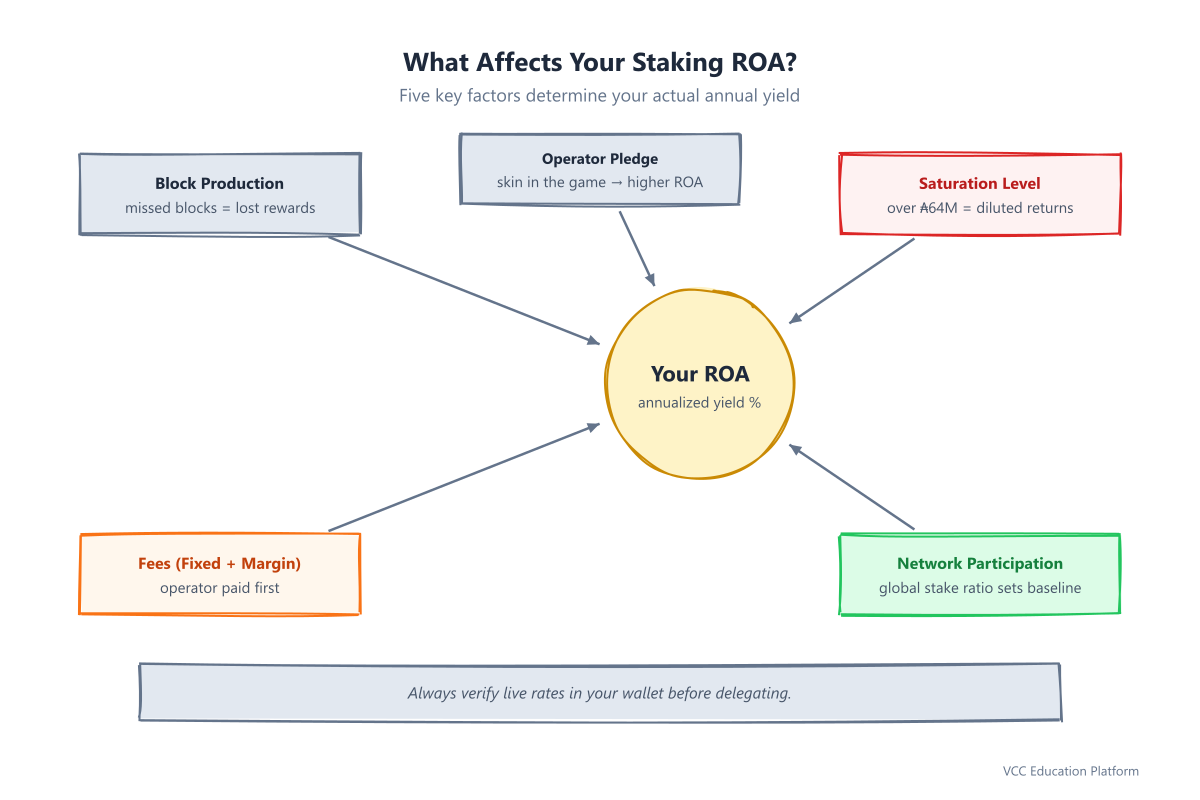
What affects ROA:
- Block production rate — Pools that produce their assigned blocks earn rewards; missed blocks mean zero rewards for that slot
- Pool fees — Fixed fee (₳340 minimum) + variable margin % deducted before rewards reach delegators
- Saturation — Over-saturated pools see diminishing returns (see Saturation section)
- Network participation — The global ratio of staked ADA to total supply influences the baseline reward rate
- Assigned slots — How many blocks the protocol scheduled for the pool
- Produced blocks — How many blocks the pool actually minted
- Missed blocks — Assigned minus produced (includes blocks minted but orphaned)
- Block rate = Produced / Assigned × 100%
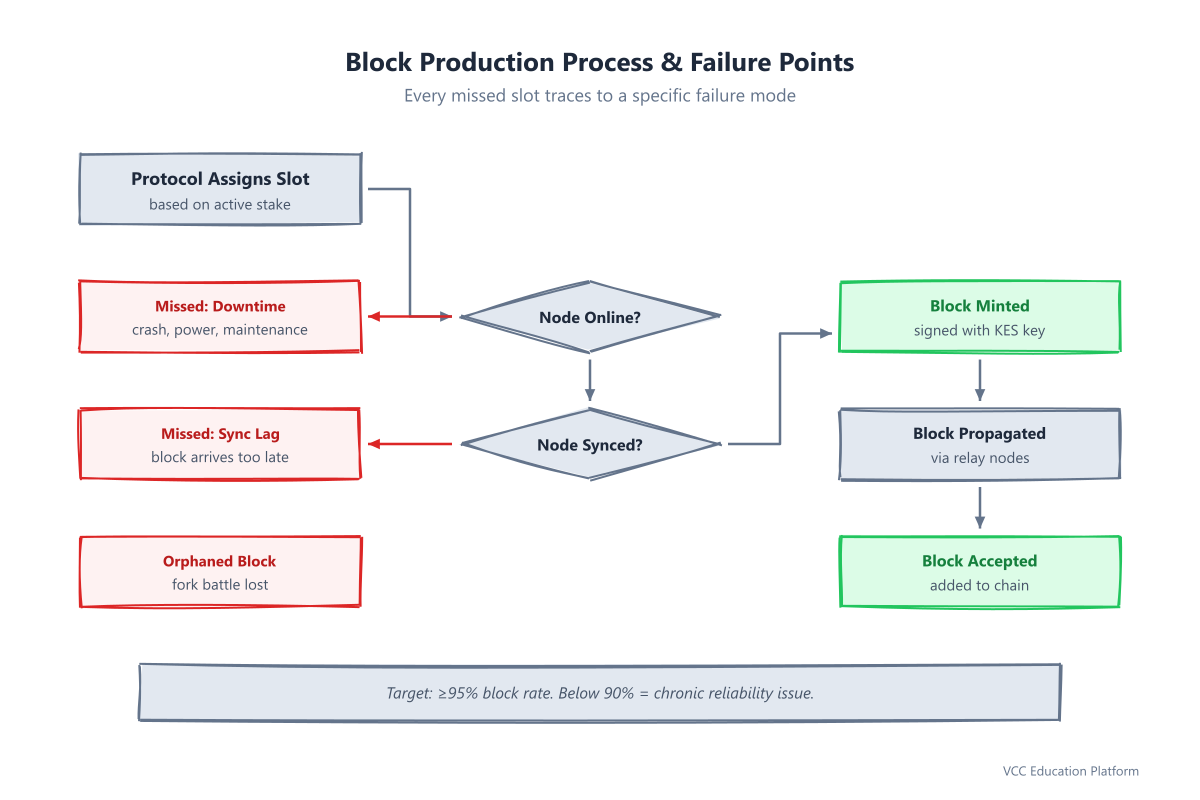
- Node downtime (maintenance, crashes, power loss)
- Network latency (block arrives too late, gets orphaned)
- Fork battles (pool's block loses to a competing chain)
- Key management errors (VRF/KES key rotation failures)
- Recent luck (epoch/30d) — Highly volatile. A small pool might hit 200% one epoch and 50% the next purely by chance.
- Consistent 95–105% lifetime luck = healthy, honest operation
- Chronic <90% lifetime luck = technical problems or adversarial behavior
- Wild recent luck swings = normal for small pools; ignore for delegation decisions
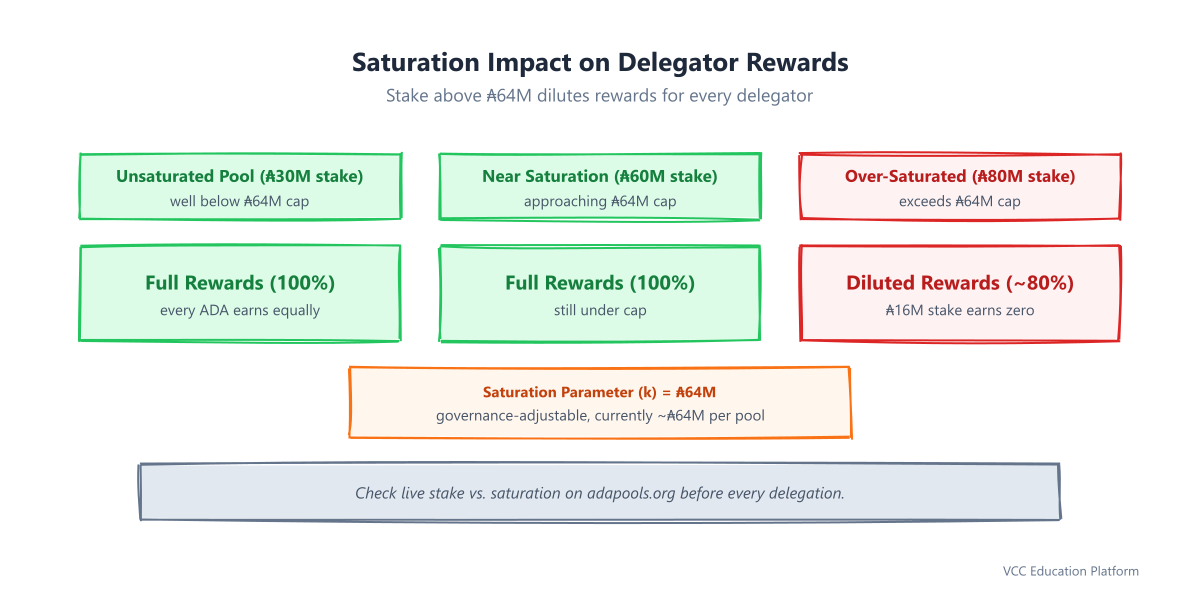
- Stake ≤ saturation → Full rewards for all delegators
- Stake > saturation → Rewards diluted proportionally. Only the first ₳64M "counts" for block selection.
- Desirability = A composite score (0–1) shown in wallets. Drops sharply once saturation is breached.
- Delegating to a saturated pool directly reduces your ROA
- Pool operators often open sister pools to absorb overflow
- Always check current live stake vs. saturation before delegating
- After fixed fee: ₳9,660
- After 2% margin: ₳9,466.80 to delegators
- Your share depends on your stake % of pool's active stake
- Higher pledge → slightly higher rewards (protocol incentive)
- Signals operator confidence — they earn the same ROA as delegators
- a0 parameter (currently 0.3) controls pledge influence strength
- Meaningful pledge (≥₳100K for serious operators)
- Pledge increasing over time = operator reinvesting
- Pledge = 0 or tiny = hobbyist or opportunistic pool
- Relay nodes — Multiple geographically distributed relays (minimum 2, preferably 3+)
- Block producer isolation — BP node hidden behind relays, no public IP
- Failover — Automatic failover to backup BP node within seconds
- Monitoring — 24/7 alerting on missed slots, peer count, sync status
- Pool misses all blocks for an entire epoch after a known rotation boundary
- Operator announces "key rotation issues" on social channels
- Pooltool shows sudden drop to 0% block rate at epoch boundaries
- Are VRF keys stored on air-gapped hardware?
- Is there a key compromise response plan?
- Has the pool ever had a security incident?
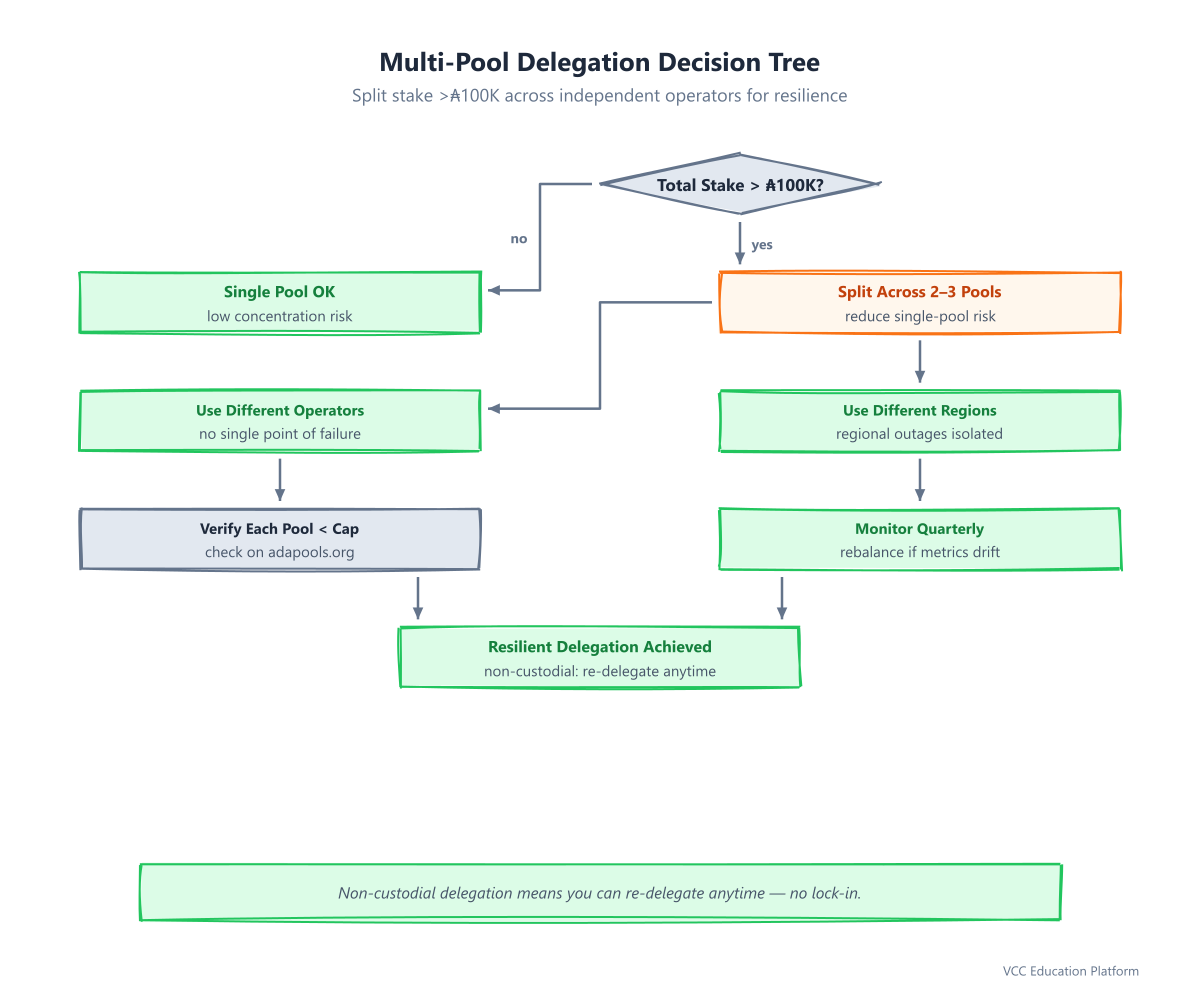
- Reduces single-pool risk (downtime, saturation, fee hike)
- Smoothes luck variance
- Supports decentralization
- Split stake across pools with different operators, geographies
- Keep each delegation below saturation individually
- Rebalance quarterly based on performance data
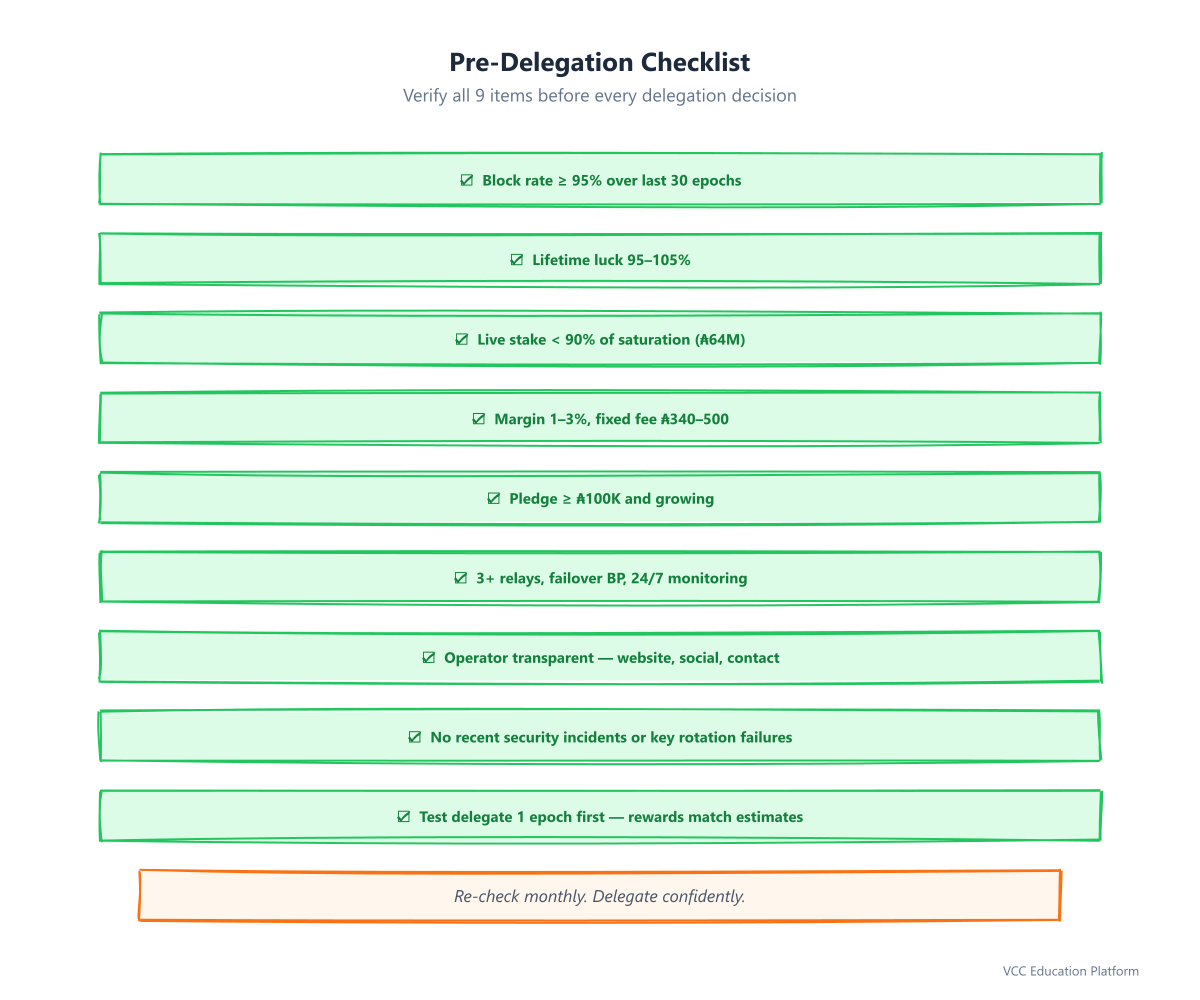
- [ ] Lifetime luck 95–105%
- [ ] Live stake < 90% of saturation (₳64M)
- [ ] Margin 1–3%, fixed fee ₳340–₳500
- [ ] Pledge ≥ ₳100K and growing
- [ ] Uptime infrastructure — 3+ relays, failover BP, monitoring
- [ ] Operator transparency — website, social, contact method
- [ ] No recent security incidents or key rotation failures
- [ ] Rewards match estimates — test delegate 1 epoch first
Typical range: 3–5% for well-run, unsaturated pools. Pools consistently below 2% usually have operational issues.
---
2. Block Production Rate
This is the heartbeat of Cardano pool blocks performance. Every epoch, the protocol assigns each pool a number of leader slots proportional to its active stake. The pool must be online and synced to mint blocks in those slots.
Metrics to track:
Target: ≥ 95% block rate. Below 90% signals chronic reliability problems.
Why blocks get missed:
---
3. Lifetime Luck vs. Recent Luck
Luck compares actual blocks produced to statistically expected blocks based on stake.
``` Luck = (Actual Blocks / Expected Blocks) × 100% ```
- Lifetime luck — Smooths variance over months/years. Should converge to ~100% for honest pools.
How to read it:
> Vietnam context: Many Vietnamese delegators check luck daily on adapools.org or pooltool.io. Remember — daily luck is noise. Monthly luck is signal.
---
4. Saturation and Desirability
Saturation caps the effective stake a pool can use for leader selection. The saturation point (k-parameter) is set by governance — currently around ₳64M per pool.
How it works:
Practical impact:
---
5. Pool Fees: Fixed Cost + Margin
Two fees eat into your rewards before you see them:
| Fee Type | Typical Range | Who Pays | |----------|---------------|----------| | Fixed fee | ₳340 minimum (protocol-enforced) | Deducted from pool's total epoch rewards first | | Margin | 0–5% (most pools: 1–3%) | Percentage of remaining rewards after fixed fee |
Calculation order per epoch: 1. Pool earns total rewards (based on blocks produced) 2. Subtract fixed fee (₳340 minimum) 3. Apply margin % to remainder 4. Remaining ADA distributed to delegators proportionally
Example: Pool produces ₳10,000 rewards in an epoch. Fixed fee ₳340, margin 2%.
Red flag: Pools with 0% margin but suspiciously high fixed fees (₳1000+) — they're hiding margin in the fixed cost.
---
6. Pledge and Operator Commitment
Pledge = ADA the pool operator stakes in their own pool. It's "skin in the game."
Why it matters:
What to look for:
> Note: Pledge doesn't protect delegators from mismanagement. A well-pledged pool with bad uptime still underperforms.
---
Operational Reliability Metrics
7. Uptime and Infrastructure
Uptime = Percentage of time the pool's block-producing node is online, synced, and ready to mint.
What good infrastructure looks like:
Verification: Check pooltool.io or adapools.org for "missed slots" history. A pool with zero missed slots for 50+ epochs likely has solid infrastructure.
---
8. KES Key Rotation
KES (Key Evolving Signature) keys are used to sign blocks. They rotate every ~90 days (129,600 slots). If rotation fails, the pool cannot produce blocks until fixed.
Warning signs:
Best practice: Operators should rotate keys before the deadline with testnet verification. Ask operators about their rotation procedure before delegating large amounts.
---
9. VRF Key Security
VRF (Verifiable Random Function) keys determine slot leadership. They must stay secret — if compromised, an attacker can predict or manipulate leadership.
What delegators can't see but should ask:
---
Comparative Analysis Tools
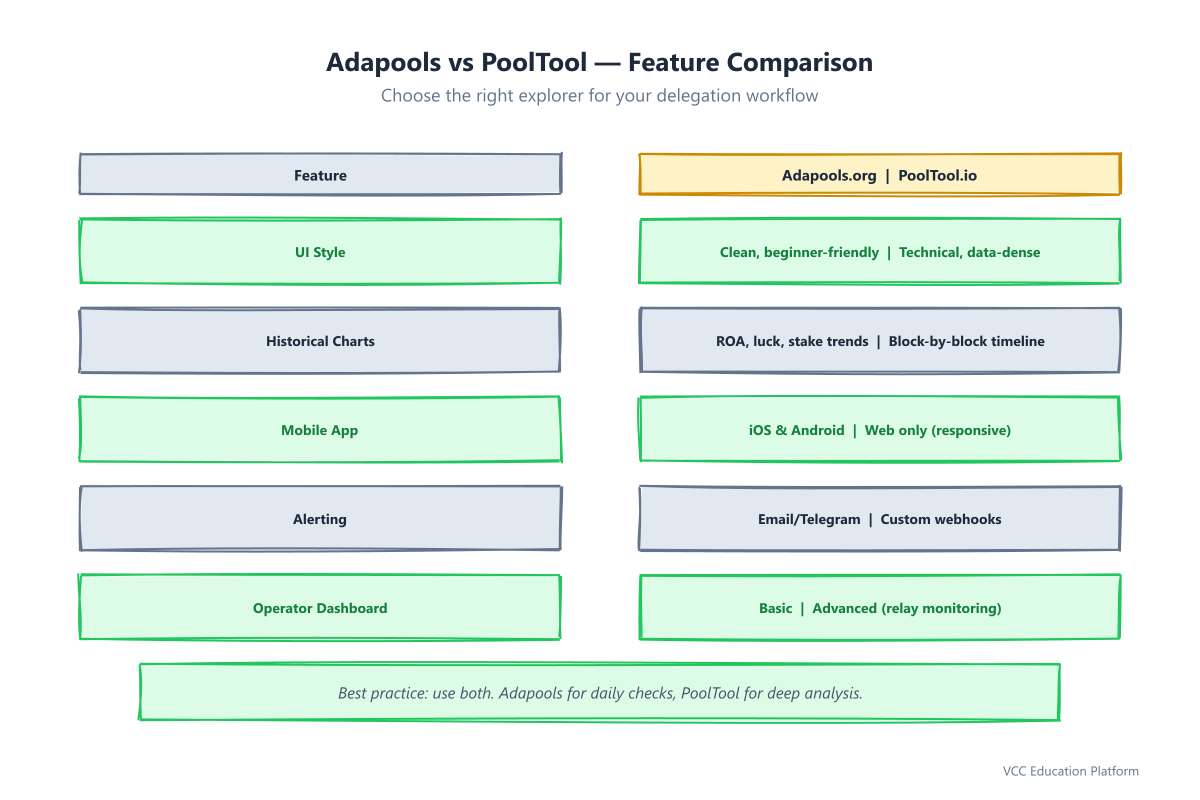
Using Adapools.org and PoolTool.io
Both explorers provide complementary views:
| Feature | Adapools.org | PoolTool.io | |---------|--------------|-------------| | UI | Clean, beginner-friendly | Technical, data-dense | | Historical charts | ROA, luck, stake trends | Block-by-block timeline | | Mobile app | Yes (iOS/Android) | Web only | | Alerting | Email/Telegram for pool changes | Custom webhooks | | Operator dashboard | Basic | Advanced (relay monitoring, etc.) |
Workflow for delegators: 1. Shortlist 3–5 pools by size, fees, pledge 2. Compare 30-day luck, block rate, missed slots on both sites 3. Check operator transparency (website, social, Telegram/Discord) 4. Delegate a small test amount first epoch 5. Monitor rewards received vs. estimated
---
Key Ratios for Quick Screening
| Ratio | Formula | Healthy Range | Red Flag | |-------|---------|---------------|----------| | Block rate | Produced / Assigned | >95% | <90% | | Luck (lifetime) | Actual / Expected | 95–105% | <90% | | Saturation | Live stake / k | <90% | >100% | | Margin | Variable fee % | 1–3% | >5% or 0% with high fixed | | Pledge ratio | Pledge / Live stake | >1% | <0.1% |
---
Monitoring Your Pool Over Time
Delegation isn't "set and forget." Re-evaluate monthly:
1. Check ROA trend — Is it stable or declining? 2. Review missed slots — Any new gaps in the last 5 epochs? 3. Watch saturation — Is the pool approaching ₳64M? 4. Verify fee changes — Operators can change margin with 1-epoch notice 5. Read operator updates — Silent operators often become negligent operators
Automation tip: Set up PoolTool webhook alerts for "missed slot" events on your pool. Get notified instantly, not weeks later.
---
Common Delegation Mistakes
| Mistake | Why It Hurts | Better Approach | |---------|--------------|-----------------| | Chasing highest ROA | Usually a small pool with lucky variance; reverts to mean | Pick consistent 95%+ block rate pools | | Ignoring saturation | Over-saturated pools pay less per ADA | Check live stake before every delegation | | Delegating to 0% margin pools | Often unsustainable; operator quits or raises fees later | 1–3% margin = sustainable operation | | Never checking after delegating | Pool degrades silently; you earn less for months | Monthly 5-minute review on adapools | | Following influencer recommendations blindly | Influencer may have undisclosed relationship | Verify metrics yourself |
---
Advanced: Multi-Pool Strategy
For larger stakes (>₳100K), consider splitting across 2–3 pools:
Benefits:
Implementation:
---
FAQ
What's a good ROA for a Cardano stake pool?
3–5% annually for unsaturated, well-operated pools. The network average fluctuates with total staked ADA and epoch parameters.How often should I check my pool's performance?
Monthly is sufficient for most delegators. Weekly if you have a large stake or the pool recently changed operators/fees.Does pool size matter for performance?
Yes, but not linearly. Very small pools (<₳1M) have high luck variance. Very large pools (>₳50M) approach saturation. Sweet spot: ₳5M–₳30M — stable luck, room to grow, usually professional operators.Can I lose my ADA by delegating to a bad pool?
No. Delegation is non-custodial. Your ADA never leaves your wallet. A bad pool only costs you missed rewards — opportunity cost, not principal loss.What happens if my pool gets saturated?
Your rewards drop because the protocol only counts the first ₳64M of stake for leader selection. Move to an unsaturated pool before the next epoch snapshot.How do I know if a pool operator is trustworthy?
Look for: transparent identity (doxxed or reputable pseudo-anon), active communication (regular updates, responsive to questions), professional infrastructure (multiple relays, monitoring), skin in the game (meaningful pledge), and history (12+ months of consistent operation).---
Summary Checklist for Pool Evaluation
Before delegating, verify each item:
- [ ] Block rate ≥ 95% over last 30 epochs
---
Stake pool performance isn't magic — it's measurable, trackable, and verifiable. The tools exist. The data is public. The only question is whether you'll use them.