
When Linh, a software engineer in Da Nang, launched her first Cardano stake pool, she did everything the tutorials said. Two nodes, a registered certificate, a ticker on the explorers. Then she waited three epochs, watched another operator confirm the blocks her pool was scheduled for, and discovered that running a pool and optimizing one are two different skills. Stake pool optimization is the discipline of closing that gap — turning every leadership slot your stake earns into a confirmed, on-chain block. This guide walks through the three levers that matter (uptime, infrastructure, economics), the metrics that tell you which lever to pull, and the uncomfortable truth about what happens when everyone optimizes at once.
What cardano pool optimization actually measures
Before touching a config file, an operator needs to understand what the network is scoring. Under Ouroboros Praos, each epoch hands your pool a randomized schedule of leadership slots — chances to build a block. Everything else is conversion. The community tooling around cncli names these stages precisely: a slot is leader (you were scheduled), adopted (you built the block), confirmed (the chain accepted it), or one of the failure states: missed, ghosted, stolen, or invalid.
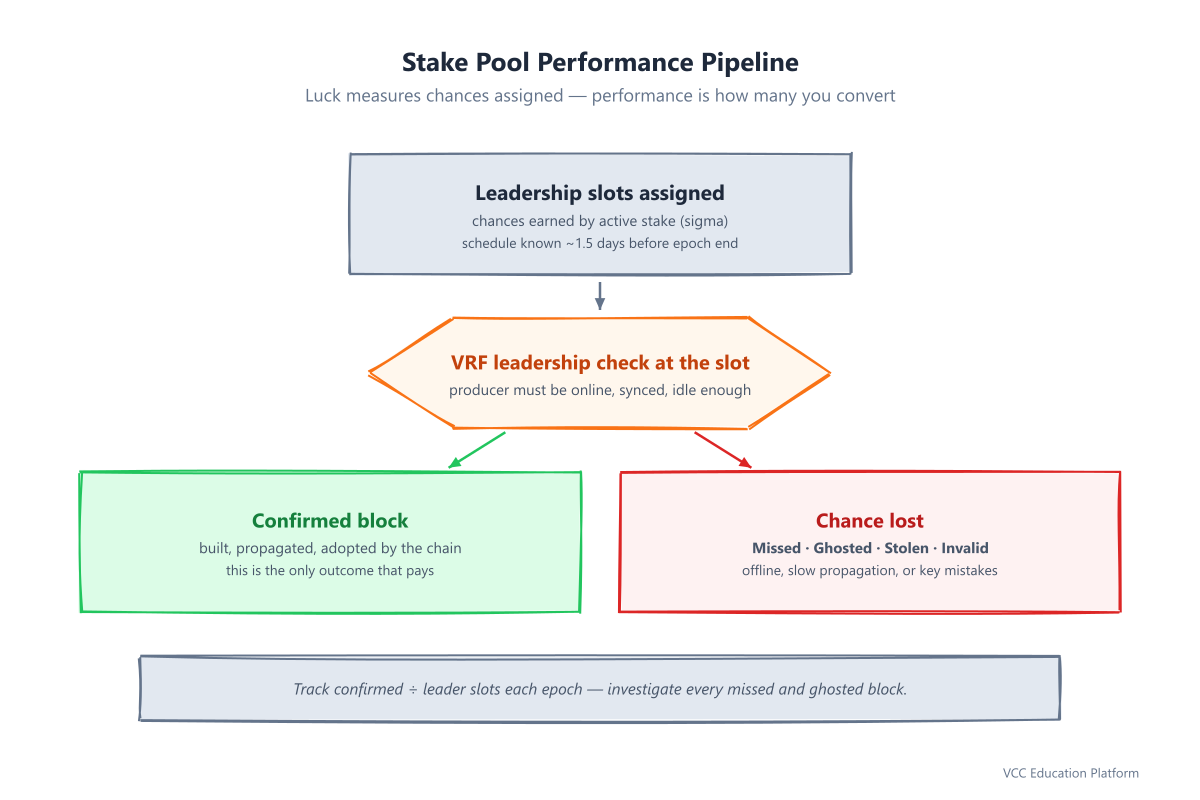
That pipeline exposes the first mistake most newcomers make: reading luck as performance. Luck compares the slots you were assigned against the slots your active stake statistically deserved. It measures how generous the lottery was. Performance is the ratio of confirmed blocks to assigned slots — how well you converted. A pool can run 105% luck for a quarter and still underperform its peers if slow propagation keeps turning would-be blocks into ghosts.
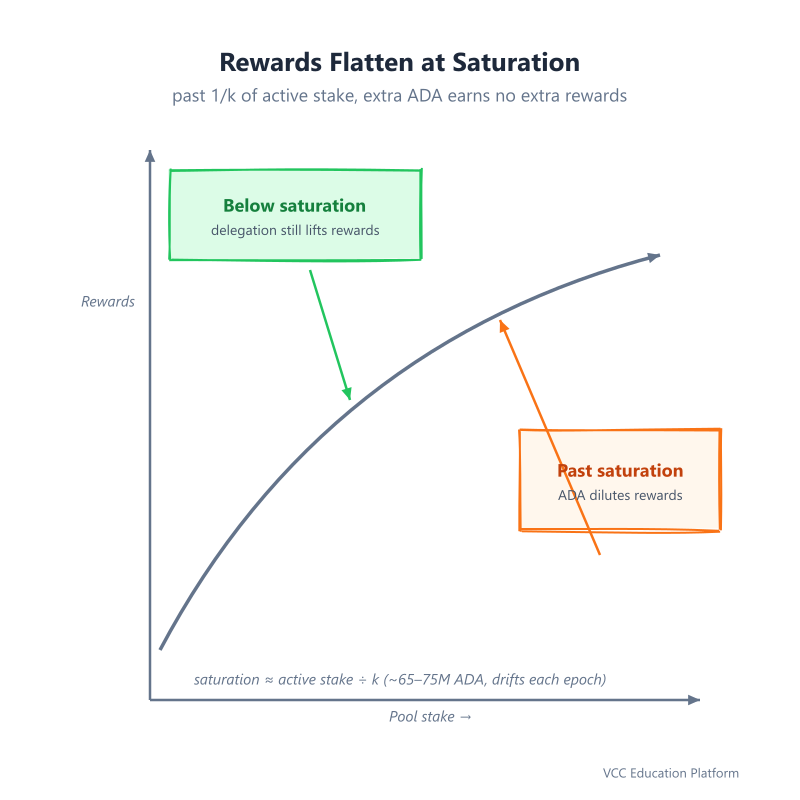
The second number to internalize is saturation. The protocol parameter k sets a target number of pools; rewards per unit of stake stop growing once a pool passes 1/k of total active stake. With today's parameters that works out to roughly 65–75 million ADA, though the exact figure drifts each epoch — think in ratios, not fixed numbers. An over-saturated pool earns no extra rewards for extra delegation, which is why mature operators monitor saturation like a fuel gauge rather than chasing raw stake.
Lever 1: Protecting cardano pool uptime
Uptime is the least glamorous lever and by far the most important. In Praos, leadership checks happen through a VRF lottery evaluated at specific slots; if your block producer is rebooting, desynced, or starved of CPU at that instant, the chance simply evaporates. There is no retry button at the protocol level.
Here is the asymmetry that defines early-stage operations: a small pool with a few million ADA might expect only one or two slots per epoch. Miss a single block and your visible monthly performance drops by half, even though statistically it was noise. Delegators browsing explorers cannot see that difference — they see a bad epoch. This is why uptime work dominates everything else for new pools: it has the highest return per hour invested precisely when the stakes look smallest.
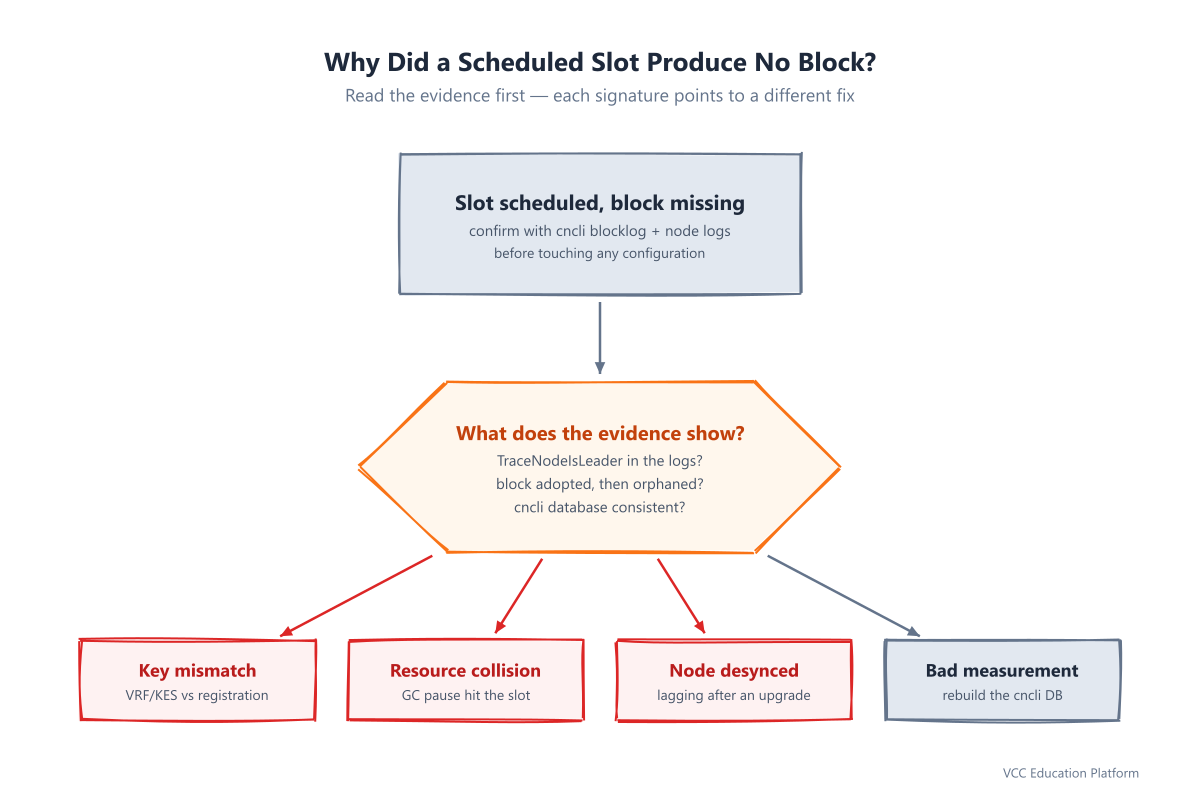
The failure modes are well documented across operator forums, and they cluster into a short list:
- Key mismatches after rotation. Swapping in a fresh VRF key without re-registering it, or letting a KES period expire, produces silent misses with clean-looking logs.
- Resource collisions. Garbage collection pauses, reward calculations, or a chatty co-located process landing exactly on your leadership check.
- Desynchronization. A block producer that fell behind during an upgrade and never fully caught up.
- Measurement bugs. A corrupted cncli database reporting phantom leaderlogs, sending you hunting for outages that never happened.
One habit separates professionals from hobbyists: treating the next-epoch leaderlog as a maintenance calendar. Because the schedule becomes computable about 1.5 days before each epoch boundary, you know in advance roughly when pressure arrives. Upgrades, restarts, and disk-heavy jobs get scheduled away from those windows. You cannot control the lottery, but you can refuse to schedule your own bad luck.
Lever 2: Pool infrastructure setup that wins propagation races
Producing a block is only half the job; the other half is telling the network about it fast enough that your block wins any race for the same slot. That is a propagation problem, and it is solved in the topology.
The canonical shape has not changed in years: one block producer whose cold keys live air-gapped, fronted by at least two public relays, ideally in different geographic regions. The block producer talks only to your own relays — its address is never advertised, and outbound peer discovery stays off. The relays face the internet, exchange blocks with the wider network, and push candidates to the producer. Official guidance goes further and suggests reciprocal peering arrangements with operators in under-represented regions, Asia-Pacific included.
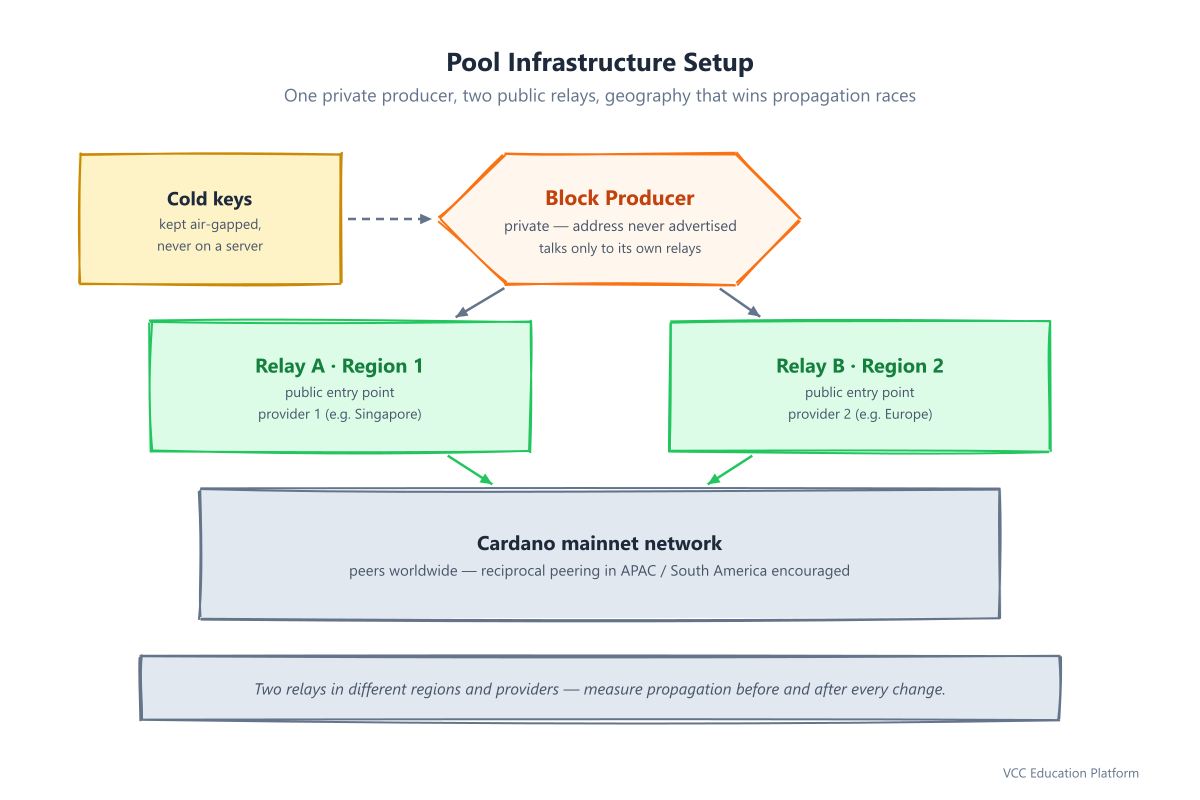
What has changed is measurement quality. Tools like blockPerf now timestamp every stage — header offer, request, download, adoption — per relay, so you can see whether your second relay actually improved anything or just doubled your bill. The gLiveView dashboard gives you the headline rule of thumb: a healthy relay sees more than 95% of network blocks arrive within 3 seconds. If your number sits below that, adding hardware will do less good than fixing where the hardware is.
None of this works as a one-off audit. Propagation quality drifts as peers come and go, so serious operators wire their nodes' EKG/Prometheus endpoints into an always-on dashboard with alerts on missed leadership checks, relay lag, and disk pressure. The goal of pool infrastructure setup is not a perfect snapshot on launch day — it is a system that tells you it is degrading before your delegators find out from an explorer.
This is also where Vietnamese operators face a genuinely interesting trade-off. A home-lab block producer offers cheap electricity and full hardware control, but monsoon-season power cuts and fiber interruptions are real operational risks that a UPS and an LTE failover line mitigate, not eliminate. Budget VPS instances from regional providers cost somewhere in the tens of US dollars per month but put your node on shared silicon next to noisy neighbors. The official documentation warns explicitly about this: correlated load spikes during block diffusion can degrade shared-host performance dramatically — in pathological cases, adding a second node to an overloaded host cuts throughput by more than half. The hybrid answer most experienced solo operators land on is unglamorous and effective: keep the producer at home on dedicated hardware behind good power protection, rent relays from two unrelated providers in different countries, and accept paying slightly more than the cheapest possible setup.
Lever 3: The economics of pledge, margin, and saturation
Infrastructure decides whether you convert your chances; economics decide whether the game is worth playing. Three numbers define a pool's offer: pledge (ADA the operator commits from their own wallet), margin (the operator's percentage cut), and the fixed fee (340 ADA per epoch at the current protocol minimum, a floor the community is actively reworking).
The honest story about pledge is more complicated than most guides admit. The a0 parameter — currently 0.3 — makes pledged stake earn modestly higher rewards, but the effect only becomes meaningful near full pledge-saturation. On mainnet today, hundreds of pools with zero pledge hold billions of ADA in delegation, because delegators respond to trust, communication, and contribution far more than to a formula term worth fractions of a percent at small scale. Pledge generously because you believe in your operation; do not expect it to substitute for being findable and trustworthy.
Saturation creates the second economic trap: past 1/k of active stake, additional delegation dilutes rewards for everyone already in the pool. Well-run pools announce they are nearing saturation and help their delegators move — which sounds like marketing malpractice until you notice it is exactly what builds the reputation that refills a pool.
The deepest trap, though, is price. New operators routinely undercut margins to climb the return rankings, pricing below what two always-on nodes, constant upgrades, and monitoring actually cost. The result is predictable: months later the pool quietly stops producing, delegators scatter in churn, and the operator has spent a year subsidizing the network's cheapest failure. Set a margin you can sustain for years, then compete on everything money cannot buy.
When optimization hurts: the decentralization bill
Now the contrarian chapter, and it matters. Every technique above scales into a network-level risk when practiced by large players. Run enough pools and the temptation appears to host them all on one cloud provider — cheap, scripted, identical. But concentrated infrastructure is correlated failure: one region outage, one NIC driver bug, one provider policy change, and dozens of pools miss blocks together. The official guidelines say this plainly, warning that virtualized, co-located setups create common-mode failures invisible in any single pool's dashboard.
Researchers have a sharper name for the economic version. Leverage — stake controlled divided by stake actually owned — is what multipool operators maximize when they split one entity into twenty low-pledge pools. IOG's own analysis calls concealed splitting akin to a Sybil attack against the ecosystem, and on-chain data backs the concern: the effective number of independent pool-making operators has persistently lagged the nominal pool count the k parameter targets. Meanwhile the parameter meant to fix this, a0, remains too weak to change behavior — a genuine, documented disagreement inside the ecosystem about whether economics can ever solve what is fundamentally a human coordination problem.
For a single-pool operator the takeaway is not guilt; it is direction. Optimize the conversion of your chances into blocks — uptime, propagation, honest pricing. Do not optimize the accumulation of stake beyond saturation, and diversify your own infrastructure even where it costs a little convenience. A network of well-run single pools beats a network of perfect clones.
A practical checklist
- Track confirmed ÷ leader slots each epoch; investigate every missed and ghosted block within 24 hours.
- Verify VRF key hashes match registration after every rotation; calendar KES expiry.
- Keep ≥2 relays in different providers and regions; measure propagation before and after changes.
- Schedule upgrades using the next-epoch leaderlog as your maintenance calendar.
- Price for sustainability; treat saturation as a handoff, not a hoard.
- Publish your infrastructure story — delegators increasingly reward transparency.
FAQ
How much ADA do you need to run a profitable stake pool?
There is no magic threshold, because profitability = (fixed fee + margin × pool rewards) − real costs. With a few million ADA of total stake, a pool typically earns close to the 340 ADA minimum fee per epoch plus a sliver of margin — usually less than server costs. Most sustainable small pools are subsidized passion projects until external delegation grows into the tens of millions of ADA. Plan finances for at least a year of operation before break-even.
Does running more relays improve cardano pool uptime?
Not directly. Relays affect propagation speed and redundancy, while uptime failures usually trace to the block producer itself — keys, resources, desync. Two well-placed relays are the standard; a third helps mainly for global reach or upgrade staging. Measure with blockPerf-style tooling before assuming more is better.
What is a good missed-slot rate for a Cardano stake pool?
Aim for zero confirmed-preventable misses over rolling months; occasional misses from GC pauses or bad luck happen even to top operators. If more than a few percent of your leader slots end in missed or invalid states repeatedly, something structural is wrong — keys, sync, or resources. Ghosted blocks point at propagation rather than availability.
Can pool optimization hurt the Cardano network?
Yes, when scaled carelessly: many pools stacked on one cloud region create correlated outages; multipool splitting with minimal pledge raises system leverage and squeezes out independent operators. Optimize conversion, diversify infrastructure, and keep leverage low — that version of stake pool optimization strengthens the network instead of extracting from it. That is also the only reliable way to improve pool performance over years rather than weeks: every technique in this guide compounds quietly, epoch after epoch, for operators who treat their pool as infrastructure worth maintaining.