
You have heard "plutus programming language" and "plutus cardano" mentioned together — but what does Plutus actually do, and why do developers talk about it as if it is different from every other smart contract platform? Most explainers jump straight to syntax or hype. This article gives you a mental model you can keep for life: what Plutus is, how a "plutus smart contract" actually works, and what "plutus core" really means.
Here is the one-sentence version: Plutus is the programming language Cardano uses for smart contracts — you write your contract in Plutus, it compiles down to Plutus Core (UPLC), and the Cardano network runs it to decide whether a transaction is allowed. Everything below unpacks that sentence.
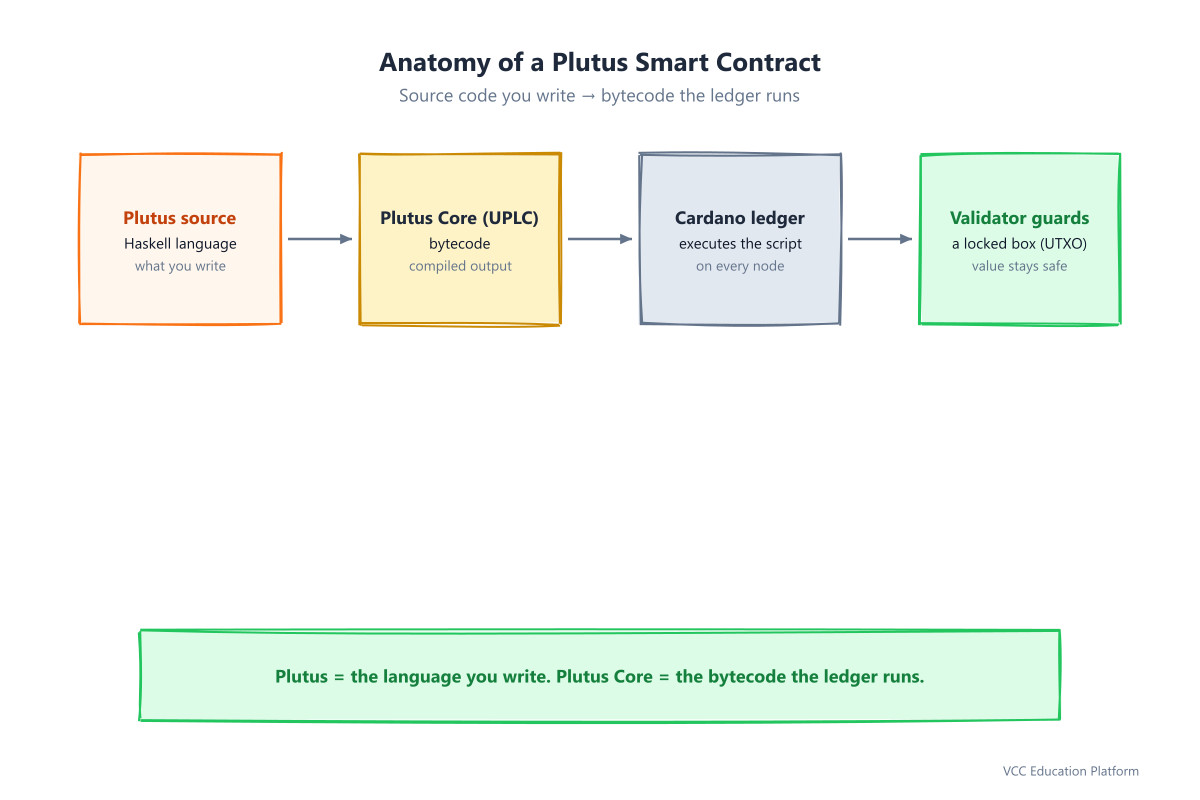
Figure 1: Anatomy of a Plutus smart contract — source, bytecode, and the validator guarding a locked box
What Is Plutus, Really?
Plutus is Cardano's smart-contract language, designed by the team behind the blockchain (Input Output Global, now stewarded by the community through Intersect) and rooted in the lambda calculus — the same mathematical foundation that also produced Haskell, the language Plutus itself is written in.
Two facts matter for beginners:
- Plutus is Haskell-based. If you know Haskell, Plutus feels like a natural extension. If you do not, the ideas still make sense — you do not need to be a Haskell expert to understand how Cardano contracts work.
- Plutus is deterministic. The same script with the same inputs produces the same result every time. There is no randomness, no dependence on global state, no surprises. That makes Cardano contracts predictable and, crucially, formally verifiable — you can mathematically prove what a contract does.
But there is a subtlety most tutorials skip: the code you write is not what runs on the ledger. Your Plutus source is compiled into Plutus Core (specifically Untyped Plutus Core, or UPLC) — a small, precise bytecode that the Cardano ledger actually executes. So "plutus core" is not a competing language; it is the destination every Cardano smart contract arrives at.
The Validator: A Program That Says Yes or No
Here is the single most important idea in the whole language: a Plutus smart contract is not a program that "does" something — it is a validator that answers one question: yes or no.
In technical terms, every Plutus validator is a function with three arguments:
- The datum — the state locked at the contract's address. Think of it as a "hồ sơ" (dossier): what this locked box contains and under what conditions.
- The redeemer — what the user is asking to do right now. A "lệnh" (command): "release these funds," "swap these tokens," "claim this reward."
- The ScriptContext — a full snapshot of the entire transaction: inputs, outputs, signatures, fees, time window. The "căn phòng" (whole room) — so the script can check nothing shady is happening elsewhere.
The validator reads all three and returns true (the transaction is allowed) or false (it is rejected).
Think of the validator as a security guard who reads the dossier, the command, and the room before opening the door. The dossier tells him what the box contains; the command says what you want; the room shows what else is happening in the building. Only if every check passes does the door open. That is the entire job of a Plutus smart contract — and it is deliberately limited, for reasons that matter.
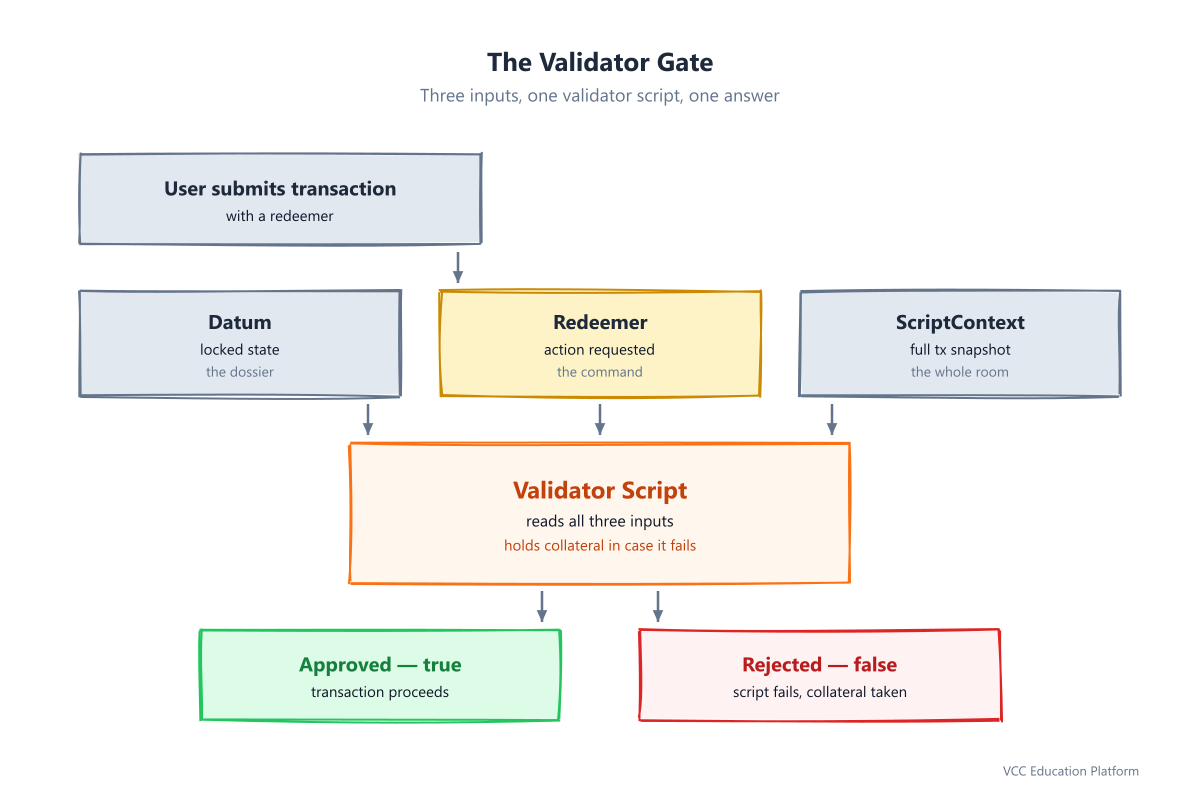
Figure 2: The validator gate — one question: yes or no
On-Chain vs Off-Chain: Two Halves of One Contract
When people say "learn plutus," they usually imagine writing one big program. In practice, a Plutus application is split into two halves:
- On-chain (the validator). The tiny, immutable logic that runs on the ledger. It has no user interface, no network calls, no database — just the three arguments above and a yes-or-no answer. It runs on every node, so it must be small and cheap.
- Off-chain (the application). Everything else: the code that finds the locked funds, builds the transaction, talks to wallets, and renders the interface. This can be written in any language and runs on your machine or a server.
This split is the reason Cardano contracts feel different from Ethereum's: only the lean validator runs on-chain; the heavy lifting happens off-chain. The ledger stays predictable, and developers are forced to keep their on-chain code small because that is what costs money.
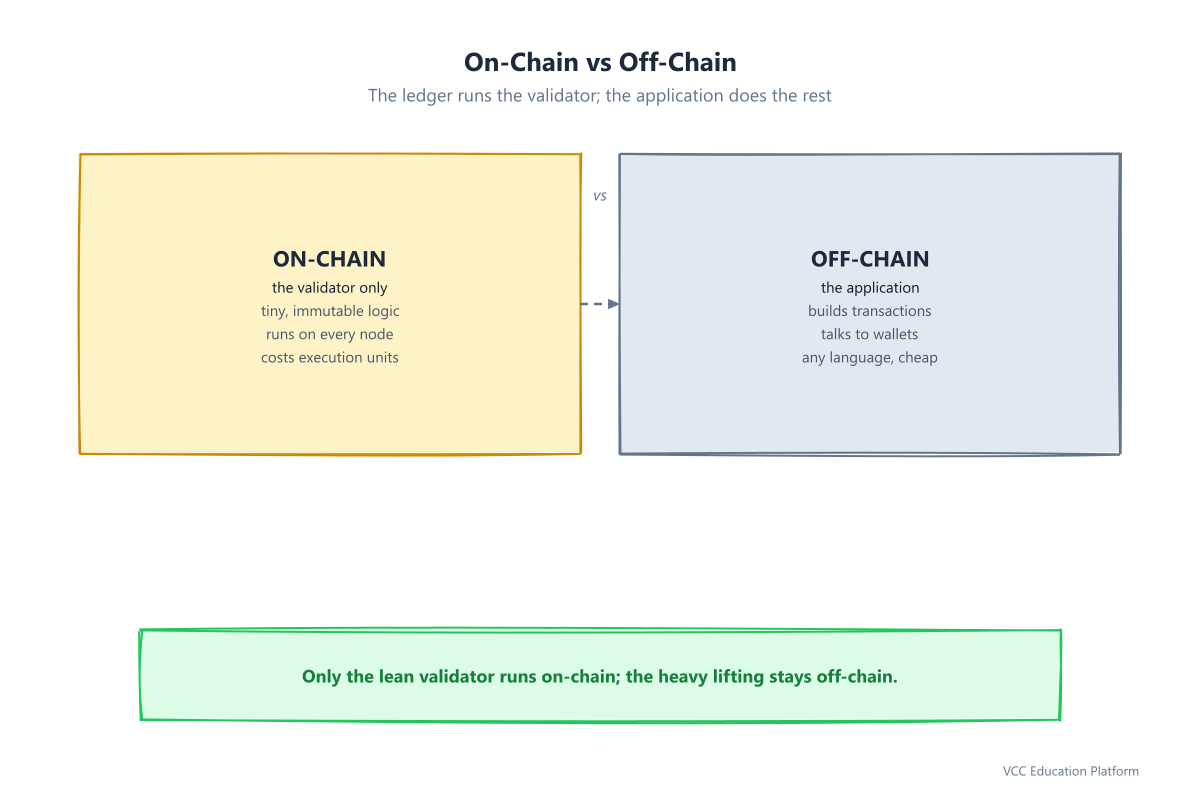
Figure 3: On-chain vs off-chain — two halves of one contract
eUTXO: Boxes, Not Accounts
To understand Plutus, you need one piece of Cardano's underlying design: the eUTXO model (Extended Unspent Transaction Output).
In Ethereum, contracts live in a shared account with mutable state — one big ledger that everyone's contract can change. Cardano deliberately chose something different: value lives in boxes (UTXOs), each locked at an address. When a Plutus contract locks value, it locks a box under the validator's rule. To "update state," a transaction consumes the old box and creates a new one with the new state — the validator checks that the transition is legal.
The practical consequences:
- No shared global state. Each box is validated independently, so many contracts can run in parallel without interfering.
- Full transparency. Every state change is a visible transaction on the ledger — there is no hidden internal state.
- Determinism preserved. Because each validator judges only its own box (plus the transaction snapshot), the same transaction always validates the same way.
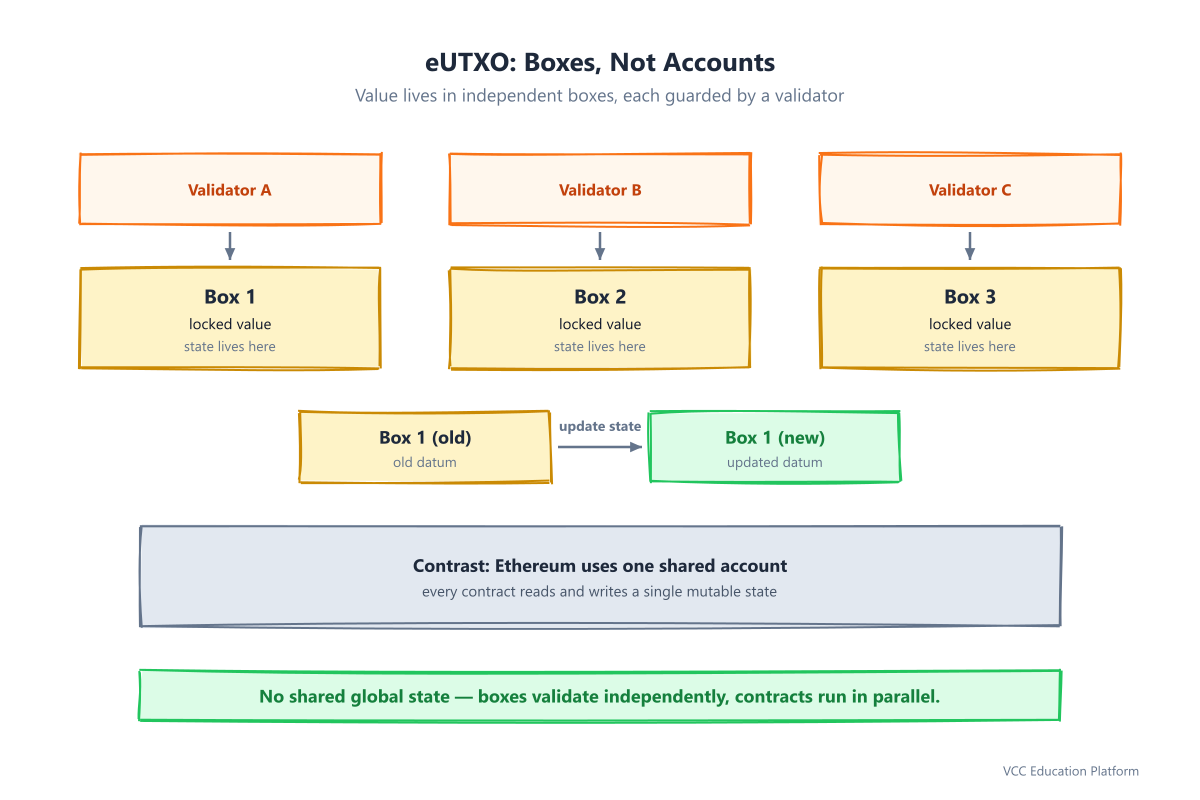
Figure 4: eUTXO — boxes, not accounts, and no shared global state
How Much Does a Plutus Script Cost?
Running a Plutus script is not free — and that is a feature, not a bug. Cardano charges for compute in the same way a cloud API charges per request:
- Execution units (ExUnits). Every Plutus operation consumes a metered amount of CPU steps and memory units, priced by the protocol's cost model. The more complex your script, the more it costs.
- Deterministic fees. The fee is a simple linear formula based on transaction size plus script execution — you can calculate the exact cost before submitting. No gas-price auctions, no surprises.
- Collateral. A transaction that runs a script must put up collateral — ADA-only funds that are forfeited only if the script fails. If your script crashes after burning node resources, the deposit covers the wasted work; if everything succeeds, you get it back untouched.
Collateral is Cardano's anti-DoS mechanism: it stops attackers flooding the network with junk scripts for free, like a đặt cọc (booking deposit) you lose if you break the rental agreement.
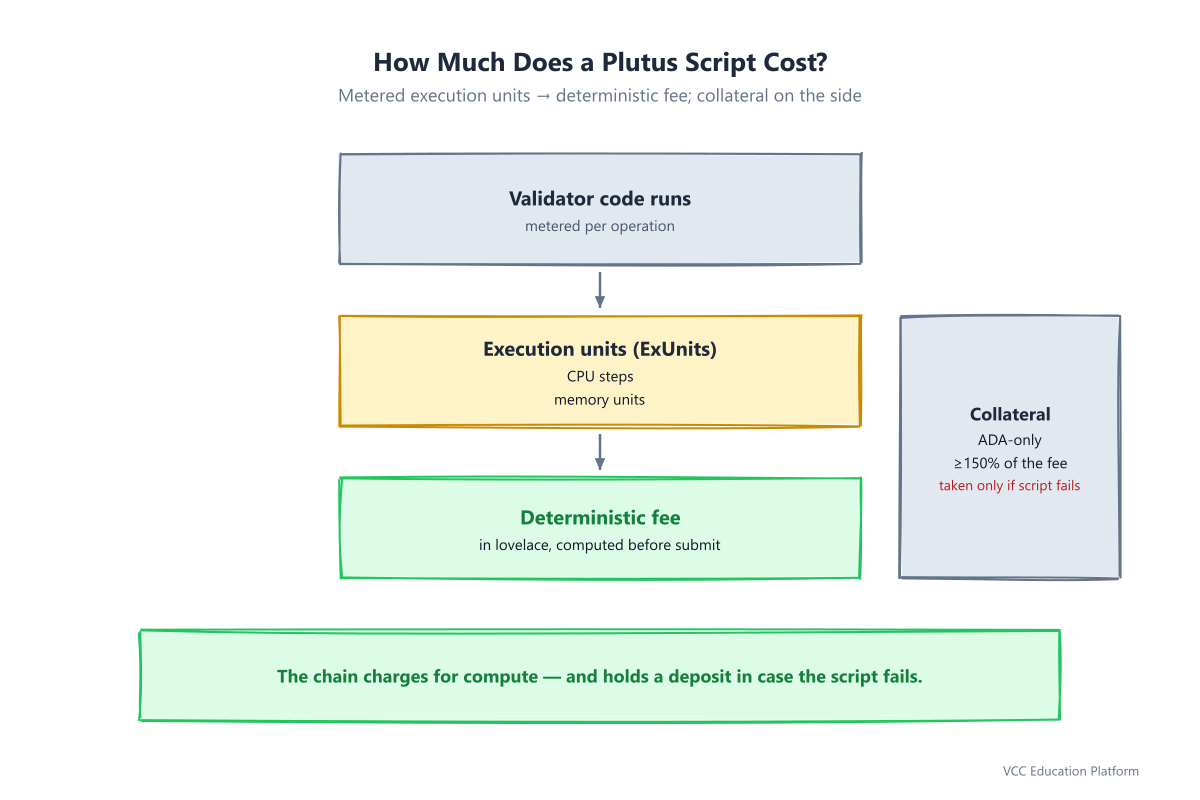
Figure 5: The Plutus cost model — metered, deterministic, and backed by collateral
One Plutus Core, Many Front-End Languages
Here is a point that surprises beginners: Plutus the language is not the only way to write a Cardano contract. Because everything compiles down to the same Plutus Core (UPLC), the ecosystem has spawned several front-end languages:
- Plutus (Haskell) — the original, full-featured language, best for complex contracts and formal verification.
- Aiken — a newer, Rust-flavored language designed for safety and a gentler learning curve; it compiles directly to Plutus Core.
- Marlowe — a domain-specific language for financial contracts, designed for auditors and non-programmers.
- Others — OpShin (Python-like), Plinth, Helios, and more, all targeting the same bytecode.
This is like writing the same program in JavaScript, TypeScript, or Python — the source differs, but the compiled machine code serves the same purpose. For beginners, the practical advice is: the validator concepts are identical in every language, so learn the model once and pick a syntax you like.
| Plutus (Haskell) | Aiken | Solidity (Ethereum) | |
|---|---|---|---|
| Model | eUTXO boxes | eUTXO boxes | Shared accounts |
| What a contract does | Validates: true/false | Validates: true/false | Executes and mutates state |
| Runs on | Cardano ledger | Cardano ledger | Ethereum ledger |
| Deterministic | Yes | Yes | Not always |
| Formal verification | First-class | Supported | Harder |
| Learning curve | Steep | Moderate | Moderate |
How to Learn Plutus (The Realistic Path)
If you want to go from zero to a working contract, this is the path that actually works:
- Learn the eUTXO mental model first. Read Cardano's developer documentation on datums, redeemers, and the ScriptContext — the model is 90% of the difficulty.
- Write a tiny validator. Pick Aiken (simpler) or Plutus, and write one that locks funds until a deadline passes. It is a few dozen lines.
- Test locally, then on a testnet. Run your contract in a local mock environment, then deploy to the Preview or Preprod testnets — free ADA, no risk.
- Deploy to mainnet. Ship the validator, attach reference scripts (CIP-33) and inline datums (CIP-32) to keep fees low.
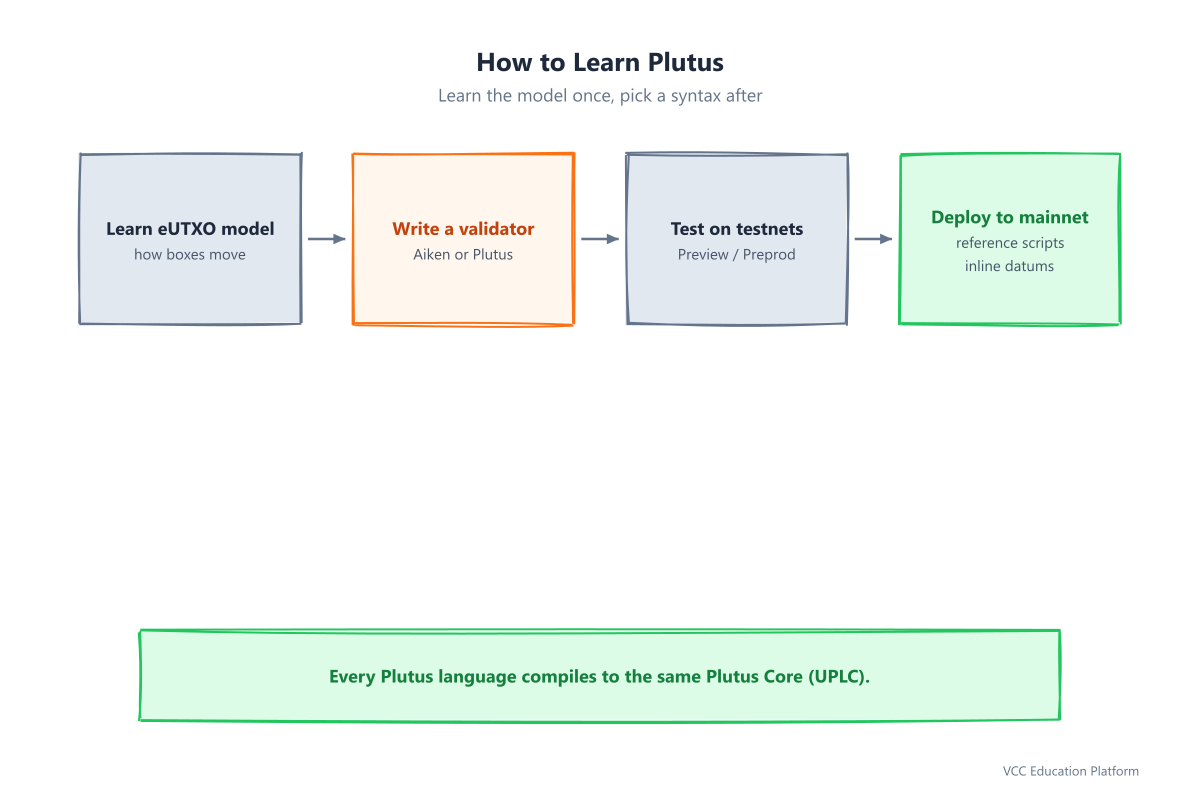
Figure 6: The realistic learning path — model first, then syntax
The Honest Version
The honesty most "learn plutus" articles skip: Plutus is powerful but genuinely demanding. It expects you to think functionally, to reason about boxes rather than accounts, and to keep your on-chain code small and correct. The learning curve is real.
But the payoff is equally real: a deterministic, formally verifiable smart contract platform where fees are predictable, parallel execution is possible, and state is transparent. For developers building on Cardano — and for anyone who wants to understand why Cardano's smart contracts work the way they do — the plutus programming language is the door into the platform's thinking.
FAQ
Is Plutus the same as Solidity? No. Plutus runs in Cardano's eUTXO model and validates (returns true/false), while Solidity runs in Ethereum's account model and executes/mutates state. Plutus is deterministic and designed for formal verification; Solidity's contracts can depend on prior state.
What is the difference between Plutus and Plutus Core? Plutus is the high-level language you write. Plutus Core (UPLC) is the compiled bytecode the Cardano ledger actually executes. Other languages like Aiken and Marlowe also compile to the same Plutus Core.
Do I need to learn Haskell first? No. Understanding the eUTXO model and the validator concept matters far more than the syntax. Beginners often start with Aiken, which has a friendlier learning curve and compiles to the same Plutus Core.
Why does my contract cost money even when nothing happens? Because running a validator consumes metered execution units (CPU steps and memory), priced by the cost model. The fee is deterministic and calculable in advance, and collateral (≥150% of the fee, ADA-only) is forfeited only if the script fails.
Can a Plutus contract update its own state? There is no mutable state. "Updating" means a transaction consumes the old box (UTXO) and creates a new one with the updated datum — and the validator checks that the transition is legal.
Is Plutus still the standard in 2026? Yes — Plutus (Haskell), Aiken, and other languages all still compile to Plutus Core, which remains the execution layer for Cardano smart contracts. The ecosystem continues to expand capacity, with the Plutus execution-unit memory limits increased through governance in 2025–2026.
The One-Sentence Takeaway
If you remember nothing else: Plutus is the programming language that powers Cardano smart contracts — you write a validator in Plutus (or a language like Aiken), it compiles to Plutus Core, and on the ledger it receives a datum, a redeemer, and a ScriptContext and answers one question: is this transaction allowed? Deterministic, metered, and boxed — that is the whole philosophy.
Quick Reference
| Term | Definition |
|---|---|
| Plutus | Cardano's smart-contract language, Haskell-based and rooted in the lambda calculus |
| Plutus Core (UPLC) | The compiled bytecode that the Cardano ledger actually executes |
| Validator | A Plutus program that receives datum, redeemer, and ScriptContext and returns true or false |
| Datum | The state locked at the contract's address (the "hồ sơ" / dossier) |
| Redeemer | The action the user is requesting (the "lệnh" / command) |
| ScriptContext | A full snapshot of the transaction being validated (the "căn phòng" / room) |
| eUTXO | Cardano's accounting model: value in independently validated boxes, not accounts |
| ExUnits | Metered CPU steps and memory units consumed when a script runs |
| Collateral | ADA-only funds forfeited only if a script fails (like a đặt cọc / deposit) |
| Aiken | A newer, Rust-flavored language that compiles to the same Plutus Core |