
You've learned that consensus is how blockchain nodes agree, and that Proof of Stake (PoS) replaces Proof of Work's energy-burning puzzles with staked coins. Now let's go deep on Ouroboros — Cardano's specific PoS protocol, the first one backed by a formal mathematical security proof.
Here's the one-sentence version: Ouroboros is a Proof of Stake protocol where the right to produce each block is randomly assigned to a stake pool, with probability proportional to the total stake it controls — and the randomness is generated by a cryptographic dice roll that everyone can verify was fair.
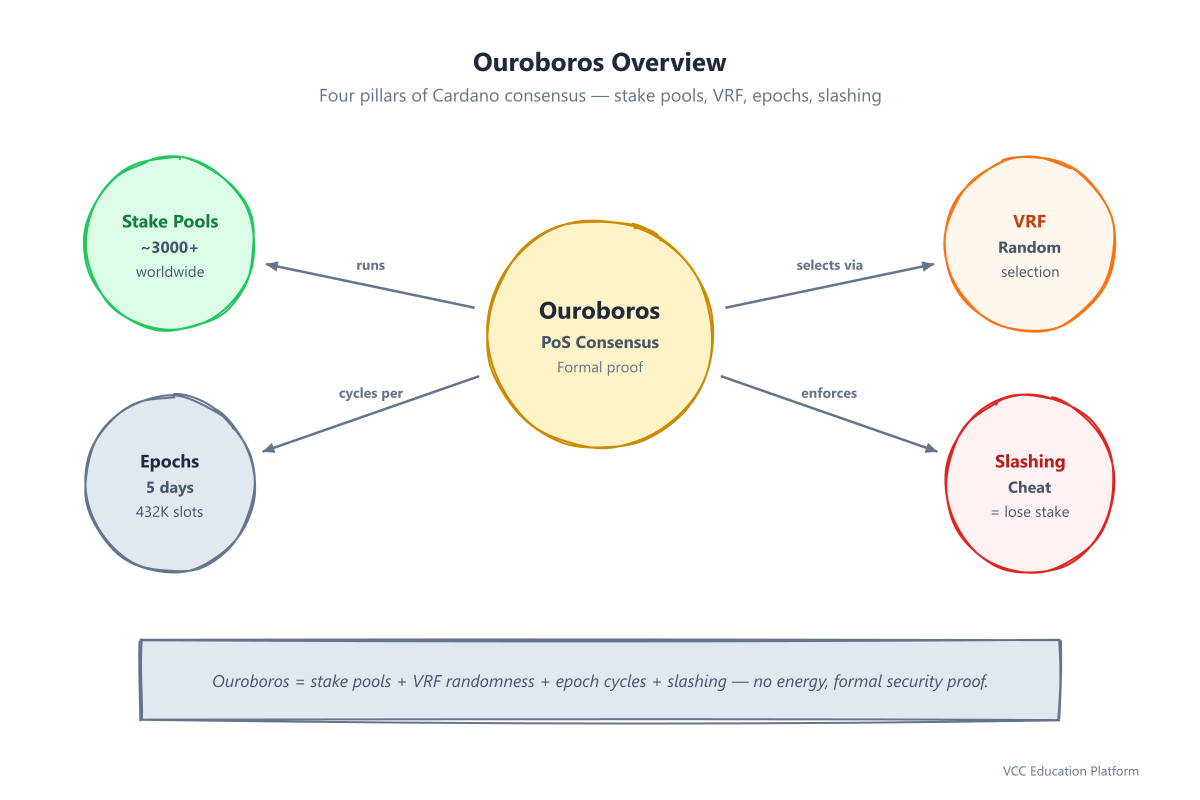
Figure 1: Ouroboros — four pillars of Cardano consensus
The "Nothing at Stake" Problem (Why PoS Was Considered Impossible)
Before Ouroboros, many cryptographers thought Proof of Stake was fundamentally broken. The reason was the "nothing at stake" problem: in PoW, mining costs real energy, so miners only work on one chain (the one they think will win). But in PoS, validating costs nothing — so a validator could theoretically validate on every competing fork simultaneously, hoping to profit no matter which wins. This would make consensus impossible.
Ouroboros solved this with slashing: if a validator is caught validating on multiple forks, they lose their staked coins. The cost of cheating isn't energy (like PoW) — it's the loss of your stake. This makes "validate on every fork" economically irrational, restoring consensus security.
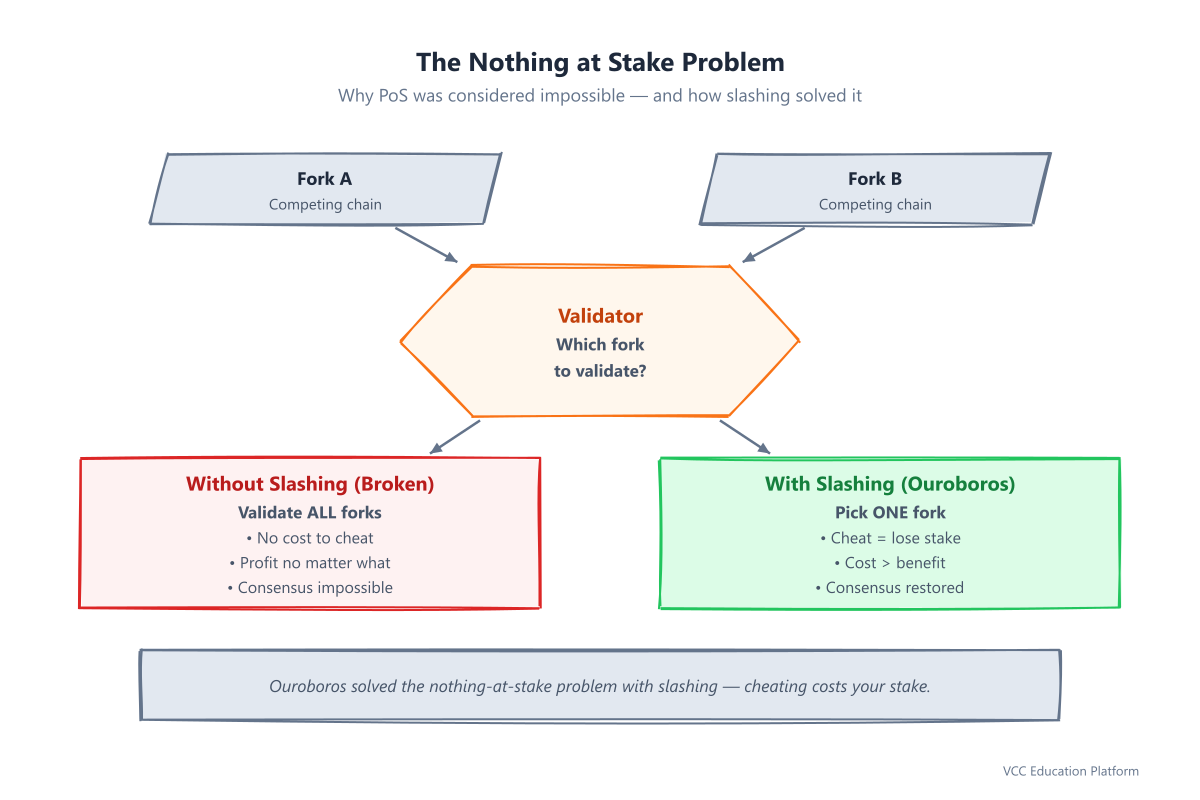
Figure 2: The nothing-at-stake problem — slashing makes cheating costly
How Ouroboros Works: Epochs, Slots, and VRF
Cardano divides time into epochs — each lasting 5 days, divided into 432,000 slots of 1 second each. Here's how block production works:
1. Epoch Election (before the epoch starts)
At the beginning of each epoch, the protocol runs an election: for each of the 432,000 slots, it determines which stake pool will produce the block. This election uses VRF (Verifiable Random Function) — a cryptographic dice roll that:- Is unpredictable before the election (no one can know who will lead which slot in advance)
- Is verifiable after the election (everyone can check the dice roll was fair)
- Is proportional to stake (pools with more stake get more slots, probabilistically)
2. Slot Leader Produces Block
When a slot arrives, the elected pool (the "slot leader") produces a block: gathers pending transactions, validates them, creates the block, and broadcasts it to the network.3. Nodes Verify
Every node checks: valid transactions? Correct slot leader (with VRF proof)? Proper chain continuity? If yes, they add the block.4. Rewards Distribution
At the end of the epoch, rewards are distributed to all pools that produced blocks, proportional to the number of blocks they produced. Pool operators share rewards with delegators (minus a margin fee).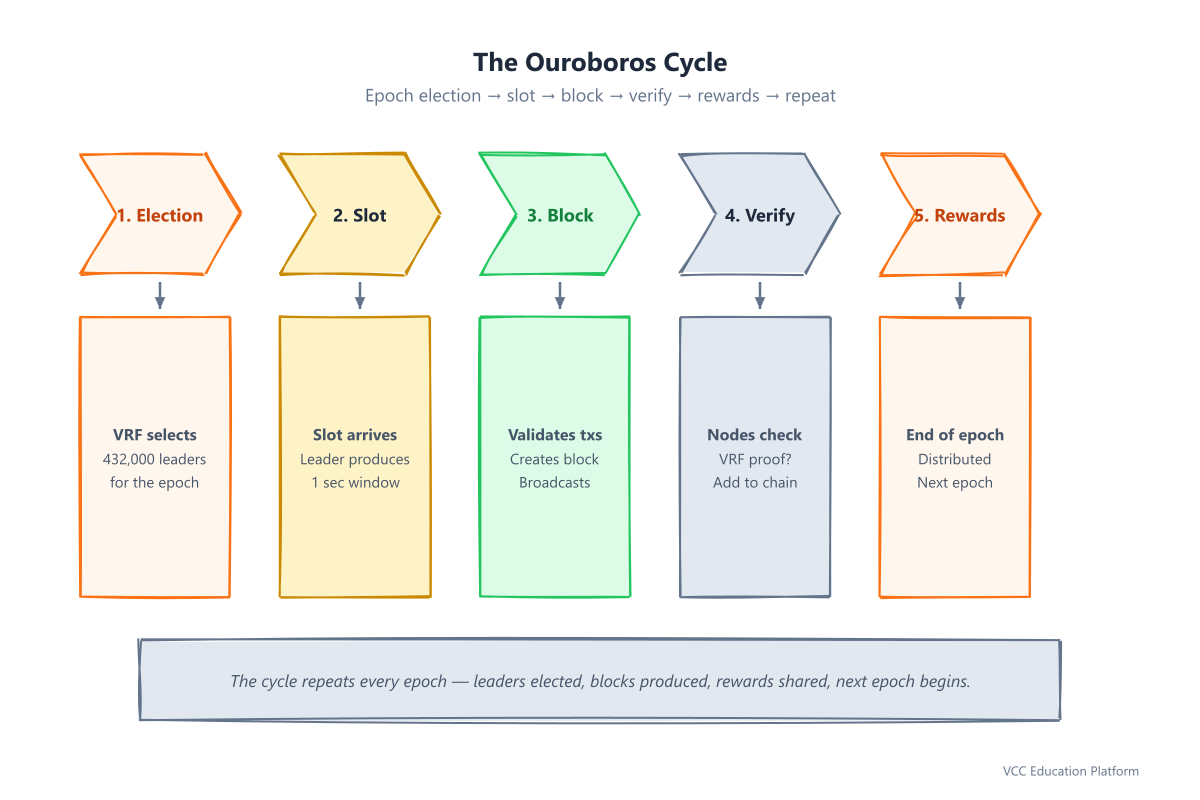
Figure 3: The Ouroboros cycle — election, slot, block, verify, rewards, repeat
Stake Pools: Pledge and Delegation
Cardano's block production runs through stake pools — currently ~3000+ worldwide. Two types of stake contribute to a pool:
- Pledge: the pool operator's own ADA, locked as collateral. Higher pledge = more skin in the game = slightly higher rewards (via the a0 parameter). This incentivizes operators to have real commitment.
- Delegation: ADA holders delegate their stake to a pool without giving up custody. They keep their coins in their wallet but tell the protocol "count my stake toward this pool." Delegators share in the pool's rewards.
Key point: delegation does NOT mean giving your coins to the pool. You never lose custody. You're simply saying "use my stake's weight to help this pool get elected more often, and share the rewards with me."
A pool's election probability is proportional to its total stake (pledge + delegation), capped at a saturation point (~64 million ADA) to prevent any single pool from dominating.
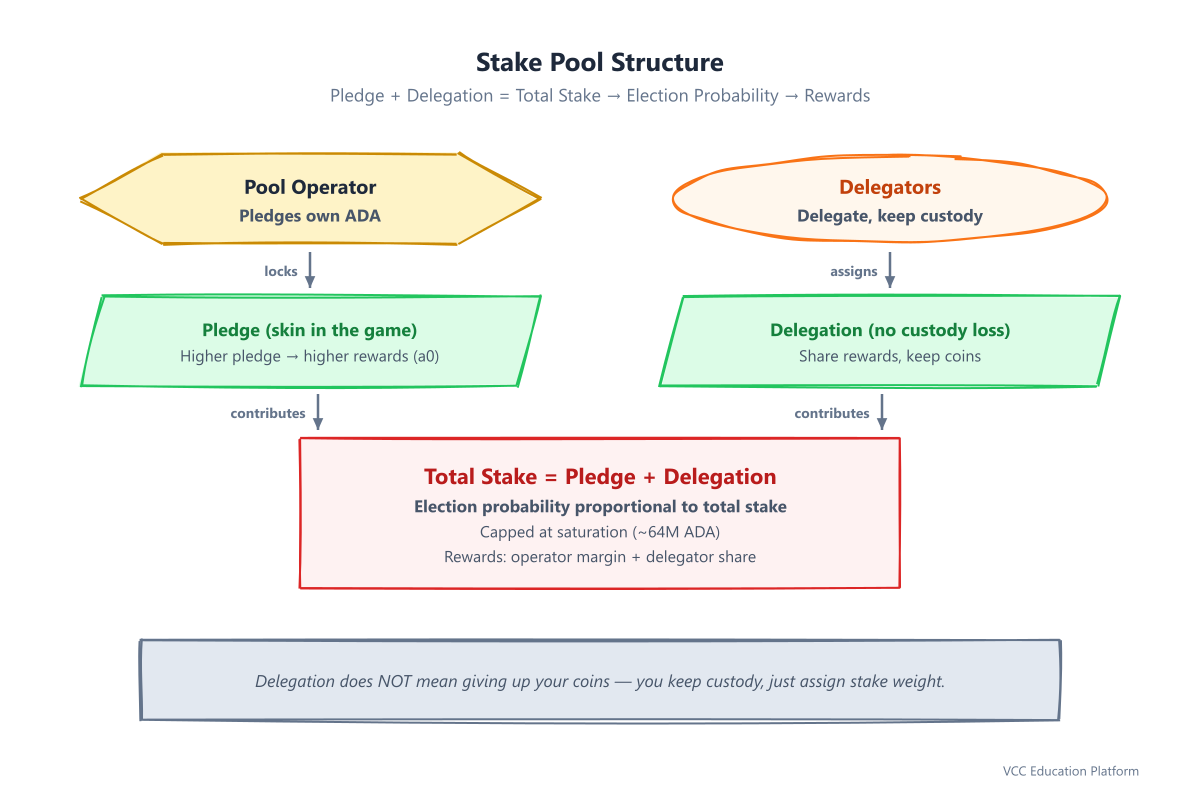
Figure 4: Stake pool — pledge + delegation = total stake for election
VRF: The Cryptographic Dice Roll
The key innovation in Ouroboros Praos is VRF (Verifiable Random Function). Here's what it does in plain language:
Imagine each stake pool has a pair of cryptographic keys. At each slot, the pool runs a computation using its private key and the current slot number. This produces:
- A random number (the "dice roll")
- A proof that the number was generated correctly
If the random number is below a threshold (proportional to the pool's stake), the pool wins the right to produce that slot's block. The proof is included in the block, so every node can verify: "yes, this pool legitimately won this slot."
Why this matters:
- Unpredictable: no one can predict who will win before the slot arrives (prevents targeted attacks)
- Verifiable: everyone can check the winner is legitimate (prevents fake leaders)
- Proportional: larger stake = higher threshold = more likely to win (but not guaranteed)
Security: Why Ouroboros Is Trustworthy
Ouroboros's security comes from three layers:
- Economic security (slashing): dishonest validators lose their stake. The cost of attacking exceeds the benefit.
- Mathematical security (formal proof): Ouroboros was the first PoS protocol with a peer-reviewed security proof, published at CRYPTO 2017. The proof shows that an attacker controlling less than 50.1% of stake cannot break the protocol's guarantees.
- Cryptographic security (VRF): leader selection is unpredictable and verifiable, preventing targeted attacks on specific slot leaders.
Compare this to PoW: Bitcoin's security is empirical ("no one has attacked it yet") and economic ("attacks are expensive"). Ouroboros adds mathematical proof on top — the strongest form of security guarantee.
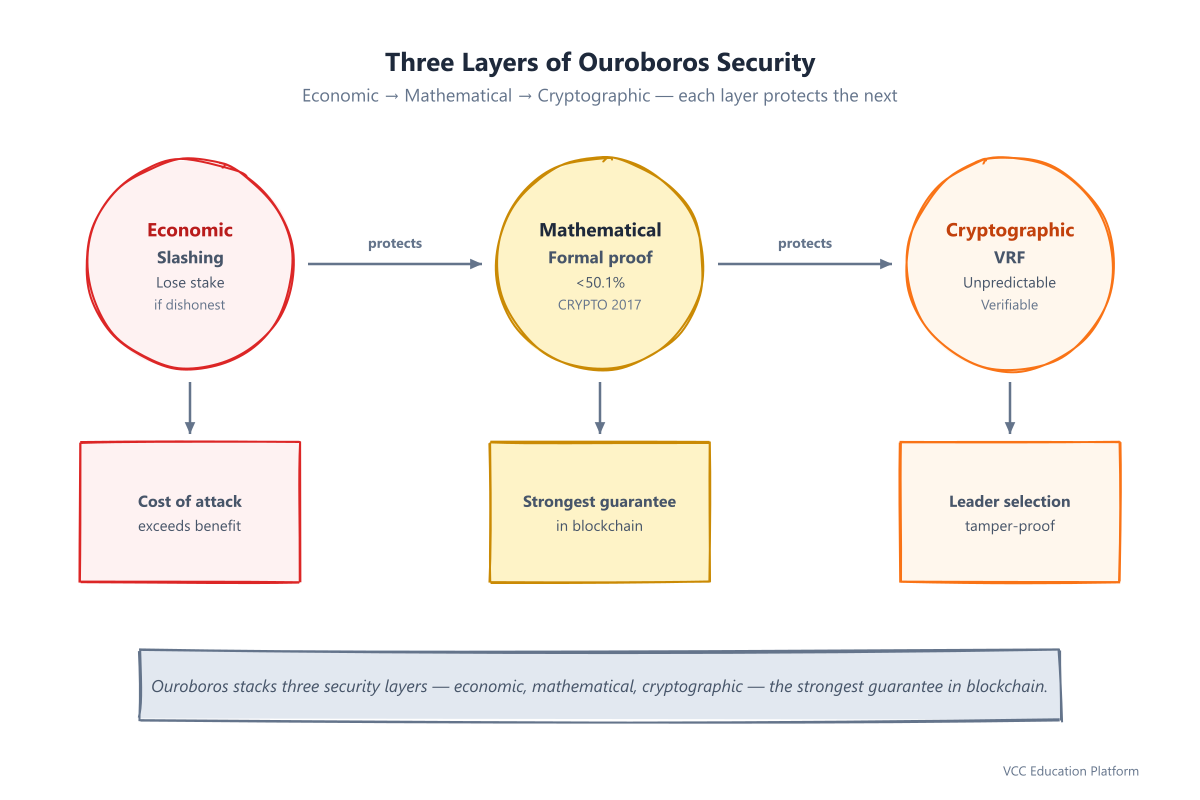
Figure 5: Three layers of Ouroboros security — economic, mathematical, cryptographic
For Vietnamese Readers: "Cổ Phần" and "Lãi Suất"
Two Vietnamese concepts make Ouroboros intuitive:
"Cổ phần" (shares): staking ADA is like holding shares in a company. More shares = more voting weight (in block production) but also more responsibility. A stake pool operator is like a CEO — they pledge their own shares (skin in the game) and manage operations. Delegators are like shareholders — they contribute stake, earn dividends (rewards), but don't run day-to-day operations.
"Lãi suất" (interest rate): staking rewards are similar to bank deposit interest — you earn passive income on your capital. But there's a key difference: with a bank, the bank uses your money and pays you interest. With staking, you keep custody of your ADA (if you're a delegator) and the protocol pays you from the treasury reserve. No middleman, no counterparty risk.
This is why Ouroboros matters: it makes "earning interest on your savings" possible without a bank — just a protocol, your wallet, and ~3000 independent pool operators around the world.
Quick Reference
| Term | Definition |
|---|---|
| Ouroboros | Cardano's PoS consensus protocol — first with formal security proof (CRYPTO 2017) |
| Epoch | 5-day period, divided into 432,000 1-second slots |
| Slot | 1-second window; one slot leader produces one block per slot |
| VRF | Verifiable Random Function — unpredictable + verifiable leader selection |
| Slot leader | Stake pool elected to produce a block for a specific slot |
| Pledge | Pool operator's own ADA, locked as collateral (skin in the game) |
| Delegation | ADA holders assign stake weight to a pool without giving up custody |
| Slashing | Loss of staked coins for dishonest behavior (validating on multiple forks) |
| Saturation | ~64M ADA cap per pool — prevents any single pool from dominating |
| Nothing at stake | The problem PoS had before slashing: validating on all forks costs nothing |
| a0 parameter | Controls pledge influence on rewards (higher a0 = more reward for higher pledge) |