
The moment Lan taps "Send" to move 50 ADA, the screen changes, and then — silence. A few seconds pass, then maybe a minute. The balance in the recipient's wallet does not update instantly, and Lan starts to wonder: is it stuck? is this normal? how long does this take? The honest answer to how long the cardano confirmation time is has two parts, and both are reassuring. In this guide, we explain the cardano confirmation time in seconds and minutes — what block time really means, how confirmations add up, and how long an ada transaction takes to go from "submitted" to "trusted."
Cardano's Clock: Slots, Epochs, and Block Time
Before we can talk about how long a confirmation takes, we need one number: the cardano block time — how often a new block is born.
Cardano's clock is unusually tidy. The network divides time into slots of exactly 1 second each. Every slot is a chance for a block: if a slot leader is elected for that slot, they produce a block. Slots group into epochs, each exactly 432,000 slots — five days — and the protocol aims to produce about one block every 20 seconds on average (about 21,600 blocks per epoch). This 20-second rhythm is a deliberate design choice. It is not a limit imposed by the code; it is a safety buffer that gives every node on Earth time to hear about each new block before the next one arrives.
This is the most useful property of Cardano's clock: it is predictable. Other chains produce blocks in uneven, hard-to-predict rhythms. Cardano produces roughly one block every 20 seconds — which turns "how long will it take?" into a simple multiplication problem.
How Long to the First Confirmation?
The first thing every beginner asks is: how long does a cardano transaction take to appear?
The answer, on a healthy network, is about 20 seconds. Here is the flow:
When you submit a transaction, it is broadcast to the network and picked up by nodes almost immediately (propagation usually takes just a few seconds). The transaction waits in the mempool — the shared waiting room — until a slot leader builds the next block and includes it. Because a block is expected roughly every 20 seconds, most transactions see their first confirmation within half a minute of submission.
That first confirmation is the moment the transaction "counts." The recipient's wallet will usually show it as received, and the 50 ADA is no longer in Limbo. But — and this is the part most people miss — one confirmation is not the same as "final."
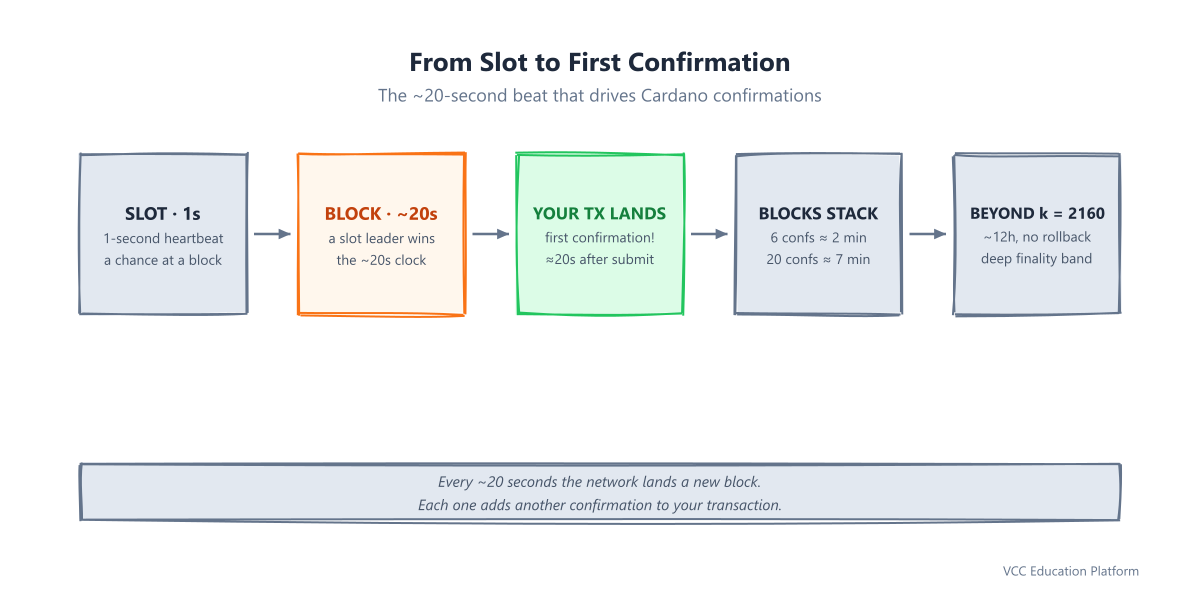
Figure 1: From slot to first confirmation — the cardano block time rhythm
How Confirmations Accumulate
A confirmation does not exist on its own; it is a measure of depth. Here is how it works:
Your transaction lands inside block number 5,000,100 (say). Now the network keeps producing blocks: 5,000,101, 5,000,102, 5,000,103… The moment block 5,000,101 is adopted, your transaction has 1 confirmation. When 5,000,102 arrives, it has 2 confirmations. Every new block on top adds one.
Why does depth matter? Because of how blockchain consensus works. In the rare event of a fork — two competing versions of the chain — the longest chain wins. Your transaction is "safer" with each block stacked on top of it, because to reverse it, an attacker would have to re-build all of those blocks, and out-produce the entire honest network.
So the confirmation count is both a trust meter and a clock. At a 20-second block time:
- 1 confirmation ≈ 20 seconds
- 6 confirmations ≈ 2 minutes
- 10 confirmations ≈ 3.5 minutes
- 20 confirmations ≈ 6.5 minutes
- 30 confirmations ≈ 10 minutes
These are the numbers behind every "how long does a cardano transaction take" answer you will ever see — the question is only ever which confirmation count the receiver wants.
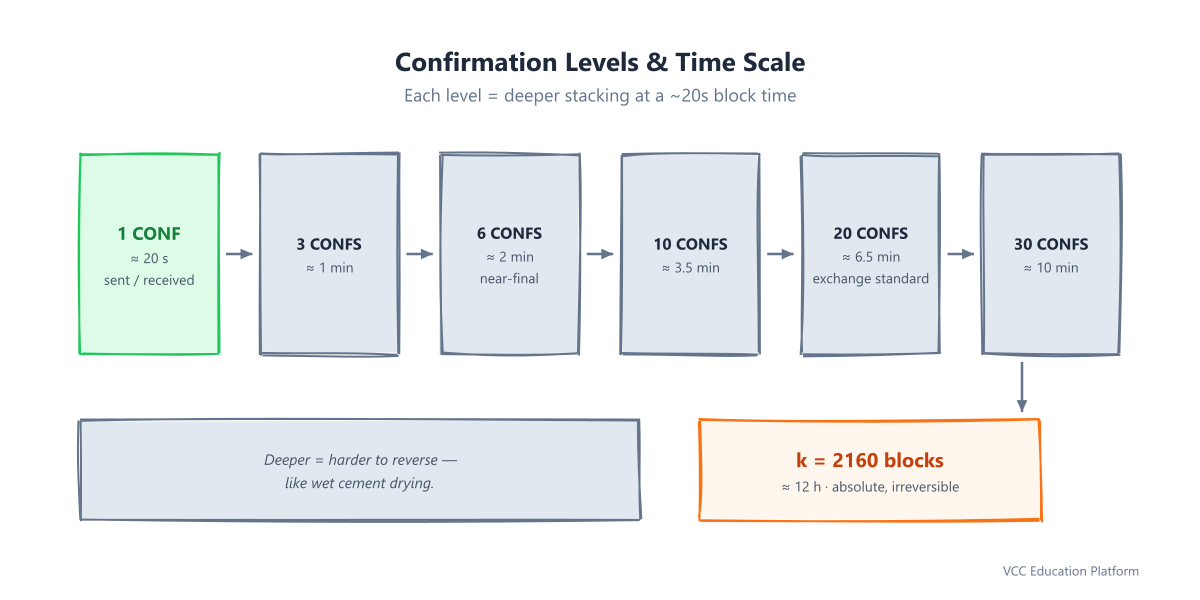
Figure 2: Confirmation levels and how long each takes at a 20-second block time
Confirmations vs Finality: Two Different Answers
This is where beginners get confused, because "confirmed" and "final" are not the same word on Cardano.
Confirmation is a practical signal. Most applications treat 6-20 confirmations as strong finality — after a few minutes, a transaction is so overwhelmingly unlikely to be reversed that it is treated as permanent. Your wallet showing "sent" or a café accepting a payment uses this practical standard.
Finality, in the strict protocol sense, is a hard guarantee. Cardano's security parameter k is 2160 blocks — once a block is more than 2160 blocks deep (about 12 hours at the current block time), the network refuses by construction to roll it back. No fork, however powerful, can ever overturn a transaction buried beyond k blocks. This deep immutability is an insurance policy "for the whole chain," and it is why Cardano is called a probabilistic finality chain: everyday finality comes in minutes, absolute assurance in hours.
This is also why how many confirmations you need is a choice, not a rule:
- 1-2 confirmations — a coffee, pocket money, a gift to a friend. Fine.
- 6-20 confirmations — a typical exchange deposit threshold or a medium-value payment.
- 20-30+ confirmations — what exchanges commonly require for large deposits before crediting your balance.
Everyone sets their own dial based on one question: how much do I stand to lose if this is ever reversed? An exchange crediting a $50,000 deposit waits deeper than a vending machine accepting a soda.
What Your Wallet Actually Shows
Wallets rarely show you the raw confirmation count. Instead they show a status, and it is worth knowing what the statuses mean in terms of confirmations and time:
- "Submitting" or "Pending" — the transaction is in the mempool, waiting for a slot leader. This can last seconds (normal) or longer (see factors below).
- "Sent" / "Received" / low-assurance — the first block included it. ~20 seconds in.
- Medium / high assurance — several blocks on top. A few minutes in.
- On Cardano explorer pages, you will always find a "confirmations" number or a block depth, which is the unfiltered truth.
One important tip: if your wallet shows a transaction as pending for longer than a few minutes, the transaction is not necessarily lost — it is usually just waiting in the queue.
Six Factors That Affect the Cardano Confirmation Time
The 20-second block time is the average rhythm, but your individual confirmation time can stretch. The reasons all fall into six groups:
- Low transaction fee. Higher-fee transactions are picked first when the network is busy. A low-fee transaction during congestion can wait several blocks — not because anything is broken, but because others are jumping the queue.
- Network congestion. When demand spikes, the mempool fills and competition increases; confirmation time rises.
- Mempool resets on network restart. After a node restart or a heavy fork, pending transactions can be re-broadcast or dropped.
- Propagation distance. Blocks and transactions must travel node-to-node. Under normal conditions this is seconds, but a wallet far from the network or on a slow connection can add a little delay.
- WaPo/validity interval. Your transaction has a validity window ("TTL"). If the network is slow and the window expires before inclusion, the transaction is rejected — a worst case that can reset the clock, though our wallets rebuild it automatically.
- Wallet-side delay. A temporarily offline node or a wallet that has not fully synced can delay submission itself — before the network clock even starts.
The first two factors — fee and congestion — cause the overwhelming majority of "why is my cardano transaction taking so long?" moments.
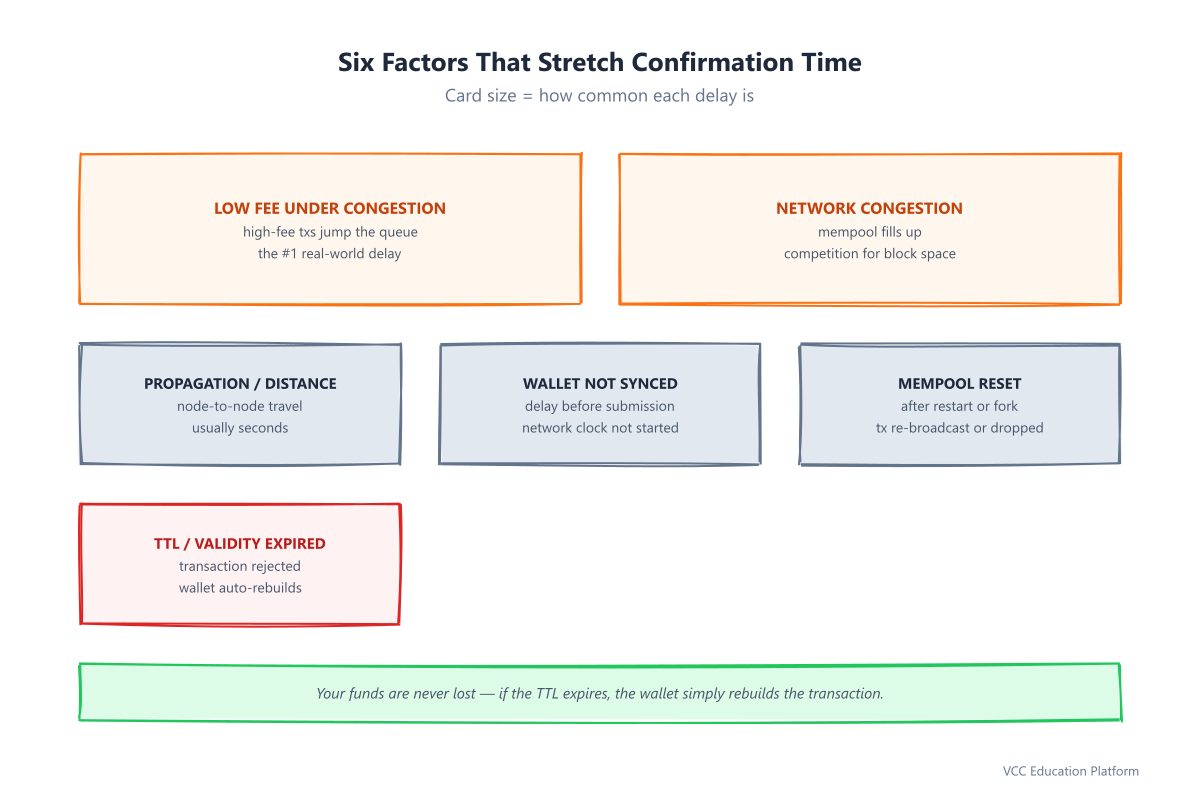
Figure 3: Six factors that stretch confirmation time, weighted by how common they are
Watch It Live: Confirmations Are Public
You never need to take any of this on faith. Paste your transaction hash into any Cardano explorer — Cexplorer, CardanoScan, or pool.pm — and you can watch the clock in action: the slot it landed in, the block number, and the confirmation count climbing in real time. This is one of Cardano's quiet superpowers: every confirmation is a public, verifiable event. If the recipient ever says "I haven't received it," the explorer settles the argument in 10 seconds.
Frequently Asked Questions
How long does a cardano transaction take on average?
On a healthy network, a simple there puzzle transfer appears in a block within about 20 seconds — that is the expected cardano block time. Strong practical finality (6-20 confirmations) arrives in 2-7 minutes.
What is the ada confirmation time for exchange deposits?
Most exchanges credit deposits after 20-30 confirmations, which is roughly 7-10 minutes at the current block time. Some smaller exchanges use fewer; the number is visible on each exchange's deposit page.
What is the cardano block time exactly?
Cardano produces about one block every 20 seconds on average. Slots are one second each, and an epoch is exactly 432,000 slots — five days. Roughly 21,600 blocks are expected per epoch.
How many ada transaction confirmations are "safe"?
It depends on the amount at risk. 1-2 confirmations suit personal transfers; 6-20 give strong practical finality; exchanges treat 20-30 as standard for large deposits. Nothing below k=2160 blocks (~12 hours) is absolutely irreversible, but beyond 20 confirmations the risk is already minuscule.
Why is my cardano transaction taking longer than usual?
Usually the mempool queue: your fee may be too low for the current congestion, so higher-fee transactions are being picked first. It will typically land within a few blocks. If your wallet shows an expired validity window, it should auto-rebuild and resubmit — your funds are never lost.
Does the network get faster over time?
Block time is a protocol parameter, not a fixed law. It is under active review — the community is discussing upgrades (such as Ouroboros Peras) aimed at cutting settlement to about two minutes. Today, though, the honest figure is ~20 seconds per block.
The Takeaway
The cardano confirmation time is short and predictable: about 20 seconds to the first confirmation on a healthy network, a few minutes to practical finality, and a hard guarantee only after ~12 hours. The number of confirmations you need is a risk dial you (or the receiver) choose — not a fixed rule. And the entire process is publicly visible, so you can always watch the clock yourself. The next time your wallet shows "pending," you will know exactly what is happening behind the screen — and roughly how many seconds are left on the clock.