
When people say "privacy crypto," they usually picture two coins: Monero and Zcash. But the privacy landscape has changed. Midnight vs Aztec are now the two most ambitious privacy-by-design platforms on the market — one a Cardano partner chain, the other an Ethereum L2 — while Secret Network quietly powers confidential smart contracts with a completely different trick. This article is a privacy coin comparison for advanced readers who want to understand why these five systems differ at the protocol level, not just which token is more anonymous. We'll map each platform's architecture, anonymity set, programmability, proof technology, interoperability, and regulatory posture — then answer the question everyone actually asks: midnight vs zcash monero is not a technical contest, it's a decision about what kind of privacy you need.
The core argument, stated up front: privacy by design is a dial, not a switch. Monero turns it to maximum and locks it there. Zcash leaves it to the user. Midnight, Aztec, and Secret hand it to the application developer. Each dial position buys something — and sells something else.
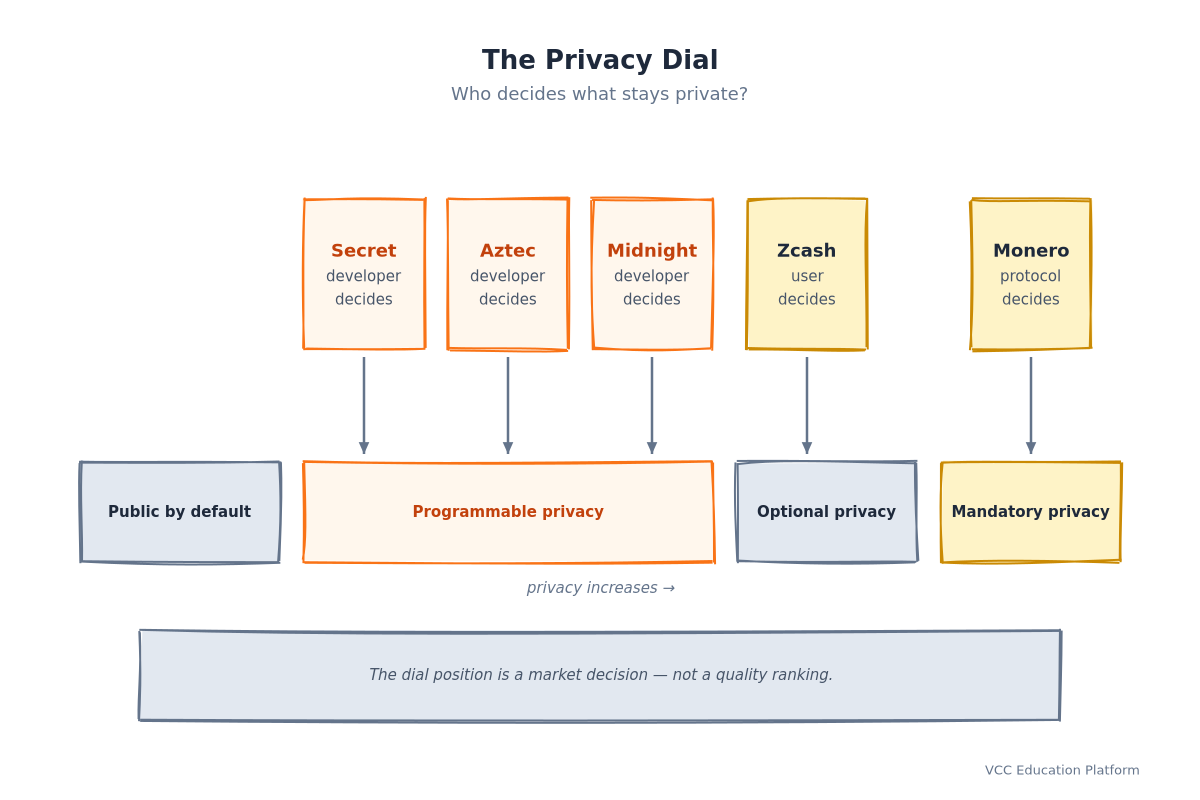
Figure 1: The Privacy Dial — who decides what stays private determines everything else
The Privacy Dial: Four Positions, Five Platforms
Every privacy system makes one decision before anything else: who decides what is private? The answer creates four distinct designs.
- Mandatory privacy — Monero. The protocol decides: every transaction hides sender, receiver, and amount. There is no opt-out, no transparent mode. This maximizes anonymity because everyone is in the crowd.
- Optional privacy — Zcash. The user decides, per transaction, whether to use a transparent (public) or shielded (private) address. Maximum flexibility — but flexibility leaks, because the transparent half of the network shrinks the shielded crowd.
- Programmable privacy — Midnight, Aztec, Secret Network. The application developer decides. A smart contract can declare some state public, some shielded, and some selectively provable. Privacy becomes a feature of the app, not a property of the network.
- No privacy — Bitcoin, Ethereum, Cardano base layers. Everything public by default. This is the baseline every privacy system is a response to.
The key insight: these are not ranked. Mandatory privacy is "strongest" per transaction but has the worst regulatory surface. Programmable privacy is "weaker" per transaction but is the only model institutions can legally use. The dial position is a market positioning decision, and that single decision explains almost every technical difference between the five platforms.
Midnight: The Cardano Partner Chain That Puts Data Back in Your Hands
Midnight is Cardano's first partner chain — not a sidechain, and not a competitor to Cardano. It is a dedicated confidential-computing network built by Input Output (the company behind Cardano) that lets smart contracts process private data without putting that data on a public chain.
The dual ledger
Midnight runs two ledgers simultaneously:
- The public ledger (unshielded): a UTXO ledger where transaction metadata, settlement, and consensus data live. NIGHT — the unshielded governance and staking token — lives here and behaves like a normal crypto asset.
- The shielded ledger: private state that lives on the user's own machine, never on the chain. Balances, contract terms, counterparty identities — all stay local.
What connects the two? Zero-knowledge proofs. When a shielded action happens, the user's machine computes a ZK proof that the private state justifies the public state change. Only the proof touches the chain. Nobody — not the block producers, not the network — ever sees the underlying data.
Kachina: proving private inputs justify public changes
The protocol underneath this is Kachina, a data-protecting smart-contract model based on non-interactive zero-knowledge proofs. Kachina formalizes the two-state bridge: a contract updates public state (on-chain) and private state (on the user's machine) in tandem, and the validity of the update is established by a ZK proof that the private inputs justify the public transition. It's grounded in the Universally Composable (UC) security model and uses ZK-SNARKs.
What makes Kachina notable is that it's a smart-contract execution model, not just a payment system. A DeFi protocol on Midnight can prove "this user passed the KYC threshold" without anyone seeing the passport. That is selective disclosure — prove a limited fact, reveal nothing else.
Compact, NIGHT, and DUST
Developers write Midnight contracts in Compact, a TypeScript-based smart-contract language. The TypeScript base is a deliberate on-ramp: millions of web developers can write privacy-preserving contracts without learning Solidity or a new cryptographic DSL. Compact contracts compile into ZK circuits; the chain stores a verification key as a fingerprint of the contract's rules.
The economy uses two assets. NIGHT is the unshielded native token — transferable, tradeable, fixed at ~24 billion supply, used for governance, staking, and security. DUST is the shielded resource — non-transferable under any circumstance, generated by holding NIGHT, and spent to pay for shielded transactions and contract execution.
DUST is the deliberately radical part. It is non-transferable, self-decaying, and exists only as a function of the NIGHT you currently hold. Why build the fuel of privacy this way? Because a transferable fee token would itself become an anonymous payment rail — Midnight would quietly turn into a shielded value-transfer network with extra steps. DUST ties the right to transact privately to holding NIGHT, not to a market for anonymity itself. It also decouples usage cost from NIGHT's market price, giving enterprises the fee predictability they need.
Where Midnight sits on the dial
Midnight is programmable privacy with a compliance-first tilt. It does not try to hide who you are from regulators; it lets you prove what they need to know without exposing everything else. Charles Hoskinson has been explicit that Midnight is not chasing Monero or Zcash users — it targets regulated industries that need privacy without anonymity. That positioning is the whole point of the DUST design and the NIGHT public ledger.
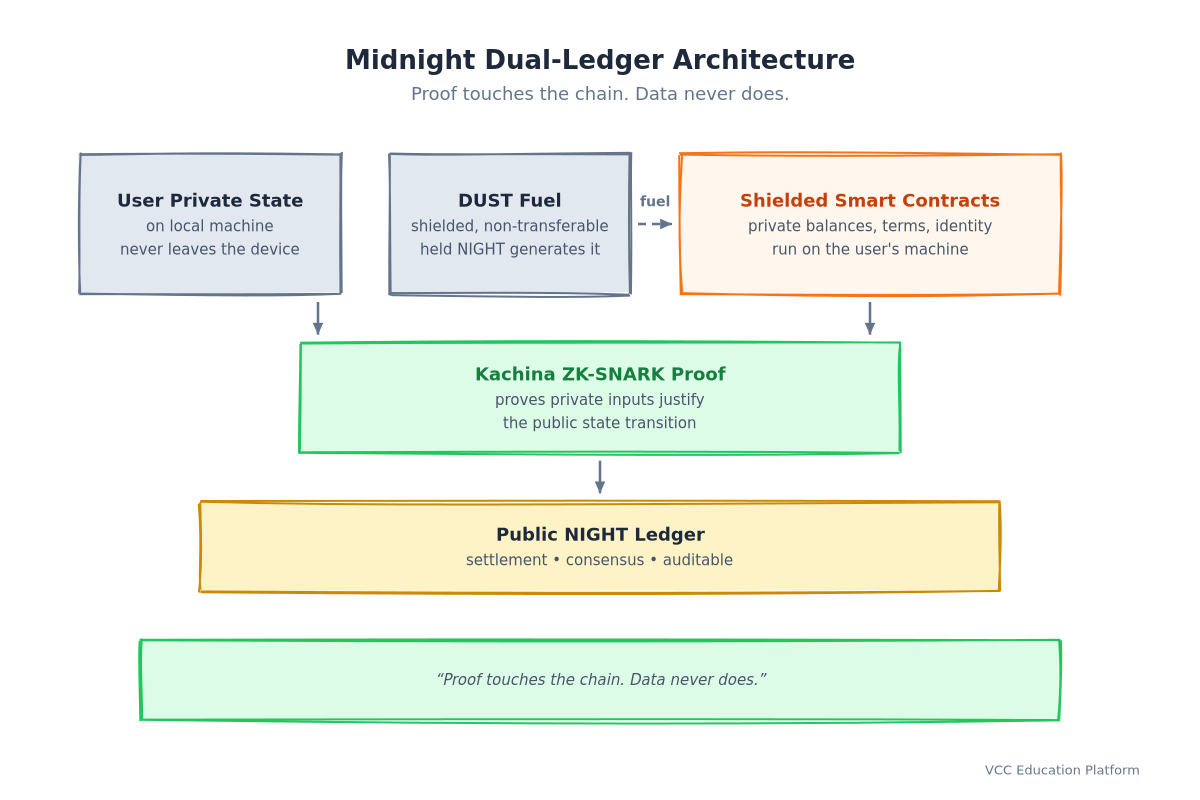
Figure 2: Midnight Dual-Ledger Architecture — proof touches the chain, data never does
Aztec: Ethereum's Programmable Privacy Layer
Aztec is the closest thing to Midnight in ambition, but it lives in a different world: it's a zero-knowledge rollup on Ethereum, built to give the Ethereum ecosystem private smart contracts. It calls itself a "zk-zk rollup" because it layers ZK privacy on top of a ZK-validated rollup.
This is the real content of the midnight vs aztec comparison: both are programmable-privacy platforms, but they answer a different question. Aztec asks "how do we give Ethereum private contracts?" Midnight asks "how do we build a chain where privacy is native and compliance is possible?"
Private notes, not accounts
Aztec's private state uses a UTXO-style model of notes — encrypted pieces of data that only their owner can decrypt. Spending a note requires generating a nullifier that marks it spent without letting an observer link the note to the nullifier (that link requires the owner's keys). The append-only, nullifier-based design is what makes the transaction graph unlinkable — the same structure Zcash and Monero use, but generalized to arbitrary contract state, not just coins.
PXE and the AVM: private runs on your device, public runs on the network
Aztec splits execution into two environments. PXE (Private Execution Environment) runs private contract functions client-side, on the user's device; the wallet generates a ZK proof locally and sensitive data never leaves the machine. AVM (Aztec Virtual Machine) runs public contract functions network-side, for state that should be visible (token supply, governance).
The two are logically disconnected — data passes between them only via proofs. This gives Aztec composable transactions: a single pipeline can mix private and public logic, so a private lending protocol can interact with a public liquidity pool without breaking confidentiality.
Noir and the proof stack
Developers write contracts in Noir (via the aztec.nr framework), a ZK DSL that lets you express private logic without knowing the cryptography underneath. The proving stack is Aztec's own: PLONK (invented by the Aztec team) plus Honk/Fflonk for efficient L1 verification, with custom circuits — Kernel (validates individual transactions), Rollup (batches kernel proofs), and Squisher (compresses rollup proofs for Ethereum).
Aztec also builds in native account abstraction (every account is a smart contract; each has a nullifier key plus incoming/outgoing viewing keys), Portals for trust-minimized L1/L2 communication, and a decentralized sequencer (Fernet) with a Based Fallback — if the L2 sequencers try to censor you, you can submit directly to Ethereum L1.
Where Aztec sits on the dial
Aztec is programmable privacy with an Ethereum-native tilt. Its anonymity set is per-note-pool, its ecosystem is Ethereum's, and its goal is "privacy for pennies" — making shielded DeFi cheap enough to be default. It is the closest architectural competitor to Midnight: same ambition (private smart contracts), different substrate (Ethereum L2 vs Cardano partner chain), different compliance story (viewing-key disclosure vs built-in selective disclosure).
Secret Network: Privacy Through Hardware
Secret Network reaches the same goal — private smart contracts — by a completely different route. It doesn't use zero-knowledge proofs at all. It uses Trusted Execution Environments (TEEs): secure enclaves inside Intel CPUs (SGX) where computation happens in encrypted isolation.
How a secret contract works
A Secret contract (written in Rust via SecretWasm) takes encrypted inputs, decrypts them only inside the enclave, processes them, and writes encrypted output back to state. The validator node operator cannot see what happened — even the machine running the computation can't observe the enclave's internals. Remote attestation verifies that the enclave is running the expected code and hasn't been tampered with.
The chain is a Cosmos SDK layer-1 with Tendermint PoS consensus and IBC interoperability. SCRT (the native token) is public — used for gas, staking, and governance. Privacy lives in SNIP-20 secret tokens (like sSCRT), where amounts and counterparties are hidden behind the TEE.
Viewing keys: consent-based disclosure
Because query senders can't be authenticated cryptographically on-chain, Secret invented viewing keys — per-contract passwords that grant decryption rights. You (or a contract you authorize) can reveal a balance or a history to a specific party by deliberate choice. This is Secret's selective disclosure: a privacy model based on consent rather than cryptographic prove-a-subset.
The trust-model difference
Here is the fundamental difference from ZK platforms: Secret trusts hardware; ZK platforms trust math. Midnight, Aztec, and Zcash place their security in mathematical hardness assumptions. Secret places its security in Intel's silicon and Intel's attestation services. That has real consequences: SGX has had side-channel vulnerabilities, and a platform whose privacy anchor is one hardware vendor carries a centralization and supply-chain exposure that a ZK system does not. In exchange, Secret gets something ZK systems struggle with: private computation on arbitrary data with reasonable performance — including, increasingly, confidential AI via its SecretVM proposal.
Zcash: The Pioneer That Made Privacy Optional
Zcash launched in 2016 as the first production deployment of zk-SNARKs — the proof system that now underpins a whole generation of privacy platforms, including Midnight. It is a UTXO blockchain forked from Bitcoin, with one addition: the option to transact privately.
Shielded pools and the user's choice
Zcash runs four value pools: Sprout (legacy), Sapling, Orchard, and Transparent. Transparent addresses (t-) behave exactly like Bitcoin — sender, receiver, amount all public. Shielded addresses (Sapling z-; newer unified addresses u-) use zk-SNARKs to hide all of that.
The proving systems tell the story of Zcash's evolution:
- Sprout (2016): the first zk-SNARK in production — slow, memory-heavy.
- Sapling (2018): Groth16, brought shielded proving under ~7 seconds on a smartphone — but required a trusted setup ceremony ("Powers of Tau").
- Orchard (2022, NU5): Halo 2 — recursive proofs with no trusted setup at all, eliminating the "toxic waste" problem. Unified addresses bundle Orchard/Sapling/transparent receivers, and wallets route to the most private option.
Zcash also introduced viewing keys — splitting the ability to see from the ability to spend, which gives accountants and auditors a sanctioned path into shielded data.
The optionality tax
Zcash's strength is also its weakness. Because privacy is optional, most ZEC activity is transparent: roughly two-thirds of supply sits outside shielded pools, and analytics firms have de-anonymized a majority of Zcash transactions by tracing the transparent boundary — not by breaking the cryptography. Every transparent transaction shrinks the shielded crowd, which shrinks the anonymity set for the shielded ones. Optional privacy requires diligent users, and users are rarely diligent.
Monero: The One That Doesn't Compromise
Monero is the reference implementation of mandatory privacy. Every transaction hides sender, receiver, and amount — there is no transparent mode, no opt-out, no selective disclosure. It is designed as private digital cash: perfectly fungible, because no coin carries a history anyone can read.
The three-layer privacy stack:
- Stealth addresses hide the receiver. Every output gets a fresh one-time key derived from the recipient's public address; observers cannot link outputs back to the address.
- Ring signatures (CLSAG) hide the sender. The real spender's signature is buried in a ring with 15 decoys drawn from the chain's history.
- RingCT hides the amount, using Pedersen commitments and Bulletproofs+.
Dandelion++ adds a fourth, often-forgotten layer: it obfuscates the network — which node actually originated a transaction — so an IP address can't be tied to an on-chain event.
FCMP++: the anonymity set goes to the whole chain
The next upgrade (expected in 2026) replaces the 16-member ring with Full-Chain Membership Proofs (FCMP++) — a ZK proof that the spent output is one of every unspent output ever created. That is an anonymity set of tens of millions (1.8M+ UTXOs at launch, ~150M+ eventually), versus 16 decoys today. It also brings forward secrecy: even a future quantum computer with a discrete-log oracle couldn't retroactively break past FCMP++ transactions.
Monero pays a price for this: no smart contracts, no tokens, no selective disclosure. You cannot prove to an auditor that you received a payment without exposing your keys. It is a currency, not a platform — and the most successful currency ever built on that principle. The IRS's $625,000 bounty for tools that trace XMR has never been publicly claimed.
The Comparison Table
| Dimension | Midnight | Aztec | Secret | Zcash | Monero |
|---|---|---|---|---|---|
| Architecture | Cardano partner chain, dual ledger | Ethereum L2 zk-rollup | Cosmos SDK L1 | Bitcoin-fork L1 | CryptoNote L1 |
| Who decides privacy | Developer (per app) | Developer (per contract) | Developer (per contract) | User (per tx) | Protocol (always) |
| Anonymity set | Per-application shielded state | Per-note-pool | Per-TEE computation | ~⅓ of supply shielded | Full chain (FCMP++ planned) |
| Programmability | Full — Compact (TypeScript) | Full — Noir | Full — SecretWasm (Rust) | Minimal/none (Tachyon planned) | None |
| Proof technology | ZK-SNARKs (Kachina) | PLONK/Honk/Fflonk | TEE (Intel SGX) — no ZK | zk-SNARKs (Groth16, Halo 2) | Ring sigs, RingCT, Bulletproofs+, FCMP++ |
| Selective disclosure | Built-in (Kachina) | Viewing keys + proofs | Viewing keys/permits | Viewing keys | None |
| Compliance posture | Designed for regulated institutions | Viewing-key disclosure | Consent-based disclosure | Optional transparency | No pathway — 70+ delistings |
| Primary use case | Confidential finance, identity, enterprise | Private DeFi on Ethereum | Confidential data, private AI | Private payments | Private digital cash |
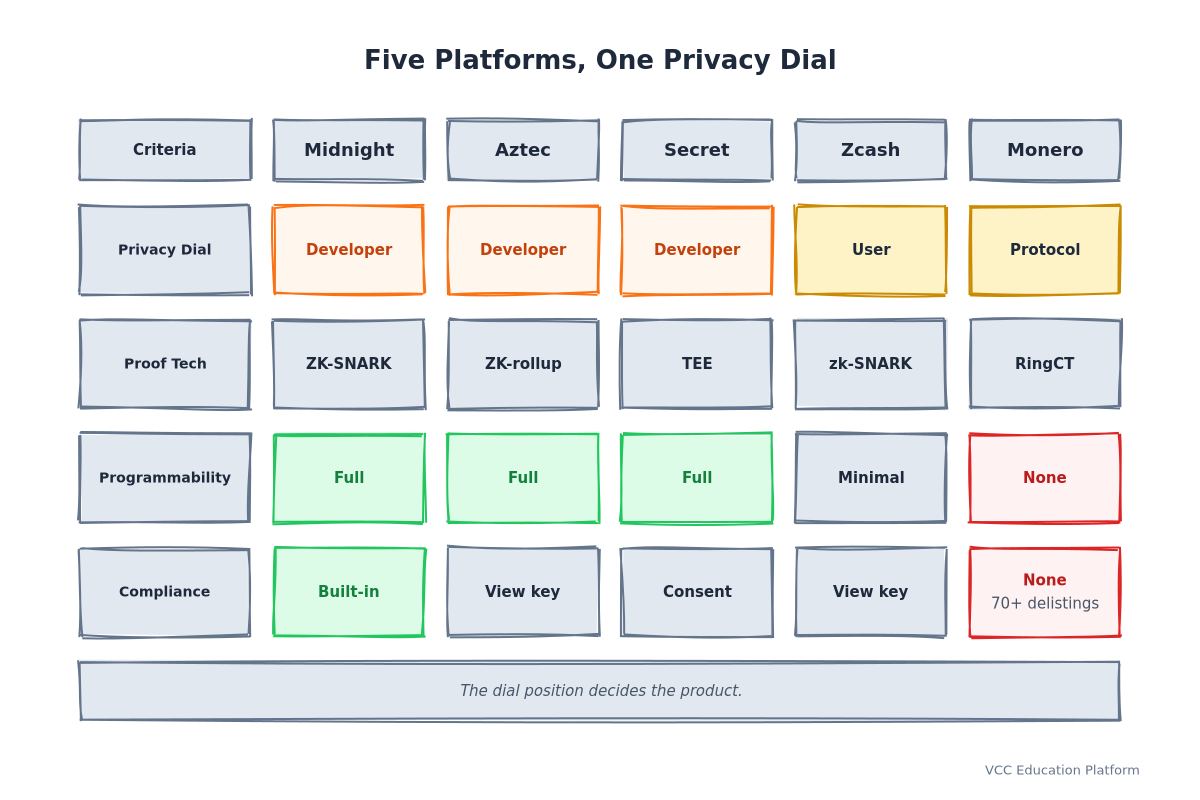
Figure 3: Five Platforms, One Privacy Dial — the dial position decides the product
Interoperability and Ecosystem
The five platforms live in different neighborhoods of the ecosystem:
- Midnight inherits Cardano's validator set as a partner chain, is firewalled from Cardano (a failure on one can't take down the other), and has announced LayerZero integration for cross-chain messaging. Its launch partners read like a regulated-finance guest list: Google Cloud, Blockdaemon, MoneyGram, Vodafone's Pairpoint, eToro, Worldpay, Bullish — with Monument Bank planning to tokenize up to £250M of retail deposits on it.
- Aztec is natively composable with Ethereum L1 and its rollup ecosystem; its Portals design makes trust-minimized bridges a protocol feature.
- Secret Network interoperates with the whole Cosmos ecosystem over IBC, letting any IBC-connected chain route data through its confidential-computing layer.
- Zcash is structurally a Bitcoin fork with limited smart-contract surface; cross-chain integration is mostly done through bridges and swaps.
- Monero is deliberately closed: standalone, no tokens, no DeFi, no bridges by design. Its interop story is atomic swaps and P2P trading — privacy preserved by not interoperating.
The Regulatory Reality: Why This Dial Exists
The privacy dial didn't emerge from cryptography — it emerged from law. In 2026, the regulatory backdrop is the strongest force shaping privacy-by-design:
- FATF Travel Rule requires exchanges to collect and transmit sender/receiver information above thresholds. A chain that hides that data by default makes compliance impossible.
- EU AMLR (Regulation 2024/1624), applying from July 2027, explicitly bans regulated platforms from offering anonymity-enhancing coins. Japan (since 2018) and South Korea have already done so.
- The result: 70+ exchanges have delisted privacy assets, and privacy coins nonetheless outperformed every sector in 2025 — scarcity drove prices up even as access narrowed.
Now the dial makes sense. Monero cannot comply at the protocol level — its privacy is structural. Zcash has a slim pathway: transparent addresses and viewing keys give exchanges a compliance argument. Midnight was designed for this environment: its selective disclosure and non-transferable DUST exist so regulated institutions can use privacy without running afoul of AML law. Aztec and Secret sit in between, with viewing-key/consent-based disclosure paths.
This is the real content of midnight vs zcash monero: it is not a fight over who has stronger cryptography. Monero has stronger anonymity. Midnight has a compliance strategy. Zcash is the compromise generation. Which one is "better" depends entirely on whether your threat model is a surveillance state or a regulator.
Making the Choice: A Decision Tree
If you need private money with maximum fungibility — send value and never have it traced, no accountabilities to anyone — the honest answer is Monero. Accept the delistings, the P2P channels, and the lack of smart-contract functionality.
If you want privacy with a credible compliance story — you're an institution, a business, or a user who must prove things to auditors — Midnight is built precisely for that: selective disclosure, a public NIGHT ledger, and a non-transferable DUST fuel that guarantees the network isn't an anonymous money rail. This is the answer to the "midnight vs zcash monero" question for enterprises.
If you live in the Ethereum ecosystem — you want private DeFi that composes with existing public liquidity — Aztec is the design reference: programmable privacy with Noir, notes-based UTXO state, and the deepest ZK-rollup tooling.
If your data, not your money, is the secret — confidential AI, private data marketplaces, encrypted identity — Secret Network gives you private computation on arbitrary data, at the cost of trusting Intel hardware.
If you want a middle path — optional privacy with auditability — Zcash remains the mature, battle-tested option, with the caveat that its privacy only works if you stay diligent about shielded addresses.
Common Questions
Is Midnight a privacy coin like Monero or Zcash?
No. Midnight is a programmable-privacy platform, not a privacy coin. Monero and Zcash hide value transfers; Midnight hides data and computation via ZK proofs, with a public NIGHT ledger and selective disclosure.Midnight vs Aztec: which is better for private DeFi?
If you want to stay inside Ethereum's ecosystem and compose private DeFi with public liquidity, Aztec (an Ethereum L2) is the natural fit. If you want a standalone chain with built-in compliance and Cardano security inheritance, Midnight is designed for it. Same ambition, different substrate.What is the real difference between Zcash and Monero?
Monero's privacy is mandatory (every transaction hides sender, receiver, amount) and its anonymity set is the entire chain. Zcash's privacy is optional (transparent or shielded addresses) and roughly two-thirds of its supply sits outside shielded pools. Monero is stronger per-transaction but has no compliance pathway; Zcash has viewing keys and a transparent layer that give it a regulatory story.How does Secret Network's privacy work without ZK proofs?
Secret uses Trusted Execution Environments (Intel SGX enclaves). Encrypted inputs are decrypted only inside the enclave, processed, and re-encrypted to state. Viewing keys grant permissioned decryption. The tradeoff: privacy anchored in hardware trust instead of mathematical proofs.What is selective disclosure, and why does it matter?
Selective disclosure lets a user prove a limited fact (e.g., "I passed the KYC threshold") without revealing the underlying data. Midnight (Kachina) and Aztec build this in; Zcash and Secret offer it via viewing keys. Monero does not offer it at all — you can't prove a fact about a transaction without exposing your keys.Which of these can I actually use in a regulated market?
Midnight is the one designed for it — selective disclosure and non-transferable DUST were built with AML/Travel-Rule compliance in mind. Zcash has a slim pathway via transparent addresses and viewing keys. Aztec and Secret offer consent-based disclosure. Monero has effectively no regulated path — which is why 70+ exchanges have delisted it.Is Monero's privacy really stronger than Zcash's?
Per-transaction, yes — Monero hides everything by default with a full-chain anonymity set, and no tracing tool has been publicly proven against it. But stronger anonymity comes with worse compliance: no selective disclosure, no audit path, shrinking exchange access. "Stronger" depends on whether you measure anonymity or usability.The Bottom Line
The five platforms are not five versions of the same product — they are five positions on a privacy dial, and the dial position determines everything else. Monero: mandatory privacy, a currency, no compliance. Zcash: optional privacy, a compromise, a shrinking crowd. Midnight: programmable privacy with compliance built in — proof touches the chain, data never does. Aztec: programmable privacy for Ethereum, the deepest ZK-rollup tooling. Secret: private computation via hardware trust.
When you're choosing, the first question is not "which has the best cryptography?" It's: who gets to decide what is private — the protocol, the user, or the developer — and who do you need to prove things to? Answer that honestly, and the choice between midnight vs aztec, between midnight vs zcash monero, and between Secret's hardware and ZK's math all resolve themselves.
Quick Reference
| Property | Midnight | Aztec | Secret | Zcash | Monero |
|---|---|---|---|---|---|
| Chain | Cardano partner chain | Ethereum L2 rollup | Cosmos SDK L1 | Bitcoin fork | CryptoNote L1 |
| Privacy trigger | Developer | Developer | Developer | User | Protocol |
| Core tech | Kachina ZK-SNARKs | PLONK + notes | Intel SGX TEE | zk-SNARKs | RingCT + stealth |
| Language | Compact (TypeScript) | Noir | SecretWasm (Rust) | — | — |
| Tokens | NIGHT + DUST | ETH-based | SCRT + sSCRT | ZEC | XMR |
| Disclosure | Selective (built-in) | Viewing keys | Viewing keys | Viewing keys | None |
| Smart contracts | Full | Full | Full | Minimal | None |
| Best for | Regulated confidential finance | Ethereum private DeFi | Confidential data/AI | Optional private payments | Maximum-fungibility private cash |