
If you have ever watched the price of ADA jump 12% in a morning and drop 8% that same afternoon, you have met crypto market volatility face to face. Volatility — the size and speed of price swings — is the single most defining feature of cryptocurrency markets, and it is the first thing every beginner must understand before putting any money in. This article explains cryptocurrency volatility explained in plain language: what volatility actually is, why crypto is so much more volatile than stocks or gold, what makes Cardano's ADA move, how to measure it, and the practical strategies you can use to survive it. We include real Vietnamese retail-trader context throughout, because the emotional mistakes that volatility triggers are universal — but the local details matter.
What Is Volatility?
Volatility is a measure of how much and how quickly a price changes over a given period. A market is "volatile" when prices move up and down in large, sudden swings; it is "stable" when prices drift gently. In finance, volatility is usually expressed as the standard deviation of returns — a number that tells you, statistically, how far a typical daily move strays from the average.
A simple way to picture it: imagine two roads to the same destination. One is flat and straight (low volatility); the other is full of steep hills and sharp dips (high volatility). Both get you there eventually, but the bumpy road is far more likely to make a passenger panic and jump out halfway. Crypto is the bumpy road, and most beginners who lose money do so not because the destination was wrong, but because they could not stomach the ride.
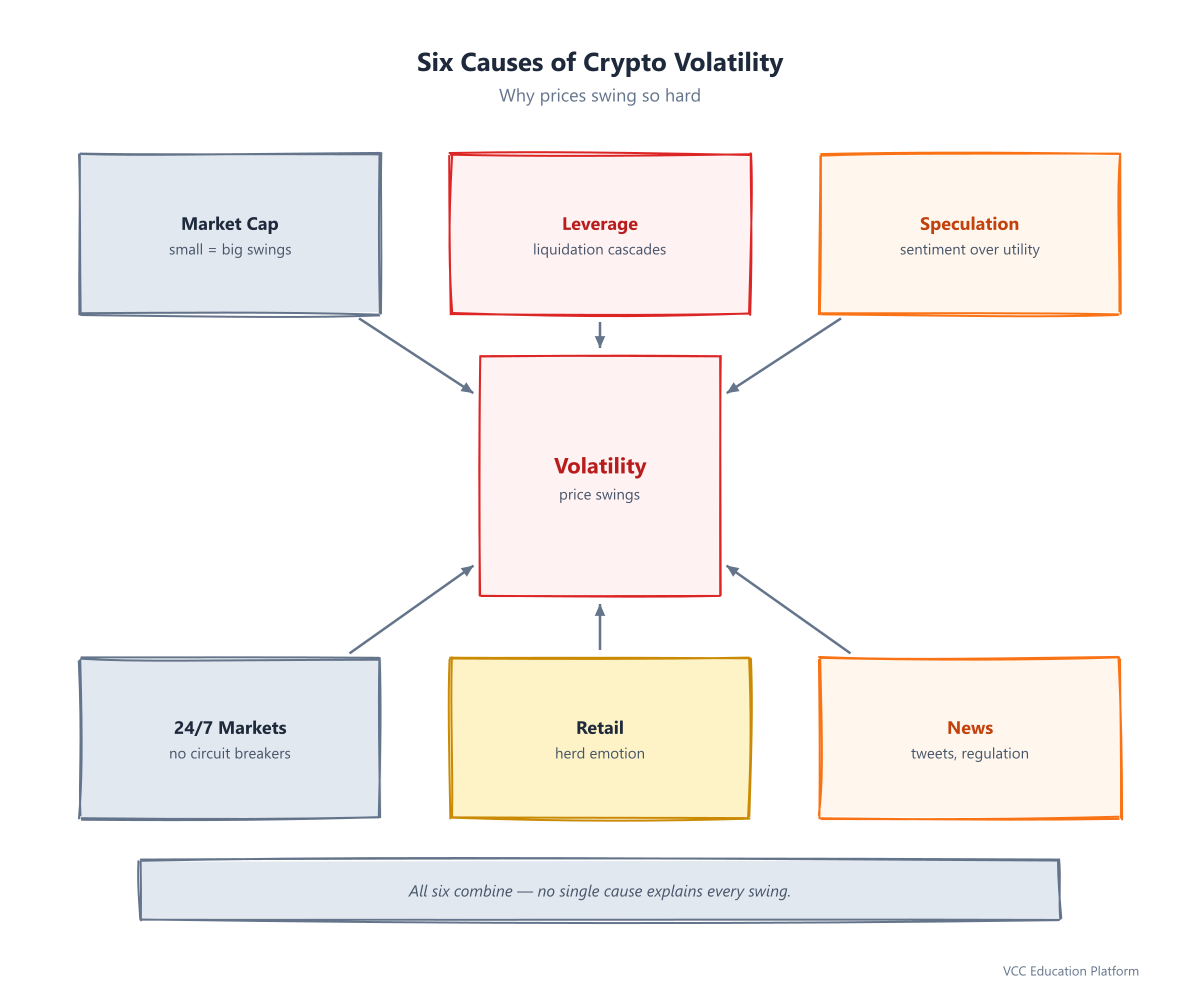
Six causes of crypto volatility: Market cap, Leverage, Speculation, 24/7 markets, Retail dominance, News events
Why Is Crypto So Volatile?
The question "why is crypto so volatile" has six overlapping answers. Understanding all six is the difference between blaming the market and understanding it.
1. Small Market Cap Relative to Traditional Assets
The total value of all cryptocurrencies is roughly a few trillion dollars. That sounds enormous, but the global stock market is worth over $100 trillion, and the bond market is even larger. When a market is small, a relatively modest amount of new money moving in or out moves the price a lot. A $1 billion inflow barely nudges the S&P 500; the same $1 billion into a mid-cap coin can move it double digits. Thin order books mean thin liquidity, and thin liquidity amplifies every trade.
2. Speculation Dominates over Utility
Most crypto buyers today are speculating on future price, not using the asset for its designed purpose. When the majority of holders are trading on sentiment rather than utility, prices follow crowd psychology — and crowd psychology is volatile by nature. A rumor on social media can move a coin 20% in an hour because most participants have no fundamental anchor to fall back on.
3. 24/7 Markets with No Circuit Breakers
Stock markets close every evening and have "circuit breakers" that halt trading after a large drop, giving everyone time to breathe. Crypto never closes. There is no weekend pause, no overnight calm, and no emergency stop. A sell-off that begins in Asia at 3 a.m. your time can wipe out 15% of your portfolio before you wake up. The absence of pauses means panic and euphoria compound in real time.
4. Leverage and Derivatives
Crypto exchanges offer leverage of 10x, 50x, even 100x. When prices move against a leveraged position, the exchange forcibly liquidates it — selling the asset into a falling market, which pushes the price down further, which triggers more liquidations. This "liquidation cascade" is why crypto crashes are often so violent and so fast. The leverage that magnifies gains on the way up magnifies losses on the way down, and the two feed each other.
5. Retail Dominance and Emotional Trading
Unlike equities, where institutional investors set the tone, crypto is still heavily retail-driven. Retail traders tend to act on emotion — FOMO (fear of missing out) at the top, panic at the bottom — and to trade in herds. When everyone reads the same Telegram group and panics at the same moment, the price reflects that herd behavior instantly.
6. News, Regulation, and Social Media
A single tweet from a prominent figure, a regulatory announcement from a major economy, or an exchange hack can move the entire market in minutes. Because crypto has no single authority and no settlement period, news is priced in instantly and often over-reacted to.
Cardano Price Volatility: What Moves ADA Specifically
ADA is a mid-to-large cap cryptocurrency, which means it shares the general volatility of the crypto market but also has its own drivers. Cardano price volatility is influenced by both crypto-wide factors and ADA-specific events.
Network Upgrades and Hard Forks
Cardano's research-driven development style means major upgrades (the Vasil hard fork, the Chang upgrade introducing governance, the Plomin hard fork) are announced well in advance and heavily discussed. Prices often rally into an upgrade on anticipation and sell off afterward on "buy the rumor, sell the news" dynamics. Beginners are often surprised that a successful upgrade can be followed by a price drop — but this is normal market behavior, not a sign the upgrade failed.
Ecosystem and DeFi Growth
When new DeFi protocols, stablecoins, or partnerships launch on Cardano, demand for ADA (which is needed for fees and as collateral) can rise. Conversely, when a major dApp migrates away or a stablecoin de-pegs on Cardano, sentiment sours. The ADA price is sensitive to the perceived health of the ecosystem, not just the tokenomics.
Staking Lock-in Effect
Roughly 60% of all ADA is staked. Staked ADA is not locked on Cardano (you can unstake any time), but stakers tend to be long-term holders who do not trade in and out. This means a large portion of supply is "sticky" and does not hit the market during mild dips — which can actually moderate ADA volatility compared to coins with no staking culture. However, in severe panics, even stakers withdraw and sell, and the stickiness evaporates.
ADA Price Fluctuations in Historical Context
ADA price fluctuations have included several dramatic episodes: the 2021 bull run from under $0.20 to over $3.00, the 2022 bear market back below $0.30, and periodic rallies tied to upgrades and broader crypto recoveries. Each swing of 50% or more was driven by a combination of macro conditions (interest rates, risk appetite), crypto-wide sentiment (Bitcoin leading the market), and ADA-specific catalysts. The lesson from history is not that ADA is uniquely risky, but that every crypto asset swings hard and that the swings are normal, not exceptional.
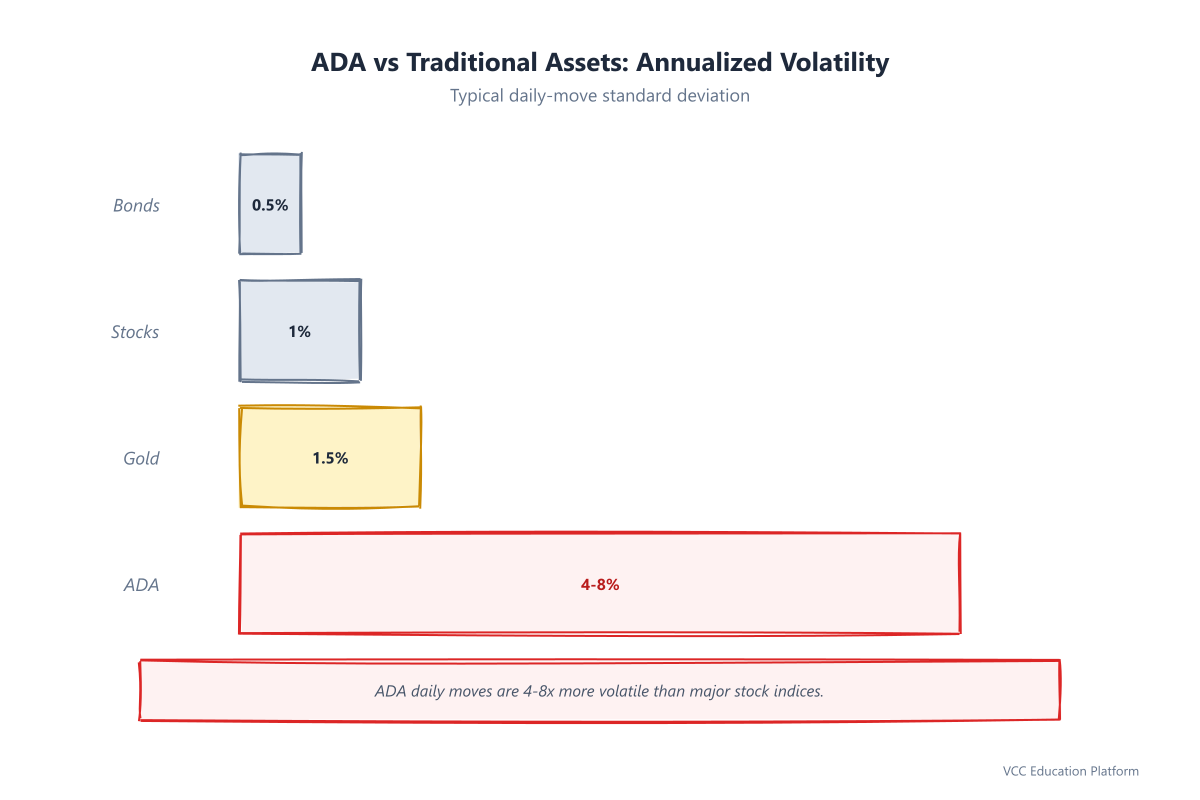
ADA vs traditional assets: annualized volatility comparison (bonds, stocks, gold, ADA)
How to Measure Volatility
You do not need to be a quant to measure volatility. Three practical tools cover most of what a beginner needs.
Standard Deviation of Returns
The most common measure is the standard deviation of daily (or weekly) returns over a window — say 30 or 90 days. A crypto asset with a 30-day standard deviation of 4% means a typical day's move is about 4% up or down. For comparison, a broad stock index might be around 1%, and a major currency pair under 0.5%. Many charting sites publish this directly as "volatility" or "historical volatility."
Beta Relative to Bitcoin
Beta measures how much an asset moves relative to a benchmark. ADA's beta to Bitcoin is typically above 1, meaning ADA tends to move more than Bitcoin in percentage terms — up more in rallies, down more in selloffs. Knowing an asset's beta helps you set expectations: if Bitcoin drops 5%, a beta-1.5 altcoin might reasonably drop 7-8%.
Implied Volatility and the "Crypto VIX"
In traditional markets, the VIX index measures expected (implied) volatility from options prices. Crypto has equivalent measures — the DVOL index on Deribit, for example — but they are less accessible to beginners. The practical takeaway: when implied volatility is very high, options are expensive, which means the market expects big moves. Beginners rarely need these tools, but knowing they exist helps you understand why "fear and greed" indices and volatility terms appear in crypto media.
The Volatility Cycle and Emotional Mistakes
Volatility is not random noise; it follows a recognizable emotional cycle that repeats in every market and every country. Recognizing the cycle is the single most useful skill for a beginner, because the cycle describes the exact moments when the worst decisions get made.
The cycle runs: Optimism → Greed → FOMO → Peak → Panic → Capitulation → Despair → Recovery. Prices rise slowly (optimism), accelerate (greed), go vertical as latecomers rush in (FOMO), top out, fall slowly, then crash as leveraged positions get liquidated (panic), hit a despair bottom where everyone declares crypto dead, and eventually recover as value buyers return.
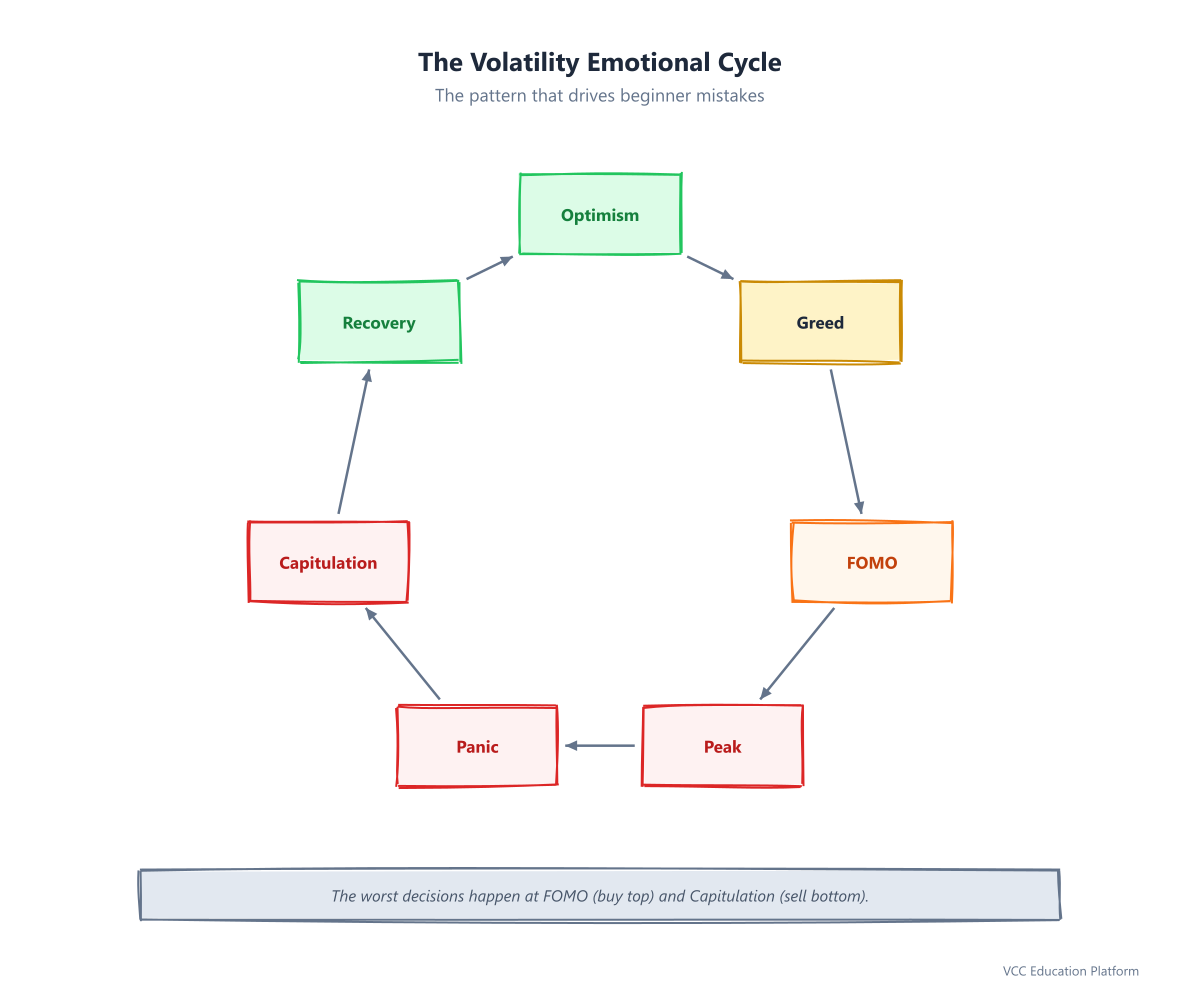
The volatility emotional cycle: Optimism → Greed → FOMO → Peak → Panic → Capitulation → Recovery
Common Emotional Mistakes (Vietnamese Retail Context)
Vietnam has one of the highest crypto adoption rates in the world, and a large, active retail trading community. The emotional mistakes below are universal, but they show up in distinctly Vietnamese ways:
- Buying at the top because friends are buying. In Vietnamese trading groups on Telegram, Facebook, and Zalo, screenshots of 300% gains spread fast. The social pressure to not "miss out" while a neighbor got rich is intense, and it peaks exactly at market tops.
- Selling at the bottom in panic. When prices crash, the same groups fill with doom posts and "crypto is dead" messages. Beginners who bought at the top often sell at the bottom, locking in the maximum possible loss.
- Over-leveraging with borrowed money. Some Vietnamese traders borrow from family or take consumer loans to "go all in" during a rally. Leverage turns a 20% drop into a total wipeout and a debt that remains after the portfolio is gone.
- Chasing "moonshots" instead of established assets. The appeal of a coin that might 100x is strong, but most such coins go to zero. Beginners who would never gamble their savings on a lottery ticket do exactly that with low-cap tokens.
- Ignoring risk management entirely. Many beginners never set a position-size limit, never use a stop-loss, and never diversify. When the one coin they hold crashes, there is nothing to fall back on.
The antidote to all of these is a plan made in advance, when you are calm, and the discipline to follow it when you are not.
Strategies to Handle Volatility
You cannot remove volatility from crypto — it is a feature, not a bug. But you can manage how it affects you. Five strategies, used together, cover most of what a beginner needs.
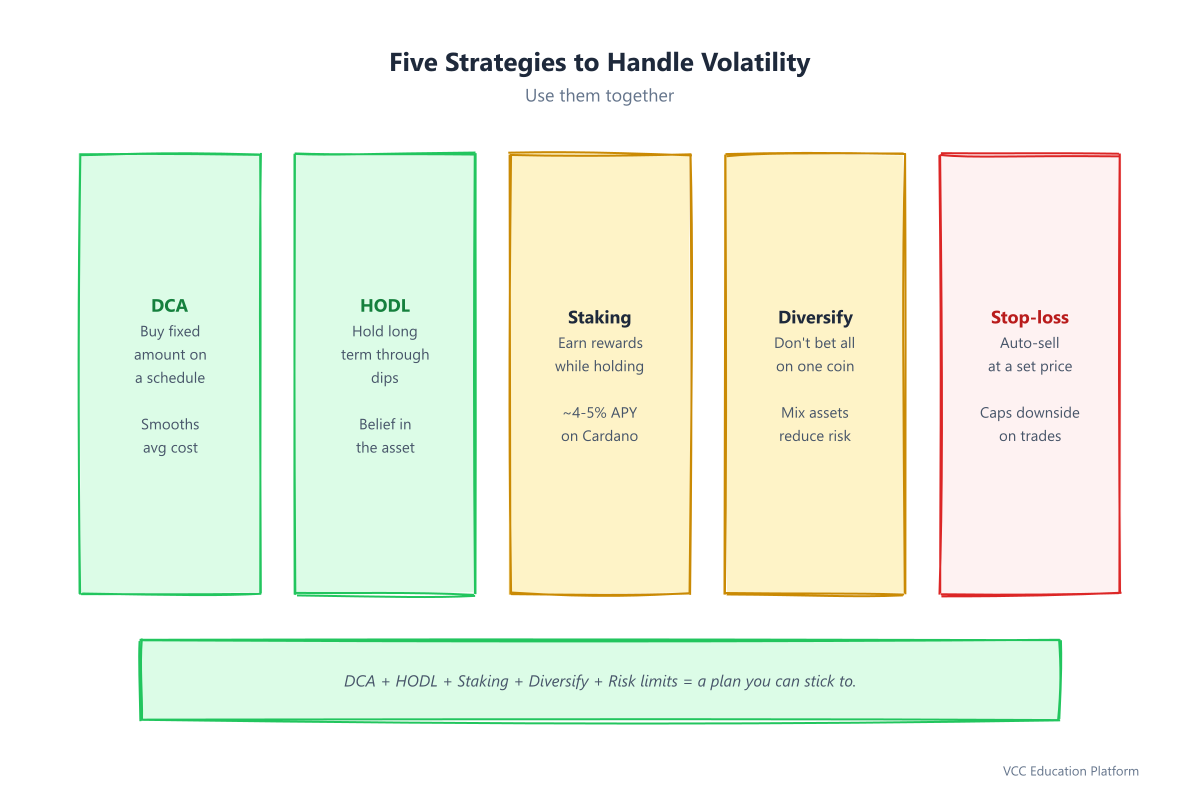
Five risk management strategies: DCA, HODL, Staking, Diversification, Stop-loss
1. Dollar-Cost Averaging (DCA)
DCA means buying a fixed amount on a fixed schedule — for example, 500,000 VND of ADA every week — regardless of the price. Over time you buy more ADA when the price is low and less when it is high, which smooths out the average cost and removes the impossible task of timing the market. DCA is especially powerful for beginners with regular income, because it turns volatility from a threat into an advantage: every dip is a chance to buy cheaper.
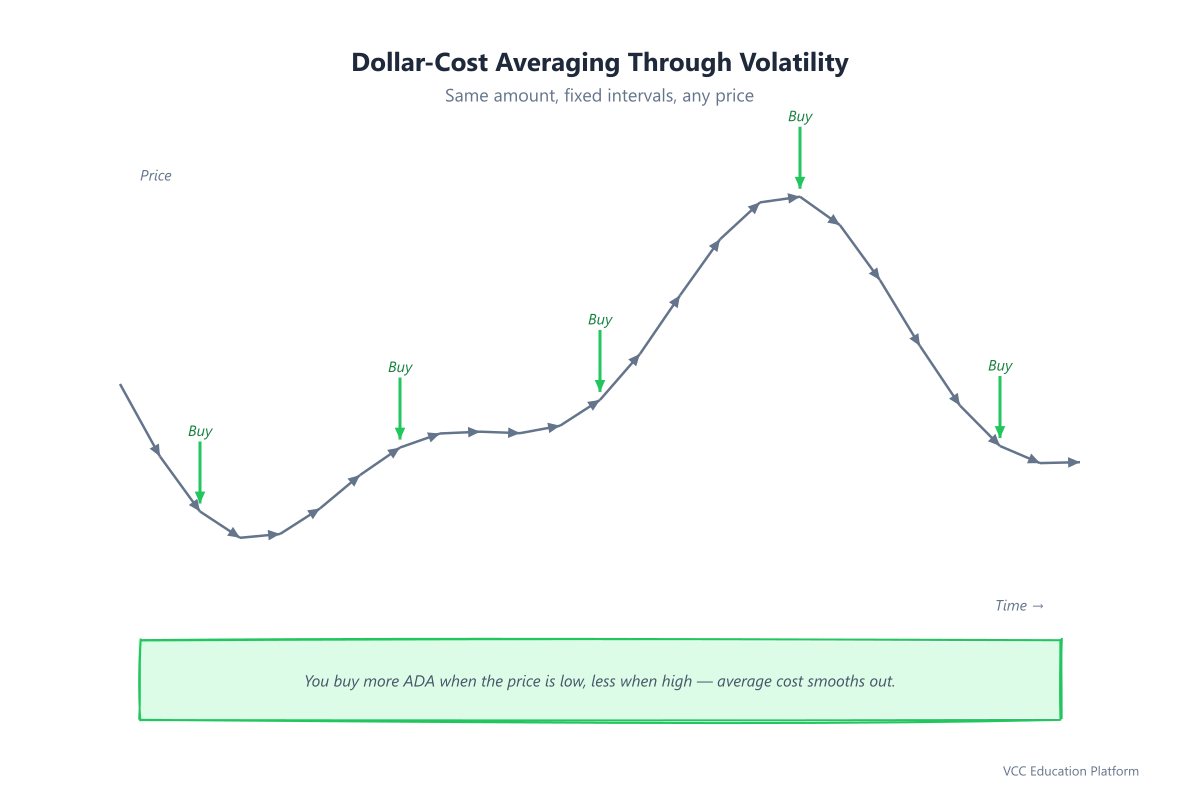
Dollar-cost averaging: buying ADA at fixed intervals through price volatility
2. HODL (Long-Term Holding)
"HODL" began as a typo for "hold" and became the philosophy of refusing to sell during dips. The logic is sound for assets you believe in long-term: if Cardano's fundamentals are improving over years, a 30% drop this month is noise, not signal. HODL works best when paired with DCA and when you have decided in advance which assets you truly believe in — not as an excuse to hold a losing coin you never researched.
3. Staking
Staking your ADA to a stake pool earns rewards (typically 4-5% per year on Cardano) and gives you a reason to hold through volatility: every epoch you stay staked, you earn more ADA. Psychologically, staking converts a volatile asset into an income-producing one, which makes dips easier to tolerate. On Cardano, staking is non-custodial and non-locking — your ADA stays in your wallet and you can unstake any time.
4. Diversification
No single asset should be your entire portfolio. A reasonable beginner allocation might include Bitcoin, a few established large-cap coins like ADA, some stablecoins for dry powder, and traditional assets (cash, stocks) outside crypto entirely. Diversification does not prevent losses in a crypto-wide crash, but it prevents a single coin's failure from wiping you out.
5. Risk Management: Position Sizing and Stop-Losses
Decide in advance how much of your portfolio you are willing to risk on crypto overall (many advisors suggest no more than what you can afford to lose entirely), and on each coin. Use stop-loss orders on trades (not on long-term HODL positions) to cap downside. Never trade with money you need for rent, food, or family obligations — volatility plus necessity is the recipe for disaster.
FAQ
Is crypto volatility decreasing over time?
Yes, gradually. As institutional participation grows, liquidity deepens, and derivatives markets mature, crypto volatility has trended down over the years — but it remains many times higher than stocks or gold. A "less volatile" crypto market is still far more volatile than a typical stock market day.
Why does ADA sometimes drop after a successful upgrade?
This is the "buy the rumor, sell the news" effect. Traders buy in anticipation of an upgrade, pushing the price up before the event. Once the upgrade succeeds, those same traders take profit, and the price falls. The drop reflects profit-taking, not failure of the upgrade.
How much volatility is normal for ADA?
Historically, ADA has shown daily moves of 3-8% routinely and 10-20% during major market events. Expecting single-digit daily swings as normal, and double-digit swings during news events, is realistic for a beginner.
Can staking protect me from volatility?
Staking does not protect the price of ADA — it can still drop. But staking rewards mean you accumulate more ADA over time, which improves your position even during price dips. Staking helps you stay invested through volatility; it does not eliminate the volatility itself.
Should I sell everything when the market crashes?
Almost never. Selling at the bottom of a crash is the most common and most expensive beginner mistake. If you have followed risk management (only money you can afford to lose, diversified), the correct response to a crash is usually to hold or to DCA in further — not to panic-sell at the worst possible price.
Conclusion
Crypto market volatility is not a flaw to be avoided; it is the price of admission to a young, fast-growing asset class. Understanding why crypto is so volatile — small market cap, speculation, 24/7 trading, leverage, retail emotion, and news sensitivity — takes the mystery out of the swings. Understanding what moves ADA specifically — upgrades, ecosystem growth, staking behavior — helps you interpret Cardano's price action without panic. And mastering a few simple strategies — DCA, HODL, staking, diversification, and risk management — turns volatility from a source of fear into a feature you can live with and even benefit from. The goal is never to eliminate volatility; it is to stay in your seat long enough to reach the destination.