
When Lan taps "Send" to transfer 50 ADA to a friend, the money does not move instantly. It takes a journey through five quiet stages — and understanding that journey is the difference between calm confidence and panicked support tickets. In this guide, we walk through exactly how do cardano transactions work and follow the full ada transaction lifecycle — from the moment you build one in your wallet to the moment it is confirmed on the blockchain. Along the way you will learn what the mempool is, why confirmations matter, and how to watch your own transaction move in real time.
The Cardano Transaction Lifecycle at a Glance
Every transaction you send on Cardano passes through the same path. Wallets hide most of it, but the machinery underneath is surprisingly simple:
- Build — your wallet collects coins, calculates the fee, and constructs the transaction.
- Sign — you approve it with your private key (password, or a hardware wallet tap).
- Submit — the signed transaction is broadcast to the network.
- Mempool — it waits in a shared "waiting room" until a slot leader picks it up.
- Confirmed — it lands in a block, and blocks stack on top of it.
This pipeline is the cardano transaction process in a nutshell. Understanding it also explains the two most common beginner surprises: why there is sometimes a short delay, and why your balance does not update the instant you hit send.
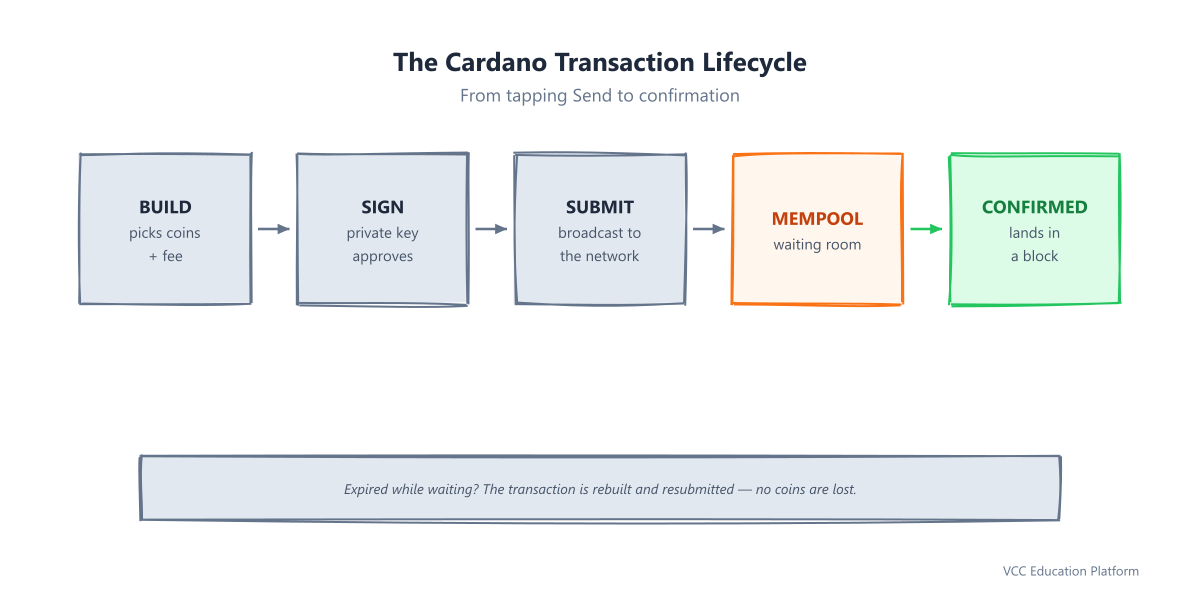
Figure 1: The five stages of a Cardano transaction
Step 1 — Building the Transaction
Before anything can move, your wallet has to assemble the pieces. Cardano uses the UTXO model — think of it as a wallet of physical cash rather than a running bank balance. The 50 ADA you want to send are not one "balance number"; they are a collection of transaction outputs, each like a banknote of a different size.
To send 50 ADA, the wallet picks up one or more of your "notes" whose value adds up to at least 50 ADA, plus a little extra for the fee. Because a note cannot be split, the wallet creates two outputs: 50 ADA to your friend, and the leftover — called change — back to a fresh address owned by you. This is why you sometimes see two transactions in your history for one transfer: the send and the change.
A simple transfer is tiny — roughly 200 bytes. The fee is calculated from the size of the transaction using two network parameters: fee = 44 × size + 155381 lovelace. For a 200-byte transfer that works out to about 0.164 ADA. To put it in perspective, sending 50 ADA costs you less than one-quarter of an ADA in fees — a fraction of a cent at typical prices. Every cardano utxo transaction follows exactly this recipe: inputs, outputs, a fee, and your signature.
Step 2 — Signing and Submitting
Once built, the transaction is only a proposal. It becomes valid when the owners of the input coins sign it with their private key. Your wallet never exposes that key — instead it creates a digital witness proving you are allowed to spend those coins. On a mobile wallet you approve with a PIN or fingerprint; on a hardware wallet you tap a button; in a browser DApp, a Cardano wallet connector (the CIP-30 standard) pops up and asks you to confirm before anything is signed.
After signing, the transaction is submitted to the network. From this moment it carries a transaction hash — a 64-character string that is your permanent receipt. If you have ever kept a bank transfer reference (mã giao dịch) to prove a payment, this is the blockchain equivalent: quote it to anyone to prove the payment exists.
Step 3 — Waiting in the Mempool
Your signed transaction does not go straight into the blockchain. It first lands in the mempool — a buffer held by each node, shared across the network through gossip. Imagine a busy train station: the mempool is the waiting hall, and your transaction is one passenger holding a ticket.
While it waits, nodes announce your transaction ID to their neighbours and pass the full transaction along when asked. When a slot leader prepares the next block, they pull transactions from the mempool — and here is the part most tutorials skip: the fee is your priority ticket. Higher-fee transactions tend to be selected first. If the network is quiet, everything clears in seconds; if it is congested, a low-fee transaction can sit in the "Submitted" state while bigger fees jump the queue.
Your transaction also has a validity interval (sometimes called TTL). If it is not confirmed before that window closes, it is dropped from the mempool. Here is the crucial part: your money is never lost. An expired transaction was never actually spent — the inputs simply return to your control, and your wallet will offer to rebuild and resubmit it with a fresh window.
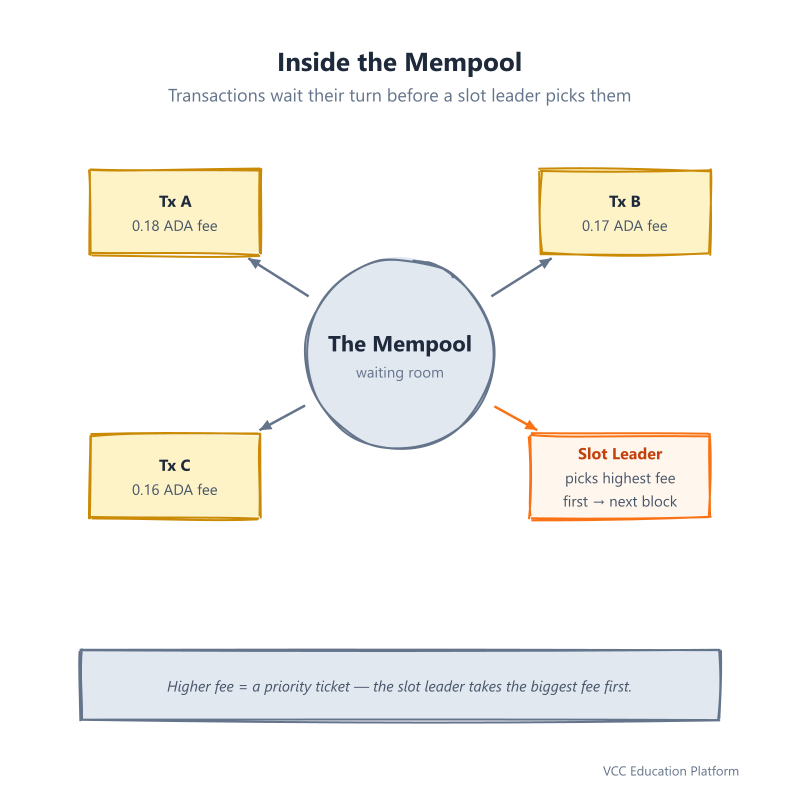
Figure 2: Inside the mempool — a higher fee is your priority ticket
Step 4 — Landing in a Block
Every few seconds, the network schedules a slot leader. Cardano's Ouroboros protocol runs a fair lottery: every staked ADA acts as a ticket in a VRF draw, and the winner for each slot gets the right to produce a block. If that slot leader is offline, the slot is skipped and the next one arrives — blocks are simply not produced for empty slots.
When a block is created, your transaction is bundled inside it, the block header is gossiped across the network in about 1–2 seconds, and other nodes validate and relay it. Once the block is adopted, your transaction is confirmed.
Block time has changed twice in Cardano's life: it started at 20 seconds, was cut to 15 seconds in March 2025 (Node v9.2), and dropped to roughly 9 seconds with the Chang-2 upgrade on 1 September 2025. That is why a simple transfer today usually shows its first confirmation in under half a minute. When you hear that Cardano is "slow," remember: the protocol parameter was deliberately conservative, and it has already been tightened twice without weakening security.
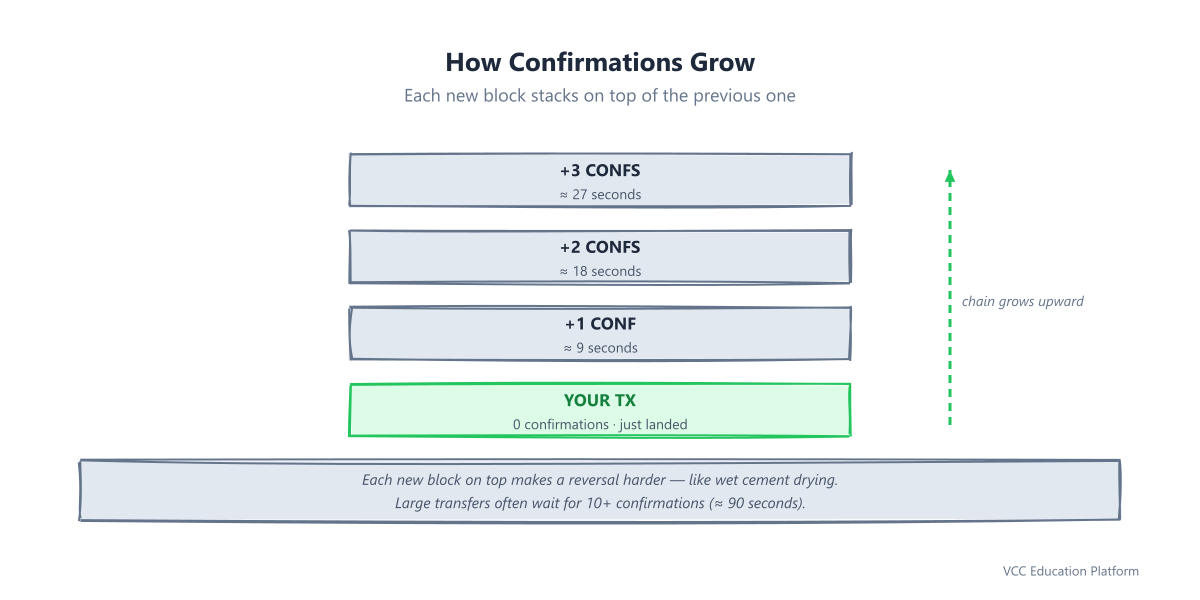
Figure 3: Confirmations — each new block on top makes a reversal harder
Step 5 — Confirmations: How Final Is Final?
Here is the nuance that trips up beginners: Cardano has no single "finality moment." Each block that stacks on top of your transaction adds one confirmation, and each confirmation makes a reversal less and less likely.
Think of writing in wet cement. The first block is your transaction pressed into the slab — visible, but still soft. Every new block on top is another trowel of cement drying over it. To change what you wrote, an attacker would need to control more than 50% of the staked ADA and rebuild the chain from before your transaction — a task so expensive that, in practice, a confirmed transaction is treated as permanent.
So how many confirmations do you need? It depends on what is at risk:
- 1–2 confirmations (~9–18 seconds): perfectly fine for sending a friend pocket money.
- 10–50 confirmations: the range many exchanges and services choose before crediting large deposits.
- The classic "51 confirmations" figure (one full historical cycle) was about 17 minutes at the old 20-second block time; at today's ~9 seconds it is about 7.6 minutes.
The number is a risk dial you choose, not a rule the network enforces. Asking "how many confirmations do I need?" is really asking "how much money is at stake?"
How to Watch Your Transaction Live
You do not need to take any of this on faith. Paste your transaction hash into any Cardano explorer — Cexplorer, CardanoScan, or pool.pm — and you can watch the whole lifecycle in real time: the state it is in, the block it landed in, the slot number, the fee you paid, and the confirmations stacking up. During high traffic you can even see transactions sitting in the mempool waiting for a slot.
This is one of the great trust features of how transactions are processed on cardano: the record is public, live, and verifiable by anyone — not just by your bank.
Frequently Asked Questions
Why is my Cardano transaction stuck as "Submitting" or "Pending"?
It is almost always the mempool. Either the network is congested and lower-fee transactions are waiting their turn, or your transaction's validity interval expired and the wallet is preparing a rebuild. Give it a few minutes; if it drops back to Draft, resubmit — your funds are safe either way.
Can a Cardano transaction fail?
Yes, in two ways. Structural problems (a wrong signature, an input that no longer exists) are caught in validation Phase 1 and simply rejected — this costs nothing. Smart-contract transactions that fail their script logic in Phase 2 must pay a small collateral penalty. For a simple person-to-person transfer, failures are extremely rare.
How many confirmations do I need to trust a Cardano payment?
For personal, low-value transfers, 1–2 confirmations is plenty. If you are accepting a large payment or running a business, choose a higher threshold — 10 confirmations or more — to reduce the (already tiny) risk that the chain gets reorganised.
Does my money disappear if a transaction expires?
No. An expired transaction was never spent — the coins simply return to your control, and your wallet will rebuild it with a new validity window. The worst case is a small delay.
Are Cardano transactions expensive?
For a simple transfer, no. A ~200-byte transfer costs roughly 0.16 ADA in fees regardless of the amount you send — sending 1 ADA and sending 10,000 ADA cost the same. Fees are predictable because they depend on transaction size, not on how much value moves.
The Takeaway
A Cardano transaction is a short, safe journey: your wallet builds it, you sign it, the network shares it, a slot leader packs it into a block, and confirmations seal it. The whole process takes seconds for a typical transfer, costs a fraction of an ADA, and can be watched live on an explorer. The next time you hit Send, you will know exactly where your money is at every step — and why it is waiting there.