
In June 2025, a privacy-focused blockchain called Midnight took a snapshot of eight blockchains and quietly decided who would receive its new token. What happened next became one of the largest token distributions in crypto history — the glacier drop midnight event delivered an airdrop night token called NIGHT to more than 8 million wallets by the time both claim phases closed. It is a fascinating case study in how airdrops work: who gets tokens, how eligibility is decided, and why a simple design can move millions of people while a complex one leaves most eligible wallets empty.
If you have ever held ADA, BTC, ETH, or any major token in a wallet or on an exchange, this story is about you. The Glacier Drop handed out free tokens to people who did almost nothing — but only if they met very specific conditions. Understanding those conditions, and the lessons from the rollout, will help you in every future airdrop you encounter.
The Glacier Drop Midnight Event, Explained Simply
Midnight is a blockchain built inside the Cardano ecosystem with a single goal: privacy with rules. It uses zero-knowledge technology so you can prove things about your data (your age, your identity, your balance) without revealing the data itself. Midnight needed users from day one, and the team behind it decided the best way to attract them was the most radical move in crypto: give the token away.
The token is called NIGHT — 24 billion of them exist. Holding NIGHT automatically generates DUST, a separate, shielded resource used to pay for private transactions on the network. Think of NIGHT as the wallet or the engine, and DUST as the fuel: the fuel is consumed when you drive, and the engine quietly produces more over time.
The Glacier Drop is the first phase of this giveaway. The name comes from the clever part: the tokens were "frozen" like ice at first, then allowed to "thaw" slowly over a year. We will come back to that.
The Snapshot: Who Got the airdrop night token
Airdrops need a fair way to pick winners. Midnight's method was a snapshot: on June 11, 2025, it recorded the balances of every address on eight networks — Cardano (ADA), Bitcoin (BTC), Ethereum (ETH), Solana (SOL), XRP Ledger (XRP), BNB Chain (BNB), Avalanche (AVAX), and Basic Attention Token (BAT). Whatever your balance was at that exact moment is what counted. Nothing before it, nothing after.
To qualify, an address had to meet three simple rules:
- Hold at least $100 of the network's native token. On Cardano, that meant a minimum of about 139.66 ADA at block height 11980709.
- Be self-custodied — the tokens had to sit in a wallet where you hold the private keys, not on an exchange.
- Not be on a sanctions list — addresses on the US Treasury's OFAC SDN list were excluded.
Almost 34 million addresses met these rules across all eight networks. The allocation was also heavily weighted: Cardano holders got 50% of the total supply (12 billion NIGHT), Bitcoin holders got 20%, and the remaining six ecosystems shared 30% in proportion to their snapshot value.
This is where the first quiet lesson hides. The $100 floor looks small, but it is a deliberate anti-cheating filter — it prices out the automated bot farms that create thousands of near-empty wallets to farm free tokens. And the "self-custody" rule means that if your ADA was sitting on an exchange in June 2025, you were simply out. No exceptions, no appeals.
How the Claim Actually Worked
Knowing you are eligible is one thing. Claiming is another. The claim portal opened on August 5, 2025, and the process was carefully designed to prove you were the real owner of each address:
- Sign a message. You connected the eligible wallet and cryptographically signed a claim message using its private key. This proves you control the address without ever revealing the key.
- Provide a destination address. You gave the portal a Cardano address where your NIGHT would eventually be delivered.
That is it. Claiming was completely free — a signature costs nothing on Bitcoin, Ethereum, or Cardano. No KYC, no questionnaires, no gas fees. You could even claim from multiple eligible addresses you owned, sending everything to one destination.
Why your destination address had to be brand new
Here is the detail that surprised thousands of people: the destination Cardano address had to be unused — it could not have ever received or sent a transaction. This is not bureaucracy; it is privacy by design. Midnight publishes on-chain proofs for every redemption, and if you reused your main wallet address, anyone could look at the proof and link your airdrop to everything else you own. A fresh address keeps your token claim disconnected from your other holdings — exactly the "selective disclosure" philosophy Midnight is built on.
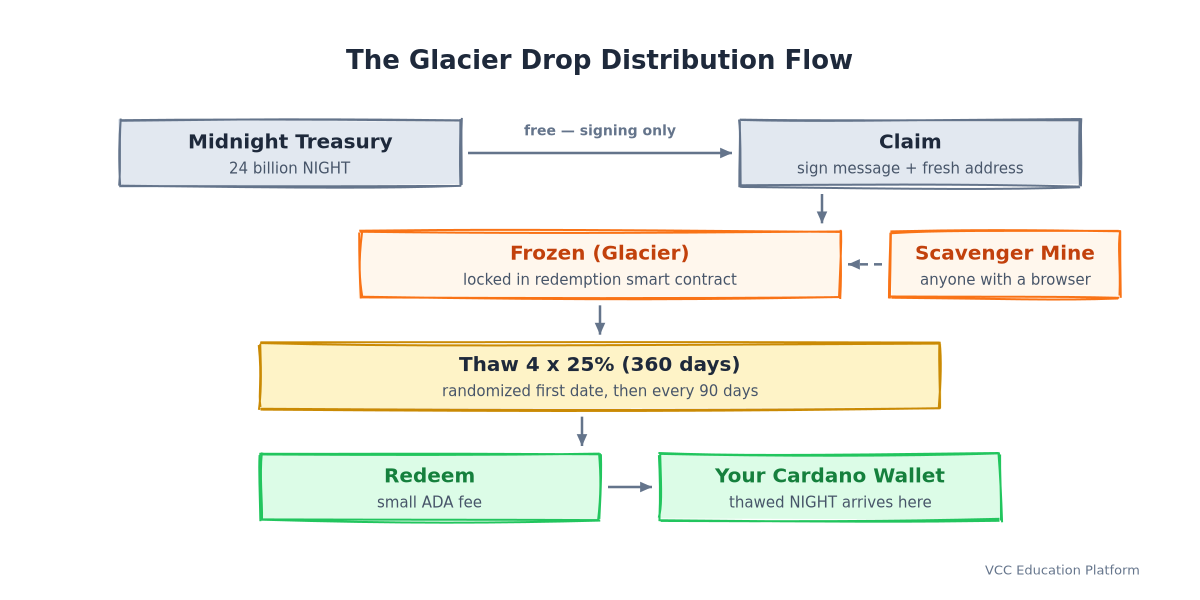
Figure 1: The Glacier Drop Distribution Flow — claim, freeze, thaw, redeem
The airdrop night token Mechanics: Frozen, Then Thawing
Remember the name Glacier Drop? This is where it pays off. Claimed NIGHT was frozen — locked in a smart contract, impossible to sell or transfer. Then, starting December 10, 2025, allocations began to thaw:
- Each wallet's allocation unlocks in four equal installments of 25%.
- The first thaw date is randomized for every destination address — it falls somewhere between December 10, 2025, and early March 2026.
- After the first thaw, the next three installments unlock every 90 days.
- You then redeem the thawed NIGHT by moving it to your Cardano wallet. Each redemption is a normal Cardano transaction, so it costs a tiny amount of ADA as a network fee.
Why randomize the first date? Imagine everyone's tokens unlocked on the same day. Millions of people would rush to sell at once, and the price would collapse in a few hours. Spreading the thaw dates across 90 days means only a fraction of wallets have tokens available at any moment — coordinated "dump events" become much harder. The glacier metaphor is marketing for what is really a clever anti-volatility vesting schedule.
This mechanic matters for you as a reader: when you see a token with "vesting" or "unlock schedule," it is usually the same idea — the project is deliberately slowing down how fast the free tokens can hit the market.
The Second Wave That Hit 8 Million Wallets
The Glacier Drop itself finished with a surprising result: only about 170,000 addresses actually claimed their NIGHT, taking roughly 3.5 billion tokens. That sounds big, but it is only about 14% of the 34 million eligible wallets. Most eligible people simply never claimed.
Midnight had planned for exactly this. Every unclaimed token rolled into a second phase called Scavenger Mine:
- Open to anyone — no snapshot, no $100 requirement, no crypto ownership needed.
- You just opened a browser page, let your computer solve simple cryptographic puzzles (proof-of-work style), and accumulated points.
- At the end of each 24-hour cycle, a snapshot divided that day's pool — about 30 million NIGHT — proportionally among everyone's completed work.
- It ran for 21 days in November 2025 and distributed 1 billion NIGHT.
The result stunned even the team: over 8 million unique wallet addresses participated — the team called it an industry record for a token distribution. It was the difference between rewarding the already wealthy (snapshot holders) and inviting everyone (anyone with a laptop).
This is the most important lesson in the whole article: friction decides participation. The snapshot claim required a compatible wallet, message signing, and a fresh Cardano address — technical hurdles that most casual holders never cleared. The Scavenger Mine required a browser tab. Simplicity multiplied participation roughly 47 times.
The midnight token phân phối Was Built to Resist Cheaters
Any free-money event attracts cheaters, and Midnight layered its defenses deliberately. Think of the midnight token phân phối (the token distribution) as a funnel with several filters:
- The $100 floor priced out trivial bot farms.
- The pre-announced snapshot meant you could not create thousands of tiny wallets after learning about the drop — the record was already taken.
- Message signing proved real ownership, so you could not claim someone else's address.
- OFAC exclusion kept the drop compliant with sanctions rules.
- Scavenger Mine's proof-of-work priced sybil accounts in CPU time instead of money — anyone could participate, but you had to actually run the tasks.
- DUST, the network's fee resource, is itself described by Midnight as a "sybil resistance mechanism" for the long term — paying for private actions makes mass fake activity expensive.
No system is perfect, and the cheater cat-and-mouse game continues today — but the Glacier Drop shows a realistic toolkit: price, proof, and time are the three dials every airdrop can turn.
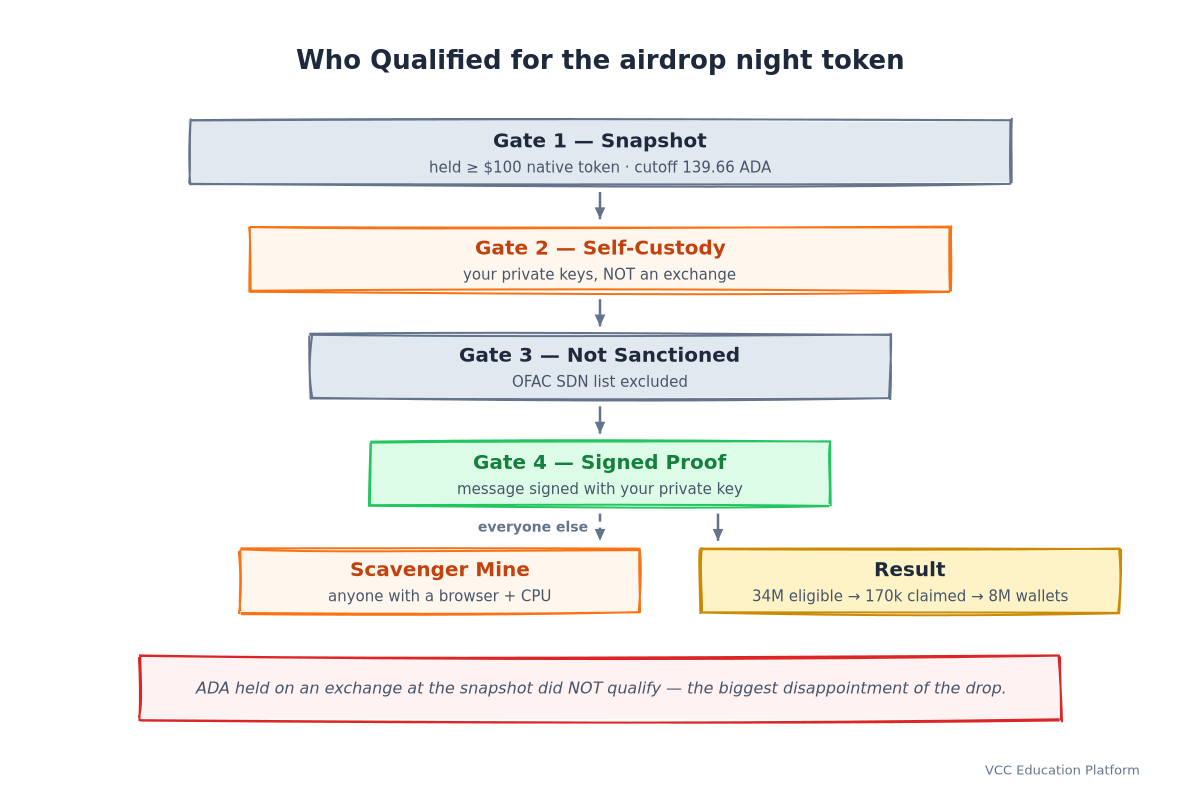
Figure 2: Who Qualified for the airdrop night token — four gates plus an open side door
What Went Wrong: Honest Lessons From the Claim
A balanced lesson needs the failures too. The rollout was not smooth, and the community documented it in detail:
- Hardware wallet gaps. On launch day, Ledger firmware (via the CIP-8 signing standard) could only sign messages up to 31 bytes, but the Glacier Drop claim message was 251 bytes — so Ledger users could not claim at first. A workaround called "null transaction signing" (placing the message in an unsigned transaction's metadata) was rushed in, but it confused users who saw an odd-looking empty transaction preview. Trezor had not implemented message signing at all.
- The "unused address" rule caused chaos. Many wallet apps return an already-used address when asked for a "new" one, and countless users submitted the wrong address and lost time fighting confusing error messages.
- Documentation lagged. Community volunteers — not the Midnight team — wrote most of the practical guides for tricky cases (XRP on Ledger, old Byron wallets, air-gapped pledge keys).
- Support was thin. People with questions found a Discord that pointed to long documents rather than answering, and some felt the team underestimated how hard the process was.
None of this stopped the eventual success — over 4.5 billion NIGHT were eventually claimed by more than 8 million addresses — but it is the difference between a successful airdrop and a smooth one. The honest summary: test every hardware wallet before launch, keep the claiming UX dead simple, and staff a real support channel. If a browser tab can onboard 8 million people, a claim portal can too — if it is built with that same simplicity.
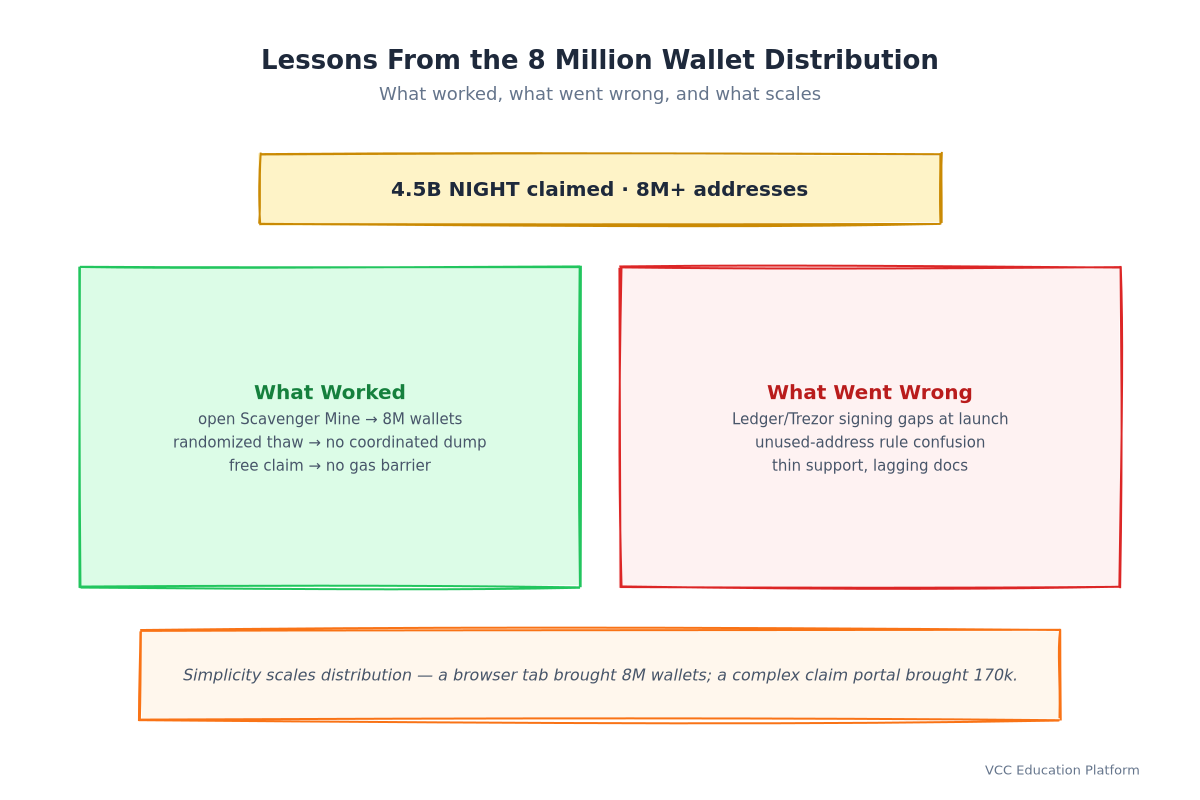
Figure 3: Lessons From the 8 Million Wallet Distribution — what worked, what went wrong
What This Means for You
If you take one idea away from this article, make it this: the modern airdrop rewards people who hold their own keys. The Glacier Drop could not have been more public — it was announced weeks before the snapshot, and the criteria were published in plain language. Yet most eligible wallets went unclaimed, and a large share of those belonged to people whose crypto sat on exchanges where they could not sign the proof.
For Vietnamese readers this hits close to home. Most Vietnamese crypto users hold on exchange wallets — and after major exchanges exited the market, many people's ADA stayed in custodial accounts. When the June 2025 snapshot was taken, that ADA simply did not count. The lesson is the same one privacy-focused projects keep teaching: a private key is like a safe-deposit box key — the bank (exchange) holds its copy, but only your copy can claim what is yours.
It also means: do not ignore announcements. Midnight announced the Glacier Drop weeks before claiming started. A short calendar check and 10 minutes of signing was the difference between receiving free NIGHT and watching it go to someone else — or into the Scavenger Mine pool for anyone with a browser.
FAQ
What exactly was the Glacier Drop midnight event?
The Glacier Drop midnight event was the first phase of the NIGHT token giveaway by Midnight, a privacy blockchain in the Cardano ecosystem. It used a June 11, 2025 snapshot to allocate NIGHT to holders of $100+ in eight cryptocurrencies, then a second open phase (Scavenger Mine) pushed participation past 8 million wallets.Was the airdrop night token free to claim?
Yes. Claiming NIGHT cost nothing — you only signed a message to prove ownership and provided a Cardano destination address. The only fee ever involved is a small ADA network cost when you later redeem thawed NIGHT to your wallet.How was the midnight token phân phối decided?
The midnight token phân phối was decided by an on-chain snapshot on June 11, 2025. Cardano wallets received 50% of the 24 billion supply, Bitcoin 20%, and the other six networks shared 30% proportionally to their snapshot value. A minimum $100 balance was required, and the funds had to be in a self-custody wallet.What is wNIGHT?
wNIGHT is wrapped NIGHT issued by the Wanchain bridge on BNB Chain — a version of NIGHT that can move outside Cardano. It is bridge infrastructure, not part of the Glacier Drop claim itself. In July 2026 the bridge's Cardano-side lock address was drained in an exploit, leaving much of the wNIGHT on BNB without backing; the Midnight network itself was not affected.I hold ADA on an exchange — would I have qualified?
No. The snapshot required self-custody: the ADA had to be in a wallet whose private keys you control. Exchange-held funds could not be signed, so they were ineligible. This was one of the biggest sources of disappointment during the Glacier Drop.When could claimed NIGHT actually be moved?
Claimed NIGHT was frozen at first. Thawing began December 10, 2025, with each allocation unlocking in four 25% installments — the first on a randomized date within 90 days, then every 90 days after. After a tranche thawed, you redeemed it to your Cardano wallet.What was Scavenger Mine?
Scavenger Mine was the second distribution phase — open to anyone with a browser and a computer. Participants solved cryptographic puzzles (proof-of-work style) over 21 days in November 2025 and shared 1 billion NIGHT proportionally. It attracted over 8 million wallets, an industry record.What is the real lesson from the Glacier Drop for beginners?
Three: hold your own keys (self-custody), read announcements early (snapshots reward those who are prepared), and never pay anyone to claim an airdrop — legitimate claims are always free.The Bottom Line
The glacier drop midnight event was a masterclass in airdrop design and a cautionary tale in airdrop execution at the same time. On the design side, it combined a fair snapshot, strict sybil defenses, a freeze-and-thaw schedule that protected the token's price, and an open second phase that turned 170,000 claims into 8 million wallets. On the execution side, it showed how hardware-wallet gaps, a confusing address rule, and thin support can quietly leave millions of eligible people behind.
For you, the practical takeaways are simple and permanent: keep your own keys, stay alert for snapshot announcements, and remember that the most accessible airdrop always wins the most wallets. Midnight's next moves, and every future airdrop you encounter, will be judged against the standard the Glacier Drop set — 8 million wallets, one browser tab at a time.