
Meta Description: Discover Cardano's roadmap beyond Voltaire. Learn about the Dijkstra era (scaling), Euler era (usability), Leios protocol, Hydra, Midnight, and what this means for Vietnam's growing crypto ecosystem.
Open a crypto wallet in Vietnam today and you'll see ADA alongside BTC and ETH. But ask where Cardano is headed next and even experienced holders pause. The five-era roadmap—Byron, Shelley, Goguen, Basho, Voltaire—is familiar. What comes after Voltaire is not.
Cardano has entered its Voltaire era (governance). The next two eras already have names: Dijkstra (scaling/performance) and Euler (usability/interoperability). This isn't speculation—it's the published roadmap. But the details, timelines, and what they mean for actual users remain opaque.
This article maps what's coming, why it matters, and what Vietnamese users should watch.
The Roadmap Beyond Voltaire: Two Named Eras
Cardano's development eras are named after mathematicians and scientists. After Voltaire (governance) come:
| Era | Focus | Status |
|---|---|---|
| Voltaire | Governance & treasury | Active (CIP-1694 live) |
| Dijkstra | Scaling, performance, throughput | Research → Implementation |
| Euler | Developer experience, interoperability, usability | Design phase |
Dijkstra = Edsger Dijkstra (algorithm pioneer). Fitting for an era about efficiency. Euler = Leonhard Euler (foundational mathematics). Fitting for an era about foundations developers build on.
Key insight: The eras overlap. Voltaire governance decisions fund Dijkstra development. Dijkstra infrastructure enables Euler usability. They're not sequential waterfalls.
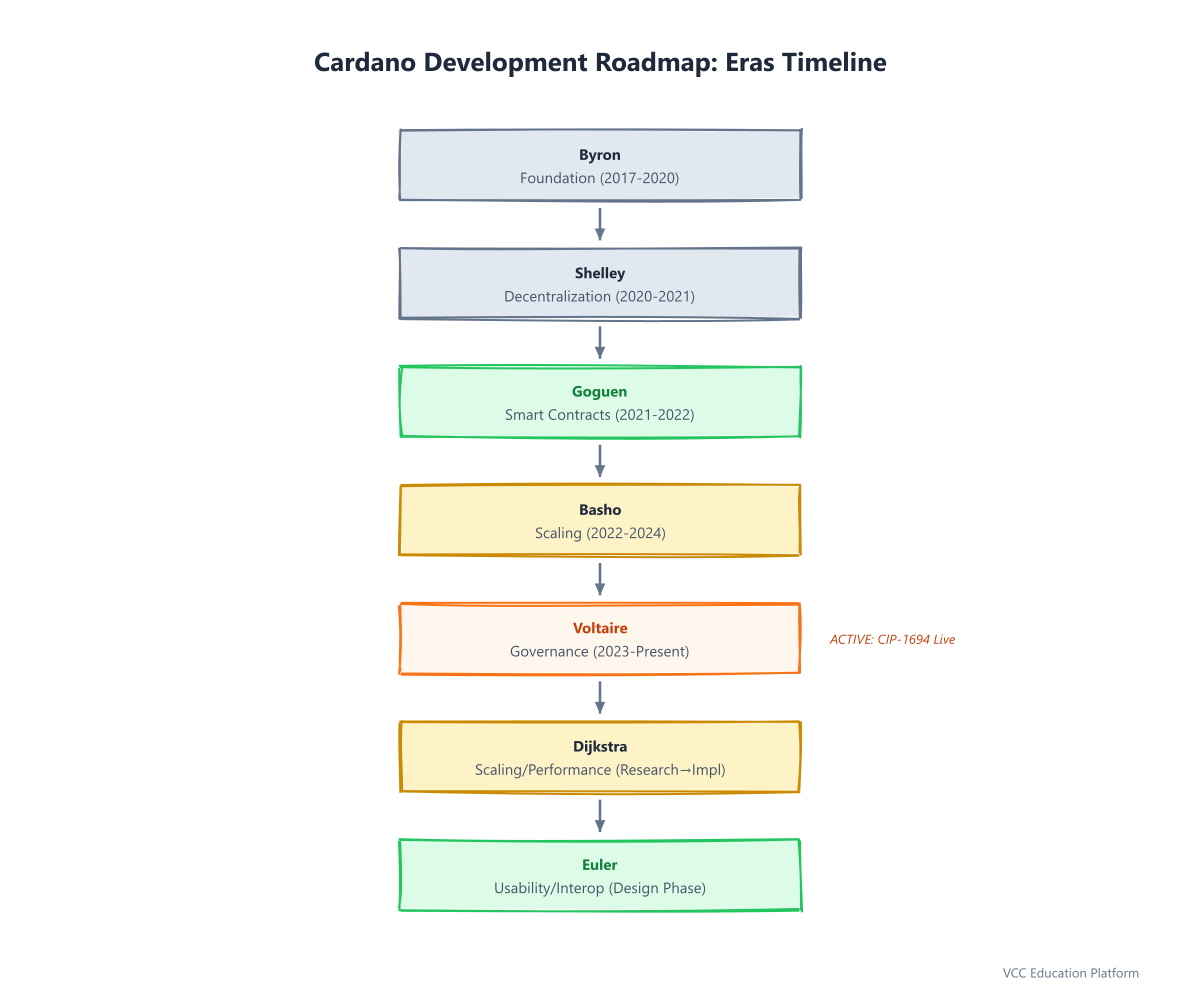
Dijkstra Era: The Scaling Push
Dijkstra targets the classic blockchain trilemma: decentralization + security + throughput. Cardano's answer is a multi-layered architecture, not a single silver bullet.
1. Leios: New Consensus for 1,000+ TPS
Leios (Lightweight Efficient Input Output System) is a proposed consensus protocol redesign. Current Ouroboros Praos produces ~250 TPS theoretical. Leios targets 1,000+ TPS by:
- Parallel block production: Multiple blocks per slot instead of one
- Pipelined validation: Overlap validation with production
- Reduced finality time: From minutes toward seconds
Reality check: Leios is in research/prototyping (2024-2025). No mainnet date committed. The "1,000+ TPS" is a research target, not a guarantee.
2. Hydra: Layer 2 Heads Already Live
While Leios rebuilds L1, Hydra scales L2 today. Hydra Heads (state channels) are live on mainnet since 2023.
| Metric | Status |
|---|---|
| Heads on mainnet | ✅ Live |
| TPS per Head | ~1,000 (theoretical) |
| Use cases | Payments, gaming, DeFi micro-transactions |
| Adoption | Growing but early |
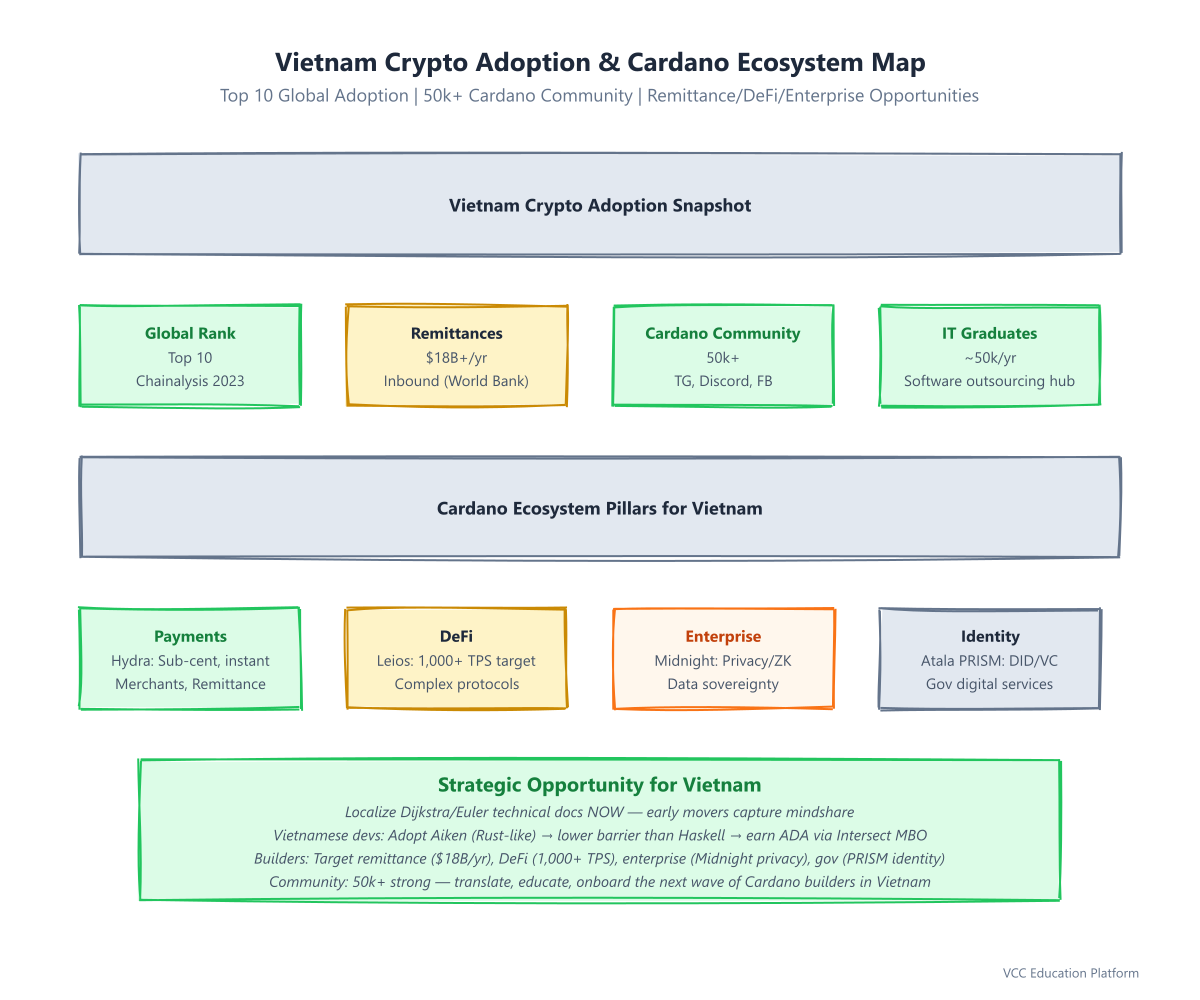
Vietnam angle: Hydra enables low-fee, instant payments—critical for Vietnamese merchants and remittance use cases.
3. Mithril: Fast Chain Sync
Mithril uses stake-based threshold signatures to let light clients sync the chain in seconds instead of hours.
- Use case: Mobile wallets, browser extensions, IoT devices
- Status: Mainnet beta (2024), integrating with Lace, Eternl, other wallets
- Impact: Removes the "wait for sync" barrier for new users
4. Partner Chains: Horizontal Scaling
Partner chains let projects launch custom blockchains secured by Cardano's validator set (via shared security).
- Midnight: Privacy-focused partner chain (zero-knowledge proofs, data protection)
- Other partners: Gaming chains, institutional settlement layers, regional chains
- Model: Like Polkadot parachains but with Cardano's security model
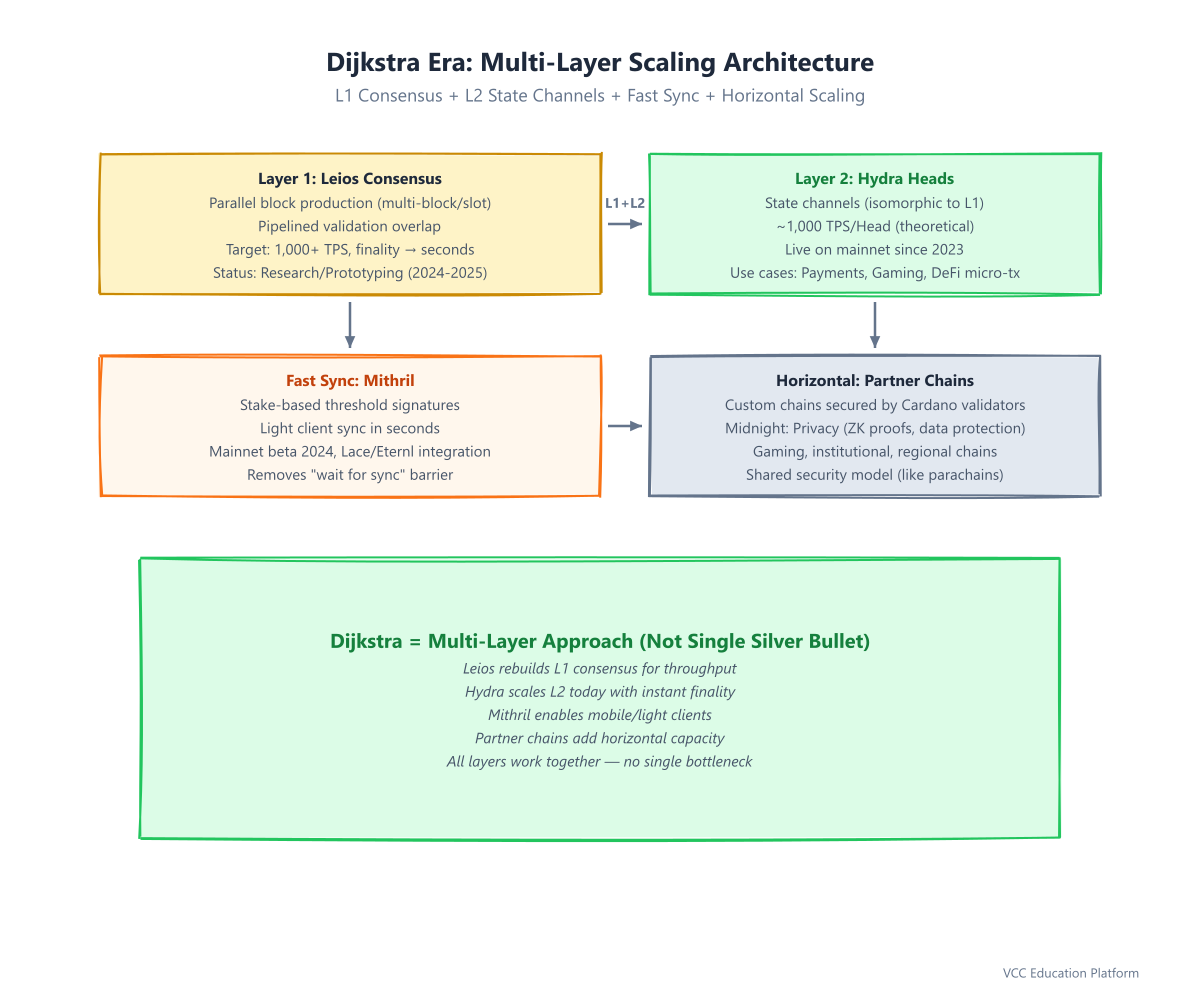
Euler Era: Usability & Interoperability
If Dijkstra is "make it fast," Euler is "make it usable."
The Real Euler Deliverable: Developer Experience
Cardano's #1 developer complaint: steep learning curve (eUTXO model, Plutus/Haskell, limited tooling).
Euler's concrete deliverables:
| Tool/Platform | What It Solves |
|---|---|
| Aiken | Rust-like language for smart contracts (replaces Plutus Tx complexity) |
| Marlowe | Domain-specific language for financial contracts (non-programmers) |
| Mesh, Lucid, Cardano Serialization Lib | Better TypeScript/JS SDKs |
| Improved Plutus tooling | Debugging, testing, formal verification integration |
Vietnam relevance: Vietnam produces ~50,000 IT graduates/year. Aiken (Rust-like) fits existing skillsets better than Haskell.
Cross-Chain Interoperability
- IBC (Inter-Blockchain Communication): Cosmos-standard bridging
- Sidechain bridges: Trust-minimized bridges to Ethereum, Bitcoin, Solana
- Universal asset standards: Move assets across chains without wrapped tokens
Governance-to-Development Pipeline
Voltaire's treasury (~1.5B ADA ≈ $500M+) funds Euler priorities. Intersect MBO (Member-Based Organization) now manages core development—community proposes, stakeholders vote, Intersect executes.
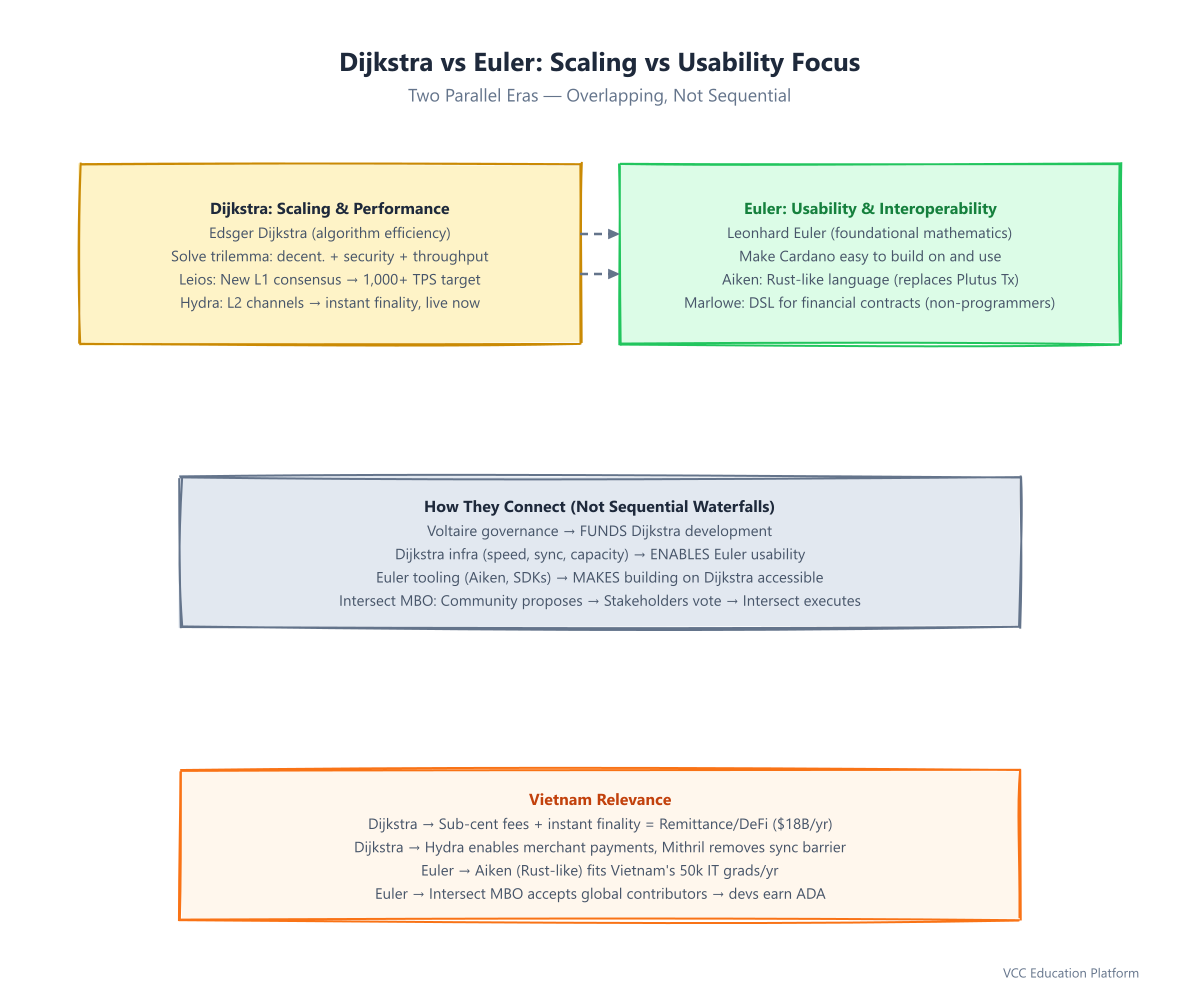
The Governance Engine: Intersect MBO & Treasury
This is the most underappreciated part of Cardano's future.
Intersect MBO: First Major Blockchain to Decentralize Core Dev
- Formed: 2023 (Cardano Foundation + IOG + Emurgo → Intersect)
- Structure: Member-based organization (anyone can join, vote, contribute)
- Role: Maintains node software, leads protocol upgrades, manages treasury spend
- Significance: No single company controls the protocol. Ethereum has EF; Solana has Solana Labs; Cardano has Intersect.
Treasury: Strategic War Chest
~1.5B ADA in treasury. At $0.35/ADA = $525M. At $1/ADA = $1.5B.
| Comparison | Treasury Size |
|---|---|
| Cardano | ~$500M–$1.5B |
| Ethereum Foundation | ~$400M (ETH + fiat) |
| Solana Foundation | ~$200M+ (SOL + grants) |
| Polkadot Treasury | ~$200M (DOT) |
Cardano's treasury is larger than most—and it's on-chain, programmatically controlled by governance.
Project Catalyst: Ecosystem Grants
- Funded: 1,000+ projects since 2020
- Categories: DeFi, tooling, education, identity, real-world assets
- Vietnam projects funded: Several (education, localization, community building)
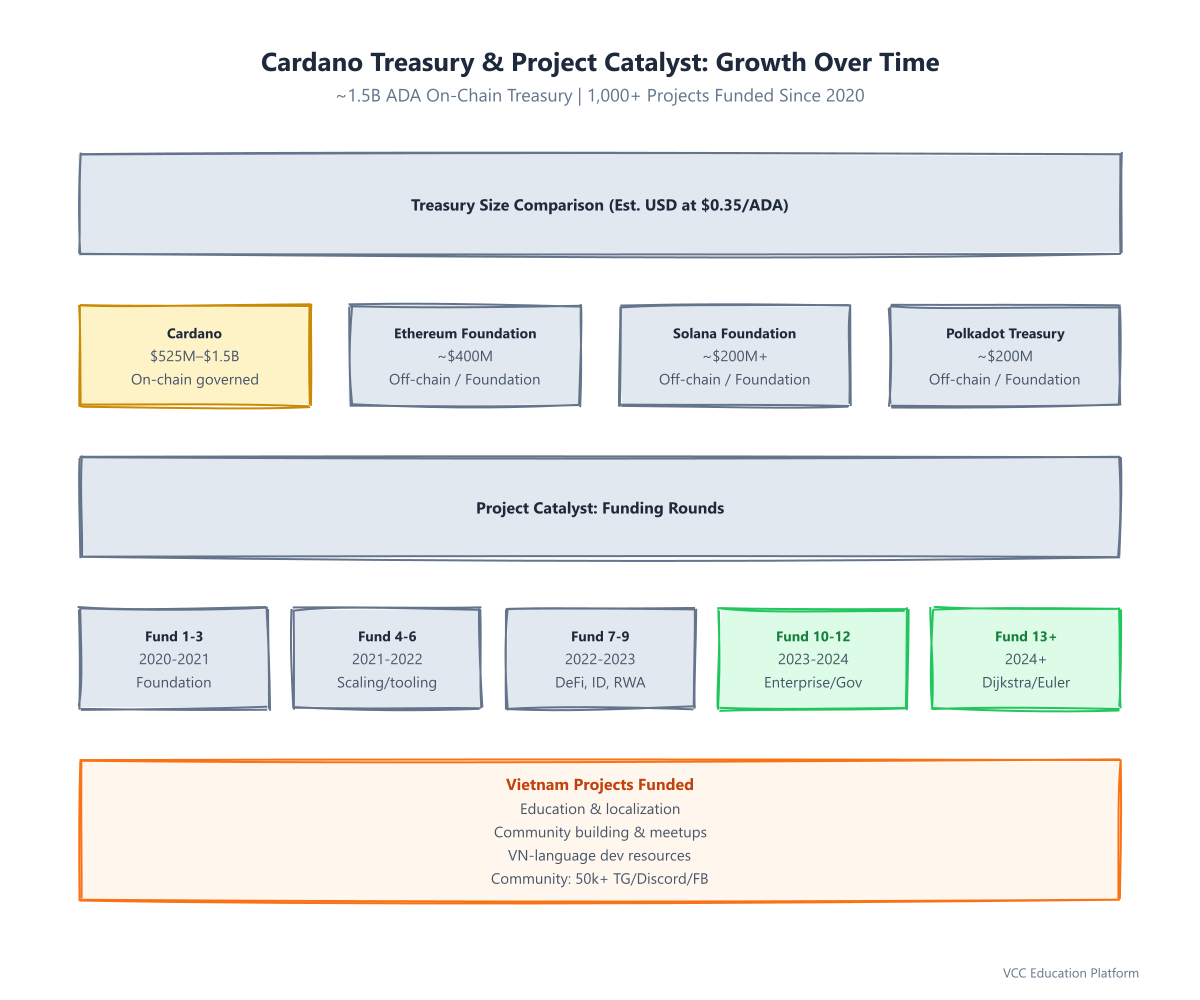
What This Means for Vietnam
1. Fees & Speed → Real Adoption
| Current | Dijkstra Target |
|---|---|
| Sub-cent fees via Hydra/Leios | |
| ~20 sec finality | Sub-second (Hydra), few seconds (Leios) |
| Limited DeFi throughput | 1,000+ TPS enabling complex DeFi |
Vietnam use case: Remittances ($18B+/year inbound). Sub-cent, instant ADA transfers + stablecoins on Cardano = compelling alternative.
2. Developer Talent Pipeline
- Vietnam: Top 10 globally for software outsourcing
- Aiken (Rust-like) + better tooling = lower barrier for Vietnamese devs
- Intersect MBO accepts global contributors—Vietnamese devs can earn ADA contributing to core protocol
3. Enterprise & Government Interest
- Midnight (privacy chain): Data sovereignty for Vietnamese enterprises
- Atala PRISM (identity): Digital ID, credential verification—relevant for gov services
- Regulatory clarity: Cardano's academic/formal methods approach aligns with cautious regulators
4. Community & Education
- Cardano Vietnam community: 50k+ across Telegram, Discord, Facebook
- Vietnamese-language resources growing (but still gap vs English)
- Opportunity: Localize Dijkstra/Euler technical docs now—early movers capture mindshare
Common Misconceptions
| Misconception | Reality |
|---|---|
| "Cardano is slow to ship" | Deliberate: formal verification prevents exploits. No major hack on L1. |
| "Hydra failed" | Heads live. Adoption takes time (like Lightning Network). |
| "Leios will solve everything" | Leios is L1 only. Full scaling = Leios + Hydra + Partner chains. |
| "Euler is vague" | Intentional: usability priorities come from developers, not top-down. |
| "Treasury will run out" | At current burn rate: decades. ADA appreciation extends runway. |
FAQ
Q: When will Dijkstra era start? A: No fixed date. Leios research 2024-2025; implementation follows. Hydra is Dijkstra infrastructure already live.
Q: Will ADA price go up from these upgrades? A: Upgrades improve fundamentals. Price follows adoption, not roadmaps. DYOR.
Q: How can Vietnamese developers contribute? A: Join Intersect MBO (free), build on Aiken/Marlowe, apply for Catalyst funding, translate docs.
Q: Is Midnight (privacy chain) launching soon? A: Testnet 2024, mainnet timeline TBD. Partner chain model means it secures itself with own token + Cardano stake.
Q: What's the difference between partner chains and sidechains? A: Partner chains = shared security (Cardano validators secure them). Sidechains = own validator set, bridge to Cardano.
Key Takeaways
- Voltaire is active → governance decides funding
- Dijkstra = scaling → Leios (L1) + Hydra (L2) + Mithril (sync) + Partner chains (horizontal)
- Euler = usability → Aiken, Marlowe, better SDKs, cross-chain interop
- Intersect MBO = first decentralized core dev org for a major L1
- Treasury = $500M+ war chest, on-chain governed
- Vietnam wins if: devs adopt Aiken early, community localizes docs, builders target remittance/DeFi/enterprise use cases
The roadmap isn't a promise—it's a coordination tool. The code ships when it's ready. But the direction is clear: scale the base layer, accelerate L2, make building easy, govern it all on-chain. Vietnam's developers, users, and enterprises have a front-row seat—and a chance to help build it.