
 ### Stake Pools vs Mining Farms
Picture the difference: a Bitcoin mining farm in Texas spans acres, humming with thousands of ASICs drawing 3–5 MW continuously. A Cardano stake pool runs on a couple of cloud servers or a home office rack — perhaps 200–500W total. The stake pool operator's "skin in the game" is the ADA pledged and delegated, not the electricity bill.
For Vietnamese users, this maps to a familiar concept: **stake delegation resembles a *hui* (rotating savings group)**. You contribute capital (delegate ADA) to a trusted operator (the pool), who does the work (validates blocks) and shares rewards. No one burns fuel to prove commitment; the capital itself is the bond.
### Stake Pools vs Mining Farms
Picture the difference: a Bitcoin mining farm in Texas spans acres, humming with thousands of ASICs drawing 3–5 MW continuously. A Cardano stake pool runs on a couple of cloud servers or a home office rack — perhaps 200–500W total. The stake pool operator's "skin in the game" is the ADA pledged and delegated, not the electricity bill.
For Vietnamese users, this maps to a familiar concept: **stake delegation resembles a *hui* (rotating savings group)**. You contribute capital (delegate ADA) to a trusted operator (the pool), who does the work (validates blocks) and shares rewards. No one burns fuel to prove commitment; the capital itself is the bond.
 ### Quantitative Comparison (Qualitative Framing)
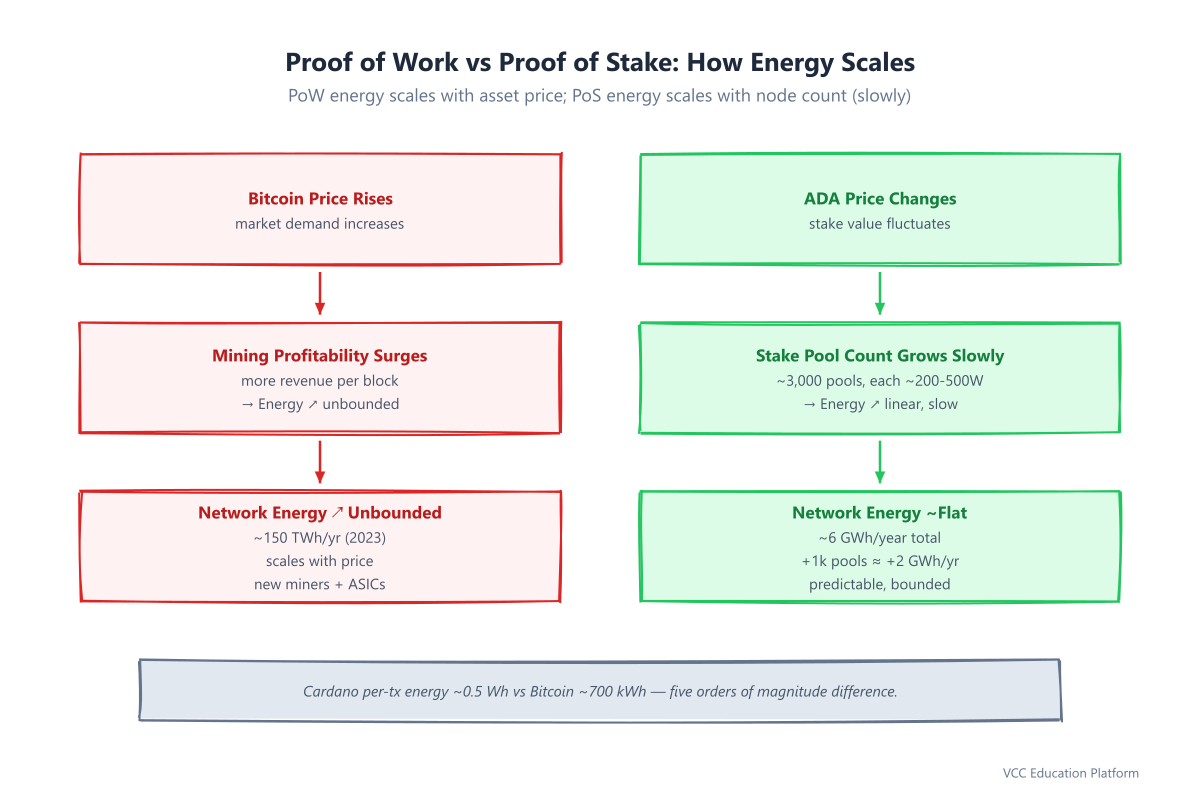
Detailed kWh-per-transaction tables belong in a dedicated energy comparison (see our companion article *Energy Efficiency Comparison*). Here, the qualitative takeaway matters: **Cardano's energy per transaction is roughly five orders of magnitude lower than Bitcoin's**. That's not "5× less" — it's 100,000× less. The difference between a motorbike and a cargo ship.
But raw numbers obscure a deeper point: PoW energy is *variable and unbounded* (price ↑ → energy ↑), while PoS energy is *stable and bounded* (node count ↑ → energy ↑ linearly, slowly). Cardano adding 1,000 more stake pools adds perhaps 2 GWh/year. Bitcoin adding 1,000 more miners could add 50 TWh/year.
## Cardano Foundation's Carbon Neutrality Commitment
### Measure, Reduce, Offset
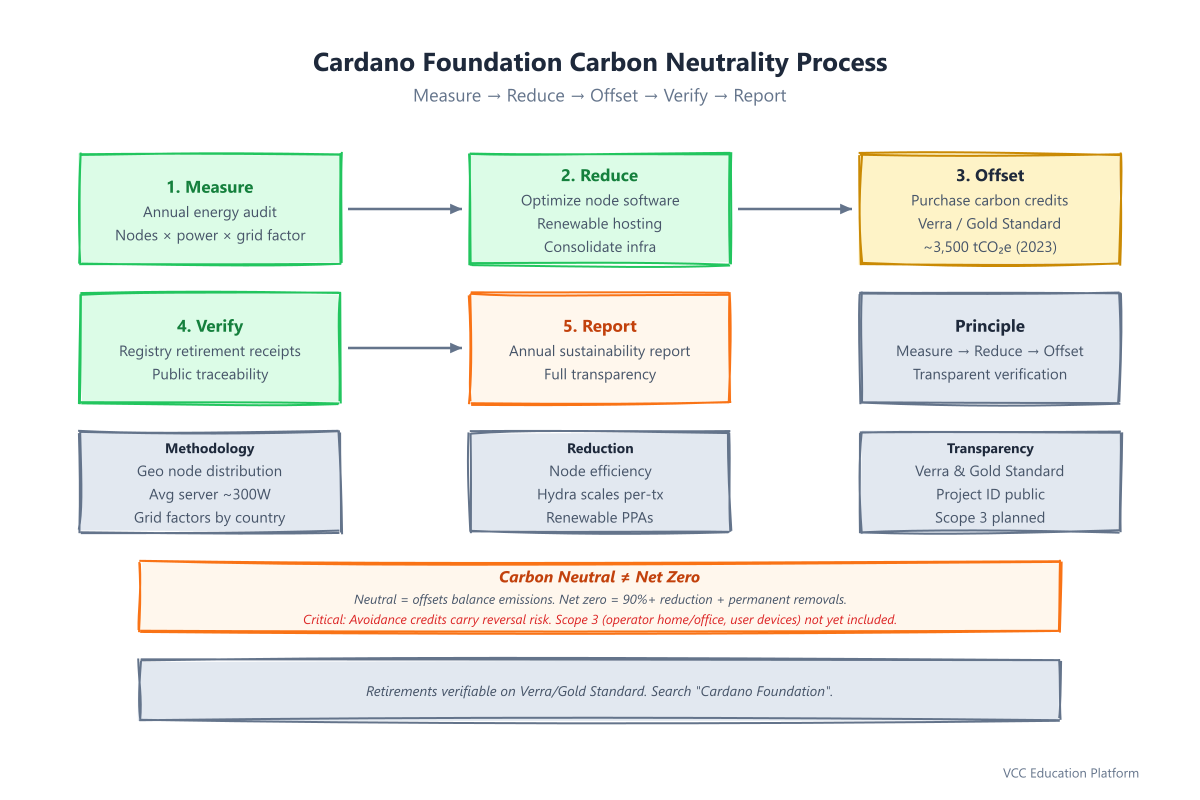
Low energy use doesn't mean zero impact. The Cardano Foundation follows a three-step framework:
1. **Measure**: Annual network energy audit (methodology: node count × average server draw × grid emission factors by geography).
2. **Reduce**: Optimize node software, encourage renewable-powered hosting, consolidate infrastructure.
3. **Offset**: Purchase and retire high-quality carbon credits for residual emissions.
The 2023 Sustainability Report documents ~3,500 tCO₂e offset via Verra-registered projects (renewable energy, forest conservation). The Foundation publishes retirement receipts — transparent, verifiable on public registries.
### Quantitative Comparison (Qualitative Framing)
Detailed kWh-per-transaction tables belong in a dedicated energy comparison (see our companion article *Energy Efficiency Comparison*). Here, the qualitative takeaway matters: **Cardano's energy per transaction is roughly five orders of magnitude lower than Bitcoin's**. That's not "5× less" — it's 100,000× less. The difference between a motorbike and a cargo ship.
But raw numbers obscure a deeper point: PoW energy is *variable and unbounded* (price ↑ → energy ↑), while PoS energy is *stable and bounded* (node count ↑ → energy ↑ linearly, slowly). Cardano adding 1,000 more stake pools adds perhaps 2 GWh/year. Bitcoin adding 1,000 more miners could add 50 TWh/year.
## Cardano Foundation's Carbon Neutrality Commitment
### Measure, Reduce, Offset
Low energy use doesn't mean zero impact. The Cardano Foundation follows a three-step framework:
1. **Measure**: Annual network energy audit (methodology: node count × average server draw × grid emission factors by geography).
2. **Reduce**: Optimize node software, encourage renewable-powered hosting, consolidate infrastructure.
3. **Offset**: Purchase and retire high-quality carbon credits for residual emissions.
The 2023 Sustainability Report documents ~3,500 tCO₂e offset via Verra-registered projects (renewable energy, forest conservation). The Foundation publishes retirement receipts — transparent, verifiable on public registries.
 ### What "Carbon Neutral" Means (vs Net Zero)
**Carbon neutral** = current emissions balanced by offsets. **Net zero** = 90%+ absolute reduction + permanent carbon removal for the remaining ≤10%. The distinction matters. The Foundation uses "carbon neutral" precisely: PoS is already near-minimal on the "reduce" lever, so offsets carry the weight.
Critics rightly note that voluntary carbon markets have quality variance — additionality (would the project happen anyway?), permanence (will the forest stand for 100 years?), and double-counting risks. The Foundation addresses this by sourcing from Verra/Gold Standard with vintage scrutiny, but the *structural* limitation remains: offsets are a bridge, not a destination.
### Transparency — Verified Offsets
Every tonne retired is traceable: project ID, vintage, registry, retirement date. This transparency exceeds most corporate carbon neutrality claims. For a Vietnamese audience familiar with greenwashing in "xanh" marketing, this verifiability is the signal that separates substance from spin.
## Beyond the Chain: Enabling Green Applications
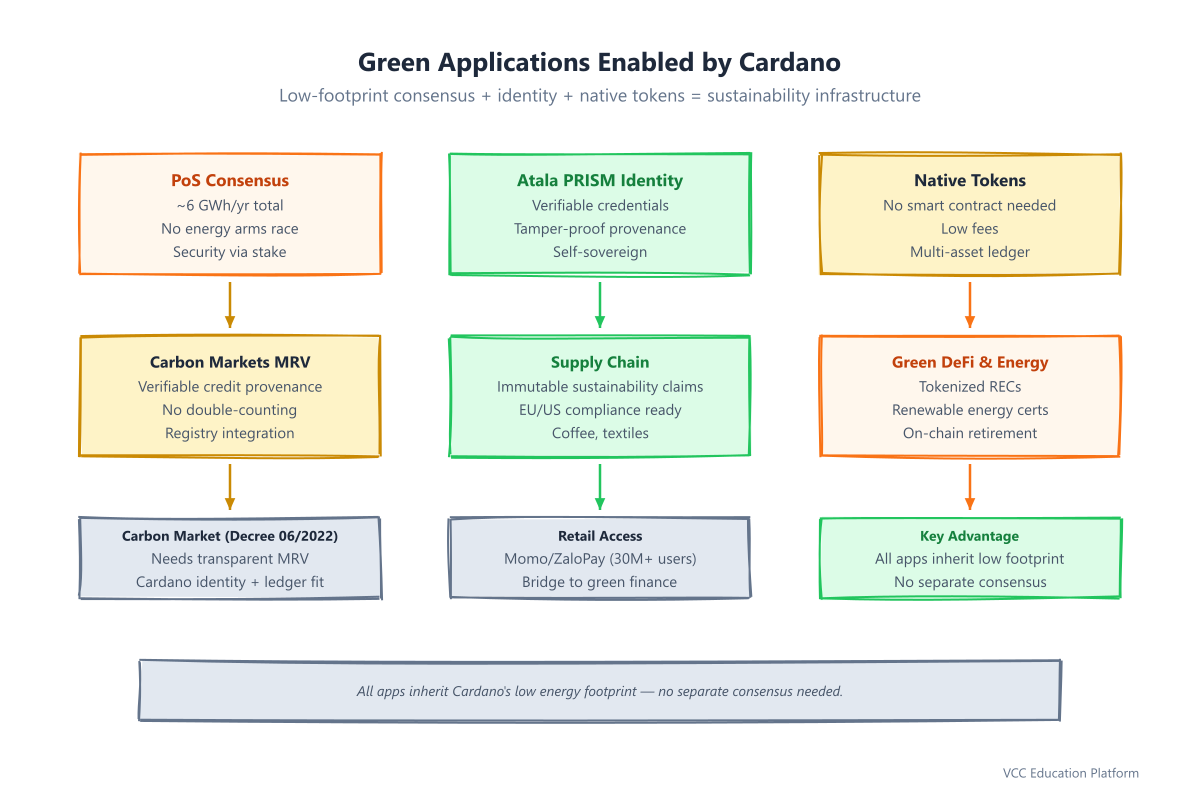
A green blockchain does more than run efficiently — it *enables* green activity. Cardano's architecture supports three high-impact domains:
### Digital Identity for Carbon Markets (Atala PRISM)
Carbon credits suffer from double-counting: the same tonne sold to multiple buyers. **Atala PRISM**, Cardano's decentralized identity framework, assigns each credit a verifiable, tamper-proof credential linked to its origin project. Buyers can verify provenance without trusting a centralized registry. Pilot projects in Kenya and Indonesia demonstrate the model; Vietnam's new domestic carbon market (Decree 06/2022) could adopt similar MRV (Measurement, Reporting, Verification) infrastructure.
### What "Carbon Neutral" Means (vs Net Zero)
**Carbon neutral** = current emissions balanced by offsets. **Net zero** = 90%+ absolute reduction + permanent carbon removal for the remaining ≤10%. The distinction matters. The Foundation uses "carbon neutral" precisely: PoS is already near-minimal on the "reduce" lever, so offsets carry the weight.
Critics rightly note that voluntary carbon markets have quality variance — additionality (would the project happen anyway?), permanence (will the forest stand for 100 years?), and double-counting risks. The Foundation addresses this by sourcing from Verra/Gold Standard with vintage scrutiny, but the *structural* limitation remains: offsets are a bridge, not a destination.
### Transparency — Verified Offsets
Every tonne retired is traceable: project ID, vintage, registry, retirement date. This transparency exceeds most corporate carbon neutrality claims. For a Vietnamese audience familiar with greenwashing in "xanh" marketing, this verifiability is the signal that separates substance from spin.
## Beyond the Chain: Enabling Green Applications
A green blockchain does more than run efficiently — it *enables* green activity. Cardano's architecture supports three high-impact domains:
### Digital Identity for Carbon Markets (Atala PRISM)
Carbon credits suffer from double-counting: the same tonne sold to multiple buyers. **Atala PRISM**, Cardano's decentralized identity framework, assigns each credit a verifiable, tamper-proof credential linked to its origin project. Buyers can verify provenance without trusting a centralized registry. Pilot projects in Kenya and Indonesia demonstrate the model; Vietnam's new domestic carbon market (Decree 06/2022) could adopt similar MRV (Measurement, Reporting, Verification) infrastructure.
 ### Supply Chain Transparency
From coffee in the Central Highlands to textiles in Bình Dương, Vietnamese export supply chains face growing EU/US due diligence requirements (CSDDD, CBAM). Cardano's native tokens and metadata standards let producers anchor sustainability claims — organic certification, fair labor, carbon footprint — immutably on-chain. Buyers verify without auditors. Several Project Catalyst-funded teams are building exactly this.
### Vietnam Context — Local Carbon Market Opportunity
Vietnam committed to net zero by 2050 at COP26. The domestic carbon credit exchange launches pilot trading in 2025. Cardano's low fees, high throughput (via Hydra), and identity layer position it as infrastructure for this market — if local developers build the bridges. Integration with Momo or ZaloPay (30M+ users each) could bring carbon credits to retail investors, not just institutions.
## Critical Perspective: Greenwashing or Genuine Progress?
### Offset Quality Concerns
Not all carbon credits are equal. Avoidance credits (protecting existing forest) carry higher reversal risk than removal credits (direct air capture, mineralization). The Foundation's portfolio leans avoidance — a valid critique. As removal technologies scale, the portfolio should shift.
### Scope 3 Emissions Gap
The Foundation's accounting covers *network operations* (stake pool servers). It does *not* fully cover:
- Node operator home/office electricity (Scope 3)
- User device energy (wallets, browsers)
- Development travel, hardware manufacturing, cloud services
For a truly comprehensive claim, Scope 3 needs inclusion. The Foundation acknowledges this; future reports may expand the boundary.
### The "Green Blockchain" Label Risk
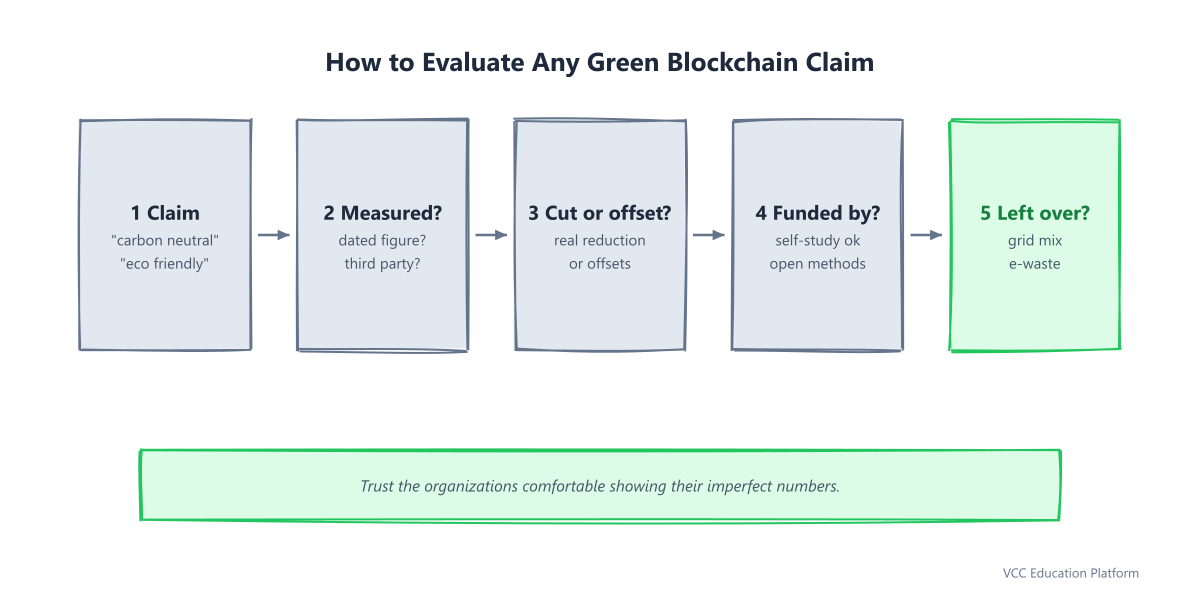
"Green blockchain" can become a marketing slogan that discourages deeper scrutiny. Cardano's PoS *is* fundamentally lower-impact than PoW — that's physics and economics, not marketing. But the *degree* of "green" depends on grid decarbonization (servers run on whatever grid powers them) and offset integrity. The honest position: **Cardano is among the lowest-impact major blockchains, with a transparent offset program and a roadmap toward broader accountability.**
## FAQ
**Q: How much energy does Cardano actually use?**
A: Approximately 6 GWh/year across all ~3,000 stake pools — roughly equivalent to 600 Vietnamese households. Per transaction: ~0.5 Wh (watt-hours), not kWh.
**Q: Is "carbon neutral" the same as "zero emissions"?**
A: No. Carbon neutral means emissions are measured and offset. Zero emissions means no emissions occur. Cardano's network *does* consume electricity; the Foundation offsets it.
**Q: Can I run a stake pool on renewable energy?**
A: Yes. Many operators host in data centers with renewable PPAs or run solar-powered home servers. The Foundation encourages this and may prioritize renewable-powered pools in future delegation tools.
**Q: Does Cardano's low energy mean it's less secure?**
A: Security model differs. PoW secures via thermodynamic cost; PoS secures via capital-at-risk (staked ADA). Both make attacks economically irrational. Cardano's ~$10B+ staked ADA (2024) represents a massive attack cost.
**Q: How does this compare to Ethereum's PoS?**
A: Ethereum's post-Merge energy use is similarly low (~2–3 GWh/year). Cardano's advantage: PoS from genesis (no PoW history), and Ouroboros' formal verification provides mathematical security guarantees.
## Conclusion
Cardano's environmental impact story has three layers: **a consensus mechanism that avoids the energy arms race**, **a foundation that measures and offsets the remainder**, and **an architecture that enables green applications in the real world**. For Vietnamese users — whether developers building on Atala PRISM, investors eyeing the domestic carbon market, or everyday users sending ADA via a future Momo integration — the takeaway is the same: the chain's low footprint isn't a side feature. It's a design choice that compounds into every application built on top.
The next time you hear "blockchain is bad for the environment," ask: *which blockchain?* The answer changes everything.
### Supply Chain Transparency
From coffee in the Central Highlands to textiles in Bình Dương, Vietnamese export supply chains face growing EU/US due diligence requirements (CSDDD, CBAM). Cardano's native tokens and metadata standards let producers anchor sustainability claims — organic certification, fair labor, carbon footprint — immutably on-chain. Buyers verify without auditors. Several Project Catalyst-funded teams are building exactly this.
### Vietnam Context — Local Carbon Market Opportunity
Vietnam committed to net zero by 2050 at COP26. The domestic carbon credit exchange launches pilot trading in 2025. Cardano's low fees, high throughput (via Hydra), and identity layer position it as infrastructure for this market — if local developers build the bridges. Integration with Momo or ZaloPay (30M+ users each) could bring carbon credits to retail investors, not just institutions.
## Critical Perspective: Greenwashing or Genuine Progress?
### Offset Quality Concerns
Not all carbon credits are equal. Avoidance credits (protecting existing forest) carry higher reversal risk than removal credits (direct air capture, mineralization). The Foundation's portfolio leans avoidance — a valid critique. As removal technologies scale, the portfolio should shift.
### Scope 3 Emissions Gap
The Foundation's accounting covers *network operations* (stake pool servers). It does *not* fully cover:
- Node operator home/office electricity (Scope 3)
- User device energy (wallets, browsers)
- Development travel, hardware manufacturing, cloud services
For a truly comprehensive claim, Scope 3 needs inclusion. The Foundation acknowledges this; future reports may expand the boundary.
### The "Green Blockchain" Label Risk
"Green blockchain" can become a marketing slogan that discourages deeper scrutiny. Cardano's PoS *is* fundamentally lower-impact than PoW — that's physics and economics, not marketing. But the *degree* of "green" depends on grid decarbonization (servers run on whatever grid powers them) and offset integrity. The honest position: **Cardano is among the lowest-impact major blockchains, with a transparent offset program and a roadmap toward broader accountability.**
## FAQ
**Q: How much energy does Cardano actually use?**
A: Approximately 6 GWh/year across all ~3,000 stake pools — roughly equivalent to 600 Vietnamese households. Per transaction: ~0.5 Wh (watt-hours), not kWh.
**Q: Is "carbon neutral" the same as "zero emissions"?**
A: No. Carbon neutral means emissions are measured and offset. Zero emissions means no emissions occur. Cardano's network *does* consume electricity; the Foundation offsets it.
**Q: Can I run a stake pool on renewable energy?**
A: Yes. Many operators host in data centers with renewable PPAs or run solar-powered home servers. The Foundation encourages this and may prioritize renewable-powered pools in future delegation tools.
**Q: Does Cardano's low energy mean it's less secure?**
A: Security model differs. PoW secures via thermodynamic cost; PoS secures via capital-at-risk (staked ADA). Both make attacks economically irrational. Cardano's ~$10B+ staked ADA (2024) represents a massive attack cost.
**Q: How does this compare to Ethereum's PoS?**
A: Ethereum's post-Merge energy use is similarly low (~2–3 GWh/year). Cardano's advantage: PoS from genesis (no PoW history), and Ouroboros' formal verification provides mathematical security guarantees.
## Conclusion
Cardano's environmental impact story has three layers: **a consensus mechanism that avoids the energy arms race**, **a foundation that measures and offsets the remainder**, and **an architecture that enables green applications in the real world**. For Vietnamese users — whether developers building on Atala PRISM, investors eyeing the domestic carbon market, or everyday users sending ADA via a future Momo integration — the takeaway is the same: the chain's low footprint isn't a side feature. It's a design choice that compounds into every application built on top.
The next time you hear "blockchain is bad for the environment," ask: *which blockchain?* The answer changes everything.