
 ## Why Cardano Created DReps
When Cardano activated full on-chain governance under **CIP-1694**, it faced an old problem: most people don't have time to read every proposal, yet a healthy network needs broad participation. Voting on every treasury withdrawal or protocol tweak yourself would be a second job.
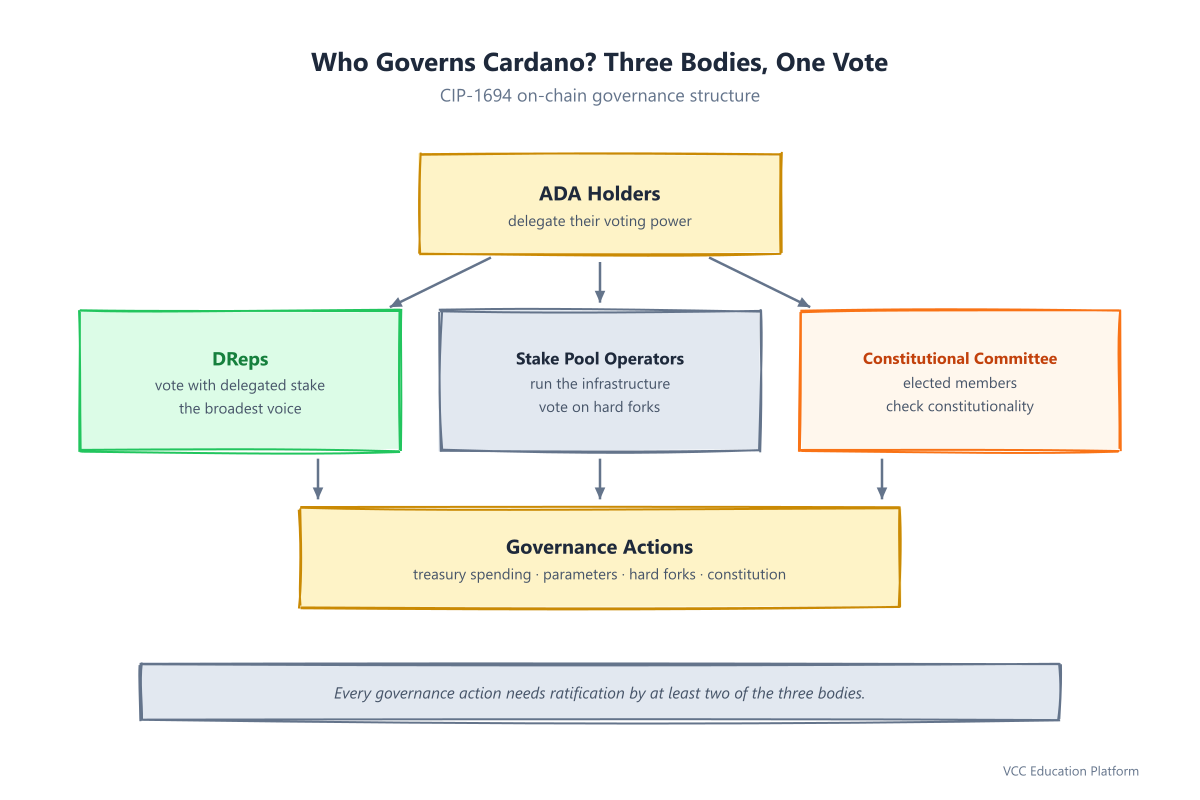
The solution was representation, but designed differently from any parliament. Cardano split governance into three bodies:
1. **DReps** — representatives who vote on behalf of delegated ADA.
2. **Stake Pool Operators (SPOs)** — the people running the infrastructure; they vote on hard forks and certain parameters.
3. **The Constitutional Committee (CC)** — checks that approved actions comply with the Cardano constitution.
Every governance action must be ratified by at least two of these bodies. The design goal is simple: no single group can push the network around.
## What Does a DRep Actually Do?
A DRep's job is **drep voting cardano** on seven types of governance actions: motions of no-confidence, committee changes, constitutional updates, hard forks, protocol parameter changes, treasury withdrawals, and informational proposals. Most everyday decisions — including spending from the network treasury — require majority approval from both DReps and the CC.
Voting weight matters here. A DRep does not get one vote; they get one vote **per lovelace delegated to them**. If 10 million ADA delegate to one DRep, that person's "Yes" or "No" carries 10 million ADA of weight. This makes DReps accountable to their delegators: lose trust, lose voting power.
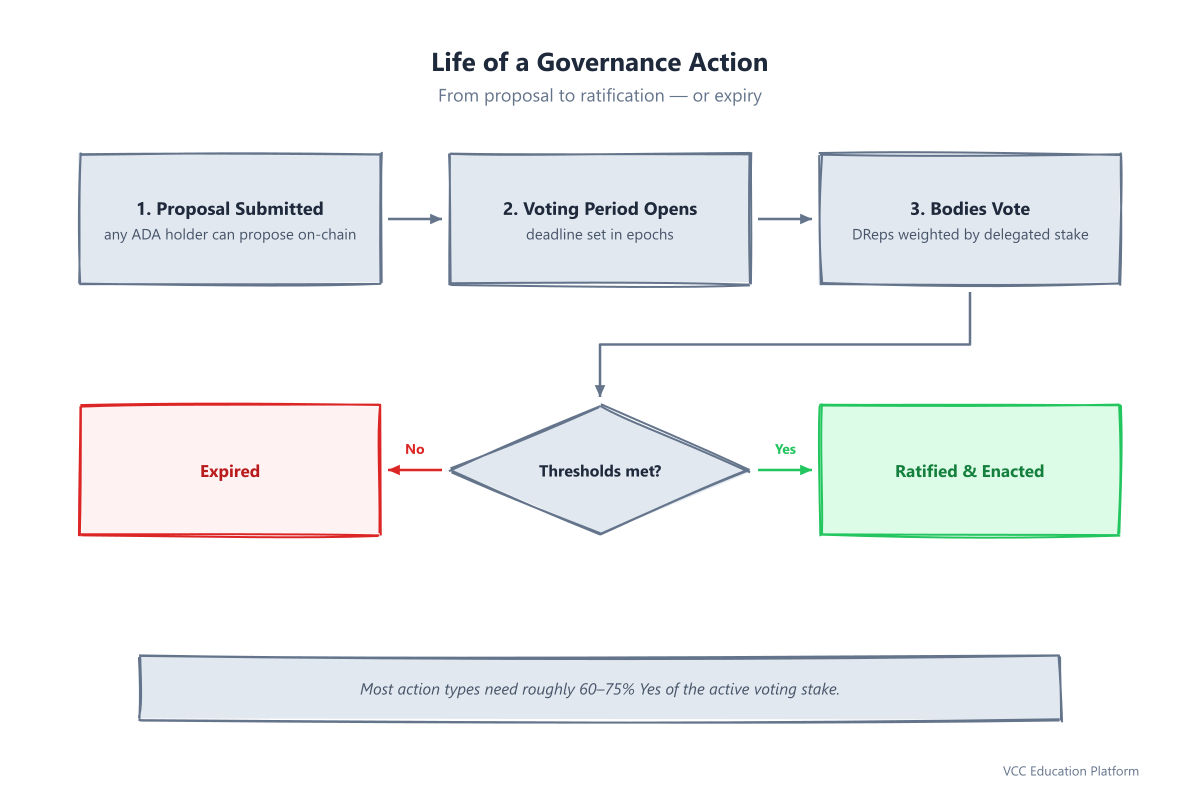
Under the Conway-era defaults, most action types need roughly 60–75% of active voting stake to approve — so DReps as a bloc are often the deciding voice. And because these thresholds are themselves governance-controlled parameters, the community can adjust its own rules later.
## Why Cardano Created DReps
When Cardano activated full on-chain governance under **CIP-1694**, it faced an old problem: most people don't have time to read every proposal, yet a healthy network needs broad participation. Voting on every treasury withdrawal or protocol tweak yourself would be a second job.
The solution was representation, but designed differently from any parliament. Cardano split governance into three bodies:
1. **DReps** — representatives who vote on behalf of delegated ADA.
2. **Stake Pool Operators (SPOs)** — the people running the infrastructure; they vote on hard forks and certain parameters.
3. **The Constitutional Committee (CC)** — checks that approved actions comply with the Cardano constitution.
Every governance action must be ratified by at least two of these bodies. The design goal is simple: no single group can push the network around.
## What Does a DRep Actually Do?
A DRep's job is **drep voting cardano** on seven types of governance actions: motions of no-confidence, committee changes, constitutional updates, hard forks, protocol parameter changes, treasury withdrawals, and informational proposals. Most everyday decisions — including spending from the network treasury — require majority approval from both DReps and the CC.
Voting weight matters here. A DRep does not get one vote; they get one vote **per lovelace delegated to them**. If 10 million ADA delegate to one DRep, that person's "Yes" or "No" carries 10 million ADA of weight. This makes DReps accountable to their delegators: lose trust, lose voting power.
Under the Conway-era defaults, most action types need roughly 60–75% of active voting stake to approve — so DReps as a bloc are often the deciding voice. And because these thresholds are themselves governance-controlled parameters, the community can adjust its own rules later.
 ## DRep Registration: How to Become One
Anyone can become a DRep. The **drep registration** process is one transaction, and the barrier is deliberately small:
- **A refundable deposit of 500 ADA** locks to your registration. It comes back in full when you deregister — think of it as tiền đặt cọc (a security deposit) that prevents spam registrations, not a fee.
- **An optional metadata anchor**: a URL plus hash describing who you are and how you'll vote (following CIP-119 conventions). Serious DReps publish this; voters use it to judge them.
- **Where to register:** GovTool (gov.tools) is the community-built interface, and major wallets like Lace and Eternl expose registration directly. Developers can also do it via cardano-cli, and even register multisig or Plutus-script DReps.
Registration also has maintenance duties. A protocol parameter (`dRepActivity`) sets an inactivity window in epochs — a DRep that stops voting can expire from the active set. And when you retire, `deregisterDRep` returns your deposit. In other words: registering is easy, staying a good DRep is the actual work.
## DRep Delegation: Vote Without Doing the Homework
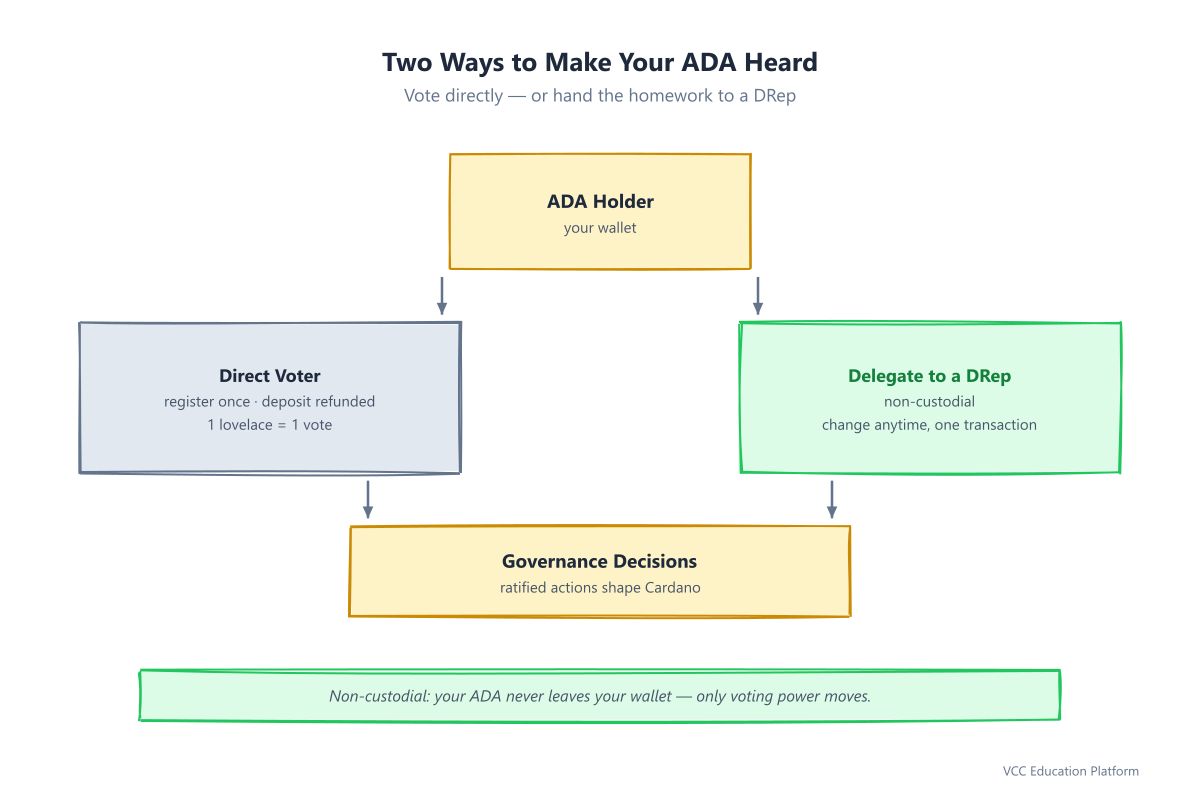
Most ADA holders should not become DReps — but everyone can still be heard through **drep delegation**. You point your stake credential at a DRep, and their votes carry your weight. Three properties make this safe:
- **Non-custodial:** delegation sends no coins anywhere. Your ADA stays in your wallet; only voting power moves.
- **Independent from staking:** voting-power delegation and stake delegation are separate operations. You can stake to pool A while delegating your vote to DRep B, and switch either without disturbing the other.
- **Instantly reversible:** no election cycle, no waiting period. One transaction replaces your representative.
There are also two built-in options for people who don't want to pick a person: delegate to **Abstain** (your power sits out) or **No Confidence** (your power actively counts against the current committee).
One rule surprises newcomers: in the Conway era, staking rewards keep accruing, but you **cannot withdraw them until your stake credential has delegated its vote somewhere** — even to Abstain. The protocol nudges every holder into participating, because a legitimacy-hungry governance system needs registered voices more than it needs idle capital.
## DRep Registration: How to Become One
Anyone can become a DRep. The **drep registration** process is one transaction, and the barrier is deliberately small:
- **A refundable deposit of 500 ADA** locks to your registration. It comes back in full when you deregister — think of it as tiền đặt cọc (a security deposit) that prevents spam registrations, not a fee.
- **An optional metadata anchor**: a URL plus hash describing who you are and how you'll vote (following CIP-119 conventions). Serious DReps publish this; voters use it to judge them.
- **Where to register:** GovTool (gov.tools) is the community-built interface, and major wallets like Lace and Eternl expose registration directly. Developers can also do it via cardano-cli, and even register multisig or Plutus-script DReps.
Registration also has maintenance duties. A protocol parameter (`dRepActivity`) sets an inactivity window in epochs — a DRep that stops voting can expire from the active set. And when you retire, `deregisterDRep` returns your deposit. In other words: registering is easy, staying a good DRep is the actual work.
## DRep Delegation: Vote Without Doing the Homework
Most ADA holders should not become DReps — but everyone can still be heard through **drep delegation**. You point your stake credential at a DRep, and their votes carry your weight. Three properties make this safe:
- **Non-custodial:** delegation sends no coins anywhere. Your ADA stays in your wallet; only voting power moves.
- **Independent from staking:** voting-power delegation and stake delegation are separate operations. You can stake to pool A while delegating your vote to DRep B, and switch either without disturbing the other.
- **Instantly reversible:** no election cycle, no waiting period. One transaction replaces your representative.
There are also two built-in options for people who don't want to pick a person: delegate to **Abstain** (your power sits out) or **No Confidence** (your power actively counts against the current committee).
One rule surprises newcomers: in the Conway era, staking rewards keep accruing, but you **cannot withdraw them until your stake credential has delegated its vote somewhere** — even to Abstain. The protocol nudges every holder into participating, because a legitimacy-hungry governance system needs registered voices more than it needs idle capital.
 ## Choosing a DRep Wisely
Delegating thoughtfully matters, because an inactive or careless DRep quietly concentrates power in someone else's hands. Treat it like choosing a fund manager:
- **Check the voting record.** GovTool shows each DRep's past votes and activity. Have they voted recently and consistently?
- **Read their stated positions.** Registered metadata should explain their philosophy on treasury spending, parameter changes, and decentralization.
- **Beware concentration.** A handful of DReps holding enormous delegated power is a governance risk; spreading delegation across thoughtful, active representatives keeps the system healthy.
- **Match your values.** Some DReps commit to voting patterns (e.g., always favoring smaller government-style minimal intervention). Pick whose judgment mirrors yours — then verify they actually follow it.
## DReps vs SPOs vs the Constitutional Committee
These three bodies are easy to confuse. Quick contrast:
| Body | Who | Votes on | Weight |
|---|---|---|---|
| **DRep** | Any registered credential | All action types | Delegated lovelace |
| **SPO** | Stake pool operators | Hard forks, some parameters | Pool-delegated stake |
| **CC** | Elected committee members | Constitutionality checks | One member, one vote |
## Choosing a DRep Wisely
Delegating thoughtfully matters, because an inactive or careless DRep quietly concentrates power in someone else's hands. Treat it like choosing a fund manager:
- **Check the voting record.** GovTool shows each DRep's past votes and activity. Have they voted recently and consistently?
- **Read their stated positions.** Registered metadata should explain their philosophy on treasury spending, parameter changes, and decentralization.
- **Beware concentration.** A handful of DReps holding enormous delegated power is a governance risk; spreading delegation across thoughtful, active representatives keeps the system healthy.
- **Match your values.** Some DReps commit to voting patterns (e.g., always favoring smaller government-style minimal intervention). Pick whose judgment mirrors yours — then verify they actually follow it.
## DReps vs SPOs vs the Constitutional Committee
These three bodies are easy to confuse. Quick contrast:
| Body | Who | Votes on | Weight |
|---|---|---|---|
| **DRep** | Any registered credential | All action types | Delegated lovelace |
| **SPO** | Stake pool operators | Hard forks, some parameters | Pool-delegated stake |
| **CC** | Elected committee members | Constitutionality checks | One member, one vote |
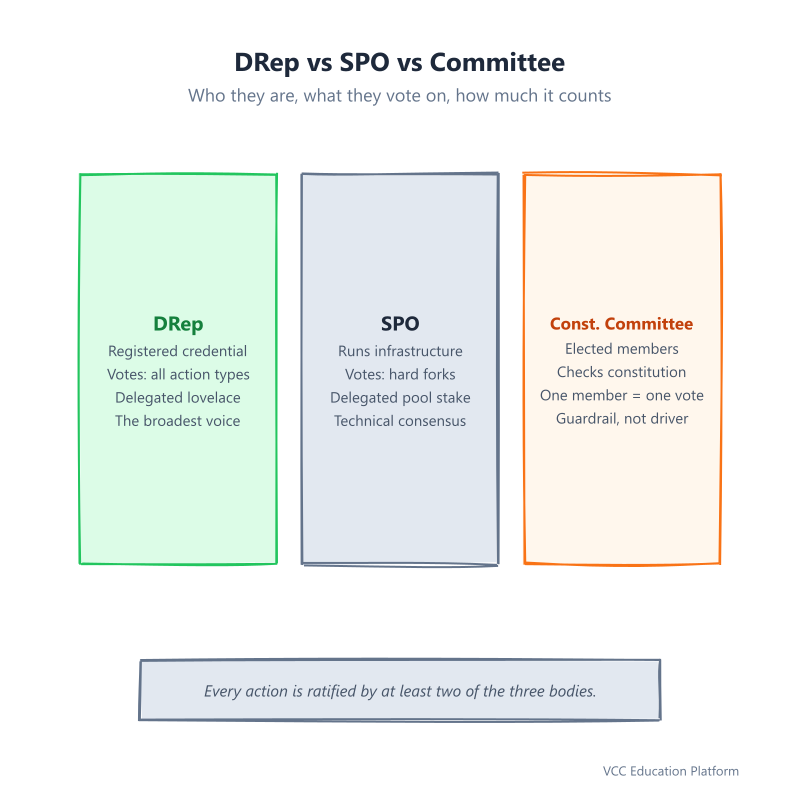 DReps are the broadest body — the political layer representing ordinary holders — while SPOs guard technical consensus and the CC guards constitutional limits.
## What DReps Mean for Vietnamese Readers
If you've voted in a đại biểu quốc hội election, you already understand the core idea of representation — what's different is the accountability loop. Recalling a sitting deputy in Vietnam requires an institutional process measured in years. Replacing a DRep takes one wallet transaction, any day, forever. Your representative serves at your continuous pleasure, not until the next election cycle.
It's closer to bầu cử tổ dân phố — electing a neighbourhood-block representative whom everyone knows personally — except the "neighbourhood" is global, the candidate list is public on-chain, and every vote they ever cast is permanently auditable. For a community that prizes minh bạch (transparency) in công quỹ (public funds), that auditability is the headline feature.
## Common Questions About Cardano DReps
### What is a cardano drep in simple terms?
A Delegated Representative — a registered participant who votes on Cardano governance actions using the combined voting power of all ADA holders who delegated to them. They never hold or move your funds.
### How much is the drep registration deposit?
500 ADA, refundable in full upon deregistration. It exists to make spam registrations expensive, not to gatekeep participation.
### Do I send my ADA to a DRep when delegating?
No. Drep delegation moves voting power only. Your ADA never leaves your wallet, and your staking rewards are unaffected.
### Can I change my drep delegation later?
Yes, instantly and as often as you like. Each change is a normal wallet transaction; there is no lock-up and no election calendar.
### Do DReps get paid?
Not by the protocol today. CIP-1694 defines no automatic DRep rewards, though community compensation models continue to be discussed. Many DReps operate on reputation or voluntary support.
### What happens if my DRep stops voting?
Inactive DReps eventually expire after the `dRepActivity` window (measured in epochs). Their delegators' power simply stops counting toward ratification — another reason to check your DRep's recent activity periodically.
---
## Quick Reference
| Property | Value |
|----------|-------|
| **What it is** | Registered voter who votes with delegated ADA power |
| **Introduced by** | CIP-1694 / Voltaire era on-chain governance |
| **Vote weight** | One lovelace = one vote (delegated total) |
| **Registration deposit** | 500 ADA, refundable on deregistration |
| **Identity metadata** | Optional anchor URL + hash (CIP-119 style) |
| **Main tools** | GovTool, Lace, Eternl, cardano-cli |
| **Delegation** | Non-custodial, separate from staking, reversible anytime |
| **Built-in options** | Always Abstain, Always No Confidence |
| **Key property** | Every vote is public and permanent on-chain |
DReps are the broadest body — the political layer representing ordinary holders — while SPOs guard technical consensus and the CC guards constitutional limits.
## What DReps Mean for Vietnamese Readers
If you've voted in a đại biểu quốc hội election, you already understand the core idea of representation — what's different is the accountability loop. Recalling a sitting deputy in Vietnam requires an institutional process measured in years. Replacing a DRep takes one wallet transaction, any day, forever. Your representative serves at your continuous pleasure, not until the next election cycle.
It's closer to bầu cử tổ dân phố — electing a neighbourhood-block representative whom everyone knows personally — except the "neighbourhood" is global, the candidate list is public on-chain, and every vote they ever cast is permanently auditable. For a community that prizes minh bạch (transparency) in công quỹ (public funds), that auditability is the headline feature.
## Common Questions About Cardano DReps
### What is a cardano drep in simple terms?
A Delegated Representative — a registered participant who votes on Cardano governance actions using the combined voting power of all ADA holders who delegated to them. They never hold or move your funds.
### How much is the drep registration deposit?
500 ADA, refundable in full upon deregistration. It exists to make spam registrations expensive, not to gatekeep participation.
### Do I send my ADA to a DRep when delegating?
No. Drep delegation moves voting power only. Your ADA never leaves your wallet, and your staking rewards are unaffected.
### Can I change my drep delegation later?
Yes, instantly and as often as you like. Each change is a normal wallet transaction; there is no lock-up and no election calendar.
### Do DReps get paid?
Not by the protocol today. CIP-1694 defines no automatic DRep rewards, though community compensation models continue to be discussed. Many DReps operate on reputation or voluntary support.
### What happens if my DRep stops voting?
Inactive DReps eventually expire after the `dRepActivity` window (measured in epochs). Their delegators' power simply stops counting toward ratification — another reason to check your DRep's recent activity periodically.
---
## Quick Reference
| Property | Value |
|----------|-------|
| **What it is** | Registered voter who votes with delegated ADA power |
| **Introduced by** | CIP-1694 / Voltaire era on-chain governance |
| **Vote weight** | One lovelace = one vote (delegated total) |
| **Registration deposit** | 500 ADA, refundable on deregistration |
| **Identity metadata** | Optional anchor URL + hash (CIP-119 style) |
| **Main tools** | GovTool, Lace, Eternl, cardano-cli |
| **Delegation** | Non-custodial, separate from staking, reversible anytime |
| **Built-in options** | Always Abstain, Always No Confidence |
| **Key property** | Every vote is public and permanent on-chain |