
 ## What Decentralization Actually Means
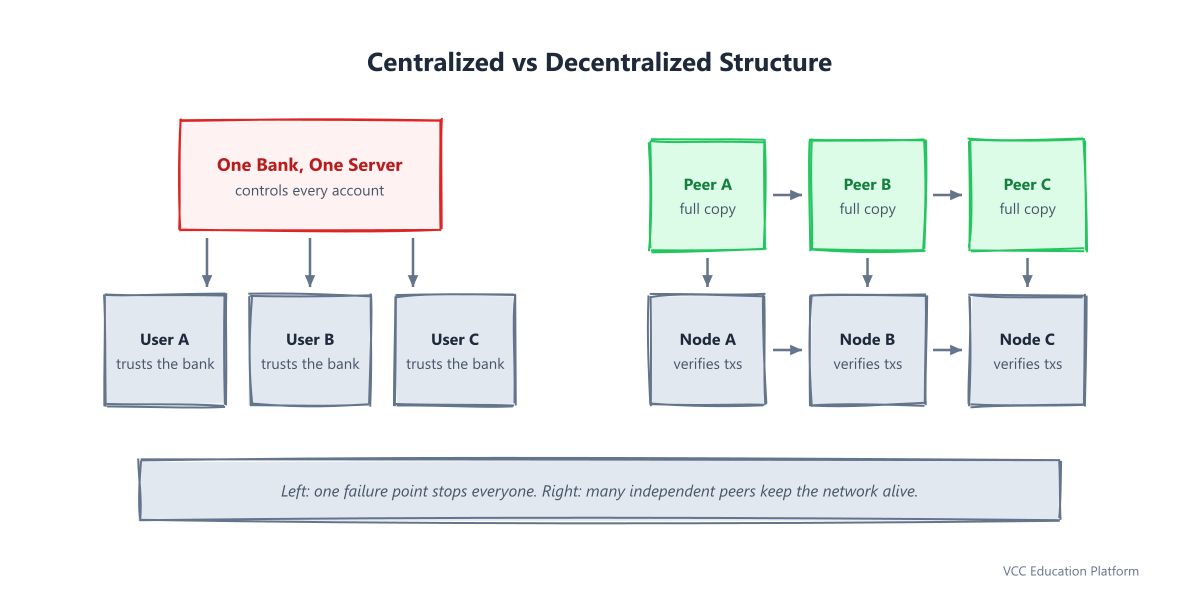
Strip away the jargon and decentralization means one thing: **no single party controls the system**. Not a company, not a government, not even the original developers.
Think of how a traditional bank works. Your deposit lives in the bank's database. If the bank freezes your account, you can only appeal — to the same bank. If its data center floods, your access stops until they fix it. You trust the institution because you have no alternative.
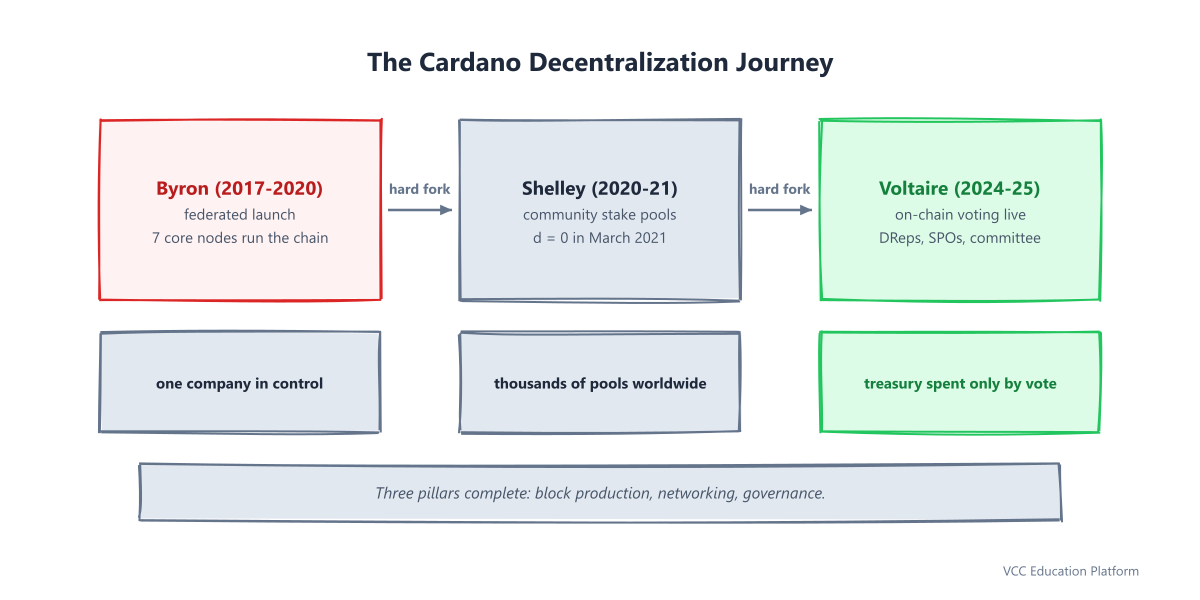
A blockchain replaces that single database with thousands of independent copies, each maintained by different people in different countries. In Cardano's case, those maintainers are called stake pool operators (SPOs) — ordinary individuals and small teams worldwide who run servers that produce blocks and verify transactions. When Cardano reached full block-production decentralization in March 2021, the last seven federated nodes operated by IOHK, Emurgo, and the Cardano Foundation were retired, and 100% of blocks came from this community.
Here is the part most explanations miss: decentralization is not a yes/no switch. It is a dial with three separate settings — who produces blocks, who connects the network, and who makes decisions. A chain can score high on one and fail on another. That is why judging a cardano decentralized network properly means looking at all three.
## Why Decentralization Matters: Four Pillars
### 1. Censorship resistance
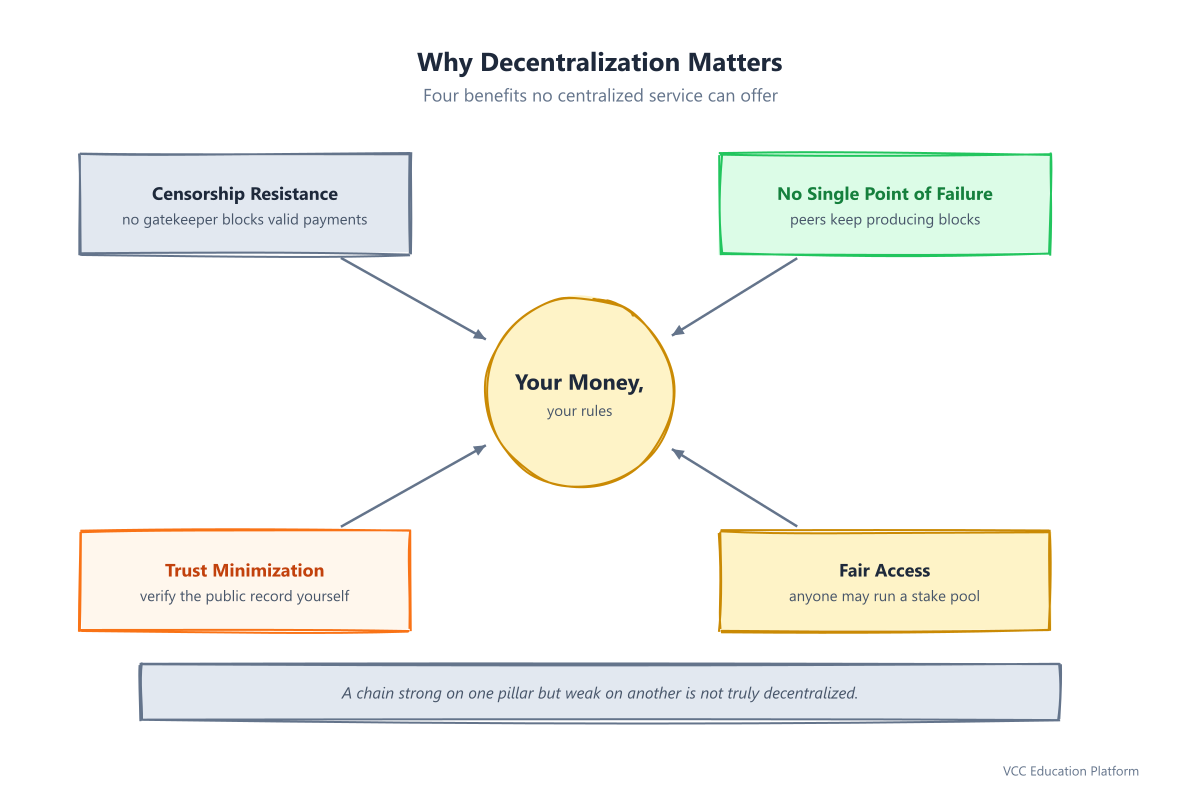
In a centralized payment system, an authority can block a transfer — by policy, by mistake, or under pressure. In a decentralized one, there is no single authority to pressure. As long as the transaction is valid, some node somewhere will include it. For anyone who has watched a remittance corridor close or a payment get frozen pending "review," this is not abstract; it is the difference between money that obeys rules and money that obeys whoever runs the server.
### 2. No single point of failure
Centralized systems break completely when their center breaks. Decentralized systems bend. If dozens of stake pools go offline simultaneously — natural disaster, power grid failure, targeted attack — the remaining pools keep producing blocks and the ledger keeps growing. Your ADA does not disappear because one company's office lost electricity.
## What Decentralization Actually Means
Strip away the jargon and decentralization means one thing: **no single party controls the system**. Not a company, not a government, not even the original developers.
Think of how a traditional bank works. Your deposit lives in the bank's database. If the bank freezes your account, you can only appeal — to the same bank. If its data center floods, your access stops until they fix it. You trust the institution because you have no alternative.
A blockchain replaces that single database with thousands of independent copies, each maintained by different people in different countries. In Cardano's case, those maintainers are called stake pool operators (SPOs) — ordinary individuals and small teams worldwide who run servers that produce blocks and verify transactions. When Cardano reached full block-production decentralization in March 2021, the last seven federated nodes operated by IOHK, Emurgo, and the Cardano Foundation were retired, and 100% of blocks came from this community.
Here is the part most explanations miss: decentralization is not a yes/no switch. It is a dial with three separate settings — who produces blocks, who connects the network, and who makes decisions. A chain can score high on one and fail on another. That is why judging a cardano decentralized network properly means looking at all three.
## Why Decentralization Matters: Four Pillars
### 1. Censorship resistance
In a centralized payment system, an authority can block a transfer — by policy, by mistake, or under pressure. In a decentralized one, there is no single authority to pressure. As long as the transaction is valid, some node somewhere will include it. For anyone who has watched a remittance corridor close or a payment get frozen pending "review," this is not abstract; it is the difference between money that obeys rules and money that obeys whoever runs the server.
### 2. No single point of failure
Centralized systems break completely when their center breaks. Decentralized systems bend. If dozens of stake pools go offline simultaneously — natural disaster, power grid failure, targeted attack — the remaining pools keep producing blocks and the ledger keeps growing. Your ADA does not disappear because one company's office lost electricity.
 ### 3. Trust minimization
With a bank, you trust two things: that its records are accurate and that it stays solvent. With Cardano, you verify both yourself — every transaction since 2017 is publicly checkable, and the protocol's rules are enforced by mathematics and many independent eyes rather than by one auditor's promise. You reduce the question "do I trust this institution?" to "can I read the public record?"
### 4. Fair access
Official Cardano documentation states the principle directly: equal opportunity for anyone who wants to run a stake pool. There is no license, no minimum capital requirement set by a regulator, no jurisdiction that gets privileged treatment. A student in Đà Nẵng and a fund in Singapore can operate identical infrastructure on identical terms.
## How Proof of Stake Decentralization Works on Cardano
Cardano secures its network using Ouroboros, a proof-of-stake consensus protocol — notably, the first of its kind published in a peer-reviewed cryptography venue (2017). Instead of miners burning electricity, Cardano selects block producers through a stake-weighted lottery: the more ADA delegated to your pool, the more often you are chosen to produce a block.
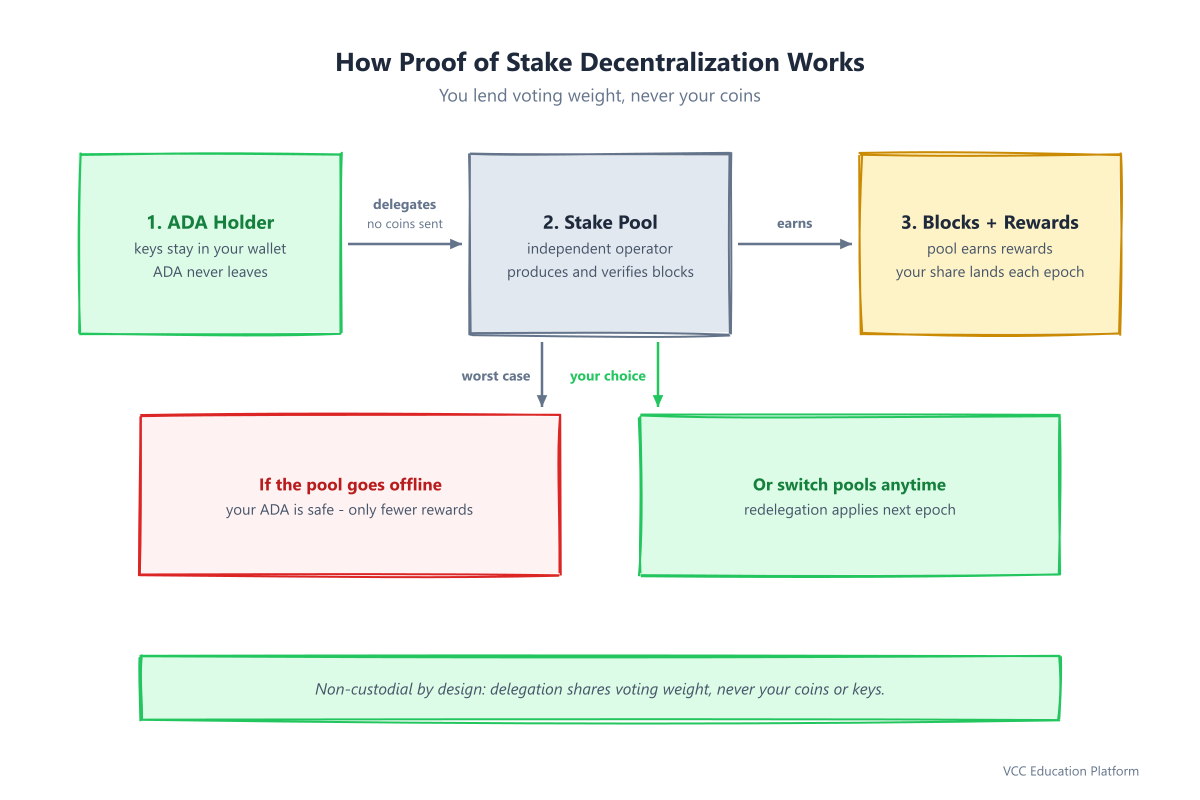
This design creates a remarkable property: **holders participate in security without giving up custody**. When you delegate your ADA to a stake pool, you are lending your *voting weight*, not your coins. Your private keys never leave your wallet, and you can redelegate or spend at any time.
The flow looks like this:
### 3. Trust minimization
With a bank, you trust two things: that its records are accurate and that it stays solvent. With Cardano, you verify both yourself — every transaction since 2017 is publicly checkable, and the protocol's rules are enforced by mathematics and many independent eyes rather than by one auditor's promise. You reduce the question "do I trust this institution?" to "can I read the public record?"
### 4. Fair access
Official Cardano documentation states the principle directly: equal opportunity for anyone who wants to run a stake pool. There is no license, no minimum capital requirement set by a regulator, no jurisdiction that gets privileged treatment. A student in Đà Nẵng and a fund in Singapore can operate identical infrastructure on identical terms.
## How Proof of Stake Decentralization Works on Cardano
Cardano secures its network using Ouroboros, a proof-of-stake consensus protocol — notably, the first of its kind published in a peer-reviewed cryptography venue (2017). Instead of miners burning electricity, Cardano selects block producers through a stake-weighted lottery: the more ADA delegated to your pool, the more often you are chosen to produce a block.
This design creates a remarkable property: **holders participate in security without giving up custody**. When you delegate your ADA to a stake pool, you are lending your *voting weight*, not your coins. Your private keys never leave your wallet, and you can redelegate or spend at any time.
The flow looks like this:
 Three mechanisms keep this system decentralized:
- **Saturation (the k parameter).** Each pool has an ideal size — roughly 70 million ADA at the current target of 500 pools. Past that point, the pool's rewards dilute per-ADA, so there is no financial reason to pile onto a giant. It is like a xe ôm stand: once one stand is overloaded, riders naturally walk to the next one, and everyone gets better service.
- **Low barriers to entry.** Anyone can register a pool. Delegation itself costs nothing extra beyond a one-time refundable ~2 ADA registration deposit, so even small holders shape which pools thrive.
- **Anti-concentration incentives.** Pool operators pledge their own ADA to their pool, and higher pledges earn better rewards — rewarding operators with skin in the game over anonymous aggregators.
## Governance: The Third Pillar of the Cardano Security Model
Many chains stopped at "many validators." Cardano's roadmap treats that as step one of a cardano security model with three pillars: block production, networking, and governance.
Block production decentralized in March 2021. Governance took longer, deliberately. Through CIP-1694 and the Chang upgrade (2024) followed by the Plomin hard fork (early 2025), Cardano replaced its last centralized mechanism — seven genesis keys that could change the protocol — with three on-chain bodies: DReps (delegated representatives elected by ADA holders), SPOs, and a constitutional committee. Today, protocol upgrades and treasury withdrawals are voted on-chain by this community, not decided in a boardroom.
Why does this belong in a discussion of the cardano security model? Because if decisions about the software still came from one company, then controlling that company would control the whole network — making validator count meaningless. Governance decentralization closes that backdoor.
Three mechanisms keep this system decentralized:
- **Saturation (the k parameter).** Each pool has an ideal size — roughly 70 million ADA at the current target of 500 pools. Past that point, the pool's rewards dilute per-ADA, so there is no financial reason to pile onto a giant. It is like a xe ôm stand: once one stand is overloaded, riders naturally walk to the next one, and everyone gets better service.
- **Low barriers to entry.** Anyone can register a pool. Delegation itself costs nothing extra beyond a one-time refundable ~2 ADA registration deposit, so even small holders shape which pools thrive.
- **Anti-concentration incentives.** Pool operators pledge their own ADA to their pool, and higher pledges earn better rewards — rewarding operators with skin in the game over anonymous aggregators.
## Governance: The Third Pillar of the Cardano Security Model
Many chains stopped at "many validators." Cardano's roadmap treats that as step one of a cardano security model with three pillars: block production, networking, and governance.
Block production decentralized in March 2021. Governance took longer, deliberately. Through CIP-1694 and the Chang upgrade (2024) followed by the Plomin hard fork (early 2025), Cardano replaced its last centralized mechanism — seven genesis keys that could change the protocol — with three on-chain bodies: DReps (delegated representatives elected by ADA holders), SPOs, and a constitutional committee. Today, protocol upgrades and treasury withdrawals are voted on-chain by this community, not decided in a boardroom.
Why does this belong in a discussion of the cardano security model? Because if decisions about the software still came from one company, then controlling that company would control the whole network — making validator count meaningless. Governance decentralization closes that backdoor.
 ## Honest Trade-offs: Where Cardano's Decentralization Falls Short
An article that only praises would be marketing, not education. Three real criticisms deserve space:
1. **Pool counts overstate independence.** Research presented in Cardano improvement proposals estimates the Nakamoto coefficient — the number of distinct entities needed to hijack block production — at around 25, far below the nominal 500-pool target. Large exchanges have run dozens of pools each; hundreds of pools carry zero operator pledge yet hold billions in delegated ADA.
2. **Wealth concentration persists.** Independent analyses find the delegation distribution highly unequal (Gini ≈ 0.84), with roughly 8% of pools holding half of all staked ADA — and small pools retiring disproportionately.
3. **Decentralization costs convenience.** No customer support hotline exists for a lost private key. Upgrades take longer because consensus among thousands of independent operators must be built openly.
Yet the counterpoint matters too: even the critics' numbers imply dozens of independent actors today versus literally seven federated nodes in 2017 — and the debate itself happens in public improvement proposals, visible to anyone. A decentralized network arguing with itself about its own flaws is healthier than a centralized one that cannot be argued with.
## What This Means for You in Vietnam
Vietnam receives tens of billions of dollars in remittances annually, much of it routed through intermediaries that charge fees and impose delays at every hop. Decentralized networks offer a structural alternative: value moves peer-to-peer across a network with no corridor to close and no head office to lobby. And the contrast with familiar apps like Momo or ZaloPay is instructive — those services are excellent, but one company's outage or policy change affects millions instantly. That fragility is precisely what distribution removes.
If you hold ADA, participating is simple: delegate to a smaller, single-operator community pool and your stake directly strengthens network diversity — something large exchange pools cannot claim. Start small, keep your keys offline where possible, and remember the Vietnamese proverb: chưa thấy quan tài chưa đổ lệ — don't wait for a crisis to learn custody.
## Frequently Asked Questions
### Is Cardano fully decentralized?
Block production and networking are fully decentralized since March 2021 (the `d` parameter reached zero), and on-chain governance went live through the Chang and Plomin upgrades in 2024–2025. However, practical influence remains concentrated: exchanges and multi-pool operators control significant stake, so decentralization is best described as substantially achieved but continuously maintained.
### How does proof of stake decentralization differ from Bitcoin mining?
Bitcoin's proof of work concentrates influence in those who own specialized hardware and cheap electricity. Proof of stake decentralization ties influence to coins staked, requires only ordinary servers, and uses vastly less energy — lowering the barrier so more independent participants can secure the network.
### Do I need a lot of ADA to help decentralize Cardano?
No. Any amount can be delegated, and delegation is non-custodial — your keys stay in your wallet. Directing even modest stakes away from saturated exchange pools toward independent operators measurably improves the network's diversity.
### What happens if my stake pool goes offline?
Nothing happens to your ADA. The pool simply earns fewer rewards while it underperforms. You can wait for recovery or redelegate to another pool — changes apply after the current epoch boundary, typically within five days.
### Is the Cardano security model weaker than proof of work?
It is different, not obviously weaker. Ouroboros assumes a stake threshold of adversarial power (roughly one-third of total stake for certain attacks, a majority for others) rather than a hash-rate majority. Its security rests on peer-reviewed cryptography plus economic penalties, and its governance layer prevents any small group from silently changing the rules.
## Honest Trade-offs: Where Cardano's Decentralization Falls Short
An article that only praises would be marketing, not education. Three real criticisms deserve space:
1. **Pool counts overstate independence.** Research presented in Cardano improvement proposals estimates the Nakamoto coefficient — the number of distinct entities needed to hijack block production — at around 25, far below the nominal 500-pool target. Large exchanges have run dozens of pools each; hundreds of pools carry zero operator pledge yet hold billions in delegated ADA.
2. **Wealth concentration persists.** Independent analyses find the delegation distribution highly unequal (Gini ≈ 0.84), with roughly 8% of pools holding half of all staked ADA — and small pools retiring disproportionately.
3. **Decentralization costs convenience.** No customer support hotline exists for a lost private key. Upgrades take longer because consensus among thousands of independent operators must be built openly.
Yet the counterpoint matters too: even the critics' numbers imply dozens of independent actors today versus literally seven federated nodes in 2017 — and the debate itself happens in public improvement proposals, visible to anyone. A decentralized network arguing with itself about its own flaws is healthier than a centralized one that cannot be argued with.
## What This Means for You in Vietnam
Vietnam receives tens of billions of dollars in remittances annually, much of it routed through intermediaries that charge fees and impose delays at every hop. Decentralized networks offer a structural alternative: value moves peer-to-peer across a network with no corridor to close and no head office to lobby. And the contrast with familiar apps like Momo or ZaloPay is instructive — those services are excellent, but one company's outage or policy change affects millions instantly. That fragility is precisely what distribution removes.
If you hold ADA, participating is simple: delegate to a smaller, single-operator community pool and your stake directly strengthens network diversity — something large exchange pools cannot claim. Start small, keep your keys offline where possible, and remember the Vietnamese proverb: chưa thấy quan tài chưa đổ lệ — don't wait for a crisis to learn custody.
## Frequently Asked Questions
### Is Cardano fully decentralized?
Block production and networking are fully decentralized since March 2021 (the `d` parameter reached zero), and on-chain governance went live through the Chang and Plomin upgrades in 2024–2025. However, practical influence remains concentrated: exchanges and multi-pool operators control significant stake, so decentralization is best described as substantially achieved but continuously maintained.
### How does proof of stake decentralization differ from Bitcoin mining?
Bitcoin's proof of work concentrates influence in those who own specialized hardware and cheap electricity. Proof of stake decentralization ties influence to coins staked, requires only ordinary servers, and uses vastly less energy — lowering the barrier so more independent participants can secure the network.
### Do I need a lot of ADA to help decentralize Cardano?
No. Any amount can be delegated, and delegation is non-custodial — your keys stay in your wallet. Directing even modest stakes away from saturated exchange pools toward independent operators measurably improves the network's diversity.
### What happens if my stake pool goes offline?
Nothing happens to your ADA. The pool simply earns fewer rewards while it underperforms. You can wait for recovery or redelegate to another pool — changes apply after the current epoch boundary, typically within five days.
### Is the Cardano security model weaker than proof of work?
It is different, not obviously weaker. Ouroboros assumes a stake threshold of adversarial power (roughly one-third of total stake for certain attacks, a majority for others) rather than a hash-rate majority. Its security rests on peer-reviewed cryptography plus economic penalties, and its governance layer prevents any small group from silently changing the rules.