
Cardano dapps — decentralized applications running on the Cardano blockchain — have grown from a handful of experimental swaps into a multi-hundred-million-dollar ecosystem of exchanges, lending platforms, NFT marketplaces, and stablecoin protocols. If you have ever used Momo or ZaloPay to pay for a coffee in Vietnam, you already understand the mental model: an app on your phone talks to a backend that moves money. The difference is that a dapp's backend is a smart contract on a public blockchain, not a company server, so no single party can freeze your funds or change the rules overnight.
This guide walks you through what Cardano dapps are, which ones matter, how to connect your wallet, and the risks you should understand before you swap your first ADA. Whether you are looking for the best Cardano dapps to trade tokens, earn yield, or buy NFTs, this cardano dapp list gives you a practical starting point.
What Is a DApp?
A dapp (decentralized application) is a piece of software whose core logic lives in a smart contract on a blockchain rather than on a private server. On Cardano, that logic is written in Plutus or Aiken and deployed to the chain's computation layer (CCL). The front-end — the website you click through — is ordinary web code, but every meaningful action (a swap, a deposit, a mint) is sent to the smart contract for execution and recorded on-chain.
The key property is non-custodial interaction: you connect your own wallet, sign each transaction yourself, and the smart contract acts on your signature. The dapp team cannot reach into your wallet, and if their website disappears tomorrow the contract keeps running.
How Cardano's eUTXO Model Shapes DApps
Cardano uses the extended UTXO (eUTXO) model rather than the account model Ethereum uses. In plain terms, every transaction consumes specific inputs (unspent transaction outputs) and produces new outputs, and the smart contract validates each batch deterministically. This makes transaction outcomes predictable — you know the fee and the result before you submit — but it also means dapp developers must design around concurrency, because each UTXO can only be spent once per block. DEXs on Cardano solve this with batcher or solver architectures that queue many user orders into a single settlement transaction.
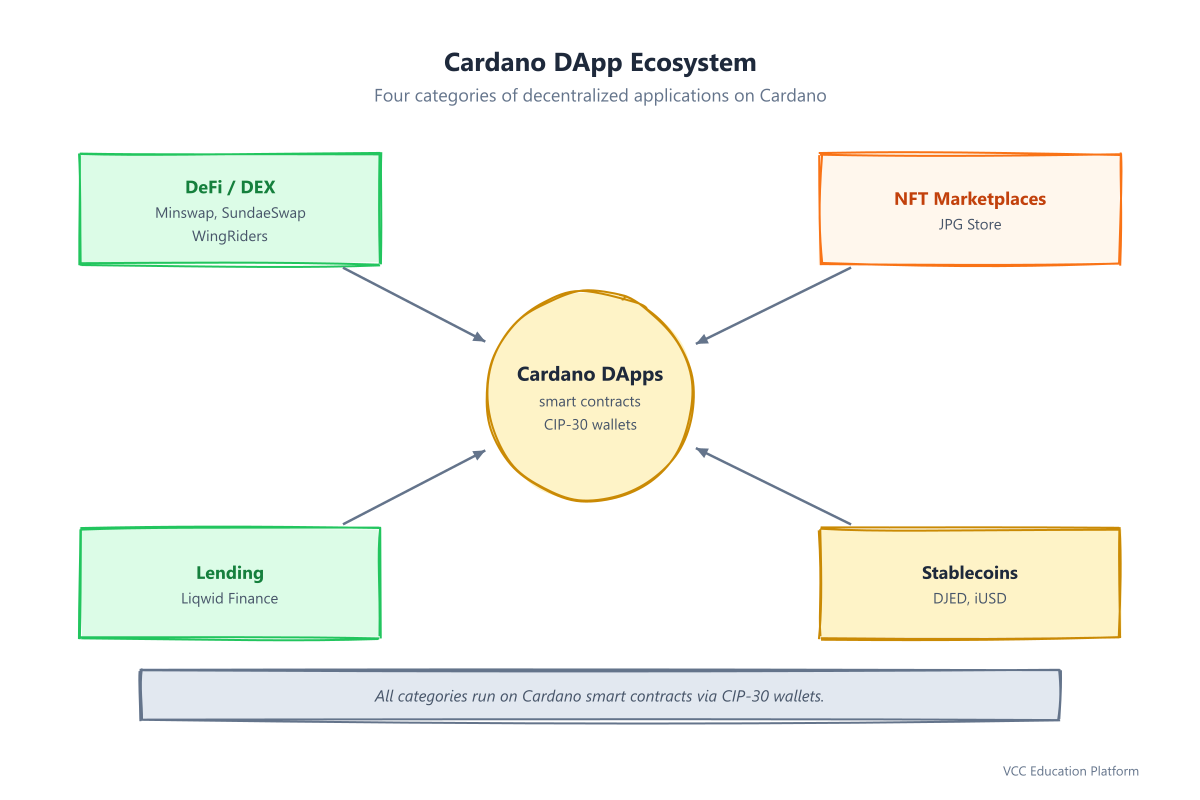
Cardano DApp ecosystem: four categories of decentralized applications
Categories of Cardano DApps
The top Cardano dapps fall into a handful of categories. Understanding the category tells you what the app does and what risks come with it.
Decentralized Exchanges (DEXs)
A DEX lets you swap one token for another without a middleman. Instead of an order book run by a company, most Cardano DEXs use automated market maker (AMM) pools: users deposit pairs of tokens into a liquidity pool, and the pool's price shifts automatically based on the ratio of the two assets. When you swap, you pay a small fee (often around 0.3%) that goes to the liquidity providers.
The three largest Cardano DEXs by activity are:
- Minswap — the dominant exchange by volume and user count, launched in 2022 with a fair, no-VC token distribution. It offers multiple pool types (constant-product and stablecoin pools), yield farming, and MIN token staking for governance. By late 2024 Minswap had over 200,000 traders and roughly $3.1 billion in cumulative volume.
- SundaeSwap — one of the earliest Cardano DEXs, a native scalable AMM with yield farming and an order-book overlay built on Plutus.
- WingRiders — a native AMM focused on fast settlement and predictable fees, with stableswap pools and an integrated yield-farming layer.
Other notable venues include Splash Protocol and Genius Yield (a concentrated-liquidity DEX). Together these platforms make up the backbone of Cardano DeFi apps.
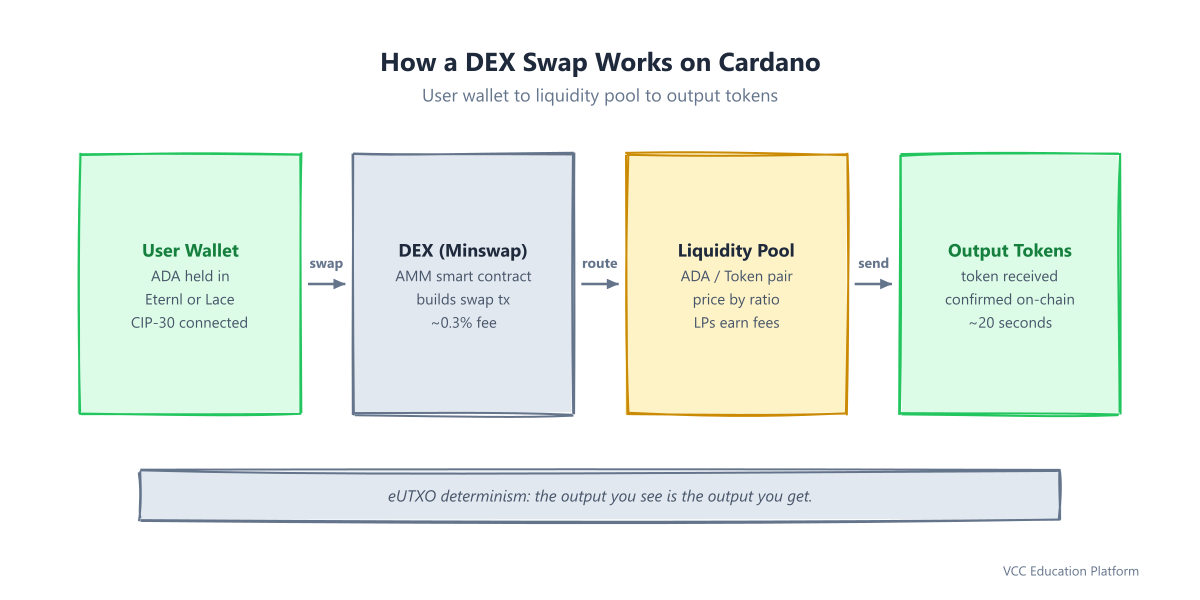
How a DEX swap works: wallet to AMM pool to output tokens
Lending and Borrowing
Lending dapps let you deposit assets to earn interest or borrow against them. On Cardano the leader is Liqwid Finance, which grew 141% in a single quarter to surpass $113 million in TVL and become the top protocol by total value locked. You supply ADA or stablecoins into a lending pool, receive interest based on demand, and can borrow other assets by posting collateral. As with any over-collateralized lending, your borrowing capacity depends on the collateral ratio — if your collateral's value drops too far, the protocol can liquidate your position.
NFT Marketplaces
Cardano's native asset standard means tokens and NFTs are first-class citizens on the ledger — no special smart contract is needed to mint them. JPG Store is the leading NFT marketplace, consistently ranking among the top dapps by transaction count. It lets you buy, sell, and discover Cardano NFT collections, from generative art to utility tokens. Because NFTs on Cardano are native assets, transferring them costs a fraction of a cent in ADA fees, which makes the marketplace experience far cheaper than on Ethereum.
Stablecoins
Stablecoins are the quiet plumbing of DeFi — they give you a dollar-pegged asset to park value in without exiting to a bank. Cardano supports several:
- DJED — a formally verified, over-collateralized stablecoin backed by ADA in a smart contract at a 400–800% reserve ratio. It launched on mainnet in January 2023 and has held its peg through every market condition since. There is no company holding dollars; the collateral is ADA you can verify on-chain.
- iUSD — a synthetic dollar-pegged asset issued by Indigo Protocol. You lock ADA as collateral in a CDP (collateralized debt position) to mint iUSD, which lets you keep ADA price exposure while holding a stable asset.
- USDM and USDC variants — fiat-backed options that reach Cardano through regulated issuers or bridges.
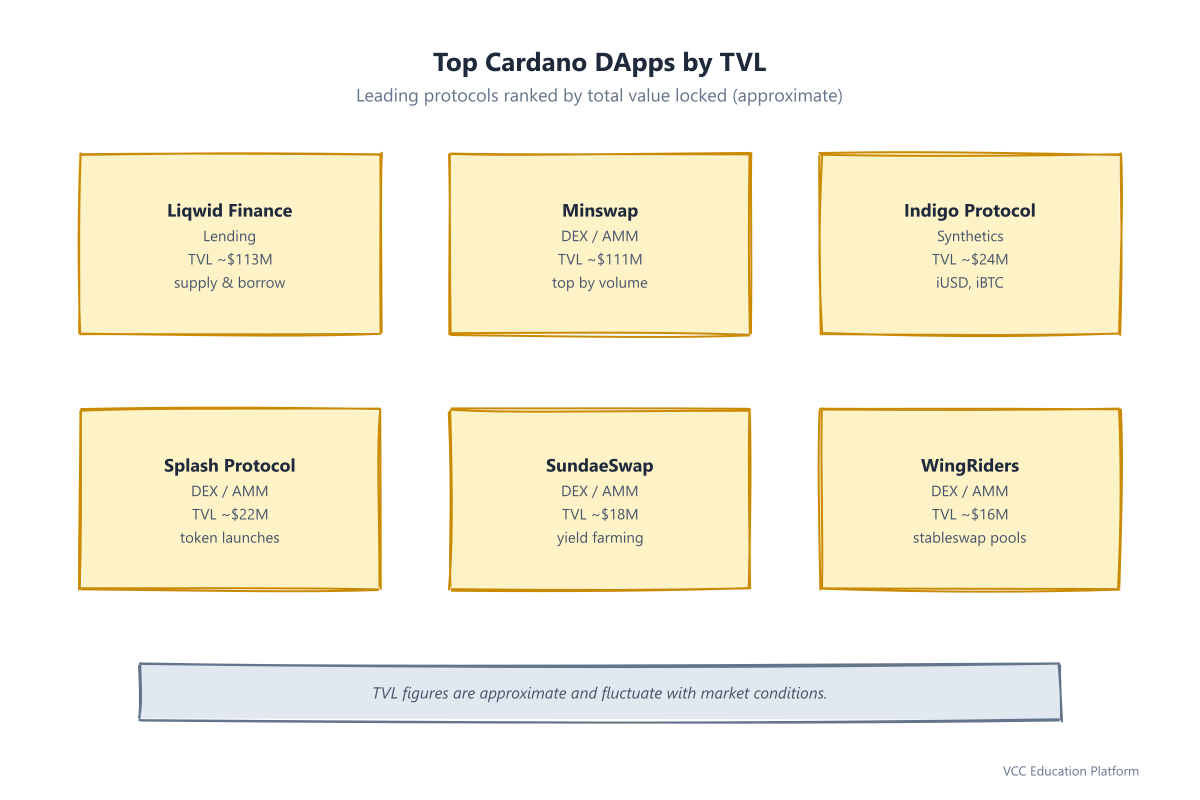
Top Cardano dapps ranked by total value locked (approximate)
How to Connect Your Wallet to a Cardano DApp
Every Cardano dapp interaction starts with connecting a wallet. The browser wallets (Eternl, Lace, Vespr, Typhon, NuFi) all implement CIP-30, the Cardano dApp-Wallet Web Bridge standard. CIP-30 defines a shared window.cardano object that each wallet extension registers into, so any dapp can discover and talk to any compliant wallet with the same code.
Here is the flow, simplified:
- Install a wallet — Eternl is the most popular full-featured choice; Lace is the official IOG wallet and good for beginners. Both are browser extensions.
- Visit the dapp — for example, minswap.org. Click "Connect Wallet."
- Approve the connection — your wallet pops up asking permission to share your address with the dapp. The dapp never receives your private keys; it only gets your public address and the ability to request signatures.
- Perform an action — say, swap ADA for MIN. The dapp builds a transaction and sends it to your wallet.
- Sign and submit — you review the transaction details in your wallet, approve the signature, and the wallet submits it to the network. The smart contract executes it on-chain.
The critical security point: your private keys never leave your device. The wallet signs locally and broadcasts only the signed transaction. If any website asks you to type your seed phrase, it is a scam — no legitimate dapp or wallet ever does that.
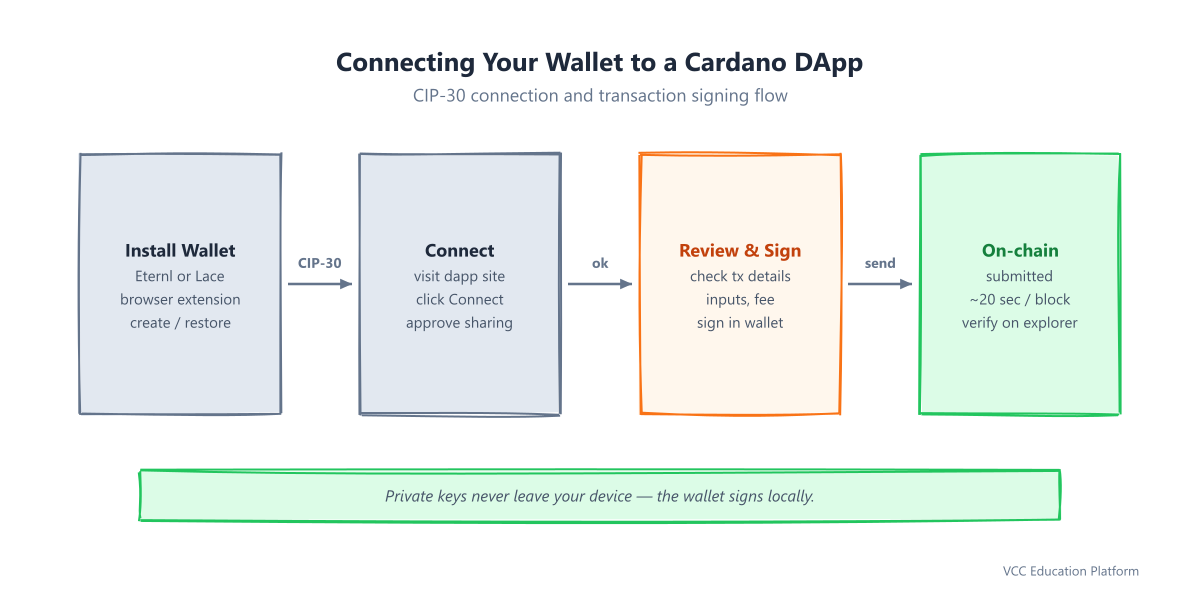
CIP-30 wallet connection and transaction signing flow
A Practical Walkthrough: Your First Swap on Minswap
To make this concrete, here is what a first swap looks like for a Vietnamese user who already holds ADA in an Eternl wallet.
Think of the mental model like topping up your Momo wallet and then paying a merchant: you load funds (your ADA is already in Eternl), you pick what to buy (on Minswap you select the output token), and you confirm the payment (you sign the swap transaction in your wallet). The difference is that instead of Momo's servers processing the transfer, a Plutus smart contract settles it on Cardano, and instead of a merchant receiving fiat, a liquidity pool receives your ADA and sends you the token you wanted.
Steps:
- Go to minswap.org and click Connect Wallet.
- Choose Eternl from the wallet list. Approve in the Eternl popup.
- Pick the Swap tab. Select ADA as the input and the token you want as output.
- Enter the amount. The interface shows you the expected output, price impact, and fee before you commit — eUTXO determinism means what you see is what you get.
- Click Swap. Eternl opens a review screen showing the full transaction: inputs, outputs, fee, and the script being invoked.
- Confirm. The transaction is submitted and usually confirmed in one block (~20 seconds). You can verify it on a Cardano explorer like Cardanoscan.
That is the entire loop. The same connect-sign-confirm pattern applies to depositing into Liqwid, buying an NFT on JPG Store, or minting iUSD on Indigo.
Risks Every DApp User Should Know
DeFi is powerful, but it is also where people lose money. Before you use any cardano defi apps, understand these risks.
Smart Contract Risk
A smart contract is code, and code has bugs. Even audited contracts can have logic flaws that an attacker exploits to drain funds. Cardano's eUTXO model and formal verification tools (the same methods used to prove DJED's stability) reduce this risk relative to some other chains, but they do not eliminate it. Mitigation: prefer dapps that have been audited, are open-source, and have been live for a long time without incidents.
Impermanent Loss
If you provide liquidity to an AMM pool and the two tokens' prices diverge, you can end up with less value than if you had simply held the tokens. This is called impermanent loss (it becomes permanent when you withdraw). It is the trade-off for earning swap fees. Stablecoin pools (two assets that stay near $1) have low impermanent loss; volatile pairs like ADA/MIN have more.
Rug Pulls and Unverified Projects
A "rug pull" happens when a dapp team disappears with user funds — often by holding the keys to a liquidity pool or by minting and dumping a token they created. Cardano's native asset model makes some rug patterns harder (you can verify token supply and policy on-chain), but new, unaudited projects still carry this risk. Mitigation: stick to established dapps with transparent teams, check the token's policy ID and supply on an explorer, and be skeptical of projects promising guaranteed high returns.
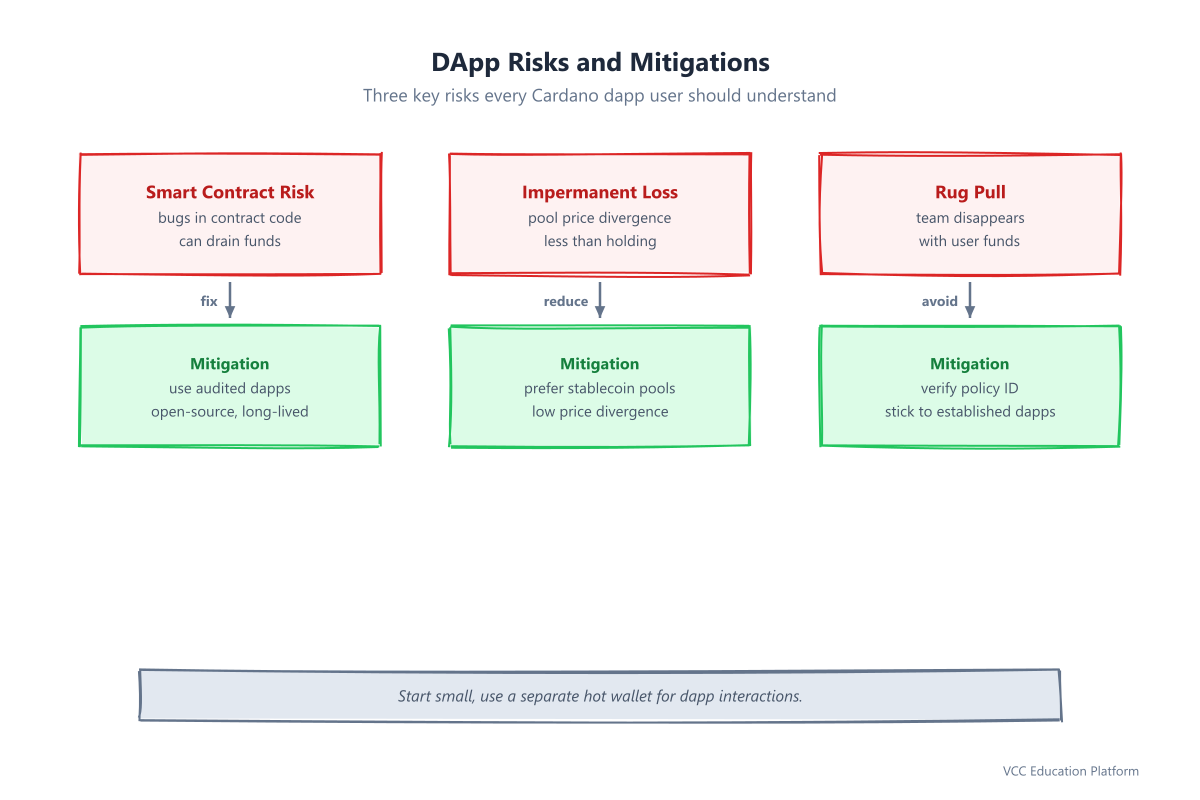
Three key dapp risks and their mitigations
The Vietnamese Context
Vietnam has one of the highest crypto adoption rates in the world, driven largely by mobile-first payment habits. Millions of Vietnamese users already move money daily through Momo, ZaloPay, and bank apps — so the leap to non-custodial wallets and dapps is more about trust calibration than technology literacy. The main adjustment is mental: with Momo, the company can reverse a wrong transaction or freeze a suspicious account. With a dapp, the smart contract's output is final and no support desk can undo it.
Practical tips for Vietnamese users:
- Start with a small amount — send 50–100 ADA to your Eternl wallet and do one swap before committing more. Treat the first transaction as a paid tutorial.
- Use a separate wallet for dapps — keep your main holdings in a hardware wallet (Ledger, Trezor) and only connect a hot wallet with a small balance to dapps. This limits exposure if a dapp is compromised.
- Watch the exchange rate — when swapping ADA for a token, compare the dapp's quoted rate against a price aggregator. Wide slippage on small-cap tokens is common.
- Beware of phishing — fake dapp front-ends that look like Minswap or JPG Store are a primary attack vector. Bookmark the official URLs and never click wallet-connect links from Telegram or Zalo messages.
FAQ: Common Questions About Cardano DApps
What are the best Cardano dapps for beginners?
Minswap for swapping tokens, JPG Store for NFTs, and Liqwid for lending are the most established and beginner-friendly. Start with a small swap on Minswap to learn the connect-sign-confirm flow before trying lending or liquidity provision.
How many Cardano dapps are there?
Tracking platforms list over 120 protocols across DeFi, NFTs, and infrastructure. The top Cardano dapps by TVL and transaction count are Minswap, Liqwid, Indigo, Splash, SundaeSwap, and WingRiders, but the long tail includes yield aggregators, oracles, and identity tools.
Do I need to keep my wallet open while using a dapp?
You need the wallet extension installed and enabled so it can pop up to request your signature, but you do not need to keep a separate app running. Once a transaction is signed and submitted, confirmation happens on-chain within about 20 seconds.
Are Cardano dapp transactions expensive?
No. A typical swap costs a fraction of an ADA in fees — often under 0.2 ADA (a few cents). This is one of Cardano's advantages over Ethereum, where a single swap can cost several dollars during congestion.
Can a dapp access my private keys?
No. CIP-30 is designed so the wallet never exposes private keys to the dapp. The dapp can request your public address and ask you to sign transactions, but signing happens inside the wallet extension on your device. Any site that asks for your seed phrase is a scam.
What is the difference between a DEX and a centralized exchange?
A centralized exchange (like Binance or OKX) holds your funds and processes trades on its own books. A DEX like Minswap settles trades through on-chain liquidity pools that anyone can provide to, and you keep custody of your funds the entire time — the trade only happens when you sign the transaction from your own wallet.
Further reading: To understand the wallets you connect with, see our guides on Eternl wallet features and setting up your first wallet. For the mechanics behind DEX pricing, read about DEX and AMM and liquidity pools.