
- What Are Cardano CIP Standards?
- The CIP Process: From Idea to Active Standard
- CIP Categories Explained: A Functional Map for Developers
- Essential CIP Examples by Developer Role
- CIP Status Reality Check: What's Actually Used?
- How to Read and Contribute to CIPs
- Vietnamese Terminology Guide
- Frequently Asked Questions
- Summary: Your CIP Learning Path
What Are Cardano CIP Standards?
If you've spent time in the Cardano ecosystem, you've likely seen references like "CIP-30," "CIP-1694," or "CIP-1852" in wallet documentation, developer forums, or GitHub discussions. But what exactly is a Cardano CIP standard, and why do they matter?
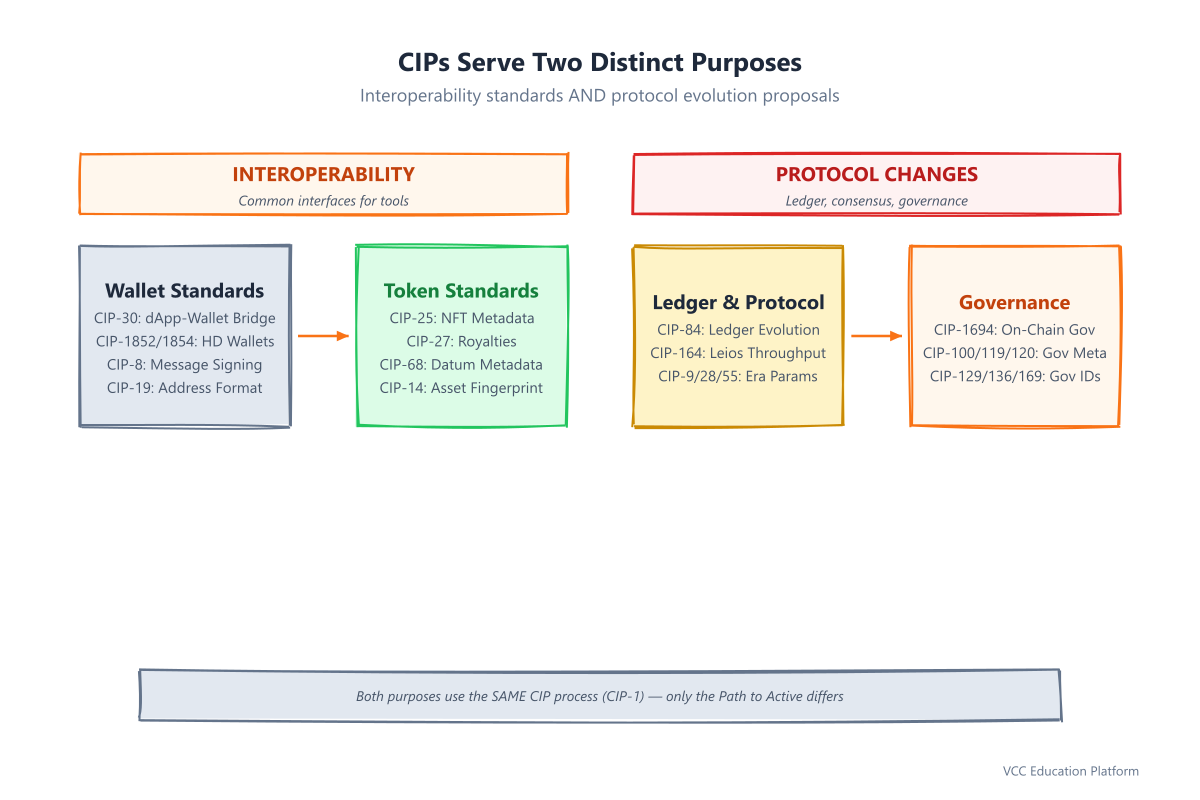
A Cardano Improvement Proposal (CIP) is a formalized design document that serves two distinct purposes in the ecosystem:
- Interoperability Standards — Common interfaces that wallets, dApps, and tools agree upon so they work together seamlessly (like how USB-C lets any charger work with any laptop).
- Protocol Change Proposals — Technical specifications for evolving the Cardano protocol itself (ledger rules, consensus parameters, governance mechanisms).
Think of CIPs as Cardano's equivalent to Bitcoin's BIPs or Ethereum's EIPs — but with a uniquely Cardano flavor: a rigorous, community-driven process governed by CIP-1 (the CIP Process), bi-weekly editor meetings, and a clear lifecycle from draft to Active standard.
Key Insight: Unlike some ecosystems where standards are dictated by a central foundation, Cardano's CIP process is deliberately decentralized. Editors facilitate; the community decides. A CIP only becomes "Active" when it's actually implemented and adopted — not just when it's approved on paper.
The CIP Process: From Idea to Active Standard
The journey of a CIP is deliberately structured to balance openness with technical rigor. CIP-1 (authored by Frederic Johnson, Sebastien Guillemot, Matthias Benkort, Duncan Coutts, Michael Peyton Jones, and Robert Phair) serves as the constitution for this process.
The Four-Stage Lifecycle
Note: Lifecycle flowchart diagram not yet created
Stage 1: Draft (Pull Request)
- Author opens a PR on
cardano-foundation/CIPswith a CIP-? placeholder number - Early discussions happen on Cardano Forum, Discord, or Telegram
- No formal review yet — this is the "shaping" phase
Stage 2: Editor Triage (Bi-weekly)
- CIP editors (currently Robert Phair, Ryan Williams, Thomas Vellekoop) meet every two weeks on Discord
- They assign a CIP number, categorize it, and check basic formatting
- This is a triage, not a technical review — editors ensure the proposal is ready for review
Stage 3: Community Review
- Deep technical discussion in the PR
- Relevant project maintainers invited (e.g., Plutus team for Plutus CIPs, Ledger team for Ledger CIPs)
- Authors must address concerns in the "Rationale" section
- Crucial: A CIP doesn't need everyone to agree it's a good idea — it needs to be technically sound
Stage 4: Merged as "Proposed"
- Once criteria are met, the CIP is merged with status
Proposed - This means: "The community agrees this is a well-specified, technically sound proposal"
- But:
Proposed≠Implemented. This is where many misunderstandings happen.
The Path to "Active" — Where Reality Happens
Every CIP must define its own Path to Active with two subsections:
| Subsection | Purpose |
|---|---|
| Acceptance Criteria | Observable metrics: "Implemented by 3+ wallets," "Live on mainnet," "Adopted by 5+ dApps" |
| Implementation Plan | Who will build it, timeline, hard-fork requirements if any |
Only when acceptance criteria are met does an author (or editor) submit a PR to change status to Active. If a CIP is superseded or abandoned, it becomes Inactive (superseded by CIP-XXXX).
Vietnamese Context: In Vietnamese developer communities (Telegram groups, Facebook dev groups), CIPs are typically referred to by number — "CIP-30," "CIP-1694" — without translation. The term "CIP" itself is untranslated. This article uses the same convention.
CIP Categories Explained: A Functional Map for Developers
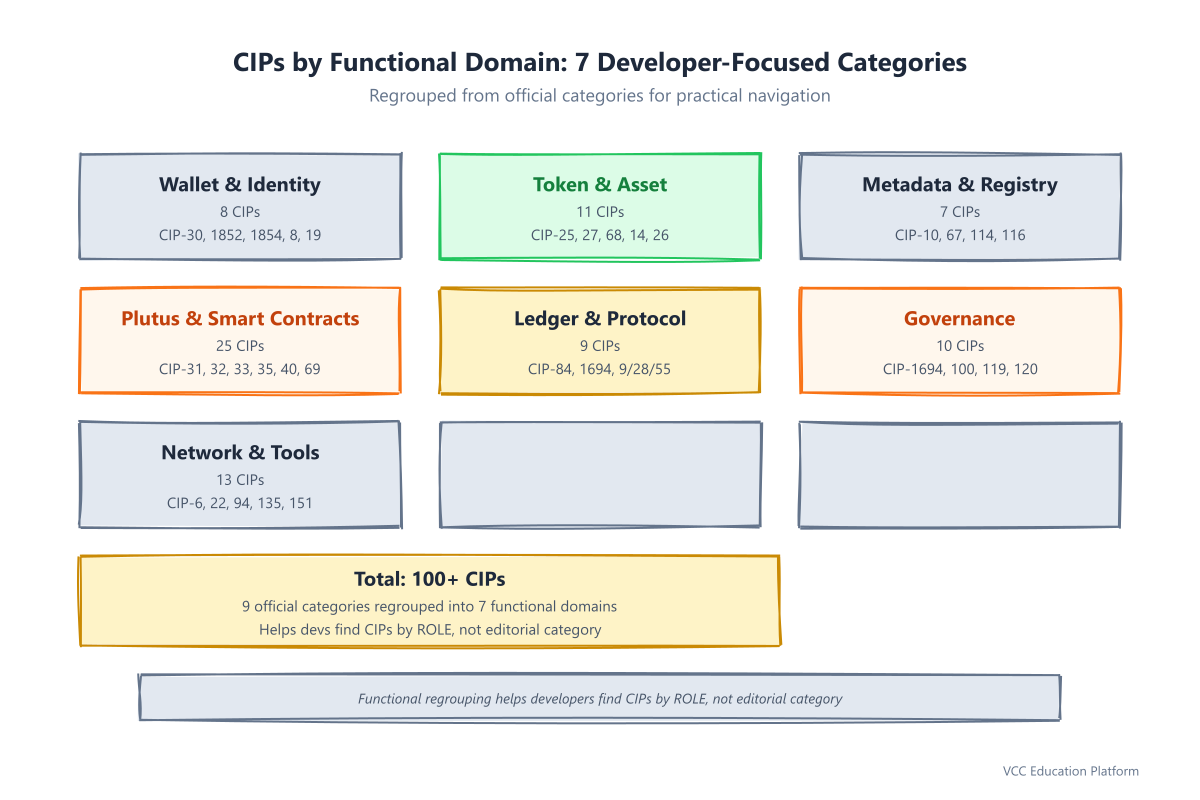
The official CIP registry uses categories like Meta, Wallets, Tokens, Metadata, Tools, Plutus, Ledger, Consensus, and Network. But for a developer trying to find relevant standards, these can feel abstract.
We've regrouped 100+ CIPs into 7 functional domains based on what they enable you to build:
1. Wallet & Identity Standards (8 CIPs)
Purpose: How wallets generate keys, sign messages, and identify users
| CIP | Title | Status | Why It Matters |
|---|---|---|---|
| CIP-3 | Wallet Key Generation | Active | BIP-32/44 derivation paths for Cardano |
| CIP-4 | Wallet Checksums | Proposed | Address checksum validation |
| CIP-8 | Message Signing | Active | Standardized off-chain signing (COSE) |
| CIP-11 | Staking Key Chain for HD Wallets | Active | Hierarchical staking keys |
| CIP-13 | Cardano URI Scheme | Proposed | cardano: links for payments |
| CIP-18 | Multi-Stake-Keys Wallets | Proposed | Multiple stake keys per wallet |
| CIP-19 | Cardano Addresses | Active | Address format specification (Bech32) |
| CIP-30 | dApp-Wallet Web Bridge | Active | The wallet connector standard — 8+ wallets |
| CIP-1852/1853/1854/1855 | HD Wallet Hierarchies | Active/Proposed | Multi-account, multi-signature, forging keys |
Start here if: Building a wallet, integrating wallet connect, or handling user keys.
2. Token & Asset Standards (11 CIPs)
Purpose: Fungible tokens, NFTs, metadata, royalties, and asset identification
| CIP | Title | Status | Why It Matters |
|---|---|---|---|
| CIP-14 | User-Facing Asset Fingerprint | Active | Human-readable asset IDs (asset1...) |
| CIP-15 | Catalyst Registration Metadata | Active | Voting registration format |
| CIP-20 | Transaction Message/Comment Metadata | Active | Standardized metadata labels |
| CIP-25 | Media Token Metadata Standard | Active | NFT metadata (images, properties) |
| CIP-26 | Off-Chain Metadata | Active | Large metadata stored off-chain (IPFS) |
| CIP-27 | CNFT Community Royalties Standard | Active | Royalty enforcement for NFTs |
| CIP-60 | Music Token Metadata | Active | Audio-specific metadata |
| CIP-67 | Asset Name Label Registry | Proposed | Human-readable token names |
| CIP-68 | Datum Metadata Standard | Active | Structured on-chain metadata |
| CIP-102 | Royalty Datum Metadata | Proposed | On-chain royalty enforcement |
| CIP-124 | Extend Token Metadata for Translations | Proposed | Multi-language metadata |
Start here if: Creating tokens, NFTs, marketplaces, or metadata tools.
3. Metadata & Registry Standards (7 CIPs)
Purpose: Registries, labels, and structured data formats
| CIP | Title | Status | Why It Matters |
|---|---|---|---|
| CIP-10 | Transaction Metadata Label Registry | Active | Reserved label numbers (674 = JSON) |
| CIP-34 | Chain ID Registry | Proposed | Network identification |
| CIP-67 | Asset Name Label Registry | Proposed | Human-readable names |
| CIP-114 | CBOR Tags Registry | Proposed | CBOR tag assignments |
| CIP-116 | Canonical JSON Encoding | Proposed | Deterministic JSON for hashing |
4. Plutus & Smart Contract Standards (25 CIPs — Largest Category)
Purpose: The Vasil/Conway era Plutus improvements that make smart contracts efficient
| CIP | Title | Status | Why It Matters |
|---|---|---|---|
| CIP-31 | Reference Inputs | Active | Read UTXOs without spending (Vasil) |
| CIP-32 | Inline Datums | Active | Attach datum directly to output (Vasil) |
| CIP-33 | Reference Scripts | Active | Reuse scripts without resubmitting (Vasil) |
| CIP-35 | Plutus Core Evolution | Active | Versioning for Plutus language |
| CIP-40 | Collateral Output | Active | Safe collateral for Plutus scripts |
| CIP-42 | serialiseData Builtin | Active | Efficient data serialization |
| CIP-49 | ECDSA/Schnorr in Plutus | Active | Cryptographic primitives |
| CIP-69 | Plutus Script Type Uniformization | Active | Unified script interface |
| CIP-85 | Sums-of-Products in Plutus | Active | Better data structures |
| CIP-110 | Plutus v1 Script References | Active | Reference scripts for v1 |
| CIP-117 | Explicit Script Return Values | Active | Clear success/failure signals |
| CIP-121/122/123 | ByteString Operations | Active | Integer↔ByteString, logic, bitwise |
| CIP-127 | RIPEMD-160 in Plutus | Active | Hash function |
| CIP-132 | dropList Builtin | Proposed | List optimization |
| CIP-133 | Multi-Scalar Multiplication (BLS) | Proposed | Cryptographic aggregation |
| CIP-138 | Array Builtin Type | Proposed | Native arrays |
| CIP-152 | Modules in UPLC | Proposed | Code organization |
| CIP-153 | MaryEraValue Type | Proposed | Multi-asset value type |
| CIP-156 | multiIndexArray Builtin | Proposed | Efficient array access |
| CIP-168 | More BuiltinValue Functions | Proposed | Extended value ops |
| CIP-381 | Plutus Pairings (BLS12-381) | Active | Advanced cryptography |
Start here if: Writing Plutus scripts, building DeFi, or optimizing script performance.
Original Analysis: The Vasil upgrade (CIP-31/32/33) was a watershed moment — it transformed Plutus from "possible but expensive" to "practical for production." Before Vasil, every datum read required spending and recreating a UTXO (1 operation per block). Reference inputs + inline datums + reference scripts removed this bottleneck entirely.
5. Ledger & Protocol Evolution (9 CIPs)
Purpose: Core protocol parameters, ledger rules, and versioning
| CIP | Title | Status | Why It Matters |
|---|---|---|---|
| CIP-9/28/55 | Protocol Parameters (Shelley/Alonzo/Babbage) | Active | Era-specific parameter registries |
| CIP-84 | Cardano Ledger Evolution | Active | Ledger change process (enlisted category) |
| CIP-164 | Ouroboros Linear Leios | Proposed | Higher throughput consensus |
| CIP-165 | Canonical Ledger State | Proposed | Standardized state representation |
| CIP-167 | Remove isValid from Transactions | Proposed | Simplification |
| CIP-173 | Net Change Limit Parameter | Proposed | Governance parameter |
| CIP-176 | Non-segregated Block Body | Proposed | Block structure change |
6. Governance & Constitution (10 CIPs)
Purpose: On-chain governance (CIP-1694/Conway era), DReps, constitutional committee
| CIP | Title | Status | Why It Matters |
|---|---|---|---|
| CIP-100 | Governance Metadata | Active | Governance action metadata format |
| CIP-108 | Governance Actions Metadata | Proposed | Specific action types |
| CIP-119 | Governance Metadata - DReps | Proposed | Delegated Representative metadata |
| CIP-120 | Constitution Specification | Proposed | On-chain constitution format |
| CIP-129 | Governance Identifiers | Proposed | IDs for governance objects |
| CIP-136 | Constitutional Committee Votes | Proposed | CC voting format |
| CIP-169 | On-Chain Binding | Proposed | Binding governance to execution |
| CIP-1694 | On-Chain Decentralized Governance | Active | The Conway governance framework |
| CIP-179 | On-Chain Surveys and Polls | Proposed | Signaling mechanism |
| CIP-181/190 | Governance Withdrawals/Proofs | Proposed | Reward withdrawal rules |
Start here if: Building governance tools, DRep interfaces, or constitution explorers.
7. Network, Communication & Tools (13 CIPs)
Purpose: P2P, URIs, SPO operations, disaster recovery, developer tooling
| CIP | Title | Status | Why It Matters |
|---|---|---|---|
| CIP-6 | Stake Pool Extended Metadata | Active | Pool metadata (ticker, homepage, etc.) |
| CIP-12/13 | SPO Communication / URI Scheme | Proposed/Proposed | Pool-delegate messaging, payment links |
| CIP-22 | Pool Operator Verification | Active | On-chain operator verification |
| CIP-45 | WebRTC dApp-Wallet Communication | Active | Peer-to-peer wallet connections |
| CIP-52 | Audit Best Practice Guidelines | Proposed | Security audit standards |
| CIP-72 | dApp Registration & Verification | Proposed | Verified dApp registry |
| CIP-80 | Transaction Serialization Deprecation | Active | Versioned serialization |
| CIP-94 | On-Chain SPO Polls | Active | Stake pool governance signaling |
| CIP-99 | Proof of Onboarding | Active | KYC/AML proof format |
| CIP-135 | Disaster Recovery Plan | Active | Network disaster procedures |
| CIP-151 | On-Chain Stake Pool Registration | Proposed | Pool registration on-chain |
Essential CIP Examples by Developer Role
Not every developer needs to read every CIP. Here's your role-based reading list:
🎯 Wallet Developers — Start With These 5
| Priority | CIP | Reason |
|---|---|---|
| Must Know | CIP-30 | The wallet-dApp bridge; 8+ wallets implement it |
| Must Know | CIP-1852/1854 | HD wallet hierarchies for multi-account |
| Should Know | CIP-8 | Message signing standard (COSE) |
| Should Know | CIP-19 | Address format (Bech32 prefixes) |
| Watch | CIP-1853/1855 | Stake pool cold keys, forging policy keys |
🎯 dApp Developers — Start With These 5
| Priority | CIP | Reason |
|---|---|---|
| Must Know | CIP-30 | Wallet connection + extensions negotiation |
| Must Know | CIP-31/32/33 | Vasil features: reference inputs, inline datums, reference scripts |
| Should Know | CIP-20/83 | Transaction metadata (user messages, encrypted) |
| Should Know | CIP-68 | Structured datum metadata for dApp state |
| Watch | CIP-95/103/106/141 | Conway-era wallet bridge extensions |
🎯 Plutus/Smart Contract Developers — Start With These 5
| Priority | CIP | Reason |
|---|---|---|
| Must Know | CIP-31/32/33 | The "Vasil trio" — reference inputs, inline datums, reference scripts |
| Must Know | CIP-35 | Plutus Core versioning and evolution |
| Should Know | CIP-40 | Collateral output (safe script execution) |
| Should Know | CIP-69 | Script type uniformization (v1/v2/v3) |
| Watch | CIP-117/121-123/127 | Explicit returns, ByteString ops, RIPEMD-160 |
🎯 Stake Pool Operators — Start With These 4
| Priority | CIP | Reason |
|---|---|---|
| Must Know | CIP-6 | Extended metadata (ticker, homepage, relays) |
| Must Know | CIP-22 | Operator verification (on-chain proof) |
| Should Know | CIP-94 | On-chain SPO polls (governance signaling) |
| Watch | CIP-151 | On-chain pool registration |
🎯 Token/NFT Creators — Start With These 4
| Priority | CIP | Reason |
|---|---|---|
| Must Know | CIP-25 | Media token metadata (images, attributes) |
| Must Know | CIP-27 | Royalties standard — marketplace enforcement |
| Should Know | CIP-68 | Datum metadata for advanced NFT logic |
| Watch | CIP-102/124 | On-chain royalties, multi-language metadata |
CIP Status Reality Check: What's Actually Used?
Here's where theory meets practice. As of August 2026, the CIP registry shows approximately:
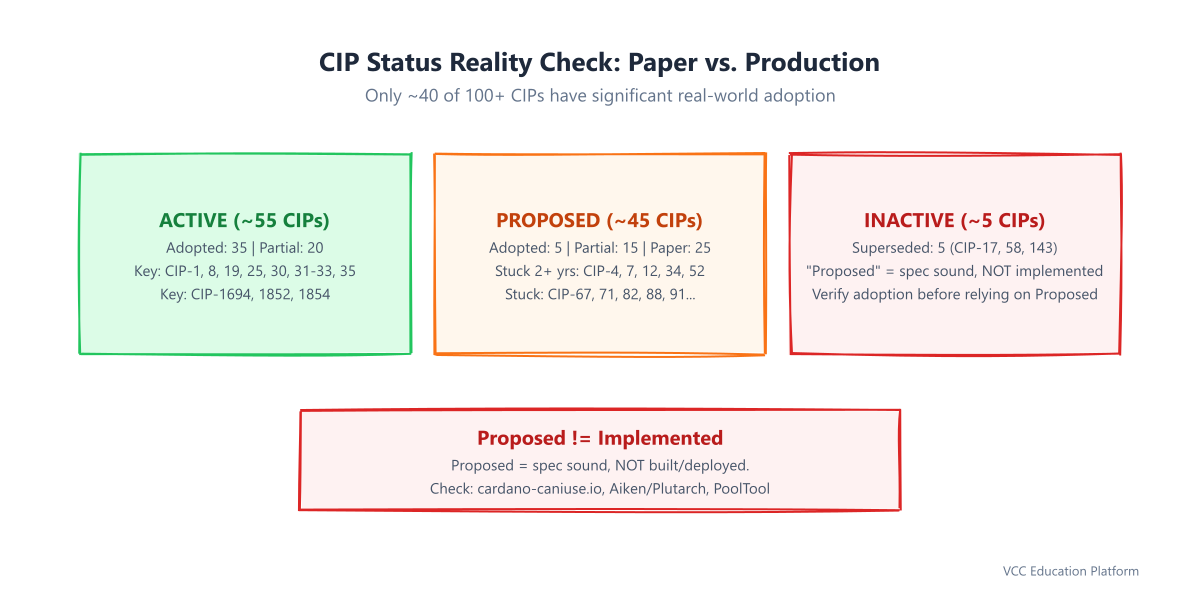
| Status | Count | Widely Adopted | Partially Adopted | Paper Only |
|---|---|---|---|---|
| Active | ~55 | ~35 | ~20 | 0 |
| Proposed | ~45 | ~5 | ~15 | ~25 |
| Inactive | ~5 | 0 | 0 | 5 |
The "Proposed ≠ Implemented" Trap
Critical Insight: A Proposed CIP means "the specification is sound and accepted by the community." It does not mean it's implemented, deployed, or usable.
Examples of long-standing Proposed CIPs (2+ years):
- CIP-4 (Wallet Checksums) — Proposed since 2020
- CIP-7 (Curve Pledge Benefit) — Proposed since 2020
- CIP-12 (SPO-Delegate Communication) — Proposed since 2020
- CIP-34 (Chain ID Registry) — Proposed since 2021
- CIP-52 (Audit Guidelines) — Proposed since 2022
Meanwhile, Active CIPs with real adoption:
- CIP-30: 8+ wallets (Nami, Eternl, Flint, Lace, Yoroi, etc.)
- CIP-31/32/33: Implemented in all major Plutus tools (Aiken, Plutarch, Helios, Lucid)
- CIP-25/27: Used by JPG Store, CNFT.io, Tokhun
- CIP-6/22/94: Standard for all registered stake pools
- CIP-1694: Live on mainnet since Conway hard fork (2024)
How to Check Real-World Support
- Wallets/DApps: cardano-caniuse.io — tracks CIP-30 extension support
- Plutus Tools: Check Aiken, Plutarch, Helios, Lucid, MeshJS changelogs
- SPO Tools: PoolTool, Koios, Cardano CLI support matrices
Vietnamese Dev Tip: Vietnamese wallet projects (if any emerge) should prioritize CIP-30 + CIP-1852/1854 implementation first — these are the foundation for any Cardano wallet.
How to Read and Contribute to CIPs
CIP Document Anatomy
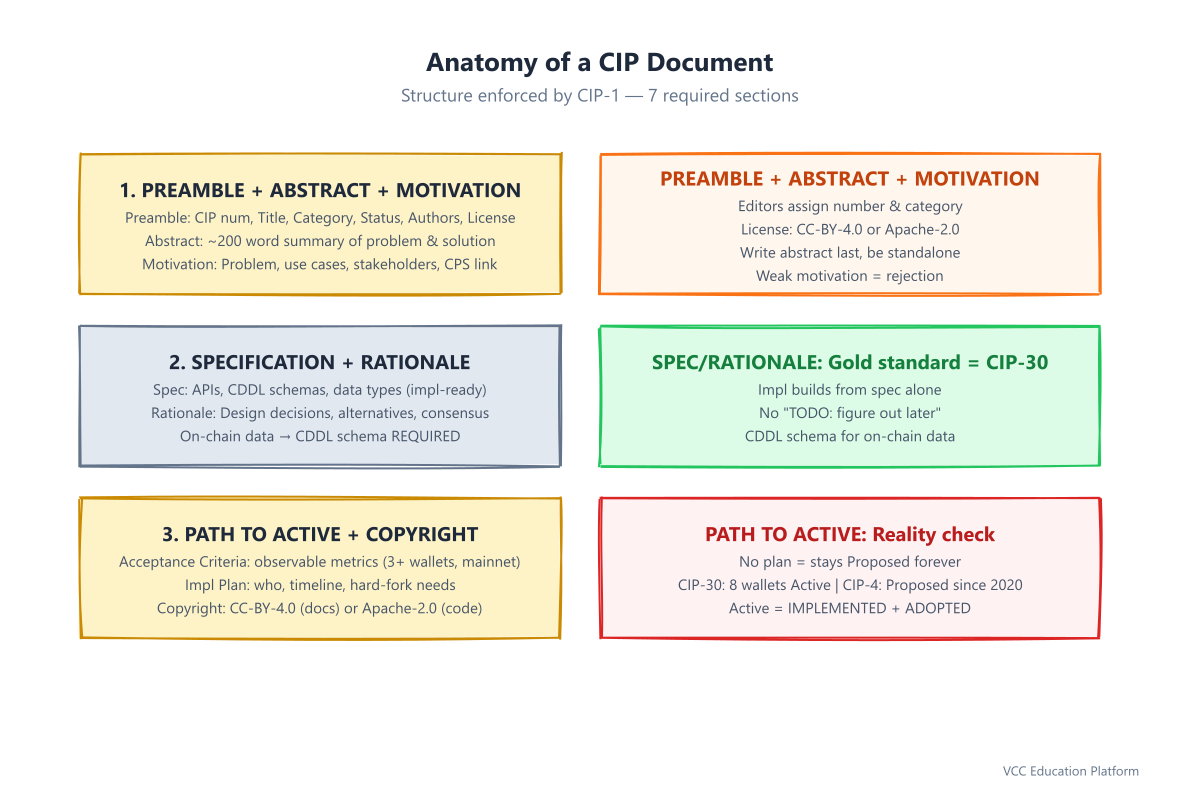
Every CIP follows this structure (enforced by CIP-1):
---
CIP: 30
Title: Cardano dApp-Wallet Web Bridge
Category: Wallets
Status: Active
Authors: [...]
Implementors: [Begin, Eternl, Flint, ...]
Discussions: [PR links]
Created: 2021-04-29
License: CC-BY-4.0
---

## Abstract
~200 word summary of the problem and solution.

## Motivation: Why is this CIP necessary?
The problem statement, use cases, stakeholders.

## Specification
Technical detail — APIs, CDDL schemas, data types.
MUST be detailed enough for independent implementation.

## Rationale: How does this CIP achieve its goals?
Design decisions, alternatives considered, backward compatibility.

## Path to Active
### Acceptance Criteria
Observable metrics for becoming Active.
### Implementation Plan
Who builds what, timeline, hard-fork needs.

## Copyright
License declaration (CC-BY-4.0 or Apache-2.0).
Finding CIPs
- Official site: https://cips.cardano.org/ — searchable, categorized
- GitHub: https://github.com/cardano-foundation/CIPs — source of truth, PR discussions
- Adoption tracker: https://www.cardano-caniuse.io/ — wallet/dApp support matrix
Contributing to the CIP Process
- Discuss first — Cardano Forum (CIPs category), Discord
#cips, Telegram - Write a CPS (optional) — For complex problems, use CIP-9999 (Cardano Problem Statements)
- Draft the CIP — Use the template
- Open a PR — Title = CIP title, CIP number =
? - Champion it — Respond to reviews, update Rationale, engage editors
- Find implementors — A CIP without implementors stays
Proposedindefinitely
Vietnamese Terminology Guide
| English Term | Vietnamese | Notes |
|---|---|---|
| Cardano Improvement Proposal (CIP) | Đề xuất Cải tiến Cardano (CIP) | Giữ nguyên viết tắt |
| Cardano Problem Statement (CPS) | Tuyên bố Vấn đề Cardano (CPS) | Giữ nguyên viết tắt |
| Proposed / Active / Inactive | Đề xuất / Hoạt động / Không hoạt động | Trạng thái |
| Interoperability | Tương tác lẫn nhau / Khả năng tương thích | Tùy ngữ cảnh |
| On-chain governance | Quản trị on-chain / Quản trị trên chuỗi | |
| UTXO | UTXO (giữ nguyên) | Thuật ngữ kỹ thuật |
| Datum | Datum (giữ nguyên) | Thuật ngữ kỹ thuật |
| Reference input | Đầu vào tham chiếu | CIP-31 |
| Inline datum | Datum nội tuyến | CIP-32 |
| Reference script | Script tham chiếu | CIP-33 |
| Hard fork | Hard fork / Nâng cấp cứng | |
| Stake pool operator (SPO) | Vận hành stake pool / SPO | |
| Delegated Representative (DRep) | Đại diện ủy quyền / DRep | CIP-1694 |
| Constitutional Committee | Ủy ban Hiến pháp | CIP-1694 |
Frequently Asked Questions
1. What's the difference between a CIP and a CPS?
A CIP (Cardano Improvement Proposal) proposes a solution — a standard or protocol change. A CPS (Cardano Problem Statement, CIP-9999) formally defines a problem without prescribing a solution. Complex CIPs often reference a CPS in their Motivation section.
2. Do I need to implement all CIPs?
No. Only implement CIPs relevant to your domain:
- Wallet dev → CIP-30, 1852, 1854, 8, 19
- dApp dev → CIP-30, 31, 32, 33, 20, 68
- Plutus dev → CIP-31, 32, 33, 35, 40, 69
- SPO → CIP-6, 22, 94
- Token creator → CIP-25, 27, 68
3. How do I know if a wallet supports a specific CIP?
Check cardano-caniuse.io — it tracks which wallets implement which CIP-30 extensions. For non-CIP-30 standards, check the wallet's GitHub or documentation.
4. Can a CIP be rejected after becoming Active?
Yes — it becomes Inactive (superseded by CIP-XXXX). Examples: CIP-17 (Delegation Portfolio) superseded by CIP-1852/1854; CIP-58 (Bitwise Primitives) superseded by CIP-121/122/123.
5. Are CIPs legally binding or mandatory?
No. CIPs are community-driven, advisory standards. However, ecosystem projects (wallets, dApps, indexers) that ignore relevant Active CIPs risk incompatibility. The Cardano Foundation recommends adoption but doesn't enforce it.
6. What's the relationship between CIP-1694 and governance?
CIP-1694 ("A First Step Towards On-Chain Decentralized Governance") is the foundational Conway-era governance framework. It introduces: DReps (Delegated Representatives), Constitutional Committee, governance actions, and on-chain voting. Subsequent CIPs (100, 108, 119, 120, 129, 136, 169, 179, 181, 190) specify metadata formats for each governance component.
7. How often are new CIPs created?
The repository has 790+ commits with new CIPs proposed several per month. Not all reach Active — many stall at Proposed awaiting implementors. Check the open PRs for current proposals.
8. Where can I discuss CIPs in Vietnamese?
- Telegram: Cardano Developers Vietnam, Cardano Việt Nam
- Facebook Groups: Cardano Developer Vietnam, Cardano Việt Nam Community
- Discord: Cardano Vietnam server (often has
#dev-cipschannel) - Forum: forum.cardano.org (English, but Vietnamese speakers welcome)
Summary: Your CIP Learning Path
| If You're... | Week 1 | Week 2 | Week 3 | Ongoing |
|---|---|---|---|---|
| New to Cardano | CIP-1 (process), CIP-19 (addresses) | CIP-30 (wallet bridge) | CIP-25/27 (tokens) | Follow cips.cardano.org |
| Wallet Dev | CIP-30, 1852, 1854 | CIP-8, 19, 1853/1855 | CIP-45 (WebRTC) | cardano-caniuse.io |
| dApp Dev | CIP-30, 31, 32, 33 | CIP-20, 68, 95 | CIP-103, 106, 141 | Plutus tool changelogs |
| Plutus Dev | CIP-31, 32, 33, 35 | CIP-40, 69, 117 | CIP-121-123, 127, 381 | Aiken/Plutarch docs |
| SPO | CIP-6, 22, 94 | CIP-151 | CIP-12, 13, 45 | PoolTool/Koios |
Further Reading
- Official CIP Site: https://cips.cardano.org/
- GitHub Repository: https://github.com/cardano-foundation/CIPs
- CIP Wiki (Reviewer Guides): https://github.com/cardano-foundation/CIPs/wiki
- Adoption Tracker: https://www.cardano-caniuse.io/
- Cardano Forum CIPs Category: https://forum.cardano.org/c/developers/cips/122