
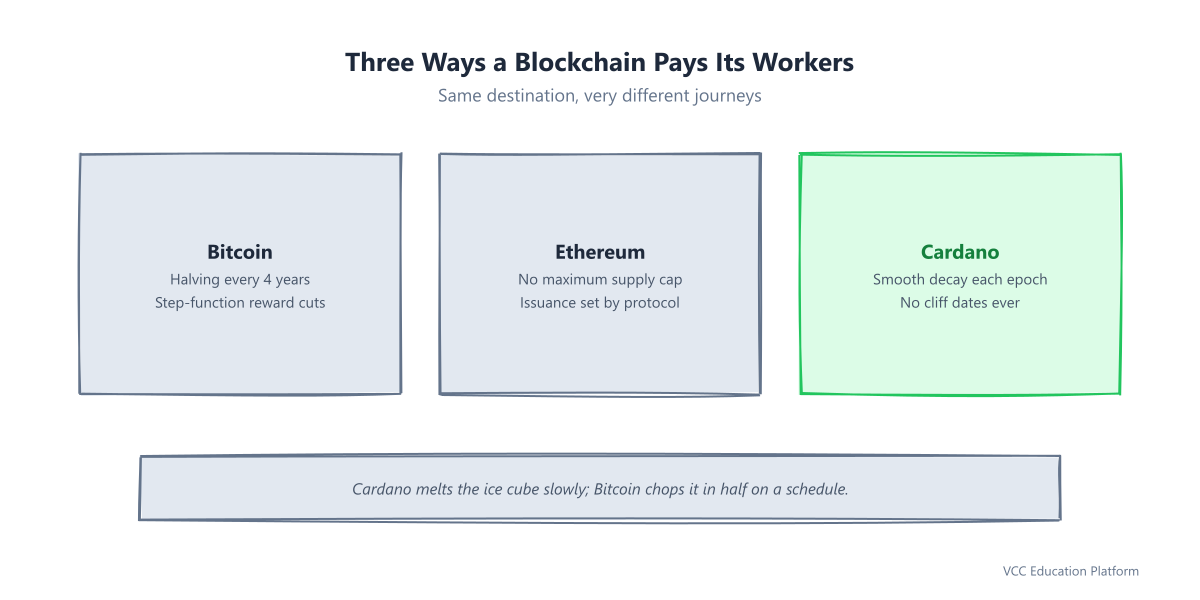
 Think of the difference this way. Bitcoin chops its ice block in half every four
years — dramatic, scheduled shocks. Cardano leaves its ice cube on the table and lets
it melt a little more each day: same destination, but nobody ever wakes up to a
supply shock they did not expect.
## Inside the Cardano Funding Model: Three Pots of Money
The total supply is hard-capped at 45 billion ADA. Nothing can ever mint above that
ceiling — there is no inflation switch, no burn mechanism below it. As of mid-2026
about 35.9 billion ADA (~80%) circulates publicly. The remaining ~9 billion sits in
three places:
1. **The reserve** — roughly 6.2 billion ADA left today. At genesis, about 13.9
billion was locked away purely to fund staking rewards.
2. **The treasury** — about 1.45 billion ADA held *on-chain*, owned by no company,
spendable only by community vote.
3. **Deposits and small allocations** — key deposits and similar protocol-held funds.
Think of the difference this way. Bitcoin chops its ice block in half every four
years — dramatic, scheduled shocks. Cardano leaves its ice cube on the table and lets
it melt a little more each day: same destination, but nobody ever wakes up to a
supply shock they did not expect.
## Inside the Cardano Funding Model: Three Pots of Money
The total supply is hard-capped at 45 billion ADA. Nothing can ever mint above that
ceiling — there is no inflation switch, no burn mechanism below it. As of mid-2026
about 35.9 billion ADA (~80%) circulates publicly. The remaining ~9 billion sits in
three places:
1. **The reserve** — roughly 6.2 billion ADA left today. At genesis, about 13.9
billion was locked away purely to fund staking rewards.
2. **The treasury** — about 1.45 billion ADA held *on-chain*, owned by no company,
spendable only by community vote.
3. **Deposits and small allocations** — key deposits and similar protocol-held funds.
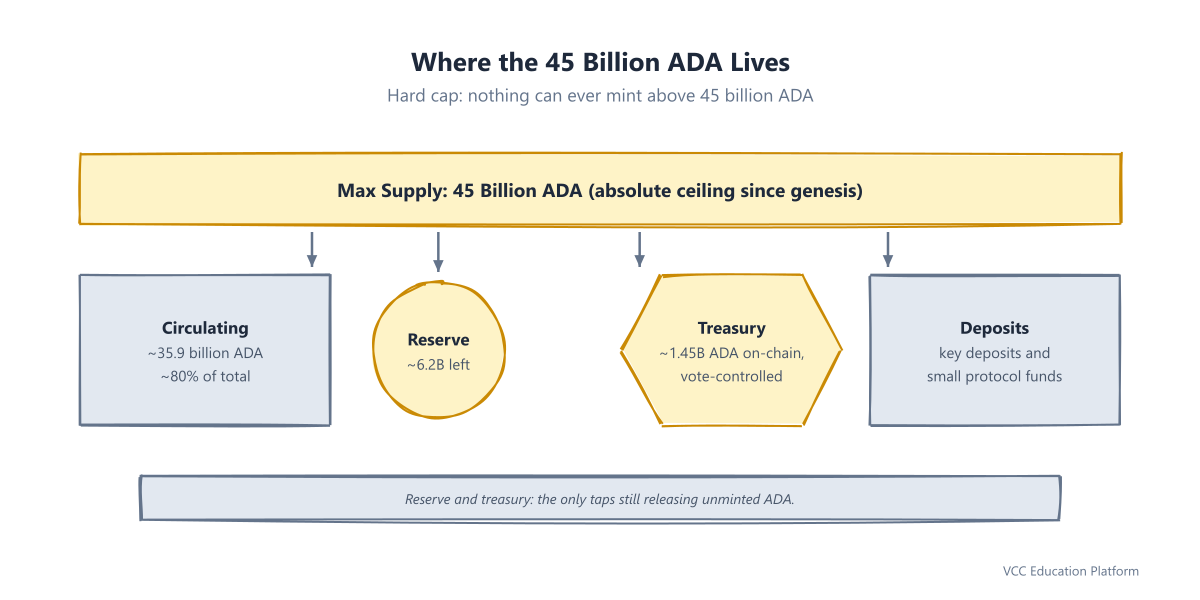 The reserve and the treasury are the heart of the sustainability story, because they
are the two "taps" through which unminted ADA still flows into the world.
## Staking Rewards and the Built-In Decay Schedule
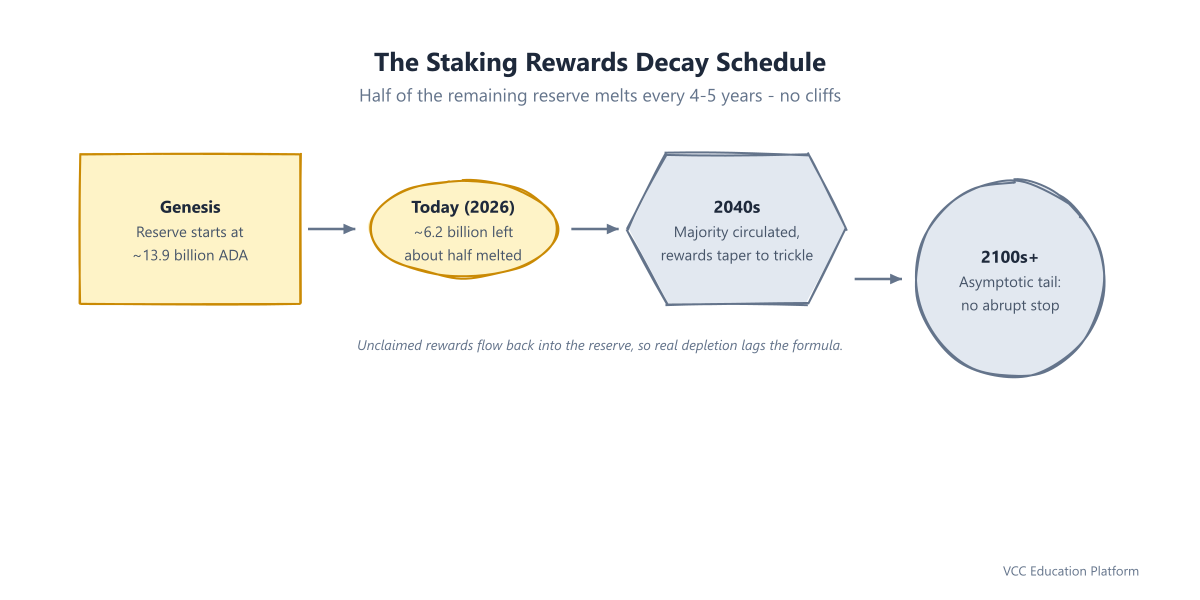
Cardano's security budget comes from people who delegate their ADA to stake pools.
Every five days — one epoch — the protocol moves a small slice of the remaining
reserve into the reward pot, alongside all transaction fees collected that epoch.
Two parameters control the flow:
- **rho (ρ) = 0.3%**: each epoch draws 0.3% of *whatever remains* in the reserve.
- Because the percentage applies to the shrinking remainder, emission declines every
single epoch — geometrically, like compound interest running in reverse.
The consequence is a decay schedule measured in decades, not months:
- The reserve loses roughly half its remaining balance every **4–5 years**.
- By the **2040s**, most of the reserve will have flowed into circulation.
- Mathematically the last drips stretch toward the **2100s–2140s** — the reserve
approaches zero asymptotically and never hits it abruptly.
One detail most summaries miss: unclaimed or unearned reward capacity flows *back*
into the reserve each epoch, so real-world depletion runs slightly behind the pure
formula. On-chain data from July 2026 shows the reserve releasing only ~115 million
ADA per quarter to the tradable float — disinflationary by construction.
The reserve and the treasury are the heart of the sustainability story, because they
are the two "taps" through which unminted ADA still flows into the world.
## Staking Rewards and the Built-In Decay Schedule
Cardano's security budget comes from people who delegate their ADA to stake pools.
Every five days — one epoch — the protocol moves a small slice of the remaining
reserve into the reward pot, alongside all transaction fees collected that epoch.
Two parameters control the flow:
- **rho (ρ) = 0.3%**: each epoch draws 0.3% of *whatever remains* in the reserve.
- Because the percentage applies to the shrinking remainder, emission declines every
single epoch — geometrically, like compound interest running in reverse.
The consequence is a decay schedule measured in decades, not months:
- The reserve loses roughly half its remaining balance every **4–5 years**.
- By the **2040s**, most of the reserve will have flowed into circulation.
- Mathematically the last drips stretch toward the **2100s–2140s** — the reserve
approaches zero asymptotically and never hits it abruptly.
One detail most summaries miss: unclaimed or unearned reward capacity flows *back*
into the reserve each epoch, so real-world depletion runs slightly behind the pure
formula. On-chain data from July 2026 shows the reserve releasing only ~115 million
ADA per quarter to the tradable float — disinflationary by construction.
 ## Treasury Sustainability: A War Chest No Company Owns
Here is where treasury sustainability gets interesting. Before any reward reaches a
stake pool or delegator, the protocol takes a cut:
## Treasury Sustainability: A War Chest No Company Owns
Here is where treasury sustainability gets interesting. Before any reward reaches a
stake pool or delegator, the protocol takes a cut:
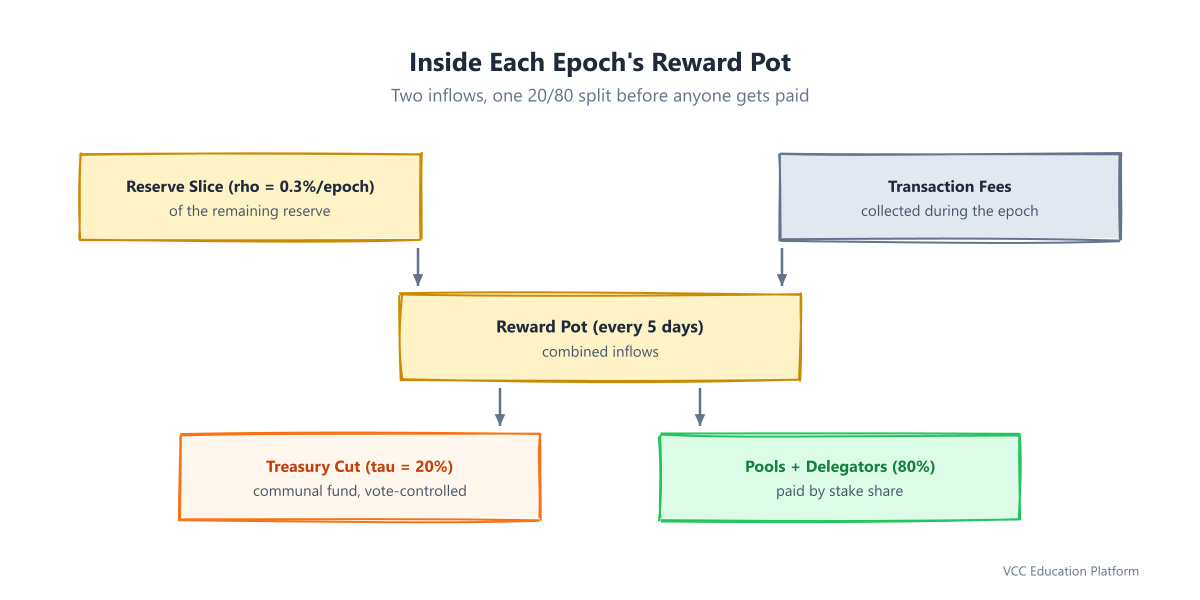 That 20% share (parameter **tau**) compounds quietly. The result is an on-chain fund
of about 1.45 billion ADA — hundreds of millions of dollars — that answers to nobody
except the community's own governance process. It resembles a Vietnamese hụ: a
communal savings circle where members decide together how the shared pot gets used.
Since Voltaire went live, that decision-making is real, not symbolic. Spending the
treasury requires a **Treasury Withdrawal Governance Action** approved by DReps
(delegated representatives) on-chain and checked against the constitution. For 2026
the community set a **Net Change Limit of 350 million ADA** — a constitutional cap on
how fast the war chest can drain — and passed a structured budget process with DRep
supermajority approval in April 2026.
The strongest behavioral evidence for cardano future sustainability: Input Output,
the founding engineering company, asked for $46.8 million from the treasury in 2026,
down from $97.5 million the year before — explicitly planning to need less each year
as specialist teams take over stewardship of core infrastructure.
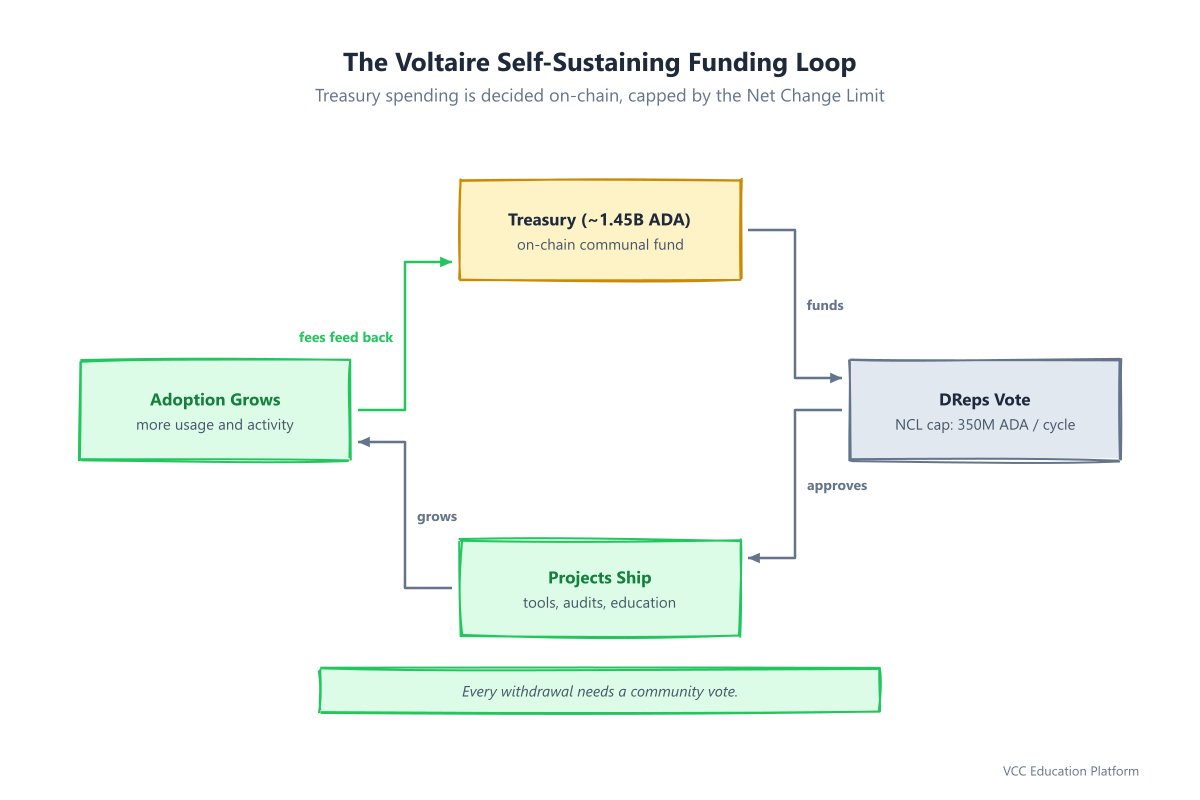
## Voltaire: The Loop That Makes Funding Self-Sustaining
The Voltaire governance era (Chang hard fork in 2024, full on-chain governance by
January 2025) turned the treasury from a static pile into a loop:
1. Anyone proposes ecosystem work — development tools, audits, education, scaling.
2. DReps review and vote; proposals need roughly two-thirds support and must fit
under the Net Change Limit.
3. Approved projects build things that grow adoption.
4. Adoption generates more transactions, more fees, more activity — and a healthier
network worth funding.
Planned upgrades extend the model further: a multi-asset treasury could hold
diversified reserves beyond ADA, and Babel fees would let users pay transaction fees
in other native tokens. Both aim directly at long-term resilience rather than short-
term price.
That 20% share (parameter **tau**) compounds quietly. The result is an on-chain fund
of about 1.45 billion ADA — hundreds of millions of dollars — that answers to nobody
except the community's own governance process. It resembles a Vietnamese hụ: a
communal savings circle where members decide together how the shared pot gets used.
Since Voltaire went live, that decision-making is real, not symbolic. Spending the
treasury requires a **Treasury Withdrawal Governance Action** approved by DReps
(delegated representatives) on-chain and checked against the constitution. For 2026
the community set a **Net Change Limit of 350 million ADA** — a constitutional cap on
how fast the war chest can drain — and passed a structured budget process with DRep
supermajority approval in April 2026.
The strongest behavioral evidence for cardano future sustainability: Input Output,
the founding engineering company, asked for $46.8 million from the treasury in 2026,
down from $97.5 million the year before — explicitly planning to need less each year
as specialist teams take over stewardship of core infrastructure.
## Voltaire: The Loop That Makes Funding Self-Sustaining
The Voltaire governance era (Chang hard fork in 2024, full on-chain governance by
January 2025) turned the treasury from a static pile into a loop:
1. Anyone proposes ecosystem work — development tools, audits, education, scaling.
2. DReps review and vote; proposals need roughly two-thirds support and must fit
under the Net Change Limit.
3. Approved projects build things that grow adoption.
4. Adoption generates more transactions, more fees, more activity — and a healthier
network worth funding.
Planned upgrades extend the model further: a multi-asset treasury could hold
diversified reserves beyond ADA, and Babel fees would let users pay transaction fees
in other native tokens. Both aim directly at long-term resilience rather than short-
term price.
 ## The Honest Skeptic's Case
No serious article should pretend the picture is spotless. Critics — including
prominent voices inside the Cardano community itself — raise three fair objections.
**First, fee dependence.** Transaction fees remain a small fraction of the security
budget today. When the reserve thins out in the 2030s and 2040s, pools must survive
on fees plus whatever the community votes them. If usage has not grown enough by
then, the math gets uncomfortable. That deadline is flexible but not optional.
**Second, single-asset volatility.** The entire treasury sits in one volatile asset.
It was worth about $400 million in March 2026 and roughly $233 million by July — the
same coins, 40% less purchasing power. Community stress tests modeled a bad year at
down 73–94%. Proposals for diversification exist; none is implemented yet.
**Third, spending pace.** In one recent quarter, enacted withdrawals moved ~270
million ADA into circulation while the treasury received only ~67 million in fresh
inflow. The treasury is currently being spent faster than it refills — sustainable
for years at the NCL cap, but only if future budgets stay disciplined.
These are not disqualifying problems. They are the actual debates the governance
system exists to have — in public, with numbers attached.
## So, Is Cardano Sustainable?
Honest verdict: Cardano has the best-funded runway in the industry — decades of
pre-programmed rewards, a nine-figure communal treasury, hard spending limits, and
working governance to manage the transition. What it does not yet have is proof that
fees alone can carry the network after the reserve era. That proof arrives gradually,
epoch by epoch, as adoption either grows or doesn't.
For cardano long term viability, the honest summary is this: the machine was built
to become self-sustaining, the fuel gauge reads decades, and the steering wheel is
now genuinely in the community's hands. Whether drivers steer well is the open
question of the next decade — visible to anyone, decided by everyone.
---
## Frequently Asked Questions
### How long will Cardano staking rewards last?
Decades. The reserve draws just 0.3% per epoch, halving roughly every 4–5 years. Most
will be distributed by the 2040s, with diminishing drips stretching past 2100.
Rewards shrink gradually — there is no cliff where staking income suddenly stops.
### Who controls the Cardano treasury?
The ADA holders' chosen representatives. Funds sit on-chain and can only move via
Treasury Withdrawal Governance Actions approved by DReps, checked against the
constitution, and capped by a Net Change Limit (350 million ADA for 2026). No company
or foundation can touch it directly.
### What happens to Cardano when the reserve runs out?
Staking rewards shift to transaction fees plus whatever the community votes to
allocate from the treasury. The transition spans decades by design, giving fee volume
time to grow into the gap. This fee-dependence is the core risk critics watch.
### Does treasury spending make ADA inflationary?
There is no new minting — the 45 billion ceiling is absolute. But treasury
withdrawals do release already-minted ADA into circulation, which is why the
community sets a Net Change Limit and votes on every withdrawal.
### Why is Cardano's decay schedule better than Bitcoin halvings?
It is different rather than strictly better. Halvings create sudden reward drops
every four years; Cardano's geometric decay smooths the same journey into a gentle
curve with no shock dates. Smoothness reduces surprises for pool operators planning
their economics — though both chains converge on the same endgame: fees must replace
issuance.
---
*Sources: docs.cardano.org parameter guide; CIP-9; formal ledger specification;
cardano.org supply dashboard; Intersect budget committee documentation (2026);
Input Output treasury proposals (2026); Cardano Forum treasury risk analyses.*
## The Honest Skeptic's Case
No serious article should pretend the picture is spotless. Critics — including
prominent voices inside the Cardano community itself — raise three fair objections.
**First, fee dependence.** Transaction fees remain a small fraction of the security
budget today. When the reserve thins out in the 2030s and 2040s, pools must survive
on fees plus whatever the community votes them. If usage has not grown enough by
then, the math gets uncomfortable. That deadline is flexible but not optional.
**Second, single-asset volatility.** The entire treasury sits in one volatile asset.
It was worth about $400 million in March 2026 and roughly $233 million by July — the
same coins, 40% less purchasing power. Community stress tests modeled a bad year at
down 73–94%. Proposals for diversification exist; none is implemented yet.
**Third, spending pace.** In one recent quarter, enacted withdrawals moved ~270
million ADA into circulation while the treasury received only ~67 million in fresh
inflow. The treasury is currently being spent faster than it refills — sustainable
for years at the NCL cap, but only if future budgets stay disciplined.
These are not disqualifying problems. They are the actual debates the governance
system exists to have — in public, with numbers attached.
## So, Is Cardano Sustainable?
Honest verdict: Cardano has the best-funded runway in the industry — decades of
pre-programmed rewards, a nine-figure communal treasury, hard spending limits, and
working governance to manage the transition. What it does not yet have is proof that
fees alone can carry the network after the reserve era. That proof arrives gradually,
epoch by epoch, as adoption either grows or doesn't.
For cardano long term viability, the honest summary is this: the machine was built
to become self-sustaining, the fuel gauge reads decades, and the steering wheel is
now genuinely in the community's hands. Whether drivers steer well is the open
question of the next decade — visible to anyone, decided by everyone.
---
## Frequently Asked Questions
### How long will Cardano staking rewards last?
Decades. The reserve draws just 0.3% per epoch, halving roughly every 4–5 years. Most
will be distributed by the 2040s, with diminishing drips stretching past 2100.
Rewards shrink gradually — there is no cliff where staking income suddenly stops.
### Who controls the Cardano treasury?
The ADA holders' chosen representatives. Funds sit on-chain and can only move via
Treasury Withdrawal Governance Actions approved by DReps, checked against the
constitution, and capped by a Net Change Limit (350 million ADA for 2026). No company
or foundation can touch it directly.
### What happens to Cardano when the reserve runs out?
Staking rewards shift to transaction fees plus whatever the community votes to
allocate from the treasury. The transition spans decades by design, giving fee volume
time to grow into the gap. This fee-dependence is the core risk critics watch.
### Does treasury spending make ADA inflationary?
There is no new minting — the 45 billion ceiling is absolute. But treasury
withdrawals do release already-minted ADA into circulation, which is why the
community sets a Net Change Limit and votes on every withdrawal.
### Why is Cardano's decay schedule better than Bitcoin halvings?
It is different rather than strictly better. Halvings create sudden reward drops
every four years; Cardano's geometric decay smooths the same journey into a gentle
curve with no shock dates. Smoothness reduces surprises for pool operators planning
their economics — though both chains converge on the same endgame: fees must replace
issuance.
---
*Sources: docs.cardano.org parameter guide; CIP-9; formal ledger specification;
cardano.org supply dashboard; Intersect budget committee documentation (2026);
Input Output treasury proposals (2026); Cardano Forum treasury risk analyses.*