
 ---
## The Three Governance Bodies
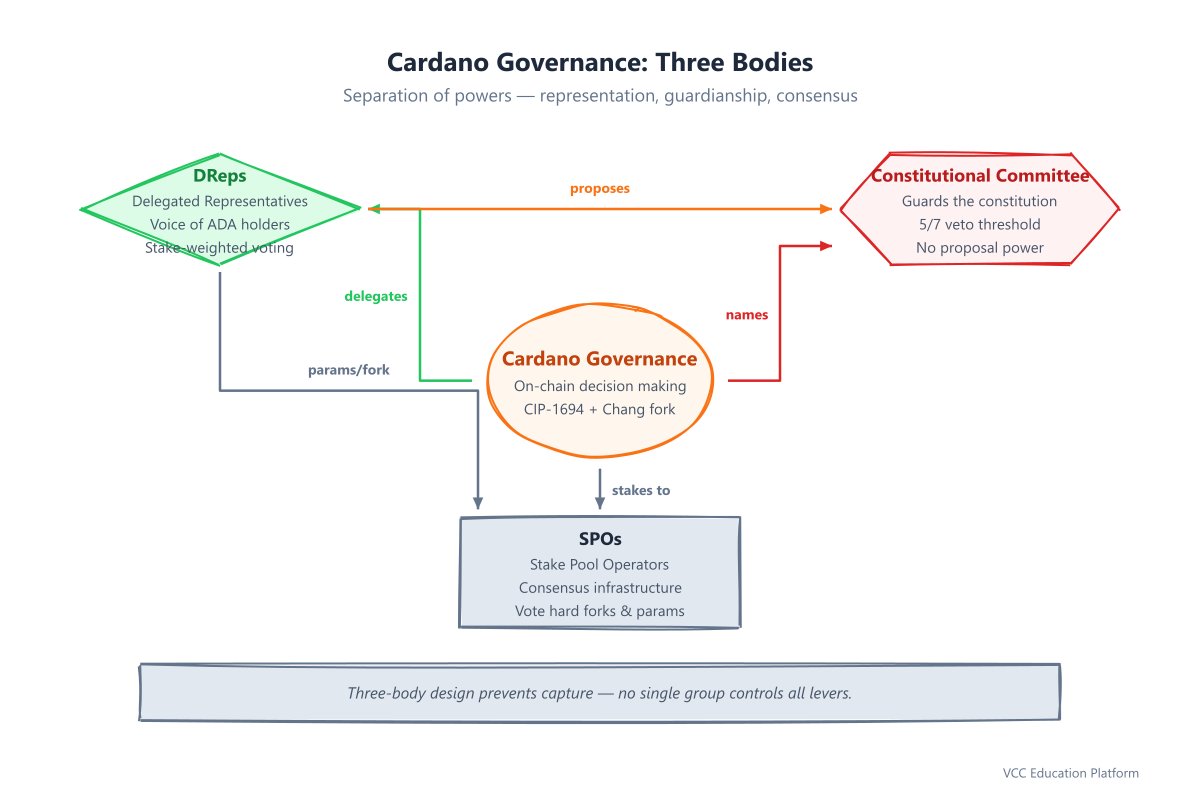
CIP-1694 establishes three distinct bodies, each with specific powers. This separation of concerns prevents any single group from dominating — a lesson learned from both corporate governance and political science.
### 1. DReps (Delegated Representatives)
**DReps** are the voice of ADA holders. Any ADA holder can register as a DRep. Others delegate their voting power to DReps they trust — similar to how you might authorize a financial advisor to manage investments, except you keep full custody of your ADA.
**Key facts about DReps:**
- **Registration:** Requires a 500 ADA deposit (refundable upon deregistration)
- **Delegation:** Stake-weighted — 1 ADA = 1 vote. Delegating does NOT transfer ownership
- **Incentives:** Configurable reward from treasury withdrawals (currently ~1.5% of withdrawal amount)
- **Accountability:** Delegators can switch DReps at any epoch boundary
- **No custody:** Your ADA stays in your wallet. Delegation is a signaling mechanism only
**Vietnamese context:** This mirrors *uy quyền* (authorization) in Vietnamese banking. You authorize a representative to act on your behalf, but the money stays in your account. Momo and ZaloPay users already trust digital intermediaries for complex transactions — DRep delegation follows the same mental model.
### 2. Constitutional Committee (CC)
The **Constitutional Committee** guards the constitution. They review governance actions for constitutional compliance before execution. Think of them as a constitutional court: they don't propose changes, but they can veto actions that violate the constitution.
**Current structure (2026):**
- **Interim Constitutional Committee (ICC):** 7 members appointed by founding entities (IOG, Cardano Foundation, Emurgo)
- **Threshold:** 5 of 7 members must approve
- **Transition:** ICC serves until elected CC takes over (target: 2025-2026)
- **Elected CC:** Will be chosen via governance action, term-limited
**Powers:**
- Veto governance actions that violate the constitution
- No power to initiate proposals
- No control over treasury or parameters directly
### 3. Stake Pool Operators (SPOs)
**SPOs** provide the network's consensus infrastructure. In governance, they vote on two critical categories: **hard fork initiations** and **protocol parameter changes**.
**Why SPOs?** They have "skin in the game" — operational costs, reputation, and community trust. A hard fork that breaks the network hurts SPOs directly. This dual incentive (protocol health + community trust) aligns them with long-term network stability.
**Voting weight:** Proportional to stake delegated to their pools (same stake-weight principle as DReps).
---
## The Three Governance Bodies
CIP-1694 establishes three distinct bodies, each with specific powers. This separation of concerns prevents any single group from dominating — a lesson learned from both corporate governance and political science.
### 1. DReps (Delegated Representatives)
**DReps** are the voice of ADA holders. Any ADA holder can register as a DRep. Others delegate their voting power to DReps they trust — similar to how you might authorize a financial advisor to manage investments, except you keep full custody of your ADA.
**Key facts about DReps:**
- **Registration:** Requires a 500 ADA deposit (refundable upon deregistration)
- **Delegation:** Stake-weighted — 1 ADA = 1 vote. Delegating does NOT transfer ownership
- **Incentives:** Configurable reward from treasury withdrawals (currently ~1.5% of withdrawal amount)
- **Accountability:** Delegators can switch DReps at any epoch boundary
- **No custody:** Your ADA stays in your wallet. Delegation is a signaling mechanism only
**Vietnamese context:** This mirrors *uy quyền* (authorization) in Vietnamese banking. You authorize a representative to act on your behalf, but the money stays in your account. Momo and ZaloPay users already trust digital intermediaries for complex transactions — DRep delegation follows the same mental model.
### 2. Constitutional Committee (CC)
The **Constitutional Committee** guards the constitution. They review governance actions for constitutional compliance before execution. Think of them as a constitutional court: they don't propose changes, but they can veto actions that violate the constitution.
**Current structure (2026):**
- **Interim Constitutional Committee (ICC):** 7 members appointed by founding entities (IOG, Cardano Foundation, Emurgo)
- **Threshold:** 5 of 7 members must approve
- **Transition:** ICC serves until elected CC takes over (target: 2025-2026)
- **Elected CC:** Will be chosen via governance action, term-limited
**Powers:**
- Veto governance actions that violate the constitution
- No power to initiate proposals
- No control over treasury or parameters directly
### 3. Stake Pool Operators (SPOs)
**SPOs** provide the network's consensus infrastructure. In governance, they vote on two critical categories: **hard fork initiations** and **protocol parameter changes**.
**Why SPOs?** They have "skin in the game" — operational costs, reputation, and community trust. A hard fork that breaks the network hurts SPOs directly. This dual incentive (protocol health + community trust) aligns them with long-term network stability.
**Voting weight:** Proportional to stake delegated to their pools (same stake-weight principle as DReps).
 ---
## CIP-1694 and the Chang Hard Fork
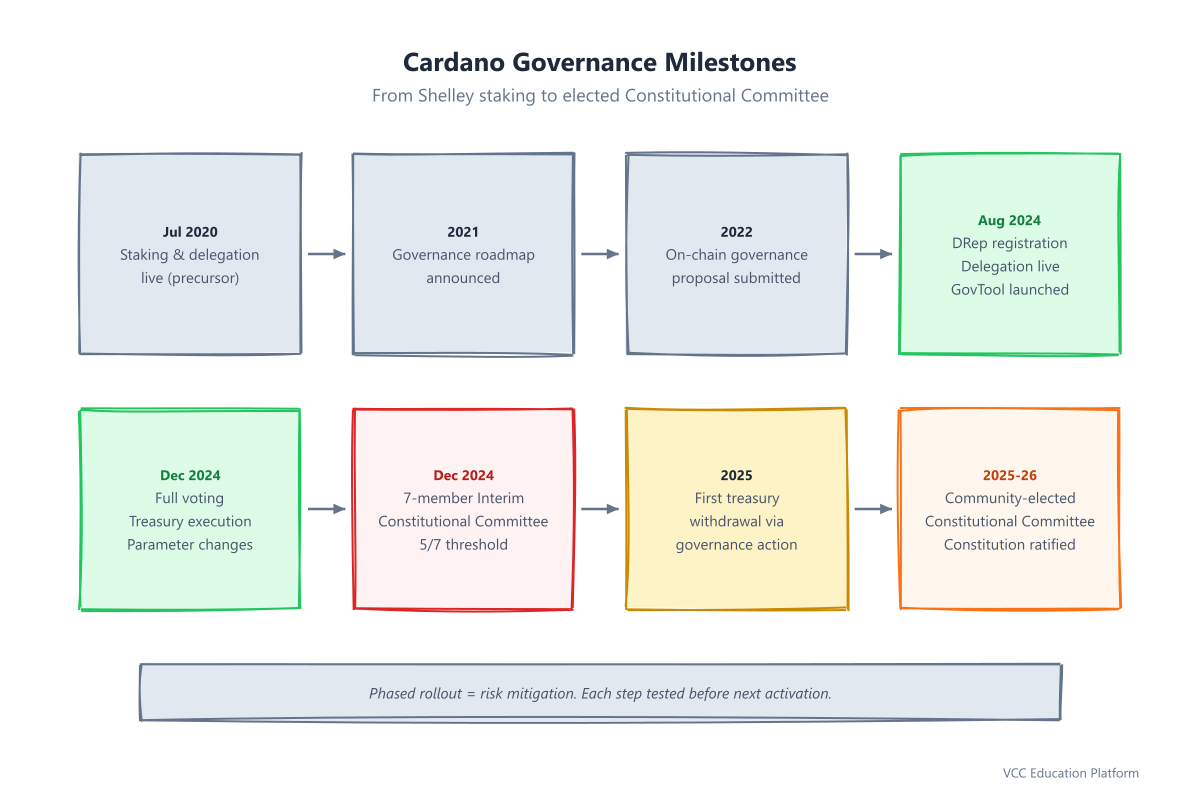
**CIP-1694** (Cardano Improvement Proposal 1694) is the technical specification for on-chain governance. It was delivered via the **Chang hard fork** in two phases:
### Chang #1 (August 2024)
- DRep registration and delegation enabled
- Governance action submission enabled
- Constitutional Committee review active
- GovTool launched for community access
### Chang #2 (December 2024)
- Full voting on governance actions
- Treasury withdrawal execution
- Parameter change execution
- Hard fork initiation via governance
**Phased rollout = risk mitigation.** This mirrors Vietnam's regulatory "sandbox" approach: test with limited scope (Chang #1: registration only) before full activation (Chang #2: execution). The ICB (Interim Constitutional Committee) provided guardrails during transition.
### What Changed for ADA Holders
| Before Chang | After Chang |
|--------------|-------------|
| Protocol changes via IOG hard forks | Protocol changes via governance actions |
| Treasury spending decided by IOG/CF | Treasury spending via governance actions |
| No formal constitution | On-chain constitution, ratifiable |
| No delegation mechanism | Delegate to DReps or vote directly |
| Off-chain signaling (CIP-0094) | On-chain, binding votes |
---
## Governance Action Types
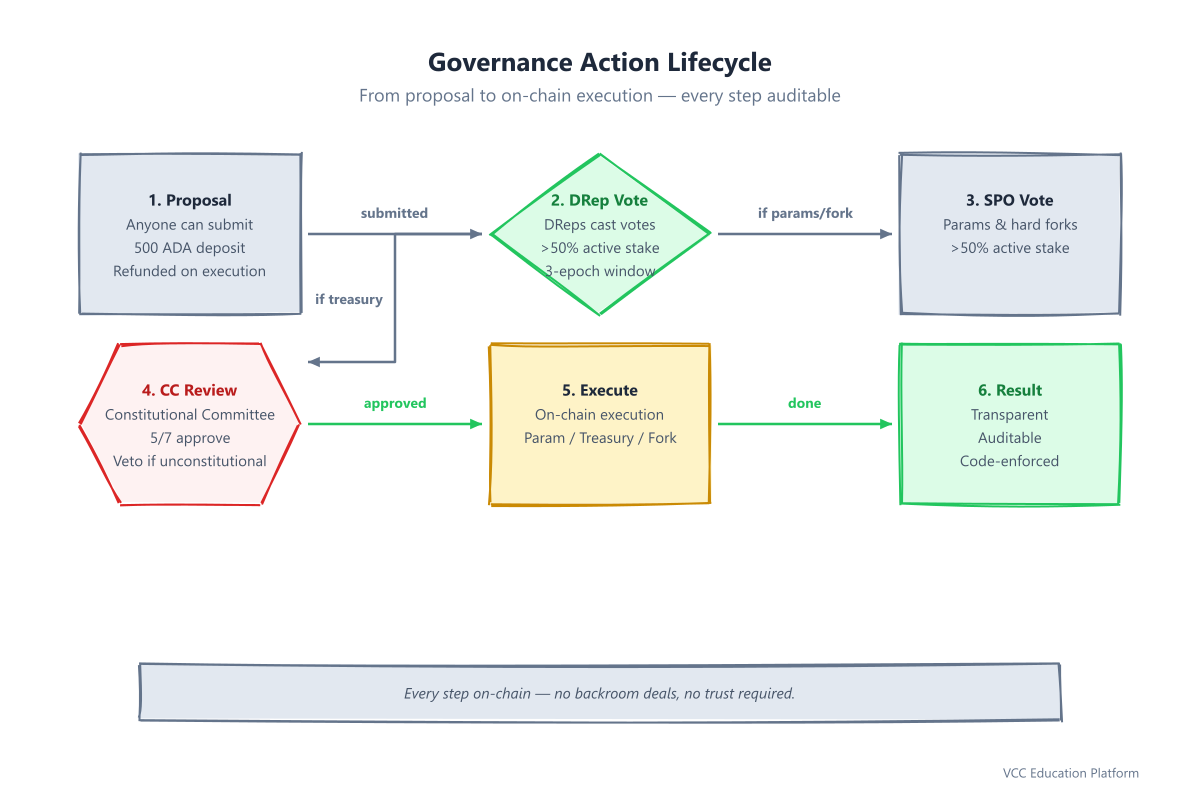
CIP-1694 defines **five categories** of governance actions. Each follows a specific lifecycle and requires different approval combinations.
### 1. Parameter Changes
Adjust protocol parameters: transaction fees, pool pledge requirements, min pool cost, etc.
- **Requires:** DRep majority + SPO majority + CC approval
- **Example:** Reducing min pool cost from 340 ADA to 170 ADA
### 2. Treasury Withdrawals
Move ADA from treasury to a designated address for development, marketing, grants, etc.
- **Requires:** DRep majority + CC approval
- **SPOs:** Not required (treasury is not consensus-critical)
- **Guardrail:** Constitution can set withdrawal limits per epoch
### 3. Hard Fork Initiations
Trigger a protocol upgrade (new ledger rules).
- **Requires:** DRep majority + SPO majority + CC approval
- **Highest threshold:** Affects all users, irreversible
### 4. Constitutional Committee Elections
Replace ICC with elected members.
- **Requires:** DRep majority + CC approval (ICC approves its own replacement)
- **Term limits:** Configurable via constitution
### 5. New Constitution Ratification
Replace or amend the constitution itself.
- **Requires:** DRep majority + SPO majority + CC approval
- **Meta-governance:** Changing the rules of rule-changing
---
## CIP-1694 and the Chang Hard Fork
**CIP-1694** (Cardano Improvement Proposal 1694) is the technical specification for on-chain governance. It was delivered via the **Chang hard fork** in two phases:
### Chang #1 (August 2024)
- DRep registration and delegation enabled
- Governance action submission enabled
- Constitutional Committee review active
- GovTool launched for community access
### Chang #2 (December 2024)
- Full voting on governance actions
- Treasury withdrawal execution
- Parameter change execution
- Hard fork initiation via governance
**Phased rollout = risk mitigation.** This mirrors Vietnam's regulatory "sandbox" approach: test with limited scope (Chang #1: registration only) before full activation (Chang #2: execution). The ICB (Interim Constitutional Committee) provided guardrails during transition.
### What Changed for ADA Holders
| Before Chang | After Chang |
|--------------|-------------|
| Protocol changes via IOG hard forks | Protocol changes via governance actions |
| Treasury spending decided by IOG/CF | Treasury spending via governance actions |
| No formal constitution | On-chain constitution, ratifiable |
| No delegation mechanism | Delegate to DReps or vote directly |
| Off-chain signaling (CIP-0094) | On-chain, binding votes |
---
## Governance Action Types
CIP-1694 defines **five categories** of governance actions. Each follows a specific lifecycle and requires different approval combinations.
### 1. Parameter Changes
Adjust protocol parameters: transaction fees, pool pledge requirements, min pool cost, etc.
- **Requires:** DRep majority + SPO majority + CC approval
- **Example:** Reducing min pool cost from 340 ADA to 170 ADA
### 2. Treasury Withdrawals
Move ADA from treasury to a designated address for development, marketing, grants, etc.
- **Requires:** DRep majority + CC approval
- **SPOs:** Not required (treasury is not consensus-critical)
- **Guardrail:** Constitution can set withdrawal limits per epoch
### 3. Hard Fork Initiations
Trigger a protocol upgrade (new ledger rules).
- **Requires:** DRep majority + SPO majority + CC approval
- **Highest threshold:** Affects all users, irreversible
### 4. Constitutional Committee Elections
Replace ICC with elected members.
- **Requires:** DRep majority + CC approval (ICC approves its own replacement)
- **Term limits:** Configurable via constitution
### 5. New Constitution Ratification
Replace or amend the constitution itself.
- **Requires:** DRep majority + SPO majority + CC approval
- **Meta-governance:** Changing the rules of rule-changing
 ---
## How Voting Works: Stake-Weighted Delegation
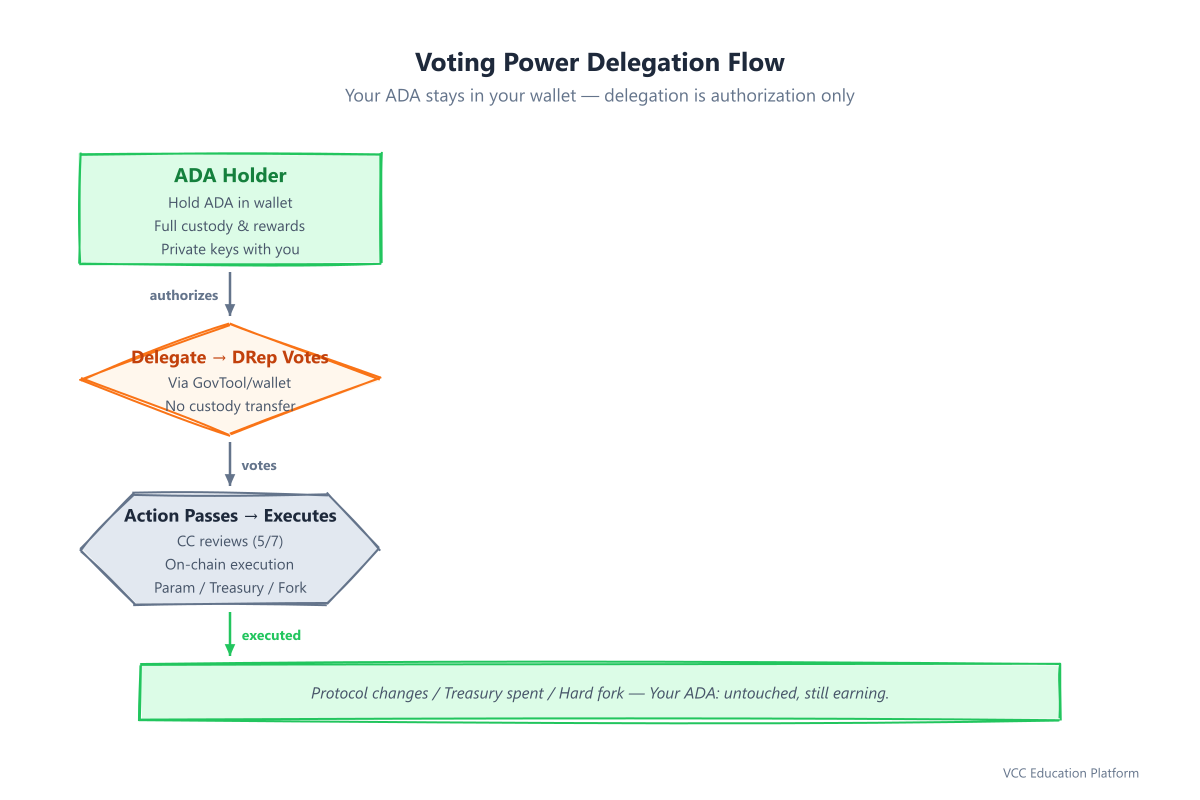
Cardano uses **stake-weighted voting**: your voting power equals your ADA stake. This differs from 1-person-1-vote democracy. The rationale: those with more at risk (more ADA) should have more say in protocol decisions.
### Direct Voting vs. Delegation
**Direct voting:** You personally vote on every governance action. High effort, full control.
**Delegation:** You choose a DRep whose judgment you trust. They vote on your behalf. Low effort, trusted representation.
**Key properties:**
- Delegation is per-epoch (can change at epoch boundary)
- No lockup — ADA remains liquid and staked
- Multiple DReps possible (split delegation)
- DRep sees only your stake weight, not your identity
### Voting Thresholds
| Action Type | DRep Threshold | SPO Threshold | CC Threshold |
|-------------|----------------|---------------|--------------|
| Parameter Change | >50% active stake | >50% active stake | 5/7 (ICC) |
| Treasury Withdrawal | >50% active stake | Not required | 5/7 (ICC) |
| Hard Fork | >50% active stake | >50% active stake | 5/7 (ICC) |
| CC Election | >50% active stake | Not required | 5/7 (ICC) |
| Constitution | >50% active stake | >50% active stake | 5/7 (ICC) |
*Active stake = stake from wallets that have delegated to a DRep or registered as DRep.*
---
## GovTool: Your Governance Dashboard
**GovTool** (govtool.cardano.org) is the official web interface for governance participation. Built by the community with IOG support, it provides:
- **DRep registration & management**
- **Delegation interface** (search DReps, view profiles, delegate/undelegate)
- **Proposal browser** (active, pending, executed governance actions)
- **Voting dashboard** (direct voting for registered DReps)
- **Wallet support:** Ledger, Trezor, Eternl, Lace, Vespr, Nami, Typhon
- **Multilingual:** English, Vietnamese, Japanese, Korean, Spanish, more
**Vietnamese users:** GovTool's Vietnamese UI makes participation accessible. Hardware wallet support means you can govern from cold storage — critical for security-conscious holders.
---
## Current State (2026): What's Live, What's Coming
### Live Now
- ✅ DRep registration & delegation
- ✅ Governance action submission & voting
- ✅ Parameter changes via governance
- ✅ Treasury withdrawals via governance
- ✅ Hard fork initiation via governance
- ✅ Interim Constitutional Committee active
- ✅ GovTool fully functional
### In Progress / Coming
- 🔄 **Elected Constitutional Committee** (target: 2025-2026)
- 🔄 **Constitution ratification** (community draft → governance action)
- 🔄 **DRep incentive optimization** (treasury reward rate tuning)
- 🔄 **Participation growth** (delegation rate currently ~20% of circulating ADA)
### Participation Reality Check
Early data shows:
- **~400-500 registered DReps** (first 6 months)
- **~15-20% delegation rate** of circulating ADA
- **>80% SPO participation** on hard fork votes
- **Whale dominance:** Top 100 wallets control ~40% of voting power
This is typical for new governance systems. Participation grows as tooling improves and social norms establish.
---
## How Voting Works: Stake-Weighted Delegation
Cardano uses **stake-weighted voting**: your voting power equals your ADA stake. This differs from 1-person-1-vote democracy. The rationale: those with more at risk (more ADA) should have more say in protocol decisions.
### Direct Voting vs. Delegation
**Direct voting:** You personally vote on every governance action. High effort, full control.
**Delegation:** You choose a DRep whose judgment you trust. They vote on your behalf. Low effort, trusted representation.
**Key properties:**
- Delegation is per-epoch (can change at epoch boundary)
- No lockup — ADA remains liquid and staked
- Multiple DReps possible (split delegation)
- DRep sees only your stake weight, not your identity
### Voting Thresholds
| Action Type | DRep Threshold | SPO Threshold | CC Threshold |
|-------------|----------------|---------------|--------------|
| Parameter Change | >50% active stake | >50% active stake | 5/7 (ICC) |
| Treasury Withdrawal | >50% active stake | Not required | 5/7 (ICC) |
| Hard Fork | >50% active stake | >50% active stake | 5/7 (ICC) |
| CC Election | >50% active stake | Not required | 5/7 (ICC) |
| Constitution | >50% active stake | >50% active stake | 5/7 (ICC) |
*Active stake = stake from wallets that have delegated to a DRep or registered as DRep.*
---
## GovTool: Your Governance Dashboard
**GovTool** (govtool.cardano.org) is the official web interface for governance participation. Built by the community with IOG support, it provides:
- **DRep registration & management**
- **Delegation interface** (search DReps, view profiles, delegate/undelegate)
- **Proposal browser** (active, pending, executed governance actions)
- **Voting dashboard** (direct voting for registered DReps)
- **Wallet support:** Ledger, Trezor, Eternl, Lace, Vespr, Nami, Typhon
- **Multilingual:** English, Vietnamese, Japanese, Korean, Spanish, more
**Vietnamese users:** GovTool's Vietnamese UI makes participation accessible. Hardware wallet support means you can govern from cold storage — critical for security-conscious holders.
---
## Current State (2026): What's Live, What's Coming
### Live Now
- ✅ DRep registration & delegation
- ✅ Governance action submission & voting
- ✅ Parameter changes via governance
- ✅ Treasury withdrawals via governance
- ✅ Hard fork initiation via governance
- ✅ Interim Constitutional Committee active
- ✅ GovTool fully functional
### In Progress / Coming
- 🔄 **Elected Constitutional Committee** (target: 2025-2026)
- 🔄 **Constitution ratification** (community draft → governance action)
- 🔄 **DRep incentive optimization** (treasury reward rate tuning)
- 🔄 **Participation growth** (delegation rate currently ~20% of circulating ADA)
### Participation Reality Check
Early data shows:
- **~400-500 registered DReps** (first 6 months)
- **~15-20% delegation rate** of circulating ADA
- **>80% SPO participation** on hard fork votes
- **Whale dominance:** Top 100 wallets control ~40% of voting power
This is typical for new governance systems. Participation grows as tooling improves and social norms establish.
 ---
## Risks and Criticisms
No system is perfect. Honest assessment requires acknowledging risks:
### 1. Interim CC Centralization
The ICC is appointed by founding entities (IOG, CF, Emurgo). Critics argue this creates temporary centralization. **Counterpoint:** ICC is time-limited, transparent (7 known members), and requires 5/7 supermajority. Transition to elected CC is constitutionally mandated.
### 2. Whale Dominance
Stake-weighted voting means large holders disproportionately influence outcomes. **Mitigation:** DRep delegation allows smaller holders to pool influence. Constitution can add quadratic voting or caps in future amendments.
### 3. Low Participation
<20% delegation rate means most ADA is silent. **Mitigation:** GovTool UX improvements, exchange delegation support, education campaigns. Vietnam's high crypto adoption (~5M users) could boost participation if localized.
### 4. Treasury Sustainability
~1.5B ADA treasury must fund decades of development. Withdrawal rate governance is critical. **Guardrail:** Constitution can enforce spending caps.
---
## FAQ
### **Q: Does delegating to a DRep mean I lose control of my ADA?**
**A:** No. Delegation only signals voting preference. Your ADA stays in your wallet, stays staked, earns rewards, and you can spend it anytime. You can change DReps at any epoch boundary.
### **Q: What happens if a governance action passes but violates the constitution?**
**A:** The Constitutional Committee reviews every passed action before execution. If 5/7 members (ICC) or the elected CC threshold determine it violates the constitution, they veto it. The action never executes.
### **Q: Can I be a DRep and delegate to another DRep simultaneously?**
**A:** Yes. You can register as a DRep (representing others) while also delegating your own stake to a different DRep. The roles are independent.
### **Q: How are DReps compensated?**
**A:** The constitution allows a configurable reward from treasury withdrawals (currently ~1.5% of withdrawal amount distributed to DReps proportional to their active stake). This is not guaranteed — it's a parameter the governance can adjust.
### **Q: What's the difference between Voltaire and CIP-1694?**
**A:** Voltaire is the *era name* for Cardano's governance roadmap. CIP-1694 is the *specific technical proposal* that implements on-chain governance. Chang hard fork *delivered* CIP-1694.
### **Q: Can the constitution be changed?**
**A:** Yes. A "New Constitution" governance action can replace or amend the constitution. It requires DRep majority + SPO majority + CC approval — the highest threshold, reflecting its meta-governance nature.
### **Q: Is GovTool the only way to participate?**
**A:** No. GovTool is the official UI, but any wallet or tool that implements the governance APIs can submit actions, register DReps, and delegate. GovTool is just the most accessible interface.
### **Q: How does this affect me as a Vietnamese ADA holder?**
**A:** You have the same rights as any ADA holder globally. GovTool supports Vietnamese. The *uy quyền* delegation model fits Vietnamese financial culture. You can participate from Vietnam using your existing wallet (Ledger, Eternl, Lace, etc.) — no KYC, no geographic restrictions.
---
## Summary
**Cardano governance** transforms ADA from a passive asset into a governance token with real decision-making power. Through CIP-1694 and the Chang hard fork, Cardano implemented:
1. **Three-body system:** DReps (representation), Constitutional Committee (guardrails), SPOs (consensus alignment)
2. **Five action types:** Parameters, treasury, hard forks, CC elections, constitution
3. **Stake-weighted delegation:** Flexible, non-custodial, epoch-granular
4. **On-chain execution:** Transparent, auditable, code-enforced
5. **GovTool:** Accessible interface with Vietnamese support
The system is live, evolving, and uniquely ambitious — a DAO managing a nation-scale treasury. For Vietnamese users, the delegation model feels familiar, the tools are localized, and the opportunity to shape a global blockchain's future is open to anyone with ADA.
**Next step:** Visit govtool.cardano.org, connect your wallet, explore active proposals, and consider delegating to a DRep whose values align with yours. Your stake is your voice — use it.
---
*Word count: ~1,850 words*
*Visual markers: 4*
*Primary keyword: "cardano governance" (H1, first 100 words)*
*Secondary keywords: "cardano governance explained", "how cardano governance works", "cardano on-chain governance", "cip 1694" (woven in H2s, body, FAQ)*
---
## Risks and Criticisms
No system is perfect. Honest assessment requires acknowledging risks:
### 1. Interim CC Centralization
The ICC is appointed by founding entities (IOG, CF, Emurgo). Critics argue this creates temporary centralization. **Counterpoint:** ICC is time-limited, transparent (7 known members), and requires 5/7 supermajority. Transition to elected CC is constitutionally mandated.
### 2. Whale Dominance
Stake-weighted voting means large holders disproportionately influence outcomes. **Mitigation:** DRep delegation allows smaller holders to pool influence. Constitution can add quadratic voting or caps in future amendments.
### 3. Low Participation
<20% delegation rate means most ADA is silent. **Mitigation:** GovTool UX improvements, exchange delegation support, education campaigns. Vietnam's high crypto adoption (~5M users) could boost participation if localized.
### 4. Treasury Sustainability
~1.5B ADA treasury must fund decades of development. Withdrawal rate governance is critical. **Guardrail:** Constitution can enforce spending caps.
---
## FAQ
### **Q: Does delegating to a DRep mean I lose control of my ADA?**
**A:** No. Delegation only signals voting preference. Your ADA stays in your wallet, stays staked, earns rewards, and you can spend it anytime. You can change DReps at any epoch boundary.
### **Q: What happens if a governance action passes but violates the constitution?**
**A:** The Constitutional Committee reviews every passed action before execution. If 5/7 members (ICC) or the elected CC threshold determine it violates the constitution, they veto it. The action never executes.
### **Q: Can I be a DRep and delegate to another DRep simultaneously?**
**A:** Yes. You can register as a DRep (representing others) while also delegating your own stake to a different DRep. The roles are independent.
### **Q: How are DReps compensated?**
**A:** The constitution allows a configurable reward from treasury withdrawals (currently ~1.5% of withdrawal amount distributed to DReps proportional to their active stake). This is not guaranteed — it's a parameter the governance can adjust.
### **Q: What's the difference between Voltaire and CIP-1694?**
**A:** Voltaire is the *era name* for Cardano's governance roadmap. CIP-1694 is the *specific technical proposal* that implements on-chain governance. Chang hard fork *delivered* CIP-1694.
### **Q: Can the constitution be changed?**
**A:** Yes. A "New Constitution" governance action can replace or amend the constitution. It requires DRep majority + SPO majority + CC approval — the highest threshold, reflecting its meta-governance nature.
### **Q: Is GovTool the only way to participate?**
**A:** No. GovTool is the official UI, but any wallet or tool that implements the governance APIs can submit actions, register DReps, and delegate. GovTool is just the most accessible interface.
### **Q: How does this affect me as a Vietnamese ADA holder?**
**A:** You have the same rights as any ADA holder globally. GovTool supports Vietnamese. The *uy quyền* delegation model fits Vietnamese financial culture. You can participate from Vietnam using your existing wallet (Ledger, Eternl, Lace, etc.) — no KYC, no geographic restrictions.
---
## Summary
**Cardano governance** transforms ADA from a passive asset into a governance token with real decision-making power. Through CIP-1694 and the Chang hard fork, Cardano implemented:
1. **Three-body system:** DReps (representation), Constitutional Committee (guardrails), SPOs (consensus alignment)
2. **Five action types:** Parameters, treasury, hard forks, CC elections, constitution
3. **Stake-weighted delegation:** Flexible, non-custodial, epoch-granular
4. **On-chain execution:** Transparent, auditable, code-enforced
5. **GovTool:** Accessible interface with Vietnamese support
The system is live, evolving, and uniquely ambitious — a DAO managing a nation-scale treasury. For Vietnamese users, the delegation model feels familiar, the tools are localized, and the opportunity to shape a global blockchain's future is open to anyone with ADA.
**Next step:** Visit govtool.cardano.org, connect your wallet, explore active proposals, and consider delegating to a DRep whose values align with yours. Your stake is your voice — use it.
---
*Word count: ~1,850 words*
*Visual markers: 4*
*Primary keyword: "cardano governance" (H1, first 100 words)*
*Secondary keywords: "cardano governance explained", "how cardano governance works", "cardano on-chain governance", "cip 1694" (woven in H2s, body, FAQ)*