
The Cardano community is one of the most active and research-driven groups in the entire cryptocurrency space. Unlike networks that are steered by a single company, Cardano is shaped by three founding entities, thousands of stake pool operators, elected governance representatives, and a global base of developers and everyday users who all contribute to its direction. This ada community guide introduces you to who those people are, where they gather, the cardano community projects they build, and the cardano community events that bring them together — including a look at the Vietnamese Cardano community.
Whether you hold a few ADA or run a stake pool, understanding the community helps you participate more confidently in governance, staking, and the wider ecosystem.
Who Makes Up the Cardano Community?
Cardano's community is not a single crowd — it is a layered ecosystem of organizations and individuals, each with a distinct role. Knowing who does what is the first step to finding your own place in it.
The Three Founding Entities
Three organizations were central to Cardano's creation, and each continues to play a defined role:
- IOG (Input Output Global) — the engineering company that builds Cardano's core node software and researches the protocol. Founded by Charles Hoskinson, IOG handles most of the peer-reviewed research that underpins Cardano's design.
- Cardano Foundation — an independent Swiss non-profit focused on adoption, standards, education, and regulatory engagement. It runs the Cardano Summit and maintains key community infrastructure.
- Emurgo — the commercial arm that invests in and incubates startups building on Cardano, with a strong presence across Asia and Africa.
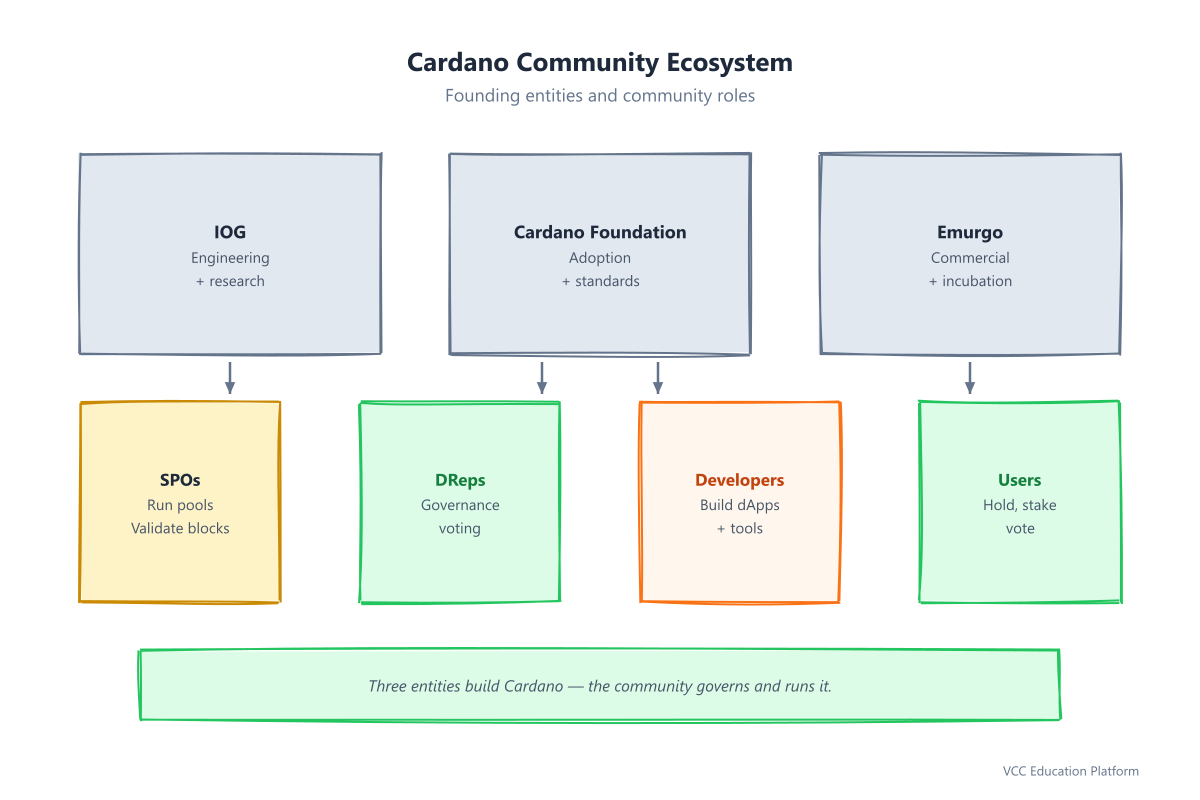
Cardano community ecosystem: IOG, Cardano Foundation, Emurgo, SPOs, DReps, Developers, Users
These three do not "own" Cardano. Since the Voltaire governance upgrade, the community itself can vote on proposals and steer the network's evolution, making the founding entities more like service providers than rulers.
Stake Pool Operators (SPOs)
Stake pool operators run the servers that produce blocks and validate transactions. There are over a thousand registered pools, and anyone holding ADA can delegate to one — no lock-up required. SPOs are some of the most visible community members: they run social channels, produce educational content, and many participate in governance.
Delegated Representatives (DReps)
DReps are elected community members who vote on governance actions on behalf of the ADA delegated to them. If you do not want to follow every governance vote yourself, you can delegate your voting power to a DRep whose values match yours — or you can become a DRep. This is the heart of Cardano's on-chain democracy.
Developers and Builders
A growing number of developers build decentralized applications, developer tools, and infrastructure on Cardano. They congregate on GitHub, in hackathons, and inside Project Catalyst, the community treasury fund that turns ideas into shipped products.
Everyday Users
The largest group is simply people who hold ADA, stake it, use dApps, or follow the project. You do not need to write code or run a pool to be part of the community — asking questions, sharing knowledge, and voting all count.
Where the Community Gathers
The Cardano community spreads across several platforms, each with a different character. Knowing which to use saves time and helps you find the right help fast.
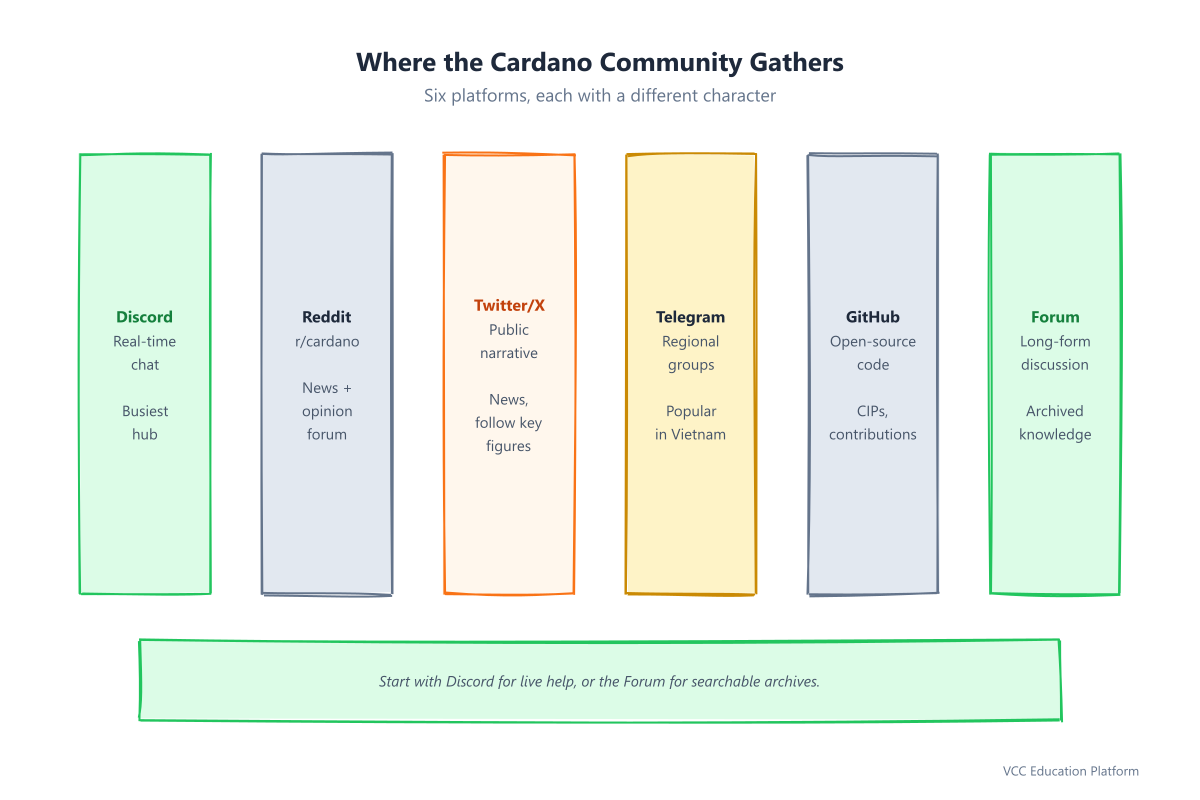
Community platforms: Discord, Reddit, Twitter/X, Telegram, GitHub, Cardano Forum
Discord
The official Cardano Discord server is the busiest real-time hub. It has channels for developers, SPOs, governance, Catalyst, and language-specific rooms (including Vietnamese). It is the best place for live help and meeting other members.
The r/cardano subreddit is the main forum-style discussion space. It is good for news, opinion, and beginner questions, with a searchable history of past discussions.
Twitter / X
Twitter is where Cardano's public narrative plays out. IOG, the Cardano Foundation, Emurgo, SPOs, and DReps all post regularly, and the #Cardano hashtag surfaces community content daily.
Telegram
Telegram hosts many regional and topic-specific groups. It is especially popular in Vietnam and other Asian communities, where local-language groups make Cardano accessible to non-English speakers.
GitHub
Cardano's code is open source. GitHub is where developers track issues, propose improvements (Cardano Improvement Proposals, or CIPs), and contribute to the many cardano community projects that keep the ecosystem running.
Cardano Forum
The cardano forum (forum.cardano.org) is the longest-running discussion board. It is slower-paced than Discord but excellent for long-form technical discussion, governance debate, and archived knowledge that is easy to search.
Cardano Community Projects
What makes the Cardano community stand out is the sheer volume of community-built tools and initiatives. Many of the wallets, explorers, and dashboards you use every day started as community projects.
Project Catalyst
Project Catalyst is Cardano's community treasury fund — one of the largest decentralized innovation engines in crypto. Anyone can submit an idea, the community votes, and winning proposals receive funding from the treasury to build their solution. The process runs in recurring "funds" or rounds.
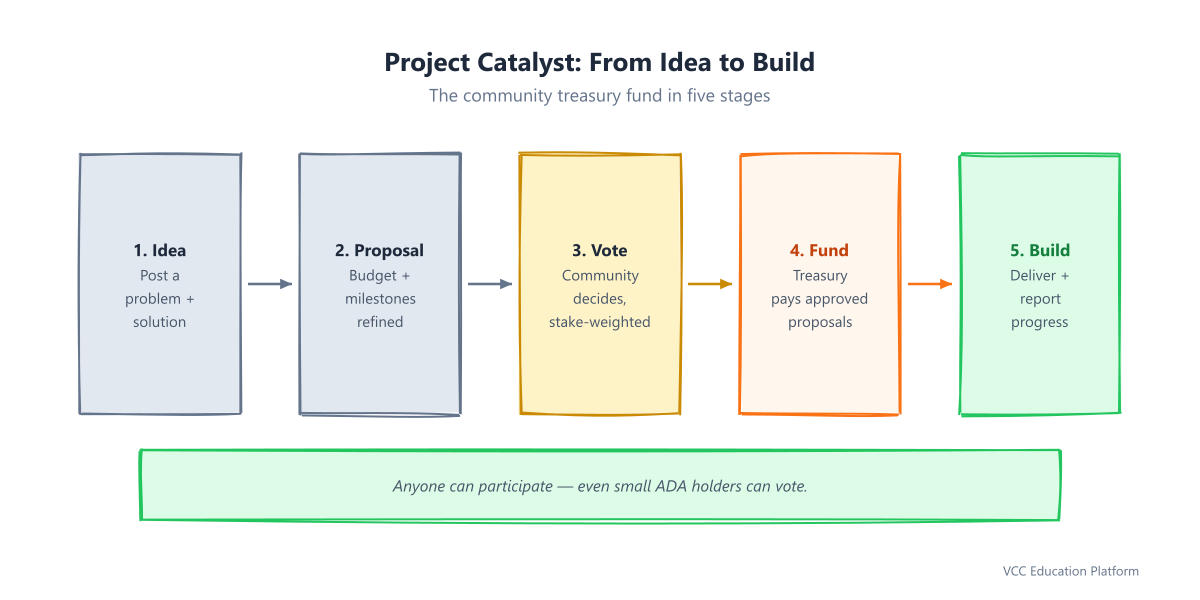
Project Catalyst flow: Idea, Proposal, Vote, Fund, Build
The typical Catalyst journey is:
- Idea — a community member posts a problem and a proposed solution.
- Proposal — the idea is refined into a formal proposal with a budget and milestones.
- Vote — every ADA holder can vote; voting power is weighted by stake.
- Fund — approved proposals receive treasury funds.
- Build — the team delivers the project and reports progress to the community.
Catalyst has funded hundreds of projects — wallets, education platforms, DeFi tools, developer libraries, and regional community hubs — making it the single biggest engine of cardano community projects.
Community-Led Tools
Beyond Catalyst, the community maintains a wide range of tools: block explorers like CardanoScan and cexplorer, wallet interfaces like Eternl and Lace, staking dashboards, governance trackers, and analytics sites. Most are open source and welcome contributions.
Stake Pools as Community Hubs
Many SPOs do more than produce blocks. They run educational channels, sponsor meetups, build tools, and mentor new operators. Choosing a pool is partly a community decision, not just a yield decision.
Governance and the Community's Role
Cardano's Voltaire era introduced on-chain governance that gives the community real power over the network's future. Understanding the three governance bodies helps you see where your voice fits.
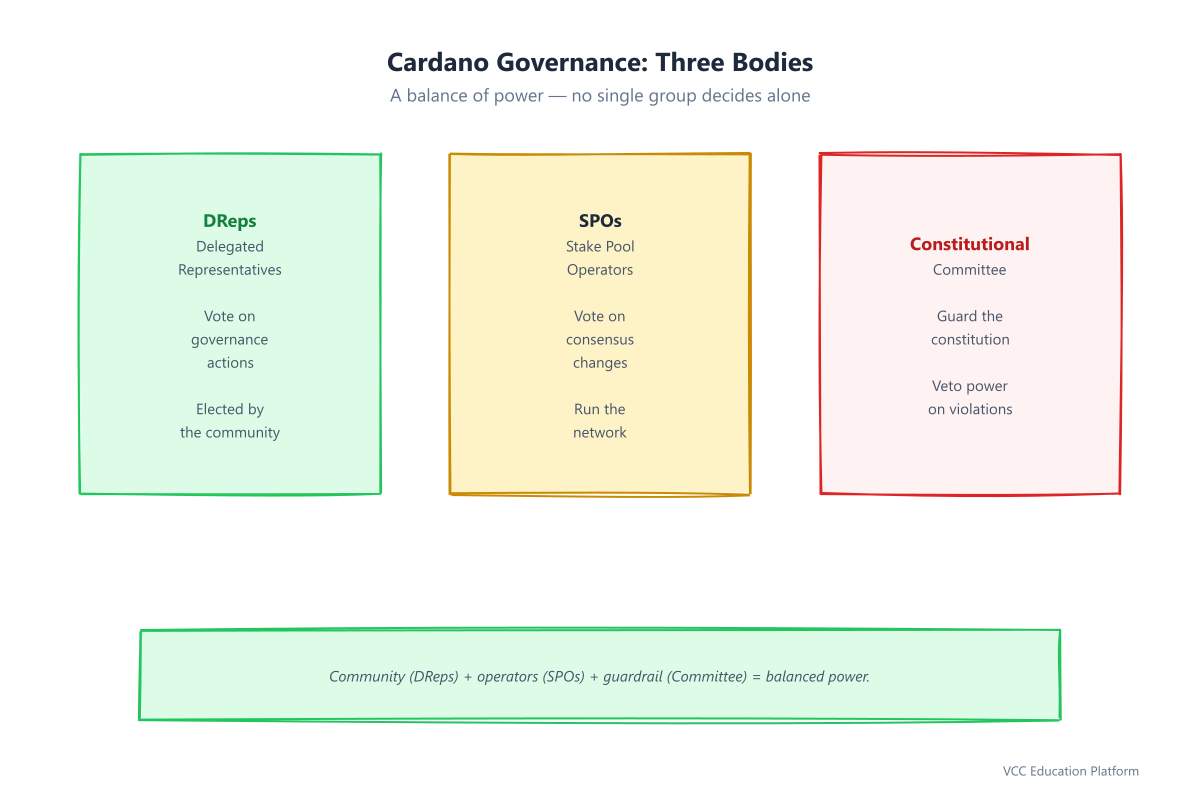
Governance roles: DReps, SPOs, Constitutional Committee
Delegated Representatives (DReps)
DReps vote on governance actions such as hard forks, parameter changes, and treasury withdrawals. You delegate your voting power to a DRep, and you can re-delegate or withdraw at any time. This makes governance accessible even if you never read a single governance action yourself.
Stake Pool Operators
SPOs have a separate voting role on certain governance actions, particularly those affecting the consensus layer. This gives the people who actually run the network a direct say in changes to it.
Constitutional Committee
The Constitutional Committee guards the Cardano Constitution — the document that sets the rules for what governance can and cannot do. It can veto actions that violate the constitution, providing a check on the other two bodies.
Together these three bodies form a balance of power: the community (through DReps), the operators (SPOs), and a guardrail (the committee). No single group can push through a change alone.
Cardano Community Events
Events are where the online community becomes a real-world network. They range from massive global conferences to small local meetups.
Project Catalyst flow: Idea, Proposal, Vote, Fund, Build
Cardano Summit
The Cardano Summit is the flagship annual event, organized by the Cardano Foundation. It brings together thousands of attendees — in person and online — for keynotes, workshops, and networking. Regional summit events also happen in cities around the world.
Catalyst Town Halls
Every Catalyst fund includes regular town halls: live video sessions where proposers pitch ideas, voters ask questions, and funded teams report progress. They are the most frequent large-scale community gathering and a great way to get involved even as a beginner.
Local Meetups
City-level meetups happen across the globe, often organized by SPOs or community ambassadors. They cover staking basics, wallet setup, governance, and developer topics. These are the easiest entry point for new members.
Hackathons
Hackathons challenge developers to build working prototypes on Cardano in a set time. They are where many Catalyst projects and dApps get their start, and they welcome newcomers alongside experienced builders.
The Vietnamese Cardano Community
Vietnam has a notably active Cardano community, which makes sense given the country's broader enthusiasm for cryptocurrency and Emurgo's historical presence in the region.
Local Groups and Channels
Vietnamese Cardano enthusiasts gather in Telegram and Facebook groups where discussion happens entirely in Vietnamese. These groups cover beginner questions, staking guidance, market news, and governance updates, lowering the language barrier for new users.
Vietnamese-Language Content Creators
Several Vietnamese content creators produce Cardano tutorials, YouTube explainers, and blog posts in Vietnamese. They cover wallet setup, staking, Catalyst participation, and market analysis, giving Vietnamese speakers resources that English-only channels cannot.
Regional Presence
Emurgo's Asia focus and past Vietnam-based operations helped seed local interest. Vietnamese developers have participated in Catalyst and hackathons, and local meetups have been held in Ho Chi Minh City and Hanoi. For a Vietnamese beginner, the local community is a friendly on-ramp to the global one.
How to Get Involved
If this overview has you ready to participate, here is a simple path:
- Join a platform — start with Discord or the cardano forum for discussion, and follow Cardano accounts on Twitter for news.
- Stake your ADA — delegating to a pool makes you a participating network member and earns rewards.
- Vote in Catalyst — even a small ADA balance gives you a voice in funding community projects.
- Delegate to a DRep — choose a representative whose views match yours, or run to become one.
- Attend an event — join a town hall online, or a local meetup if one is near you.
You do not need to do everything at once. The community is welcoming to beginners, and every expert started exactly where you are now.
FAQ
What is the Cardano community? The Cardano community is the global network of people who build, run, govern, and use Cardano — including the three founding entities (IOG, Cardano Foundation, Emurgo), stake pool operators, DReps, developers, and everyday ADA holders.
Where can I talk to other Cardano users? The busiest hubs are the official Discord, the r/cardano subreddit, the cardano forum, and Telegram groups. Twitter/X is best for news and following key figures.
What is Project Catalyst? Project Catalyst is Cardano's community treasury fund. Anyone can propose an idea, the community votes, and approved proposals receive funding to build — making it the main source of cardano community projects.
Do I need a lot of ADA to participate in governance? No. Any ADA holder can vote in Catalyst and delegate to a DRep. Your voting power is proportional to your stake, but even a small balance gives you a voice.
Is there a Vietnamese Cardano community? Yes. Vietnam has active Telegram and Facebook groups, Vietnamese-language content creators, and a history of local meetups — making it easy for Vietnamese speakers to get involved without needing English.
What is a DRep? A Delegated Representative is an elected community member who votes on governance actions on behalf of the ADA delegated to them. You can delegate your voting power to a DRep or run to become one yourself.