
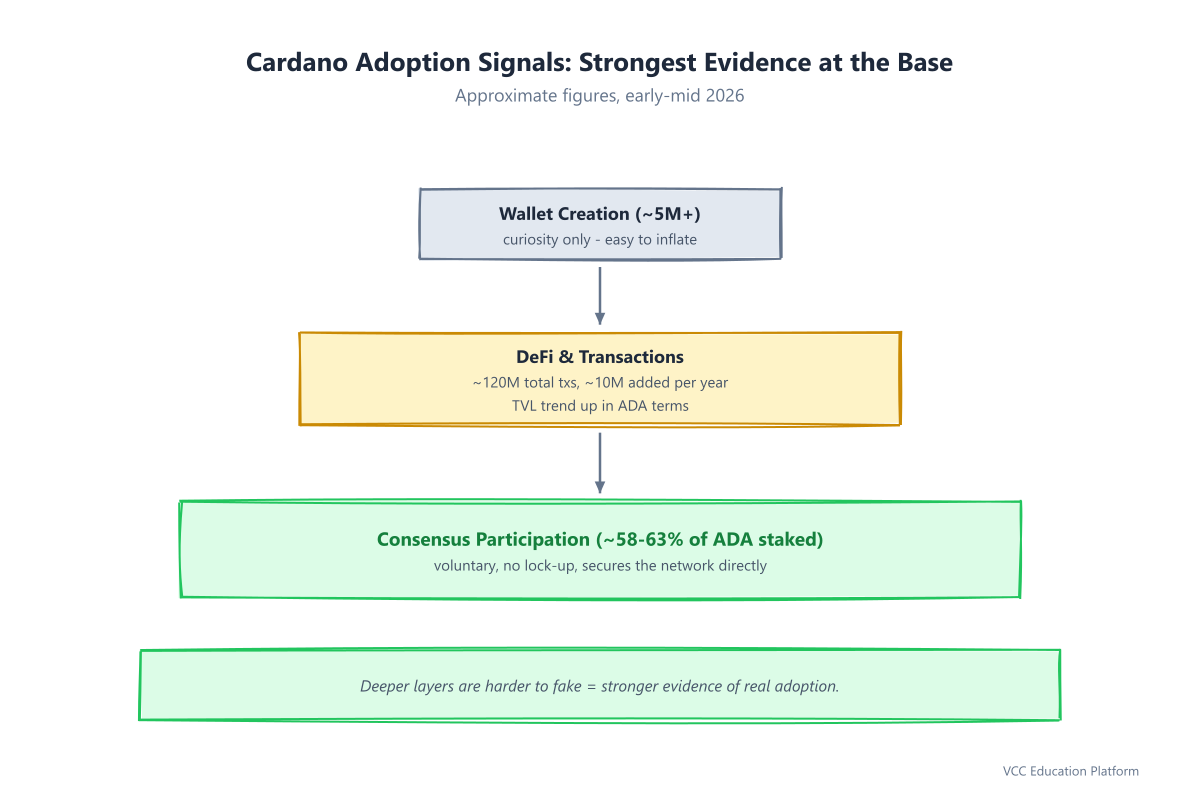
 ### 1. Stake participation — the strongest signal
Roughly **58–63% of all circulating ADA is staked** across more than 3,000 independent stake pools (as of early-to-mid 2026; the exact figure shifts each five-day epoch). For context, Ethereum stakes around 28% of its supply — Cardano's participation rate leads most major proof-of-stake chains.
Why is this the strongest signal? Because staking is voluntary, requires holding ADA through your own wallet, and directly contributes to network security. It's the difference between *owning* a currency and *participating* in it.
### 2. Active addresses — useful, but read them loosely
Depending on the tracker, Cardano shows somewhere between **~12,000 and ~35,000 active addresses per day**. That threefold spread isn't sloppy bookkeeping — it's methodology. Some counters deduplicate change addresses; others count every address touched once. On a UTXO chain like Cardano, wallets generate fresh addresses constantly, so raw address counts inflate user numbers.
The honest takeaway from cardano usage statistics like these: treat them as orders of magnitude ("tens of thousands daily"), not precise figures.
### 3. Wallet creation — measures curiosity, not commitment
More than **5 million wallets** have been created on Cardano, growing by roughly 1,700–2,300 per day during 2025. But here's the catch: only about **1.3 million wallets are actively delegating** to stake pools — roughly one in four.
### 1. Stake participation — the strongest signal
Roughly **58–63% of all circulating ADA is staked** across more than 3,000 independent stake pools (as of early-to-mid 2026; the exact figure shifts each five-day epoch). For context, Ethereum stakes around 28% of its supply — Cardano's participation rate leads most major proof-of-stake chains.
Why is this the strongest signal? Because staking is voluntary, requires holding ADA through your own wallet, and directly contributes to network security. It's the difference between *owning* a currency and *participating* in it.
### 2. Active addresses — useful, but read them loosely
Depending on the tracker, Cardano shows somewhere between **~12,000 and ~35,000 active addresses per day**. That threefold spread isn't sloppy bookkeeping — it's methodology. Some counters deduplicate change addresses; others count every address touched once. On a UTXO chain like Cardano, wallets generate fresh addresses constantly, so raw address counts inflate user numbers.
The honest takeaway from cardano usage statistics like these: treat them as orders of magnitude ("tens of thousands daily"), not precise figures.
### 3. Wallet creation — measures curiosity, not commitment
More than **5 million wallets** have been created on Cardano, growing by roughly 1,700–2,300 per day during 2025. But here's the catch: only about **1.3 million wallets are actively delegating** to stake pools — roughly one in four.
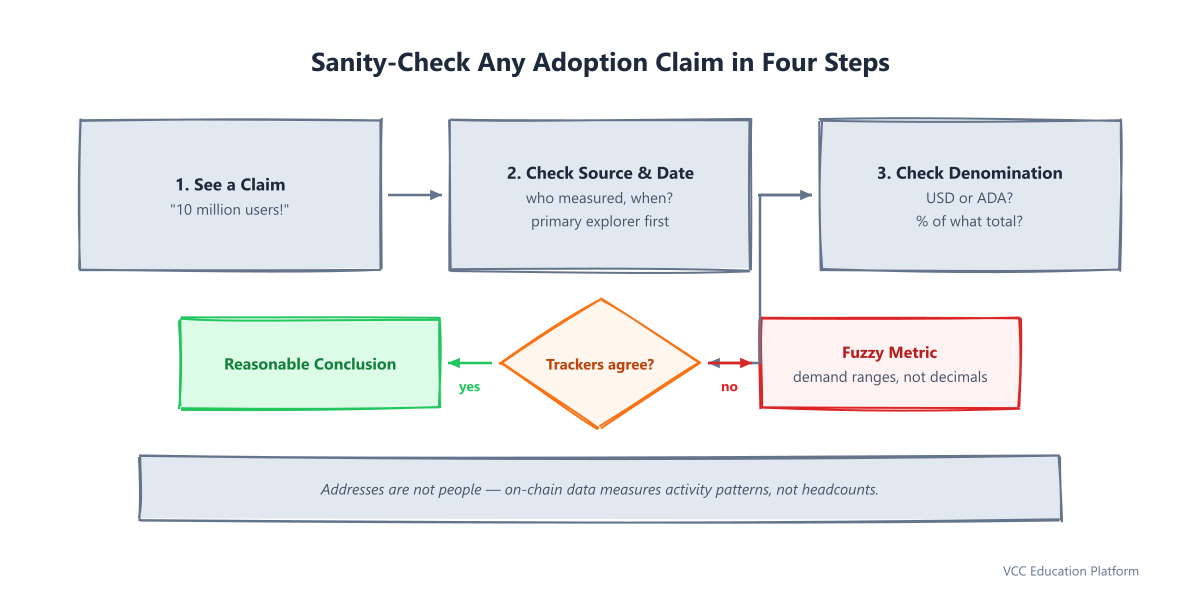 That ratio is more informative than either number alone. Wallet creation measures interest; delegation measures conviction. When the gap widens, newcomers are arriving but not committing. When it narrows, holders are deepening their engagement.
### 4. Transactions — steady accumulation
Cardano passed **~120 million total transactions** by early 2026, adding roughly 10–12 million over the previous year. One technical quirk matters when comparing chains: Cardano's eUTXO model batches multiple payments into a single transaction, so transaction counts understate economic activity relative to account-based blockchains like Ethereum's.
### 5. DeFi TVL — always ask "in what currency?"
Total Value Locked in Cardano DeFi tells two different stories depending on denomination:
- **In USD:** swung roughly between $60M and $150M during 2025–2026, whipsawed by ADA's price.
- **In ADA:** grew from ~380M ADA (September 2025 low) to ~560M ADA (April 2026 high) — a genuinely rising usage trend even while the dollar figure bounced around.
That ratio is more informative than either number alone. Wallet creation measures interest; delegation measures conviction. When the gap widens, newcomers are arriving but not committing. When it narrows, holders are deepening their engagement.
### 4. Transactions — steady accumulation
Cardano passed **~120 million total transactions** by early 2026, adding roughly 10–12 million over the previous year. One technical quirk matters when comparing chains: Cardano's eUTXO model batches multiple payments into a single transaction, so transaction counts understate economic activity relative to account-based blockchains like Ethereum's.
### 5. DeFi TVL — always ask "in what currency?"
Total Value Locked in Cardano DeFi tells two different stories depending on denomination:
- **In USD:** swung roughly between $60M and $150M during 2025–2026, whipsawed by ADA's price.
- **In ADA:** grew from ~380M ADA (September 2025 low) to ~560M ADA (April 2026 high) — a genuinely rising usage trend even while the dollar figure bounced around.
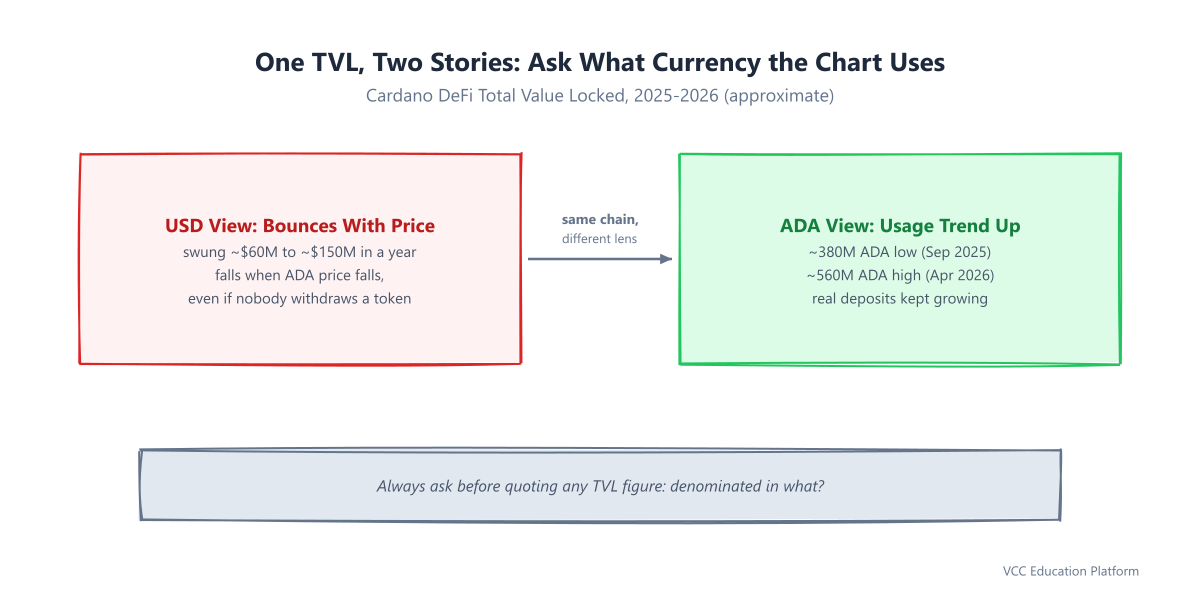 This is the single most common way adoption charts mislead. When ADA's price falls, USD-denominated TVL falls too — even if nobody withdraws a single token. Actual usage didn't change; only the measuring stick did. (We've even seen major publications quote "$552M TVL" — almost certainly the ADA figure mislabeled as dollars.)
---
## How to Read Cardano Network Metrics Without Being Fooled
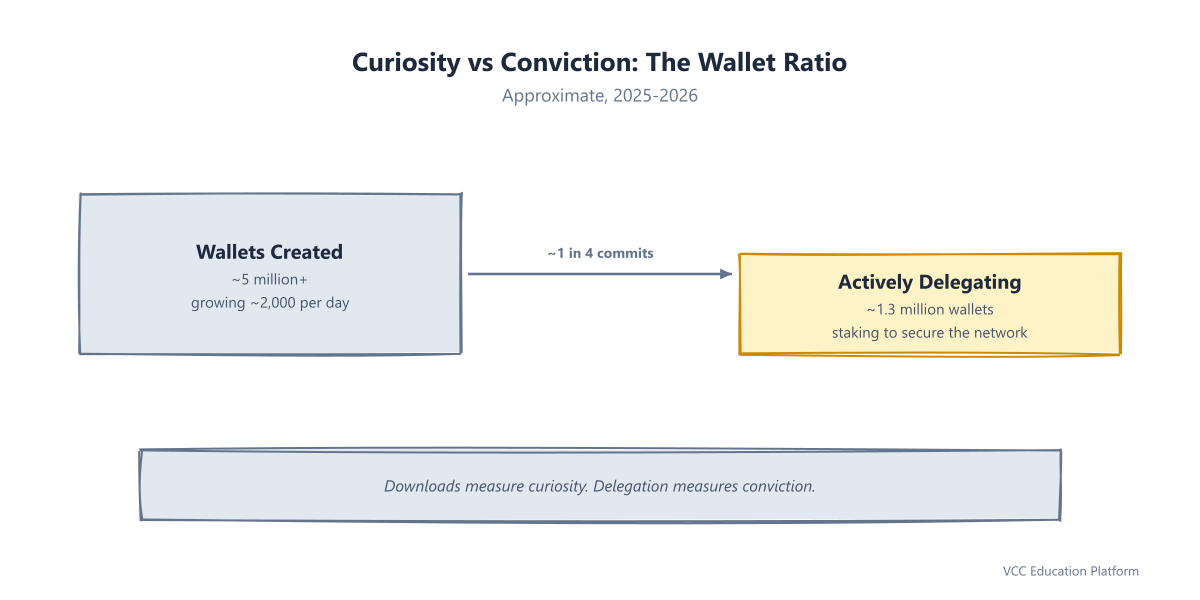
Three habits will protect you from most bad adoption claims:
1. **Check the denominator.** Percentages without denominators are marketing. "Staking grew 40%" — of what, measured over when?
2. **Distrust round, impressive numbers.** "10 million users!" deserves the same skepticism as any statistic that happens to be perfectly memorable. Real on-chain data is messy.
3. **Cross-check at least two sources.** If DefiLlama, Dune, and an explorer disagree wildly on active addresses, that disagreement *is* the finding — the metric is fuzzy, so treat big claims built on it as fuzzy too.
And remember the deepest caveat in all of cardano usage statistics: **addresses are not people.** One exchange hot wallet may represent hundreds of thousands of users, while one whale may hold dozens of personal addresses. On-chain data measures activity patterns, not headcounts.
This is the single most common way adoption charts mislead. When ADA's price falls, USD-denominated TVL falls too — even if nobody withdraws a single token. Actual usage didn't change; only the measuring stick did. (We've even seen major publications quote "$552M TVL" — almost certainly the ADA figure mislabeled as dollars.)
---
## How to Read Cardano Network Metrics Without Being Fooled
Three habits will protect you from most bad adoption claims:
1. **Check the denominator.** Percentages without denominators are marketing. "Staking grew 40%" — of what, measured over when?
2. **Distrust round, impressive numbers.** "10 million users!" deserves the same skepticism as any statistic that happens to be perfectly memorable. Real on-chain data is messy.
3. **Cross-check at least two sources.** If DefiLlama, Dune, and an explorer disagree wildly on active addresses, that disagreement *is* the finding — the metric is fuzzy, so treat big claims built on it as fuzzy too.
And remember the deepest caveat in all of cardano usage statistics: **addresses are not people.** One exchange hot wallet may represent hundreds of thousands of users, while one whale may hold dozens of personal addresses. On-chain data measures activity patterns, not headcounts.
 ---
## What Healthy Cardano Adoption Would Look Like Next
The current picture is consistent: strong consensus-layer participation (~60% staked), modest but steadily accumulating transactions and wallets, and a small-but-growing DeFi layer that looks better in ADA terms than dollar terms. Skeptics fairly point out that DeFi TVL remains tiny next to Ethereum or Solana, and that stablecoin liquidity — essential for payments and remittances — is still thin on Cardano.
For Vietnamese readers watching this space: the remittance use case (kiều hối) is often cited as crypto's killer app for Vietnam, but today's thin stablecoin depth on Cardano means that story remains aspirational rather than current reality. Watch stablecoin market cap and TVL-in-ADA as the leading indicators — if those climb together while staking holds near 60%, that would be genuine Cardano ecosystem growth, not just narrative.
---
## Frequently Asked Questions
### Does Cardano adoption mean the price will go up?
No direct link. Adoption metrics describe network usage; price reflects market expectations, sentiment, and macro conditions — sometimes moving opposite to fundamentals for months at a time. Use adoption data to judge the project's health, not to time trades.
### How many people actually use Cardano?
Nobody knows precisely, and any exact claim should make you suspicious. On-chain data shows tens of thousands of daily active addresses and over a million staking wallets — but addresses don't map one-to-one to people. A fair statement: hundreds of thousands of real participants, likely low millions of holders globally.
### Where can I verify Cardano adoption metrics myself?
Start with Cardanoscan (the block explorer, for totals like transactions and stake), DefiLlama (DeFi TVL — toggle between USD and ADA views), and Dune or Token Terminal for activity dashboards. Our [network statistics guide](/knowledge/cardano-network-statistics) explains how to read each dashboard step by step.
### Is ~60% staked ADA good compared to other blockchains?
Yes — it's among the highest participation rates of any major proof-of-stake network, well above Ethereum's ~28%. Partly this reflects design: Cardano staking has no minimum amount, no lock-up period, and no slashing risk in normal delegation, making participation nearly frictionless.
---
## What Healthy Cardano Adoption Would Look Like Next
The current picture is consistent: strong consensus-layer participation (~60% staked), modest but steadily accumulating transactions and wallets, and a small-but-growing DeFi layer that looks better in ADA terms than dollar terms. Skeptics fairly point out that DeFi TVL remains tiny next to Ethereum or Solana, and that stablecoin liquidity — essential for payments and remittances — is still thin on Cardano.
For Vietnamese readers watching this space: the remittance use case (kiều hối) is often cited as crypto's killer app for Vietnam, but today's thin stablecoin depth on Cardano means that story remains aspirational rather than current reality. Watch stablecoin market cap and TVL-in-ADA as the leading indicators — if those climb together while staking holds near 60%, that would be genuine Cardano ecosystem growth, not just narrative.
---
## Frequently Asked Questions
### Does Cardano adoption mean the price will go up?
No direct link. Adoption metrics describe network usage; price reflects market expectations, sentiment, and macro conditions — sometimes moving opposite to fundamentals for months at a time. Use adoption data to judge the project's health, not to time trades.
### How many people actually use Cardano?
Nobody knows precisely, and any exact claim should make you suspicious. On-chain data shows tens of thousands of daily active addresses and over a million staking wallets — but addresses don't map one-to-one to people. A fair statement: hundreds of thousands of real participants, likely low millions of holders globally.
### Where can I verify Cardano adoption metrics myself?
Start with Cardanoscan (the block explorer, for totals like transactions and stake), DefiLlama (DeFi TVL — toggle between USD and ADA views), and Dune or Token Terminal for activity dashboards. Our [network statistics guide](/knowledge/cardano-network-statistics) explains how to read each dashboard step by step.
### Is ~60% staked ADA good compared to other blockchains?
Yes — it's among the highest participation rates of any major proof-of-stake network, well above Ethereum's ~28%. Partly this reflects design: Cardano staking has no minimum amount, no lock-up period, and no slashing risk in normal delegation, making participation nearly frictionless.