
The QR code on your screen is a cardano address — a string that looks like random characters but is actually a small, carefully engineered package of information. When someone sends you ADA, they are not sending to an "account"; they are locking coins to an address that only your private key can unlock. This guide covers what a cardano address really is, the anatomy hiding inside those characters, the address types (payment, stake, enterprise, delegated), how Bech32 and the derivation path work, and the mistakes beginners most often make.
Address Is a Mailbox, Not an Account
Think of a Cardano address as a mailbox with a very special lock. Anyone can find the mailbox and drop coins in — that is why it is safe to publish. But only the person holding the private key (the "key to the mailbox") can open it and spend what is inside. This clears up the most common beginner confusion: "If someone has my address, why can't they take my money?" Because having the address tells you where the mailbox is — nothing about the key that opens it.
An address is never a key and never an account number. It is a hash of a public key — a one-way scrambled fingerprint produced by the wallet's cryptographic math. The private key stays safely inside your wallet (or hardware device). This is why an address is shareable forever while the key must never leave your possession.
The Anatomy of a Cardano Address
A modern Cardano address (Shelley era onward) is a Bech32-encoded string. Strip away the encoding and you find two credentials side by side:
- The payment credential — the identity allowed to spend the ADA. Without it, coins locked to this address are permanently stuck.
- The staking credential — the identity controlling delegation and where rewards accumulate. Optional on some address types.
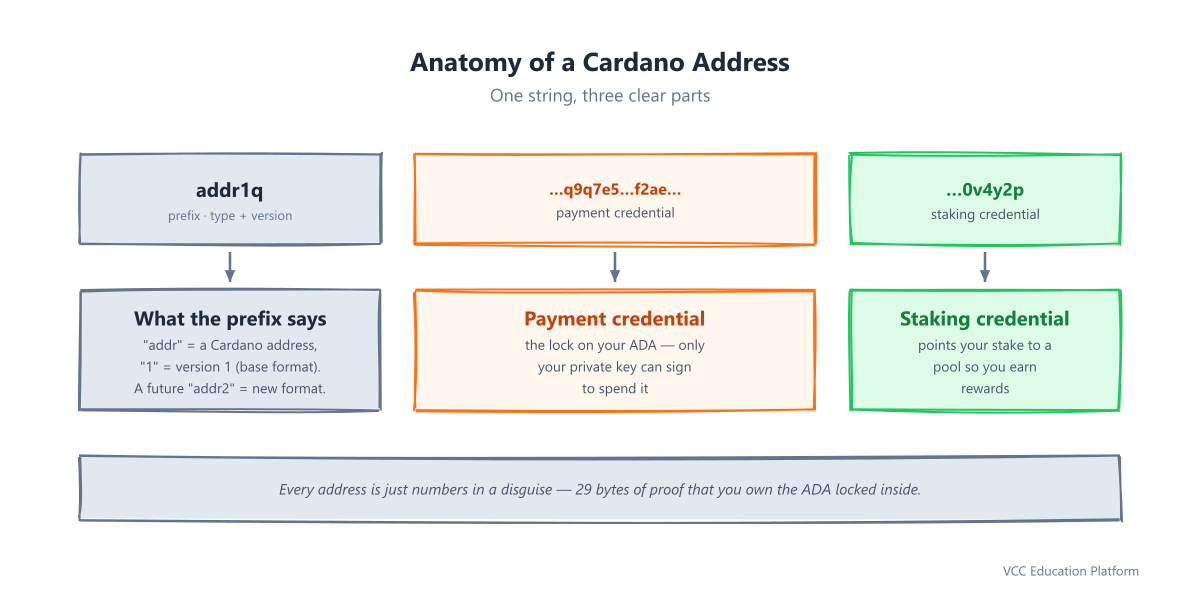
Figure 1: Anatomy of a Cardano address — three parts in one Bech32 string
The first part of the address is the human-readable prefix. It is not decoration — it tells every wallet what kind of address it is looking at:
addr1...— a mainnet address (Shelley)addr_test1...— a testnet addressstake1...— a staking (reward) address
Because the prefix is part of the address, a wallet can check the format before anything happens. Paste a testnet address into a mainnet wallet and it refuses, politely — the prefix does not match.
Why Bech32 instead of a plain number?
Cardano chose Bech32 because it detects typos. The character set excludes lookalikes (no 0/O, no 1/l), and every address carries a checksum that verifies itself. If you mistype one character while sending, the checksum fails and the transaction is rejected before any money moves. A real safety net — but read the mistakes section below, because it does not protect you from every error.
The Types of Cardano Address
Not every address is the same. Cardano defines several types, and each has a job. The three a beginner actually meets are payment, stake, and the "delegated" base address.
Base address (addr1...) — the everyday one
A base address carries both the payment credential and the staking credential. This is the type your wallet shows on the Receive screen. Because the staking credential is attached, coins sitting at a base address count toward your staked balance — when you delegate, the staking part of the address is what the pool "talks to." When people say "my address is delegated to a pool," they mean a base address whose staking credential is actively registered.
Enterprise address (addr1..., shorter) — payment only
An enterprise address carries only the payment credential — no staking credential at all. It is typically shorter, and ADA sent to it simply does not participate in staking. Exchanges use enterprise addresses heavily because they hold all customer staking keys centrally, offline, and do not want every deposit wallet attached to a delegation. For a personal wallet you almost never need one — a base address does everything an enterprise address does and lets you delegate.
Stake (reward) address (stake1...) — the delegation identity
The stake address carries only a staking credential. It does not hold ADA directly, but it is the "delegation identity" of the wallet: it is the address registered when you delegate, and it is where staking rewards are sent. When you delegate in a wallet like Yoroi or Eternl, you are (behind the scenes) registering your stake address with a pool. You can publish a stake1... address safely — it cannot receive someone else's regular ADA transfer intended as a payment.
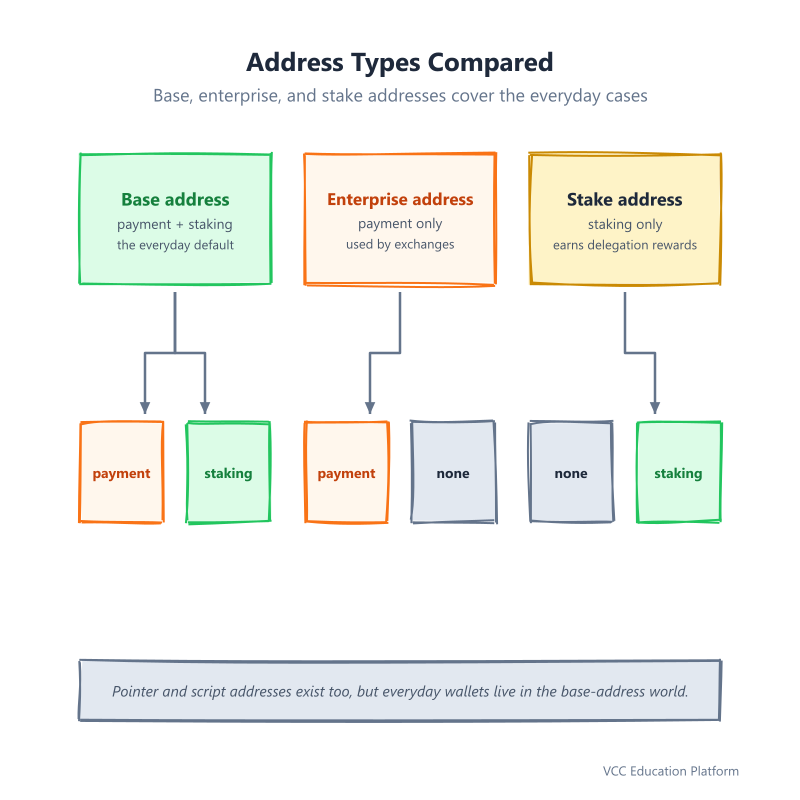
Figure 2: Cardano address types — what each one can and cannot do
Two rarer types complete the family: pointer addresses (payment credential plus an on-chain pointer to a stake registration — rare, not used by wallets) and script addresses (the credential is a Plutus script hash rather than a key hash — created when interacting with smart contracts).
The Format Story: Byron and Base58
Older Byron-era addresses (from Cardano's first years) use a different encoding, Base58, and have no staking credential — they predate delegation. Shelley addresses use Bech32. The network is strict: an address in the wrong format is rejected, not auto-converted. In practice this is invisible to you, since wallets handle both. The history matters only because you may occasionally see a long old-format address in a transaction from 2020.
How a Wallet Creates Fresh Addresses (Derivation)
This is where the "magic" of endless fresh addresses comes from. Your wallet does not store thousands of addresses — it stores one secret, the seed phrase, and a recipe to derive everything else. Cardano's recipe is the CIP-1852 derivation tree:
m / 1852' / 1815' / 0' / 0 / 0
Read left to right, it is just a filing system:
1852'— Cardano's purpose (Shelley scheme)1815'— the coin type (ADA; Ada Lovelace's birth year)0'— account number (usually 0)0— role: 0 = receive, 1 = change, 2 = staking0— index, counting up from 0
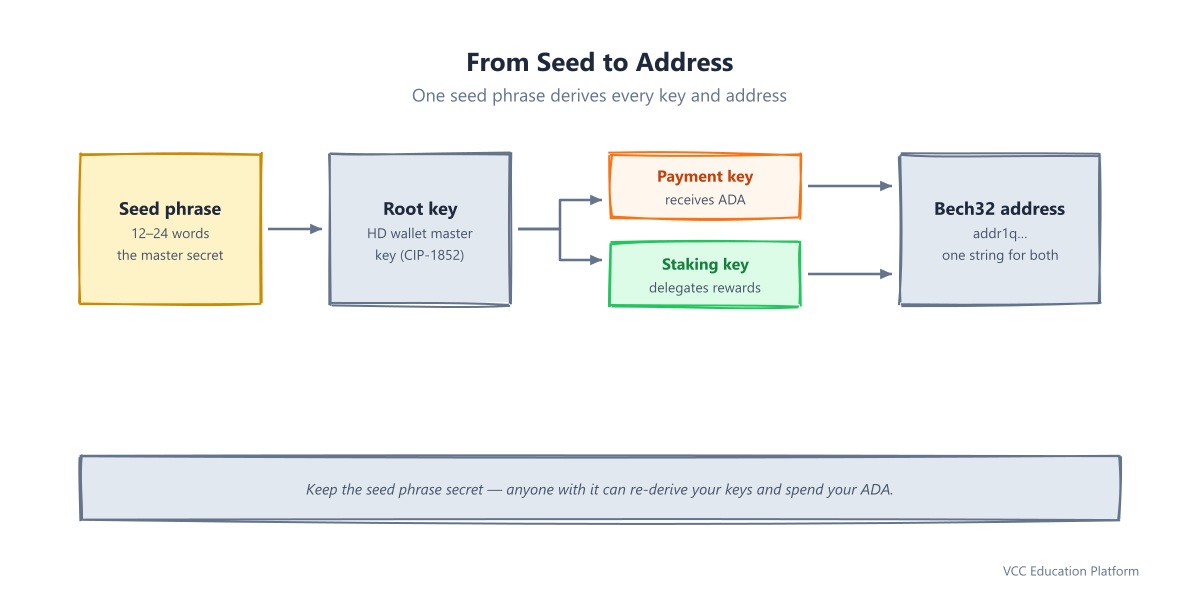
Figure 3: From seed phrase to address — one secret, endless fresh addresses
Your wallet walks down the tree and hands you the next unused index every time you tap "New address." That is why you can generate a fresh receive address forever without going back to the seed phrase — and why restoring a wallet from a 24-word phrase rebuilds every address you ever used. The path is not a secret; it is a phone book, and the only truly secret thing is the seed at the top.
One account, two keys
The tree splits: the staking key lives at a fixed path (role 2), payment keys at roles 0 and 1. One staking key for delegation, many payment keys for spending — you can delegate your whole balance without ever exposing spending control to the pool.
Why Your Address Changes (and Why That Is Good)
Your wallet will happily generate a new address for every transaction. This is not a glitch — it is address hygiene. Each address you reuse is a public label that forever links together everything deposited to it. Anyone watching the chain can see "all ADA ever sent to addr1abc..." — a picture of your income. Fresh addresses keep each deposit in its own unlabeled mailbox. Reusing an address is safe (your key still controls it) — it is just less private.
This matters for Vietnamese readers used to a fixed bank account number: on Cardano, a changing address is a feature. Sellers who share an address can either reuse a personal one for small amounts or generate a fresh one per invoice.
Mistakes That Actually Cost Money
Bech32's checksum protects you from most typos — but not from a valid address that belongs to someone else, or from sending to the wrong type of address. The checksum verifies the format, never the owner.
The two rules that matter:
- Copy the full address, character by character. Send a small test amount first and confirm the receiver sees it before sending a large balance. The network delivers ADA to any valid address — irreversibly.
- Match the type. Do not send a payment meant to be spendable into a
stake1...reward address — it will sit where the recipient's normal wallet will not automatically spend it.
There is no "undo" button on a blockchain. If an address is valid, the money goes. The checksum catches typos; it is your eyes that catch the owner.
Frequently Asked Questions
Why does my Cardano receive address keep changing?
Your wallet derives a fresh address (the next unused index in the CIP-1852 tree) for each transaction. The change is deliberate: reusing one address links all your deposits publicly. Old addresses still work — coins sent to them are controlled by the same key — they are just not private.
Can I send ADA to a stake address?
A stake1... address is a staking/reward address, not a normal payment destination. Coins sent there are not controlled the way a payment address controls them, and a typical wallet will reject or warn before sending. Always send ADA to the recipient's payment address (addr1...).
Is a Cardano address the same as a public key?
No. An address is a hash of a public key — a one-way fingerprint. The public key is usually not even shown to you; wallets present only the address. Giving someone your address reveals nothing that lets them spend your coins.
Do I need to back up my addresses?
No. Your seed phrase is the only backup that matters. Every address your wallet will ever show is derived from that phrase via CIP-1852 — restore the phrase in any wallet and all your addresses reappear.
Is my Cardano address private?
Your address is public by design, but reveals only what you deposit to it over time. Reusing one address makes that history linkable; a fresh address per payment keeps deposits unlabeled. That is the "privacy dial" of a Cardano wallet.
The Takeaway
A Cardano address is not an account number — it is a mailbox: a Bech32-encoded hash of a public key, split into a payment credential and (for base addresses) a staking credential. The addr1 prefix tells you the network, the checksum catches typos, and the CIP-1852 tree hands out endless fresh addresses from a single seed phrase. Understand those three pieces, and you understand every address you will ever paste, scan, or share.