
Introduction
Addresses are a fundamental concept on the Cardano blockchain. Understanding addresses is one of the first steps to equip yourself when exploring the Cardano ecosystem. However, addresses on Cardano can be quite complex due to changes over time, as well as the requirement for certain knowledge about the Cardano ecosystem and cryptography. In this article, we will explore addresses in the most basic way, and the different types of addresses on the Cardano blockchain.
Address Classification
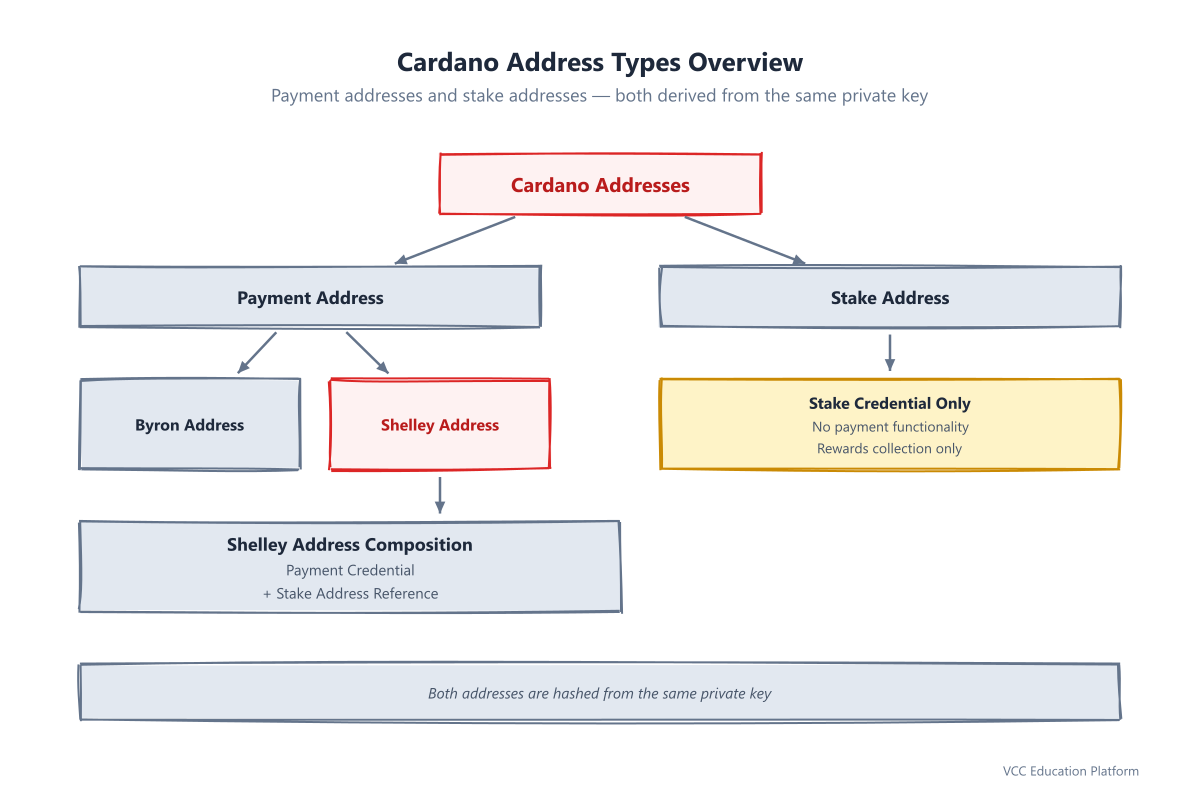
Figure 1 provides an overview of the different address types on Cardano. Basically, the Cardano blockchain has two types of addresses: payment addresses and stake addresses. These two addresses have a close relationship with each other.
A. Payment Address
Payment addresses are divided into two smaller types corresponding to the development through each phase of the Cardano Blockchain.
- Byron address is the address used in the Byron era and earlier.
- Shelley address is the address used starting from the Shelley era. If you don't know about Cardano eras, you can refer to here.
Currently, we are past the Shelley era, so most addresses we use will be of this type. These addresses have a very recognizable feature: they start with addr1, for example addr1vpu5vlrf4xkxv2qpwngf6cjhtw542ayty80v8dyr49rf5eg0yu80w. We will go deeper into Shelley addresses in the section below.
B. Stake Address
The stake address is the address used to receive rewards when we delegate ADA to pools. The stake address only contains staking credential information. Note that we cannot use the stake address to send and receive payments like a payment address. The stake address will start with stake1, for example stake1vpu5vlrf4xkxv2qpwngf6cjhtw542ayty80v8dyr49rf5egfu2p0u. The stake address is also created simultaneously when we create a payment address, whether we delegate to pools or not.
C. The Relationship
Shelley addresses and stake addresses have a close relationship. Both of these addresses are hashed from the private key of a wallet address. Figure 1 shows that a Shelley address will be composed of 2 components:
- The component containing payment information (payment credential)
- The component containing staking information (Stake Address Reference).
In a Shelley address, staking information may or may not exist (depending on the type of Shelley address we use, which will be presented below), or in other words, a Shelley address may include a stake address or not. Below are some examples of Byron, Shelley, and stake addresses. Note that these addresses have been encoded in Bech32 or Base58 format for users to easily identify.
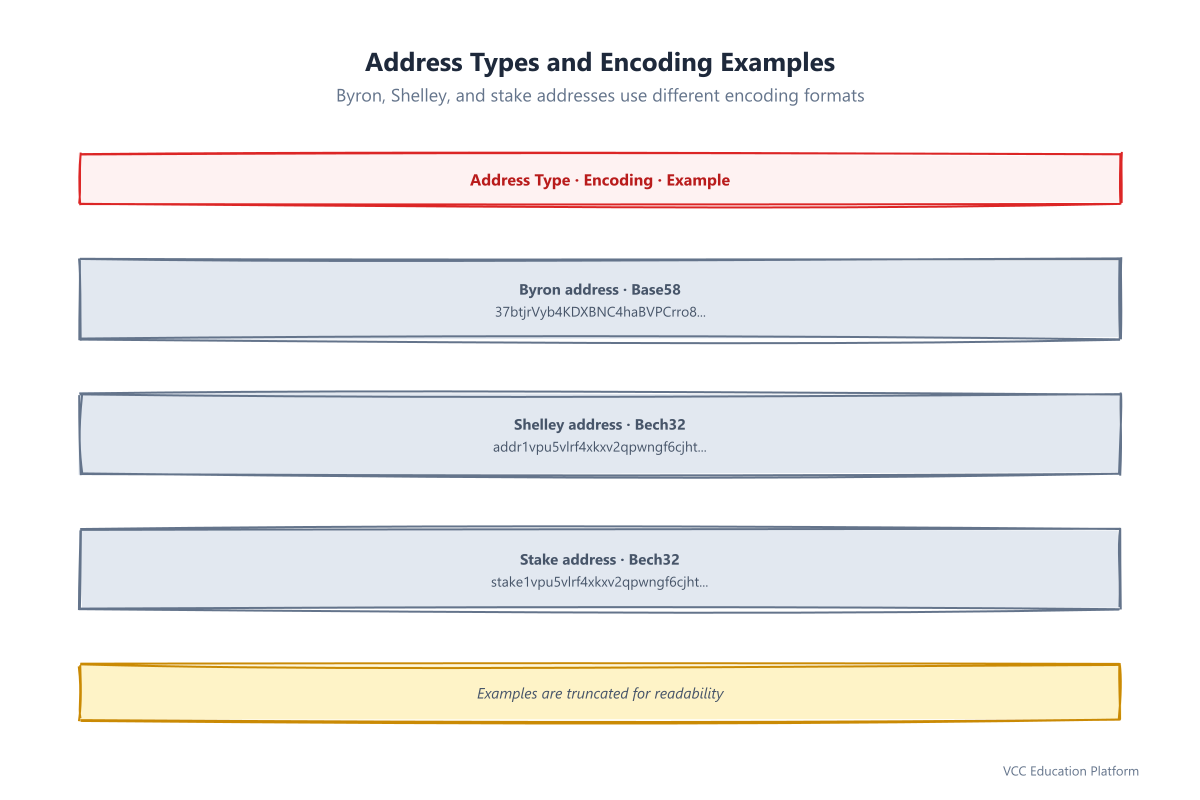
| Address Type | Encoding | Example |
|---|---|---|
| Byron address | Base58 | 37btjrVyb4KDXBNC4haBVPCrro8AQPHwvCMp3RFhhSVWwfFmZ6wwzSK6JK1hY6wHNmtrpTf1kdbva8TCneM2YsiXT7mrzT21EacHnPpz5YyUdj64na |
| Shelley address | Bech32 | addr1vpu5vlrf4xkxv2qpwngf6cjhtw542ayty80v8dyr49rf5eg0yu80w |
| Stake address | Bech32 | stake1vpu5vlrf4xkxv2qpwngf6cjhtw542ayty80v8dyr49rf5egfu2p0u |
Binary Address Structure
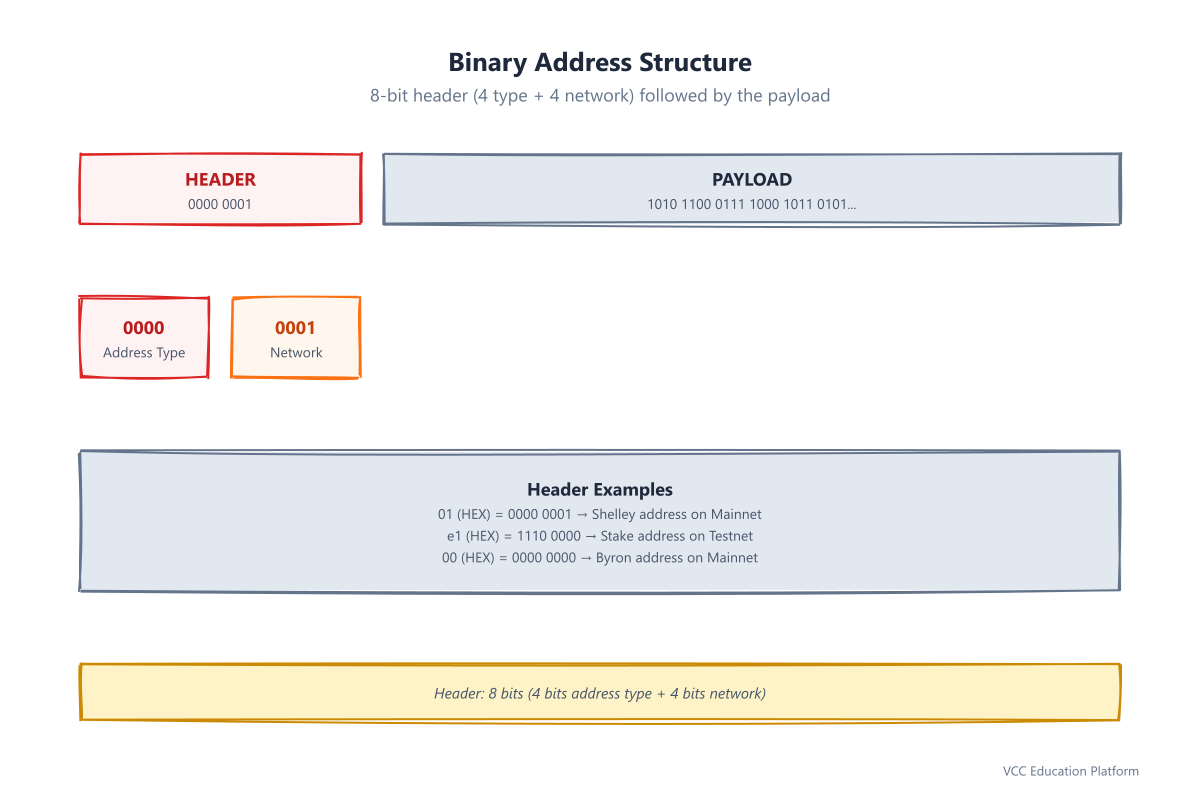
Before encoding, whether it's a payment address or stake address, a Cardano blockchain address is just binary number strings. This binary string is composed of two components: the header part containing information specifying the address type, and the payload part containing that address.
The header has 8 binary bits, where the first 4 bits specify the address type (Shelley, Byron, or stake address), and the next 4 bits specify the Mainnet or Testnet network. Thus, if there is an address starting with 0000 0001... (or 01 in HEX code), we know this is a Shelley address on the Mainnet. If an address starts with 1110 0000 (or e1 in HEX code), this is a stake address on the Testnet.
Base Address, Pointer Address, and Enterprise Address
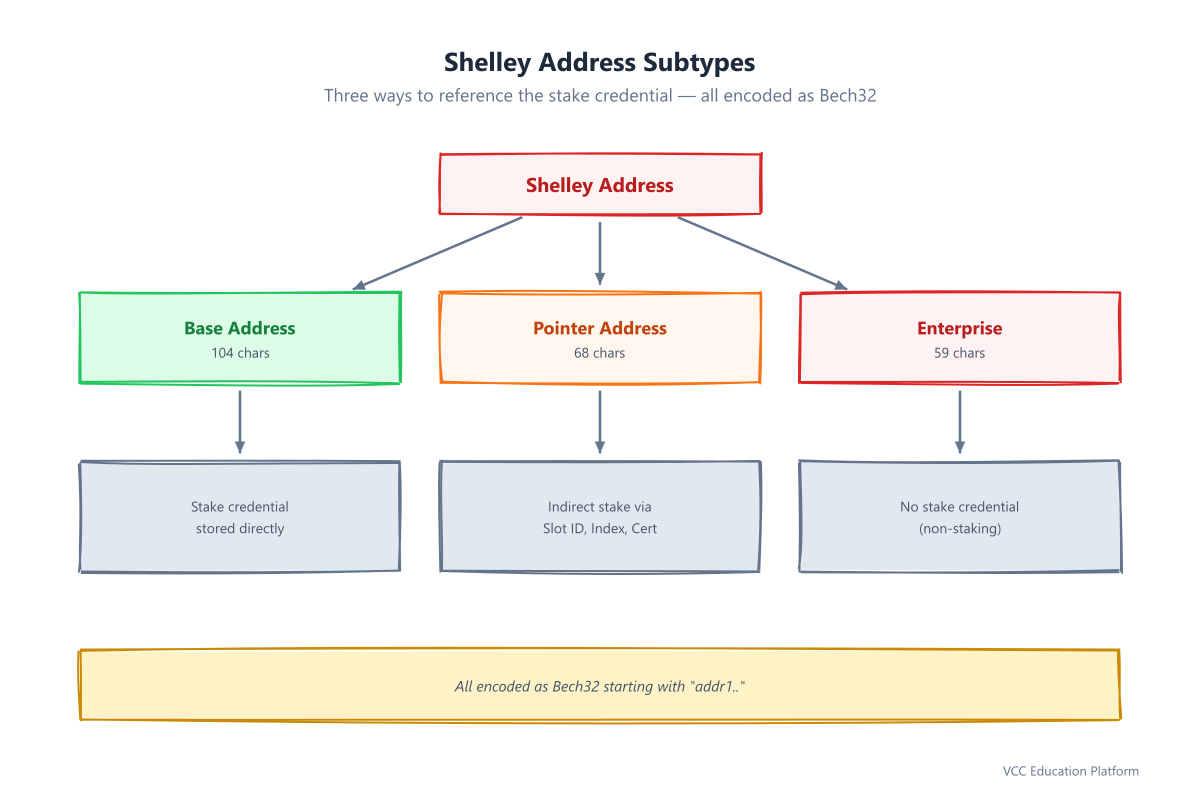
Shelley addresses can be further divided into smaller types:
- Base address
- Pointer address
- Enterprise address
These addresses are created due to different ways of referencing the Stake Credential, or in other words, different Stake Address Reference parts.
For example: if we reference the Stake Credential through a Value, we will have a Base address. If we reference through a pointer, we will have a Pointer address. Or if there is no reference part, we will have an Enterprise address. Below is an example of Base address, Pointer address, and Enterprise address.
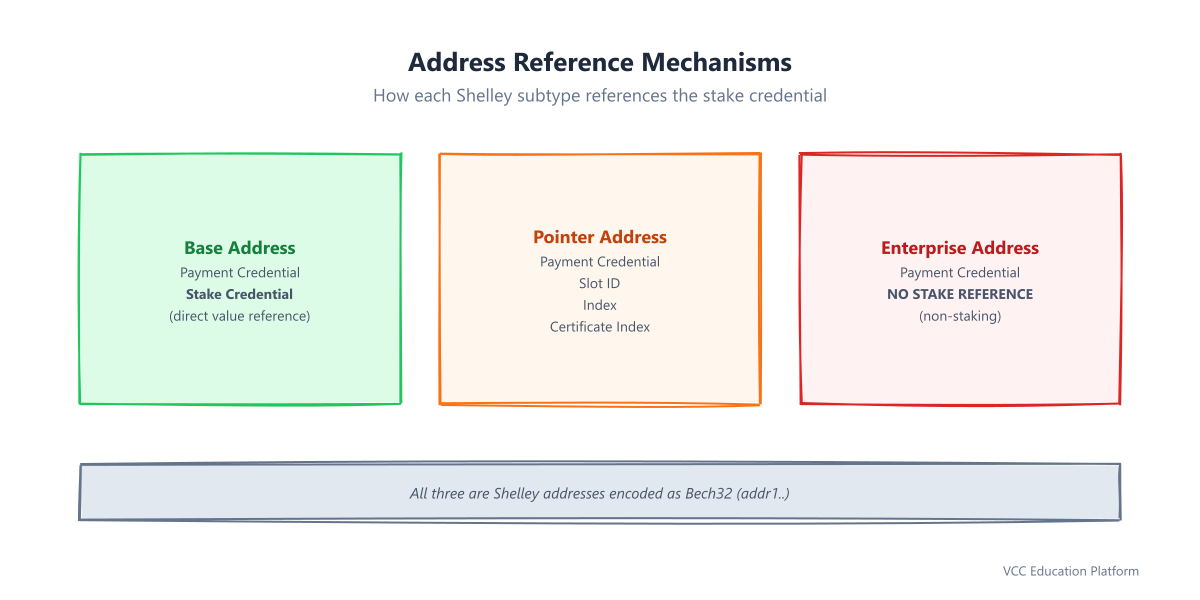
Base address contains staking information (stake credential) directly within itself. This means a Base address is formed by combining payment credential and stake credential information (refer back to Figure 1 for the relationship between payment and stake credentials).
Base address is also the address that most of us users are using. Enterprise address does not contain staking information, so we cannot use this address to delegate to pools.
Enterprise address was initially designed for exchanges or organizations, companies to use. When using this address, exchanges or organizations convince users that they do not use users' assets to delegate to pools and profit from it.
Pointer address contains staking information indirectly. Staking information can be determined through Slot ID, Index, and Certificate index. Therefore, instead of storing directly like a Base address, a Pointer address only stores information about Slot ID, Index, and Certificate index. In practice, pointer addresses are not widely used on the Cardano blockchain due to some limitations of this address type.
In binary form, we can distinguish these three addresses, but after Bech32 encoding, all these addresses start with addr1.., so we cannot distinguish them accurately. However, we can rely on the short length of the address to distinguish relatively. Enterprise address does not contain stake credential information, so it is the shortest address, with only 59 characters. Pointer address has a length of 68 characters, while base address contains all staking information so it has the longest length, 104 characters.
How to Check Addresses
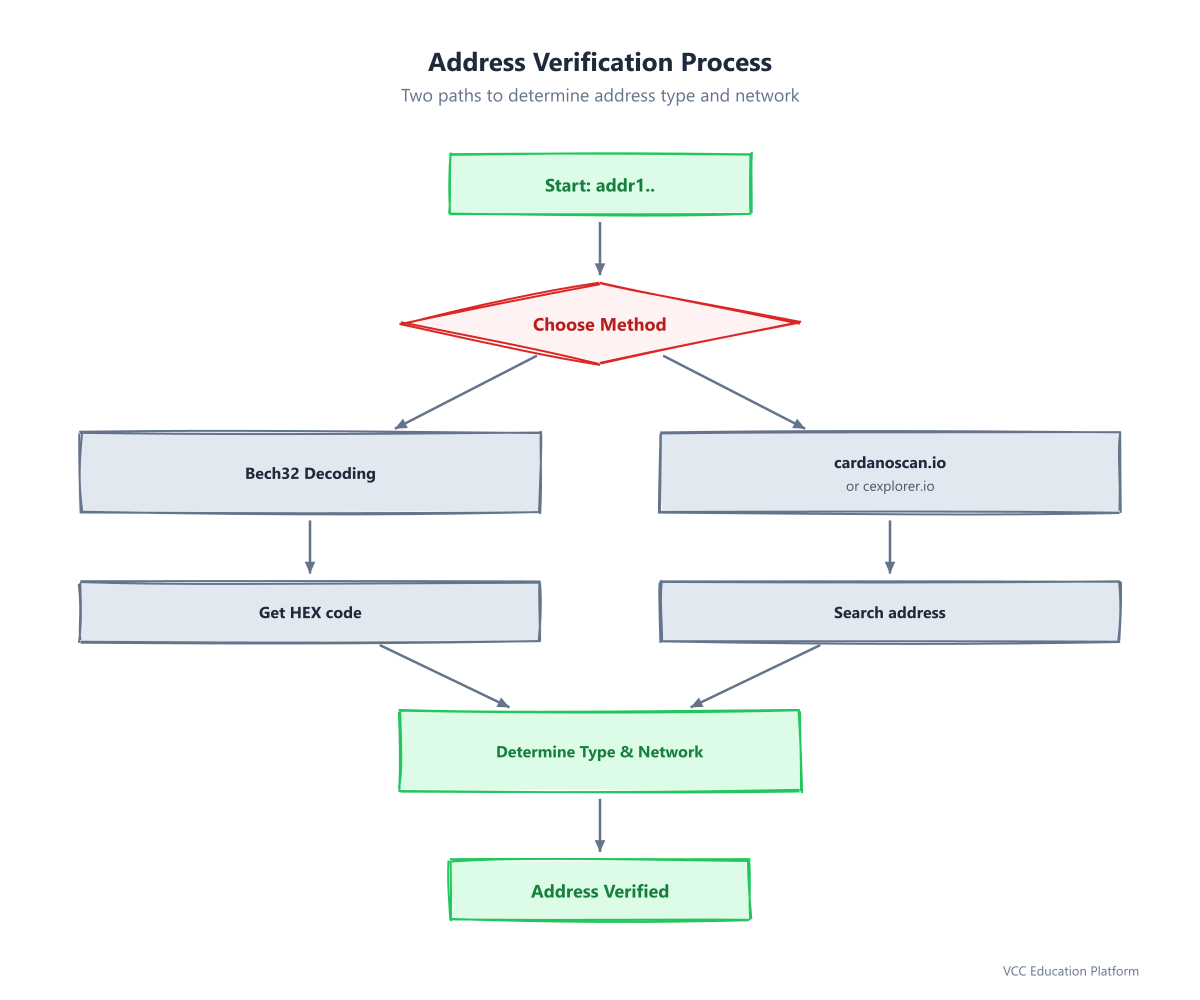
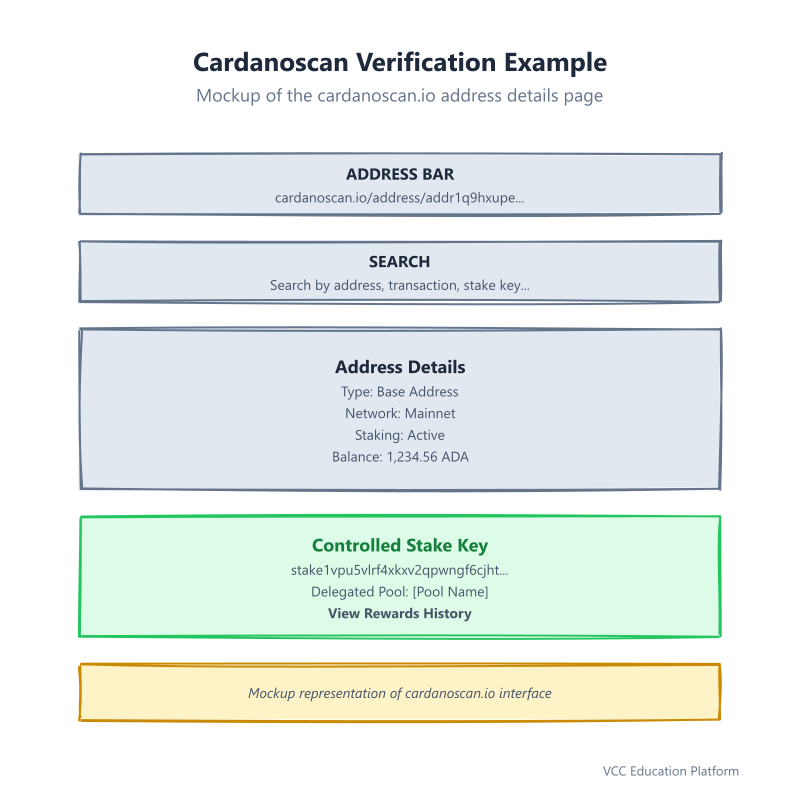
The addresses we usually see starting with addr1.. are encoded in Bech32 format. We can decode by using Bech32 software here. For example, using the command > bech32 <<< addr1q9hxupe…f8nm we will get the address in HEX format as 01dea64b3a890f0…3cecf5b3. Since this address starts with 01, this is a base address. Another simpler way is to use tools like cardanoscan.io or cexplorer.io. Below is an example using cardanoscan.io. Enter the Shelley address into the search box, we will have similar results as above. In addition, we can also check the stake address we are using in the Controlled Stake Key section as illustrated in the figure below.
Practical Use Cases: Combining Different Address Types
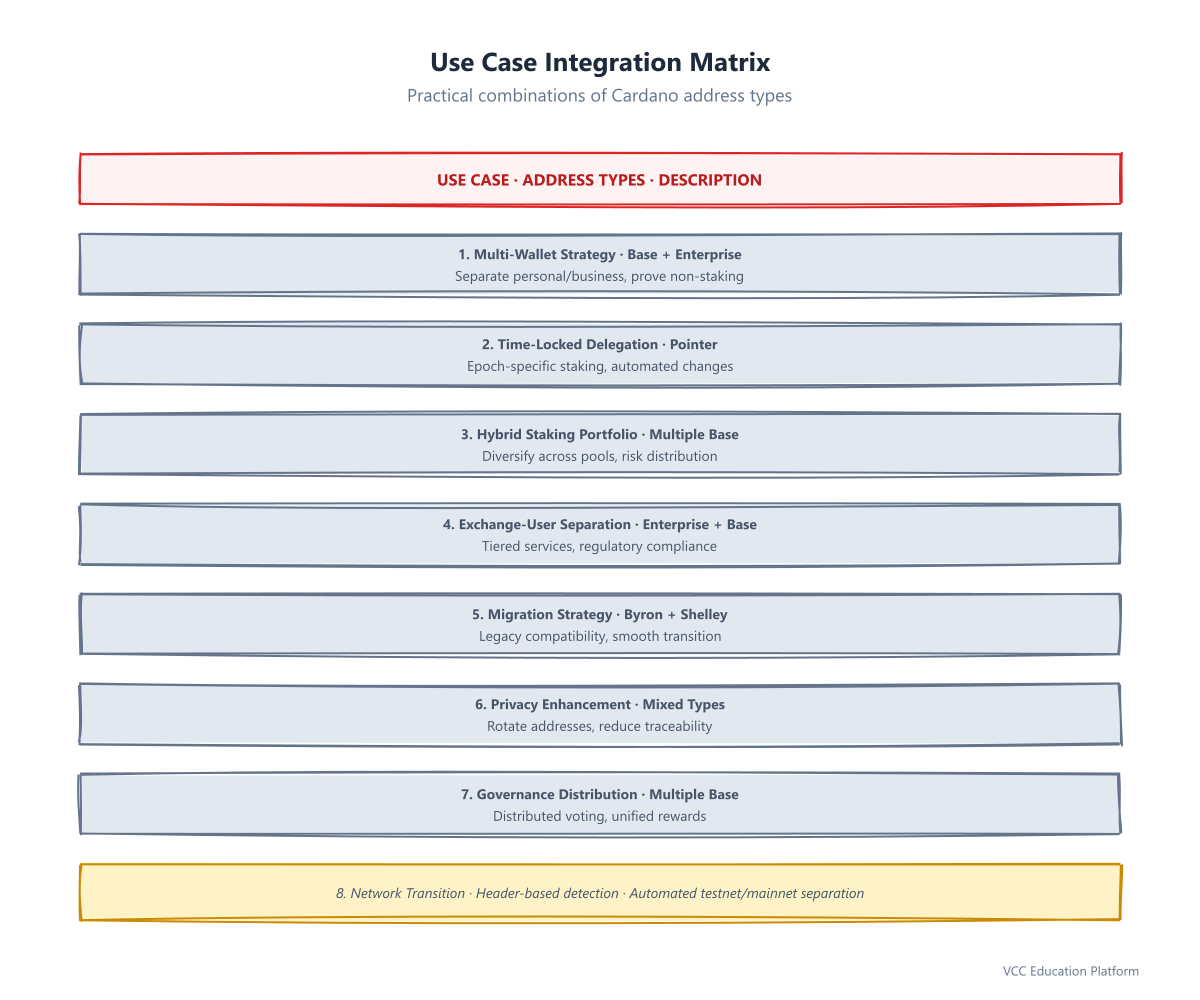
Understanding how different address types can be combined opens up powerful possibilities for developers and users in the Cardano ecosystem. Here are practical use cases that leverage the unique characteristics of each address type:
1. Multi-Wallet Strategy for Enhanced Privacy
Use Case: Combine Base addresses and Enterprise addresses to separate personal and business transactions.
Implementation:
- Use Base addresses for personal ADA holdings to participate in staking and earn rewards
- Use Enterprise addresses for business operations to demonstrate transparency and non-staking of customer funds
- This combination allows exchanges and custodial services to prove they're not using customer funds for staking while still enabling staking for their own treasury
Benefits: Enhanced privacy, regulatory compliance, and clear separation of concerns
2. Time-Locked Delegation with Pointer Addresses
Use Case: Use Pointer addresses to create time-locked delegation scenarios.
Implementation:
- Create Pointer addresses that reference stake credentials from specific time periods
- Enable delegation strategies that automatically expire or change based on blockchain epochs
- Useful for time-sensitive voting or governance participation
Benefits: Automated delegation management, epoch-specific staking strategies
3. Hybrid Staking Portfolio
Use Case: Combine multiple Base addresses with different stake credentials to diversify staking rewards.
Implementation:
- Create multiple Base addresses each linked to different stake addresses
- Delegate each stake address to different stake pools
- This allows for risk distribution across multiple pools while maintaining a unified wallet experience
Benefits: Risk diversification, maximized rewards through optimal pool selection
4. Exchange-User Separation Architecture
Use Case: Enterprises using a mix of Enterprise and Base addresses for different user categories.
Implementation:
- Enterprise addresses for cold storage and institutional accounts (non-staking)
- Base addresses for retail user accounts (staking-enabled)
- Clear separation allows for different service tiers and reward structures
Benefits: Regulatory compliance, differentiated service offerings, transparent asset management
5. Migration and Compatibility Strategy
Use Case: Maintain Byron addresses for legacy compatibility while using Shelley addresses for new operations.
Implementation:
- Keep Byron addresses active for legacy systems and old contracts
- Use Shelley addresses (Base/Enterprise) for all new transactions
- Gradual migration path ensures no disruption to existing services
Benefits: Backward compatibility, smooth transition, zero downtime
6. Privacy-Enhanced Transaction Patterns
Use Case: Rotate between different address types to enhance transaction privacy.
Implementation:
- Use Base addresses for regular staking activities
- Occasionally use Enterprise addresses for one-time transactions
- Mix address types to break transaction pattern analysis
Benefits: Enhanced privacy, reduced transaction traceability
7. Governance and Voting Power Distribution
Use Case: Leverage stake addresses across multiple Base addresses for distributed governance.
Implementation:
- Create multiple Base addresses with the same stake credential
- Distribute voting power while maintaining unified staking rewards
- Useful for DAOs and organizations requiring distributed decision-making
Benefits: Distributed governance, unified reward collection, organizational flexibility
8. Testnet to Mainnet Transition Strategy
Use Case: Use address header knowledge to distinguish and manage testnet vs mainnet addresses.
Implementation:
- Develop tools that automatically detect network based on address header bits
- Separate testnet and mainnet address management in wallet software
- Prevent accidental cross-network transactions
Benefits: Network safety, automated address management, reduced user error
Conclusion
Thus, we have been able to understand and distinguish some popular address types on the Cardano blockchain. Hopefully, this article can provide initial knowledge for us to explore deeper into address-related knowledge, such as mangled addresses (Franken addresses), or HD Wallets.