
You have heard the word "blockchain" a hundred times — on the news, in a YouTube ad, from a friend who bought some crypto. But if someone asked you to explain what a blockchain actually is, in one sentence, could you? Most people can't, and that is not your fault: most explainers either drown you in jargon ("distributed hash-linked ledger with Byzantine fault tolerance") or hype it as magic ("it will change everything!"). This article does neither. By the end you will be able to explain blockchain to your grandmother, in one sentence, and you will know exactly what it is good for and what it is not good for.
Here is the one-sentence version: a blockchain is a shared notebook that many computers keep identical copies of, where once something is written down it is practically impossible to secretly change. That is the whole idea. Everything else — blocks, hashes, consensus, nodes — is just the engineering that makes that notebook work. Let's unpack it.
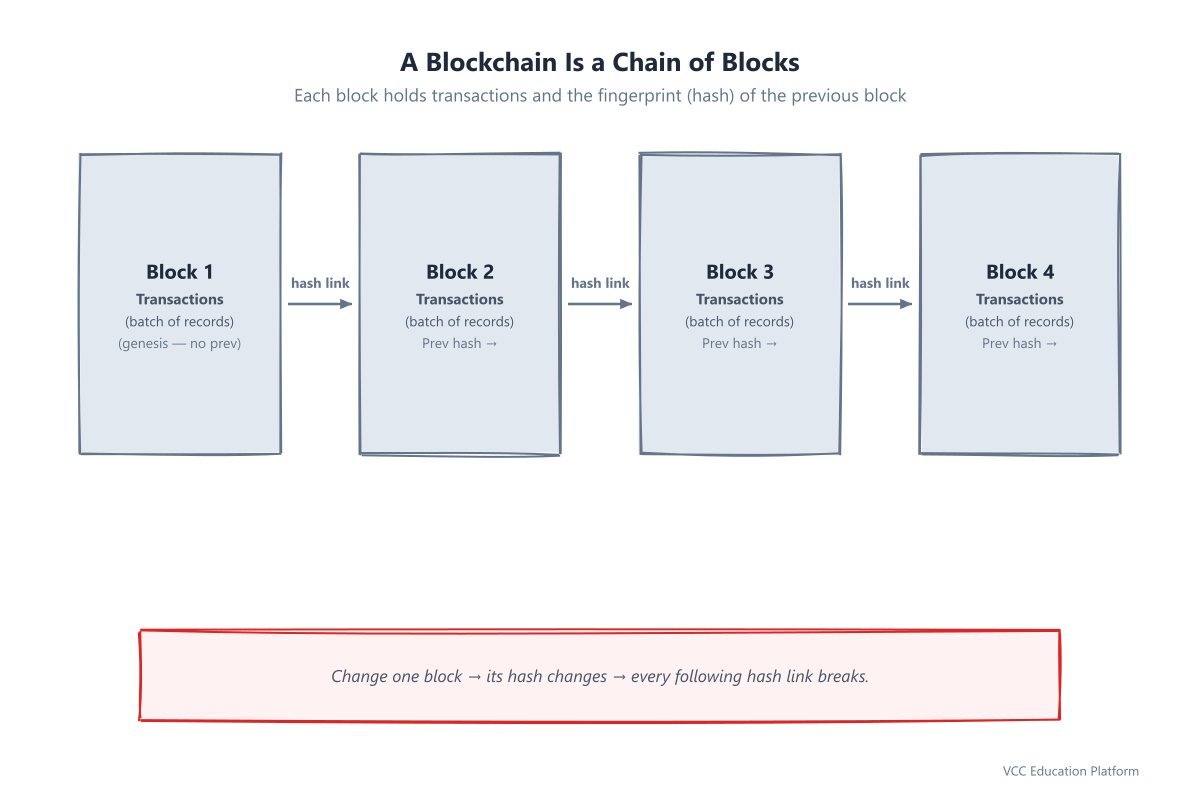
Figure 1: A blockchain is a chain of blocks, each holding transactions and the hash of the previous block
The Mental Model: A Notebook Everyone Keeps
The fastest way to understand blockchain is to stop thinking about computers for a moment and think about a notebook.
Imagine a village where, instead of one accountant keeping the only record of who owes whom, every household keeps its own notebook with the same list of transactions. Whenever someone wants to add a new entry — "Lan paid Minh 500,000 đồng" — they announce it to the whole village. Every household checks that Lan actually has 500,000 đồng, and if she does, they all write the entry down. Now there are, say, 200 identical notebooks around the village, all agreeing.
If one person later tries to sneak into their notebook and change "500,000" to "50,000," it does not matter — the other 199 notebooks still say 500,000, and the forgery is obvious. That is the core of a blockchain: many copies, all kept in sync, so no single party can quietly rewrite history.
For a Vietnamese reader, this should feel familiar. A "sổ hộ khẩu" (household registration) or a shared village land record is a kind of multi-party record that people could inspect — not controlled by one clerk behind a counter. A blockchain takes that idea and automates it with software, across the whole internet, without trusting any villager individually.
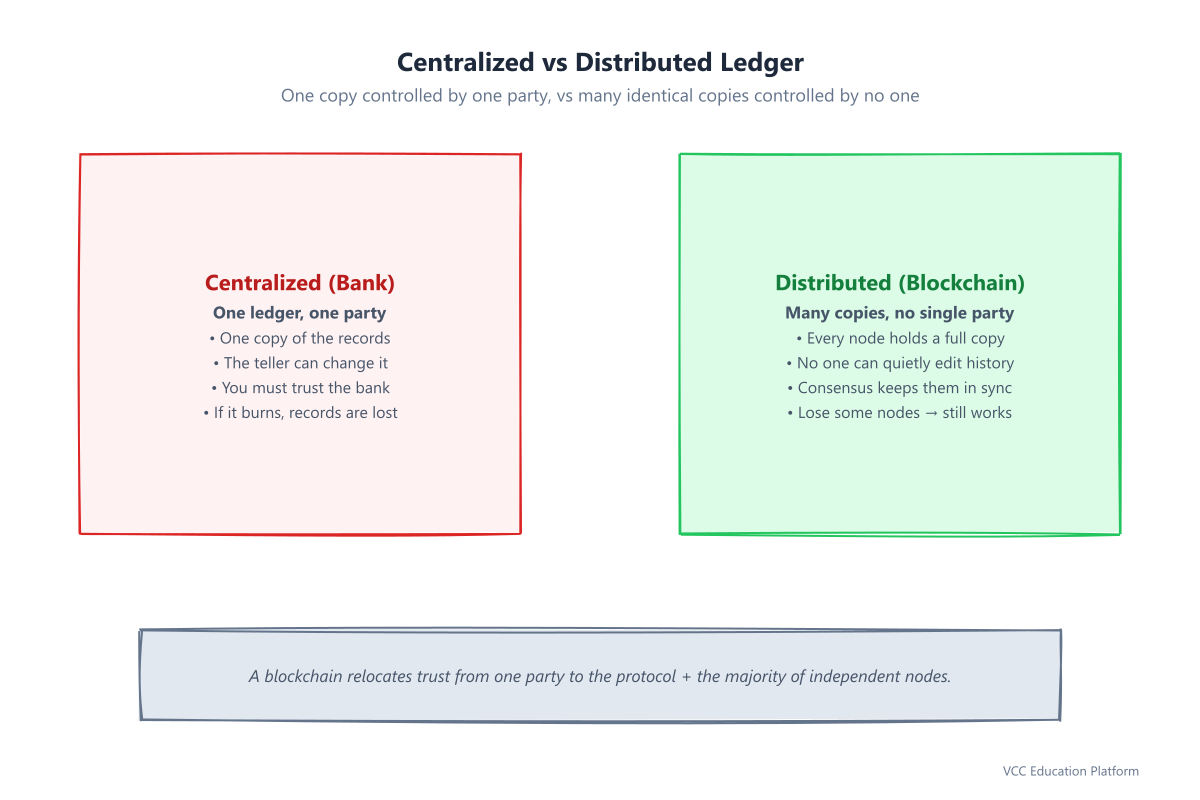
Figure 2: Centralized ledger (one party controls it) vs distributed ledger (many identical copies, no single party)
The Building Blocks: Blocks, Hashes, and the Chain
Now let's add the engineering words, one at a time.
A block is just a page in the notebook. It contains a batch of transactions (who sent what to whom), plus a little header of metadata. When a page fills up, the network seals it and starts a new one.
A hash is a fingerprint. You feed any data — a sentence, a file, a whole block — into a mathematical function, and it spits out a short, fixed-length string of characters that uniquely represents that data. Change even one letter in the input and the hash changes completely. Cardano and Bitcoin both use the SHA-256 family for this kind of fingerprinting.
The chain is the clever part. Each block's header contains the hash of the previous block. So Block 3's fingerprint is baked into Block 4, Block 4's fingerprint is baked into Block 5, and so on. This means the blocks are literally chained together by their fingerprints.
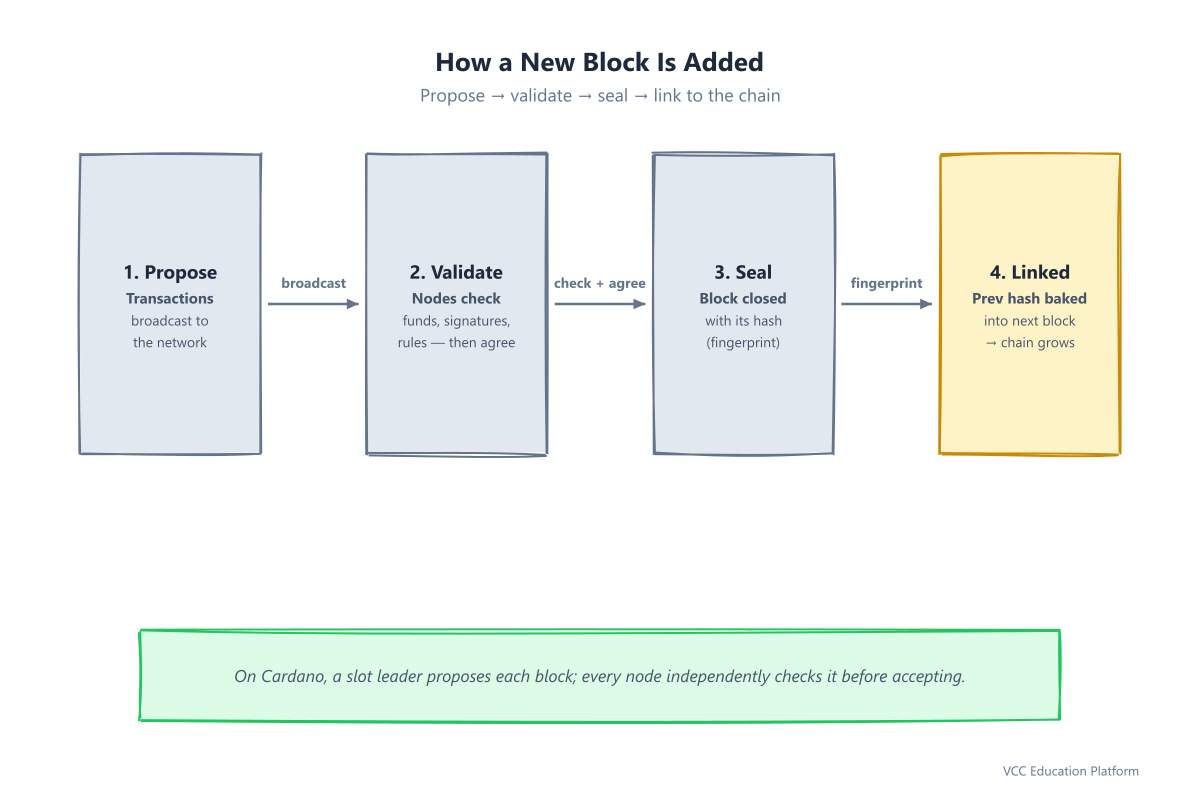
Figure 3: How a new block is added — propose, validate, seal, link to the chain
Why does this matter? Because if someone tries to alter an old block, that block's hash changes, which breaks the fingerprint stored in the next block, which breaks the one after that, and the one after that — the whole chain from that point onward unravels. To tamper undetected, an attacker would have to re-do the work of every block since the one they changed, and do it faster than the rest of the network is producing new blocks. On a network with thousands of independent participants, that is computationally impractical. Notice the careful wording: not "impossible," but "impractical." Honest explainers use the precise word.
Nodes and Consensus: How the Copies Stay Identical
So far we have a notebook with pages chained by fingerprints. But who actually holds these notebooks? Nodes. A node is simply a computer running blockchain software that holds a copy of the ledger and talks to other nodes over the internet. Anyone with a normal computer and an internet connection can run a Cardano node — there is no license and no permission required.
But if hundreds of computers each hold a copy, how do they all agree on what the next page should be? That is the job of consensus — the rule the network uses to agree on the next valid block. Different blockchains use different rules:
- Bitcoin uses Proof of Work: computers race to solve a math puzzle, and the winner seals the next block.
- Cardano uses Ouroboros Proof of Stake: the software randomly picks a "slot leader" for each short time window, weighted by how much ADA that operator has staked as a guarantee of good behavior. No energy-guzzling puzzle race.
The key point for a beginner: consensus is just the voting rule that keeps all the notebooks in sync. You do not need to understand the cryptography of Ouroboros to grasp blockchain any more than you need to understand engine thermodynamics to drive a car. (We go deep on Ouroboros in a companion article.)
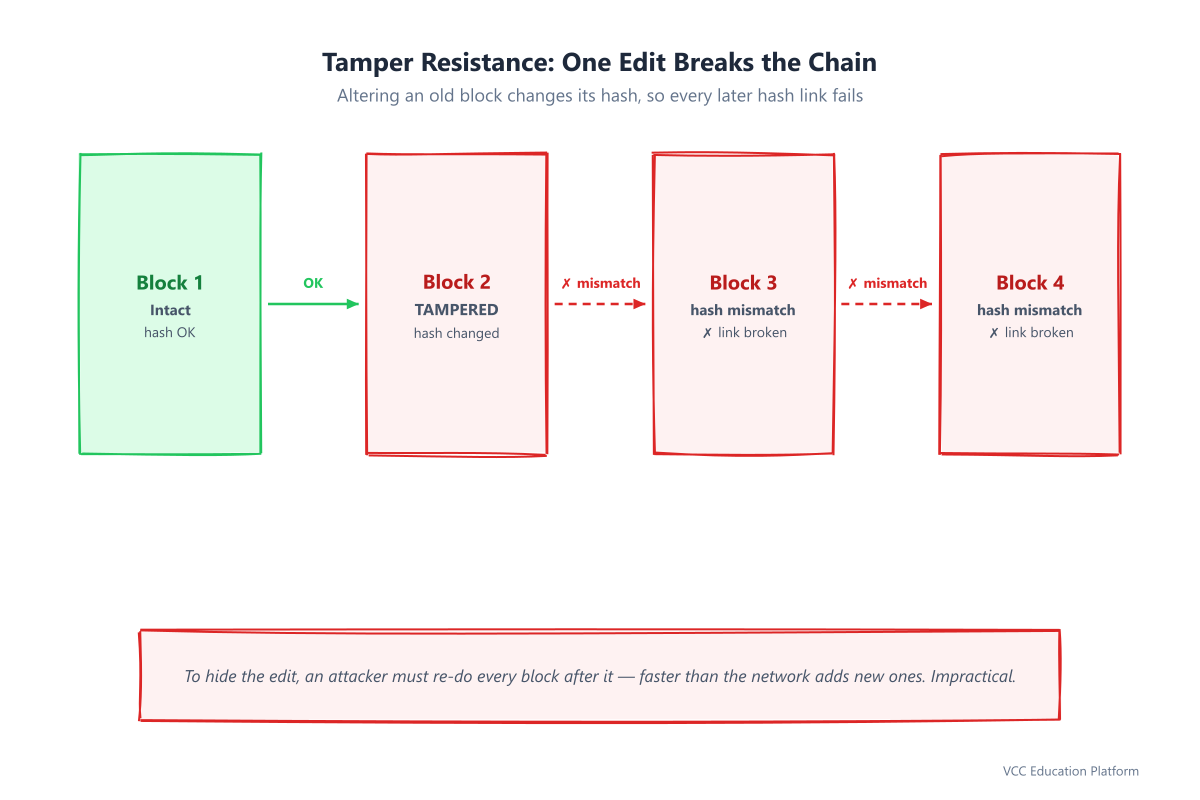
Figure 4: Tamper resistance — altering one block breaks every following hash link
Public vs Private Blockchains: Where Cardano Sits
Not every blockchain is open to everyone. There are two broad families, and confusing them is one of the most common beginner mistakes:
- Public (permissionless) blockchains — like Cardano and Bitcoin — let anyone read the ledger, send transactions, and run a node. No one can be kicked out, because there is no membership list. This is the category where "no single party controls it" is actually true.
- Private (permissioned) blockchains — used by some banks and consortia — restrict who can read, write, and validate. They are really shared databases with audit logs, and they usually have no native cryptocurrency.
Cardano is a public, permissionless blockchain. That distinction matters: it is the reason "decentralization" is a real property on Cardano and a marketing word on many enterprise ledgers. When a Vietnamese reader asks "ai kiểm soát?" (who controls it?), the honest answer for a public blockchain is: no single party — the protocol and the majority of independent node operators do. On a private chain, the honest answer is usually "the consortium members do," which is a very different thing.
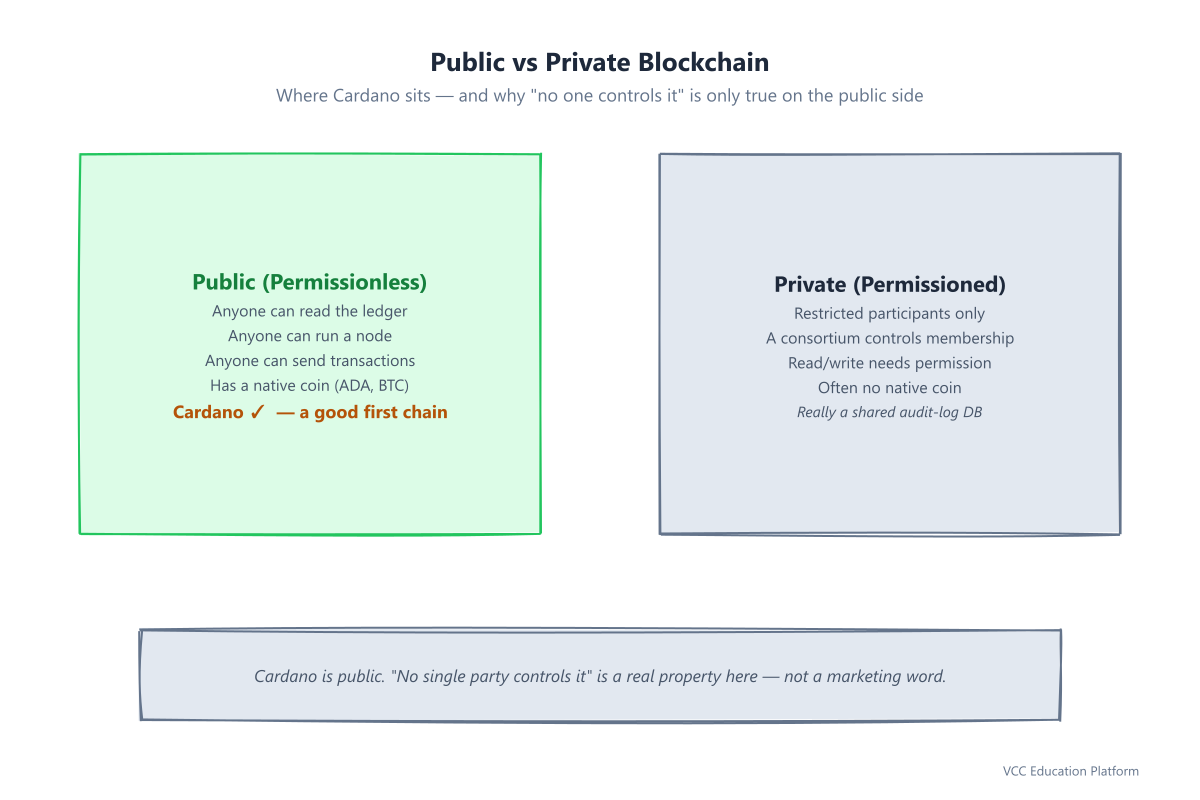
Figure 5: Public vs private blockchain — Cardano sits on the public, permissionless side
What a Blockchain Is NOT (The Honesty Section)
A good teacher spends as much time on what something is not as on what it is. Here are the three most common beginner misconceptions, corrected:
- "Blockchain is unhackable." No. Tampering with a well-secured public chain is computationally impractical, not mathematically impossible. If an attacker controlled a supermajority of the network's stake or hash power, they could rewrite recent history. The security comes from making that economically and technically absurd, not from a law of physics.
- "Blockchain and crypto are the same thing." No. Blockchain is the technology — the shared notebook. A cryptocurrency like ADA or Bitcoin is an asset that runs on top of a blockchain. You can have a blockchain without a cryptocurrency (private chains do), and you can understand the technology without owning any coin.
- "Blockchain is a better database for everything." No. A regular database is far faster and cheaper for almost any storage task, because it does not force every node to validate every transaction. A blockchain is deliberately inefficient as a database — that inefficiency is the price you pay for the trust property: no single party can quietly change the records. Use a blockchain when you need that trust property; use a normal database when you do not.
Why Cardano Is a Good "First Blockchain" to Learn
If you are starting from zero, Cardano is a gentle on-ramp for three practical reasons:
- Low, predictable fees. A typical transaction costs around 1 ADA (a fraction of a US dollar), and the fee does not spike the way Bitcoin or Ethereum fees can during congestion. You can experiment without fear of a $30 fee for a $5 transfer.
- Proof of Stake, no mining baggage. Because Cardano does not require energy-guzzling mining hardware, the mental model is simpler: you hold ADA, you can delegate it to a stake pool, you earn rewards. No "rigs," no "hash rate," no electricity bills to wrap your head around first.
- Peer-reviewed design. Cardano's core protocols are published as academic papers and reviewed before they ship. For a beginner, that means the explanations tend to be documented and consistent — you can look up the original paper rather than rely on a tweet.
None of this means Cardano is "the best blockchain" — that is a separate debate for a separate article. It means Cardano is a good teaching example: the concepts transfer cleanly to other chains, and the on-ramp is low-friction.
The One-Sentence Takeaway
If you remember nothing else from this article, remember this: a blockchain is a shared, append-only notebook that many computers keep identical copies of, so that no single party can secretly rewrite the past. Blocks are the pages, hashes are the fingerprints that chain the pages, nodes are the computers holding the copies, and consensus is the voting rule that keeps them in sync. Everything else — ADA, staking, smart contracts, governance — is built on top of that foundation, and each gets its own article in this series.
The most useful skill you will develop as you learn more is the honesty test: when someone pitches "putting X on the blockchain," ask yourself whether X actually needs the trust property (no single party can change the records) or whether a regular database would do the job better. Nine times out of ten, a regular database is the right answer — and knowing that is what separates someone who understands blockchain from someone who just repeats the word.
Quick Reference
| Term | Definition |
|---|---|
| Blockchain | A shared, append-only ledger replicated across many nodes, with blocks chained by hashes |
| Block | A batch of transactions plus a header; one "page" of the ledger |
| Hash | A short fingerprint of data; changing the data changes the hash completely |
| Node | A computer running blockchain software, holding a copy of the ledger |
| Consensus | The rule the network uses to agree on the next valid block |
| Proof of Stake | Consensus where validators are chosen by staked collateral (Cardano's Ouroboros) |
| Proof of Work | Consensus where computers race to solve a puzzle (Bitcoin) |
| Public blockchain | Anyone can read, transact, and run a node (Cardano, Bitcoin) |
| Private blockchain | Restricted participants; often no native coin |
| Tamper resistance | Changing one block breaks all following hashes, making secret edits impractical |