
cardano wallet features go far beyond sending and receiving ADA. If you've mastered the basics — delegating to a stake pool, checking your balance, maybe even minting an NFT — you're ready for the next level. This guide explores the advanced capabilities that transform your wallet from a simple payment tool into a complete Web3 command center.
Think of your wallet like a Vietnamese digital wallet app: Momo or ZaloPay. You started with basic transfers. Then you discovered "pockets" for budgeting, QR payments for merchants, transaction notes for tracking, and investment features. Cardano wallets have the same depth — but the features live under different names: HD accounts, dApp connectors, Catalyst voting, metadata viewers, and multi-signature setups.
---
The Hidden Layer: What "Advanced" Actually Means
Most users interact with 10% of their wallet's capability. The other 90% falls into three categories:
1. Architecture features — how keys, accounts, and addresses are structured (CIP-1852) 2. Integration features — how your wallet talks to dApps, hardware, and governance (CIP-30, Catalyst) 3. Visibility features — what you can see and verify (metadata, NFT galleries, raw transactions)
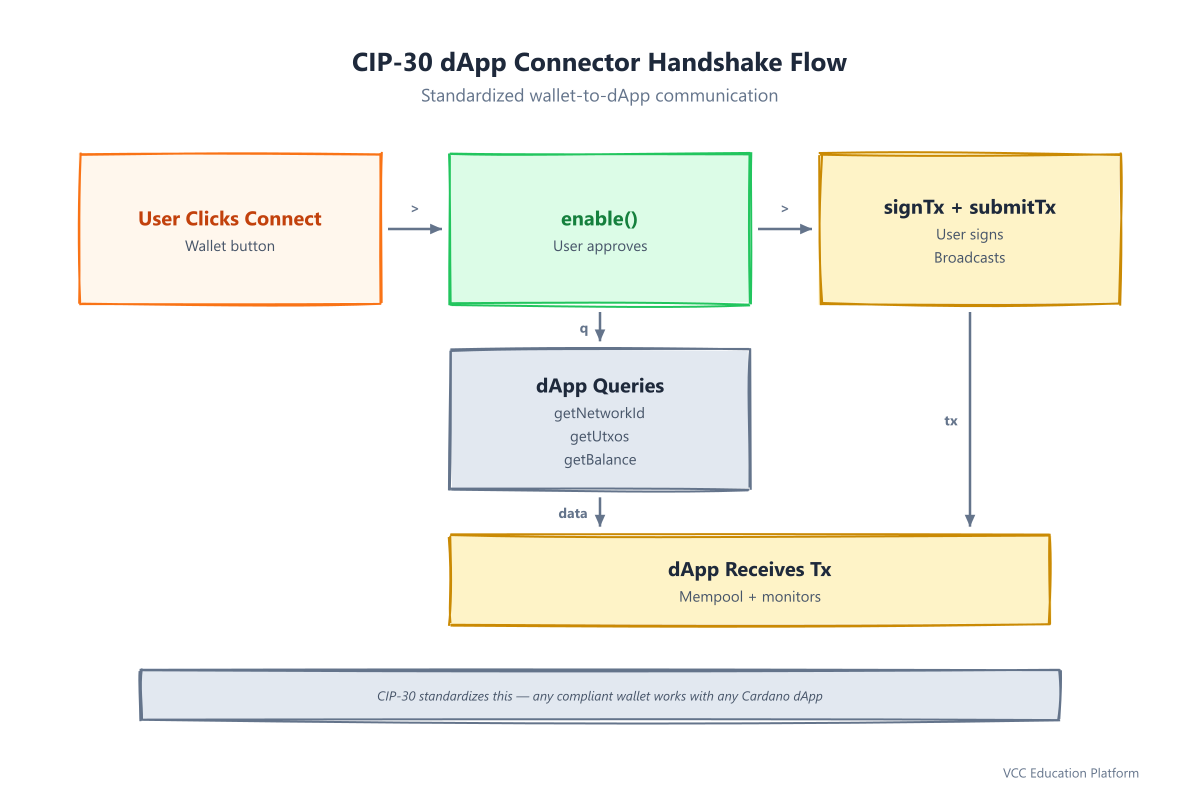
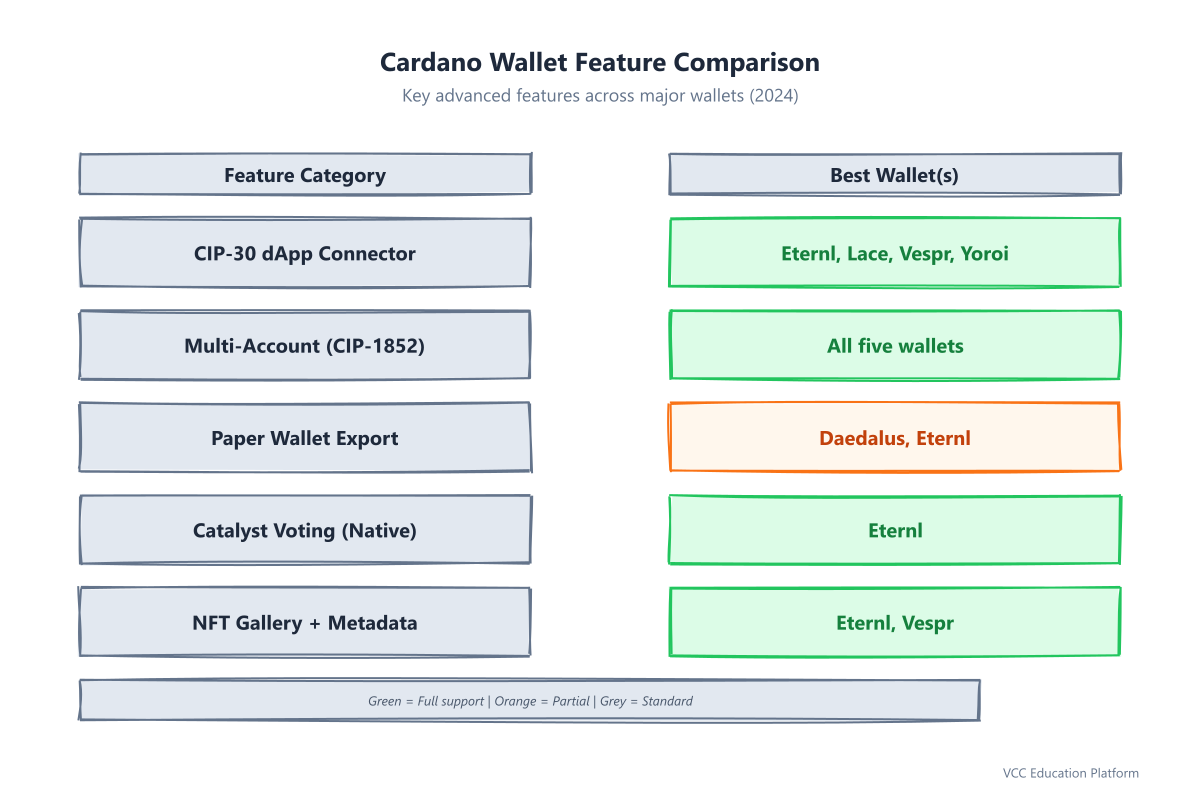
The CIP-30 standard is the bridge between categories 1 and 2. It defines a universal API so any compliant wallet (Eternl, Lace, Vespr, Yoroi, Flint, Typhon, Nami) can connect to any Cardano dApp. Daedalus supports it via a browser extension bridge. When you click "Connect Wallet" on a DEX or NFT marketplace, you're invoking CIP-30 methods: `enable()`, `getUtxos()`, `signTx()`, `submitTx()`.
Key insight: CIP-30 means wallet choice no longer locks you out of dApps. The differentiation shifts to native integrations (Catalyst voting in-app vs. external portal) and advanced views (metadata, NFT gallery richness).
---
Multi-Account Mastery: One Seed, Many Identities
The CIP-1852 Standard
Every modern Cardano wallet uses CIP-1852 (based on BIP-44) for hierarchical deterministic (HD) key derivation. The path looks like this:
``` m / 1852' / 1815' / account' / role / index ```
- `1852'` = Cardano purpose (hardened)
- `1815'` = Cardano coin type (hardened, ADA = 1815)
- `account'` = your account number (0, 1, 2...)
- `role` = 0 (external/receiving) or 1 (internal/change)
- `index` = address index within that role
- UTxO set (no accidental spending from HODL stash)
- Stake delegation (delegate Account 0 to Pool A, Account 1 to Pool B)
- Transaction history
- dApp connections
- Gifting ADA to non-technical recipients
- Air-gapped signing for maximum security
- Estate planning / inheritance scenarios
- Fire / water damage
- Loss / theft
- Ink fading (use laser printer, archival paper)
- Single point of failure (no multi-sig)
- Minimum 500 ADA (deposited as voting power collateral)
- Snapshot taken at registration deadline
- Registration transaction fee ~0.17 ADA
- CIP-68 metadata rendering (traits, properties, dynamic fields)
- Collection verification badges (verified policy IDs)
- Floor price / market data integration
- Transfer / list / burn actions inline
- Cross-chain bridge status (for bridged NFTs)
- Rarity ranking within collection
- NFT minting (CIP-25/68 metadata)
- dApp interactions (contract datum, redeemer)
- Messaging / notarization
- Catalyst registration / voting
- Custom application data
- `all` — every signer must sign
- `any` — any one signer can sign
- `atLeast(N)` — N of M signers required
- Business ops: 3-of-5 (founders + advisors) for company treasury
- DAO treasury: Match Catalyst proposal multi-sig requirements
- Inheritance planning: Time-locked scripts via Plutus (advanced)
- DeFi user → dApp connector (CIP-30), metadata viewer, multi-account for risk isolation
- NFT collector → Advanced NFT gallery (Eternl/Vespr), metadata verification
- Governance participant → Native Catalyst voting (Eternl), multi-account for voting power management
- Family/Business → Multi-sig (Eternl experimental), clear account naming, shared recovery plan
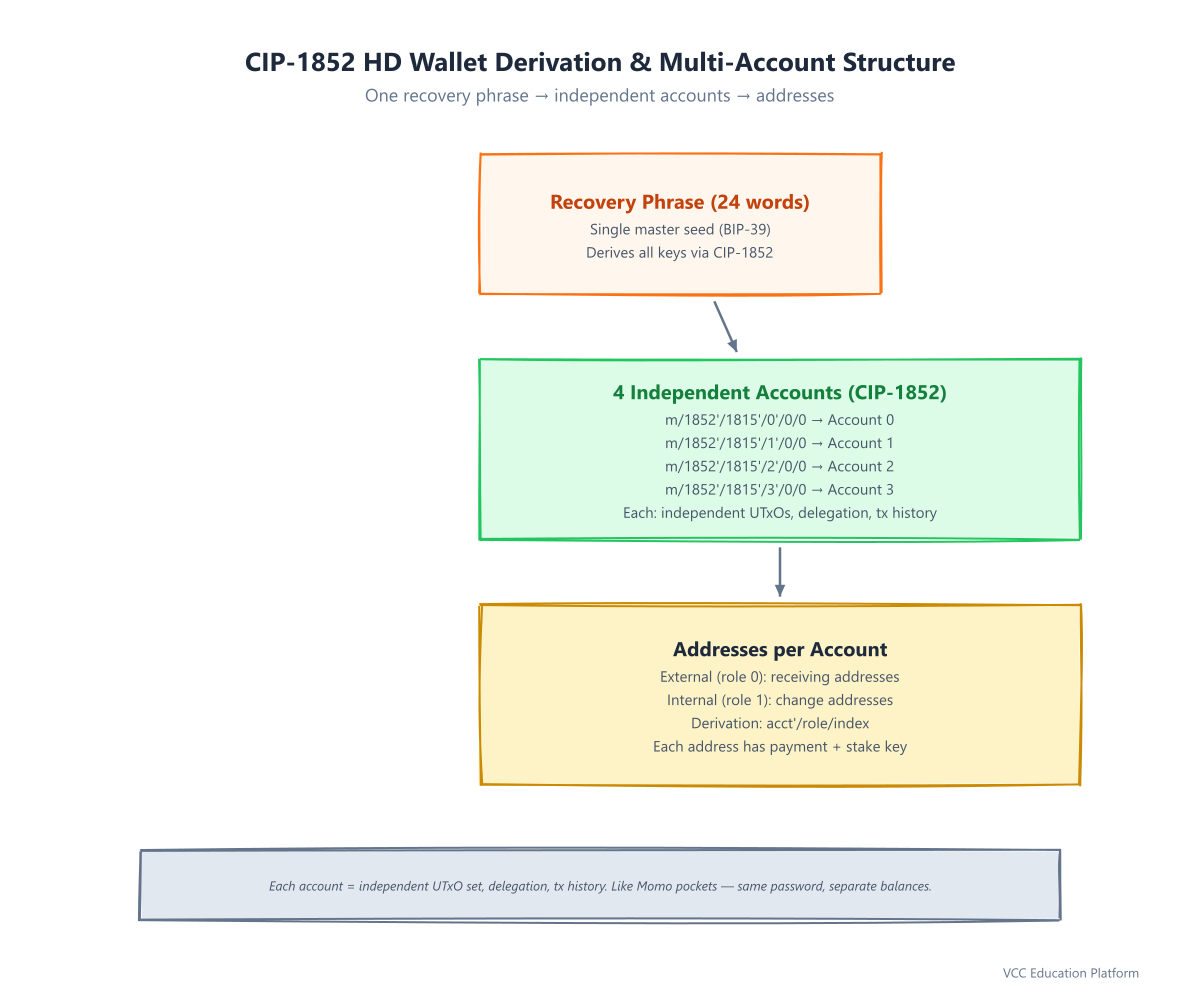
Why Multiple Accounts Matter
Account 0 — Main spending, daily delegation Account 1 — Long-term HODL, separate delegation Account 2 — Trading / DeFi experimentation Account 3 — Family / shared custody (with multi-sig)
Each account has independent:
Vietnamese analogy: Each CIP-1852 account = một "pocket" trong Momo. Cùng một mật khẩu khôi phục (recovery phrase), nhưng số dư, lịch sử giao dịch, và liên kết ngân hàng tách biệt hoàn toàn.
Wallet Comparison: Multi-Account UX
| Wallet | Max Accounts | Switching UX | Account Naming | Delegation Per Account | |--------|-------------|--------------|----------------|------------------------| | Daedalus | Unlimited | Sidebar dropdown | Custom labels | Full | | Yoroi | 5 (extension) / 3 (mobile) | Top bar | Default "Account 1, 2..." | Full | | Eternl | Unlimited | Sidebar + keyboard shortcut | Custom labels + emoji | Full | | Lace | Unlimited | Top-right avatar | Custom labels | Full | | Vespr | Unlimited | Bottom nav | Custom labels | Full |
Pro tip: Name accounts by purpose, not number: "HODL Vault," "DeFi Lab," "Family Fund." Future you will thank present you.
---
Cold Storage & Paper Wallets: The Offline Option
When to Use Paper Wallets
- Long-term storage (>1 year) without hardware wallet
Wallet Support
| Wallet | Paper Wallet Export | Import / Sweep | |--------|---------------------|----------------| | Daedalus | ✅ Full (encrypted PDF) | ✅ Via CLI | | Eternl | ✅ Encrypted export | ✅ QR scan | | Yoroi | ❌ | ❌ | | Lace | ❌ | ❌ | | Vespr | ❌ | ❌ |
The Security Tradeoff
Paper wallets eliminate digital attack surface but introduce physical risks:
Best practice: If you use paper wallets, create multiple copies stored in geographically separate locations. Consider a multi-sig setup instead (see below) — it achieves similar security with better recoverability.
---
Catalyst Voting: Governance From Your Wallet
Project Catalyst is Cardano's on-chain treasury voting system. Every fund cycle, ADA holders vote on which projects receive funding. Your voting power = your stake snapshot at registration time.
Registration Requirements
Wallet Workflows Compared
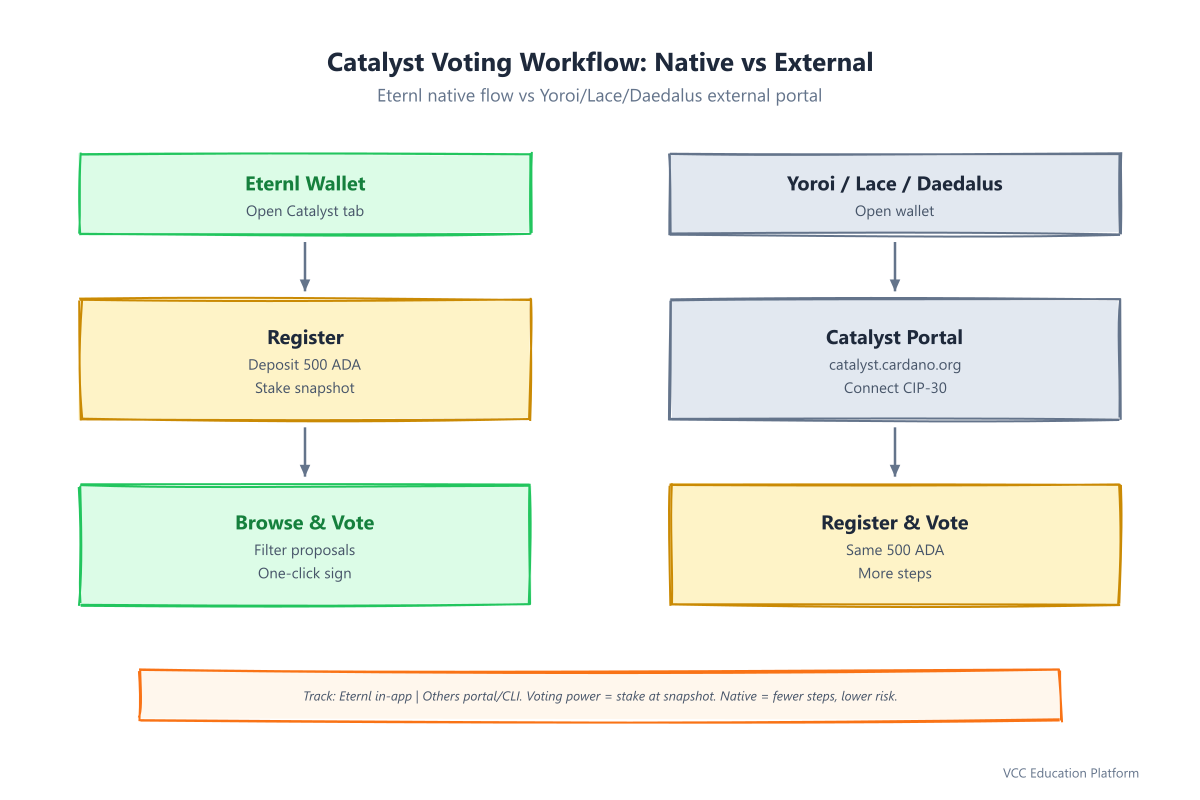
| Wallet | Registration | Voting | Results Viewing | |--------|--------------|--------|-----------------| | Eternl | In-app wizard | In-app (one-click) | In-app dashboard | | Lace | Via dApp connector | Via dApp connector | Via dApp | | Yoroi | Web portal | Web portal | Web portal | | Daedalus | CLI / external tool | CLI / external tool | CLI / explorer | | Vespr | Planned | Planned | Planned |
Eternl's Native Advantage
Eternl built Catalyst voting natively — no external browser, no dApp connector handshake. You register, browse proposals, vote, and track results without leaving the wallet. For Vietnamese users familiar with ZaloPay's in-app voting for community features, this feels natural.
Critical nuance: Voting power is stake-weighted, not wallet-weighted. If you split 10,000 ADA across 5 accounts delegated to different pools, your total voting power = 10,000 ADA. But you must register each account separately if you want to vote from all of them.
---
NFT Galleries: Beyond the Collectible
What Makes a Gallery "Advanced"?
Basic galleries show: image, name, policy ID, asset name. Advanced galleries add:
Wallet Comparison
| Wallet | Gallery Depth | CIP-68 Support | Market Data | Actions | |--------|---------------|----------------|-------------|---------| | Daedalus | Basic (list only) | ❌ | ❌ | Send only | | Yoroi | Basic + image | Partial | ❌ | Send only | | Eternl | Full (traits, rarity, collection) | ✅ | ✅ (via API) | Send, list, burn | | Lace | Good (traits, collection) | ✅ | Partial | Send, list | | Vespr | Good (traits, collection) | ✅ | Partial | Send, list |
Why it matters: If you're active in Cardano NFTs (Clay Nation, SpaceBudz, Pavia land), Eternl's gallery saves you hours of cross-referencing explorers. You see traits, rarity, and can list on JPG Store directly.
---
Transaction Metadata Viewer: The Debugging Superpower
What Is Transaction Metadata?
Every Cardano transaction can carry metadata (key-value pairs) in auxiliary data. Used for:
Why View It?
1. Verify dApp actions — Did the DEX actually submit the swap you signed? 2. Audit NFT mints — Confirm policy ID, metadata integrity 3. Debug failed transactions — See what datum/redeemer was attached 4. Learn Cardano internals — Raw CBOR teaches you how scripts work
Wallet Support
| Wallet | Metadata View | Raw CBOR | Search/Filter | |--------|---------------|----------|---------------| | Daedalus | CLI only | CLI only | ❌ | | Yoroi | ❌ | ❌ | ❌ | | Eternl | ✅ Full (decoded + raw) | ✅ | ✅ By key | | Lace | Partial (decoded) | ❌ | ❌ | | Vespr | ✅ Full (decoded + raw) | ✅ | ✅ By key |
Eternl and Vespr lead here. Click any transaction → "View Metadata" → see decoded JSON + raw CBOR hex. Filter by metadata key (e.g., "674" for NFT metadata, "1780" for Catalyst).
---
Hardware Wallet Integration: The Security Baseline
All five major wallets support Ledger and Trezor. But feature parity varies:
| Feature | Daedalus | Yoroi | Eternl | Lace | Vespr | |---------|----------|-------|--------|------|-------| | Basic sign | ✅ | ✅ | ✅ | ✅ | ✅ | | Multi-account | ✅ | ✅ | ✅ | ✅ | ✅ | | Catalyst voting | ❌ (CLI only) | ❌ | ✅ Native | Via dApp | Planned | | NFT gallery | ✅ | ✅ | ✅ | ✅ | ✅ | | Metadata view | ❌ | ❌ | ✅ | ❌ | ✅ | | Multi-sig | CLI only | ❌ | Experimental | ❌ | Planned |
Key limitation: Hardware wallets sign what the host wallet presents. If the wallet UI has a bug or shows misleading info, the hardware device signs it blindly. Always verify the on-device display matches your intent.
---
Multi-Signature Wallets: Shared Custody
CIP-1854: Native Scripts for Multi-Sig
Cardano supports multi-sig via native scripts (no Plutus smart contract needed). Policies:
Current Wallet State (2024)
| Wallet | Multi-Sig Status | Notes | |--------|------------------|-------| | Daedalus | CLI only | Full control, steep learning curve | | Eternl | Experimental UI | Create 2-of-3, 3-of-5, sign coordination | | Vespr | Planned | Roadmap Q1 2025 | | Lace | Not announced | — | | Yoroi | Not supported | — |
Use Cases for Vietnamese Users
- Family treasury: 2-of-3 (parents + adult child) for household funds
Reality check: Multi-sig UX is still early. For most users, hardware wallet + single seed + clear instructions for heirs is more practical than coordinating multiple signers.
---
Feature Decision Matrix: Which Wallet for You?
| Priority | Recommended Wallet | Why | |----------|-------------------|-----| | Maximum sovereignty (full node, self-validation) | Daedalus | Only full-node wallet; validates entire chain | | Mobile-first convenience | Vespr / Yoroi Mobile | Best mobile UX, dApp connector, metadata | | Feature completeness (all-in-one) | Eternl | Native Catalyst, best metadata, best NFT gallery, multi-account, paper wallet | | IOG-backed / future-proof | Lace | IOG development, clean UX, growing feature set | | Hardware wallet + advanced features | Eternl / Lace | Best hardware + feature combo | | Beginner graduating to intermediate | Yoroi → Eternl migration | Familiar UX, then unlock advanced features |
Migration path: Start with Yoroi (familiar, mobile-friendly). When you need Catalyst voting, metadata viewing, or advanced NFT management → add Eternl as a second wallet using the same recovery phrase (CIP-1852 accounts sync automatically).
---
Security Checklist: Advanced Features, Advanced Responsibility
| Feature | Risk | Mitigation | |---------|------|------------| | dApp connector permissions | Malicious dApp requests excessive access | Review each `enable()` prompt; revoke unused connections in wallet settings | | Multi-account | Forgetting accounts exist; sending from wrong account | Name accounts clearly; verify account selector before signing | | Paper wallet | Physical loss/damage; single point of failure | Multiple copies, geographically separate; consider multi-sig instead | | Catalyst voting | Phishing sites mimicking registration | Only register via official wallet UI; verify URL | | Metadata viewing | None (read-only) | N/A — but don't share raw CBOR with untrusted parties | | Hardware wallet | Supply chain attacks; firmware bugs | Buy direct from manufacturer; update firmware regularly | | Multi-sig | Coordinator loss; script complexity | Test with small amounts first; document recovery procedure |
---
FAQ: Advanced Wallet Features
Q: Can I use multiple wallets simultaneously with the same seed phrase?
A: Yes. CIP-1852 ensures account derivation is deterministic. Import your 24-word phrase into Daedalus, Yoroi, Eternl, Lace, and Vespr — all will show the same accounts, balances, and delegation. Warning: Each wallet is a separate attack surface. Only keep active wallets you actually use.Q: Does multi-account mean multiple recovery phrases?
A: No. One 24-word recovery phrase derives all accounts via CIP-1852. The accounts are mathematically linked. If you compromise the seed, you compromise all accounts. For true isolation, use separate hardware wallets with separate seeds.Q: Which wallet has the best Catalyst voting experience?
A: Eternl — native in-app registration, voting, and results tracking. Lace and Yoroi require external dApp/portal. Daedalus requires CLI.Q: Can I view transaction metadata on mobile?
A: Eternl mobile and Vespr support full metadata viewing on mobile. Yoroi mobile does not. Daedalus has no mobile app.Q: Is multi-sig ready for production use?
A: Eternl's experimental UI works for basic 2-of-3, 3-of-5 setups. Test thoroughly with small amounts. For significant funds, consider Plutus-based multisig (more audited) or a custody provider.Q: How do I export a paper wallet from Eternl?
A: Settings → Security → Export Paper Wallet. Creates an encrypted PDF with QR codes for address and private key. Set a strong password. Print on archival paper, store securely.Q: What's the difference between "metadata" and "datum"?
A: Metadata = arbitrary key-value data attached to a transaction (auxiliary data). Datum = data attached to a UTxO at a script address, consumed by Plutus validators. Both appear in Eternl/Vespr metadata viewer.Q: Can I delegate different accounts to different stake pools?
A: Yes. Each CIP-1852 account has independent delegation. In Eternl: Accounts → Select Account → Delegate → Choose Pool. Great for diversification or testing pool performance.---
Summary: Your Wallet, Your Rules
cardano wallet features form a spectrum. You don't need all of them — you need the right ones for your use case:
- HODLer → Multi-account (HODL vs spending), hardware wallet, paper wallet backup
The beauty of Cardano's standards (CIP-1852, CIP-30, CIP-1854) is interoperability. Your keys, accounts, and delegation work across wallets. Choose the interface that matches your workflow today — switch tomorrow without friction.
Start with one advanced feature this week. Enable multi-account in your current wallet. Connect to a dApp via CIP-30. View a transaction's metadata. Each step builds competence. Before long, you'll operate your wallet like the Web3 command center it was designed to be.
---
Next steps: Explore the [Cardano dApp ecosystem](https://cardano.org/ecosystem/dapps/) with your CIP-30 wallet, or dive into [Catalyst voting](https://projectcatalyst.io/) to shape the protocol's future.