
When Linh, a teacher in Da Nang, delegated her first 10,000 ADA to a stake pool two years ago, she treated it like a savings account: set it, forget it, check the balance monthly. Then a Telegram group she follows started posting screenshots of pool rankings, and suddenly everyone had an opinion. Split your stake! Chase the highest pledge! Switch to whichever pool topped last epoch's chart! She tried three different approaches in four months and earned less than if she had done nothing at all.
Her story is the norm, not the exception. Advanced Cardano staking is not about finding secret tricks — it is about understanding which variables actually move your rewards, which ones only look like they do, and how the protocol's own design quietly equalizes most of what people chase. This article walks through a complete staking strategy Cardano holders can actually act on: how the reward pipeline really works, what to optimize, why the famous multi pool strategy cardano advice is mostly myth, and the timing tricks that let you switch pools without losing a single payout.
The Reward Pipeline: Where Your Rewards Actually Come From
Before optimizing anything, you need to see the machine. Cardano runs on Ouroboros, where each 5-day epoch opens with a snapshot of all delegated stake. That snapshot decides who can produce blocks roughly one epoch later, and the rewards from those blocks are computed after that and paid about three epochs after the original snapshot — a pipeline of roughly 15 to 20 days from delegation to first payout.
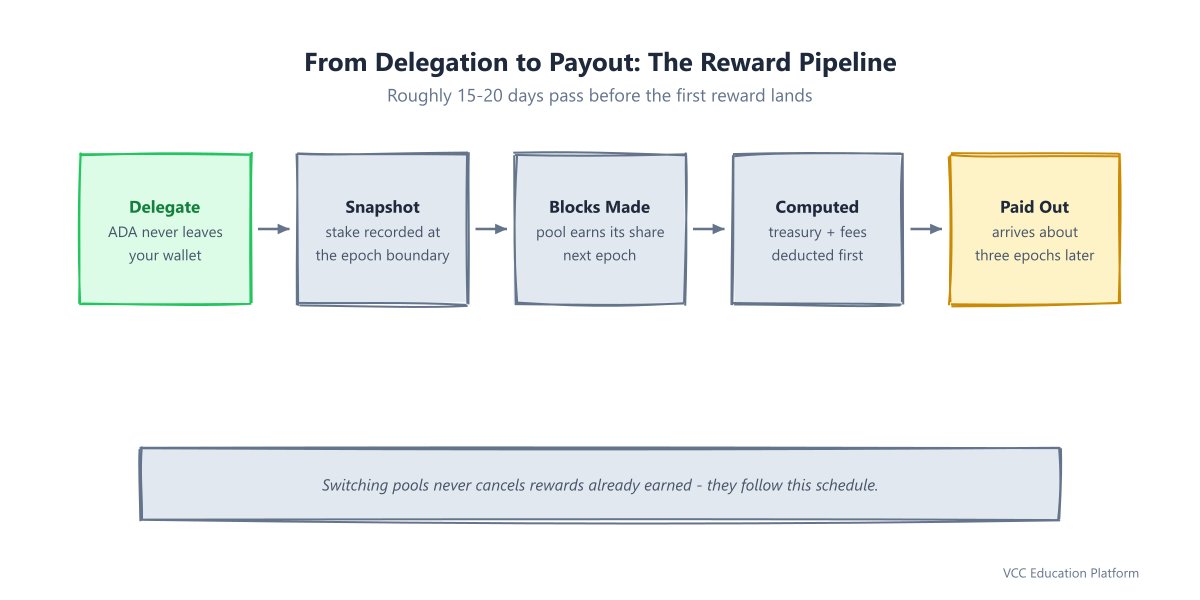
Three things flow out of every block reward before it reaches you:
- The treasury cut (~20% of each epoch's total reward pot funds future development).
- The pool's fixed cost — currently 340 ADA per producing epoch, taken off the top.
- The operator margin — a percentage of whatever remains.
Only then does the rest split proportionally among delegators by stake share. Every optimization decision downstream depends on understanding this order of operations, because the biggest deductions happen before percentage fees ever enter the picture.
Staking Strategy Fundamentals: Saturation, Pledge, and Fees
Why saturation is the only structural disadvantage
Cardano targets k = 500 saturated pools. A pool hits saturation at roughly 64 million ADA; past that point its block production stops growing while its delegator count keeps rising, so the same rewards divide among more stake and yield drops. This single mechanism explains almost everything about pool selection: an unsaturated, reliably performing pool pays nearly the same per ADA as any other unsaturated pool, regardless of size, age, or branding. When you browse adapools and see healthy non-saturated pools clustered around 3% annualized return on staking (ROS), you are watching this equilibrium in action.
So the first rule of any serious staking strategy cardano guide should state plainly: avoid saturated pools, ignore everything else cosmetic. A pool at 105% saturation is mathematically guaranteed to underperform a pool at 60%, no matter how good its luck looks.
Pledge is an operator signal, not your bonus
The protocol parameter a0 = 0.3 makes pledged stake boost a pool's rewards — but here is the detail most summaries skip: that boost accrues to the operator's own pledged coins, and it barely activates until a pool holds a large relative pledge at meaningful saturation. Forum-level analysis of the reward curves shows the effect is negligible for typical public pools below ~20% saturation. As a delegator with 10,000 or 100,000 ADA, treat high pledge as evidence the operator has skin in the game and something real to lose if they misbehave — a useful trust signal, but not a reason to expect fatter rewards yourself.
The fixed fee distortion nobody normalizes
Here is arithmetic you will not find in most guides. Take two pools in one epoch:
| Pool | Epoch rewards | Fixed fee | Margin | Operator take | Effective take |
|---|---|---|---|---|---|
| Small (half-saturated), 2% margin | 850 ADA | 340 ADA | ~10 ADA | 350 ADA | ~41% |
| Large (saturated edge), 5% margin | 3,400 ADA | 340 ADA | ~153 ADA | 493 ADA | ~15% |
The "cheap" 2% pool hands its operator a bigger slice than the "expensive" 5% pool, because the flat 340 ADA dominates small pools. Comparing margins between pools of different sizes without normalizing the fixed cost is comparing apples to invoices. This is the first genuinely advanced insight: effective operator take, not advertised margin, tells you what a pool really costs.
Optimize Staking Rewards: What Actually Moves the Needle
Strip away the noise and only four factors meaningfully change your per-ADA returns. Rank them like a ladder — climb down only as each rung ties:
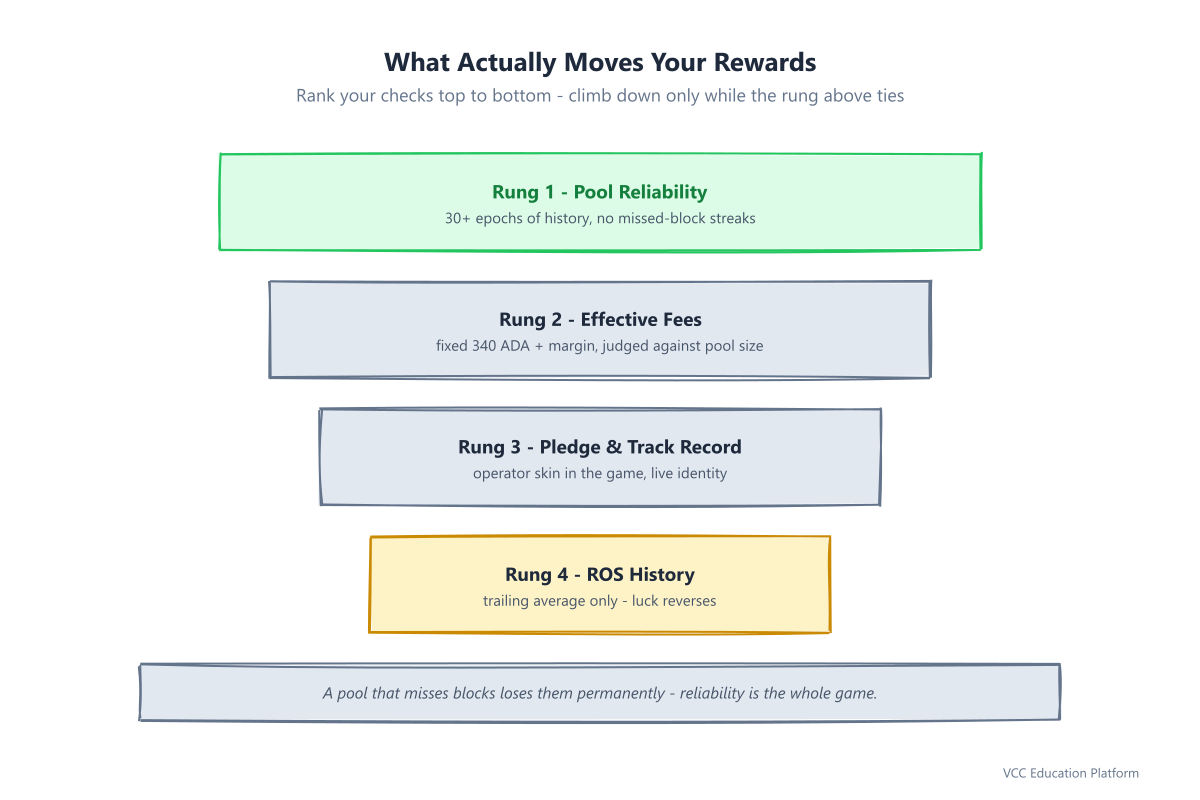
Rung 1 — Reliability beats everything. A pool that misses blocks due to poor infrastructure loses those blocks permanently; there is no compensation. Check at least 30 epochs of history on adapools or pooltool, not last epoch's leaderboard. Single-epoch ROS rankings are lottery tickets; a month of consistent block production is a business record.
Rung 2 — Effective fees, normalized. Compute (fixed cost + expected margin) as a share of realistic epoch rewards for the pool's actual size, as shown in the table above. Prefer honest operators who charge sustainable rates over loss-leader 0% margin pools that vanish within a year — migrating costs you more than the discount saved.
Rung 3 — Pledge and operator track record as trust signals. Meaningful pledge plus a live website, transparent identity, and responsive communication correlate with longevity. In Vietnamese community groups, "pool uy tín" lists circulate constantly, but many are referral-driven marketing. Verify directly on adapools before trusting anyone's screenshot.
Rung 4 — ROS history, averaged. Use trailing averages over many epochs as a sanity check, never as the selection criterion itself. If two unsaturated pools differ by 0.2% ROS, the difference is mostly VRF luck and will reverse.
A quick reality check on effort versus payoff: at ~3% annualized, 10,000 ADA earns about 300 ADA per year. Closing a 0.2% ROS gap saves you roughly 20 ADA annually — less than a month of mobile data in Vietnam. Optimize once, thoroughly, then stop tinkering. The biggest gains come from avoiding mistakes, not micro-chasing yields.
Multi Pool Strategy Cardano: Separating Myth From Math
The most repeated advice in staking threads — split your ADA across several pools to diversify — deserves scrutiny, because on Cardano it solves the wrong problem.
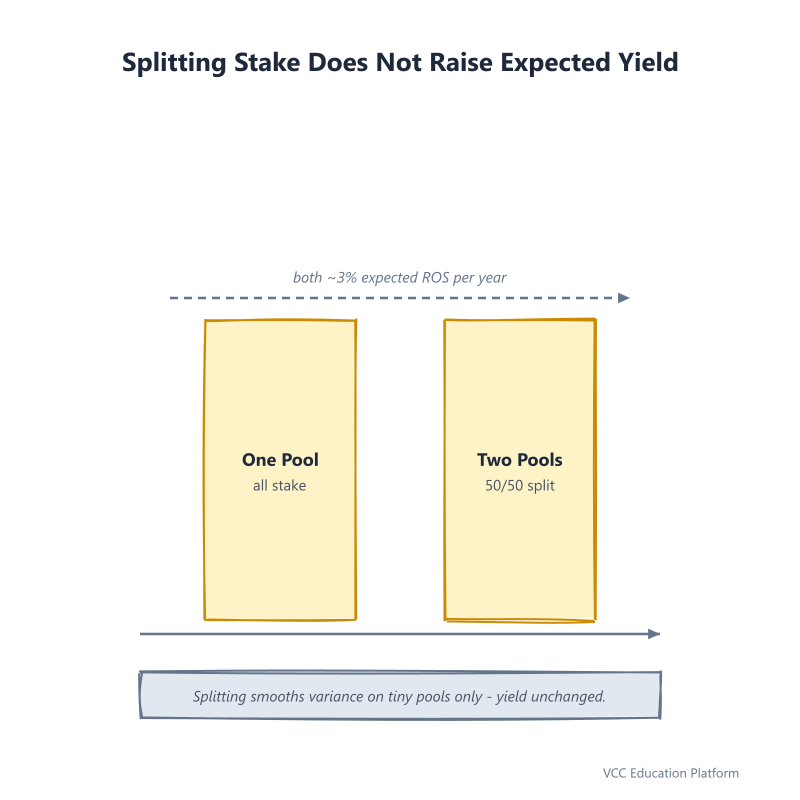
In proof-of-work mining, pooling strategy matters enormously because hardware concentrates. In Ouroboros, your delegated stake simply buys lottery tickets in whatever pool holds it, and the epoch reward pot divides by stake share across all non-saturated pools equally. Whether Linh stakes her full 10,000 ADA in one good unsaturated pool or splits it 5,000/5,000 across two equally good ones, her expected annualized return is statistically identical — both configurations draw from the same reward-sharing formula.
What splitting actually changes is variance smoothing. A tiny pool under ~1M total stake produces blocks so rarely that one lucky or unlucky epoch swings its short-term ROS wildly, so spreading stake across small pools dampens the bumps. But for a personal stake of 10k–100k ADA delegated to reasonably sized pools, the smoothing benefit rounds to statistical noise, and multi-spread adds real costs: more transactions, more snapshots to track, and diluted attention across pool health checks.
There is one legitimate variant worth knowing: some large operators run multipool brands — the same team operating several pools. CIP-0075 critics argue such brands exploit leverage and dilute decentralization, since splitting pledge across sibling pools weakens the skin-in-the-game signal. If you value ecosystem health alongside yield, prefer independent single pools with genuine pledges. Your wallet will not show the difference; the network will.
Verdict: treat multi pool strategy cardano content as a variance tool at most. Diversification here is not a yield strategy, and presenting it as one is the most common misconception among intermediate delegators.
Timing: Switching Pools Without Losing Rewards
Because rewards travel the snapshot-to-payment pipeline, switching pools never cancels rewards already earned — but careless timing stretches the gap between payouts to nearly a full cycle. The mechanics: your stake joins the next epoch-end snapshot; blocks produced against that snapshot pay out roughly three epochs later. If you switch mid-cycle, the old pool's final rewards still arrive on schedule, but your new position starts from the following snapshot.
Practical cardano staking tips for timing:
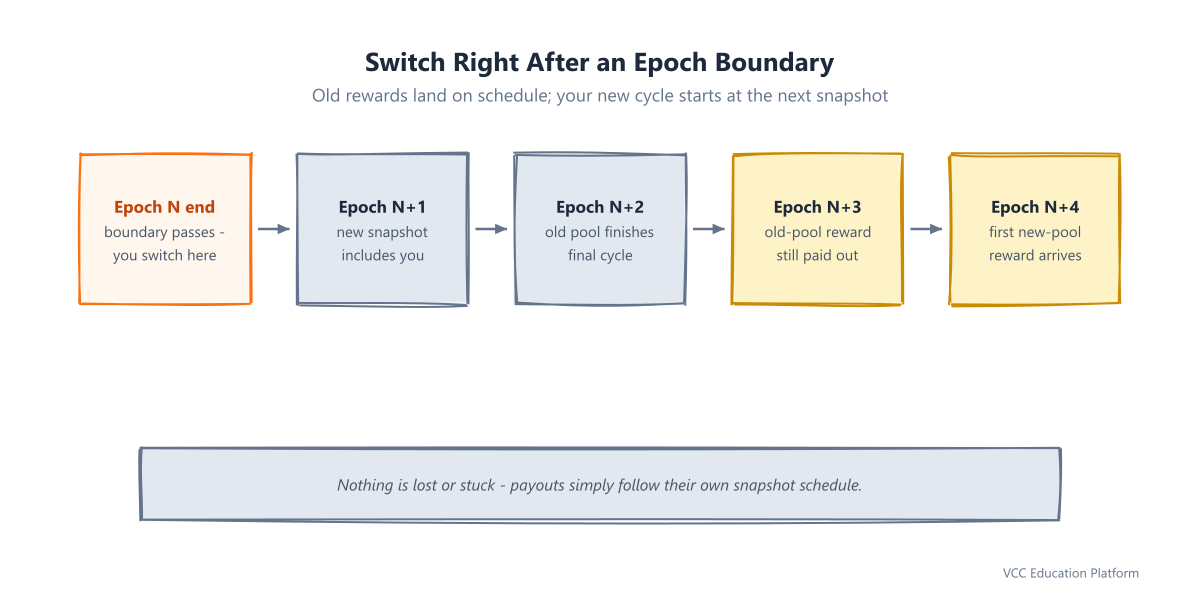
- Switch right after an epoch boundary passes. You lose at most a few days of snapshot freshness instead of waiting out a full 5-day epoch twice.
- Never judge a new pool by its first payout. Your first reward reflects the previous holder's cycle, not yours. Wait two full cycles before evaluating.
- Expect the 15–20 day silence after any delegation change and plan cash-flow expectations accordingly. Nothing is stuck; it is queued.
Risk Management: The Mistakes That Cost Real ADA
Every strategy section needs a red-flag list, because in staking the losses come from errors, not markets:
- Staking through exchanges when you hold self-custody options. Exchange delegation adds custodial risk to a system designed to eliminate it — your keys, your coins.
- Falling for "guaranteed high ROS" pools. Anything advertising double-digit stable returns contradicts the protocol math; the reward pot sets a hard ceiling near low single digits.
- Confusing delegation with lending. Your ADA never leaves your wallet and cannot be stolen by the pool. Unlike a hụi circle, there is no counterparty who can disappear with the group's money — worst case is underperformance, not default.
- Chasing referral-listed pools from Telegram and Facebook groups without independent verification on adapools.
- Over-engineering. Rebalancing weekly burns transaction attention for pennies. Review quarterly; sleep the rest of the time.
Your Action Checklist
- Open adapools; filter out saturated (>95%) pools.
- Pull 30+ epochs of history; discard pools with missed-block streaks.
- Normalize fees using the effective-take method above.
- Confirm live channels and verifiable identity; cross-check pledge.
- Delegate once, right after an epoch boundary, then wait two full cycles before judging results.
Advanced staking on Cardano rewards understanding over activity. The protocol already flattened most of the field; your job is simply to stand on the part of it that is solid.
Frequently Asked Questions
Does splitting my ADA between multiple pools increase my rewards? No. Across unsaturated pools the expected return per ADA is essentially identical, so splitting changes variance, not yield. It only smooths results when spread across very small, block-starved pools.
What ROS should I realistically expect? Healthy non-saturated pools cluster around 2.8–3.5% annualized, declining gradually as the reserve shrinks. Pools promising far more are either saturated-and-lucky briefly or misleading you.
If I switch pools, do I lose pending rewards? Never. Rewards already earned arrive on their normal schedule (~three epochs after their snapshot). Only the start of your next earning cycle shifts, which careful timing right after an epoch boundary minimizes.
Is a higher-pledge pool better for me as a delegator? Indirectly, at best. The a0 pledge boost mainly benefits the operator's own coins and only becomes significant at large relative pledge. Read high pledge as a trust signal about the operator, not a personal bonus.
Do I need to lock my ADA or pay a fee to delegate? No lock-up exists — undelegation takes effect after the current epoch, and your funds stay spendable throughout. The only costs are negligible transaction fees, which is why staking remains the lowest-effort way to earn on idle ADA.