
If you have ever watched the ADA token swing 10% in a single day and wondered why, you are asking the right question. Understanding what affects Cardano price is the foundation of any sensible ada price analysis, because ADA — like every cryptocurrency — is driven by a mix of tokenomics, network adoption, macroeconomic conditions, regulation, and market sentiment. This beginner-friendly guide breaks down the main cardano price factors so you can read the market with confidence instead of reacting to headlines. We will cover the cardano price drivers that move ADA in both directions, with practical Vietnamese context throughout, so you can apply these cardano market factors to your own research.
Why ADA Has a Price at All
Before diving into the factors, it helps to know what ADA actually is. ADA is the native asset of the Cardano blockchain. You need it to pay transaction fees, delegate to stake pools, interact with decentralized applications (dApps), and participate in governance. In other words, ADA has real utility on a live network — it is not just a speculative token with no use case.
Price, then, is the market's ongoing estimate of how valuable that utility and that network are. When more people want to use, hold, or stake ADA than want to sell it, the price rises. When the opposite is true, it falls. Every factor below is ultimately a force that shifts that balance of buyers and sellers.
Factor 1: Supply and Demand
The most fundamental of all cardano price factors is simple supply and demand. Cardano has a fixed maximum supply of 45 billion ADA. No more will ever be minted. That hard cap gives ADA a built-in scarcity that inflationary fiat currencies lack.
Circulating supply — the portion of ADA actually available on the market — grows slowly as new ADA is issued through staking rewards. Because issuance is predictable and capped, the inflation rate of ADA declines over time and approaches zero. This stands in contrast to tokens with uncapped or rapidly expanding supply, where constant dilution can weigh on price.
On the demand side, ADA is needed for fees, staking, DeFi collateral, and NFT minting. When network activity rises, demand for ADA rises with it. When activity falls, demand softens. The price you see is the constant negotiation between this growing-but-capped supply and fluctuating demand.
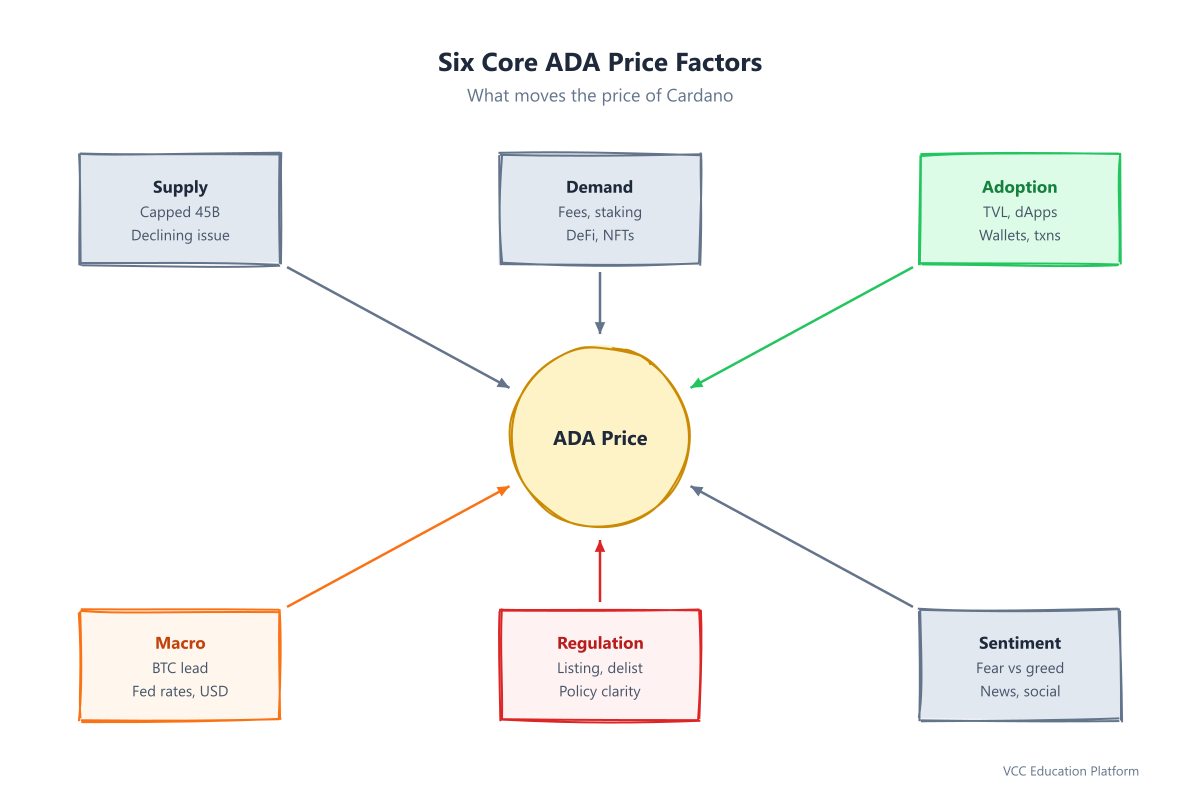
The six core factors that move ADA price
Factor 2: Tokenomics
Tokenomics — the design of a token's supply and distribution — is a structural cardano price driver that operates quietly in the background. Cardano's tokenomics are unusually transparent and predictable, which is itself a positive signal for long-term holders.
Max supply, circulating supply, and reserves
Cardano's 45 billion ADA maximum supply was set at launch. A large portion was allocated to a treasury and a reserve that releases ADA gradually through staking rewards. As the reserve is drawn down, the rate of new ADA entering circulation slows. This means the inflationary pressure on price decreases over time — a tailwind for value as the network matures.
Staking ratio
A high proportion of circulating ADA is locked in staking (often above 60%). Staked ADA still earns rewards, but it is committed to the network and less likely to be dumped on exchanges during a panic. A high staking ratio effectively reduces the freely-floating supply available for trading, which can amplify price moves when demand spikes. It also signals confidence — holders are choosing yield over immediate liquidity.
Transaction fee burning
A fraction of every transaction fee on Cardano is sent to the treasury and effectively removed from the circulating supply. While this is not a dramatic "burn" like some other chains, it is a steady, usage-linked reduction in sell pressure: the busier the network, the more ADA is redirected away from the open market.
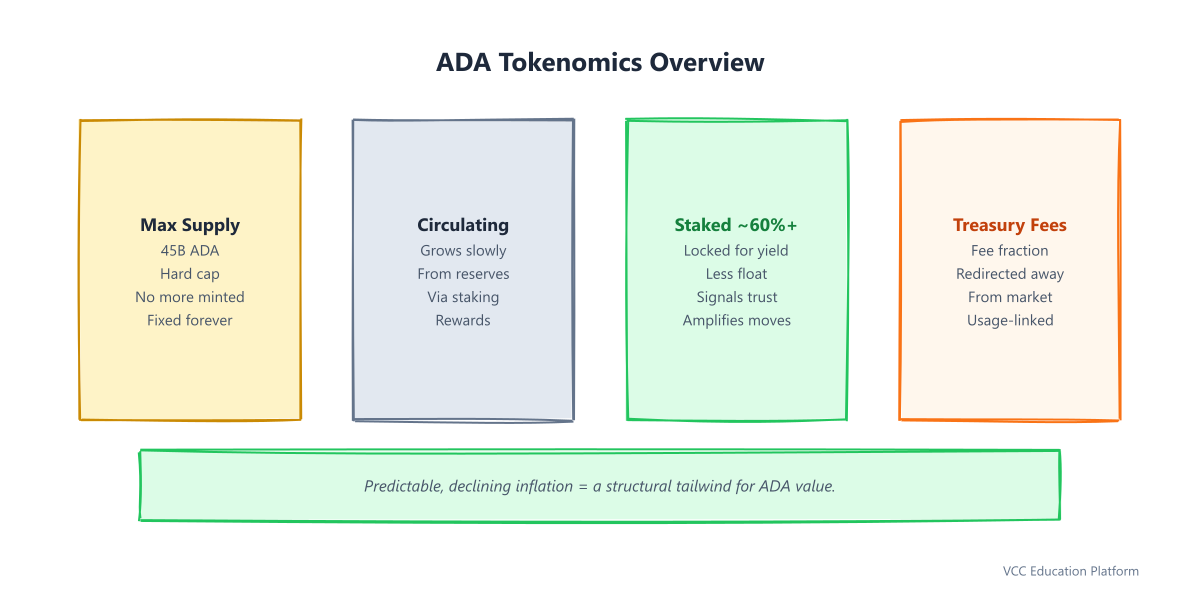
ADA tokenomics: capped supply, declining issuance, staked float, fee redirect
Factor 3: Network Adoption
Adoption is where utility turns into demand. The more people and applications actually use Cardano, the more ADA is needed — and the stronger the fundamental case for its price. This is why adoption metrics are central to any serious ada price analysis.
Total Value Locked (TVL)
TVL measures how much capital is locked in Cardano's DeFi protocols — DEXs, lending platforms, and stablecoin markets. Rising TVL means real capital is being put to work on-chain, which directly increases demand for ADA as collateral and gas. A sustained TVL uptrend is one of the clearest on-chain signals that adoption is growing.
dApps and transaction volume
The number of active dApps and daily transactions shows whether the network is being used, not just hyped. New protocol launches, rising unique wallet counts, and growing transaction throughput all feed into the demand side of the price equation.
Wallets and active addresses
A growing base of ADA holders and active addresses is a leading indicator. More wallets means more participants entering the ecosystem, many of whom will buy and hold ADA to interact with it.
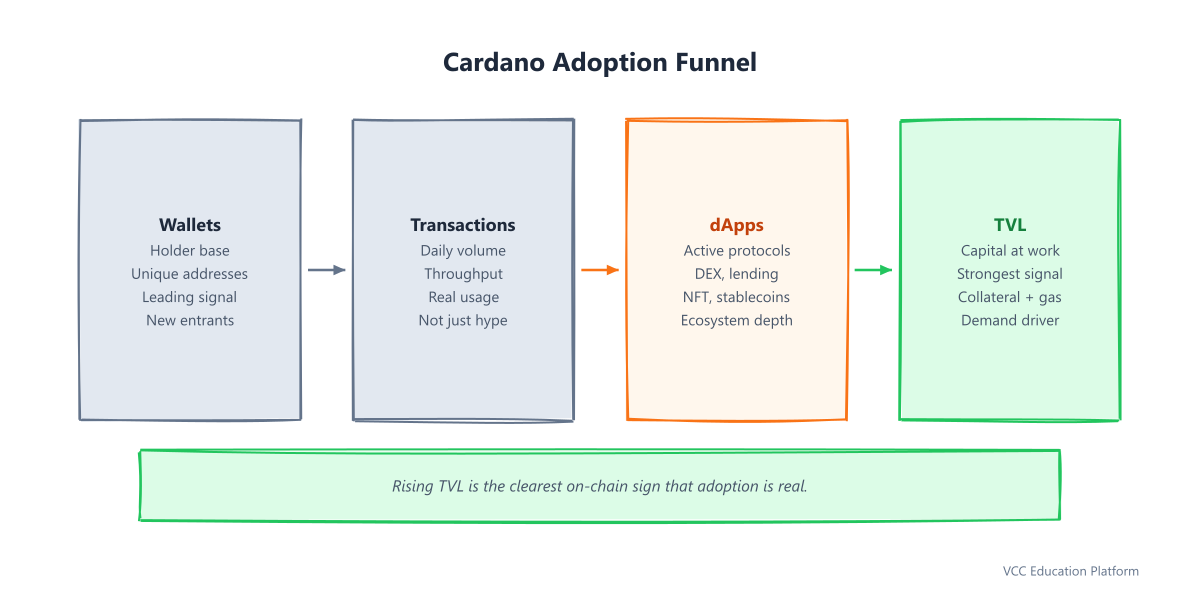
Adoption funnel: from wallets to locked value on Cardano
Factor 4: Macroeconomic Conditions
ADA does not exist in a vacuum. It is part of the broader crypto market, which is itself sensitive to global macroeconomic forces. Ignoring macro is one of the most common mistakes beginners make.
Bitcoin correlation
Cardano, like most altcoins, tends to correlate with Bitcoin. When BTC rallies, ADA usually follows; when BTC dumps, ADA often falls harder. This correlation means that Bitcoin's halving cycles, ETF flows, and dominance trends indirectly set the tone for ADA. A strong BTC bull market lifts most boats, including ADA.
Interest rates and liquidity
When central banks — especially the US Federal Reserve — raise interest rates, liquidity tightens and risk assets (including crypto) tend to fall. When rates fall or stay low, cheap capital flows into higher-risk assets and crypto rallies. ADA is sensitive to this risk-on / risk-off cycle, so watching Fed policy is part of understanding cardano market factors.
Dollar strength
A strong US dollar often pressures crypto prices downward, since most tokens are priced in dollars. A weakening dollar can have the opposite effect. These macro currents move all cryptocurrencies together, but they explain a large share of ADA's short-term swings.
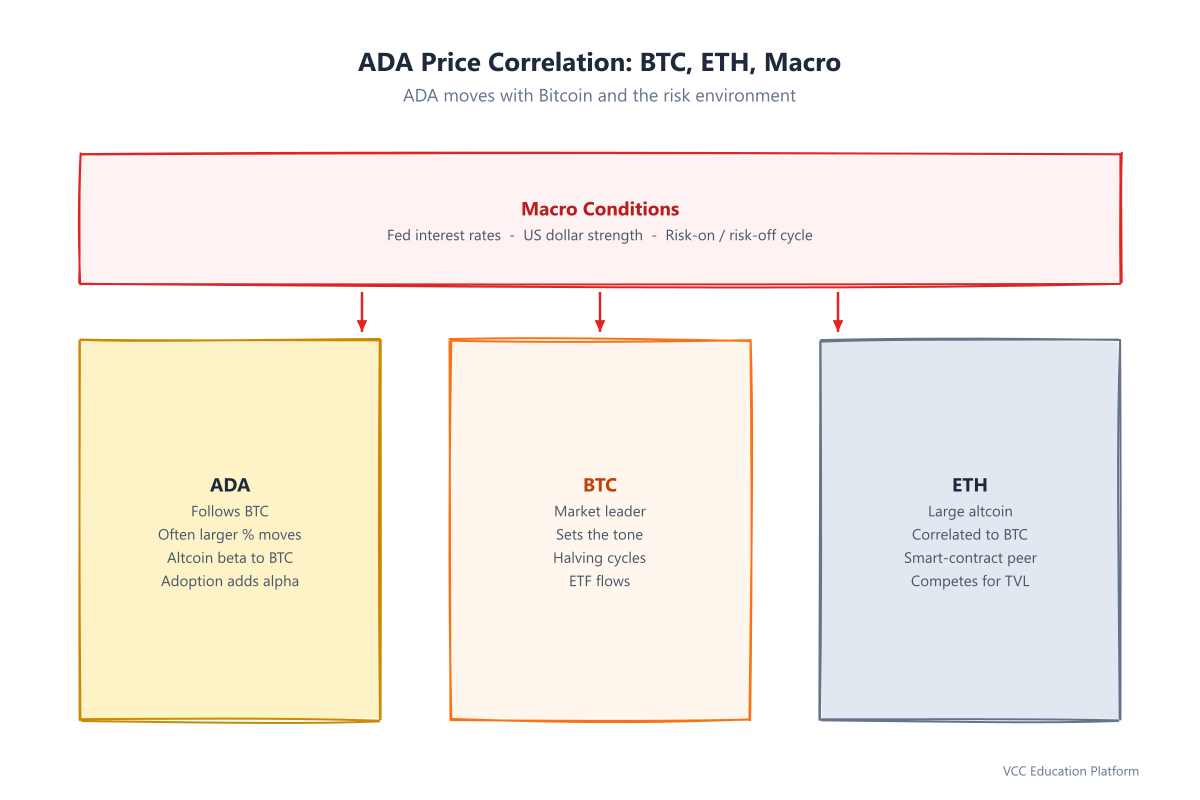
ADA moves with Bitcoin and the broader macro risk environment
Factor 5: Regulatory News
Regulation can move ADA prices faster than almost any other factor, because it changes the rules of the game overnight.
Classification and clarity
Whether regulators classify ADA as a security or a commodity has huge implications. Clear, favorable classification (commodity status, spot ETF approval, regulated staking products) tends to boost price by opening the door to institutional capital. Adverse rulings or lawsuits can trigger sharp sell-offs as exchanges delist the token in affected jurisdictions.
Exchange listings and delistings
A new listing on a major exchange increases accessibility and liquidity, often lifting price. A forced delisting does the opposite. For Vietnamese traders, the availability of ADA on locally popular exchanges (Binance, OKX, HTX) with VND on-ramps directly affects how easily local demand can flow into the token.
Government policy
Broader government stance toward crypto — licensing frameworks, tax rules, bans — shapes the environment. Vietnam's evolving regulatory approach matters because Vietnam has one of the highest crypto adoption rates in the world; a friendly or hostile shift can move local demand meaningfully.
Factor 6: Ecosystem Milestones
Cardano is a research-driven project that ships upgrades in named hard forks. These milestones are concrete cardano price drivers because they unlock new capability and signal progress.
Hard forks and protocol upgrades
Major upgrades — such as the introduction of smart contracts (Alonzo), improved scalability (Vasil), and governance features (Chang) — expand what developers can build on Cardano. Each successful upgrade reassures the market that the roadmap is real and on track, which supports long-term price. Conversely, delays or bugs can dent confidence.
Hydra and scaling
Hydra is Cardano's layer-2 scaling solution. Progress on Hydra directly affects the market's view of Cardano's ability to handle mass adoption. Strong scaling benchmarks raise the ceiling on how many users the network can serve, which strengthens the adoption-driven price thesis.
Governance and community
Cardano's move to on-chain governance (Voltaire) lets ADA holders vote through DReps. A healthy, engaged governance community signals a decentralized, self-sustaining network — attractive to long-term investors who value resilience over hype.
Factor 7: Market Sentiment
Sentiment is the wildcard. Even when fundamentals are strong, fear and greed can dominate short-term price action.
Social media and news cycles
Hype on social platforms, influencer commentary, and major news events can drive rapid price moves that have little to do with on-chain reality. These moves often revert, but they create real volatility in the meantime.
Fear and greed
Crypto sentiment oscillates between fear and greed. Extreme greed often marks local tops; extreme fear often marks local bottoms. Learning to read sentiment indicators helps you avoid buying at the peak of hype or selling into panic.
Vietnamese trader sentiment
In Vietnam, ADA is widely held and discussed in local crypto communities on Telegram, Facebook, and Zalo. Vietnamese traders tend to track Bitcoin's lead closely and view ADA as a "strong project" with good staking yield — a narrative that supports steady local accumulation during quiet periods and faster participation during rallies. Local sentiment often amplifies global moves: when global news turns positive, Vietnamese P2P volumes and social discussion rise quickly, adding fuel to ADA demand.
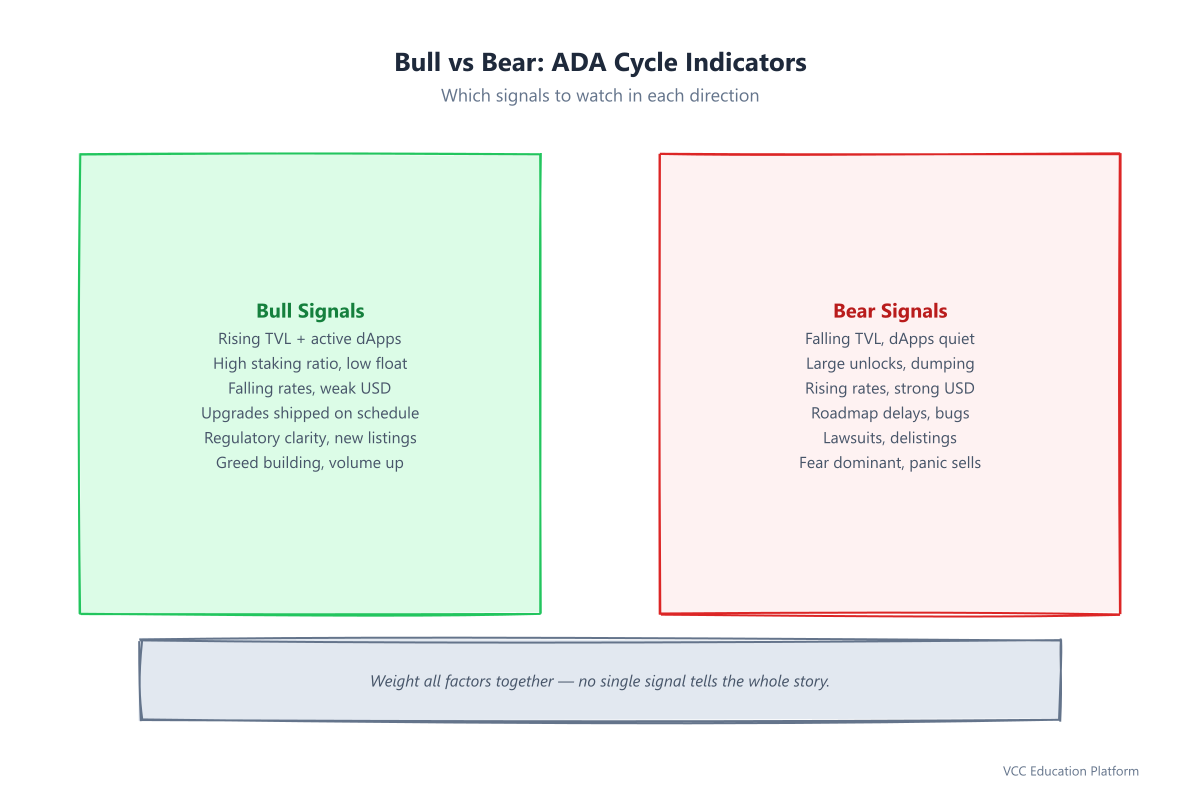
Bull vs bear: which signals to watch for ADA
How the Factors Combine
No single factor determines ADA's price in isolation. The reality is an interaction:
- Bull case: capped supply + rising TVL + falling rates + regulatory clarity + successful upgrades + greedy sentiment = strong upward pressure.
- Bear case: token unlocks + falling TVL + rising rates + adverse regulation + delayed roadmap + fearful sentiment = downward pressure.
The art of ada price analysis is weighing which factors are dominant right now. During a macro bull run, adoption and sentiment dominate; during a regulatory crackdown, regulation overrides everything else.
Practical Takeaways for Beginners
- Watch on-chain data, not just price charts. TVL, staking ratio, and transaction counts tell you whether adoption is real.
- Track Bitcoin and macro. Most ADA moves start with BTC and the broader risk environment.
- Follow the roadmap. Hard forks and scaling progress are scheduled — use them as checkpoints, not surprises.
- Read sentiment skeptically. Hype fades; fundamentals compound.
- Keep a Vietnamese lens. Local exchange liquidity and community sentiment add a layer specific to your market.
FAQ
What affects Cardano price the most? The biggest single driver is usually the broader crypto market led by Bitcoin, but over the long term network adoption (TVL, dApps, transactions) and tokenomics (capped 45B supply, staking ratio) are the most important fundamental cardano price factors.
How does staking affect ADA price? A high staking ratio reduces the freely-tradable supply of ADA, which can amplify price increases when demand rises. Staking also signals holder confidence, since participants choose yield over immediate liquidity.
Does Bitcoin's price affect Cardano? Yes. ADA correlates strongly with Bitcoin. When BTC rallies, ADA typically follows, often with larger percentage moves. Bitcoin's halving cycle and ETF flows set the tone for the whole altcoin market, including Cardano.
Is ADA deflationary? Cardano has a fixed maximum supply of 45 billion ADA, and a portion of every transaction fee is redirected to the treasury rather than remaining in circulation. New issuance through staking rewards declines over time as the reserve depletes, so ADA's inflation rate trends toward zero.
How do Vietnamese traders influence ADA price? Vietnam has among the highest crypto adoption rates globally. Local demand through P2P markets (Binance, OKX) and active community discussion can amplify global ADA moves, especially during rallies when Vietnamese participation rises quickly.
Can regulation crash ADA's price? Yes. Adverse regulatory actions — such as classifying ADA as a security or forcing delistings — can cause sharp sell-offs. Conversely, regulatory clarity and approved products (like ETFs) can boost price by attracting institutional capital.
Next Steps
- Understand the token: [Cardano Tokenomics](/cardano-tokenomics) — max supply, reserves, and fee flow
- See the network: [Network Statistics Overview](/network-statistics-overview) — live on-chain metrics
- Earn yield: [Staking Rewards Explained](/staking-rewards-explained) — how staking ties into supply
- Go deeper: [Getting Started with Cardano](/getting-started-with-cardano) — full beginner path
Disclaimer: This article is educational, not financial advice. Cryptocurrency prices are volatile; never invest more than you can afford to lose. Always do your own research before making investment decisions.
Last updated: August 2026 Author: VCC Education Team