
Imagine two new restaurants opening in your neighborhood. Both promise faster service and cheaper meals than the famous original place everyone loves — Ethereum. But they solve the problem in completely opposite ways.
The first restaurant copies the original's menu exactly. Same recipes, same ingredients, same dishes. You can walk in with the menu you already know and order the same food you always ate. That restaurant is zkSync.
The second restaurant throws out the old menu and builds a brand-new kitchen with a brand-new way of cooking, designed from scratch to be faster and cheaper. But you have to learn a whole new menu to eat there. That restaurant is Starknet.
This article is a detailed zksync vs starknet comparison — two of the most important Ethereum layer-2 rollups, built on the same core idea but with directly opposing EVM philosophies. We'll break down how each one works, what they agree on, and how to choose between them.
Two Kitchens, Two Philosophies
Before comparing the two, let's set the stage. Both zkSync and Starknet are zero-knowledge rollups (zkRollups) built on Ethereum. That means both of them process transactions off the main Ethereum network, batch them up, and post a single cryptographic "receipt" back to Ethereum for verification.
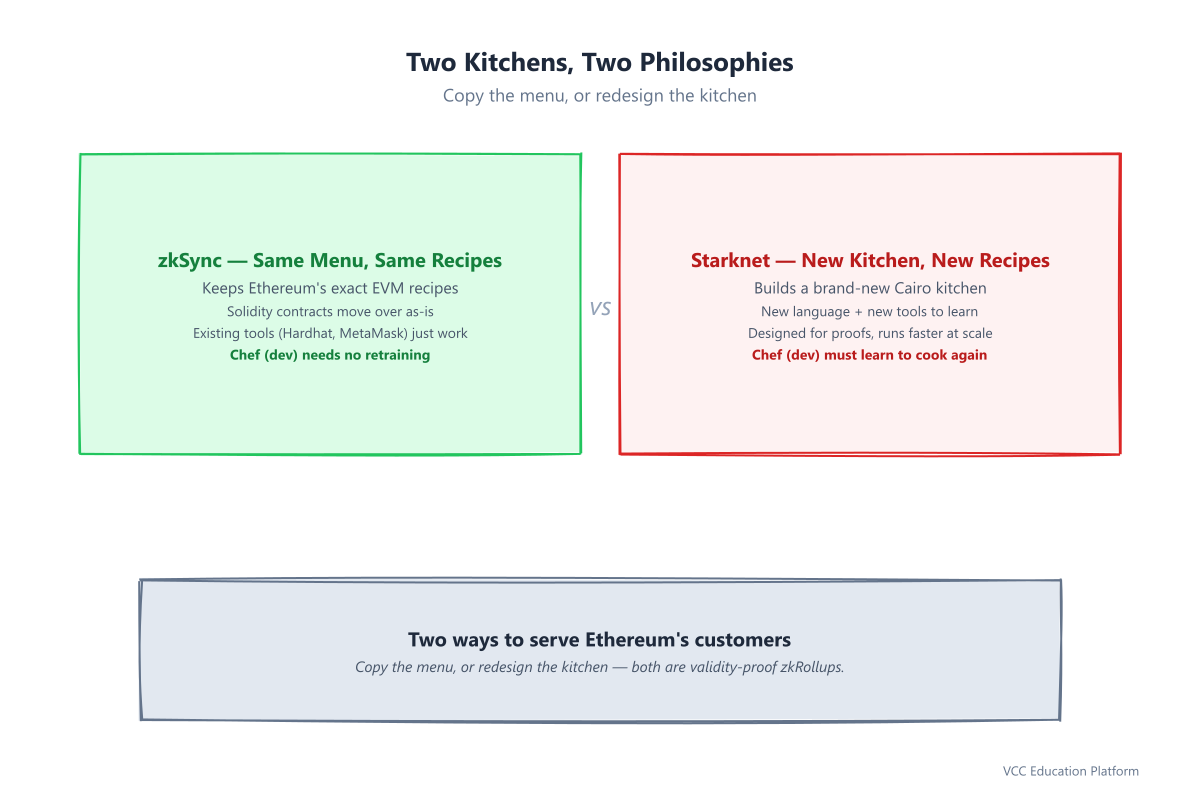
Figure 1: Two kitchens, two philosophies — copy the menu, or redesign the kitchen
This shared foundation is important. The restaurants are both offering the same core service — take the load off Ethereum's crowded kitchen — but they serve that need with completely different menus.
What Both Restaurants Agree On: Validity Proofs
There are actually two main types of rollups: optimistic rollups and validity-proof (zk) rollups. Both zkSync and Starknet belong to the second category, and that choice shapes everything they do.
Here's how a validity-proof rollup works:
- Users send transactions to the rollup's sequencer.
- The sequencer batches thousands of transactions together.
- A prover generates a tiny cryptographic proof that every transaction in the batch was executed correctly.
- The rollup posts the batch summary plus the proof to Ethereum.
- Ethereum's verifier contract checks the proof in milliseconds and accepts the state update.
The genius is that Ethereum never re-runs the transactions. It just checks the proof. This is fundamentally different from optimistic rollups, which assume transactions are valid and give challengers a week to dispute them.
Both zkSync and Starknet share this validity-proof philosophy. Where they diverge is the engine they use to run and prove transactions — and that's the EVM question.
The EVM Question: Copy It or Replace It?
The Ethereum Virtual Machine (EVM) is the computer that runs Ethereum smart contracts. Every contract ever written in Solidity runs on the EVM. Over a decade, developers have built thousands of contracts, dozens of tools, and a massive library of audited code around it.
The core philosophical question each rollup had to answer: do we preserve the EVM, or do we replace it?
zkSync: Copy the Menu Exactly (EVM-compatible)
zkSync chose preservation. Its custom virtual machine, the zkEVM, is designed to be as close to the EVM as possible — bytecode-compatible at the level of the actual machine instructions. Solidity and Vyper contracts compile into zkEVM bytecode almost identically to how they compile for Ethereum.
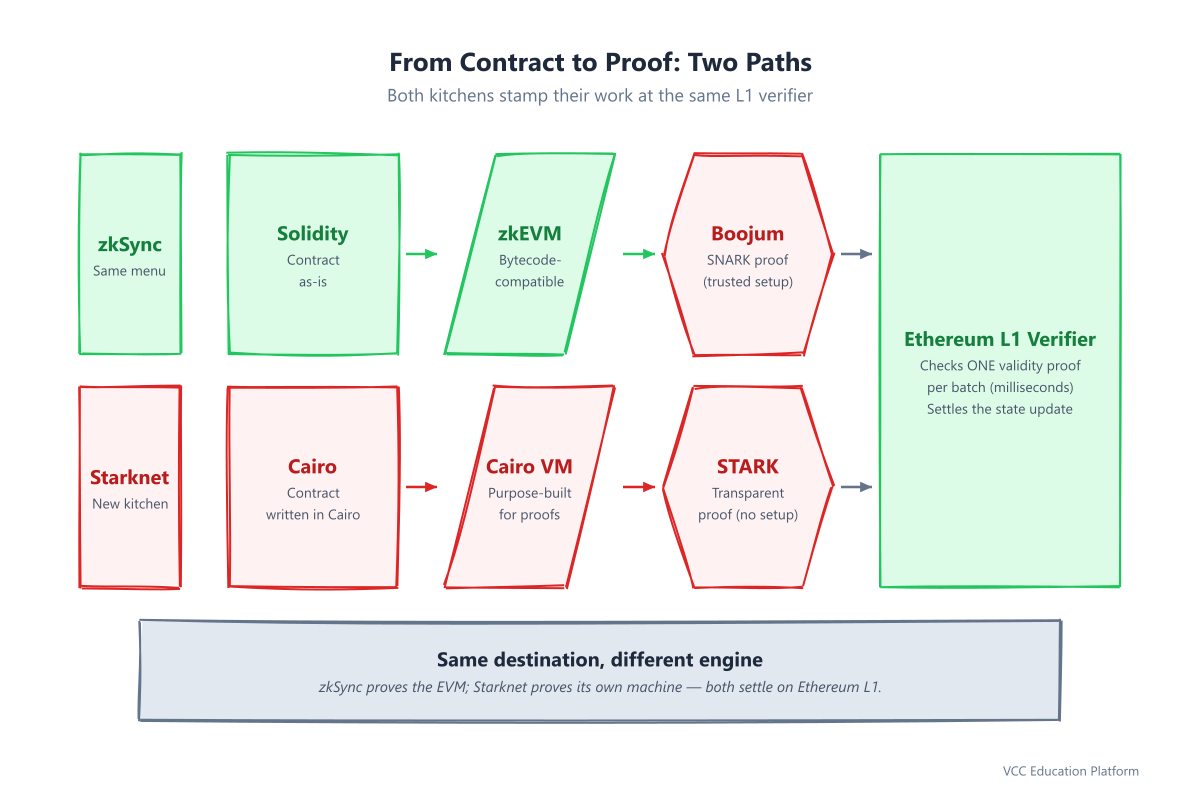
Figure 2: From contract to proof — two paths, one Ethereum L1 verifier
For developers, this is a massive win. Existing contracts like Uniswap and Aave were ported to zkSync with minimal changes. Your existing tools — Hardhat, Foundry, MetaMask — work with zkSync out of the box. If you can write a smart contract for Ethereum, you can write one for zkSync today, with no new language to learn.
But there's a cost. The zkEVM has to faithfully simulate a general-purpose computer inside a zero-knowledge proof. Proving the EVM is mathematically harder than proving a purpose-built machine, which means the proof generation is heavier and slower than a designed-for-zk system could be.
Starknet: Build a New Kitchen (STARK-native)
Starknet chose replacement. Instead of the EVM, Starknet runs the Cairo VM — a virtual machine purpose-built for zero-knowledge proofs. Contracts are written in Cairo, a language designed from the ground up to be easy to prove.
Cairo is not Solidity. It's closer in feel to Rust. If you're a Solidity developer, you'll need to learn a new language and a new mental model. The tooling is different, the wallets are different, the libraries are different. This is the "new menu" cost.
But the payoff is real. Because Cairo was designed for proofs, the prover has a much easier job. Starknet can achieve higher throughput and is particularly good at compute-heavy applications like on-chain gaming, machine-learning inference, and complex financial logic. The proof system is also inherently transparent — more on that next.
zkRollup So Sánh: EVM-Compatible vs STARK-Native
Let's lay out the two philosophies side by side. This is the heart of any zk rollup so sánh — a direct comparison of the two approaches.
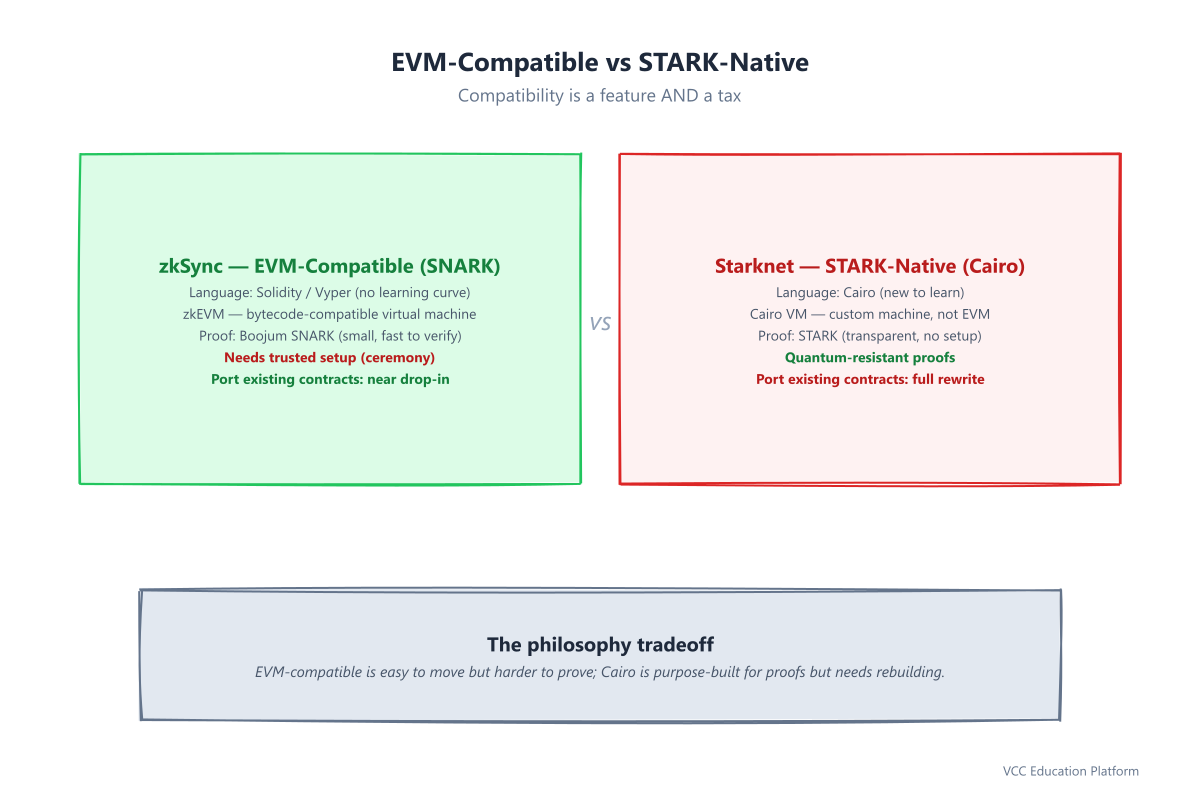
Figure 3: EVM-compatible vs STARK-native — the core tradeoff
Proving Technology
zkSync uses zk-SNARKs. Its proving system, called Boojum, evolved from the Plonky2 technology. SNARKs produce small, fast-to-verify proofs, which is great for on-chain costs. But SNARKs require a trusted setup — a cryptographic "ceremony" where the proving parameters are generated. If the ceremony were compromised, fake proofs could theoretically be created. Modern multi-party ceremonies mitigate this, but the trust assumption exists.
Starknet uses zk-STARKs. STARKs need no trusted setup at all — they're fully transparent. They're also based on hashing, which makes them resistant to quantum computers. The tradeoff: STARK proofs are much larger than SNARK proofs, so Starknet must use recursive wrapping to compress them for on-chain verification.
Migration Difficulty
| zkSync | Starknet | |
|---|---|---|
| Language | Solidity, Vyper | Cairo |
| Virtual machine | zkEVM (EVM-compatible) | Cairo VM (custom) |
| Proof system | SNARK (Boojum) | STARK |
| Trusted setup | Yes | No |
| Porting existing contracts | Near-drop-in | Full rewrite |
| Learning curve for Ethereum devs | Minimal | Weeks to months |
Starknet EVM: Compatibility Through Cairo
Here's where the "starknet evm" question gets interesting. Starknet has no EVM by design — so how do people talk about "EVM compatibility" on Starknet?
The answer is transpilation. Tools like Warp can convert Solidity source code into Cairo, and projects like Kakarot aim to run the EVM inside Starknet's Cairo VM. But these are translation layers, not native compatibility. Warp doesn't support every Solidity feature, and the translated contracts often need manual fixes. It's like reading the menu in a foreign language — you get the gist, but the subtleties are lost.
So when you hear "starknet evm," understand it as transpilation toward compatibility — a bridge, not a native home. zkSync's compatibility is native; Starknet's is a construction project.
The Ecosystem: Two Families, One Ethereum
Neither rollup exists alone. Each has built a family of products around its philosophy.
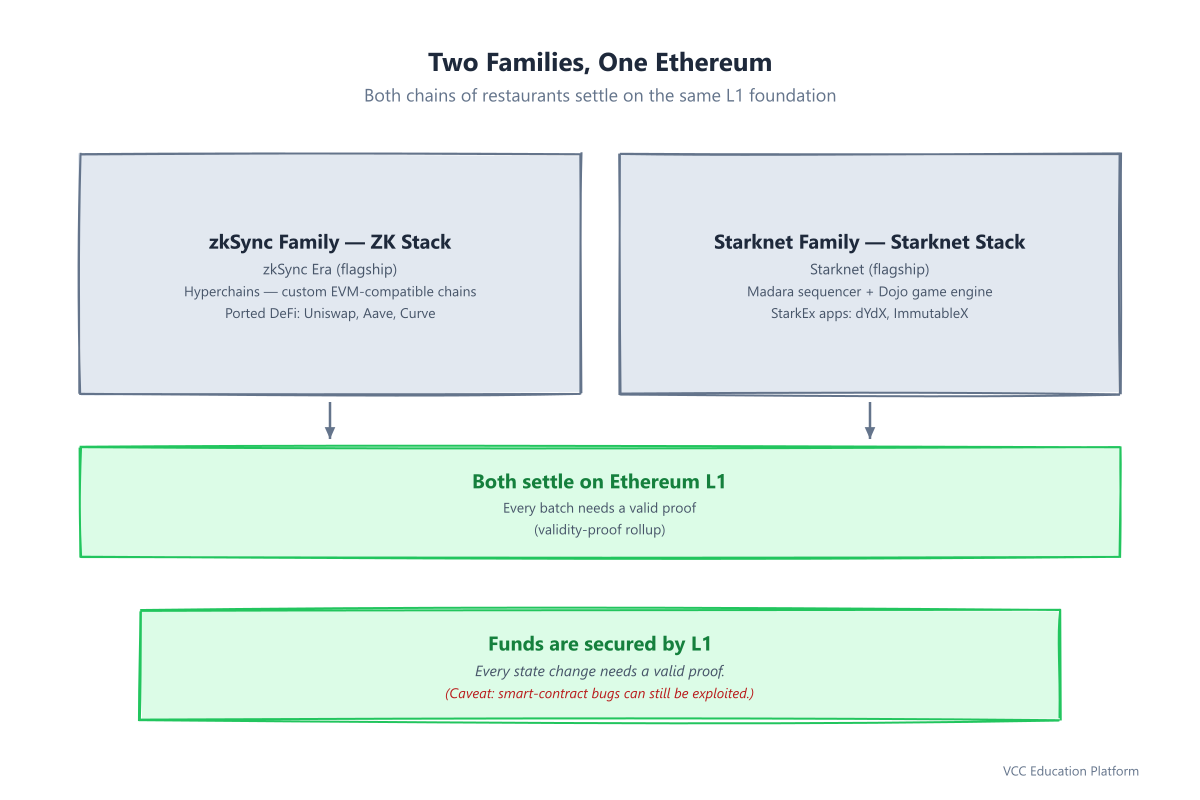
Figure 4: Two families, one Ethereum — both settle on L1
zkSync's family centers on the ZK Stack, a modular framework for building Hyperchains — customizable, interoperable zkRollups that share the same technology. zkSync Era is the flagship, and the ZK Stack lets teams spin up their own chains with the same EVM-compatible engine.
Starknet's family includes the Starknet Stack — with Madara (a modular Cairo sequencer) and Dojo (a game engine built on Cairo). Starknet also powers the StarkEx engine used by high-volume apps like dYdX and ImmutableX.
Both families ultimately settle on the same foundation: Ethereum L1. Every proof, from either kitchen, is stamped and verified by the same municipal inspector.
Fees and Speed: The Numbers
Both rollups are dramatically cheaper than Ethereum mainnet. Thanks to EIP-4844 (proto-danksharding), which introduced cheap "blob" data storage for rollups, transaction fees on both zkSync and Starknet now sit in the $0.01–$0.20 range.
Speed is where the philosophies show up. zkSync has historically had faster proof submission — on the order of minutes to tens of minutes to finality. Starknet was slower due to its original Python-based sequencer, but the Cairo Upgrade rewrote the sequencer in Rust, dramatically improving throughput and latency. By early 2025, Starknet was processing transactions in about a second — with the proof-and-settlement step still lagging zkSync.
Which Kitchen Should You Choose?
There's no single "winner" — it depends on what you're building.
Choose zkSync if:
- You have existing Solidity contracts you want to move with minimal effort.
- Your team knows Ethereum tooling and doesn't want to learn a new language.
- You want to join a mature DeFi ecosystem with ported blue-chip dApps.
Choose Starknet if:
- You're building compute-heavy applications that push the limits of what the EVM can do — gaming, AI, complex trading.
- You value transparency and quantum-resistance in the proof system.
- You're willing to invest in learning Cairo for long-term performance gains.
- You're starting greenfield and don't need to port existing contracts.
FAQ
Is Starknet EVM-compatible?
Not natively. Starknet uses its own Cairo VM and the Cairo language. "Starknet EVM" compatibility exists only through transpilers like Warp (Solidity → Cairo) or projects like Kakarot that run an EVM inside Cairo. It's a translation layer, not native compatibility.Is zkSync cheaper than Starknet?
Both are very cheap thanks to EIP-4844 blob data — typically $0.01–$0.20 per transaction. Fee differences are small and change with network load.Which has higher throughput, zkSync or Starknet?
Starknet's Cairo VM is purpose-built for proofs and has a higher theoretical throughput ceiling, especially after the Rust sequencer upgrade. zkSync's EVM-compatible engine pays a proof-generation tax for its compatibility.Do both rollups use zero-knowledge proofs?
Yes. Both are validity-proof rollups that post cryptographic proofs to Ethereum L1. The difference is the proof type: zkSync uses SNARKs (with trusted setup), Starknet uses STARKs (transparent, no trusted setup).Can I use MetaMask with Starknet?
Not directly. Starknet uses a native account-abstraction model and its own wallet ecosystem (like ArgentX and Braavos). zkSync works with MetaMask out of the box because it's EVM-compatible.Conclusion
The zksync vs starknet debate isn't really about which rollup is "better" — it's about two opposing EVM philosophies. zkSync says: the EVM is a decade of accumulated value; preserve it and prove it. Starknet says: the EVM is the past; build a new machine optimized for the future.
Both kitchens serve the same neighborhood. Both stamp their work with validity proofs that Ethereum verifies. If you're a chef who wants to move your existing dishes with minimal fuss, the EVM-compatible menu of zkSync is waiting for you. If you're ready to learn a new way of cooking for a faster, more efficient kitchen, Starknet's Cairo is your path.
Whichever you choose, you're eating at a table that's dramatically faster and cheaper than the original — and that's a win for everyone building on Ethereum.