
Every serious ZKML discussion eventually hits the same wall: the zkml chi phí — the proving cost — explodes as models grow. Run the math yourself. A linear-regression model proves in 0.118 seconds on a laptop using 19 MB of memory. A 13-billion-parameter LLM takes up to 15 minutes of GPU time to produce a proof for a single inference. Between those two points lies the entire reason zero-knowledge machine learning ships in production for credit scoring, fraud detection, and KYC — but not for the frontier models everyone talks about. This article quantifies exactly where that cost comes from, what it does to your hardware budget, and why the boundary sits where it does today.
Zero-knowledge proofs let you prove that a model produced a given output without revealing the model. The prover (the model owner) generates a cryptographic receipt; the verifier checks it in milliseconds. It is a beautiful primitive — and it is useless if proving a single inference costs more than the inference is worth. So before you bet your product on ZKML, understand the cost curve you are stepping onto, and the zk proving cost techniques that can bend it.
Why the proof, not the model, is the expensive step
A neural network runs in milliseconds. Proving it ran correctly takes orders of magnitude longer. The numbers are not subtle.
- Modulus Labs benchmarked an MNIST digit classifier in 2023: $0.20 and about 15 seconds per proof — for a model that classifies one handwritten digit.
- ChainScore Labs measured a similar story for ResNet-50: over 10 minutes of proving on consumer hardware and roughly $0.50 of GPU time on a high-end accelerator.
- The cleanest datapoint comes from zkGPT benchmarks reported by zkComposer: proving 64 tokens of GPT-2-style inference took 147.7 seconds on a 192-core machine with 755 GB of RAM, while the model response itself took 94.55 milliseconds on the same machine. That is a ~1,560x overhead.
The pattern is consistent across every independent benchmark: generating the proof costs 100-1000x the compute of running the model. This is the single most important number in ZKML economics — everything else is an attempt to shrink that multiplier.
Why is the overhead so brutal? To prove a computation in zero knowledge, you must first translate it into an arithmetic circuit: a system of constraints over a prime field. Every float multiplication in your model becomes between 100 and 1,000 arithmetic gates, depending on the precision you demand and your lookup-table strategy. Then the prover must evaluate the circuit, commit to every intermediate value, and run the proof machinery — multi-scalar multiplications (MSMs) and number-theoretic transforms (NTTs) — over tens of millions of gates. Modern silicon was not built for this finite-field arithmetic, at a volume that dwarfs the original inference.
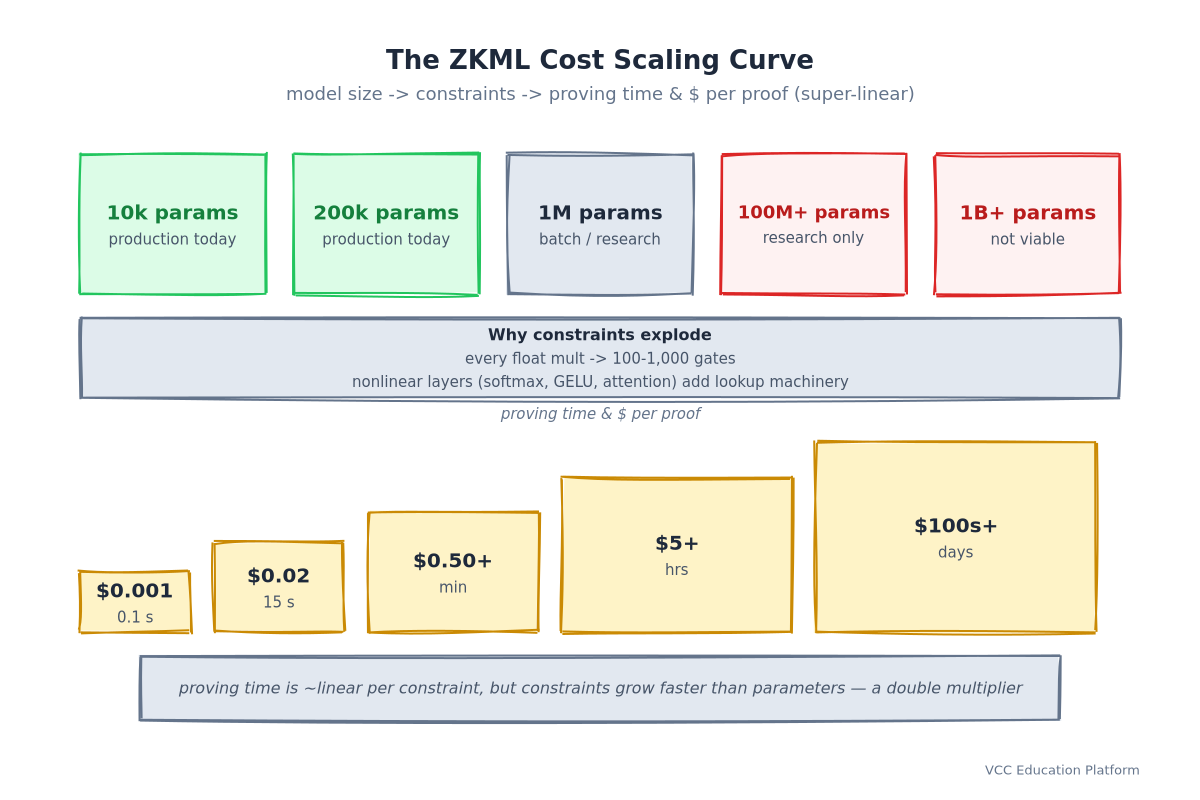
Figure 1: The ZKML Cost Scaling Curve — proving time and cost per proof grow super-linearly with model size
The double multiplier: how proving cost grows with model size
Here is where most explanations go wrong. People assume proving time scales linearly with parameter count, so a 10x bigger model costs 10x more to prove. The real curve is steeper, because two effects stack.
Effect one — proving time is roughly linear in the number of constraints. Empirically, a Groth16 proof takes about 1.4 seconds at 10,000 constraints, 3.2 seconds at 100,000, 28 seconds at 1 million, and 4.2 minutes at 10 million. STARKs are slightly better at scale (quasilinear: 10 million constraints in ~1.4 minutes) but still growing. Verification, by contrast, is constant: 3.1 ms regardless of whether the circuit has 10,000 or 10 million constraints. The expensive side — the prover — is the side that scales with computation size.
Effect two — constraints grow faster than parameters. Each parameter is not one gate. It participates in matrix multiplications, activations, and normalization passes, and each of those produces gates. The blow-up comes from three compounding sources:
- Nonlinear layers. Softmax, GELU, SiLU, and LayerNorm cannot be expressed as raw field arithmetic. They require lookup tables, piecewise approximations, or precision machinery — the cost driver researchers at the frontier of lookup-based zkML identified in 2026: "the dominant cost... concentrates in the nonlinearities a transformer must evaluate inside the proof system." The ZIP protocol (2025) showed that replacing naive nonlinear encodings can cut circuit size by up to three orders of magnitude — nonlinearity, not linear algebra, is where the gates multiply.
- Attention and sequence length. Transformers put softmax in every attention head, on every token. Intermediate tensors for a whole sequence must be committed and checked, and the KV dimensions explode the circuit.
- Precision. If you insist on high-precision arithmetic (the IEEE-754 semantics some applications demand), each operation needs more gates. This is the dial most people tune first: quantization exists precisely to trade precision for gate count.
The combined result is a super-linear cost curve: double the parameters and the proving cost more than doubles, because you doubled both the number of operations and the per-operation gate cost. This is the math behind the giới hạn zkml model lớn — the limit that keeps large models out of production.
GPU hardware cost vs model size
Once you know the proving time, the dollar cost is simply proving time × GPU price per hour. Verified 2026 cloud rates make the arithmetic concrete:
| GPU tier | Typical on-demand price | What proves comfortably |
|---|---|---|
| RTX 4090 (24 GB) | $0.34-0.74/hr | 10k-200k params in 0.1-15 s |
| A100 80 GB | $1.19-2.49/hr | mid models, zkLLM 13B fits in VRAM |
| H100 80 GB | $1.99-3.49/hr | large-model proving (minutes+) |
| H200 / B200 | $3.29-5.98/hr | research-scale circuits |
RunPod Community sells the RTX 4090 at $0.34/hr; Vast.ai can drop to $0.27. Lambda Labs charges $2.49/hr for an A100 80 GB and $2.99/hr for an H100. Hyperscalers (AWS, GCP) typically run 2-3x those prices. None of this is exotic — a Vietnamese startup can sign up for any of these today with a credit card.
Now multiply. A 50k-parameter EZKL proof takes ~10 seconds on a 4090: at $0.34/hr that is roughly $0.001 per proof — genuinely cheap. A 13B-parameter zkLLM proof takes ~15 minutes on an A100-class GPU: at ~$1.64/hr that is ~$0.41 per proof in GPU time alone, and the GPU is blocked for the full 15 minutes. Industry benchmarks for GPU-accelerated proving on an A100 put the range at $0.02-$0.50 per proof depending on circuit complexity. A 70B-parameter forward pass, at the current rate of ~10 million constraints per second, would take days and run into petabytes of memory — the price tag is effectively unbounded and irrelevant for a product decision.
The ratio that matters for product teams: proof cost per inference should be a tiny fraction of the value of that inference. Credit scoring, fraud detection, and KYC decisions are worth dollars to tens of dollars — a $0.001-0.02 proof is noise. An LLM chat completion is worth fractions of a cent in pure compute, and a $0.41+ proof is fatal. That asymmetry, more than any hardware limit, is why small models ship and large models stay in research.
The prover's memory wall
Time is not the only cost. Proving large circuits has a memory problem that is often the harder wall.
- A Groth16 proving key runs about 500 MB per million gates — and you must hold the whole thing while proving.
- EZKL's Halo2 circuits on large models produce proving keys and circuit artifacts measured in hundreds of gigabytes of RAM — more than a single GPU's 24-80 GB of VRAM.
- zkLLM, the most memory-efficient large-model prover, keeps 13B-parameter proving under 23.1 GB — just barely inside an A100. That was a research contribution, not an accident: its
zkAttnandtlookupdesigns exist specifically to kill the memory blowup in attention and nonlinear layers. - zkComposer (2026) quantified the baseline for common models at 240-532 GB of main memory, then showed that sharding the circuit into sub-proofs drops each shard to 32-66 GB, small enough to fit device memory and exploit GPU bandwidth.
Memory is a cost multiplier you cannot hide behind a faster GPU. If the circuit does not fit in memory, no hourly rate saves you — you need a bigger machine (more expensive), a sharding strategy (more engineering), or a smaller model (the pragmatic choice).
Proof size vs verification: the tradeoff you actually control
The third cost dimension is the proof itself. Proof size determines transmission cost, on-chain calldata gas, and storage — and it varies enormously across proof systems:
| System | Proof size | Verification | Setup |
|---|---|---|---|
| Groth16 | 128-192 bytes | constant ~1.2-5 ms | trusted setup (MPC ceremony) |
| EZKL / Halo2 | ~5 KB+ | constant ms | transparent |
| zkLLM (13B LLM) | 160-200 KB | 1-4 s | transparent commitment |
| STARK / zkVM | larger | polylog (12-42 ms) | transparent, post-quantum |
Verification is never the bottleneck — SNARK verification is constant in circuit size, STARK verification grows polylogarithmically (12 ms at 10k constraints, 42 ms at 10M). But the proof-size side has sharp teeth. On-chain, EZKL's Halo2 KZG verifier costs roughly 173x more than a Groth16 reference because of the pairing operations: Halo2 proofs are KB-scale and cheap to transmit but expensive to verify in a smart contract; the common on-chain range is 200k-600k gas per proof (~$3-18 at high mainnet prices, a few cents at low gas). Meanwhile, Groth16's 192-byte proofs verify almost free on-chain but require a circuit-specific trusted-setup ceremony — a real organizational cost.
So the tradeoff you control is: transparent + heavier (Halo2, STARKs, zkLLM) for off-chain and audit use; trusted-setup + featherweight (Groth16) for on-chain verification. Proof size and verification cost are inverse dials, and both are secondary to the proving cost that dominates the system.
The path down the cost curve: recursion, aggregation, parallel provers
The proving wall is not permanent. Three families of techniques are actively flattening the curve — recursion, aggregation, and parallel/distributed proving — and they matter for anyone deciding when to adopt ZKML.
Recursion and composition. Recursive SNARKs — Nova-style folding, Plonky2, and STARK-to-SNARK wrapping (SP1, Risc Zero) — let a prover prove that another proof is valid, then prove that proof, indefinitely. This is how you turn a computation too large to prove in one shot into a chain of small, provable steps; Halo2's recursive approach delivers SNARK-like proof sizes without a trusted setup. The catch: recursion adds per-step overhead, so it helps when the alternative is a single circuit that does not fit or does not prove in time.
Aggregation. SnarkPack aggregates n Groth16 proofs into one proof of size O(log n): for 1,024 proofs, roughly 2 KB instead of 192 KB, with a ~340x verification speedup. If your product generates thousands of proofs per day, aggregation is the difference between 100,000 individual on-chain verifications and one.
Parallel proving and sharding. zkComposer splits a circuit into K shards, proves each shard on a separate device, and combines the sub-proofs — turning a memory-impossible baseline (240-532 GB) into something that fits a GPU. Inference Labs shards large-model proving across a decentralized cluster: their Subnet-2 has tallied over 283 million proofs and reduces peak memory up to 3x on a 1.27B-parameter model. This is the "prover network" thesis: instead of one expensive centralized prover, rent many cheap provers and compose their outputs.
Better hardware and proving markets. Ingonyama's ICICLE GPU library cut EZKL MSM time by 98% and total proof time by 35% with software alone; zk-ASICs (Cysic, Ingonyama, Fabric Cryptography) target 10-100x further. And the DePIN wave — Vast.ai, Akash, and dedicated proving markets like Boundless — lets you buy proving time from distributed GPU pools, pushing the effective zk proving cost per proof down the same way spot GPU markets cut training costs.
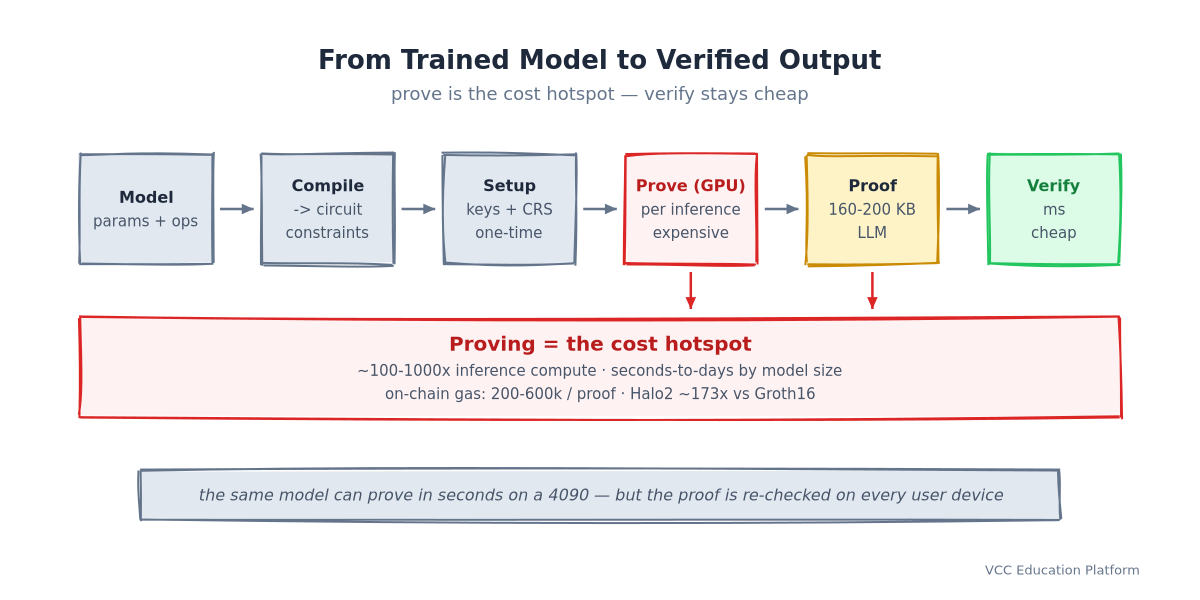
Figure 2: Where ZK Proving Cost Accrues — the pipeline from trained model to verified proof, with prove flagged as the expensive step
Cost-reduction techniques that work today
Before you reach for recursion, there are proven, boring optimizations that cut the proving bill today. They are listed here in order of leverage:
- Quantization first, always. Fixed-point arithmetic with fewer bits means fewer gates per operation. EZKL's calibration lets you set a scale factor and verify accuracy against your test suite; NanoZK's 16-bit lookup-table approach reports zero measurable accuracy loss on standard benchmarks. For a credit model, quantize to 8-10 bits, run the held-out set, and confirm the AUC delta stays under your tolerance.
- Lookup tables for nonlinearity. ReLU, softmax, GELU, and LayerNorm become table lookups instead of thousands of gates. This is exactly what EZKL (Plookup-style) and zkLLM (
tlookup) do — the single largest lever for transformer-heavy models. - Optimized arithmetization. zkCNN has dedicated convolution circuits; zkGPT uses "circuit squashing" and computes nonlinear results as advice rather than simulating them in the circuit, cutting proof complexity from hundreds of relations to a single one. Choosing a framework with the right arithmetization for your layer types is a 10-100x decision, not a tweak.
- Batching and aggregation. Prove one inference, or prove ten thousand in one batched proof. Aggregated proofs amortize setup, commitment, and on-chain cost across many inferences.
- Parallel proving. Shard the circuit (zkComposer) or run a cluster (Inference Labs). If your circuit fits in one GPU's memory, parallelism buys wall-clock speed; if it does not, it buys feasibility.
The honest budget for a 50k-parameter production model: compile once (hours), setup once (hours), then 0.1-15 s per proof on a $0.34/hr GPU — $0.001-0.02 per proof, dominated by the model's nonlinear layers.
Realistic benchmarks: where small, mid, and large models actually sit
| Model size | Typical proof time | Memory | GPU | Cost per proof | Status today |
|---|---|---|---|---|---|
| 10k-200k params (regression, scoring, fraud) | 0.1-15 s | <1 GB circuit | RTX 4090 | ~$0.001-0.02 | Production-ready |
| 1M-10M params (small CNN, ResNet-scale) | 15 s - minutes | 1-100 GB | A100 | ~$0.02-0.50 | Batch / research |
| 100M-13B params (LLMs, zkLLM) | 12-15 min | up to 23 GB+ | A100/H100 | ~$0.41-0.90 | Research / async only |
| 70B+ params (frontier) | days | petabytes | cluster | unbounded | Not viable |
The boundary is not fuzzy. 10k-200k parameters is the production zone today; 1M-10M is the batch-processing zone; 100M+ is where every benchmark stops sounding like a product and starts sounding like a paper. The zkLLM result — 13B parameters, proof in under 15 minutes, proof under 200 KB, memory under 23.1 GB — is genuinely remarkable, and it is still 15 minutes of dedicated GPU per inference. That is not a chat product; it is an audit product.
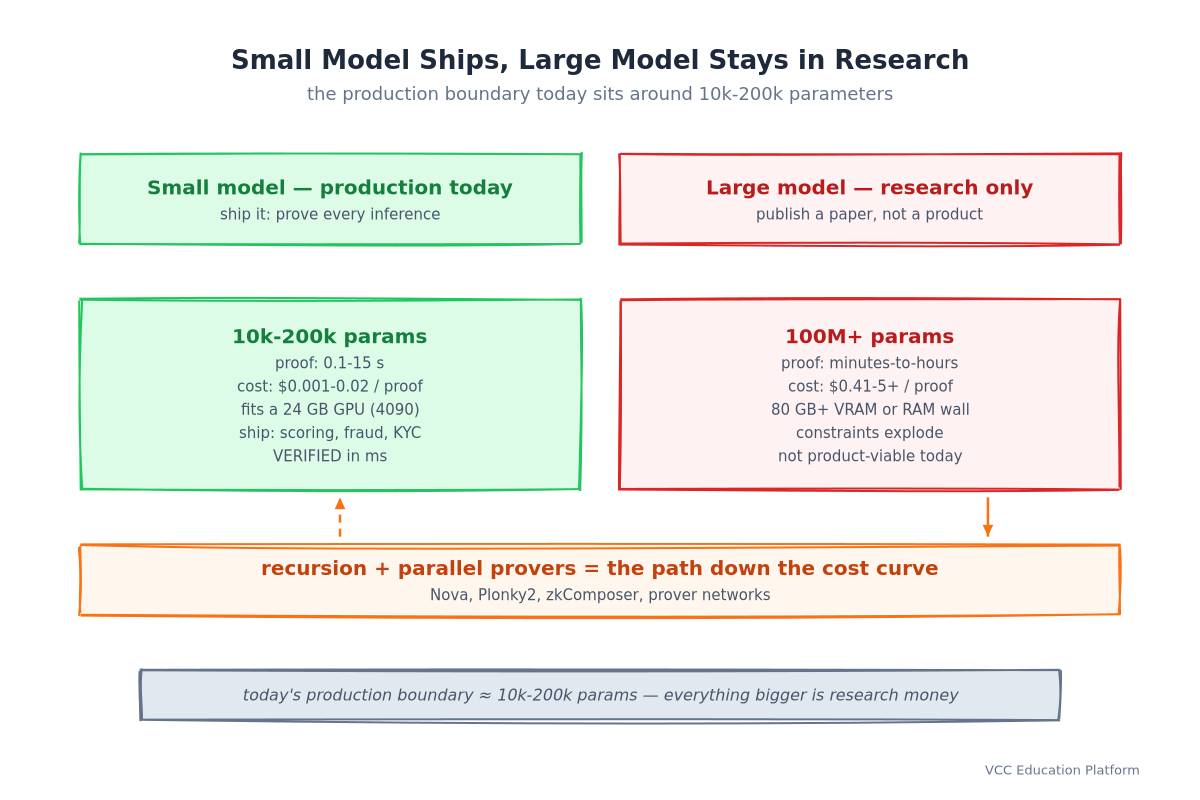
Figure 3: Small Model Ships, Large Model Stays in Research — today's production boundary and the path down the cost curve
The giới hạn zkml model lớn: why 100M+ parameters stay research-only
Pull all of the above together and the giới hạn zkml model lớn — the boundary where ZKML stops being viable — is the intersection of four walls:
- Constraints. A 100M-parameter model compiles to billions or trillions of constraints once you count gates per operation, nonlinearity machinery, and sequence-length effects. At ~10M constraints per second, that is hours to days of proving per inference.
- Memory. Halo2-class circuits at that scale need hundreds of gigabytes of RAM; even zkLLM's 13B optimization sits at the edge of a single A100's 80 GB.
- Cost. GPU-time alone is $0.41-5+ per proof, and the GPU is blocked for the entire proving window. At 10,000 proofs per day, a 13B model would need ~100 days of continuous A100 time — $4,000-6,000/month in GPU rental before engineering.
- Latency. Nothing about a 15-minute proof supports interactive products. The only honest deployments are batch, async, audit-style — and those must be worth $1+ per verified inference.
Meanwhile, the 10k-200k zone clears all four walls: sub-second to 15-second proofs, circuit memory that fits a consumer GPU, proofs at fractions of a cent, and latency compatible with the async decision paths that dominate finance. The conclusion is uncomfortable but honest: the size of the model you can prove is set by your cost curve, not your ambitions. Solve the small-model problem first, make money proving it, and let recursion, sharding, and prover networks pull the boundary upward over the next few years.
Vietnam: GPU costs and why Vietnamese teams should start small
For Vietnamese AI teams, the cost curve lands on a specific terrain. Cloud GPU rental is dollar-denominated and offshore: RunPod (RTX 4090 at $0.34/hr), Lambda Labs (A100 at $1.19-2.49/hr), Vast.ai (spot pricing below both). Local A100/H100 colocation for startups is scarce and expensive, and hyperscaler rates (AWS, GCP) add 2-3x on top of the specialized providers. In practice a Vietnamese team pays roughly the same hourly rate as a US team — but earns and prices in VND, which makes every $0.01 of per-proof cost matter more.
That is precisely why the small-model zone is the right starting point for Vietnam. A fraud-detection or credit-scoring model with 50k parameters — the bread-and-butter of Vietnamese fintech — proves in seconds on a $0.34/hr 4090. At 10,000 proofs per day, the proving infrastructure costs roughly $10-30/month of GPU time. That is affordable for a seed-stage team, and it lands inside the SBV sandbox story (Nghị định 94/2025/NĐ-CP) where auditable, privacy-preserving AI decisions are an explicit regulatory signal.
The trap to avoid is buying a large-model proof as a vanity experiment. A 13B zkLLM-style proof at ~$0.41-0.90 per inference, on a rented H100, for a product with no unit economics for that cost — that is research money, and it runs out fast at Vietnamese seed-stage burn rates. The pragmatic sequence: (1) ship ZKML on a 10k-200k-param model, (2) reuse the same circuit compiler and prover infra as your model grows, (3) adopt batching and aggregation the day per-proof cost matters, and (4) revisit recursion and prover networks when your model genuinely outgrows one GPU.
Frequently asked questions
What exactly drives the zk proving cost up as models grow?
Three stacked effects: more parameters mean more operations; each float operation becomes 100-1,000 arithmetic gates; and nonlinear layers (softmax, GELU, attention) add lookup/precision machinery that multiplies gate count further. Proving time is roughly linear per constraint, but constraints grow faster than parameters, so total zk proving cost grows super-linearly with model size.How much does a ZKML proof actually cost in dollars today?
Verified 2026 numbers: a linear-regression proof costs fractions of a cent ($0.001 class) on a $0.34/hr RTX 4090; GPU-accelerated proving on an A100 runs $0.02-$0.50 per proof depending on circuit complexity; a 13B LLM proof costs ~$0.41-0.90 in GPU time. On-chain verification adds 200k-600k gas (~$3-18 at high mainnet prices). The dominant line item is always the proving time.Is there any way to prove a large model without waiting hours?
Not yet at product latency, but three lines of work are closing the gap: recursion/Nova-style folding splits huge computations into provable steps; parallel sharding (zkComposer, Inference Labs) proves sub-circuits concurrently; and STARK-to-SNARK wrapping combines fast proving with small proofs. Each adds engineering overhead, so today they push large-model proving from "days" toward "minutes" — research-useful, not yet user-facing.Why do verification and proof size barely change as models get bigger?
SNARK verification is constant in circuit size (Groth16 verifies in ~3.1 ms whether the circuit has 10,000 or 10 million constraints) and STARK verification grows only polylogarithmically. Proof size grows slowly (zkLLM: 160-200 KB for 13B parameters). The imbalance is structural: proving scales with the computation, verification does not — which is why batch-and-aggregate architectures are the standard answer.Conclusion
The zkml chi phí curve is the real governor of the technology. Proving costs 100-1000x more than inference, and that multiplier grows super-linearly with model size through constraints, memory, and GPU hours. The result is a hard production boundary: 10k-200k parameters ship today on a $0.34/hr GPU for fractions of a cent per proof; 100M+ parameters remain research projects measured in minutes, dollars, and gigabytes. None of this is a reason to skip ZKML — it is a reason to pick the model size your cost curve can afford, master quantization and batching, and ride recursion and prover networks as they pull the boundary upward. For Vietnamese teams, the small-model zone is both the financially sane choice and the strategic one: prove the models you actually run, make the proof cheap enough to ignore, and grow into the frontier as the curve flattens underneath you.
Quick Reference
| Property | Value |
|---|---|
| Proving vs inference overhead | 100-1000x compute for the proof (zkGPT: 147.7 s vs 94.55 ms) |
| Scaling behavior | ~linear per constraint; constraints grow super-linearly with parameters |
| Production-ready zone | 10k-200k params (0.1-15 s proofs, ~$0.001-0.02/proof) |
| Batch/research zone | 1M-10M params (15 s-minutes, ~$0.02-0.50/proof) |
| Research-only zone | 100M+ params (minutes-days, $0.41-5+/proof) |
| GPU rates (2026) | RTX 4090 ~$0.34-0.74/hr; A100 ~$1.19-2.49/hr; H100 ~$1.99-3.49/hr |
| Proof sizes | Groth16 128-192 B; Halo2 ~5 KB+; zkLLM 160-200 KB; STARK larger |
| Verification | constant ms (SNARK) / polylog (STARK) — never the bottleneck |
| Memory | Groth16 PK ~500 MB/1M gates; Halo2 large circuits need hundreds of GB; sharding (zkComposer) cuts to 32-66 GB |
| On-chain verify | 200k-600k gas (~$3-18 at high mainnet prices); Halo2 ~173x Groth16 |
| Path to scale | recursion (Nova/Plonky2), aggregation (SnarkPack), parallel provers, zk-ASICs |
| Cost levers today | quantization → lookup tables → optimized arithmetization → batching → parallel proving |
| Vietnam fit | 50k-param fraud/credit models prove for ~$10-30/month GPU at 10k proofs/day; start small, reuse tooling |