
At 9 p.m. in Hanoi, a mother picks up a video call from her "son," who is studying abroad. The face is right, the voice is right -- 20 seconds of audio scraped from TikTok was enough to clone it. At the same moment, a video of a celebrity "recommending" an investment group is being shared across Facebook groups, and a newsroom editor in Ho Chi Minh City is staring at a photo that might be a leaked government document or might be synthetic. None of these people failed to "look carefully." In one 2025 study, only 0.1% of participants correctly identified all the real and manipulated content shown to them. This is the problem zkml chống deepfake exists to solve -- not by teaching us to spot fakes, but by giving authentic images a cryptographic receipt that makes "untouched" a checkable mathematical fact instead of a hopeful guess.
Deepfake fraud in Vietnam is no longer an abstract fear. The Ministry of Public Security's cybercrime division (A05) recorded hundreds of deepfake fraud cases in 2025 alone, costing victims tens of billions of đồng. The question this article answers is deceptively simple: when nobody can see the difference, how does anyone verify it? The answer is provenance -- and specifically, why zero-knowledge machine learning (ZKML) turns xác thực nguồn ảnh (image-source verification) from a forensic guess into a cryptographic guarantee.
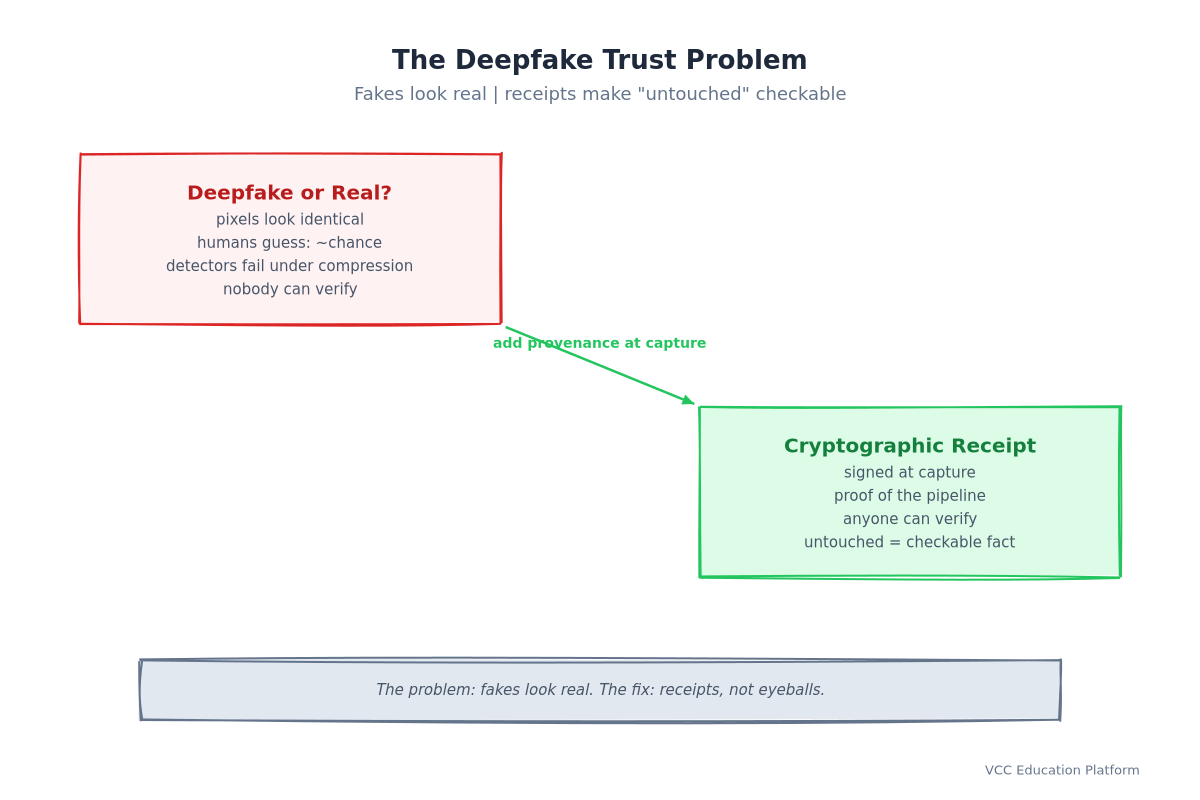
Why deepfake detection keeps losing
Detection is a guessing contest, and generation is a learning contest. Every deepfake detector is a classifier trained on a frozen dataset; every generator is trained with a loss function that is explicitly trying to fool the latest detector. That asymmetry is structural, and the evidence confirms it.
Compression is the deepfake's friend. Platforms re-encode every upload, and compression erases exactly the high-frequency artifacts detectors rely on. On the FaceForensics++ benchmark, detectors that reach roughly 98% accuracy on lightly compressed video fall sharply under heavy compression (the C40 setting), and every model tested loses more ground when moved to a different dataset -- models trained on one generation technique fail to generalize to unseen ones.
Adversarial attacks make it worse. In the 2025 AADD challenge, researchers were asked to add imperceptible perturbations to deepfakes that would defeat four different state-of-the-art detectors while preserving visual similarity. They succeeded, repeatedly. A detector is a static snapshot; an attacker is an adaptive adversary.
Humans are no backup. Nightingale and Farid's peer-reviewed PNAS study found AI-synthesized faces are not only indistinguishable from real faces -- they are rated more trustworthy. And in the iProov study, people were about 36% less likely to spot a fake video than a fake image. "Trust your eyes" fails exactly when it matters most.
This matters in Vietnam today. Celebrity impersonation videos of Lại Văn Sâm, Đan Trường, Khắc Việt and Lý Hải–Minh Hà now circulate on TikTok, Facebook and YouTube selling investments and loans. Scam "deepfake call" kits are rentable on underground platforms for a few hundred thousand đồng. A fake voice of a family member, a fake face of a public figure -- neither can be reliably stopped by looking at them. The intervention has to happen before the image is fake-able, or not at all.
What xác thực nguồn ảnh really means: a receipt, not a guess
Xác thực nguồn ảnh is the practice of verifying three things about an image: where it came from, whether it has been edited, and who vouches for it. The incumbent way to do this is the Coalition for Content Provenance and Authenticity (C2PA) standard, which attaches a cryptographically signed "Content Credential" to a media file. The credential records capture device, editing history, and the signing entity, and it is designed to be tamper-evident: change the pixels or the metadata and the signature breaks.
C2PA has real strengths. Camera makers ship it -- Leica, Nikon, Canon and Google Pixel phones sign images at capture time. In a 2026 pilot, Reuters, Canon and Starling Lab ran a full photojournalism workflow where a camera's embedded key signed each photo at capture, the signature survived editorial ingestion, and it was registered on a public blockchain so downstream verifiers could confirm the photo was the one the photographer captured.
But C2PA has a structural weakness the security literature documents thoroughly. The signature is attached to the file's metadata, and metadata can be separated from pixels. Every major platform -- Instagram, X, TikTok, WhatsApp, LinkedIn -- strips Content Credentials during re-encoding; anyone can sign a claim with a self-issued certificate; validators from Adobe, Truepic and Microsoft have returned contradictory verdicts on the same file; and in a well-known 2025 incident, a Nikon camera whose certificate was revoked after it was used to sign an AI-generated image was still reported as "valid" by a major validator months later. As one security researcher put it: "a strong cryptographic signature around untrusted data does not make the data more trustworthy."
None of this means C2PA is broken. It means provenance attached to pixels keeps breaking, because the attachment and the pixels can be divorced. Which brings us to the fundamental upgrade this article is about: what if the provenance claim were bound inside a proof, so it could not be stripped at all?
How ZKML proves an image is untouched
Zero-knowledge machine learning (ZKML) lets a prover generate a short proof that a computation was executed correctly, without revealing the private inputs to that computation. Applied to images, this unlocks a deceptively powerful move: proving that a model did NOT alter an image.
Here is the trick. Instead of asserting "nothing touched this image" (which cannot be proved), we prove two checkable facts:
- Integrity. The current image bytes hash to exactly the value the capture device committed to. If a single pixel changed, the hash changes and every subsequent proof fails.
- Pipeline continuity. Every declared step between capture and the current file -- crop, resize, compression, denoise -- was itself executed as a proved computation. The chain "camera bytes → current bytes" is provably continuous, with no unaccounted step.
From those two facts, "untouched" is derived, not asserted: if the bytes hash to the post-pipeline commitment and every step in the pipeline was a no-op on the content field, then no generative model inserted anything. Absence of editing costs the same as proving "edited as declared," because both are the same proof over the same chain.
This approach is not speculative. ZK-IMG (Stanford, 2022) built attested cameras that hash images inside a ZK-SNARK circuit, chain transformations privately, and run on commodity hardware at HD resolution. In 2026, researchers at Adobe and the University of Surrey published "soft redaction" techniques that construct ZKPs over C2PA assertions -- proving an image was captured within a certain distance of a location, or that a face matches a hidden registered likeness -- compatible with the existing C2PA standard, built in seconds and verified in milliseconds. Systems like zk-REAL (2026) extend the same idea to repeated edits with lattice hashing, and Brevis Vera (2026) packages C2PA capture signatures with a zero-knowledge virtual machine so that a crop or resize stays verifiably linked to the original source, on-chain.
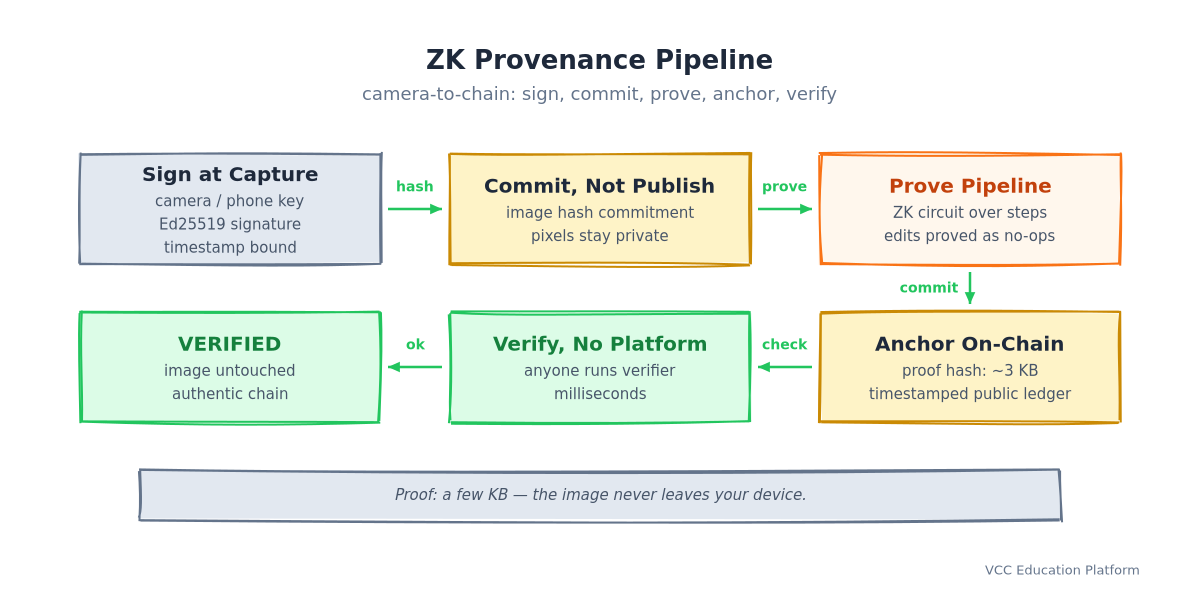
The zk provenance pipeline: camera-to-chain
Zk provenance is the discipline of turning an image's entire life story into mathematical claims that anyone can check. The pipeline has five stages, and -- critically for a world of phones and newsrooms -- the image itself never needs to be uploaded anywhere.
Stage 1: Sign at capture. The moment the shutter closes, the device signs a binding of three things: the image hash, a device/identity key, and a timestamp. On hardware this is a standard Ed25519 signature in a secure enclave or camera firmware; on a phone it can be done by an app at the OS level. The signature is the receipt's root.
Stage 2: Commit, don't publish. A commitment -- a small hash-like fingerprint of the image's current state -- is what enters the proof system. The raw image, the faces in it, the GPS coordinates if sensitive: all can stay private. This is the ZKML privacy win: you can prove things about the image without revealing the image.
Stage 3: Prove the pipeline. Every edit tool in the chain (or the absence of edits) runs its step through the ZK circuit and produces a proof that the current bytes are exactly what the declared operations produce. The output is a proof of a few kilobytes.
Stage 4: Anchor on-chain. The proof hash is written to an open attestation registry -- a blockchain metadata field, an NFT-style record, or a public smart contract. This timestamped anchor means the claim can be checked years later even if the hosting platform disappears, and it binds the proof to the time it was made.
Stage 5: Verify, without trusting the platform. Anyone -- a newsroom, a platform, a regulator, a buyer of a photo -- runs the verifier against the proof and the public commitment. Verification takes milliseconds and needs no central authority. The platform hosting the image becomes irrelevant to the question "is this the image that was captured?" The chain and the circuit answer it.
The cost reality
Uploading a 5 MB photo to a blockchain is absurd; uploading a 3 KB proof of what that photo is is trivial. Verification is milliseconds; proof generation for an image pipeline is seconds to minutes on a normal laptop or phone GPU. The expensive step happens once, at creation, and the check everyone else runs is cheap.
Detection vs cryptographic provenance
The two approaches are not rivals; they are different layers of the same courtroom.
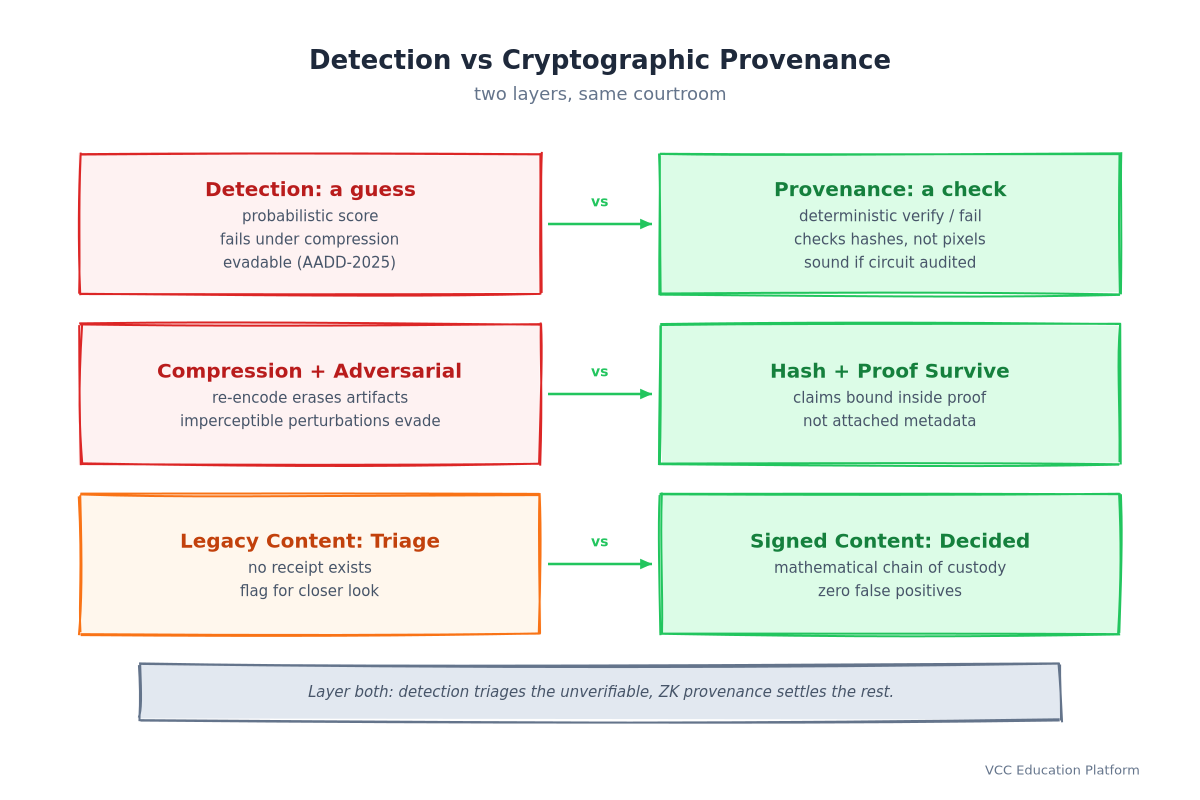
Detection is a forensic expert. It examines the evidence and testifies: "this looks synthetic." It is probabilistic, it degrades under compression, it can be wrong in both directions, and a false negative -- a deepfake the detector lets through -- carries the same social damage as no detector at all. Detection's honest role is triage: flag content that lacks a verifiable receipt for a closer look, and catch the legacy deepfakes already circulating before provenance existed.
Cryptographic provenance is a chain-of-custody exhibit. It does not guess; it checks. A photo with a valid signature chain and a passing ZK proof is mathematically the output of the pipeline it claims to be. Its limits are the limits of cryptography itself: the circuit must faithfully represent the pipeline (the "garbage in, gospel out" problem of ZKML), and the signing key must be protected. But within those bounds, the answer is deterministic.
A platform that combines both gets the best of each: detection catches unverifiable legacy content; provenance settles the provenance-bearing content with zero false positives. And when they disagree -- a detector screams "synthetic" while a proof chain insists "captured by camera X" -- the contradiction itself is a signal that one of the layers has been attacked.
What this means for Vietnam
Vietnam is arriving at provenance at exactly the right regulatory moment. The deepfake problem here is fundamentally a biometric-data problem: scam networks harvest publicly shared faces and voices, clone them, and weaponize the clone. That is why the personal-data regime is the natural frame. Nghị định 13/2023/NĐ-CP (effective 1 July 2023) classified biometric data as sensitive personal data requiring consent and impact assessments -- and its successor, the 2025 Personal Data Protection Law implemented by Nghị định 356/2025/NĐ-CP, keeps that accountability logic at its core. An organization that can produce a signed capture record and a verifiable edit chain is, in effect, demonstrating lawful processing of face and voice data -- exactly the audit evidence the regime demands.
For a Vietnamese newsroom, provenance is a publishing decision. A breaking-news photo with a verifiable signature chain can be published with "authenticated source" confidence; a photo with no chain and a suspicious detector score gets flagged or dropped. For platforms, C2PA-style signals are becoming part of content moderation -- Meta, TikTok and Lazada have all tightened AI-content rules for the Vietnamese market. For creators, a signed original is proof of authorship in the era where your face and voice can be rented by strangers. For regulators, a cryptographic receipt is stronger evidence than a screenshot.
The practical roadmap for a Vietnamese stakeholder is short. For a creator or photographer: shoot with a C2PA-enabled device or a signing app, or sign your finished originals before publishing. For a newsroom: add a verification step that checks signature chains and runs ZK verifiers on provenance-bearing media, and treat unverifiable viral content with the suspicion it deserves. For a platform: integrate detection for triage and provenance verification for deterministic answers, and make AI-content labels machine-readable. For a developer: the tools are open -- zk circuits for image hashing exist today, and anchoring a proof hash to a public ledger costs pennies.
Frequently asked questions
Does ZKML replace deepfake detection?
No. Detection remains essential for the enormous backlog of content that was published before signing became common -- it has no receipt, so triage is the only tool. ZK provenance only protects content that carries a signed chain from capture. The mature architecture runs both layers and treats their disagreement as an alarm.
Can a zk provenance proof be faked?
The proof itself cannot be forged if the circuit is sound and the signing key is protected -- that is the point of the cryptography. What can be wrong is the circuit (proving the wrong pipeline honestly) or the key (an attacker with the capture key can sign anything, as the Nikon case demonstrated). This is why circuit audit and key protection are part of any serious provenance deployment, and why anchoring the proof to a timestamped ledger matters: a claim can be re-signed, but it cannot be re-timestamped.
Do I need a special camera for xác thực nguồn ảnh?
No. C2PA-signed capture is the gold standard and already ships in several flagship cameras and phones, but a signing app at the OS level or a signing step in your editing tool produces a valid chain for images you already own. The strength of the chain depends on how well the signing key is protected and how early in the image's life the signature was applied -- signing at export is weaker than signing at capture, but far better than no signature.
Does on-chain verification cost anything meaningful?
No. What goes on-chain is a proof hash -- a few kilobytes -- not the image. Anchoring a commitment costs a fraction of a cent on modern ledgers, and verification is milliseconds, done by anyone. The expensive operation is proving, which happens once at creation time and can run on a normal laptop.
Conclusion
The deepfake era does not end when detection becomes good enough -- because it never will. It ends when authenticity stops being a guess and becomes a receipt. Zkml chống deepfake reframes the fight: instead of teaching humans and models to spot the fake, we give every authentic image a cryptographic birth certificate that survives the platforms, the re-encodes, and the algorithms. Vietnam's newsrooms, creators, platforms and regulators are standing in front of the same trap -- an identity-layer crime that no amount of careful looking can stop. The exit is not more careful looking. It is a signature at capture, a proof over the pipeline, and an anchor on a public ledger. Three steps, and "untouched" becomes something you can check instead of something you hope.
Quick Reference
| Core benefit | Prove an image is the untouched output of its declared pipeline |
| Primary tool | ZKML + C2PA Content Credentials (signature chain + ZK proof) |
| What is public | Proof hash, commitment, verification key |
| What stays private | Image pixels, faces, GPS, edit details (private witness) |
| Proof size | A few KB -- the image never leaves your device |
| Verification cost | Milliseconds, done by anyone, no trusted platform |
| On-chain cost | Fraction of a cent (proof hash, not the image) |
| Weakness | Circuit must match the pipeline; signing key must be protected |
| Reference systems | ZK-IMG, soft redaction (Adobe), zk-REAL, Brevis Vera |
| Vietnam fit | Newsroom verification; Nghị định 13/2023 → 2025 PDP Law accountability |