
What Is a ZK Bridge? The Short Answer
A ZK bridge (Zero-Knowledge bridge) is a cross-chain transfer protocol that uses zero-knowledge proofs to verify the validity of transactions on one blockchain and execute corresponding actions on another — without trusting any intermediary, committee, or custodian. Think of it like sending money through a bank transfer, but instead of trusting the bank to move your funds correctly, you give the receiving bank a mathematical proof that the sending bank actually locked your money. The receiving bank verifies this proof in seconds, and your money appears on the destination chain. No bank employee can steal, freeze, or misroute it.Key distinction: A "trustless bridge" doesn't mean "no trust at all." It means trust is minimized to cryptography and code — the same assumptions that secure Bitcoin and Ethereum themselves.
The Bridge Problem: Why $2 Billion+ Was Stolen
Before understanding ZK bridges, you need to understand why traditional bridges keep failing.$3
Vitalik Buterin identified three properties a bridge can have — pick two:- Trust-minimized — No honest-majority assumption
- General message passing — Arbitrary data, not just tokens
- Low latency — Fast finality
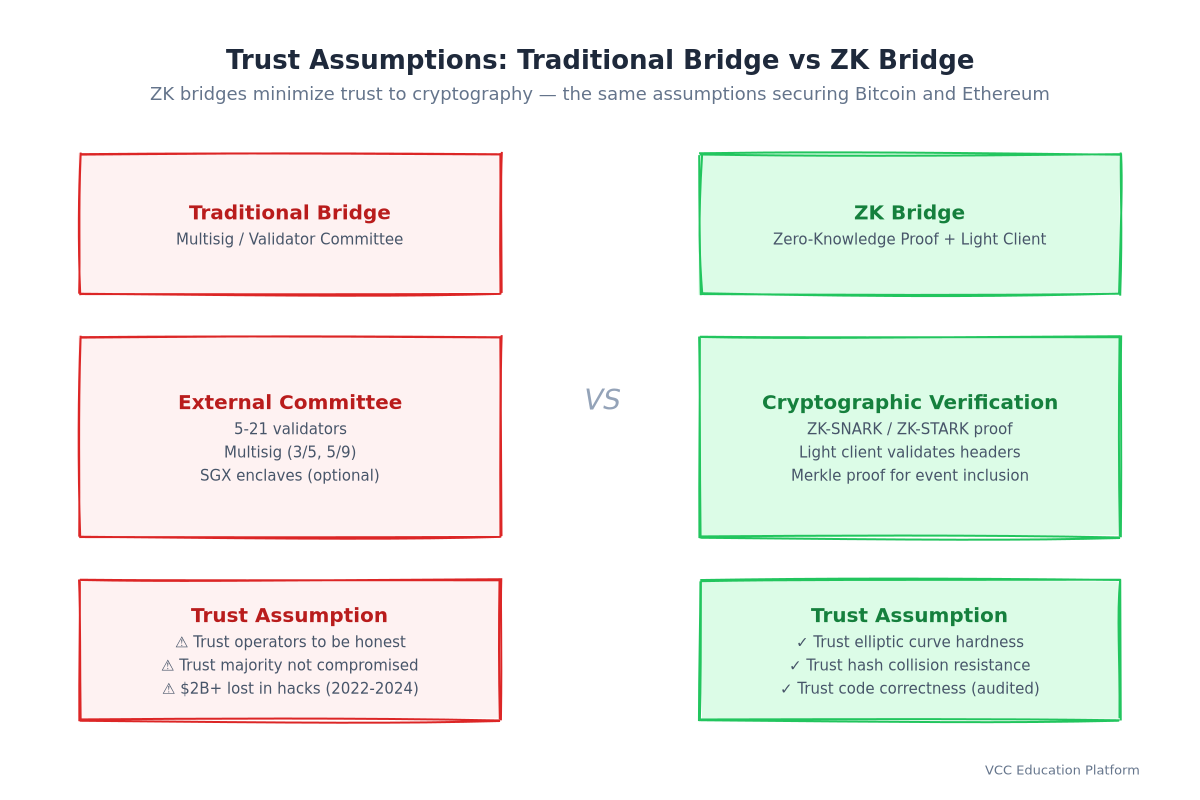
Traditional bridge vs ZK bridge trust assumptions: traditional shows multisig/committee with "trust operators" label in warning red; ZK bridge shows math/cryptography with "trust only code" label in positive green
**$3
Traditional bridges rely on external validators (multisig, PoS validators, SGX enclaves) to attest that "Event X happened on Chain A." If the committee is compromised, the bridge is compromised. ZK bridges replace the committee with a verifiable computation: "Here is a mathematical proof that Event X happened on Chain A."How ZK Bridges Work: Lock → Prove → Verify → Mint
The ZK bridge flow has four phases. Each phase replaces a trust assumption with a cryptographic guarantee.$3
User callslock(amount, destinationChain, recipient) on the bridge contract. Tokens are escrowed. An event TokensLocked(user, amount, nonce, destChain, recipient) is emitted.
**
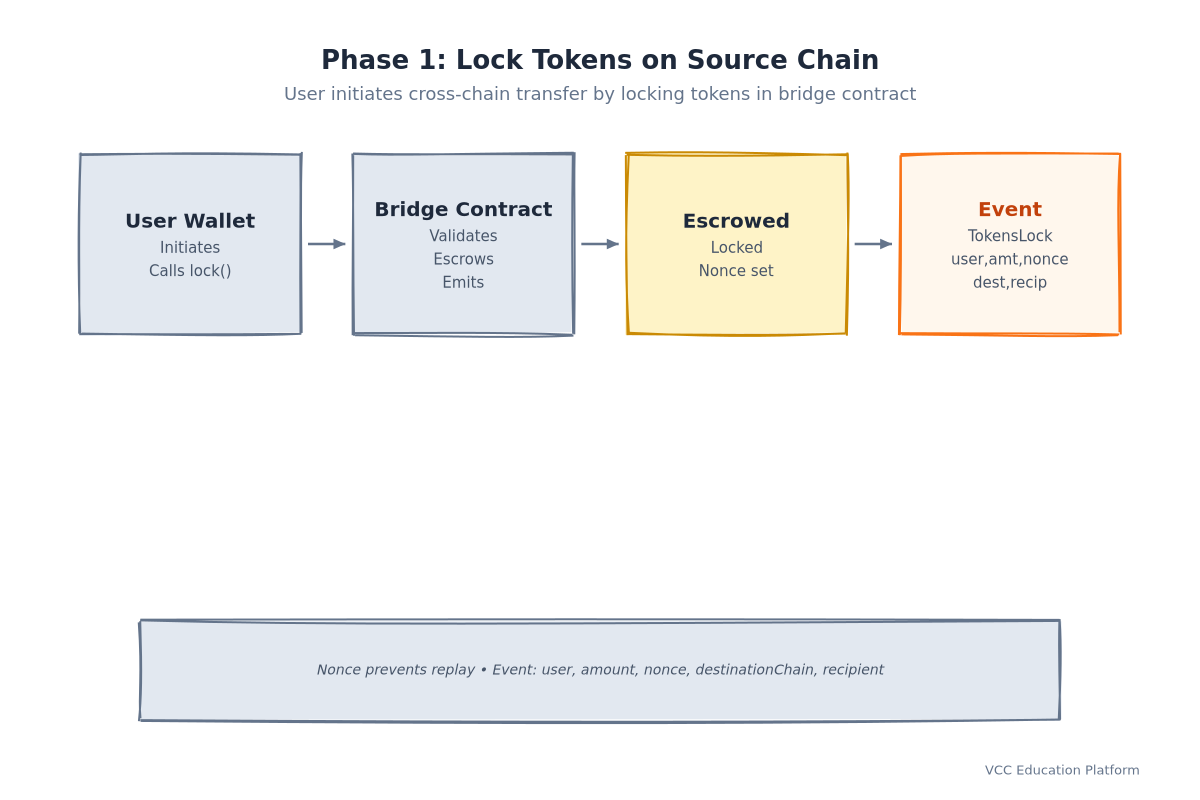
Lock phase: User wallet → Bridge Contract (Lock) → Tokens escrowed → Event emitted with nonce
**$3
A prover (anyone can run one) monitors the source chain forTokensLocked events. The prover:
- Fetches the block header containing the event
- Generates a ZK proof that:
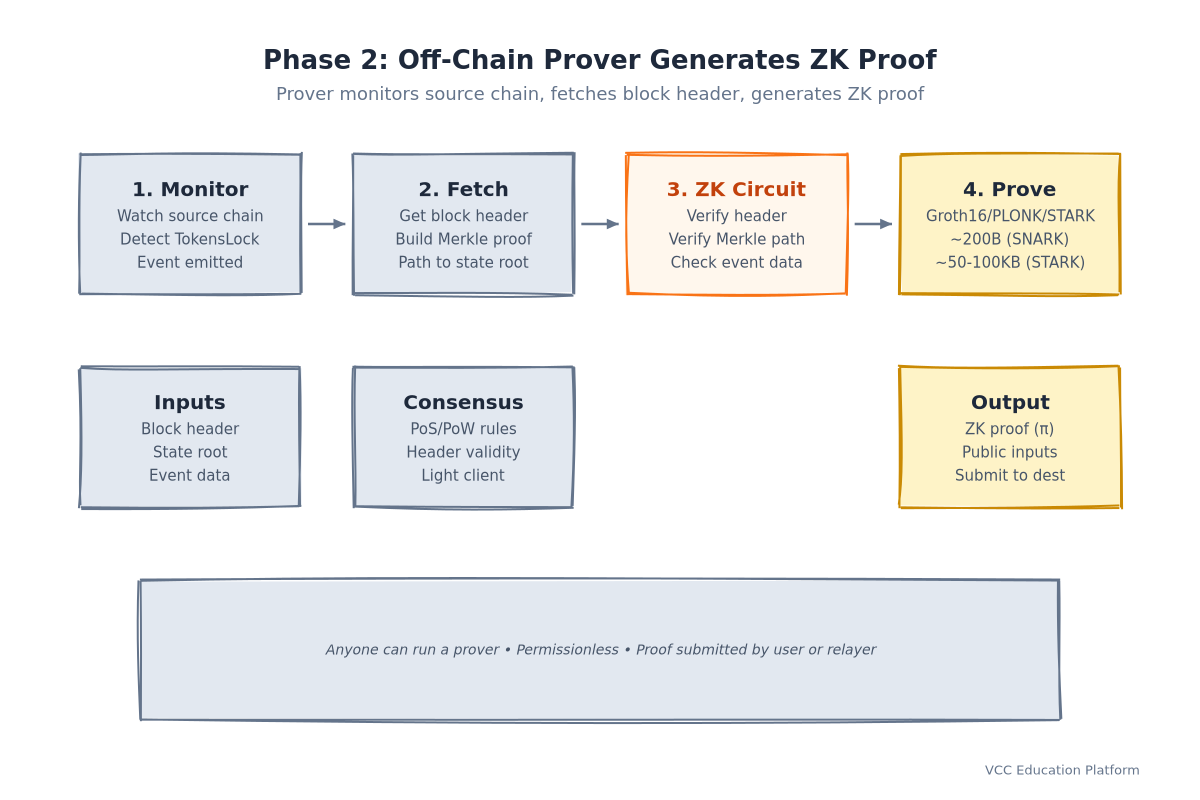
Prover workflow: Block header → Merkle proof → ZK circuit → ZK proof (π)
**$3
The user (or a relayer) submits the proof to the destination chain's verifier contract. The contract:- Checks the proof against the source chain's light client state (block header root)
- Verifies the ZK proof is valid
- If valid: emits
ProofVerified(nonce, amount, recipient)
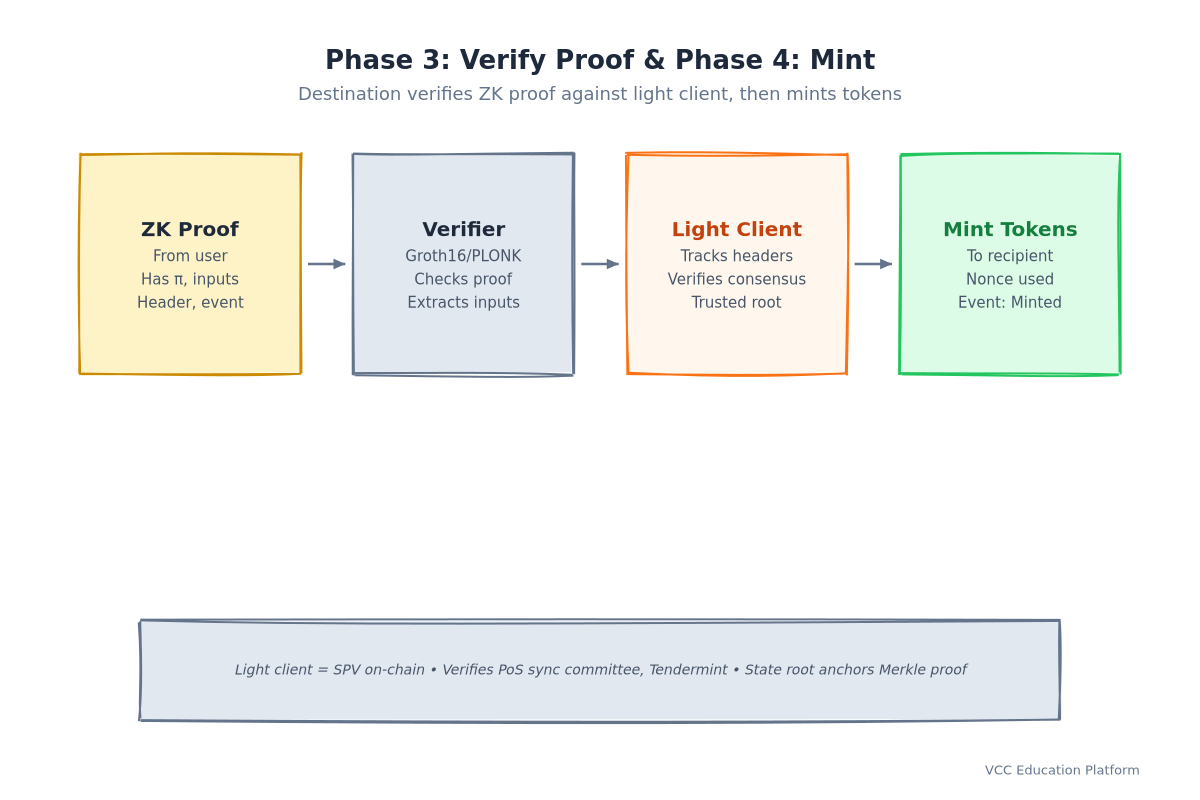
Verify phase: ZK proof → Verifier contract → Light client check → Proof valid? → Mint tokens
**$3
Upon successful verification, the destination bridge contract mints wrapped tokens to the recipient. The nonce prevents replay attacks.ZK-SNARK vs ZK-STARK: Which Proof System?
Not all ZK proofs are equal. The choice affects trust assumptions, proof size, and verification cost. | Property | ZK-SNARK (Groth16, PLONK) | ZK-STARK | |----------|---------------------------|----------| | Trusted Setup | Required (per circuit) | None (transparent) | | Proof Size | ~200 bytes | ~50-100 KB | | Verification Gas | ~200k-300k | ~500k-1M+ | | Quantum Resistance | No (pairing-based) | Yes (hash-based) | | Proving Time | Fast (seconds) | Slower (minutes) | | Recursion | Native (Halo2, Nova) | Native (recursive STARKs) | **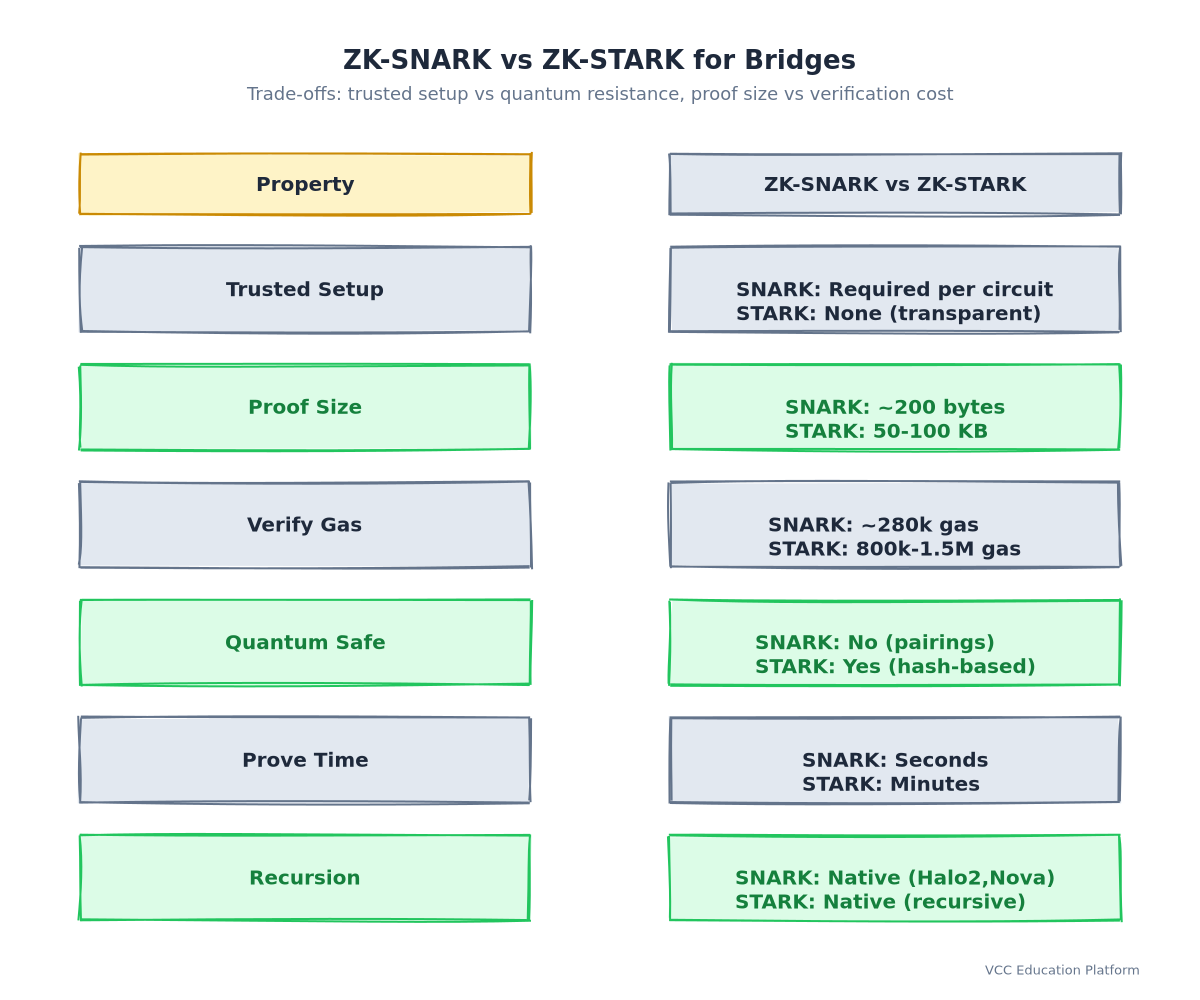
ZK-SNARK vs ZK-STARK for bridges: table with checkmarks/crosses for trusted setup, quantum resistance, proof size, verification cost
**$3
- ZK-SNARK bridges (Polygon zkEVM, Scroll, zkSync): Lower gas, smaller proofs, but require trusted setup ceremonies. Acceptable for EVM-equivalent chains where setup is one-time.
- ZK-STARK bridges (StarkNet, Herodotus, Lagrange): No trusted setup, quantum-safe, but higher gas. Better for heterogeneous chains (EVM → non-EVM) where new circuits are added frequently.
Vietnamese Context: Just as Vietnam leapfrogged landlines to mobile phones, ZK-STARK bridges let new chains skip the "trusted committee" phase entirely — they start with math-based security from day one.
Light Clients: The On-Chain Verification Anchor
A ZK bridge verifier doesn't check the entire source chain. It checks a light client — a smart contract that tracks the source chain's block headers.$3
- Header sync: Relayers submit source chain block headers to the light client
- Consensus verification: Light client verifies headers follow consensus rules (PoW, PoS, BFT)
- State root access: Once header is trusted, its state root is trusted
- Merkle proofs: Events/storage slots proven against the state root
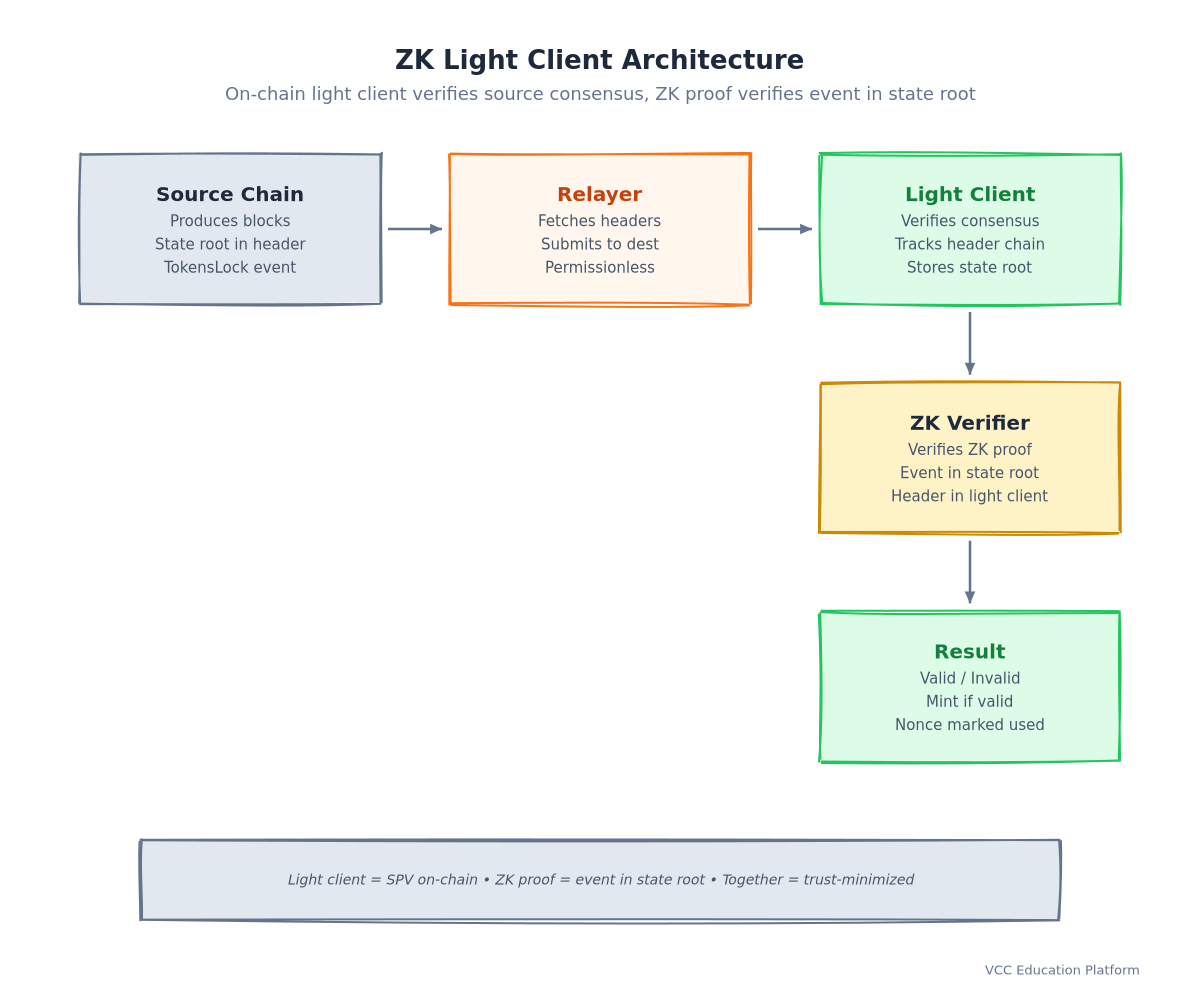
Light client architecture: Source chain → Relayer → Block headers → Light client (verify consensus) → State root → Merkle proof → ZK proof verifies event in state root
**$3
| Light Client Type | Trust Assumption | Examples | |-------------------|------------------|----------| | Full PoS verification | Trust >2/3 validators honest | Ethereum sync committee, Tendermint | | Optimistic header | Trust 1 honest watcher (challenge period) | Optimism fault proofs | | ZK light client | Trust cryptography only | Herodotus, Lagrange, zkBridge | ZK bridges pair ZK light clients with ZK proofs for full trust-minimization: the light client proves "this header is valid," the ZK proof proves "this event is in this header."Real-World ZK Bridge Projects
$3
- Architecture: ZK-SNARK (Groth16) + recursive aggregation
- Chains: Ethereum, BSC, Polygon, Arbitrum, Optimism, Avalanche
- Innovation: Recursive proofs aggregate 100+ block proofs into one
- Status: Mainnet live, 1M+ transfers
$3
- Architecture: ZK-STARK for Ethereum state access
- Use case: Any chain reads Ethereum state trustlessly
- Innovation: "Storage proofs" — prove any storage slot at any block
$3
- Architecture: ZK-SNARK (Halo2) for cross-chain state queries
- Use case: DeFi protocols query balances, prices, governance state cross-chain
- Innovation: ZK coprocessor — off-chain compute, on-chain verify
$3
- Architecture: RISC-V ZK-VM (SP1) proves arbitrary Rust code
- Use case: General message passing, not just tokens
- Innovation: Write bridge logic in Rust, compile to ZK circuit automatically
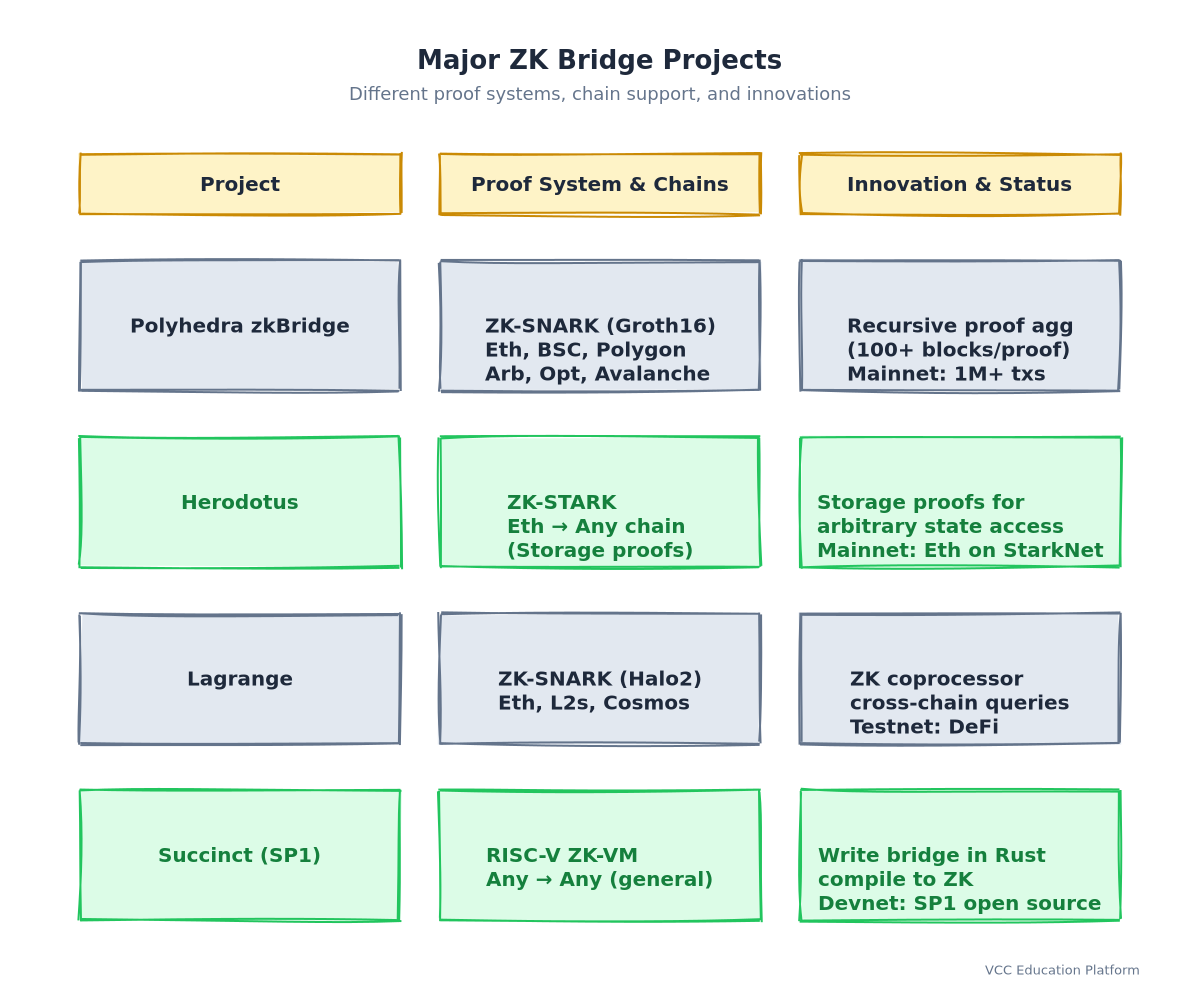
Major ZK bridge projects: table with columns for proof system, chains supported, novelty, status
**The Trade-Offs: Why Isn't Everything a ZK Bridge Yet?
$3
| Operation | Typical Time | |-----------|--------------| | Block finality (Ethereum) | ~15 min | | ZK-SNARK proof generation | 30 sec - 5 min | | ZK-STARK proof generation | 2 - 10 min | | On-chain verification | 1 block (~12 sec) | | Total (SNARK) | ~16-20 min | | Total (STARK) | ~17-25 min | **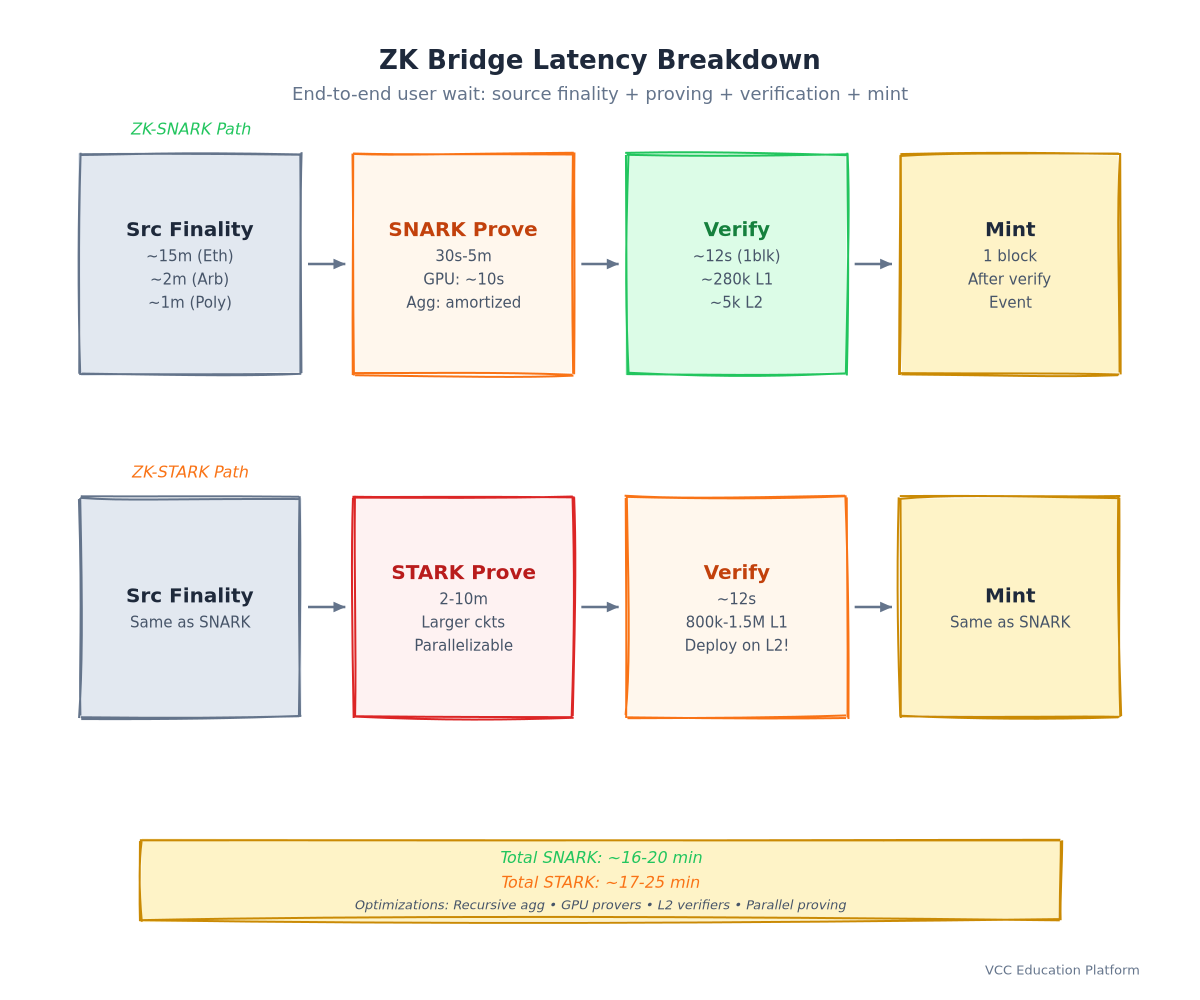
Latency breakdown: Source finality → Proving → Verification → Destination mint = Total user wait time
** Optimization: Recursive proofs (aggregate many blocks), GPU provers, parallel proving.$3
- Groth16 verifier: ~280k gas (~$5-15 on Ethereum L1)
- PLONK verifier: ~350k gas
- STARK verifier: ~800k-1.5M gas
$3
Each new chain or consensus mechanism needs a new ZK circuit. Building and auditing circuits takes months. Solution: ZK-VMs (SP1, RISC Zero, Cairo) let developers write bridge logic in general-purpose languages.$3
ZK bridges prove validity, not liquidity. You still need:- Liquidity pools on destination chain
- Market makers for price discovery
- Mechanisms to rebalance (canonical token bridges,mint/burn)
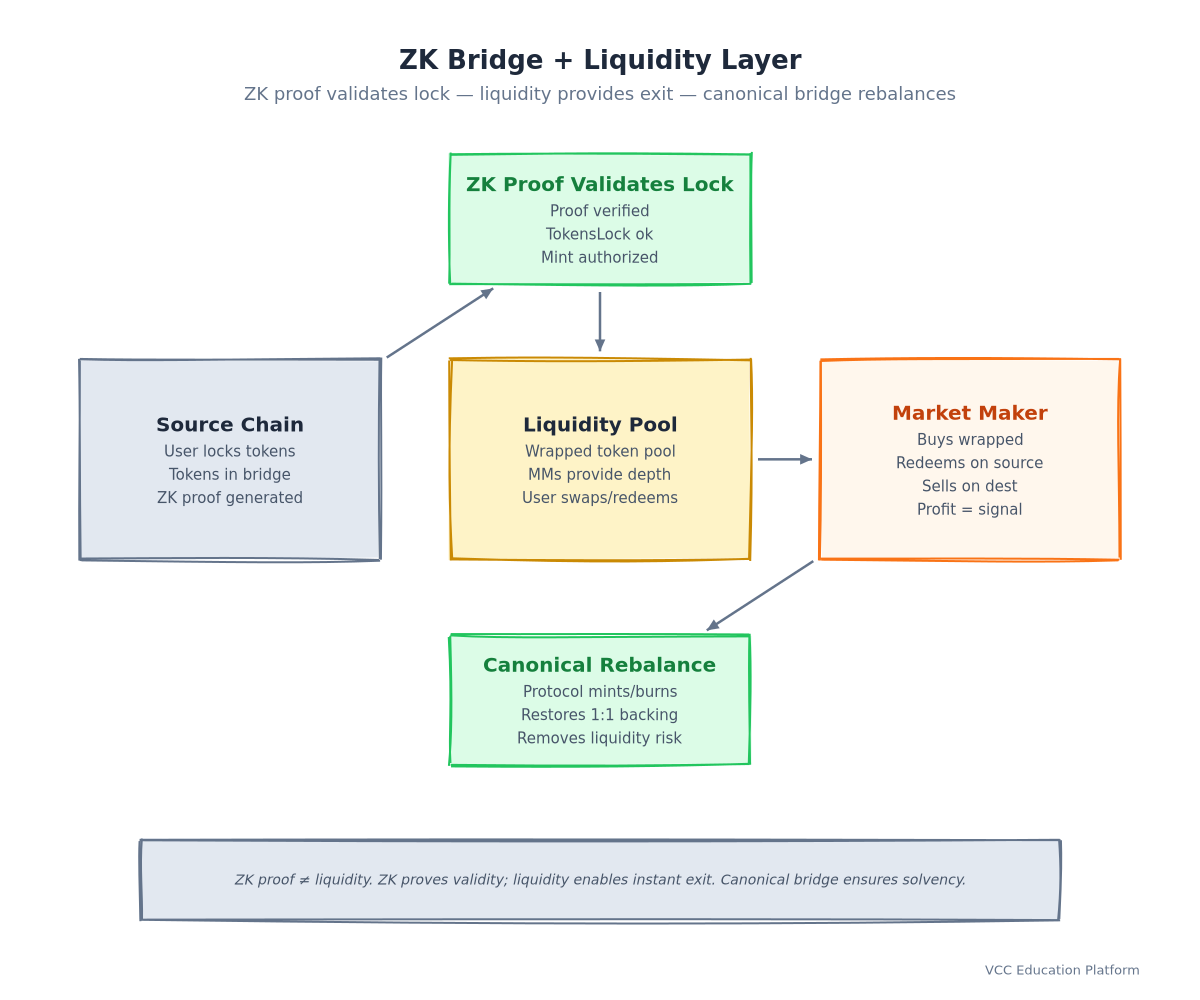
ZK bridge + liquidity layer: ZK proof validates lock → Liquidity pool provides exit liquidity → Market maker arbitrages → Canonical bridge rebalances
**Vietnamese Context: Why ZK Bridges Matter for Vietnam
$3
Vietnam receives $19B+ annually in remittances (top 10 globally). Current flow:`
Overseas worker → Bank/MTO (3-5% fee, 1-3 days) → Vietnamese bank → Recipient
`
ZK bridge flow:
`
Overseas worker → Stablecoin on chain A → ZK bridge (minutes, <0.1% fee) → Stablecoin on chain B → Local off-ramp (MoMo, ZaloPay, bank) → Recipient
`
Savings: ~$500M+ per year in fees for Vietnamese families.
$3
Vietnamese users accessing global DeFi (Aave, Uniswap, Pendle) currently:- Deposit to Binance/OKX → Withdraw to wallet → Bridge (risky) → DeFi
- Direct wallet-to-wallet cross-chain → DeFi
- No CEX KYC, no custodial bridge risk
$3
- Supply chain: Prove goods shipped (IoT + ZK) → Release payment on finance chain
- Carbon credits: Verify forest preservation on MRV chain → Issue credits on registry chain
- Cross-border trade: Letter of credit on trade chain → Settlement on payment chain
Security Checklist: Evaluating Any Bridge
Before using a bridge, ask:- What does the bridge trust?
- Is the proof system audited?
- What happens if the prover goes offline?
- Are funds upgradable?
- Is there a bug bounty?
Bridge security evaluation: 5 questions with checkboxes, risk ratings
**The Future: Aggregation, Standards, and Intent-Based Bridges
$3
Instead of each bridge running its own prover network, aggregation layers (Nexus, Aligned Layer, Gevulot) will:- Collect proofs from many sources
- Recursively aggregate into one proof
- Verify once on Ethereum
- Distribute verification results to all destination chains
$3
New standard for "I want X on Chain B, here's Y on Chain A." Solvers compete to fill intents. ZK bridges provide the settlement layer — solvers prove they filled the intent, ZK bridge verifies and releases funds.$3
Cosmos IBC with ZK light clients instead of full light clients. Enables trust-minimized bridges between Cosmos and EVM chains without running full validators.Summary: ZK Bridges Are the Endgame for Cross-Chain Security
| Bridge Type | Trust Model | Finality | Best For | |-------------|-------------|----------|----------| | Custodial | Trust operator | Minutes | Small amounts, trusted brands | | Optimistic | Trust 1 honest watcher | 7 days | High throughput, EVM ↔ EVM | | ZK Bridge | Trust math only | Minutes | High value, heterogeneous chains | ZK bridges don't just improve bridges — they change the trust model from "trust people/institutions" to "trust mathematics." For a country like Vietnam with massive cross-border flows and growing crypto adoption, this isn't just technical progress — it's financial infrastructure that keeps value in users' hands.FAQ
$3
A: They minimize trust to cryptographic assumptions (elliptic curve hardness, hash collision resistance) and code correctness (circuit audit). This is the same trust model as Bitcoin and Ethereum themselves.$3
A: ZK proofs verify validity (the lock happened), not liquidity (someone wants to buy your wrapped token). You still need AMMs, market makers, or canonical bridges for the asset side.$3
A: Yes, if both chains have:- A light client verifiable in ZK (or a ZK light client)
- A way to submit and verify proofs (smart contracts or native verification)