
Meta Title: Yield Aggregator Protocols: Auto-Compound Your DeFi Returns Meta Description: Compare top yield aggregator protocols: Yearn, Beefy, Harvest. Learn auto-compounding mechanics, risks, and cross-chain strategies. Maximize DeFi yields safely. URL Slug: /yield-aggregator-protocols Primary Keyword: yield aggregator protocols Secondary Keywords: defi yield aggregators, yield farming automation, auto-compounding yields, best yield aggregators, yield aggregator comparison
Every DeFi user knows the routine: deposit into a lending protocol, stake the reward token, claim rewards, swap to the base asset, re-deposit. Repeat daily. Manual yield farming works — until gas fees eat your profits, you miss a compounding window, or a strategy rotates while you sleep.
Yield aggregator protocols solve this by automating the entire cycle. They pool user funds, deploy them into optimized strategies, and continuously compound returns — all without your daily intervention. The result: higher effective APY, lower gas costs per user, and strategies that execute 24/7.
But not all aggregators are equal. Some prioritize security over yield, others chase the highest APY with unaudited code. Some operate on a single chain; others bridge across ecosystems. Understanding the mechanics, risks, and trade-offs is essential before depositing.
This guide breaks down how yield aggregator protocols work under the hood, compares the top players, and gives you a framework to choose the right one for your risk tolerance and capital.
What Are Yield Aggregator Protocols?
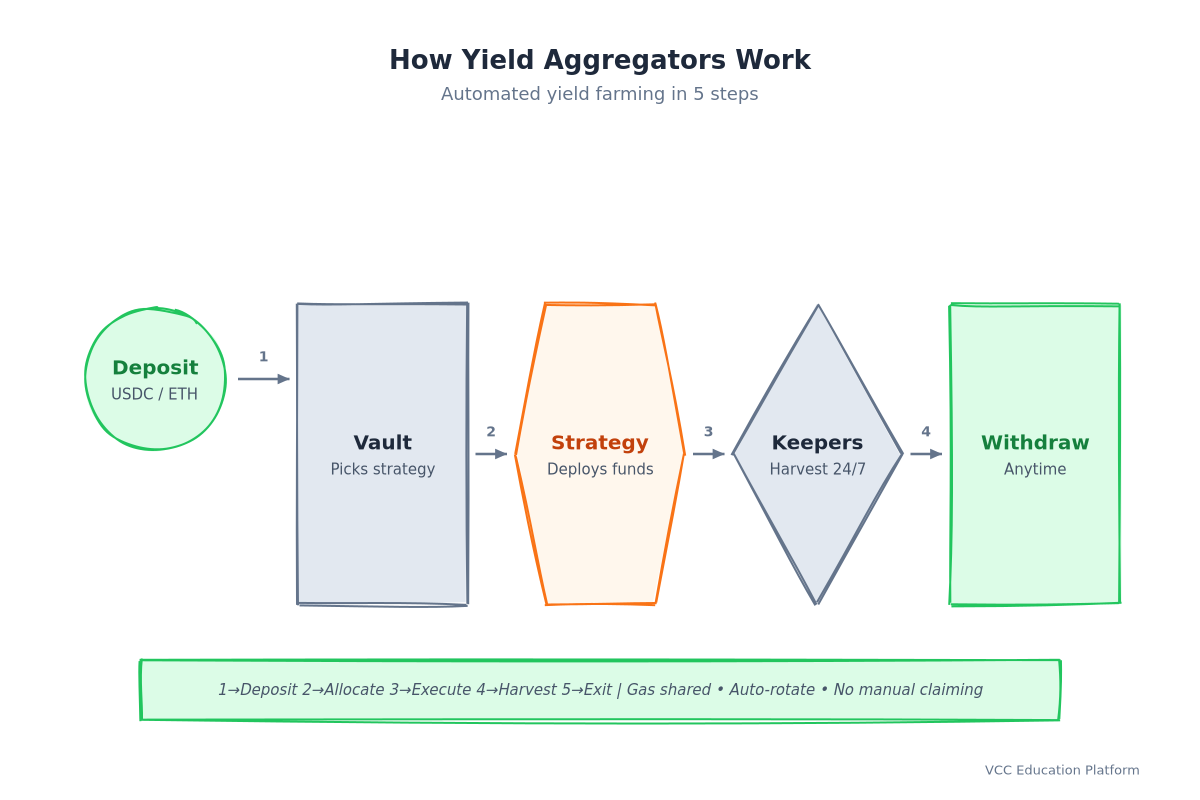
At their core, yield aggregator protocols are smart contract systems that pool user deposits and allocate them across one or more yield-generating strategies. Think of them as automated portfolio managers for DeFi: you deposit a single asset (e.g., USDC), and the protocol handles strategy selection, execution, rebalancing, and compounding.
The Core Value Proposition
| Manual Yield Farming | Yield Aggregator |
|---|---|
| You research strategies | Protocol curates vetted strategies |
| You execute transactions | Keepers/bots execute 24/7 |
| You pay gas per action | Gas shared across pool (batch txs) |
| You compound manually | Auto-compounding every block/epoch |
| You monitor positions | Dashboard + alerts handle monitoring |
| Single-chain typically | Multi-chain via cross-chain vaults |
The magic is yield farming automation at scale. By batching hundreds of users' deposits into a single strategy contract, aggregators amortize gas costs — a 300k gas transaction split 500 ways costs each user ~600 gas instead of 300k.
How They Differ from Lending Protocols
Lending protocols (Aave, Compound) are sources of yield. Aggregators are consumers and optimizers of that yield. An aggregator might deposit your USDC into Aave, stake the aUSDC on a yield optimizer like Beefy, which then deposits into a Curve pool, stakes the CRV rewards on Convex, and auto-compounds the entire stack. Each layer adds yield; the aggregator stitches them together.
How Yield Aggregators Work: Under the Hood
Deposit & Strategy Selection
When you deposit into a Yearn vault or Beefy vault, your funds don't sit idle. The vault controller (governance or algorithmic) selects a strategy — a smart contract that implements a specific yield logic. Strategies are modular: a USDC vault might have strategies for Aave lending, Curve 3pool, Convex staking, or a combination.
Strategy selection criteria typically include:
- Historical APY (trailing 30/90 days)
- TVL depth (liquidity for entry/exit)
- Audit status (Trail of Bits, PeckShield, etc.)
- Smart contract risk score (internal or third-party)
- Correlation with other vault strategies (diversification)
Keeper Networks & Strategy Execution
Strategies don't run themselves. They require keepers — automated bots that call harvest(), tend(), or rebalance() functions at optimal intervals. Keepers are incentivized via:
- Performance fees (a % of harvest profits)
- Gas reimbursement (protocol treasury covers keeper gas)
- Native token rewards (e.g., YFI for Yearn keepers)
Professional keeper networks (Chainlink Automation, Gelato, Keep3r) provide reliable execution. Some aggregators run their own keeper infrastructure; others decentralize it.
Auto-Compounding Mechanism
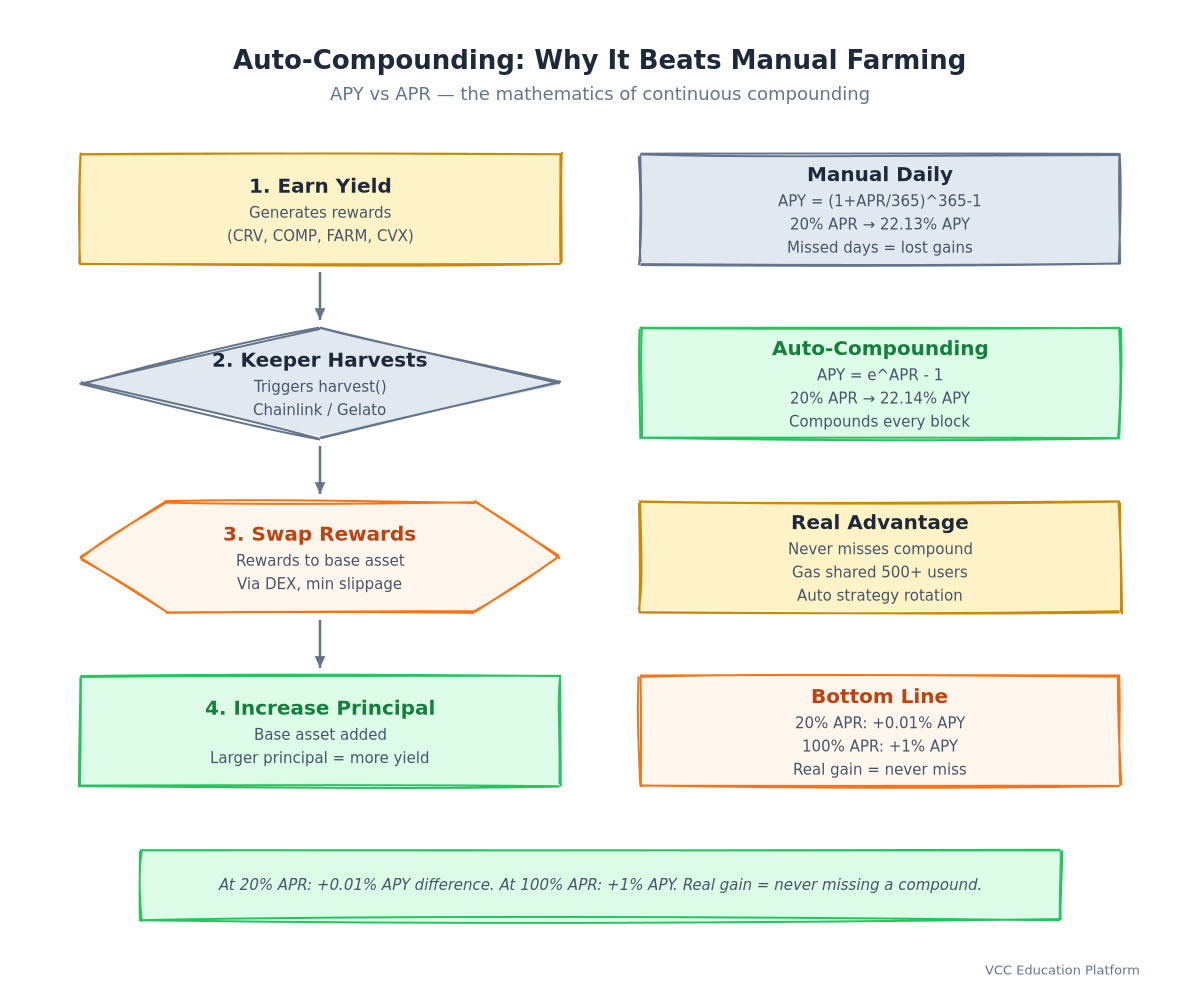
This is where auto-compounding yields create the APY/APR gap. Here's the math:
` Manual (daily compound): APY = (1 + APR/365)^365 - 1 Auto (per-block compound): APY = e^APR - 1 (continuous compounding) `
At 20% APR:
- Manual daily: 22.13% APY
- Auto per-block: 22.14% APY (marginal at low rates)
- At 100% APR: Manual 171% vs Auto 172% — still close
The real gain isn't compounding frequency — it's consistency. Manual farmers miss days, pay high gas on small positions, and fail to rotate strategies. Aggregators compound every harvest (often multiple times daily) with near-zero marginal gas cost per user.
Fee Structure (typical):
- Management fee: 0-2% annually on TVL (Yearn: 0%, Beefy: 0%, some: 1-2%)
- Performance fee: 10-30% of harvest profits (Yearn: 10%, Beefy: 4.5-9.5%)
- Withdrawal fee: 0-0.5% (anti-snipe, usually dynamic)
Top Yield Aggregator Protocols Compared
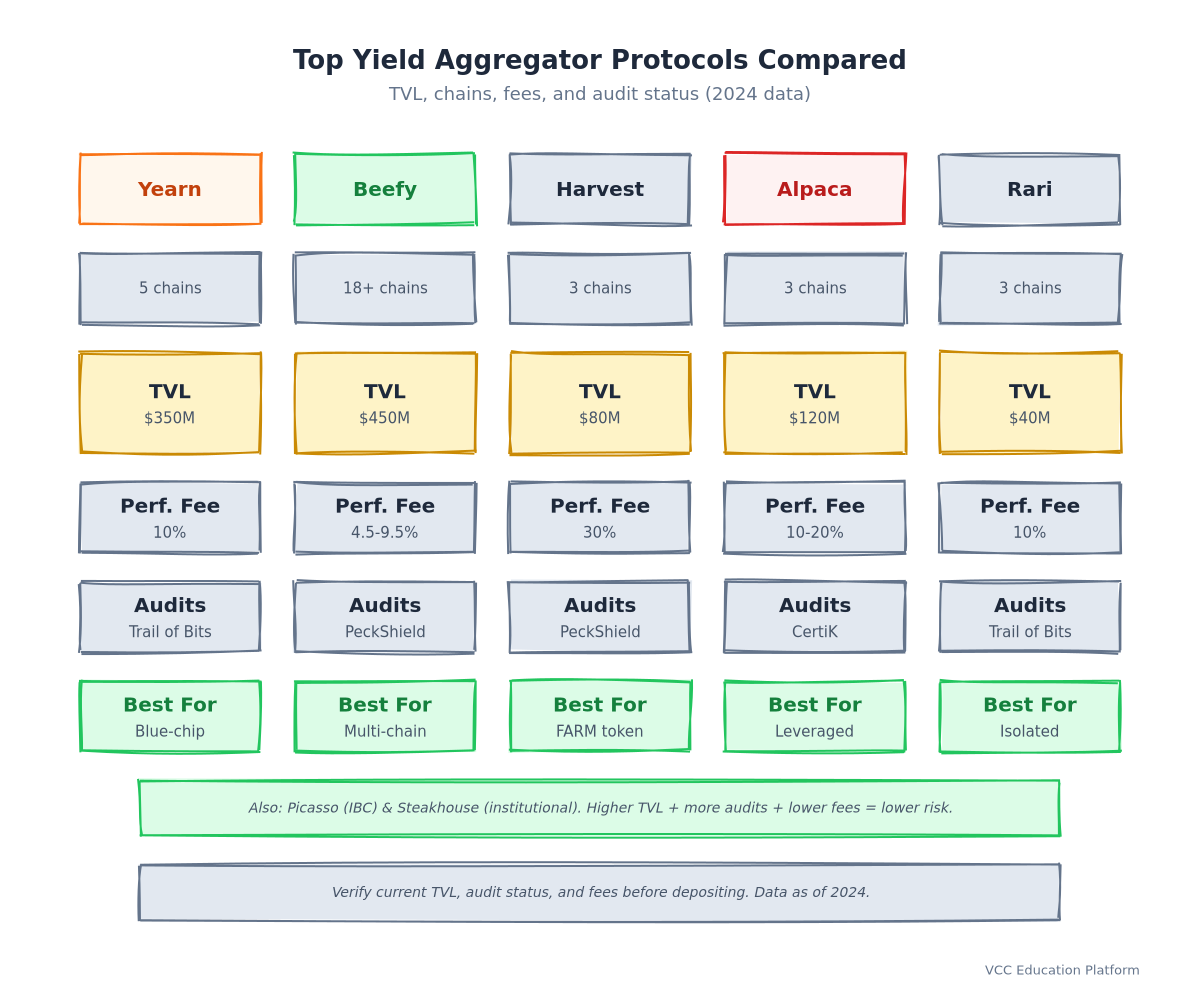
| Protocol | Chains | TVL (2024) | Vaults | Performance Fee | Audit Status | Best For |
|---|---|---|---|---|---|---|
| Yearn Finance | Eth, Arb, Opt, Base, Fantom | ~$350M | 300+ | 10% | Multiple (Trail of Bits, MixBytes) | Blue-chip, governance participation |
| Beefy Finance | 18+ chains (Eth, BSC, Polygon, Arb, Avax...) | ~$450M | 800+ | 4.5-9.5% | PeckShield, CertiK, Hacken | Multi-chain coverage, highest vault count |
| Harvest Finance | Eth, BSC, Polygon | ~$80M | 100+ | 30% (FARM buyback) | PeckShield, Quantstamp | FARM token exposure, BSC native |
| Alpaca Finance | BSC, Fantom, Eth | ~$120M | 50+ (leveraged) | 10-20% | CertiK, PeckShield | Leveraged yield, lending + farming |
| Rari Capital | Eth, Arb, Opt | ~$40M | 30+ | 10% | Trail of Bits | Isolated pools, Fuse lending |
| Picasso (Composable) | Cosmos, Polkadot, Eth | ~$25M | 20+ | Variable | Multiple | Cross-chain (IBC), DeFi legos |
| Steakhouse Financial | Eth, Arb | ~$15M | 15+ | 10% | Trail of Bits | Institutional-grade, DAO treasuries |
Yearn Finance: The Pioneer
Launched 2020 by Andre Cronje. Yearn V3 (2023) introduced tokenized strategies — each strategy is an ERC-4626 vault, composable and permissionless. Governance (YFI holders) controls fee switches, strategy approval, and treasury. Best for: users wanting battle-tested code and governance say.
Beefy Finance: The Multi-Chain Leader
Deployed on 18+ chains with 800+ vaults. Beefy's cowcentrated vaults concentrate liquidity on Uniswap V3 for higher fee capture. Native BIFI token earns protocol revenue share. Best for: users farming across multiple L1s/L2s.
Harvest Finance: The FARM Ecosystem
FARM token captures 30% performance fees via buyback-and-distribute. Strong on BSC and Polygon. Higher fee but token upside. Best for: users bullish on FARM tokenomics.
Emerging Players
- Rari Capital Fuse: Isolated lending pools — a hack in one pool doesn't affect others
- Picasso: Cross-chain via Composable Finance's IBC + Centauri bridges
- Steakhouse: DAO treasury management, institutional onboarding, custom strategies
Key insight: TVL alone doesn't indicate quality. A $50M vault with 2 audits and 2 years live > $200M vault with 1 audit and 3 months live.
Cross-Chain Yield Aggregation: The Next Frontier
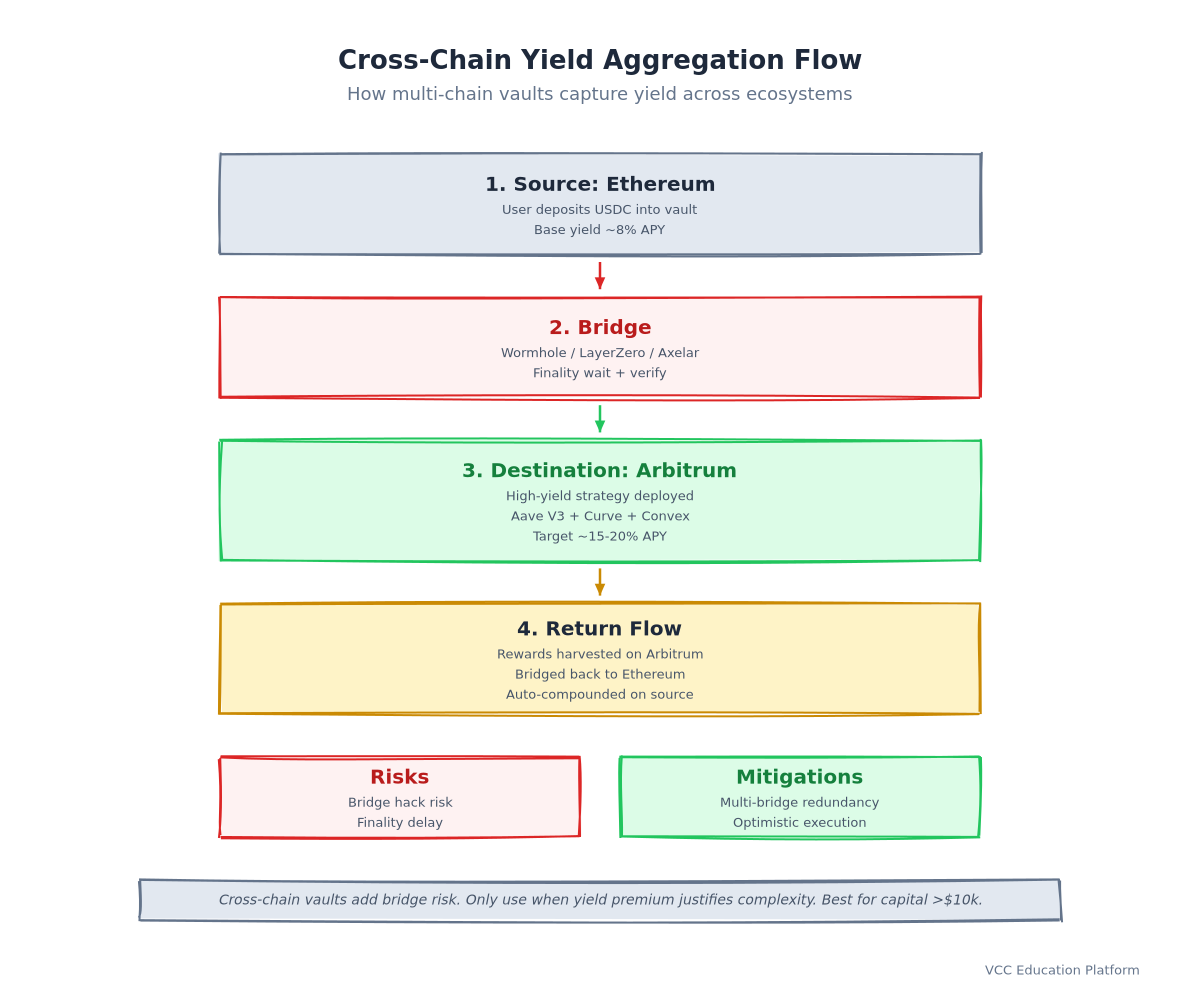
Single-chain aggregators hit a ceiling: the best yield on Ethereum mainnet might be 8% while Arbitrum offers 15% and Solana 20%. Cross-chain yield aggregators bridge this gap.
How It Works
- User deposits USDC on Ethereum
- Protocol bridges to target chain (via Wormhole, LayerZero, Axelar, or native bridge)
- Funds deployed into high-yield strategy on destination chain
- Rewards harvested, bridged back, auto-compounded on source chain
- User withdraws on original chain
Bridge Risks & Mitigation
| Risk | Mitigation |
|---|---|
| Bridge hack | Use multiple bridges, limit per-bridge exposure |
| Finality delay | Optimistic execution with fraud proofs |
| Liquidity fragmentation | Aggregator maintains liquidity pools on each chain |
| Gas cost variance | Batch bridging, execute during low-fee windows |
Current leaders: Beefy (native multi-chain vaults), Picasso (IBC-based), Yearn (V3 multi-chain strategies via partner vaults).
Risk Assessment Framework
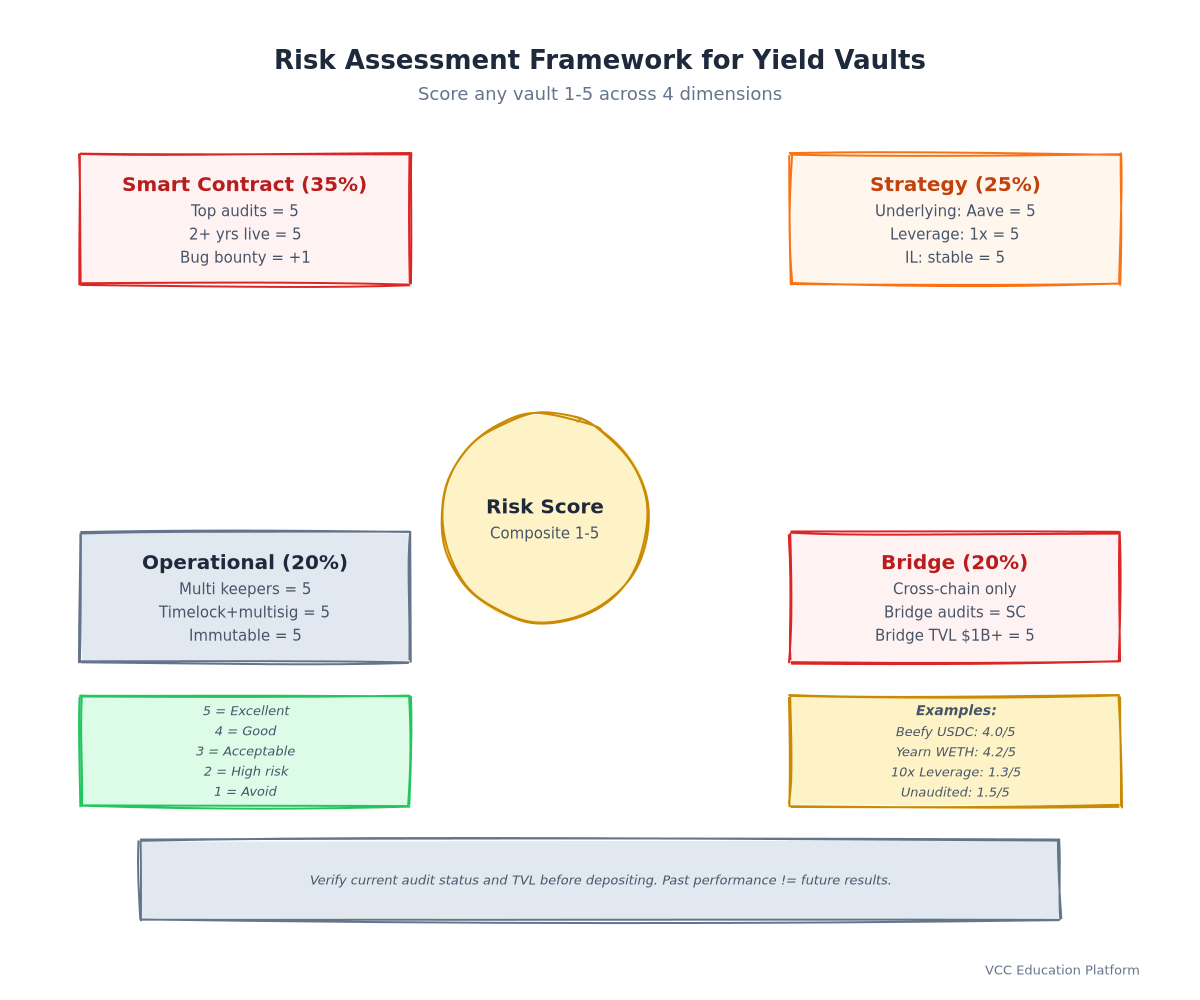
Not all yield is created equal. Use this framework to score any vault before depositing.
1. Smart Contract Risk (Weight: 35%)
- Audit count & quality: 3+ top-tier audits = 5/5; 1 audit = 2/5; unaudited = 0/5
- Time in production: 2+ years no incidents = 5/5; <6 months = 1/5
- Bug bounty: Active Immunefi program >$100k = +1
- Formal verification: Yes = +1
2. Strategy Risk (Weight: 25%)
- Underlying protocol risk: Aave/Compound = 5/5; new unaudited protocol = 1/5
- Leverage used: 1x = 5/5; 3x+ = 2/5 (liquidation risk)
- Impermanent loss exposure: Stable-stable = 5/5; volatile-volatile = 2/5
- Strategy complexity: Single protocol = 5/5; 5+ hops = 2/5
3. Operational Risk (Weight: 20%)
- Keeper decentralization: Multiple independent keepers = 5/5; single keeper = 2/5
- Governance risk: Timelock + multisig = 5/5; single EOA = 1/5
- Upgradeability: Immutable = 5/5; proxy with 48h timelock = 3/5; no timelock = 1/5
4. Bridge Risk (Weight: 20% — cross-chain only)
- Bridge audit status: Same as smart contract risk
- Bridge TVL & history: $1B+ TVL, 1+ years = 5/5
- Redundancy: Multiple bridge routes = 5/5; single bridge = 2/5
Scoring Example: Beefy USDC Vault (Arbitrum)
- Smart Contract: 4/5 (multiple audits, 2+ years)
- Strategy: 4/5 (Aave + Curve, no leverage)
- Operational: 4/5 (decentralized keepers, timelock)
- Composite: 4.0/5 → Low risk
Scoring Example: New Unaudited 10x Leverage Vault
- Smart Contract: 1/5
- Strategy: 1/5 (10x leverage, new protocol)
- Operational: 2/5
- Composite: 1.3/5 → Avoid
Gas Optimization & Advanced Strategies
Modern aggregators go beyond simple auto-compounding:
Batch Transactions
Multiple user deposits/withdrawals aggregated into single transaction. Gas savings: 80-95% per user.
ERC-4337 Account Abstraction
User operations bundled by bundlers; aggregator pays gas in ERC-20, user pays in any token. Enables gasless deposits for end users.
Intent-Based Execution
Users sign "intents" (I want to deposit USDC into best vault); solvers compete to execute optimally. Reduces MEV, improves pricing.
ZK-Rollup Integration
Yearn V3 on zkSync, Beefy on zkEVM — lower L2 fees enable higher-frequency compounding (hourly vs daily).
How to Choose the Right Yield Aggregator
Flowchart - Decision tree for choosing a yield aggregator
Decision Framework
Step 1: Define your constraints
- Chains you use → filters protocols (Beefy for multi-chain, Yearn for Eth/L2)
- Risk tolerance → filters vaults (stablecoin only = low risk)
- Capital size → gas sensitivity (small capital favors batch-optimized aggregators)
Step 2: Score top 3 vaults using risk framework above
Step 3: Compare net APY (after fees)
- Gross APY × (1 - performance fee) - management fee = net APY
- Example: 20% gross, 10% perf fee, 0% mgmt = 18% net
Step 4: Check liquidity & exit
- Vault TVL > $10M for <$100k deposits
- Withdrawal queue time (some vaults have cooldowns)
Step 5: Monitor & rebalance quarterly
- Strategy performance drifts
- New vaults launch with better yields
- Protocol upgrades change risk profile
FAQ
Q: What is the difference between APY and APR in yield aggregators? A: APR is simple interest; APY includes compounding. Aggregators auto-compound, so their displayed APY assumes continuous compounding. Always compare net APY after fees.
Q: Are yield aggregator protocols safe? A: They add a layer of smart contract risk (the vault + strategy contracts) on top of underlying protocol risk. Use the risk framework above. Blue-chip aggregators (Yearn, Beefy) have strong track records but are not risk-free.
Q: Which yield aggregator has the highest APY? A: Highest APY often correlates with highest risk. Leveraged vaults (Alpaca) or new unaudited strategies may show 50-100%+ APY but carry liquidation and smart contract risk. For sustainable yields, compare risk-adjusted returns.
Q: Can I use yield aggregators with a hardware wallet? A: Yes. All major aggregators support Ledger, Trezor, GridPlus via WalletConnect or direct connection. Always verify the contract address on the device screen.
Q: How are yield aggregator fees calculated? A: Performance fee: % of profits at each harvest (e.g., 10% of $100 profit = $10 to protocol). Management fee: % of TVL annually, accrued continuously. Both reduce your net APY.
Q: What happens if a strategy gets hacked? A: Only funds in that specific strategy are at risk (isolation). Yearn V3 and Beefy use per-strategy isolation. Protocol treasury may cover losses (Yearn has $50M+ treasury, Beefy has insurance fund), but not guaranteed.
Last updated: 2024. Data from DeFiLlama, protocol docs, audit reports. Not financial advice. Always do your own research.