
You have heard "crypto," "tiền ảo," "Bitcoin," "ADA" — but if someone asked you to explain what a cryptocurrency actually is, in one sentence, could you? Most people can't, and that is not your fault: most explainers either drown you in jargon ("DLT-secured digital asset with algorithmic monetary policy") or hype it as a get-rich ticket. This article does neither. By the end you will be able to explain cryptocurrency to a friend, in one sentence, and you will know exactly how it differs from the money in your Momo wallet.
Here is the one-sentence version: a cryptocurrency is digital money whose supply and ownership are enforced by software rules on a shared public ledger, instead of by a bank or government. That is the whole idea. Everything else — wallets, keys, transactions, coins vs tokens — is just the machinery that makes that money work. Let's unpack it.
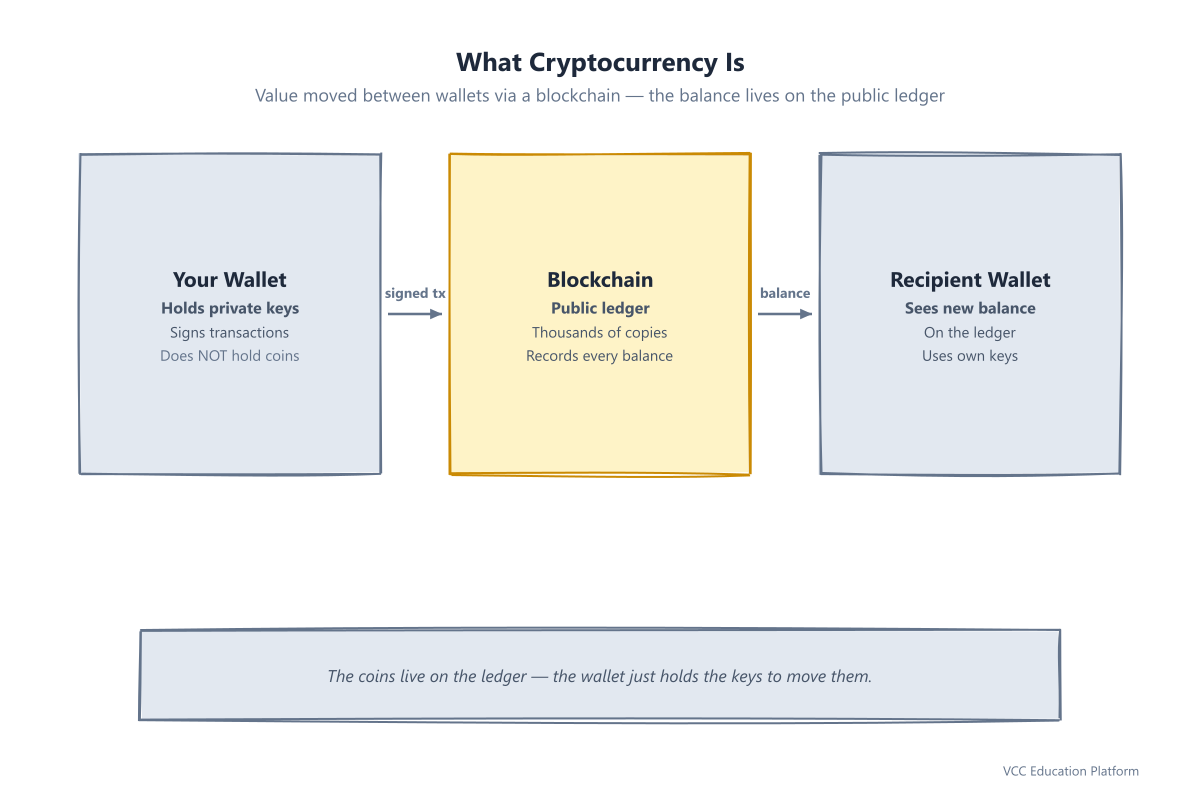
Figure 1: Cryptocurrency is value moved between wallets via a blockchain — the balance lives on the public ledger
The Mental Model: It Is Not "in" Your Wallet App
The fastest way to understand cryptocurrency is to compare it to something you already use. If you have Momo or ZaloPay, you see a "balance" on your phone. But that balance is really a claim on money sitting in a bank account — the e-wallet company holds the bank deposit and shows you a mirror of it. The money is in the bank; the app just lets you move it.
Cryptocurrency flips this. The balance is recorded on the public ledger itself — there is no bank behind it. Your "wallet" is not a container holding coins; it is a small program that holds your private keys — the secret passwords that let you prove you own a given balance and authorize a transfer. Lose your keys and the coins do not vanish (they are still on the ledger), but nobody can move them — including you. That is why "back up your seed phrase" is the first rule of crypto: you are backing up the keys, not a balance.
For a Vietnamese reader, this answers the most common fear — "tiền ảo, vậy tiền đâu?" (it's virtual, so where is the money?). The money is on the blockchain, a public, tamper-resistant record that thousands of computers keep identical copies of. It is no more "in your phone" than a land title is "in the paper" — the paper just proves who owns it.
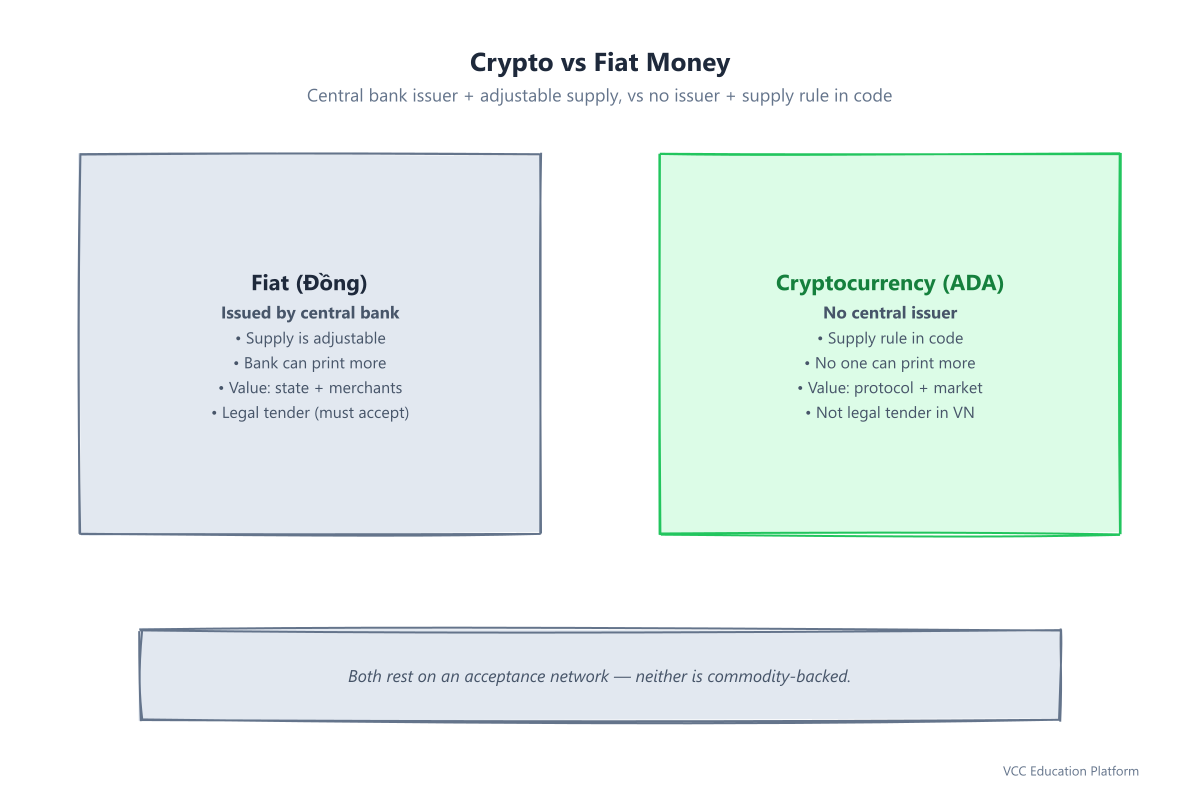
Figure 2: Crypto vs fiat — central bank issuer vs no issuer, supply rule in code
How Crypto Differs from Regular Money (Đồng)
The cleanest way to see the difference is to ask one question: "Ai phát hành?" (who issues it?)
- Fiat money (đồng, dollar, euro) is issued by a central bank. The State Bank of Vietnam decides how much đồng exists. It can print more or change interest rates. The money has value because the state declares it legal tender and merchants accept it.
- Cryptocurrency has no central issuer. The supply rule is written into the protocol's code, and it is enforced by the same network of nodes that process transactions. No person, no company, no central bank can quietly create more. Bitcoin's supply is capped at 21 million. Cardano's ADA is capped at 45 billion. To change those caps, you would have to convince the majority of independent node operators to run new software — and they have no reason to dilute their own holdings.
A common criticism is that crypto is "backed by nothing." This is half-true but misleading: modern fiat is also not backed by gold (that ended in 1971). Both rest on an acceptance network — fiat on state authority and merchant trust, crypto on protocol rules and market demand. Neither is "backed" the way a gold certificate used to be. The honest statement is: value comes from people willing to accept it, however that willingness is produced.
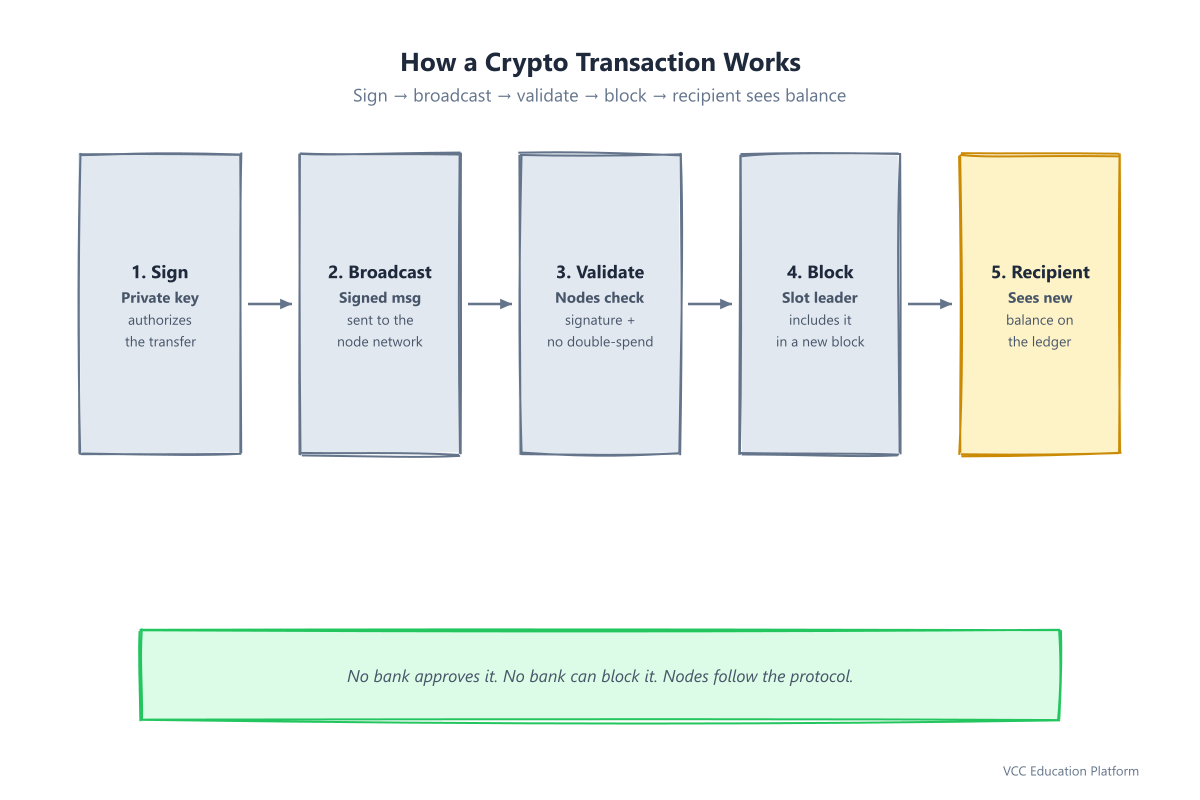
Figure 3: How a crypto transaction works — sign, broadcast, validate, block, recipient
How a Crypto Transaction Actually Works
You do not need to understand cryptography to grasp the flow. It mirrors how you would hand over cash, except the "handing over" is done with math:
- You sign. Your wallet uses your private key to sign a message saying "send X ADA to this address." The signature proves you authorized it, without revealing your key.
- You broadcast. The signed transaction goes out to the network of nodes.
- Nodes validate. Each node checks: is the signature valid? Does the sender actually have X ADA? Has that ADA already been spent (a "double-spend" check)? If all checks pass, the transaction is valid.
- A block producer includes it. On Cardano, a randomly chosen slot leader bundles valid transactions into a new block and links it to the chain.
- The recipient sees the new balance. Once the block is added, every node updates its copy of the ledger, and the recipient's wallet reflects the incoming ADA.
Notice what is missing: no bank approves it, no bank can block it. The validation is done by independent nodes following the protocol. The fee you pay (a fraction of an ADA on Cardano) goes to the network, not to a middleman. That is the structural difference from a bank transfer, where a single institution decides whether your payment goes through.
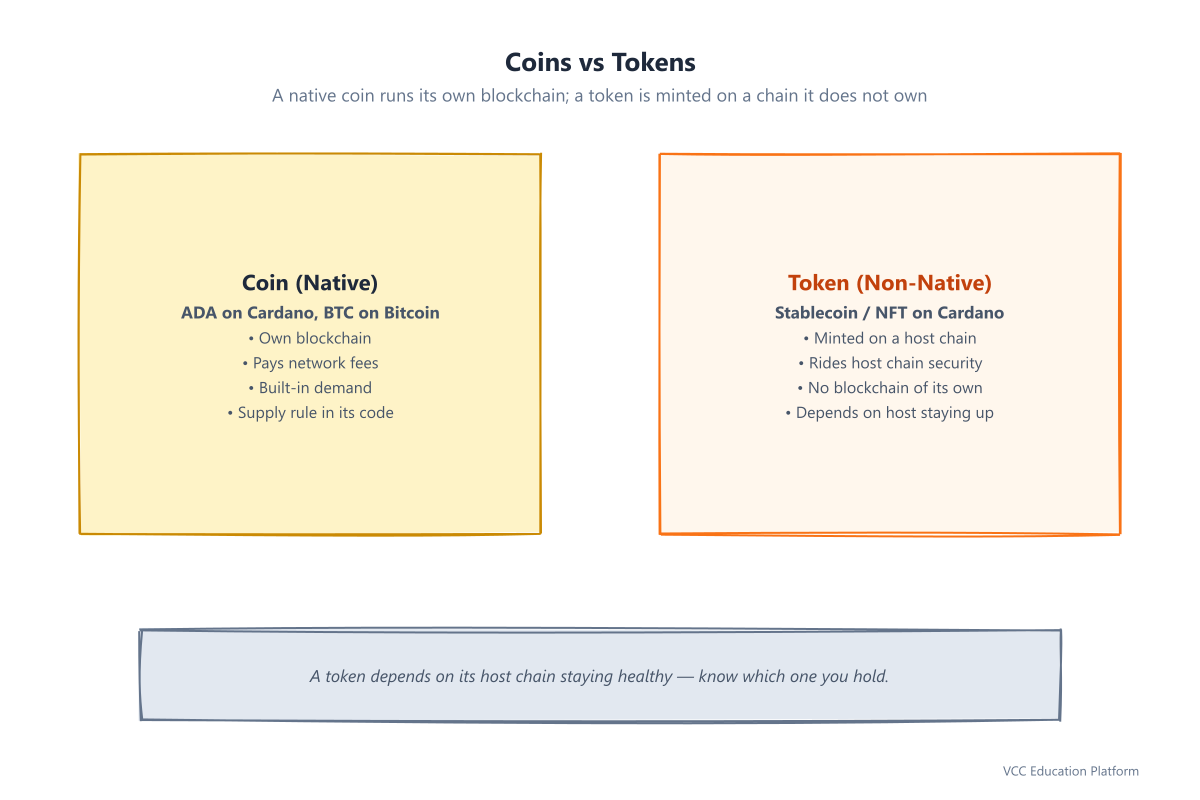
Figure 4: Coins vs tokens — native coin on its own chain vs token minted on a host chain
Coins vs Tokens: A Distinction Beginners Miss
People use "cryptocurrency" loosely for everything, but there is an important split:
- A coin is the native asset of its own blockchain. ADA is the native coin of Cardano; BTC is the native coin of Bitcoin. Every transaction on that chain pays fees in the native coin, which is why the coin has built-in demand.
- A token is an asset minted on top of a blockchain it does not own. On Cardano, anyone can mint a native token (a stablecoin, an NFT, a reward token) without writing a smart contract, thanks to the Mary era upgrade. That token rides on Cardano's security but is not ADA.
Why does this matter? Because a token's value depends on the chain it lives on staying healthy, while a coin's value is tied to the chain's own usage. If you hold a token on Cardano and Cardano's network slows down, your token moves slowly too — even if the token's own project is fine. Beginners often buy "a crypto" without knowing whether it is a coin (its own chain) or a token (riding someone else's). Knowing the difference is the first step past the hype.
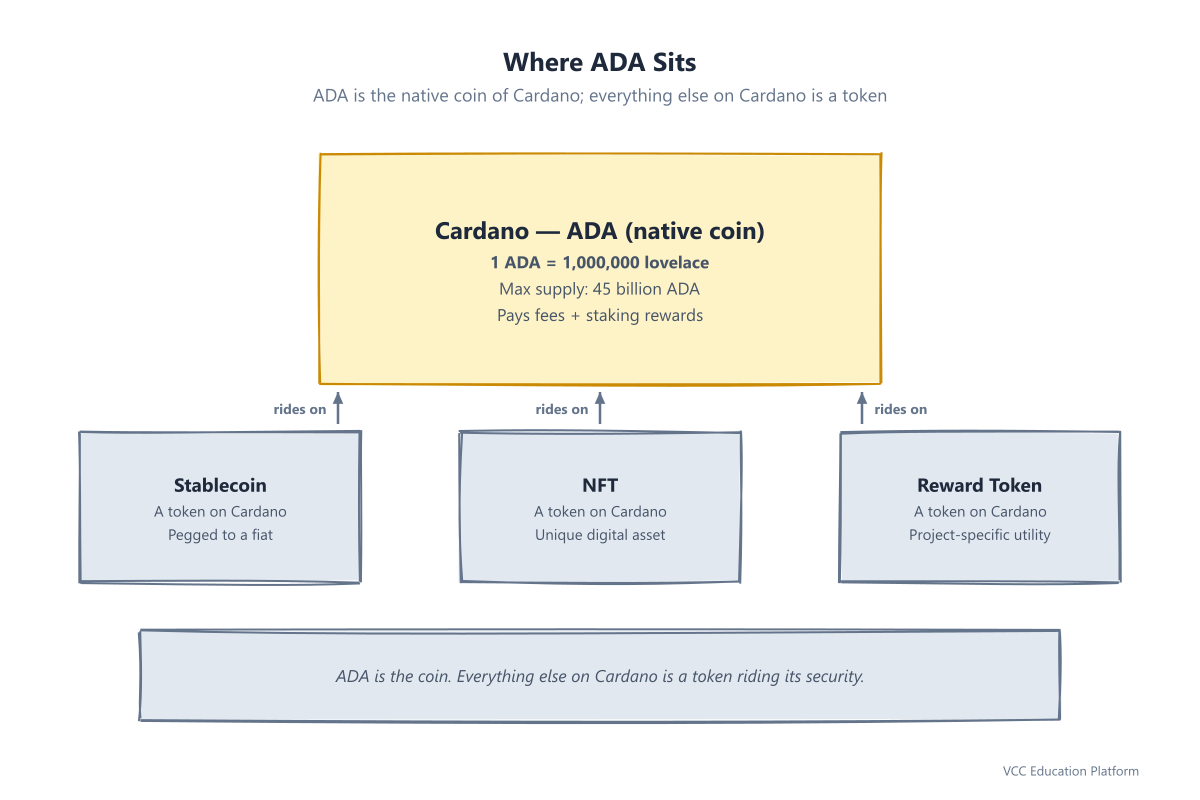
Figure 5: Where ADA sits — Cardano native coin with token examples riding its security
Where ADA Fits In
ADA is the native coin of Cardano. A few facts that ground the concept:
- Smallest unit: 1 ADA = 1,000,000 lovelace. Lovelace is to ADA what a cent is to a đồng — the smallest denomination. Fees and amounts are calculated in lovelace under the hood.
- Max supply: 45,000,000,000 ADA, minted at genesis. A defined reserve is released over time to fund staking rewards and the treasury. The cap is a protocol rule, not a policy a committee can quietly raise.
- Use: You pay transaction fees in ADA, delegate ADA to a stake pool to earn rewards, and use ADA as the settlement asset for tokens minted on Cardano.
If you are starting from zero, ADA is a reasonable first coin to understand because Cardano's fees are low and predictable (typically a fraction of 1 ADA), so you can experiment without fearing a $30 fee on a $5 transfer.
What Cryptocurrency Is NOT (The Honesty Section)
A good teacher spends as much time on what something is not as on what it is:
- "Crypto is anonymous cash." No. Cardano and Bitcoin are pseudonymous, not anonymous. Every transaction is visible on a public explorer, tied to an address. With enough analysis, addresses can be linked to people. True privacy requires extra tools; the base chains are not them.
- "Crypto is free to send." No. Every transaction pays a network fee. Cardano's fees are low, but they are not zero — and during congestion they can rise.
- "Crypto is guaranteed to make you rich." No. Crypto prices are volatile. ADA, Bitcoin, and tokens can drop 50% in weeks. Treat any "sure thing" pitch as a red flag. Never invest money you cannot afford to lose, and never put in more than you can explain to yourself.
- "Crypto is illegal in Vietnam." Not exactly. The State Bank of Vietnam does not recognize crypto as a lawful means of payment — you cannot legally pay for a bowl of phở with ADA. But owning and holding crypto is a separate question, and regulations continue to evolve. Check the current rules before acting; this article explains the technology, not the law.
The One-Sentence Takeaway
If you remember nothing else: a cryptocurrency is digital money whose supply and ownership are recorded on a shared public ledger and enforced by software, with no bank or government in the middle. A wallet holds your keys (not your coins), a transaction is a signed message validated by the network, a coin is the native asset of its own chain while a token rides on someone else's, and ADA is Cardano's native coin with a fixed 45-billion cap.
The most useful skill as you learn more is the "ai phát hành?" test: whenever someone pitches a crypto, ask who issues it, what the supply rule is, and whether it is a coin or a token. If the answer is "a founder can mint more anytime," that is a red flag. If the answer is "a protocol rule no single party can change," you are looking at something closer to what cryptocurrency was meant to be.
Quick Reference
| Term | Definition |
|---|---|
| Cryptocurrency | Digital money whose supply and ownership are enforced by software on a shared ledger, no central issuer |
| Fiat money | Government-issued money (đồng, dollar); supply controlled by a central bank |
| Wallet | Software that holds your private keys and signs transactions; it does not "hold" the coins |
| Private key | Secret password that proves ownership of a balance and authorizes transfers |
| Transaction | A signed message moving coins from one address to another, validated by nodes |
| Coin | The native asset of its own blockchain (ADA on Cardano, BTC on Bitcoin) |
| Token | An asset minted on top of a blockchain it does not own (a stablecoin or NFT on Cardano) |
| ADA | Cardano's native coin; 1 ADA = 1,000,000 lovelace; max supply 45 billion |
| Lovelace | The smallest unit of ADA, like a cent to a đồng |
| Pseudonymous | Transactions are public and tied to an address, not a name — not the same as anonymous |