
You have heard "Cardano," "ADA," "Charles Hoskinson," "Ouroboros" — but if someone asked you to explain what Cardano actually is, in one sentence, could you? Most people can't, and that is not your fault: most explainers either drown you in jargon ("peer-reviewed proof-of-stake blockchain with extended UTXO model") or hype it as the next 100x. This article does neither. By the end you will be able to explain what is Cardano to a friend, in one sentence, and you will know exactly how it differs from Bitcoin, Ethereum, and the money in your Momo wallet.
Here is the one-sentence version: Cardano is a third-generation proof-of-stake blockchain whose supply, security, and governance are enforced by peer-reviewed protocols instead of by a central authority. That is the whole idea. Everything else — ADA, staking, smart contracts, epochs — is just the machinery that makes that system work. Let's unpack it.
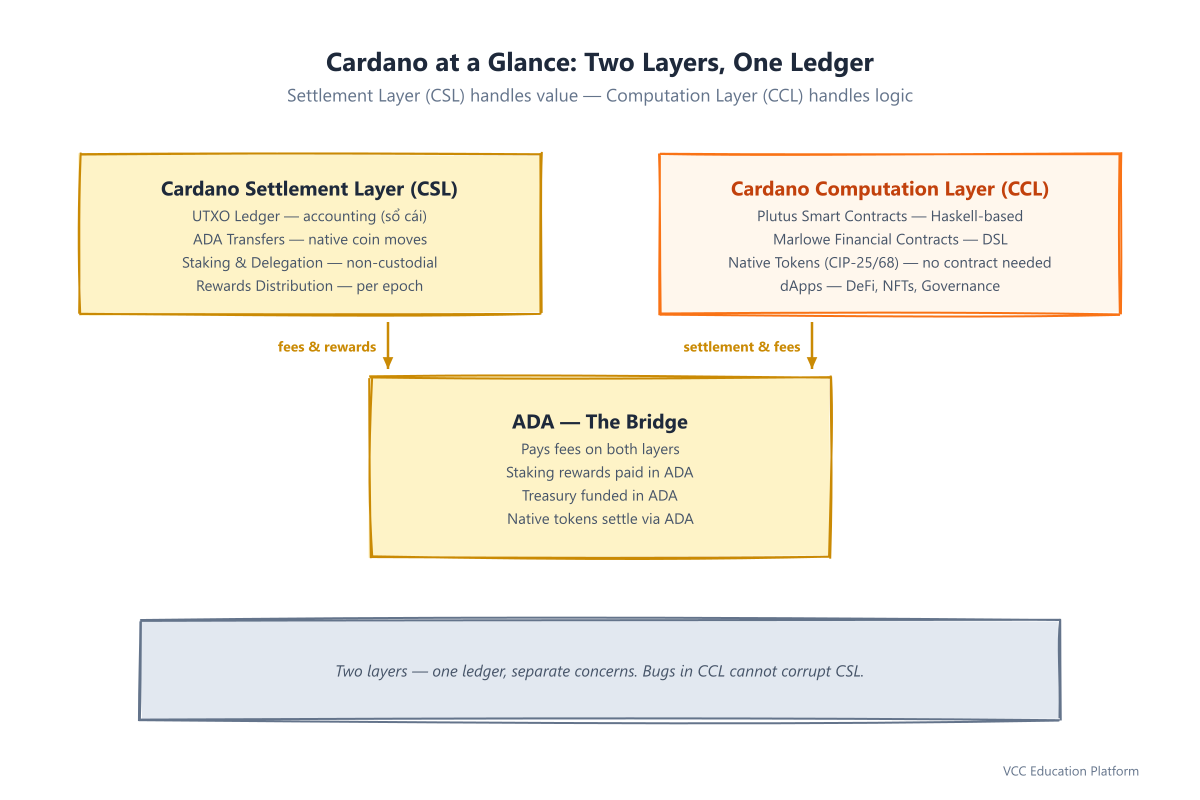
Figure 1: Cardano — two layers (CSL + CCL) with ADA bridging them
The Mental Model: It Is Not "in" Your Wallet App
The fastest way to understand Cardano is to compare it to something you already use. If you have Momo or ZaloPay, you see a "balance" on your phone. But that balance is really a claim on money sitting in a bank account — the e-wallet company holds the bank deposit and shows you a mirror of it. The money is in the bank; the app just lets you move it.
Cardano flips this. The balance is recorded on the public ledger itself — there is no bank behind it. Your "wallet" (Daedalus, Yoroi, Eternl) is not a container holding coins; it is a small program that holds your private keys — the secret passwords that let you prove you own a given balance and authorize a transfer. Lose your keys and the coins do not vanish (they are still on the ledger), but nobody can move them — including you. That is why "back up your seed phrase" is the first rule of Cardano: you are backing up the keys, not a balance.
For a Vietnamese reader, this answers the most common fear — "tiền ảo, vậy tiền đâu?" (it's virtual, so where is the money?). The money is on the blockchain, a public, tamper-resistant record that thousands of computers keep identical copies of. It is no more "in your phone" than a land title (sổ đỏ) is "in the paper" — the paper just proves who owns it.
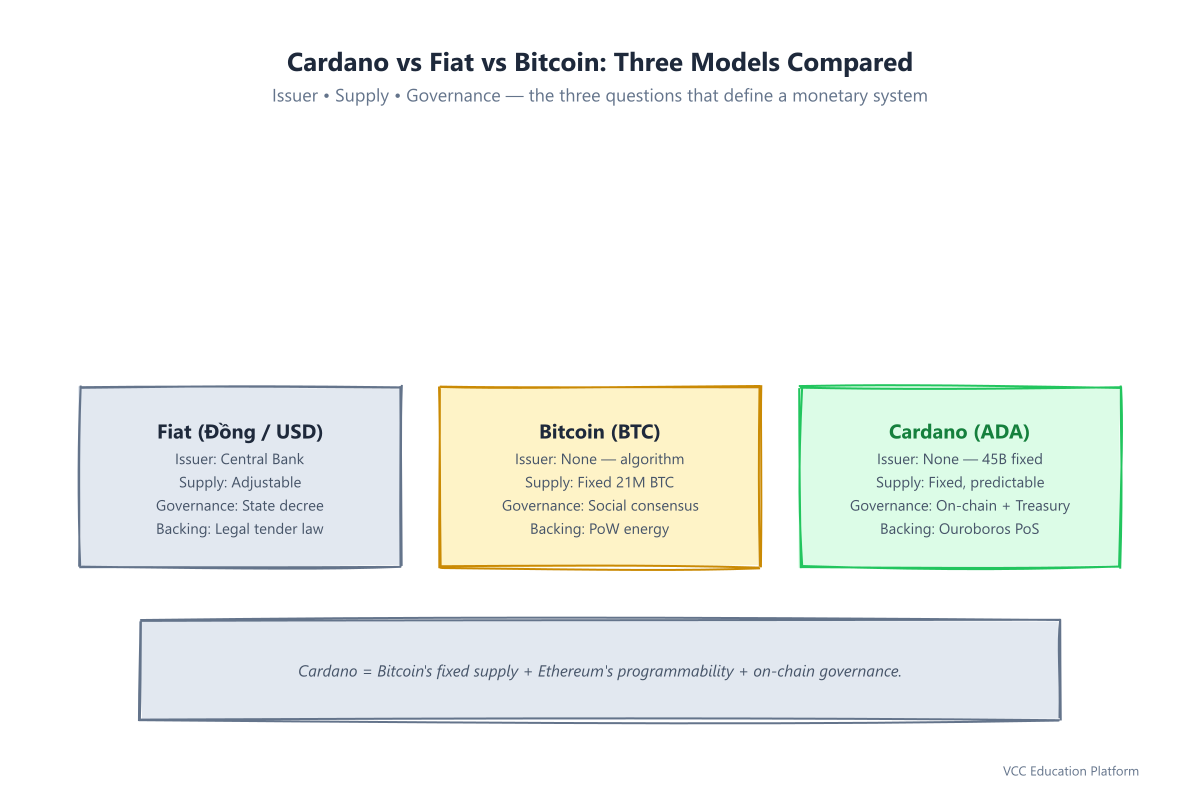
Figure 2: Fiat vs Bitcoin vs Cardano — treasury-funded development + fixed supply
How Cardano Differs from Bitcoin and Ethereum
The cleanest way to see the difference is to ask three questions:
1. "Ai phát hành?" (Who issues it?)
- Fiat (Đồng, USD): Central bank. State Bank of Vietnam decides how much đồng exists.
- Bitcoin: No issuer. Fixed algorithm (21M cap). No one can change it.
- Cardano: No monetary issuer (45B ADA cap is fixed). But it has a protocol treasury that funds development — a built-in "issuer" for improvements, not for new coins.
2. "Làm sao để đồng thuận?" (How does consensus work?)
- Bitcoin: Proof-of-Work. Miners burn electricity to solve puzzles. Secure but energy-intensive.
- Ethereum: Proof-of-Stake (since 2022). Validators stake ETH. More efficient than PoW.
- Cardano: Ouroboros Proof-of-Stake. First peer-reviewed PoS protocol. Validators (stake pools) are chosen by verifiable random function (VRF) — a mathematical lottery. No mining hardware needed.
3. "Kiến trúc như thế nào?" (How is it built?)
- Bitcoin: Single layer. Script language is intentionally limited (not Turing-complete).
- Ethereum: Single layer (EVM). Smart contracts run on the same layer as transfers.
- Cardano: Two layers — Settlement Layer (CSL) handles UTXO accounting and ADA transfers; Computation Layer (CCL) handles smart contracts. They communicate but are separate. This means a bug in a smart contract cannot corrupt the ledger.
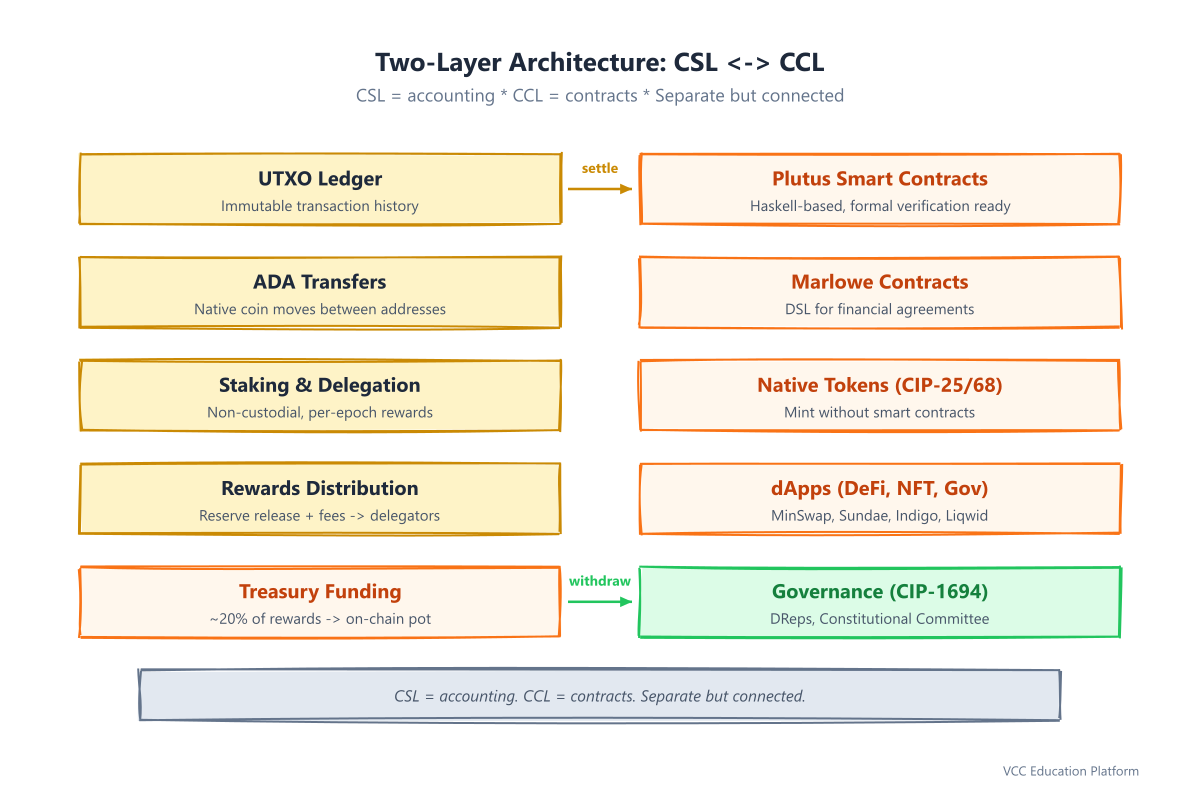
Figure 3: Two-layer architecture — CSL (UTXO ledger) <-> CCL (smart contracts)
The Engine: Ouroboros Proof-of-Stake
You do not need to understand cryptography to grasp the idea. Think of a lottery where every staked ADA is a ticket.
- Time is divided into epochs (5 days) and slots (1 second).
- Each slot, a VRF lottery picks a slot leader from all stake pools, weighted by their stake.
- The slot leader creates a block (if online) and broadcasts it.
- Other nodes validate and add it to their chain.
- Rewards (from reserves + fees) are distributed proportionally to stake.
This is cardano consensus protocol in a nutshell. No ASICs, no mining farms, no wasted electricity. A Raspberry Pi can run a node. The security comes from staked value at risk, not energy burned.
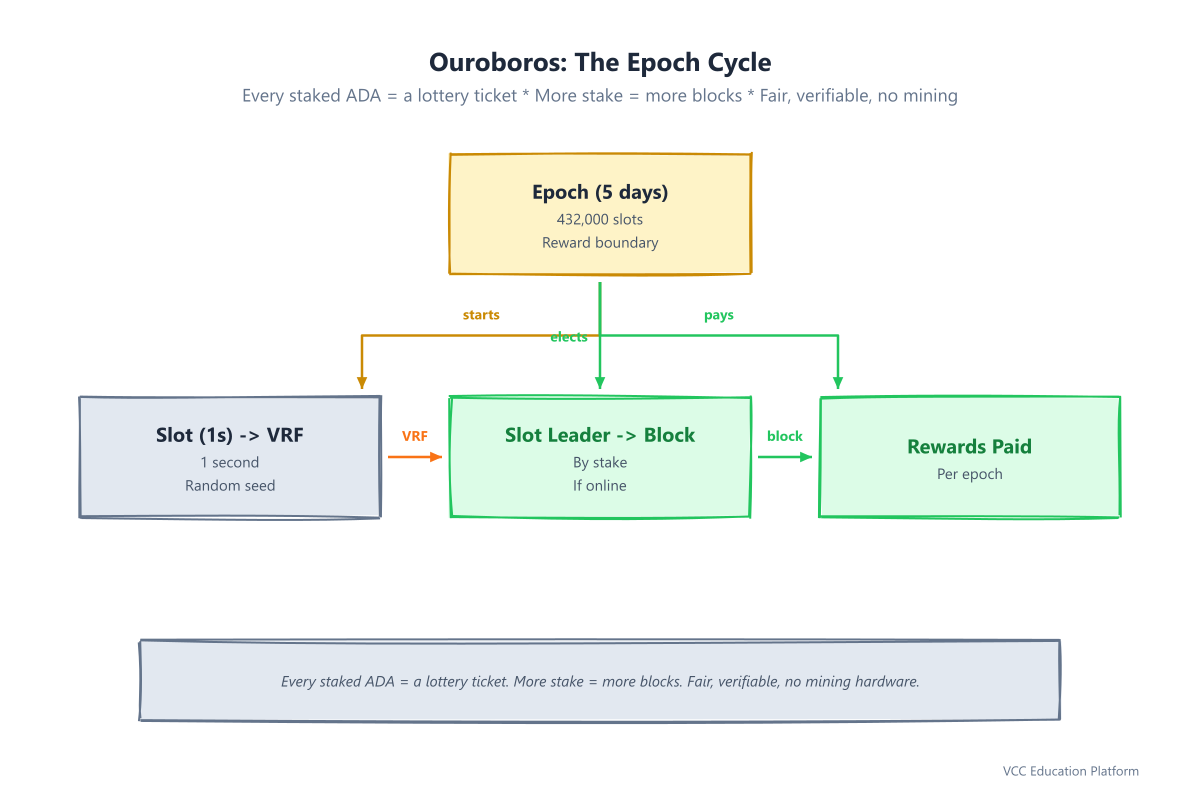
Figure 4: Ouroboros cycle — epoch (5 days) -> slot (1s) -> VRF -> leader -> block -> rewards
Where ADA Fits In
ADA is the native coin of Cardano. A few facts that ground the concept:
- Smallest unit: 1 ADA = 1,000,000 lovelace. Lovelace is to ADA what a cent is to a đồng — the smallest denomination. Fees and amounts are calculated in lovelace under the hood.
- Max supply: 45,000,000,000 ADA, minted at genesis. A defined reserve is released over time to fund staking rewards and the treasury. The cap is a protocol rule, not a policy a committee can quietly raise.
- Use: You pay transaction fees in ADA, delegate ADA to a stake pool to earn rewards, and use ADA as the settlement asset for tokens minted on Cardano.
If you are starting from zero, ADA is a reasonable first coin to understand because Cardano's fees are low and predictable (typically 0.16–0.20 ADA per transfer), so you can experiment without fearing a $30 fee on a $5 transfer.
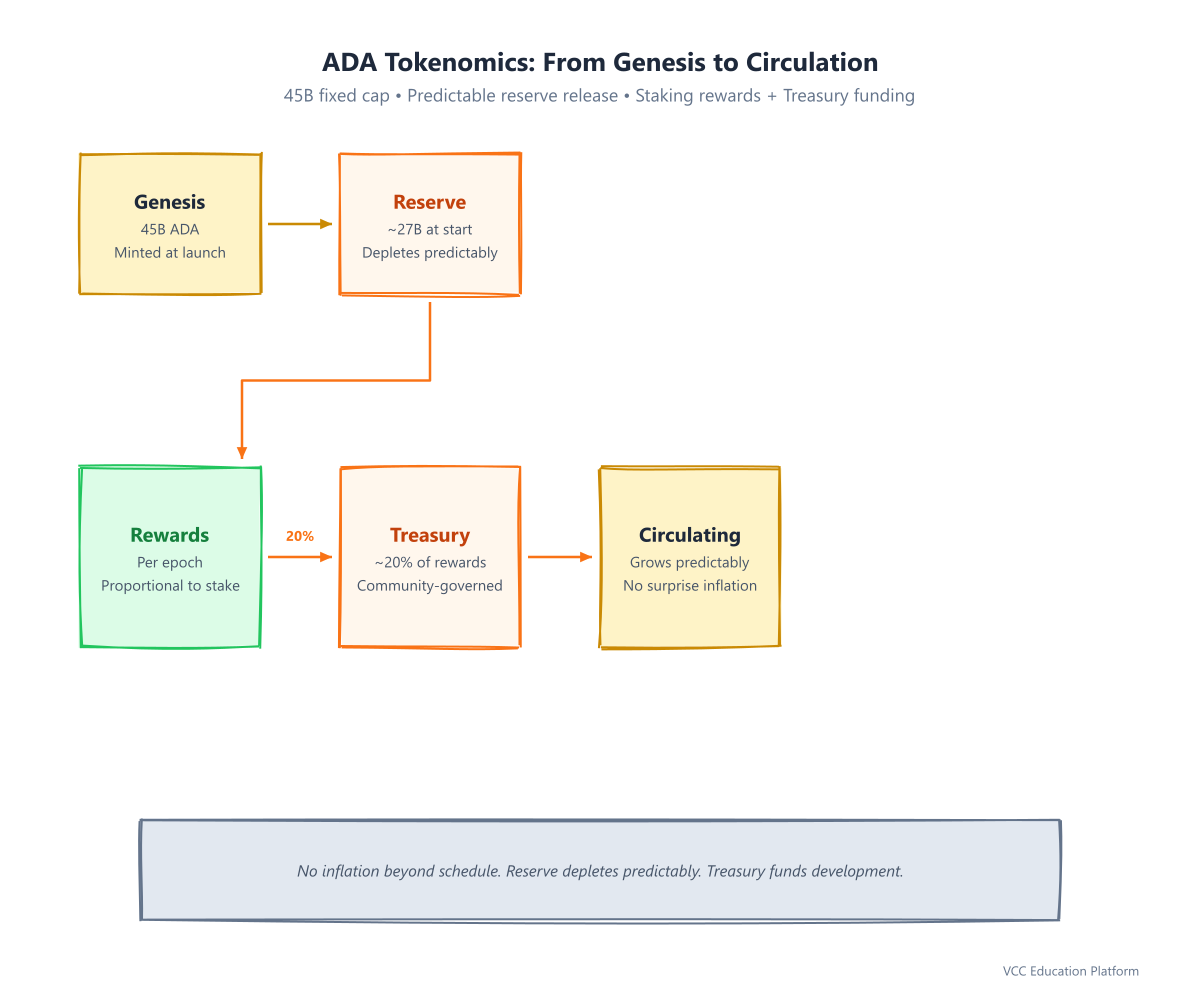
Figure 5: ADA tokenomics — 45B fixed cap, predictable reserve release, self-funding treasury
Staking: "Gửi Tiết Kiệm Có Lãi" But You Keep the Keys
This is the feature that surprises Vietnamese users most. In a bank, you deposit money, the bank lends it out, and you get interest — but the bank holds your money.
In Cardano staking:
- You delegate your ADA to a stake pool (SPO runs the node).
- Your ADA never leaves your wallet. You keep full custody — the delegation is a on-chain certificate, not a transfer.
- The pool produces blocks and earns rewards from the protocol.
- Rewards are auto-distributed to delegators proportionally (minus the pool's margin + fixed fee).
- You can un-delegate anytime. No lock-up, no penalty (except missing rewards for the epoch boundary).
This is non-custodial yield — the protocol pays you for securing the network, not a counterparty paying you for lending your money. The risk is different: smart contract risk ≈ zero (delegation is a native protocol feature), but you choose the pool's reliability.
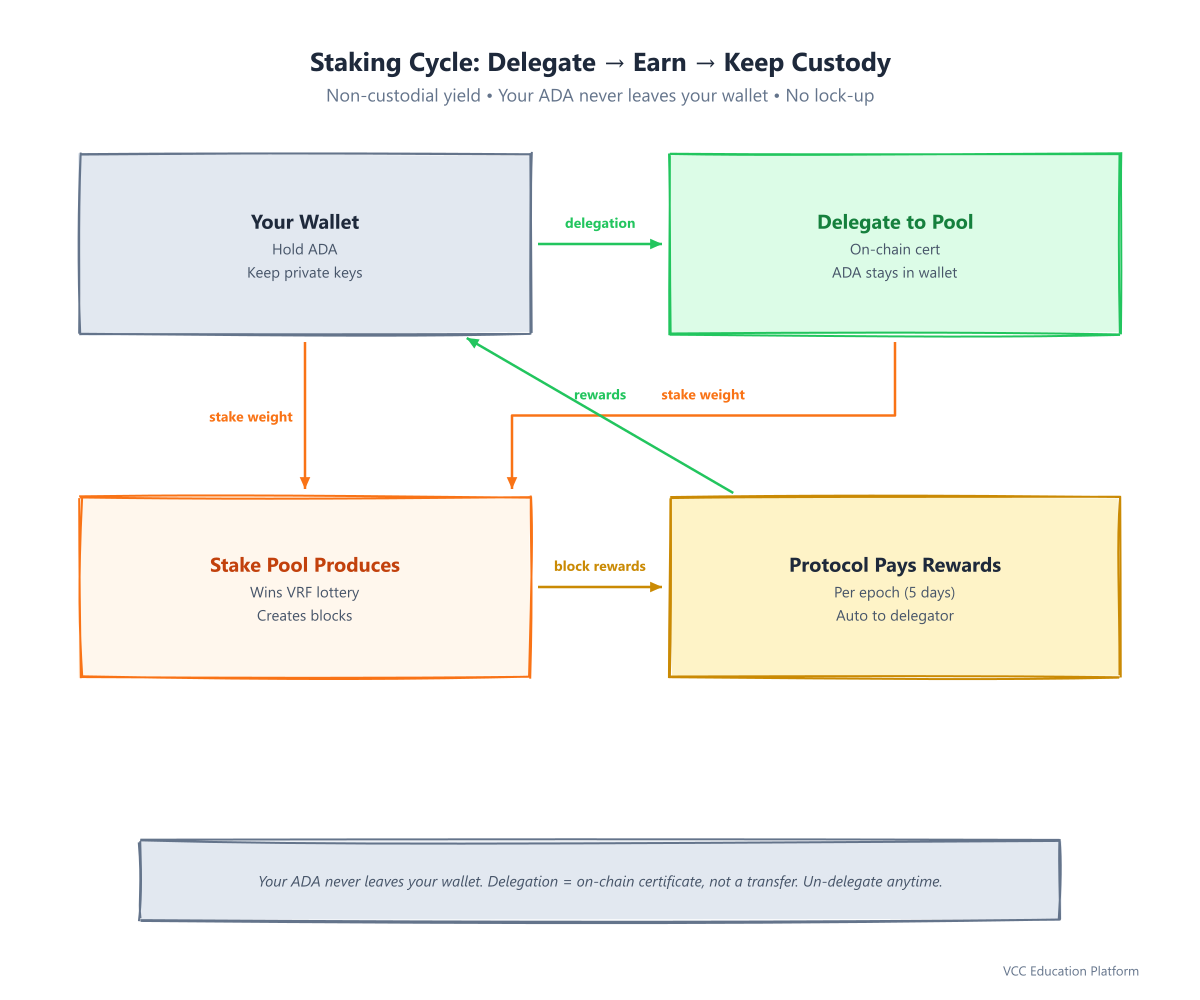
Figure 6: Staking cycle — your ADA never leaves your wallet, delegation = on-chain certificate
Governance: The Treasury and Voltaire
Most blockchains have no budget for ongoing development. Bitcoin relies on volunteers and corporate sponsors. Ethereum has the EF but no on-chain funding.
Cardano is different. A portion of every block reward + transaction fees flows into the on-chain treasury. This is not a company bank account — it is a smart-contract-controlled pot that only the community can spend through governance actions.
With the Voltaire era (CIP-1694), ADA holders can:
- Register as DReps (Delegated Representatives) or delegate voting power to one
- Vote on governance actions: parameter changes, treasury withdrawals, protocol upgrades
- The Constitutional Committee safeguards the constitution
This makes Cardano a self-funding, self-governing system — the closest thing to a "digital nation" with a budget and a parliament.
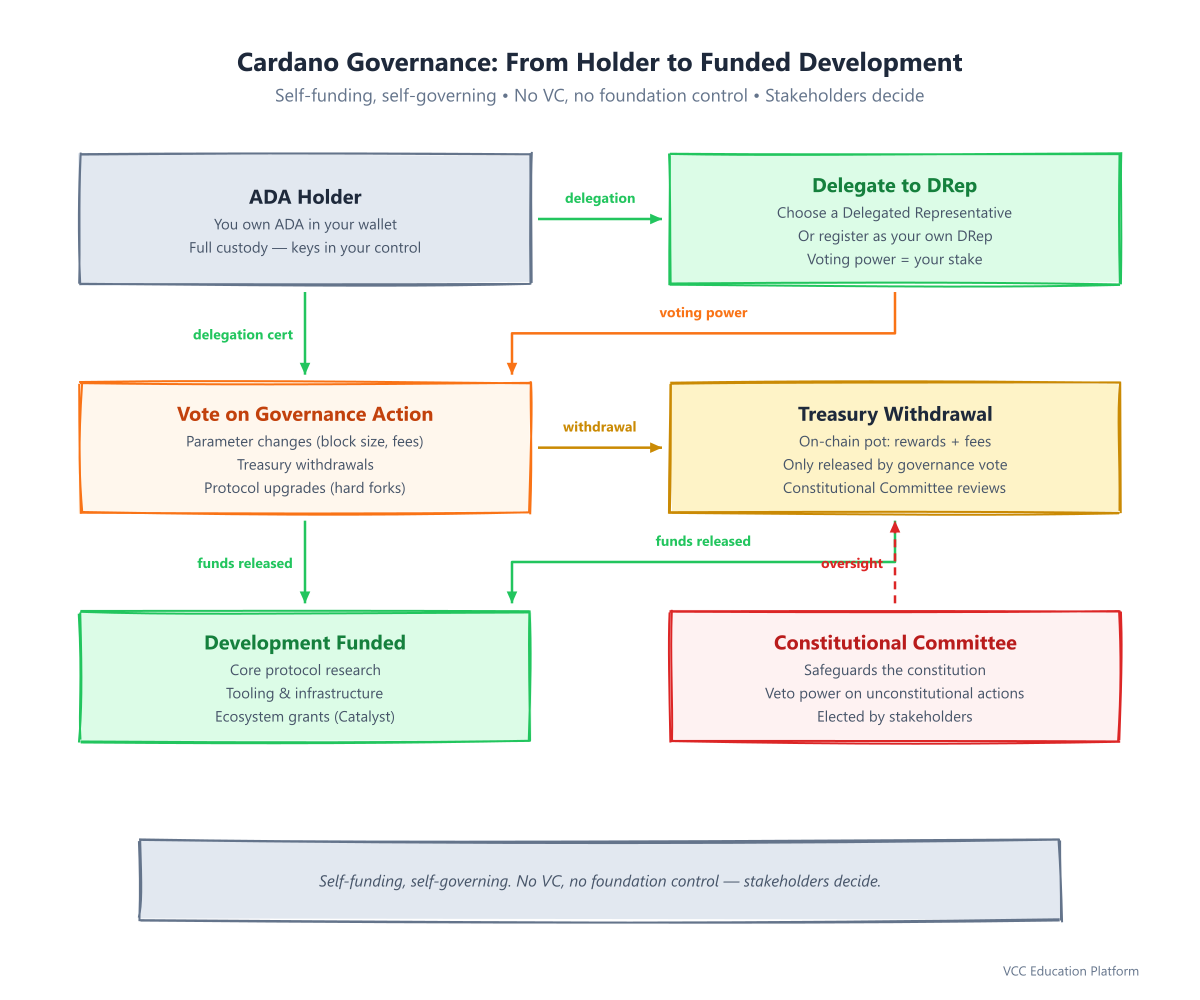
Figure 7: Cardano governance — self-funding, self-governing via Voltaire (CIP-1694)
What Cardano Is NOT (The Honesty Section)
A good teacher spends as much time on what something is not as on what it is:
- "Cardano is an Ethereum killer." No. Different design philosophies. Ethereum prioritizes developer ecosystem and L2 scaling; Cardano prioritizes formal verification and base-layer correctness. Both can coexist.
- "Cardano is slow." Block time is ~9 seconds (Chang-2). Finality is probabilistic (like Bitcoin/Ethereum). For a simple transfer, 1–2 confirmations (~18s) is plenty. The "slow" label comes from the original 20s block time — already tightened twice.
- "Cardano has no dApps." False. MinSwap, SundaeSwap, WingRiders, Minswap, Indigo, Liqwid, and 100+ more are live. The ecosystem is smaller than Ethereum's but growing.
- "ADA is guaranteed to go up." No. Crypto prices are volatile. ADA dropped 80%+ from its 2021 peak. Treat any "sure thing" pitch as a red flag. Never invest money you cannot afford to lose.
- "Cardano is illegal in Vietnam." Not exactly. The State Bank of Vietnam does not recognize crypto as a lawful means of payment — you cannot legally pay for a bowl of phở with ADA. But owning and holding crypto is a separate question, and regulations continue to evolve. Check current rules before acting; this article explains the technology, not the law.
The One-Sentence Takeaway
If you remember nothing else: Cardano is a proof-of-stake blockchain where the ledger, the consensus, and the governance are all enforced by peer-reviewed protocols — with a fixed 45B ADA supply, non-custodial staking, and an on-chain treasury that funds its own development.
The most useful skill as you learn more is the "ba câu hỏi" test: whenever someone pitches a blockchain, ask:
- Ai phát hành? (Who issues the asset?)
- Làm sao đồng thuận? (How does consensus work?)
- Tiền phát triển từ đâu? (Where does development funding come from?)
If the answers are "a central team," "trust us," and "VC money" — that is a company, not a protocol. If the answers are "fixed supply," "verifiable random function," and "on-chain treasury voted by stakeholders" — you are looking at something closer to what Cardano was meant to be.
Quick Reference
| Term | Definition |
|---|---|
| Cardano | Third-generation proof-of-stake blockchain with peer-reviewed protocols |
| ADA | Native coin; 1 ADA = 1,000,000 lovelace; max supply 45 billion |
| Ouroboros | Cardano's consensus protocol — first peer-reviewed PoS |
| Epoch | 5-day period (432,000 slots); reward cycle boundary |
| Slot | 1-second time slice; one potential block per slot |
| Stake Pool (SPO) | Node operator that produces blocks; earns rewards for delegators |
| Delegation | Assigning your stake to a pool; non-custodial, no lock-up |
| CSL | Cardano Settlement Layer — UTXO ledger, ADA transfers, staking |
| CCL | Cardano Computation Layer — smart contracts (Plutus, Marlowe) |
| Treasury | On-chain fund (block rewards + fees) controlled by community governance |
| DRep | Delegated Representative — votes on governance actions for delegators |
| Voltaire | Governance era (CIP-1694) enabling on-chain voting and treasury control |
| Lovelace | Smallest ADA unit (1 ADA = 1,000,000 lovelace) |
| VRF | Verifiable Random Function — cryptographic lottery for slot leader selection |
Frequently Asked Questions
Is Cardano better than Ethereum?
Neither is "better" — they optimize for different things. Ethereum has the largest developer ecosystem and L2 scaling. Cardano has formal verification, predictable fees, and on-chain governance. Use the one that fits your need.How do I buy ADA in Vietnam?
Use a reputable exchange (Binance, OKX, Bybit, Gate.io) that supports VND deposits via P2P or bank transfer. After buying, withdraw to your own wallet (Daedalus, Yoroi, Eternl) — do not leave funds on the exchange.What wallet should I use?
- Daedalus: Full node, maximum security, downloads entire blockchain (~20GB). Desktop only.
- Yoroi: Light wallet, browser extension + mobile. Good balance of convenience and security.
- Eternl: Light wallet, advanced features (multi-account, NFT gallery, dApp connector). Mobile + browser.
- Hardware (Ledger/Trezor): Best for large holdings. Connect to Daedalus/Yoroi/Eternl for signing.